

★★★★½ 4.6/5 — A field guide for the week after a good meeting, when most sellers go quiet.
Best for: Sellers who can open a conversation and then lose it in the silence.
Reading time: ~4.5 hrs (240 pages), guide: 16 min
Difficulty to apply: Moderate. The cadence is simple. Keeping it when you are busy is the work.
Sell It Like Serhant in one minute
The sale is rarely won in the first conversation. It is won in the touches that follow.
Ryan Serhant wrote this after building a New York real estate business through the years after 2008. The stories are apartments and long silences. The system travels. Confidence is a practice of saying yes to the next useful risk. A deal has an emotional weather pattern, not a straight line. Once a person is in your world, the job is three moves: follow up while it is live, follow through on what you promised, and follow back later.
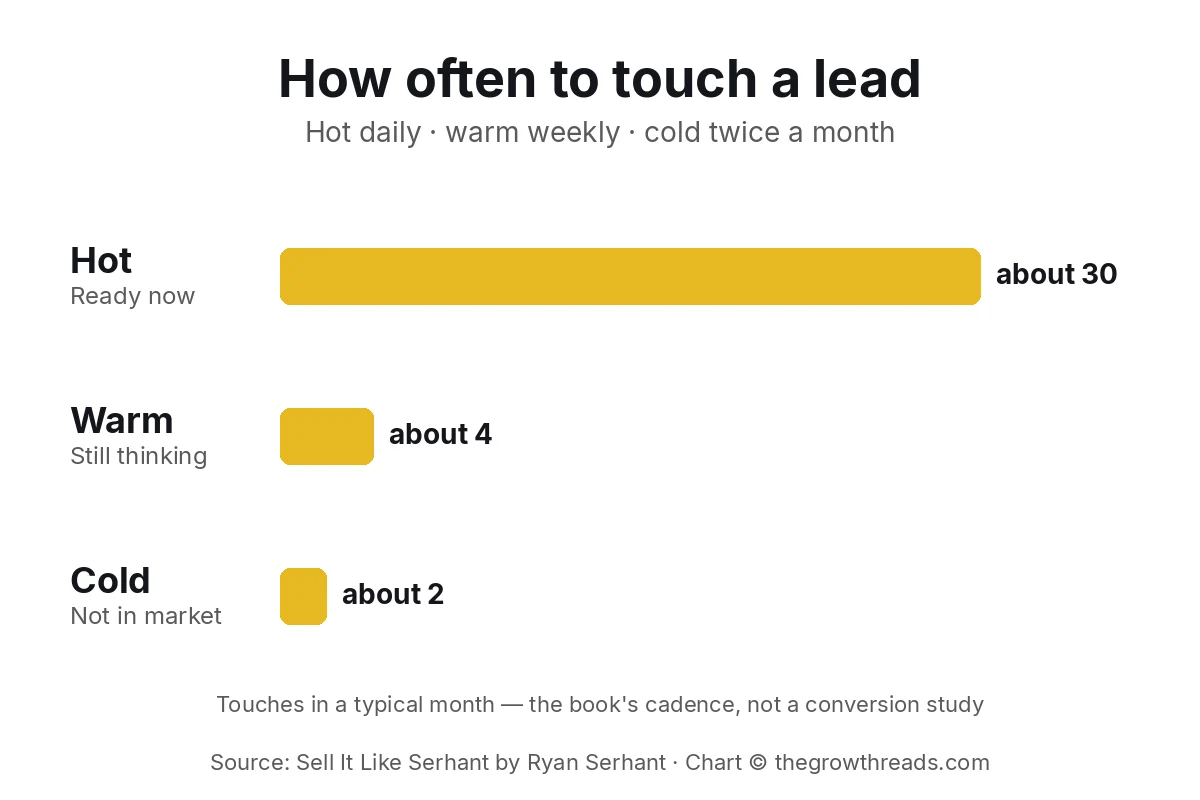
If you only take one tool, sort every open conversation into hot, warm, or cold, and give each group a rhythm. Hot gets a daily touch. Warm gets a weekly one. Cold gets about two touches a month. Then look at tomorrow and make sure it contains time to find, time to keep, and time to do.
Key takeaways
- Follow-up is the job: A first meeting that goes well is the start of the sale, not the proof that you are done.
- Three F’s: Follow-Up keeps the live deal warm. Follow-Through keeps your word. Follow-Back reopens old relationships.
- Sort before you pester: Daily, weekly, and twice-a-month rhythms stop you from treating every name the same.
- Yes is a muscle: Serhant treats a willingness to try, including improv and small risks, as the way confidence shows up.
- Deals have feelings: Excitement, fear, disappointment, and relief are normal stages. Silence is often a stage, not a verdict.
- Indecision needs a path: With a stuck buyer, push, pull, and persist. Do not add three more options and hope.
- Finder, Keeper, Doer: If tomorrow is only delivery, next month’s pipeline is already thinner.
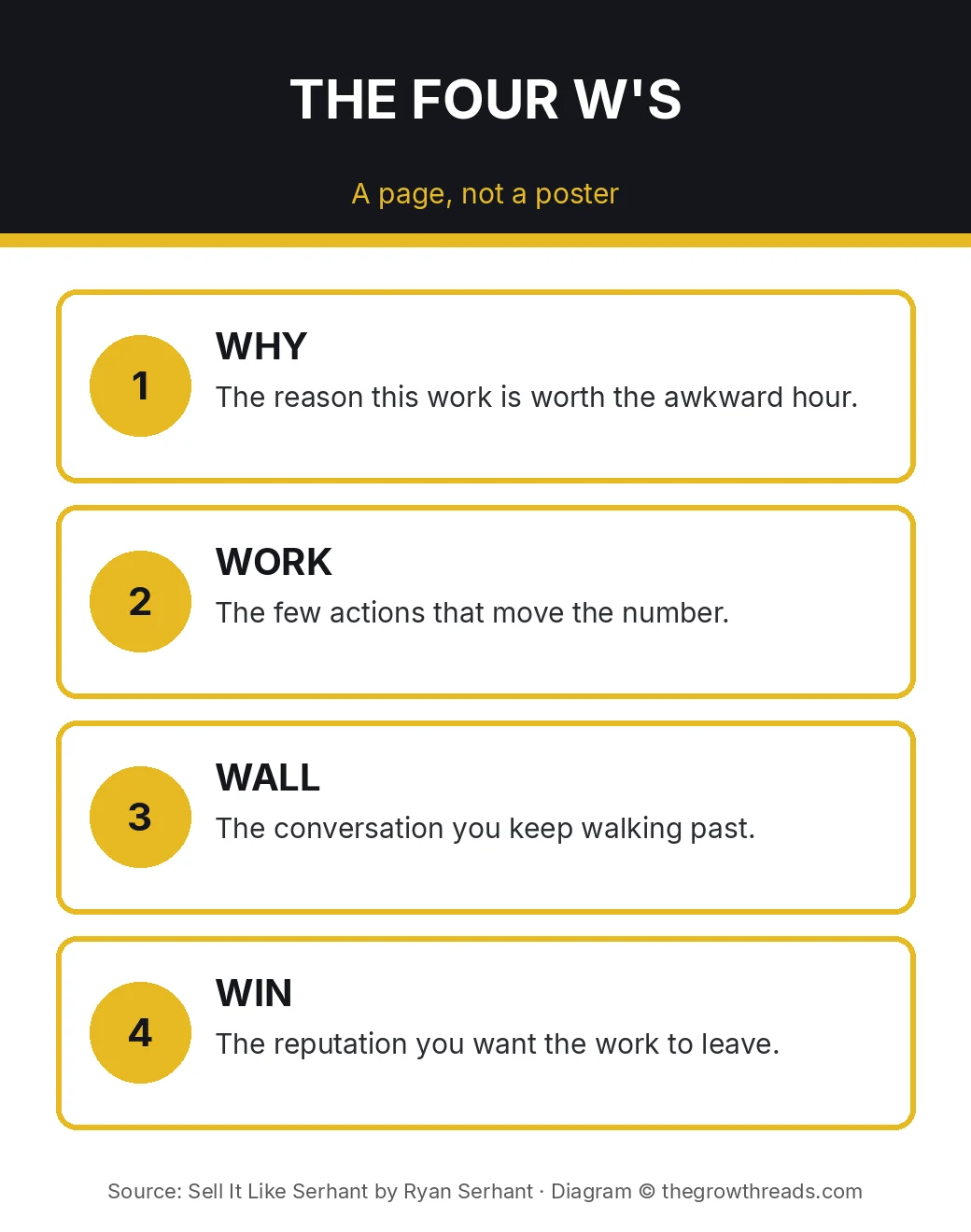
- Four W’s: Why you sell, the work of today, the wall you avoid, and the win you want on the other side.
- Promises are the product: People remember whether you sent the thing. They forget the clever line.
- Come back later: A lost deal and a past client are still a relationship. Serhant’s line is that deals can die, and relationships do not have to.

What is Sell It Like Serhant about?
Sell It Like Serhant is Ryan Serhant’s 2018 field guide for people who can start a sale and then lose it in the quiet. The book turns follow-up into a system: three relationship moves, a hot-warm-cold cadence, and a workday split into finding, keeping, and doing.
About the author
Ryan Serhant is an American real estate broker and the founder of the Serhant brokerage. He became widely known on Bravo’s Million Dollar Listing New York and later as the lead of Netflix’s Owning Manhattan. The book looks back at the earlier version of that career: a shy newcomer who entered New York real estate around the 2008 downturn, when confidence was scarce and listings were not. Explore all Ryan Serhant book summaries →
That origin is the point of the method. Serhant does not describe a natural gift he always had. He describes endurance, a habit of saying yes before he felt ready, and a refusal to let a relationship end just because a deal went quiet. Sell It Like Serhant, published by Hachette Books in 2018, is his attempt to turn that personal operating system into steps another seller can run without a television crew.
Key concepts at a glance
| Concept | What it means | Use it when |
|---|---|---|
| Power of Yes | Treat a yes as practice. Volume of honest yeses builds the confidence the pitch needs. | You freeze before you offer, or you wait to feel ready. |
| Seven emotional stages | A deal moves through excitement, friction, fear, disappointment, acceptance, happiness, and relief. | A buyer goes quiet and you assume the deal is dead. |
| Three F’s | Follow up on live deals, follow through on promises, and follow back with people from earlier. | You only hunt new names and never return. |
| Hot, warm, cold | Daily for people who are ready, weekly for people who are thinking, twice a month for everyone else. | You give every lead the same nagging check-in. |
| Finder, Keeper, Doer | Split the day into new opportunities, existing relationships, and the work of the deal. | Your calendar is full of delivery and empty of next month. |
| Four W’s | Name your why, today’s work, the wall you avoid, and the win you want to leave. | You are busy and cannot say what this quarter is for. |
| Fail smarter | When a deal stalls, name which ball dropped instead of inventing a story about your worth. | You replay one loss and stop prospecting. |
Confidence, and the power of yes
The opening of the book is a confidence argument dressed as a memoir. Serhant was not a polished closer when he started. He was new, the market was ugly, and the feeling he writes about is fear with a calendar attached. The move he recommends is not a mood. It is a series of small yeses: take the meeting, make the introduction, try the line, stay in the room one minute longer.
He treats improv as a sales skill because buyers do not follow your outline. Saying yes to the scene in front of you, then steering it, is the practice. One risk at a time. Shyness does not have to leave before the work begins. Waiting to feel like the person on the cover is how a pipeline stays theoretical.
TGR Note: The same idea shows up, in a quieter register, in The Trusted Advisor: people buy the relationship before they buy the recommendation. Serhant builds that relationship with energy and repetition. Maister, Green, and Galford build it with credibility and intimacy. Use both. Energy without trust feels like a performance. Trust without a next touch never gets a meeting.
Seven stages, and working the deal
Once a person is actually in a deal, Serhant stops talking about mindset and starts talking about weather. A sale does not travel in a straight line from charm to signature. He walks the emotional sequence sellers pretend is unprofessional to name: excitement, frustration, fear, disappointment, acceptance, happiness, and relief. Buyers feel those in a different order than the seller’s hope. Your job is to notice which one you are in.
With an indecisive client he uses push, pull, and persist. Push is one clear recommendation. Pull is room when more pressure would insult them. Persist means a stall is not a no. Extra options often feed the stall. He also wants one moment the person did not expect: the answer that arrived before they asked twice. That is how you are remembered on the day they decide.
TGR Note: If the stall is really indecision, The Challenger Sale gives you the commercial insight, and this chapter gives you the tempo. Challenger teaches you what to teach. Serhant teaches you not to disappear while the buyer feels the fear that teaching created. For the words on that next touch, keep Exactly What to Say open. A cadence without a sentence is just a reminder notification.
The Three F’s of follow-up
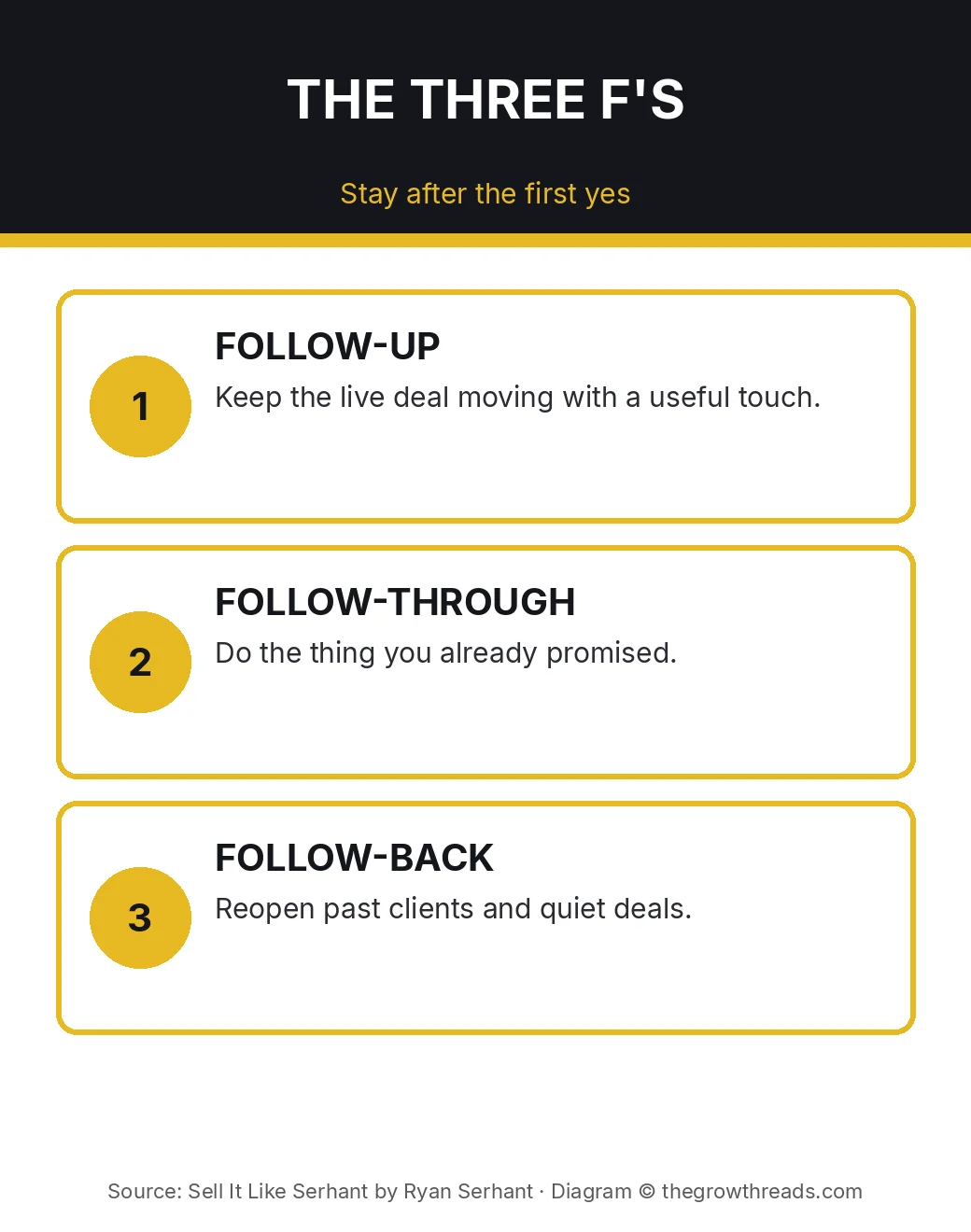
This is the center of the book. Serhant splits staying in someone’s life into three jobs that sellers usually mash into one guilty feeling.
Follow-up is for the live deal. The person is in motion, or could be, and your silence is a vote for a competitor who writes back. He sorts those people by temperature. Hot: ready to buy or sell, touch them every day with something that helps the decision. Warm: curious, comparing, not ready to sign, touch them every week. Cold: not in the market, still a human you might serve later, touch them about twice a month. The daily touch is not “just checking in.” It is a useful piece of the decision. The twice-a-month touch is not a pitch. It is proof you still exist when they did not ask you to.
Follow-through is the promise. If you said you would send the comparison, send it. Serhant’s point is that dependability is a sales strategy, because the next deal with the same person is cheaper than a stranger. A listing that sits, in his telling, sometimes moves only after you stop waiting and create a reason for people to engage. The tactic changes by industry. The standard does not: you do the thing.
Follow-back is the long game. Past clients, almost-clients, and people who said no are not a dead archive. He tells a version of a relationship that started years before the large sale, and another where a missed chance became a much bigger assignment because he stayed in touch. One short line from the book is worth keeping on the wall: deals can die, but relationships never have to. Your database is a list of relationships, not a list you blast when the month looks thin.
TGR Note: This is the chapter to read next to Fanatical Prospecting and Smart Calling. Blount fills the top of the funnel. Sobczak makes the first ten seconds sound like a person. Serhant owns day nine. If you only study openers, you will keep having good first calls and empty Fridays. Run the Three F’s on the names you already have before you buy another list.
Finder, Keeper, Doer, and the Four W’s
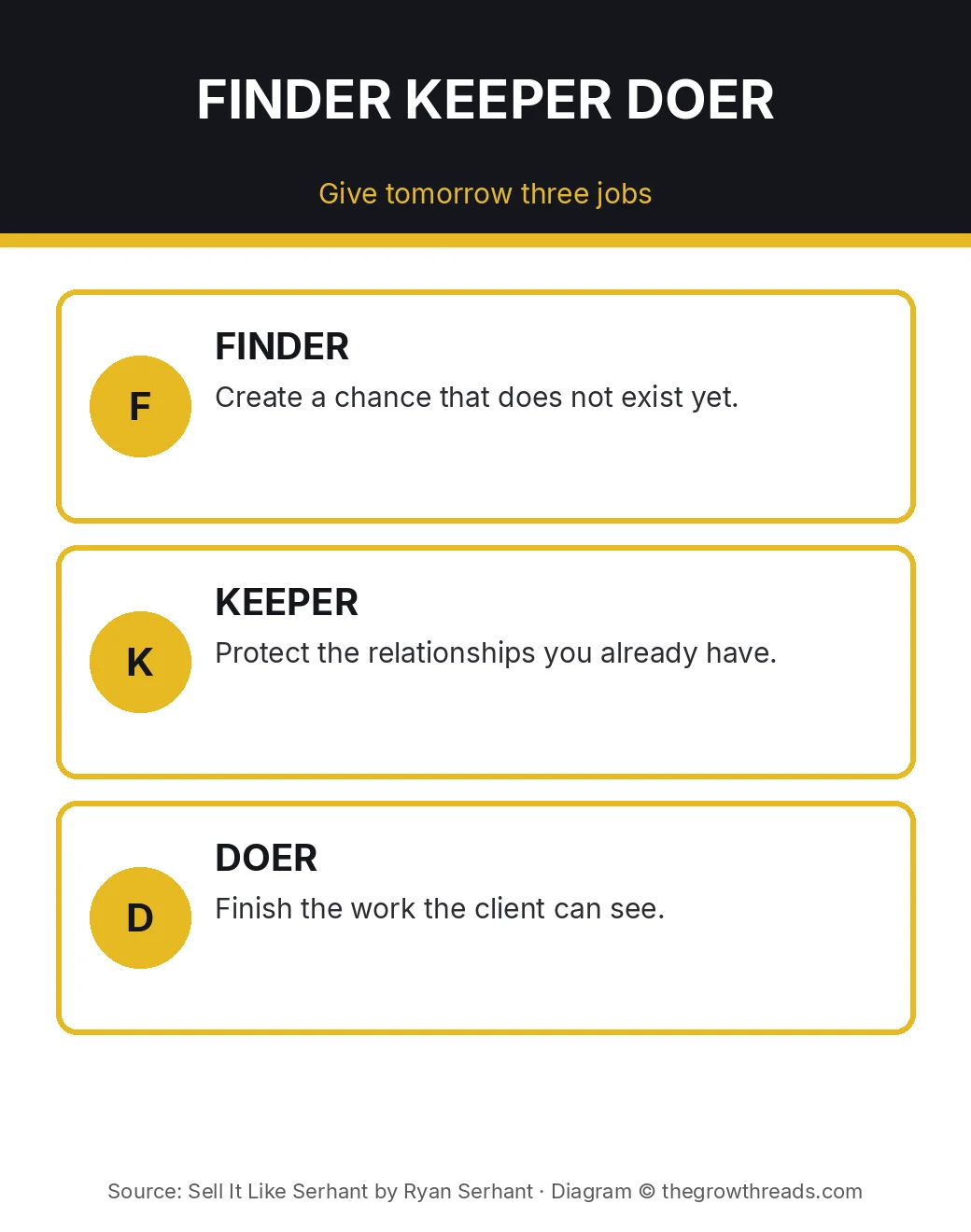
Serhant wrote the time chapter after a dry spell, which is when most sellers decide the problem is motivation. He decided the problem was the shape of the day. Finder, Keeper, Doer is the repair. Finder blocks create opportunities that do not exist yet. Keeper blocks are the Three F’s, on purpose, not squeezed between other tasks. Doer blocks are the work the client can see. A day that is all doer feels heroic and produces no next deal. A day that is all finder produces conversations nobody services.
The Four W’s sit underneath that calendar. Why is the reason you are willing to do this when it is awkward. Work is the short list of actions that actually move your number. Wall is the task you keep walking past, usually a conversation. Win is the outcome you want the work to add up to, including the kind of reputation you want in five years. Positivity, in this section, is not a poster. It is the decision to run the list again after a no.
The closing chapters are about failing without making it your identity. Deals drop for ordinary reasons: a slow answer, a fuzzy next step, a relationship you assumed was fine. Name which one happened, then do the next small action the same day. The future you, in his framing, is the person who kept the cadence.
TGR Note: Finder time is the same muscle as the questions in SPIN Selling: you cannot discover a need you never asked about. Keeper time is To Sell Is Human in calendar form. Pink argues that moving people is ordinary work. Serhant tells you which hour of Thursday is for it. If your offer itself is the reason people stall, fix that with $100M Offers before you add more follow-up to a fuzzy promise.
Who is Sell It Like Serhant best for — and who should read something else first?
Read this if you already talk to buyers and your leak is the quiet week after a good meeting. It is especially useful for founders, agents, consultants, and account managers who know they “should follow up” and have no rule for when or what to send.
Read something else first if the leak is earlier. If you do not have enough first conversations, start with Fanatical Prospecting or Smart Calling. If the sale is a committee and a long evaluation, start with SPIN Selling or The Challenger Sale. If people enjoy you and still refuse the price, the offer needs $100M Offers. If you are becoming a long-term advisor, read The Trusted Advisor beside this.
Questions to reflect on
- Which three live deals went quiet in the last month, and what was the last useful thing you sent?
- Who on your list is hot, who is warm, and who is cold? Where have you been using one rhythm for all three?
- What promise is still open from a conversation this week?
- Which hour tomorrow is Finder, which is Keeper, and which is Doer? Which one did you skip last week?
- What is the wall: the call you are dressing up as “research”?
🔥 Ready to make follow-up a calendar, not a mood?
Take the Three F’s and the hot-warm-cold rhythm into the deals you already have open.
How to apply Sell It Like Serhant (7-day plan)
- Day 1 — Sort the list. Write every open conversation. Mark each hot, warm, or cold. If you cannot tell, it is warm until a sentence from them proves otherwise.
- Day 2 — Touch the hottest oldest. Send one useful thing to every hot name, starting with the person you have neglected longest. No “just checking in.”
- Day 3 — Follow through. Close one promise you already made: the comparison, the intro, the answer. Tell them it is done.
- Day 4 — Follow back. Write to one past client or lost deal from more than 90 days ago. Offer a specific observation, not a reunion for its own sake.
- Day 5 — Block the three roles. Put Finder, Keeper, and Doer on tomorrow’s calendar before other people fill it. Protect the Keeper block.
- Day 6 — Name the wall. Book 25 minutes for the conversation you are avoiding. Do it inside that block. Stop when the time ends.
- Day 7 — Write the Four W’s. One page: Why, Work, Wall, Win. Put only Work on the calendar for next week. Leave the page where Monday can see it.
Frequently asked questions
What is Sell It Like Serhant about?
Sell It Like Serhant is Ryan Serhant’s 2018 sales book from Hachette. It is a working week, not a stack of scripts. He treats confidence as something you practice, maps a deal as a run of emotions, and argues that quiet deals are usually unfinished relationships. The part you can use on Monday is the cadence: touch hot leads daily, warm leads weekly, and cold leads about twice a month. He then splits the day into finding new chances, keeping the people you already know, and doing the work you promised.
What are the Three F’s in Sell It Like Serhant?
The Three F’s are Follow-Up, Follow-Through, and Follow-Back. Follow-up keeps a live conversation moving so a buyer does not have to remember you. Follow-through is doing the thing you said you would do, which is how trust shows up in a calendar rather than a slogan. Follow-back reopens people you already sold, lost, or left idle. Serhant treats the three as one system. A seller who only chases new names, and never returns to old ones, is restarting from zero every Monday.
What is Finder, Keeper, Doer?
Finder, Keeper, Doer is Serhant’s split of the workday. Finder time creates new opportunities: calls, introductions, content, and rooms you were not in yesterday. Keeper time protects relationships that already exist, including the follow-up the rest of the book is about. Doer time is the actual work of the deal: the tour, the proposal, the answer, the paperwork. The point is that a day with only doer work feels productive and still starves next month. Block all three or the pipeline thins out.
How often does Serhant say you should follow up?
Sort the person first, then set the rhythm. Hot means ready to move, so the book calls for a daily touch. Warm means they are thinking and comparing, so a weekly touch is enough to stay present. Cold means they are not in the market, so about two touches a month keeps the relationship without pretending they are ready. The touch should carry something useful, not a nudge that says just checking in. Frequency without a reason is how follow-up becomes noise.
Is Sell It Like Serhant only for real estate agents?
The stories are real estate, because that is the job Serhant was doing when he wrote the book. The system is not. A consultant, a founder, a recruiter, or anyone who sells a service still has hot, warm, and cold relationships, still makes promises, and still loses deals in the quiet week after a good meeting. You will translate apartments into your own offer. If your work is enterprise discovery with a buying committee, start with SPIN Selling or The Challenger Sale, then bring this cadence back.
How is this different from Smart Calling or Fanatical Prospecting?
Fanatical Prospecting is about opening enough conversations that the pipeline does not depend on luck. Smart Calling is about the first ten seconds of a call you prepared before you dialed. Sell It Like Serhant starts after that first conversation exists. It asks what you do on day nine, when the person liked you and then went silent. Use Blount and Sobczak to start the thread. Use Serhant to keep it, to keep your promises, and to come back months later without sounding like a stranger.
Who should read a different sales book first?
Read a different book first if you do not yet have conversations to follow up on. Fanatical Prospecting or Smart Calling will build that list. Read The Trusted Advisor first if your buyers are choosing a long relationship, not a listing. Read $100M Offers first if people like you and still say no because the offer is fuzzy. Read SPIN Selling or The Challenger Sale first if the sale is a complex B2B evaluation. Serhant is the right next book once a real pipeline already exists and the leak is silence.
Related summaries
- Smart Calling Summary & Review — prepare the first ten seconds so the call does not sound like a script.
- Fanatical Prospecting Summary & Review — open enough conversations that follow-up has someone to land on.
- Exactly What to Say Summary & Review — the sentences for the touch you already decided to send.
- The Trusted Advisor Summary & Review — how credibility and intimacy earn the right to advise.
- Best Productivity Books — the full silo list, including the sales books that sit next to this one.
How we analyze books: we read for the models you can run this week, separate a memorable story from a step you can copy, and write the application plan ourselves. Read our full methodology.