

★★★★½ 4.5/5 — Decide the words before you speak. Then let one phrase do one job.
Best for: Sellers, founders, and anyone who freezes, rambles, or waits for a mood once the other person is listening.
Reading time: ~2.5 hrs (guide: 12 min)
Difficulty to apply: Easy to pick one phrase today; hard to stop improvising when the room goes quiet.
Exactly What to Say in one minute
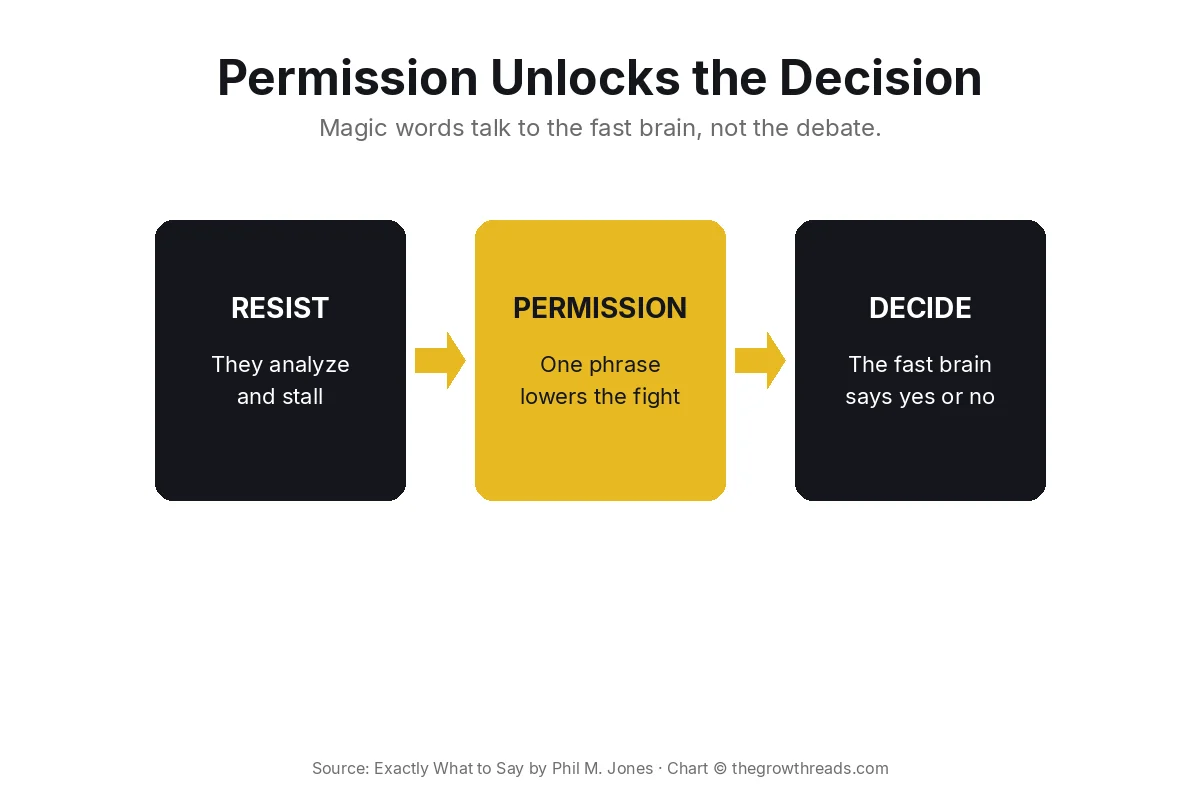
Decide the words before you speak. Phil M. Jones’s argument is a pocket dictionary, not a pep talk. Most conversations stall because we invent the line while we are already in it. The analytical brain wants a debate. The fast brain decides. Magic words are short phrases that talk to the fast one: permission first, then a real question, then a named next step. One sentence, one job. A stack of three asks in one breath is how you leave with a maybe.
Exactly What to Say (Page Two, 2017) is the 137-page field guide Jones uses to train that habit. It is not a memoir and not a theory of persuasion. If you already get conversations and still go blank, ramble, or wait for them to volunteer a yes, start here.
Key takeaways
- Decide before you speak: The worst time to think about the line is while you are saying it.
- Talk to the fast brain: Short phrases skip the debate. Long explanations invite a stall.
- Permission first: “I’m not sure if it’s for you, but…” lowers the fight so they can hear the offer.
- Curiosity is safer than a trap: “Just out of curiosity…” makes the next question feel human.
- Nobody wants to be closed-minded: “How open-minded are you…” earns a hearing without a pitch.
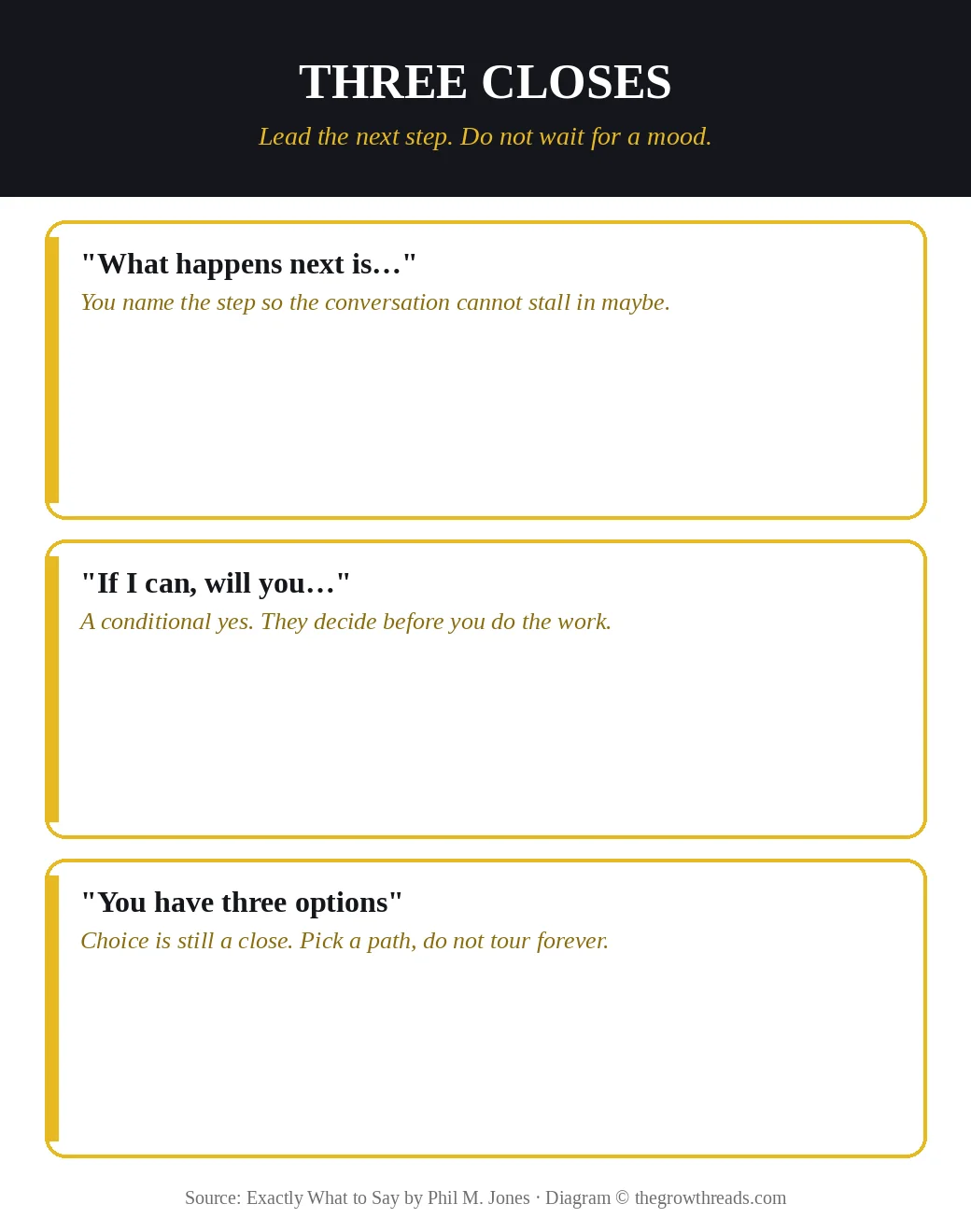
- Name the next step: “What happens next is…” leads so the conversation cannot die in maybe.
- Conditional yes: “If I can, will you…” gets a decision before you do extra work.
- Choice is still a close: “You have three options” beats an open-ended tour.
- One phrase, one job: Do not stack three asks. Score the one you chose.
- A no is information: A maybe you protected by rambling taught you nothing.
What is Exactly What to Say about?
Exactly What to Say is a sales-productivity manual for preparing the sentence before the meeting. Jones trains you to speak to the fast, deciding brain with short permission phrases, then a named next step. It is a field book for anyone who already talks to people and still improvises the ask.
About the author
Phil M. Jones is a British sales trainer who treats language as a tool you prepare, not a speech you invent under pressure. Exactly What to Say (Page Two, 2017, 137 pages) is the pocket dictionary of “magic words” that made his name — lines designed to lower resistance so a yes or a no can actually happen. He trains teams to pick the sentence before the conversation starts, then to let that sentence do one job. There is no usable Wikipedia page for this Jones; the footballer is a different person. Empty calendar: Fanatical Prospecting. Frame in the room: Pitch Anything. The phrase itself: start here. Explore all Phil M. Jones book summaries →
Key concepts at a glance
| Concept | What it means | Use it when |
|---|---|---|
| Magic words | Short, prepared phrases that talk to the deciding brain. | You improvise and stall. |
| Decide before | Pick the line before you walk in. Do not invent it live. | You go blank in the ask. |
| I’m not sure if it’s for you | Permission. They can hear the offer without a fight. | They brace for a pitch. |
| Just out of curiosity | A safe on-ramp to a real question. | Your questions feel like traps. |
| How open-minded are you | Nobody wants to play the closed-minded role. | They shut the new idea down. |
| What happens next is | You name the step so maybe cannot hide. | The call ends in fog. |
| If I can, will you | A conditional yes before you do extra work. | You over-deliver for a maybe. |
| Three options | Choice is still a close. Pick a path. | You tour features forever. |
Part 1 — Decide the words before the conversation
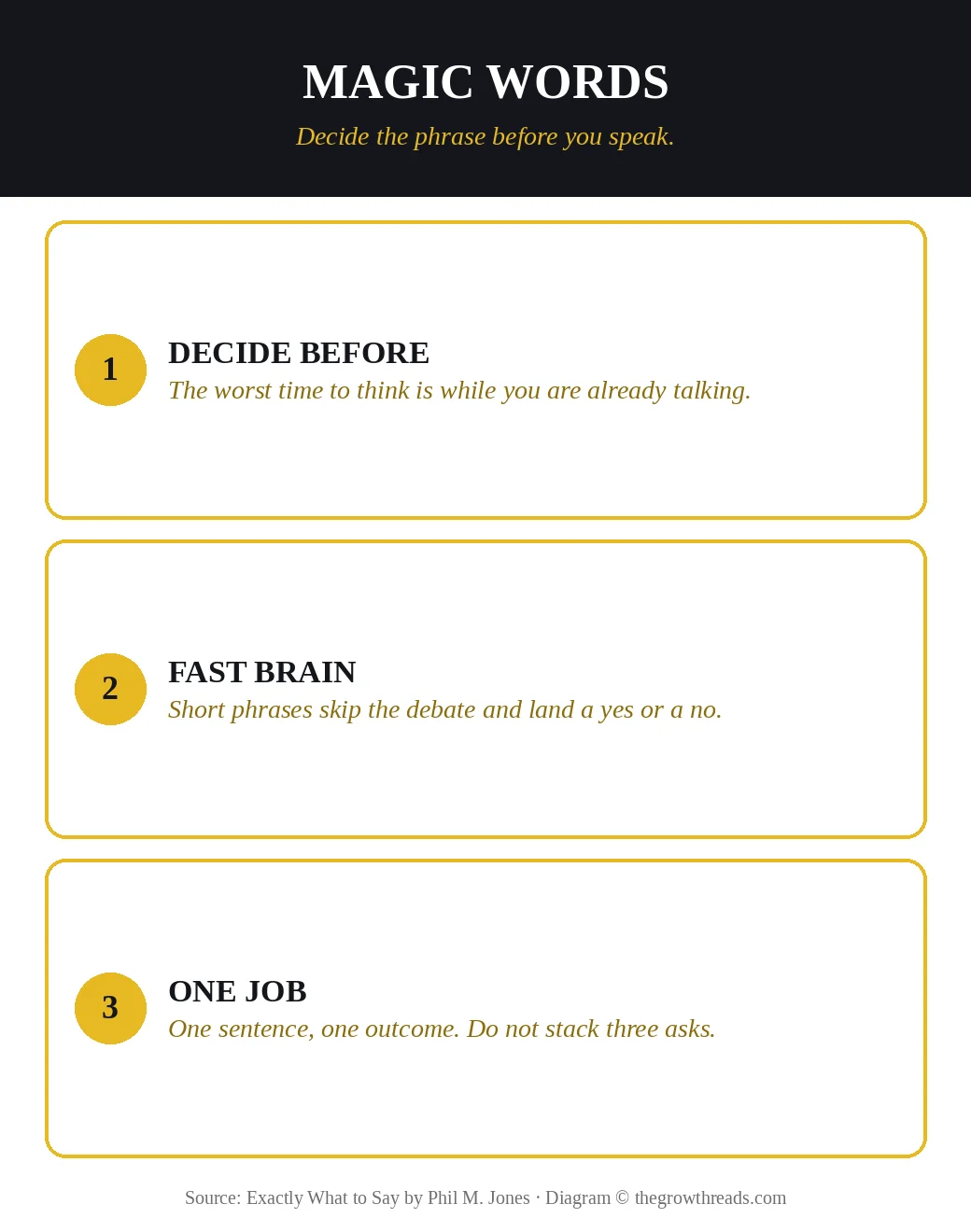
Jones’s first useful picture is not a funnel. It is a clock. The worst time to think about what you will say is the moment you are saying it. Under pressure the analytical brain writes a paragraph. The other person hears a stall. Magic words are the opposite: a sentence you chose when you were calm, short enough to speak to the fast brain that actually decides. That is why a 137-page dictionary can be a productivity book. The week is a set of conversations. If every one of them is improvised, you will spend the hour recovering from the first clumsy sentence.
Preparation here is not a script you recite. It is one phrase with one job — open, shift, or close — written down before you walk in. People who “just wing it” often sound busy and leave with a maybe. People who stack five clever lines in a row sound pushy and still leave with a maybe. The discipline is picking one. If that sounds small, watch a recorded call. Most of us explain, then explain again, then ask a question that is really another pitch.
That is why this sits next to other TGR conversation books instead of replacing them. Talk Like TED is the stage. The Charisma Myth is presence. Jones is the sentence in a one-to-one. A magnetic room that still has no next step is a good story and a quiet Thursday.
TGR Note: Empty calendar: Fanatical Prospecting — prospect today so you eat in thirty days. Stage cousin: Talk Like TED. Jones sits after both: you will not close a conversation you never prepared a sentence for.
Part 2 — Open without a fight
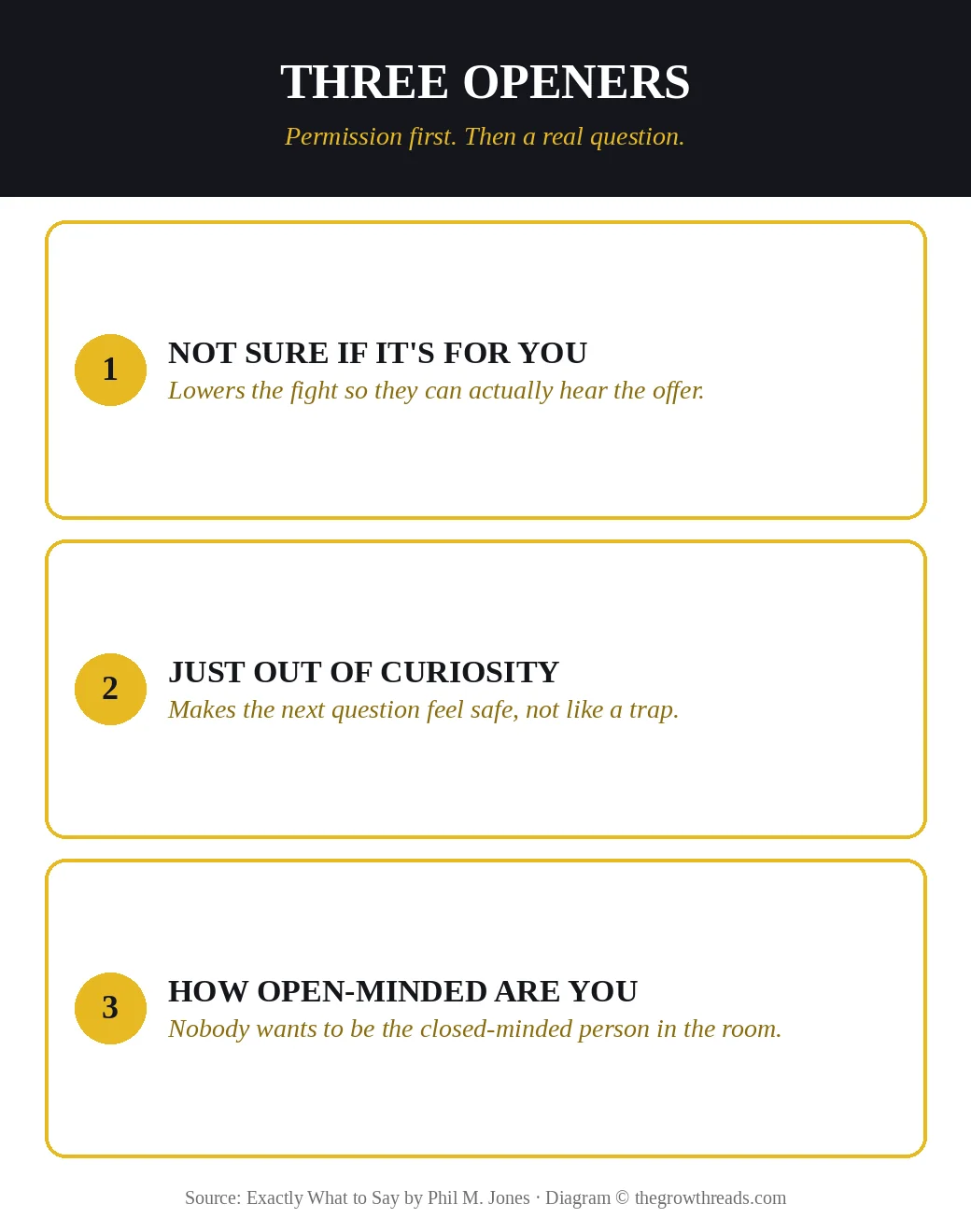
The memorable openers in Exactly What to Say all do the same first job: they lower the fight. “I’m not sure if it’s for you, but…” is permission. The other person can hear the offer without putting on armor. “Just out of curiosity…” makes the next question feel human, not like a trap you built in the car. “How open-minded are you about…?” is almost unfair in a useful way — almost nobody wants to play the closed-minded role in a room. You are not tricking them into a yes. You are earning a hearing so a real decision can happen.
Use one. The mistake is stacking all three, then adding a fourth explanation of why you called. Permission that turns into a monologue is still a pitch. Ask after the phrase. Listen. If they are not a fit, a clean no is a gift. Jones is not asking you to steamroll. He is asking you to stop making the other person do the work of guessing what you want. A ramble forces them to interrupt you to get to the point. A permission phrase lets them stay in the conversation.
None of this replaces a diagnosis. A beautiful opener into the wrong problem is still a wasted chair. SPIN Selling is what you do once they are willing to talk — situation, problem, implication, need-payoff. Jones is why they did not hang up in the first twenty seconds. To Sell Is Human is the gentler on-ramp if the word “sales” still makes you leave. Come back to Jones when you are in the conversation and still cannot start it cleanly.
TGR Note: In a live deal, SPIN Selling is the question sequence. If the word “sales” still makes you flinch, To Sell Is Human is the map. The opener is the door: they decide whether to stay before you have earned a diagnosis.
Part 3 — Lead the next step
Opens that never close are how good talkers finish empty. Jones’s closes are as short as the openers. “What happens next is…” names the step so the conversation cannot hide in maybe. You are not asking them to invent the process. You are showing the path. “If I can, will you…?” is a conditional yes — they decide before you do extra work. If they will not, you just saved an afternoon. “You have three options” turns a foggy tour into a choice. Choice is still a close. An open-ended “so what do you think?” is how you hand the meeting back to hope.
The body of the call still has to raise certainty. A named next step on a product they do not trust is just pressure. Way of the Wolf is the line and the three tens — product, you, company — so a close is earned. Jones is the sentence you use when a ten is high enough to ask. Pitch Anything is the frame so you are not the one being interviewed. Use Klaff to take the room. Use Belfort to stay on the line. Use Jones so the ask is a prepared phrase, not a panic.
A smaller next step is still a close. A date, a second meeting with the decider, a paid pilot. People who only ask for the whole deal train themselves to wait for a magical mood. People who never ask train themselves to tour. The magic-word close sits between those mistakes. Say it. Then be quiet long enough for them to answer.
TGR Note: Frame war: Pitch Anything. Stay on the line: Way of the Wolf. The close is not a speech. It is the sentence you decided before they stalled.
Part 4 — Make one phrase a week habit
Two practical rules sit on top of the dictionary. First: do not collect twenty-three lines and use none. Pick one opener for this week and one close. Write them on a card. Say them out loud twice before the meeting. If you need a new phrase every time, you are still improvising. The book is a menu. The week is a diet.
Second: score the phrase. Did it earn a hearing, a yes, a no, or a stall? A no on a clean ask is information. A maybe you protected by adding two more sentences is a story. Go for No is the attempt cousin: collect nos so a hot morning cannot send you home. Jones is more precise: the attempt is a specific sentence, not volume for its own sake. If you fold at the first stall, Sell or Be Sold will not take that stall as the truth. Come back to Jones with one line and a tally, not a longer highlight reel.
The week design is where magic words become productivity. Three conversations. Same opener. Same close. If you only present, you will see it. If you never name the next step, you will see it. If every stall ends the meeting, you will see it. An ask without a prepared sentence is a good story and a quiet Thursday.
Who is Exactly What to Say best for — and who should read something else first?
Best for sellers, founders, managers, and anyone who already has conversations and still freezes, rambles, or waits for a mood once the other person is listening. It is also for people who hate “scripts” but keep leaving meetings without a next step. If you invent the ask in the moment and then regret the paragraph, this is the book.
Read something else first if your calendar has no conversations — start with Fanatical Prospecting. If you get in the room and cannot diagnose, SPIN Selling. If the room is a status fight, Pitch Anything. If you wander once they are listening, Way of the Wolf. If you reject the word “sales,” To Sell Is Human. Come back when access is not the issue — the sentence after the open is.
Questions to reflect on
- On your last ask, did you decide the sentence before you walked in, or invent it live?
- Which one job did your first phrase actually have — open, shift, or close?
- When they stalled, did you name a next step or add another explanation?
- What smaller option would have turned “what do you think?” into a choice?
- If you could use only one opener this week, which one would earn a hearing?
🔥 Ready to decide the words first?
Pick one phrase before your next conversation so a ramble cannot replace the ask.
How to apply Exactly What to Say (7-day plan)
- Day 1 — Write one opener. “I’m not sure if it’s for you, but…” plus the offer in one sentence. Say it out loud twice.
- Day 2 — Write one close. “What happens next is…” plus a real date or step. Keep it under fifteen words.
- Day 3 — Use the opener once. Do not stack a second clever line. Note whether they stayed in the conversation.
- Day 4 — Ask one curiosity question. Start with “Just out of curiosity…” and then be quiet.
- Day 5 — Close once while it is early. Name the next step before you have used every proof.
- Day 6 — Offer three options. Write A / B / C for one live deal. Do not add a fourth tour.
- Day 7 — Review three conversations. Which phrase did you actually use? Set next week’s rule: one opener, one close.
Frequently asked questions
What is Exactly What to Say about?
Exactly What to Say is Phil M. Jones’s pocket guide to short phrases that move a conversation. His claim is simple: the worst time to think about the line is while you are already saying it. Magic words speak to the fast, deciding brain — permission first, then a question, then a named next step. The book is a dictionary of those lines, not a memoir and not a 400-page theory. Read it when you already get conversations and still freeze, ramble, or wait for a mood. Pair it with Fanatical Prospecting if the calendar is empty, and with Pitch Anything if the room is a status fight.
Who wrote Exactly What to Say?
Phil M. Jones is a British sales trainer who treats language as something you prepare. Exactly What to Say (Page Two, 2017) is the 137-page dictionary of magic words that made his name. He later extended the phrases into industry editions. There is no usable Wikipedia page for this Jones — the footballer is a different person. Start here for the phrases. Empty calendar: Fanatical Prospecting. Frame in the room: Pitch Anything. Diagnosis in the chair: SPIN Selling. Jones sits after all three: you still need a sentence once you are in.
What are the magic words in Exactly What to Say?
Magic words are short, prepared phrases that lower a fight so a decision can happen. Jones’s useful openers include “I’m not sure if it’s for you, but…”, “Just out of curiosity…”, and “How open-minded are you…”. Useful closes include “What happens next is…”, “If I can, will you…”, and “You have three options.” Each line has one job. Stacking three asks in one breath is how you sound pushy and still leave with a maybe. The book is the dictionary. The week is one phrase, scored.
How long does it take to read Exactly What to Say?
About two and a half hours for the 137-page Page Two edition, or one evening. The TGR guide is twelve minutes. The useful unit is not a highlight reel of twenty-three phrases. It is one line you decide before a real conversation, then a note on whether it earned a yes, a no, or a stall. If you only collect quotes, you will finish informed and still improvise the next ask. Read it when you have conversations this week. If you do not, start with Fanatical Prospecting, then come back with a chair.
Is Exactly What to Say worth reading if I already know Pitch Anything?
Yes, because they do different jobs. Pitch Anything is the frame war — status in the room so you are not interviewed. Exactly What to Say is the sentence once you have the floor. Way of the Wolf is the line from open to close. SPIN Selling is the diagnosis. Fanatical Prospecting fills the chair. If your problem is being talked over, stay with Klaff. If your problem is going blank, rambling, or waiting for a mood, this is the book.
What should I read after Exactly What to Say?
If the calendar is empty, Fanatical Prospecting. If you get in the room and cannot find the pain, SPIN Selling. If the room is a status fight, Pitch Anything. If you wander once they are listening, Way of the Wolf. If you fold at the first stall, Sell or Be Sold. If you reject the word sales, To Sell Is Human, then come back. Exactly What to Say is the phrase. The other books fill a chair, diagnose, or keep you from hiding. Pick the gap you actually have this week, not a longer stack.
Does Exactly What to Say work outside sales?
Yes. Jones wrote it for people who need a next step from another human — sellers, founders, managers, and anyone who asks for time, budget, or a decision. A one-to-one is still a conversation with resistance. The same permission phrase that opens a demo can open a request for a meeting, a hire, or a change at home. It is not a license to script every friendship. It is a way to stop improvising the one sentence that actually matters. If the relationship is the work, How to Talk to Anyone sits in another silo. This book is the ask.
Related summaries
- Fanatical Prospecting Summary & Review — fill the empty chair first
- Pitch Anything Summary & Review — take the frame, then speak
- Way of the Wolf Summary & Review — stay on the line after the open
- To Sell Is Human Summary & Review — if the word sales still makes you leave
- Best productivity books — the full Productivity silo
How we analyze books: we paraphrase arguments, add original application notes, and skip chapter-by-chapter reproduction. Read our full methodology.