

★★★★½ 4.6/5 — Prospecting is a daily system with a thirty-day lag, not a mood you wait to feel.
Best for: sellers, founders, and managers whose calendar goes quiet after a busy close.
Reading time: ~7 hours (guide: 45 min).
Difficulty to apply: Medium — the ideas are simple; protecting Golden Hours is the work.
Fanatical Prospecting in one minute
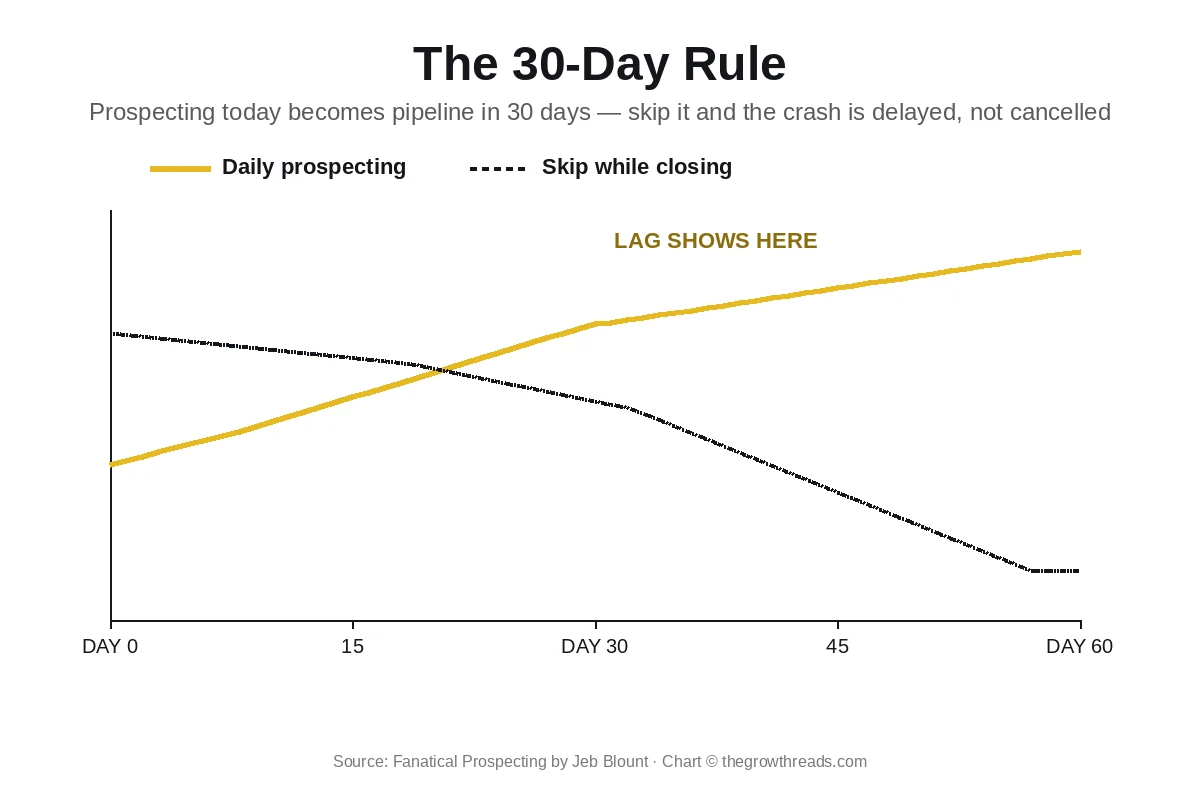
The pipeline you skip today goes quiet in thirty days — not tonight, which is why you keep getting surprised. Jeb Blount wrote Fanatical Prospecting for people who already know they “should call,” then watch a closing week eat the only hour that would have filled next month. The book is blunt on purpose. Inbound is a gift, not a plan. Social is research, not a substitute for interrupting a human. A prospecting call has four possible wins, and closing the whole deal is not one of them.
Read it as a calendar book wearing a sales jacket. The 30-day rule, the law of replacement, and Golden Hours are the whole engine. Scripts help. Lists help more. What changes a quarter is logging enough first conversations this week that next month has somewhere to go.
Key takeaways
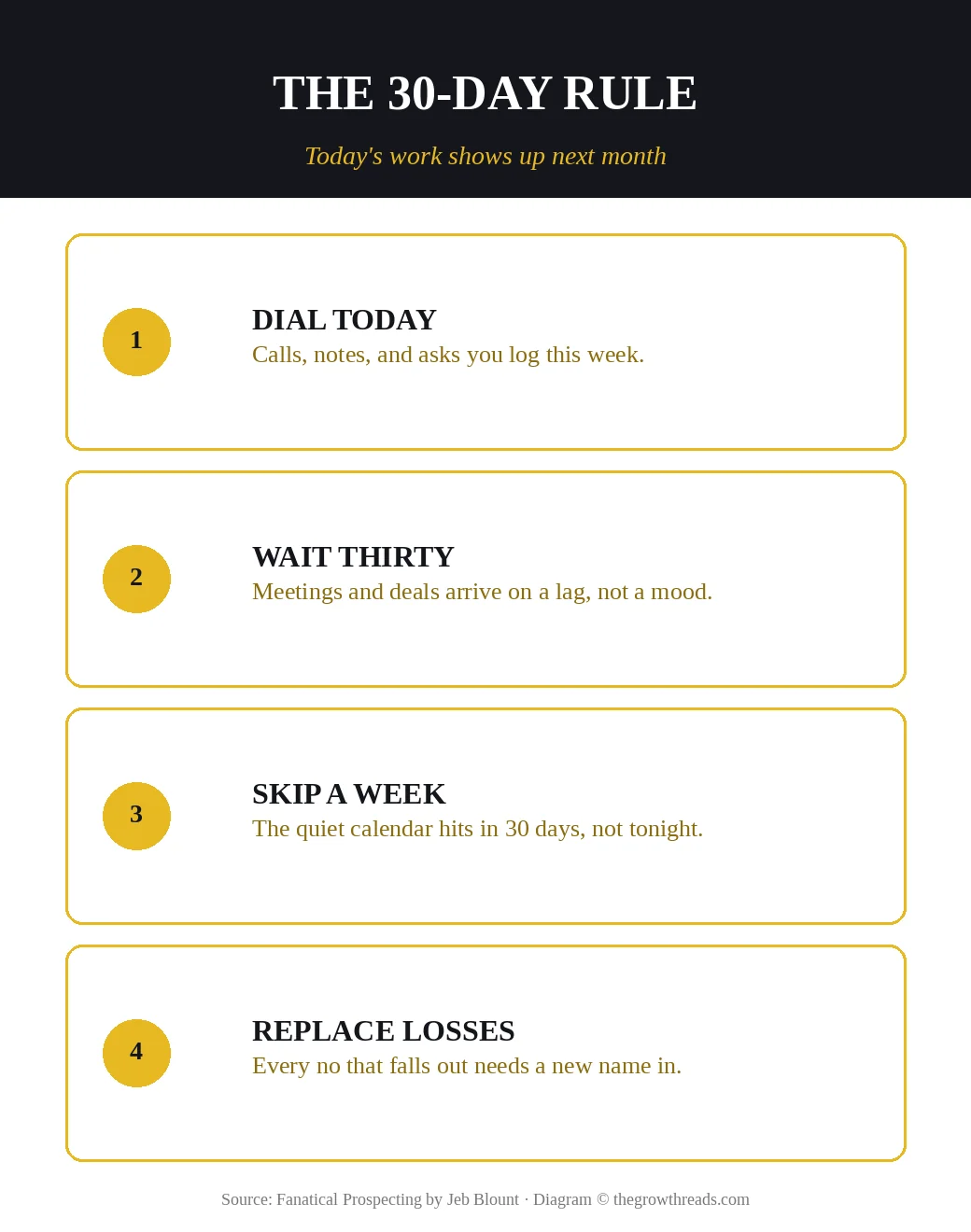
- The 30-day rule: This month’s prospecting is next month’s pipeline. You cannot panic-dial your way out of a gap you created four weeks ago.
- Feast or famine is scheduled: You starve later because you stopped starting conversations while you were busy closing.
- The law of replacement: Every no, stall, and loss needs a new name in. Close-rate math tells you how many.
- Fanatical is daily, not desperate: Desperate prospecting is a binge when the calendar empties. Fanatical prospecting is a protected hour when the calendar is full.
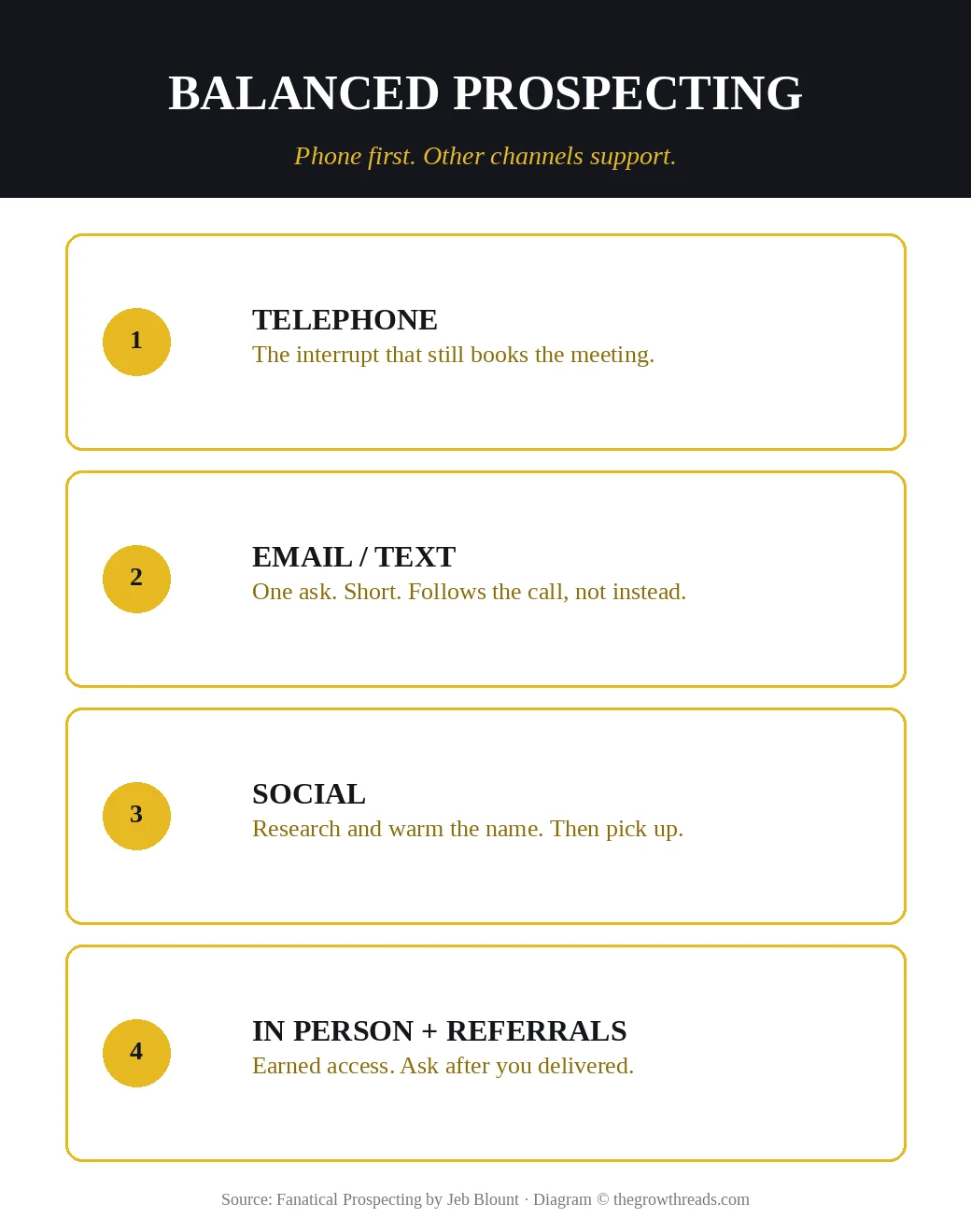
- Phone still interrupts: Email and social support the ask. They rarely replace a live voice if you need a meeting this month.
- Balance the channels: Telephone, email, text, social, in-person, and referrals. One-trick ponies die when that one channel cools.
- Four objectives, not one close: Book a meeting, gather a fact, win a small yes, or lock a next commitment. Then get off the call.
- Golden Hours are a meeting with the pipeline: Block them like a client. Do not donate them to inbox theater.
- Better lists beat prettier scripts: The right names, with a reason to interrupt, outperform clever openers on bad data.
- Rejection is volume, not a verdict: Track activity. Feelings follow the log, not the other way around.
What is Fanatical Prospecting about?
Fanatical Prospecting is Jeb Blount’s system for starting sales conversations every day so the pipeline stays full on a thirty-day lag. It covers channel mix, call objectives, lists, time blocking, and the mindset that keeps you dialing after a no — without turning prospecting into a once-a-quarter panic.
About the author
Jeb Blount is a sales trainer and the founder of Sales Gravy, the company behind a large library of practical sales courses and the Fanatical Prospecting book series. He came up as a seller and sales leader before he started teaching, which is why the book sounds like a manager who has watched a team starve a quarter by “focusing on closing.” He later wrote companions on emotional control in deals (Sales EQ), handling pushback (Objections), and negotiation (Inked). This title is the front door: how conversations get started at all. He is not the 1970s NFL quarterback of the same name — search the Sales Gravy author if you want talks and interviews. Explore all Jeb Blount book summaries →
Key concepts at a glance
| Concept | What it means | Use it when |
|---|---|---|
| 30-day rule | Prospecting now shows up as pipeline in ~30 days. | The calendar looks fine and you are tempted to skip dials. |
| Law of replacement | Every lost opportunity needs a new name in, sized to your close rate. | You celebrate a win and forget the hole it leaves. |
| Fanatical vs desperate | Daily disciplined interrupts vs binge dialing after a famine. | You only prospect when you are scared. |
| Balanced prospecting | Phone plus email, social, in-person, referrals — not one channel. | LinkedIn feels busy and the meeting count is not. |
| Four objectives | Meeting, information, small yes, or next commitment. | You stay on calls trying to close the whole deal. |
| Golden Hours | Protected blocks for first conversations, treated like a client meeting. | Inbox and “internal” work eat the morning. |
| Interrupt | Prospects are busy. Starting a conversation is the job, done with a reason. | You wait to be in the mood, or for them to email first. |
| Lists over scripts | Who you call, and why, beats a clever opener on a bad list. | You rewrite the pitch instead of cleaning the names. |
Part 1: The 30-day lag that empties your calendar
Blount’s opening move is not a pep talk. It is delayed cause and effect. Sellers experience pain in the present — an empty Tuesday — and look for a present-tense explanation: the market, the product, marketing’s leads. The book relocates the cause. If you went quiet four weeks ago because deals were “about to close,” this Tuesday was scheduled then. The 30-day rule is the sentence you put on the wall: prospecting is a leading indicator with a lag, like training for a race you will run next month.
That lag is why binge prospecting feels productive and still fails. A heroic Friday of fifty dials after three quiet weeks does not refill March if February was empty. Volume has to be even, not dramatic. Fanatical, in Blount’s use, means you do not negotiate the block when you are busy. Desperate means you only start when the famine is already on the calendar.
The law of replacement is the same math from the other side. Suppose you need eight closed deals a quarter and you win one in four qualified opportunities. You do not need eight conversations. You need a working stock of opportunities, plus a replacement for every stall and loss, or the stock shrinks every time you “win.” Closing without replacing is how a good month becomes a bad quarter. Blount wants the replacement work on the same board as the close — not a motivational poster, a count.
He is also unromantic about inbound. A form-fill is a gift. It is not a prospecting system. Teams that “went inbound” and stopped interrupting humans did not eliminate prospecting. They outsourced it to a channel they do not control, then blamed the channel when the lag showed up. Keep the inbound. Do not fire the Golden Hours.
TGR Note: Once a meeting exists, this book hands off. The Challenger Sale summary is how you teach and take control inside a complex deal. SPIN Selling is how you investigate so the buyer names the need. Blount fills the empty chair those two books assume is already booked.
Part 2: Interrupt on every channel, not just the comfortable one
The middle of the book is a channel argument dressed as tactics. Blount’s hierarchy is clear: the telephone is still the cleanest interrupt for a meeting this month. Email and text are short, one-ask follow-through. Social is how you stop calling a stranger blind — title, trigger, a reason — then you still pick up. In-person and referrals are earned access, slower, high trust. The mistake is not using social. The mistake is living there and calling it pipeline.
Balanced prospecting is insurance. When a platform throttles messages, or a company bans cold email, the team that only knew that trick goes quiet for thirty days and calls it a market shift. The team with a phone block, a short email sequence, a referral ask, and a short list of live events barely notices. Blount is not asking you to be everywhere. He is asking you not to be a one-trick pony.
Scripts in the book are utilitarian: name, reason for the interrupt, a qualifying question, the ask for time. They are not poetry. That is the point. You are not performing. You are requesting a next step from a busy person. Length is the enemy. So is the “just checking in” email that asks for nothing. One ask. One reason. Then silence long enough for them to answer.
He spends real pages on the emotional dodge: rewrite the email, open a sixth tab, wait until after the stand-up. Golden Hours exist because that dodge looks professional. If the block is not loaded with names, the day fills with work that cannot fill next month.
TGR Note: Protecting that hour is the same fight as Eat That Frog and Deep Work — do the high-leverage block before the inbox assigns your morning. Prospecting is just the frog that salespeople are most likely to kiss instead of eat.
Part 3: Four jobs for a prospecting call (and none of them is “close the deal”)
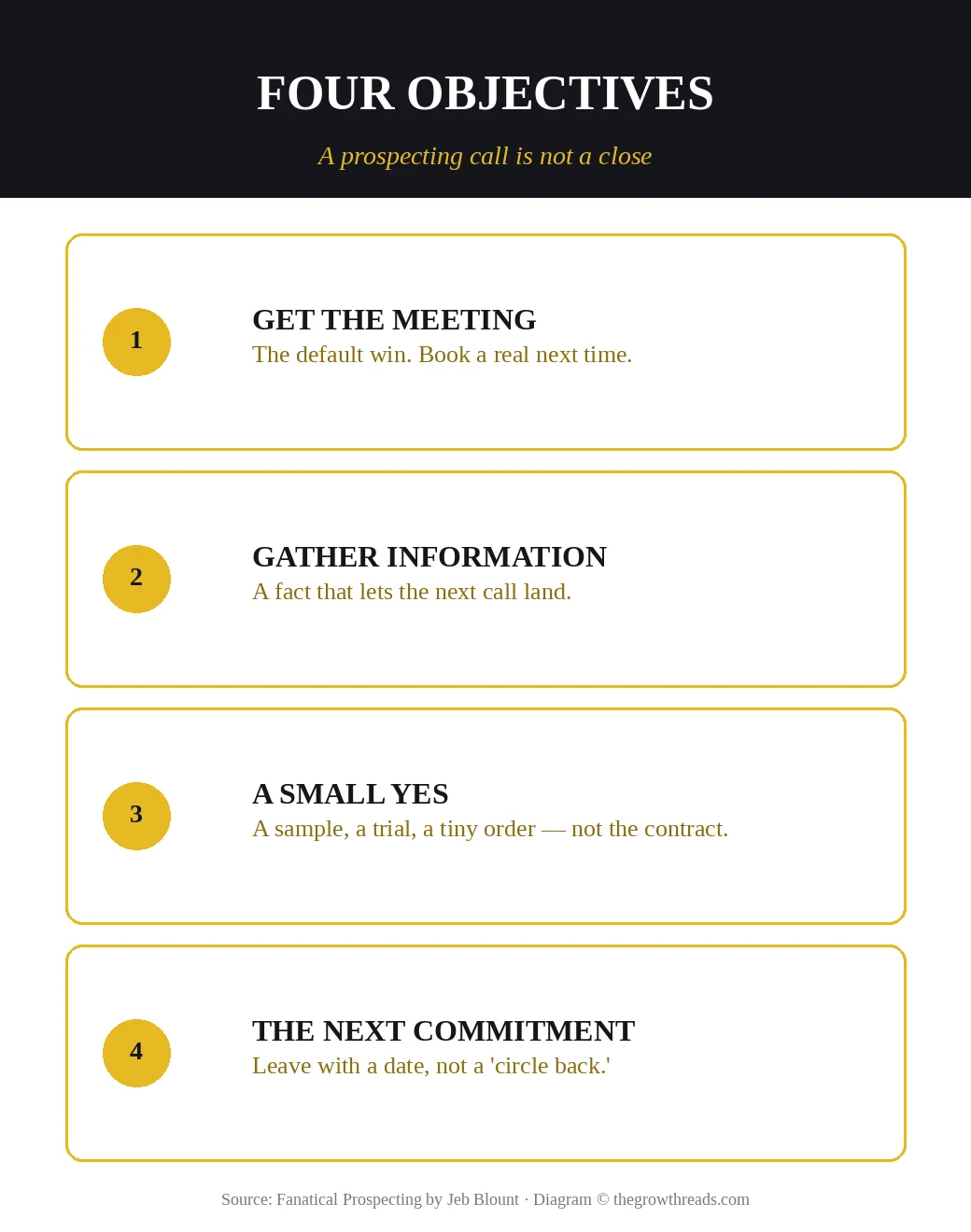
Blount is specific about what a first conversation is for, because most people stay on it too long. They try to pitch the company, handle every objection, and walk out with a signed order. That turns a five-minute interrupt into a ramble, and busy prospects learn to dodge you. He gives the call four legitimate endings:
- You book a meeting with a real date.
- You gather information that makes the next call land.
- You sell something small — a sample, a trial, a tiny order.
- You leave with a next commitment, not a vague “circle back.”
Hit one. Get off. That rule alone cuts rambling. It also makes rejection cheaper: a no to a fifteen-minute meeting is not a no to your whole career. You asked for an objective. They answered. Log it. Next name.
Lists sit under the scripts. A clever opener on a bad list is still a bad morning. Blount wants names you have a right to interrupt: ICP fit, a trigger, a reason that would make a human pause. Clean the list on Sunday. Load Monday’s Golden Hours before you sleep. The book is repetitive here on purpose. Prospecting fails in the ten minutes before the block, when you sit down with no names and “research” until the hour is gone.
On rejection, he is almost mathematical. If your meeting rate is one in ten live connects, nine nos are not a story about you. They are the receipt. Track connects, asks, and meetings — not vibes. The mental toughness chapters (confidence, competitiveness, optimism as chosen postures) will feel familiar if you have read sports performance books. The useful part is attaching those postures to a log, not to a TED talk you play in the car.
TGR Note: If interrupting itself is the freeze, read To Sell Is Human first — Pink’s point is that everyone already moves people. Then come back to Blount for the daily count. If the meeting is booked and you lose the room, Pitch Anything is about owning the frame once you are in it.
Part 4: Golden Hours, managers, and a quarter that does not starve
The last movement is operational. Golden Hours are not “when you feel like it.” They are a recurring meeting with the future pipeline, usually early, usually phone-first, with a list that does not require a decision. Managers who skip this for forecast theater are teaching the team that prospecting is optional until it is an emergency. Blount wants coaching on activity quality — who you called, what you asked for — not on motivational quotes after a missed month.
He also separates prospecting from account management. Farmers who only farm eventually farm a shrinking field. Someone still has to plant. In a small company that someone is you. In a larger team it is an SDR plus an account executive who has not been allowed to retire from first conversations. The 30-day rule does not care about the org chart.
Apply it at team scale with three numbers on one page: leading activity this week, replacement needed for current pipeline, meetings booked. If those three are healthy, the lag works for you. If you only track revenue, you will keep being shocked in week five. That is the whole fourth part: make the lag visible so you stop using hope as a CRM.
Who is Fanatical Prospecting best for — and who should read something else first?
Best for individual contributors with lumpy pipelines, sales managers who inherited a “we wait on inbound” culture, and founders who are still the first conversation. It is also a fit for consultants and coaches who feast after a launch and then go quiet.
Read something else first if your calendar is already full of qualified meetings and you lose them — start with SPIN Selling or The Challenger Sale. If you need discovery for a product idea more than a sales meeting, The Mom Test is the better interrupt. If you want a relationship-first path and you already have a network, Never Eat Alone or The Go-Giver will feel closer. Come back to Blount when the issue is not warmth — it is a missing daily hour.
Questions to reflect on
- How many first conversations did I actually start in the last 30 days — not emails written, conversations started?
- If my close rate stayed the same, how many new names must I add this week to replace what will fall out?
- Which channel am I hiding in because it does not interrupt anyone?
- What is the one objective I will ask for on the next call, and how will I get off the line when I get it?
- Where, exactly, are Golden Hours on next week’s calendar — and what is allowed to cancel them?
🔥 Ready to stop starving next month?
Install the 30-day rule this week: one Golden Hour, a clean list, four possible wins on every call.
How to apply Fanatical Prospecting (7-day plan)
- Day 1 — Count the lag. List meetings won in the last 30 days and first conversations started 30–60 days before that. Notice the delay. Write your replacement number: deals you need × inverse of close rate, minus what is already in play.
- Day 2 — Block Golden Hours. Put a 45–60 minute first-conversation block on the next five workdays, early. Treat it as a client meeting. Load tomorrow’s list tonight.
- Day 3 — Phone only. During the block, interrupt live. Track dials, connects, asks, meetings. Ignore email until the block ends.
- Day 4 — Support channels. After the phone block, send the one-ask follow-up and check social for a trigger on tomorrow’s names. Do not reverse the order.
- Day 5 — Clean the list. Thirty names you have a reason to interrupt. Fit, trigger, ask. Delete the zombie rows you have been “researching.”
- Day 6 — One objective. On every live connect, pick meeting, information, small yes, or next commitment before you dial. Stop when you get it.
- Day 7 — Review the log. Activity vs replacement number. Keep or move the Golden Hour. Schedule next week’s five blocks before Sunday night ends.
Frequently asked questions
What is Fanatical Prospecting about?
It is Jeb Blount’s field manual for filling a sales pipeline on purpose. Most feast-or-famine quarters are not a closing problem — they are a prospecting gap that shows up thirty days later. He covers the 30-day rule, replacement math, balanced channels, four call objectives, and Golden Hours. Read it when you need meetings, not when you need a better demo.
What is the “30-day rule” in Fanatical Prospecting?
The prospecting you do in this thirty-day window shows up as conversations and deals in the next thirty. Skip the phone this week because you are busy closing, and the quiet calendar arrives next month — right when you expected a feast. The rule is a lag, not a slogan. Track activity now the way you already track revenue later. If last month’s dials were thin, this month’s pipeline will be thin, no matter how inspired you feel in the meeting.
Does Fanatical Prospecting say cold calling still works?
Yes. Blount treats the telephone as the interrupt that still books meetings, with email, text, and social as support — not replacements. Social is for research and a warmer name; the ask still usually happens live. He is not anti-digital. He is anti-hiding. If your whole week is posting and hoping, you are prospecting for attention, not for a calendar. Use the channel mix. Keep one daily block that interrupts a human.
Fanatical Prospecting vs SPIN Selling vs The Challenger Sale?
Prospecting gets you in the room. SPIN Selling is how you investigate once you are there — situation, problem, implication, need-payoff. The Challenger Sale is how you teach and take control of a complex deal. Blount’s book does not replace either. It fills the gap most teams skip: a daily system for starting conversations so SPIN and Challenger have someone to talk to. If your calendar is empty, start here. If your calendar is full and deals stall, start with SPIN or Challenger.
How long does Fanatical Prospecting take to read?
The Wiley hardcover runs about 288 pages. Most readers finish it in six to eight hours. You can pull the 30-day rule, replacement math, and Golden Hours in an afternoon, then install them over a week. The hard part is the calendar, not the prose.
Who should read Fanatical Prospecting?
Individual contributors and sales managers whose pipeline is lumpy, founders who still own the first conversations, and anyone who has outsourced prospecting to inbound and is watching the calendar thin out. Skip it if you already have more qualified meetings than you can run — then read Challenger or SPIN. Also skip it as your first book on influence if you freeze at the idea of interrupting anyone; start with To Sell Is Human, then come back for the daily system.
Is Fanatical Prospecting only for enterprise salespeople?
No. The math is the same in a five-person shop: if you need ten yeses a quarter and you close one in three qualified conversations, you need a replacement list working every week. Consultants, coaches, and account managers who live off renewals use the same Golden Hours to start new names before the current book of business goes quiet. Enterprise teams will map it onto SDRs. Solo operators map it onto one protected hour. The rule does not care about your title.
Related summaries
- SPIN Selling Summary & Review — what to ask once the meeting exists
- The Challenger Sale Summary & Review — teach and take control in the deal
- To Sell Is Human Summary & Review — why everyone already moves people
- Pitch Anything Summary & Review — own the frame in the room
- Best productivity books — the full Productivity silo
How we analyze books: we paraphrase arguments, add original application notes, and skip chapter-by-chapter reproduction. Read our full methodology.