

★★★★½ 4.6/5 — Trust is a practice you run in the meeting, not a trait you wait to be given.
Best for: consultants, advisors, and sellers who are already skilled and still get treated like a vendor.
Reading time: ~4 hrs (guide: 12 min)
Difficulty to apply: Medium — the equation is simple; lowering self-orientation while a client is watching is the hard part.
The Trusted Advisor in one minute
Clients do not trust you because you are right. They trust you when you are credible, reliable, and safe to talk to — and when the meeting is clearly about them.
David H. Maister, Charles H. Green, and Robert M. Galford put that test into one equation: credibility, plus reliability, plus intimacy, divided by self-orientation. Most professionals keep adding to the top — another framework, another slide — and miss the moment the meeting becomes about their quota or their fear. The book’s sequence is how you earn the right to advise: engage, listen, frame, envision, commit. Skip to the recommendation and you stay a smart vendor.
Key takeaways
- Trust has a denominator: credibility, reliability, and intimacy only count if self-orientation stays low.
- Three levels, not one skill: expert, problem framer, and trusted advisor are different relationships.
- Being right is not the same as earning the right: advice that arrives too early gets ignored by people who like you.
- Intimacy is specific: it is the client’s willingness to say the risky thing, not your warmth in the abstract.
- Reliability is a trail of kept promises: small commitments, kept in public, beat a dazzling first meeting.
- The sequence is the method: engage, listen, frame, envision, then commit. Do not open with the answer.
- You cannot skip stages: a relationship has an order, the way a personal one does. Technique cannot jump it.
- Cross-selling after trust is service: cross-selling before trust is self-orientation the client can hear.
- Fast trust is still real trust: a first meeting can raise intimacy if you name the issue and drop the pitch.
What is The Trusted Advisor about?
The Trusted Advisor is a field guide to earning the right to advise. Maister, Green, and Galford argue that clients trust you when credibility, reliability, and intimacy are high and self-orientation is low. The book then shows the meeting-by-meeting sequence that builds that trust.
About the author
David H. Maister, a former Harvard Business School professor, spent his career on one problem: brilliant professionals still lose the clients who need them. Born in London, he later became a U.S. citizen and wrote Managing the Professional Service Firm and True Professionalism before this book with Charles H. Green and Robert M. Galford. The first edition appeared in 2000. This review follows the Free Press paperback of September 25, 2001 (256 pages). Explore all Charles H. Green book summaries →
Green carried the equation into trust-based selling. Galford, an author and executive educator, asked what a firm rewards: the advisor who puts the client’s problem first, or the one who protects utilization and a cross-sell quota. The book is short on purpose. The argument is a practice for the next meeting, not a personality type.
Key concepts at a glance
| Concept | What it means | Use it when |
|---|---|---|
| Trust equation | (Credibility + reliability + intimacy) / self-orientation. | The relationship is still thin. |
| Credibility | They believe your words and your command of the subject. | You are new to the account. |
| Reliability | Your actions keep matching your words afterward. | They have been burned by a good first meeting. |
| Intimacy | It feels safe to say the risky part. | The brief and the real worry differ. |
| Self-orientation | How much of the hour is about your win or your fear. | You notice yourself performing. |
| Three levels | Expert, problem framer, trusted advisor. | You want a different relationship. |
| Five moves | Engage, listen, frame, envision, commit. | You want to open with the answer. |
| Fast path | Name the issue and drop the pitch, even on call one. | You have no history with this buyer. |
What a trusted advisor actually is
The book separates respect from trust. Clients can respect your craft and still keep you at arm’s length. Respect sounds like “you are the best person we know at this task.” Trust sounds like “call her before we decide what the task is.” That second sentence is a different job. You hear things that are not in the brief. You are asked about people, not only about the work. You are expected to tell the truth when the truth is inconvenient for your invoice.
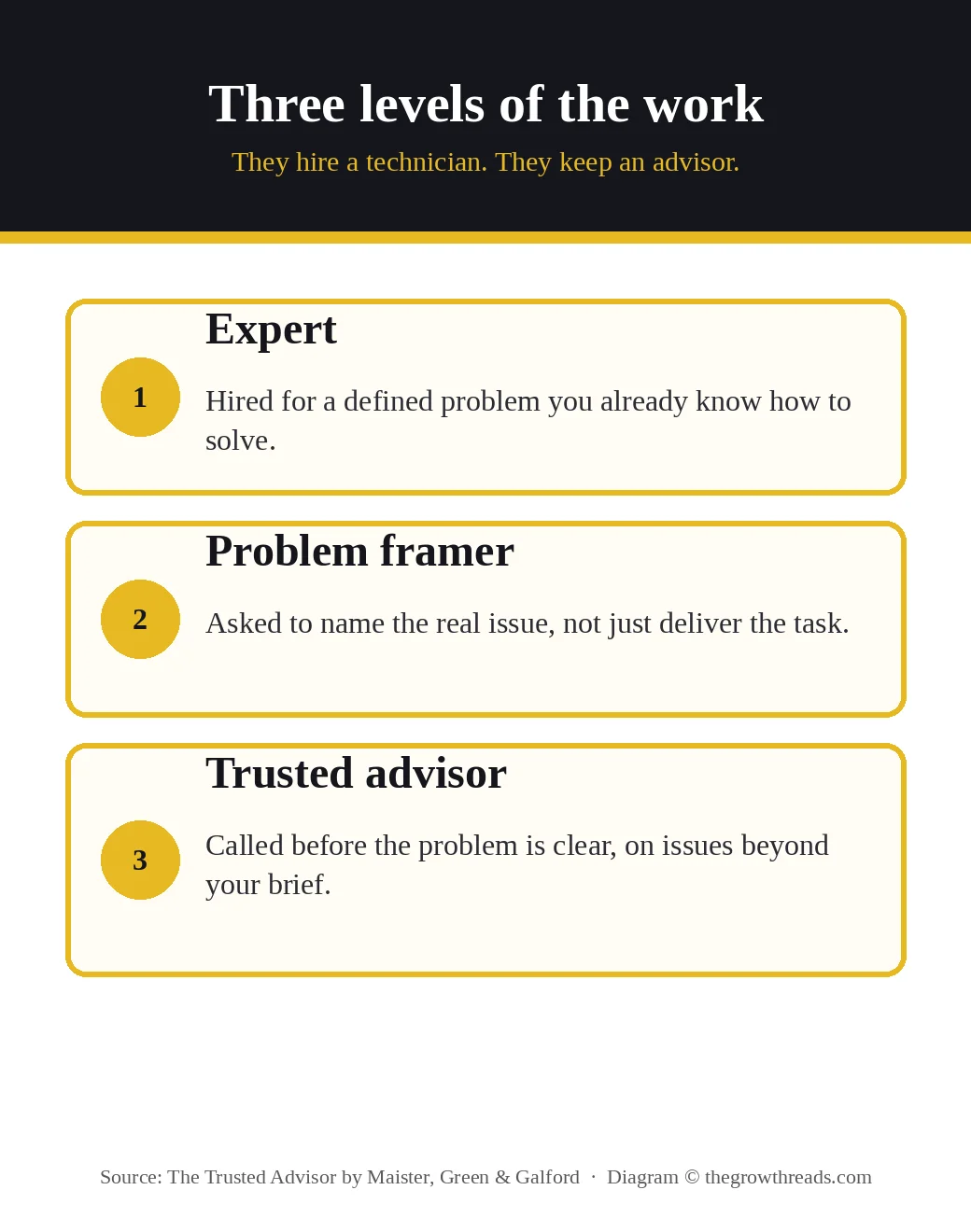
Three levels make the gap visible. Level one is the expert, hired for a problem the client has already named. Level two is the problem framer, asked to challenge the brief. Level three is the trusted advisor, brought into ambiguous and personal questions because your judgment has become part of how they think. Most careers stall between one and two. You get busier, you get referred for the same work, and the market seems to have typed you. Often it has typed your behavior: you answer too quickly to be handed a harder question.
You also cannot skip stages. A stranger who proposes on the first coffee is not bold. He is unsafe. A professional who opens a first meeting with a full recommendation makes the same mistake. The content can be correct and the timing can still destroy it. Technical excellence is the entry ticket. It is not the relationship. Earning the right to advise is a sequence, and the sequence is the respect.
TGR Note: Pair this with SPIN Selling when you need questions, and with Exactly What to Say when you need the words after trust is already in the room. A perfect question still fails when the hour is about your win.
The trust equation
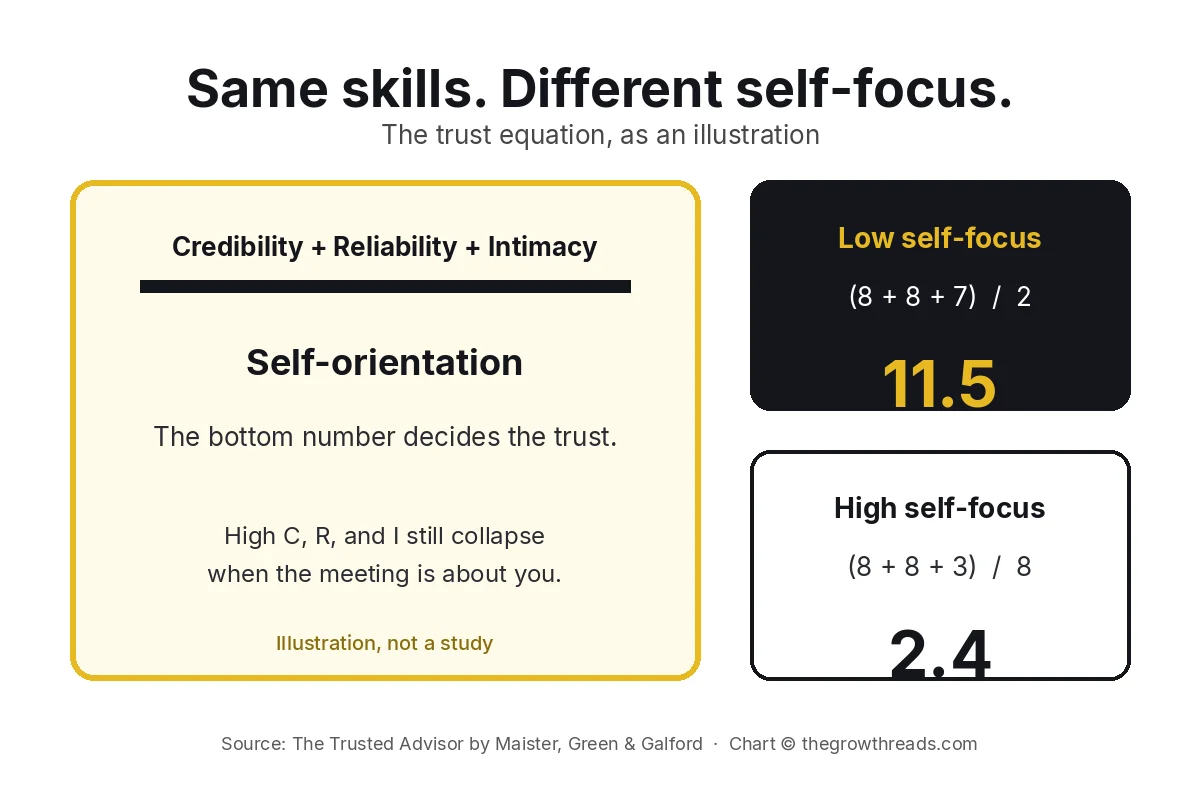
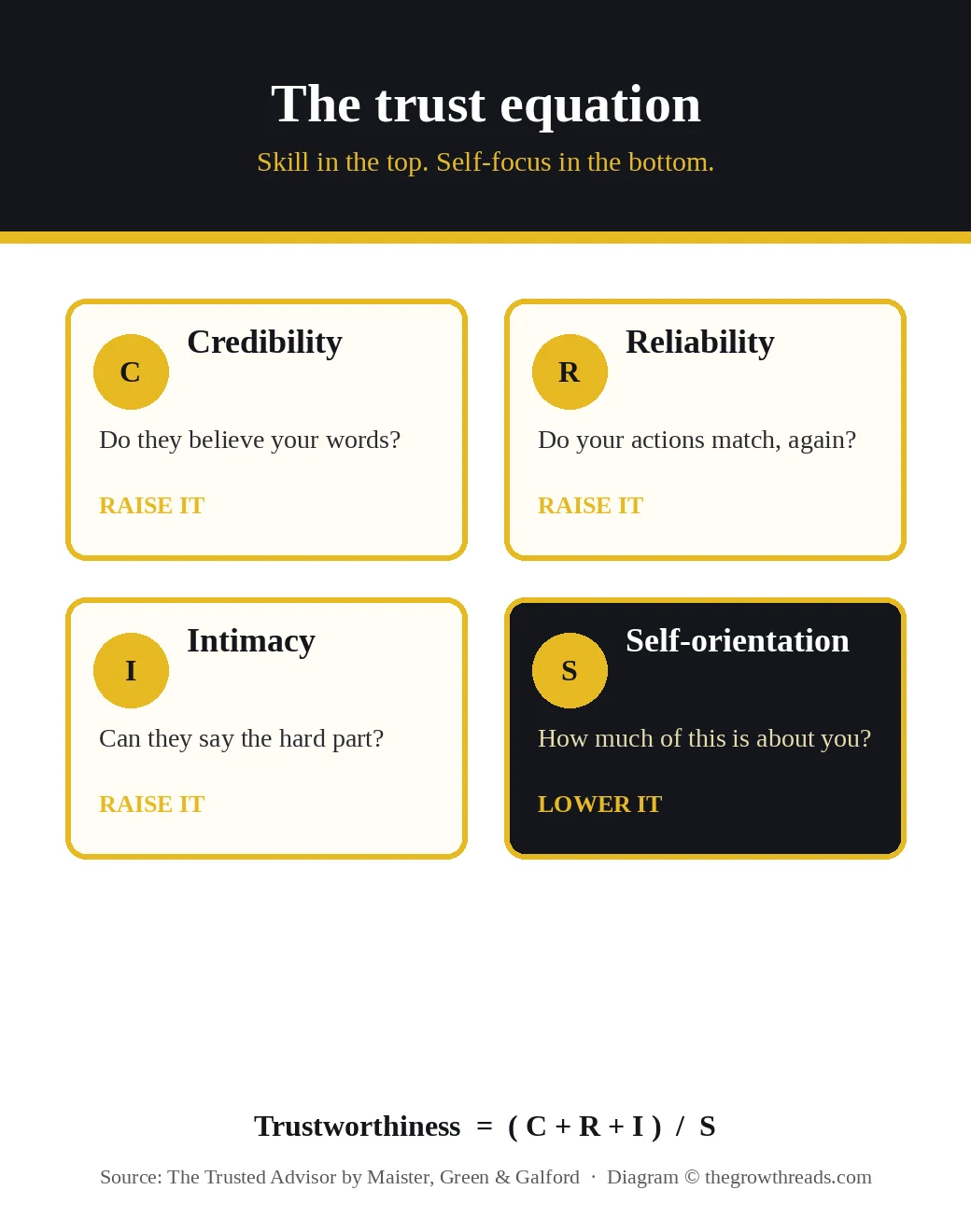
Learn the equation as a sentence you can say in a hallway. Trustworthiness equals credibility, plus reliability, plus intimacy, divided by self-orientation. Credibility is whether they believe your words. Reliability is whether the note arrives when you said it would. Intimacy is not charm. It is whether they can tell you what would be awkward in front of their boss.
Self-orientation is the term that accuses the high performer. It is the share of attention stuck on you. That includes greed, and it also includes nerves. A junior advisor who cannot stop proving she belongs is highly self-oriented, even when she is generous. A senior partner who steers every story back to a recent win is highly self-oriented, even when the stories are true. A high denominator does not subtract from trust. It divides it. Strong content cannot outrun a meeting that feels like an audition.
Replay the last hour and mark each minute as theirs or yours. Theirs means you asked and waited. Yours means you credentialed, filled a silence, or angled toward a service they did not ask about. Intimacy without reliability is a performance, and clients spot it. Low self-orientation is not the same as having no point of view. You can still say they are aiming at the wrong target. The words can match. The denominator cannot hide.
TGR Note: Use The Speed of Trust when a whole team is slow. Use the equation when one relationship is stuck. If the hour is a negotiation, read Never Split the Difference only after the denominator is quiet. Tactics on top of self-focus still sound like tactics.
Five moves that build trust
The sequence gives a Thursday its shape. Engage by earning the right to be in the conversation: one sentence on why you are there, and what you will not pitch. “I am here to understand the decision. I will not walk through our capabilities unless you ask.” That spends a little credibility to buy down self-orientation. Most first meetings do the opposite.
Listening is not a nod while you wait to speak. It is finding the problem behind the problem: the risk to a career, the fear of a public failure, the constraint nobody put in the brief. Framing is the moment you say that problem back and the client corrects you. A good frame is specific enough to be wrong. Then envision: describe the outcome in their language before you attach your method. People commit to a picture they helped draw. They resist a picture that arrives as your deliverable.
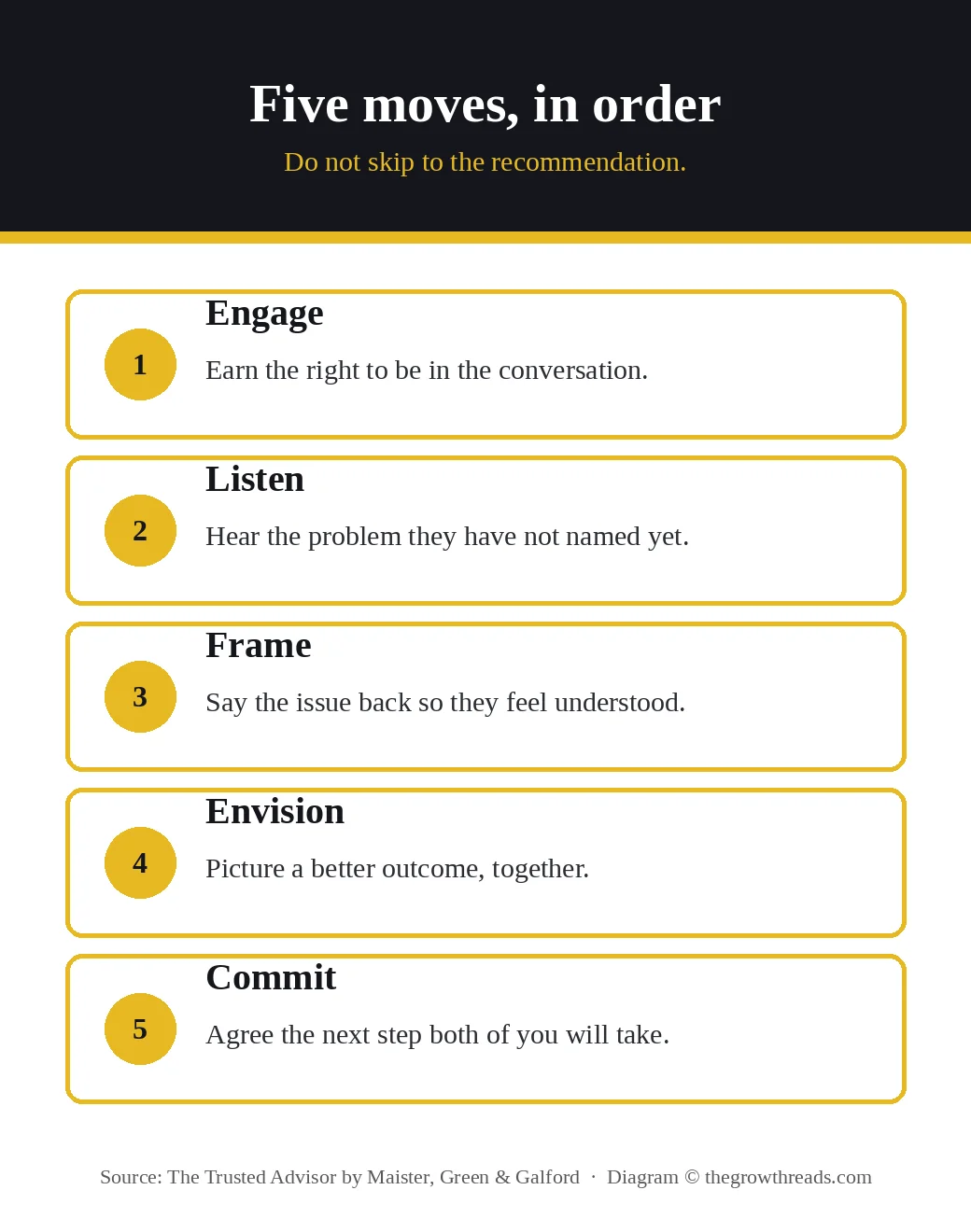
Commit is the unglamorous close. Leave with a next step both sides own: who does what, by when, and what would make the step a failure. That is where reliability is born. The sequence fails when people listen just enough to spot a hook, skip the frame, and commit the client to their preferred project. If you cannot frame the issue in the client’s words, you are not ready to recommend anything. On a first call you may compress the five moves. You still do not get to skip them. Speed is allowed. Self-orientation is not.
Hard moments: bad news, cross-selling, and the first meeting
The hard moments are where professionals grab for technique: bad news, a no, a cross-sell, a first meeting with a buyer who did not choose you. Lead with their interest, say the hard thing early, and do not decorate it with your anxiety. Bad news wrapped in a long preamble is self-orientation. Name the finding, name the consequence for them, and be quiet long enough for them to respond. Silence is a tool. Filling it is usually fear.
A second service is a gift when it serves a problem you have already framed together. The same sentence is a raid when it shows up before that frame exists. The authors do not tell you to hide your range. They tell you to earn the moment. If you have been reliable on the first problem, a relevant introduction feels like care. If the introduction is aimed at your quarter, no phrasing will save it. Fix the denominator before you expand the menu.
The first meeting sets the ceiling. State their world in plain language, with one observation that proves you did the work and one specific limit: “We have not seen how your operators use the report.” A vague “excited to partner” is self-orientation in costume. Hear the story from the person who lives it, and do not correct it in the first ten minutes. You can challenge a story you have honored. You cannot challenge a story you have talked over. You may not control the firm’s quotas. You do control the sentence at minute three, and the promise you keep before Friday.
TGR Note: The Challenger Sale is the companion when you must teach something the client did not ask for. To Sell Is Human widens the same idea past a sales job. Keep this book for the relationship you are trying not to spend.
Who is The Trusted Advisor best for — and who should read something else first?
This is the right book if people already pay you for judgment and you want the problem earlier. Consultants, partners, advisors, and founders who still hold key relationships will recognize the denominator. It is also the right book if you watch a colleague win trust you cannot yet explain. The explanation is learnable.
Read something else first if you do not yet have a live client conversation. Start with SPIN Selling for the questions, or The Speed of Trust if the problem is a team. For a negotiation, start with Never Split the Difference, then come back so the tactic does not become the whole relationship. The best productivity books list is the wider shelf.
Questions to reflect on
- In your last client hour, which minutes were about their problem, and which were about your performance?
- Where are you stuck at “expert” because you answer the brief too quickly to be handed a harder question?
- What is one promise you could make smaller so that you could keep it in public this week?
- Which cross-sell, introduction, or extra slide exists to help your quarter more than their decision?
- What risky thing has a current client not told you — and what, in your behavior, would make that sentence safer?
🔥 Ready to earn the relationship before the recommendation?
Use the trust equation in the next meeting already on your calendar — then keep one promise in public before the week ends.
How to apply The Trusted Advisor (7-day plan)
- Day 1 — Name the level. Pick one live relationship. Write expert, problem framer, or trusted advisor, plus the sentence the client would use.
- Day 2 — Score the last hour. Mark credibility, reliability, intimacy, and self-orientation from 1 to 10. Circle the denominator.
- Day 3 — Rewrite the open. Draft why you are there and what you will not pitch. Say it once before you join.
- Day 4 — Ask one question you cannot answer. Ask it, then wait. Write their words before you add yours.
- Day 5 — Frame and stop. Send five lines: the issue, the outcome they want, and one place you might be wrong. No menu of services.
- Day 6 — Keep a small promise. Finish one visible commitment before Friday. Reliability is a trail, not a claim.
- Day 7 — Review the denominator. Note two moments you pulled the hour back to yourself, and write the next engage line on the invite.
Frequently asked questions
What is the trust equation in The Trusted Advisor?
Maister, Green, and Galford write trustworthiness as credibility plus reliability plus intimacy, divided by self-orientation. Credibility is whether the client believes your words and your command of the subject. Reliability is whether your actions keep matching those words after the meeting ends. Intimacy is the safety to talk about risk, doubt, and politics. Self-orientation is how much of the hour you spend protecting your win, your utilization, or your fear of looking unprepared. Because that last term is the denominator, a spike in self-focus can cancel strong technical skill. The move is to shrink it on purpose before you polish the recommendation.
What is a trusted advisor, in this book?
A trusted advisor is the person a client calls when an issue is still forming, including issues outside the original scope of work. The book draws three levels. At the first, you are the expert hired for a defined problem. At the second, you help name the real problem, not just deliver the task. At the third, the client brings you the ambiguous, personal, and political questions. Technical excellence can keep you at level one forever. The third level is a relationship the client chooses because you have been credible, reliable, close enough to hear the hard part, and more interested in their outcome than in your own airtime.
How is The Trusted Advisor different from The Speed of Trust?
Both books treat trust as a practical skill, and they are worth reading as a pair. Stephen M. R. Covey’s The Speed of Trust organizes trust as character and competence, then shows how trust changes speed and cost across a team or a market. The Trusted Advisor stays inside the professional relationship: one advisor, one client, one meeting. Its signature tool is the equation, especially the warning about self-orientation, and the five-move sequence from engage to commit. Read Covey when the problem is organizational trust. Read Maister, Green, and Galford when the problem is earning the right to advise a specific person.
Who should read The Trusted Advisor?
Read it if you sell judgment rather than a SKU: consultants, accountants, lawyers, architects, agency leads, customer-success managers, and founders who still do the key accounts. It is especially useful when you are already competent and still feel the client treating you like a vendor. It is a weaker first book if you have never run a client conversation and need a question script. In that case start with SPIN Selling, then come back and use the equation to see why a perfect script still fails when the meeting is about you. The book is short on purpose. The practice is not.
Does The Trusted Advisor still apply to modern selling?
Yes. The 2000 argument has aged well because the failure mode has not changed. Clients still meet experts who rush to a deck, still hear cross-sell pitches before the first problem is solved, and still decide in the first ten minutes whether this person is safe. Remote meetings make self-orientation louder: a camera, a quota, and a slide share all pull attention back to you. The equation does not depend on a mahogany conference room. Engage, listen, frame, envision, commit still fits a forty-minute video call. What changed is the number of people in the buying group, not the need to be trusted by each of them.
What are the five steps for building trust?
The book’s development sequence is engage, listen, frame, envision, and commit. Engage means you earn the right to be in the conversation instead of assuming the calendar invite did that work. Listen means you hear the problem the client has not fully named, including the feeling under the facts. Frame means you say the issue back in a way that makes the client feel understood. Envision means you picture a better outcome together, before you prescribe. Commit means you agree a next step both sides will actually take. Skipping ahead to the recommendation is the usual way bright people stay stuck at “smart vendor.”
How do you lower self-orientation in a live meeting?
Notice the moment your attention snaps back to your own performance, and hand the hour back with a specific move. Name what you are there to do for them in one sentence that does not mention your firm. Ask one question you cannot already answer. When you want to fill a silence with a credential, let the silence stand. If you are afraid, say so in their service: “I may be wrong about the priority — what am I missing?” Afterward, write down where you talked in order to be seen. The equation is easy to recite. The denominator moves only when you catch it in the room.
Related summaries
- The Speed of Trust — trust as a team habit.
- SPIN Selling — questions for a complex sale.
- The Challenger Sale — teach without making the hour about you.
- To Sell Is Human — moving others when sales is not your job title.
- Best productivity books — the shelf this summary sits on.
How we analyze books: we read for the argument, the evidence, and the action a reader can take this week. Read our full methodology.