

★★★★½ 4.6/5 — Fix the offer before you buy more attention.
Best for: owners and freelancers who keep competing on price
Reading time: about 3 hours (a short, tactical read)
Difficulty to apply: Moderate. The steps are clear. Honesty about the current offer is the hard part.
$100M Offers in one minute
People do not reject your work. They reject a fuzzy thing that asks them to wait, work, and hope. This 100M Offers summary is for that loop. When what you sell looks like everyone else’s, the only lever left is a lower price, and then you need more ads to make the math work. The book flips the order. Make the offer specific, believable, and easy to start, so a higher price feels fair. Then turn on attention.
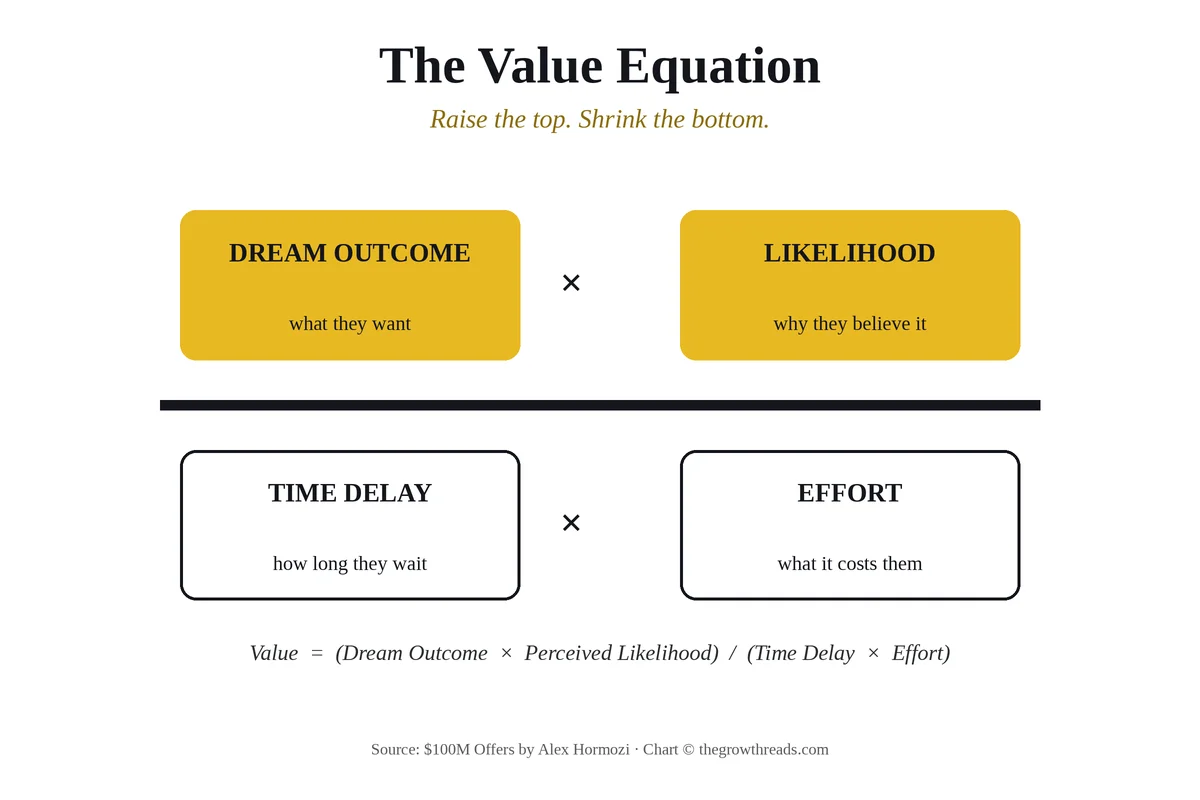
The tool he uses is a fraction. The top is the dream outcome times how likely the buyer thinks it is. The bottom is how long they wait times how much effort and sacrifice you still require. Raise the top. Shrink the bottom. Package what remains as one named offer, not a menu of vague packages. Add a real limit, a real deadline, a bonus that solves the next fear, and a guarantee you can keep.
Key takeaways
- Offer before ads: more leads into a commodity just make you busier and cheaper.
- Value is a fraction: dream outcome and belief sit on top; delay and effort sit underneath.
- Name their result, not your category: “marketing” is a commodity. A specific outcome is not.
- Belief is designed: proof, a mechanism, and a promise that fits this buyer raise likelihood.
- Speed is part of the product: a win in the first week beats a perfect result in month six.
- Effort is a cost they feel: every chore you leave on their plate lowers what they will pay.
- Trim, then stack: list every obstacle, solve the ones that matter, cut what is expensive and invisible.
- One offer, not a ladder of confusion: they should repeat what they get in a sentence.
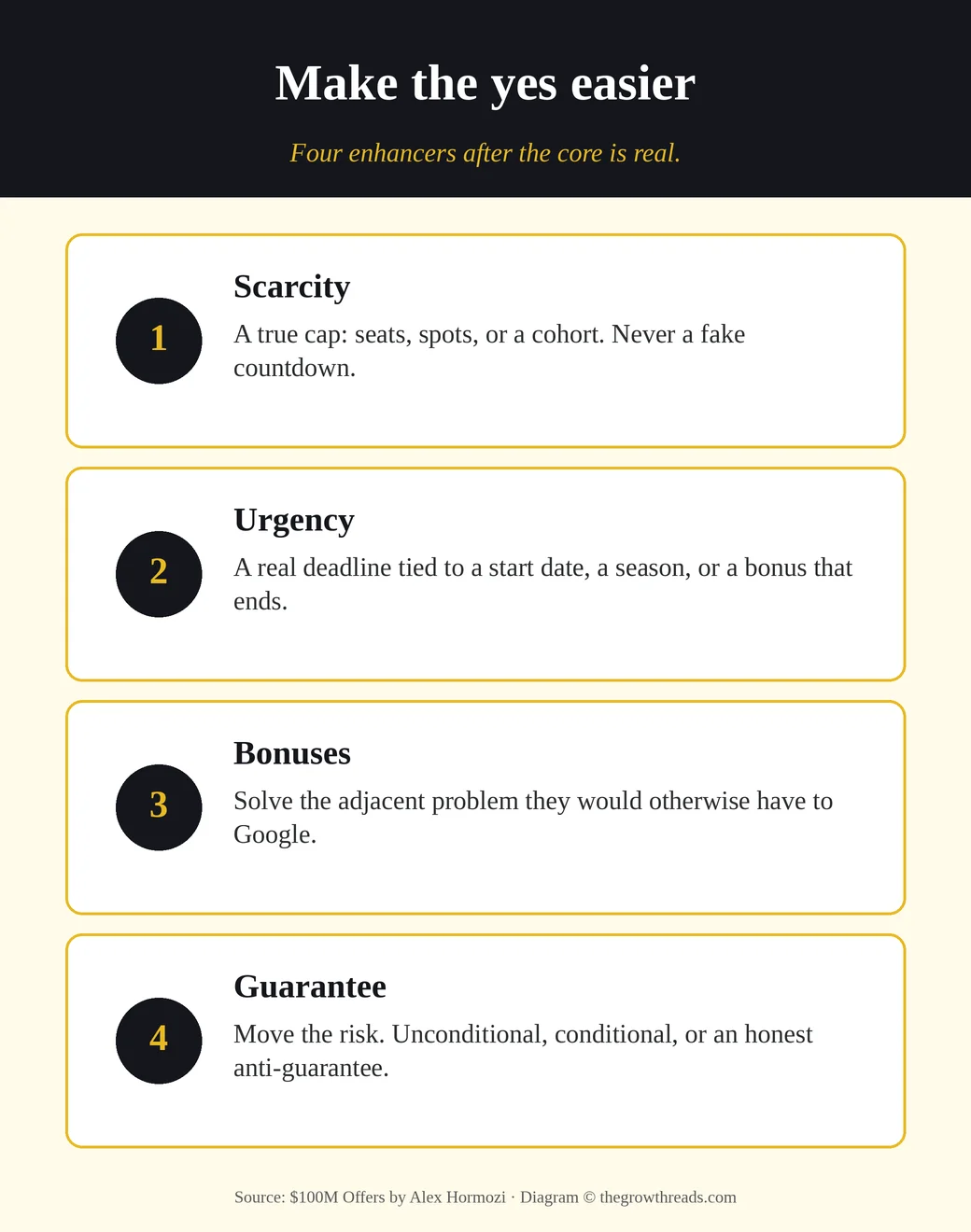
- Enhancers come second: scarcity, urgency, bonuses, and guarantees only work after the core is real.
- Price follows the package: raise price when the outcome, the proof, the speed, and the ease moved with it.
What is $100M Offers about?
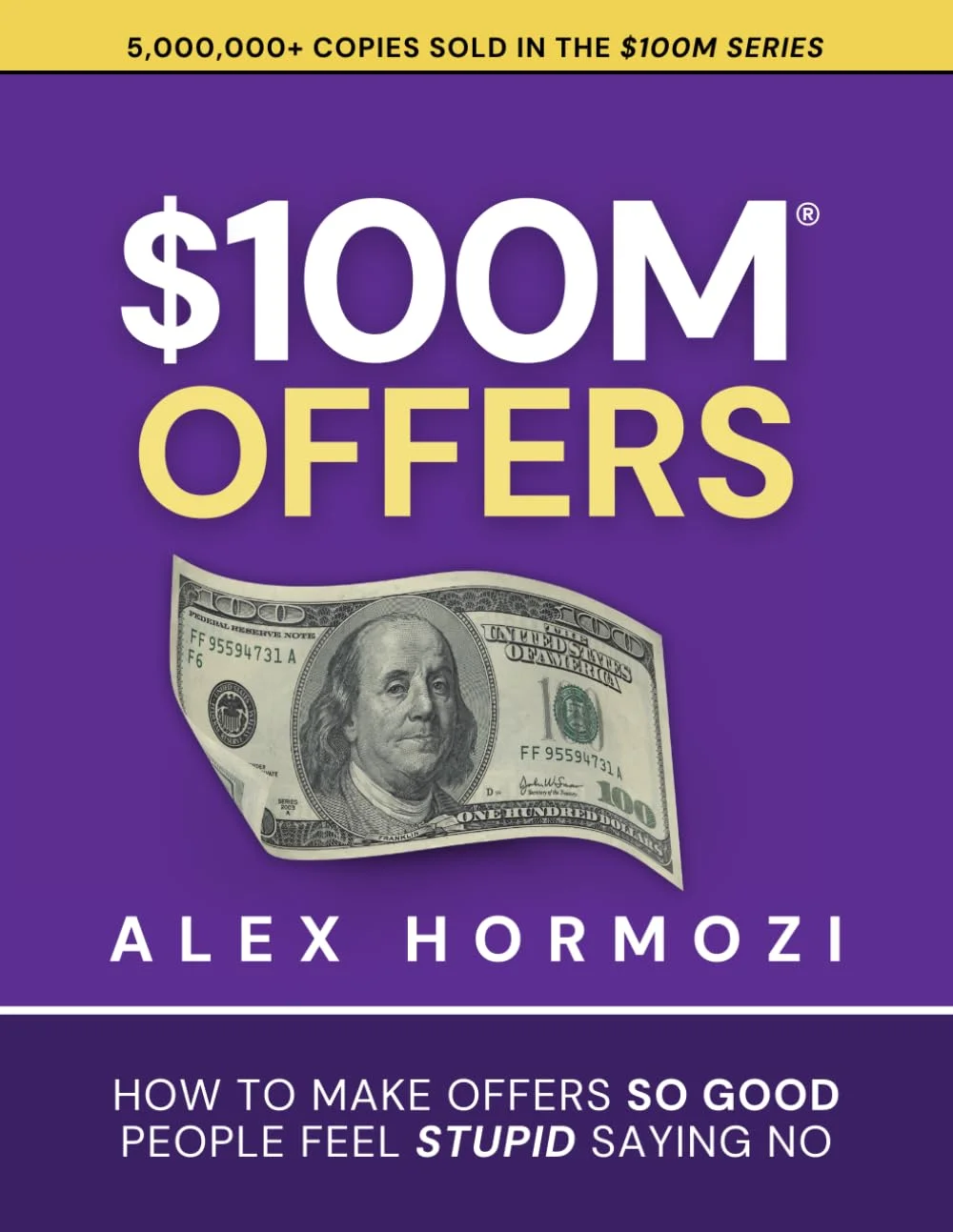
$100M Offers is Alex Hormozi’s field manual for making a product or service worth saying yes to. He shows how dream outcome, belief, speed, and effort combine into value, then how to stack solutions, proof, and a guarantee so price stops being the only lever.
About the author
Alex Hormozi is an American entrepreneur and investor. He and his wife, Leila Hormozi, built and bought companies across services and education. By the time this book came out in 2021, that portfolio had crossed a $100 million valuation, and the work had shifted toward helping other owners package offers that can scale without outside capital. Acquisition.com, their firm, is the publisher and the name on the series this book opens. Explore all Alex Hormozi book summaries →
He is not writing as a pricing professor. The method comes from making offers in gyms and other services, then watching what changed when the promise, the proof, and the workload changed. This is the first book in the series, and it stays on the offer. Later books take up leads and money models. Start here if the thing you sell is the bottleneck.
Key concepts at a glance
| Concept | What it means | Use it when |
|---|---|---|
| Value equation | Outcome times belief, divided by delay times effort. | The price feels high and you cannot explain why. |
| Dream outcome | The result they would brag about, in their words. | Your page leads with a category, not a change. |
| Perceived likelihood | Proof and a mechanism that make the result feel likely for them. | People like the idea and still do not believe it. |
| Time delay | How long until they feel a win, not until the contract ends. | The payoff is real but far away. |
| Effort and sacrifice | The work, risk, and hassle still sitting on the buyer. | They say yes and then stall. |
| Trim and stack | Cut costly low-value pieces. Bundle the rest into one offer. | You are maintaining a menu nobody can remember. |
| Grand slam offer | One named package a buyer can repeat in a sentence. | Proposals keep turning into custom scavenger hunts. |
| Enhancers | Real scarcity, urgency, bonuses, and a guarantee you can honor. | The core offer is clear and the yes is still slow. |
Why a commodity offer forces you to discount
Most stalled businesses have a comparison problem before they have a traffic problem. If a buyer can line you up next to three people who “do marketing” or “do coaching,” one column is left: price. Win that column by charging less, and you need more strangers to make the same money. The ads get more expensive because the yes is still weak.
Hormozi’s point is that the market is not cruel. It is literal. People pay for a change they can picture, believe, reach quickly, and reach without a second job. A category label provides none of those. A grand slam offer provides all four, which is why two firms with the same skill can live in different price bands. The skill did not change. The packaging of the outcome did.
Attention multiplies whatever the offer already is. A clear offer turns it into revenue. A fuzzy offer turns it into polite noes. Fix the thing being multiplied before you buy a bigger microphone.
The value equation, applied
Write the fraction on one page before you touch a script. Top: dream outcome times perceived likelihood. Bottom: time delay times effort and sacrifice. You are finding which corner is weak.
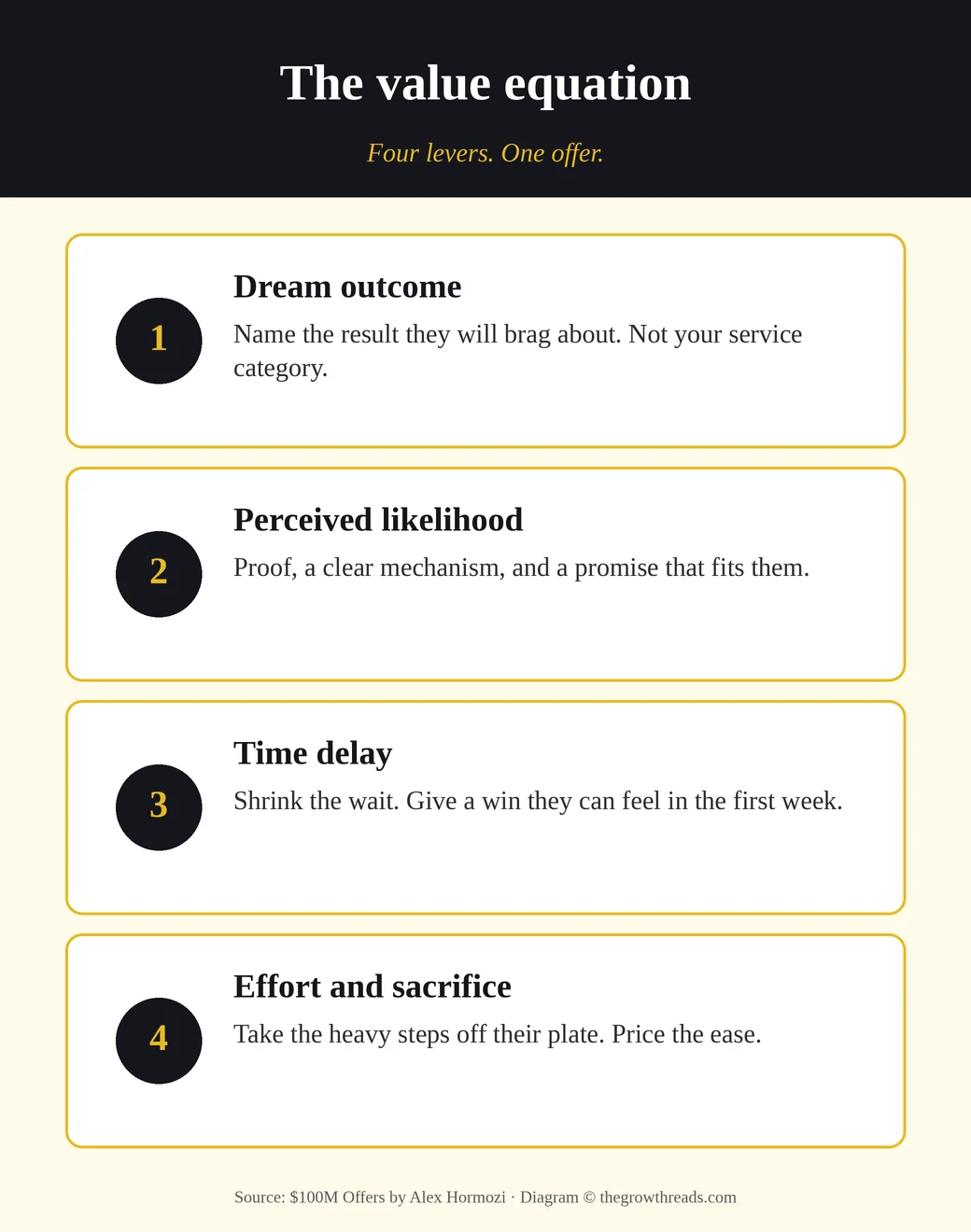
Dream outcome means the result they would tell a friend, not the deliverable you find easy to invoice. A founder does not want “a content retainer.” They want a pipeline that does not depend on them posting at midnight. A homeowner does not want “consulting hours.” They want the leak stopped and the ceiling looking normal by Friday. Say that.
Perceived likelihood is whether they think it will work for them, not for your favorite case study. Specific proof, a mechanism they can follow, and a scope that matches their situation raise this number. “We are passionate” is not a mechanism.
Time delay is the wait they feel. A full result can take a quarter and still include a win in week one: an audit, a first fixed leak, a booked call, a draft they can react to. If the first felt moment is day 90, you are asking them to fund a hope.
Effort and sacrifice is everything you still hand back: homework, risk, meetings, tools, embarrassment, cash tied up. Every item you leave on their side of the table is a discount they will eventually ask for. Taking a heavy step off that list is often worth more than adding another feature.
Trim and stack until one offer remains
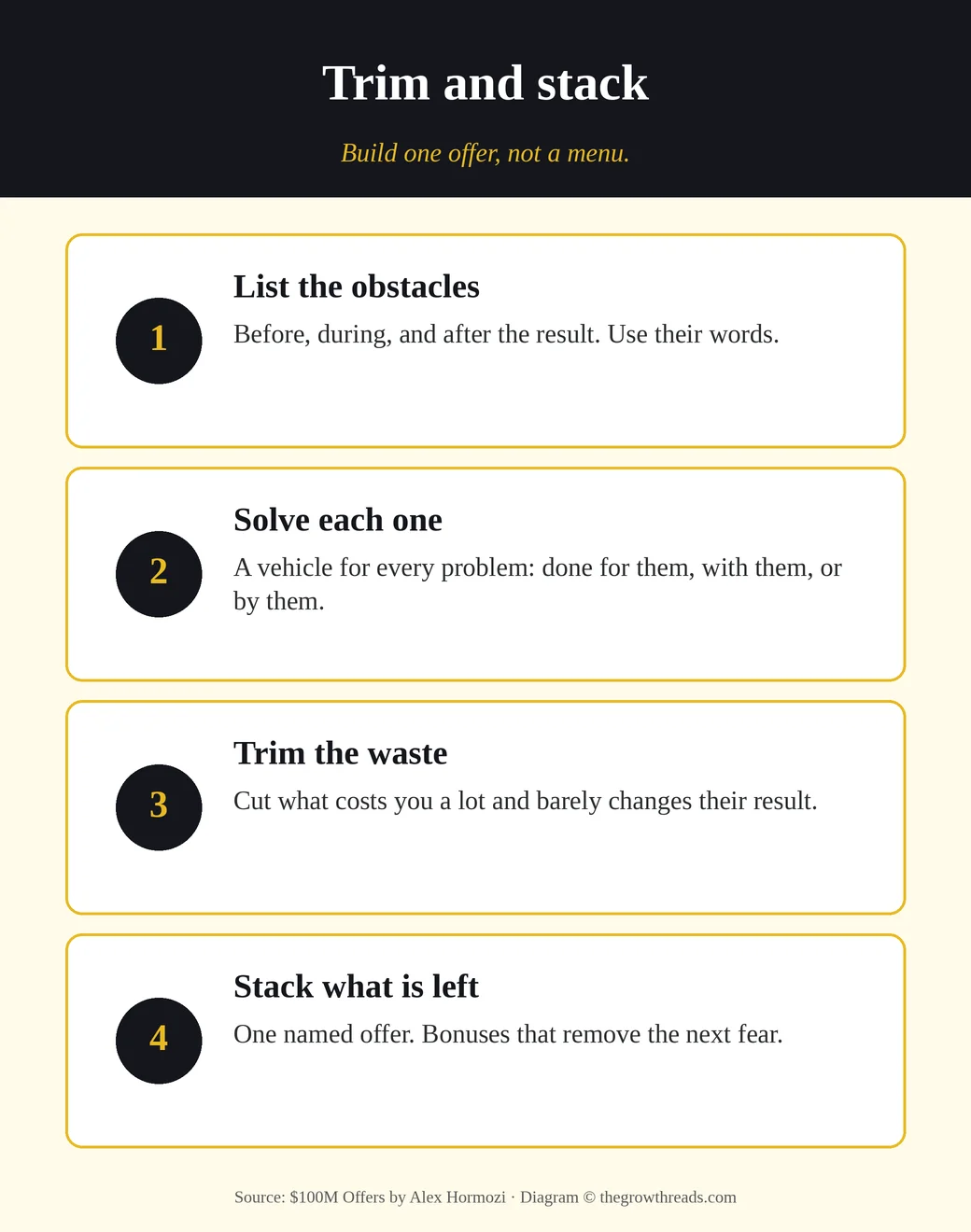
The build sequence in the book is practical. Pick a narrow avatar who already wants the outcome and can pay for it. “Everyone with a business” is how you end up back in a commodity. A specific situation gives you specific obstacles, and specific obstacles are what you can solve on purpose.
List obstacles before they start, while the work is happening, and after the result shows up. Before might be “I tried this once.” During might be “I do not have time to feed you content.” After might be “what if I look foolish for paying this.” Each line is a piece of the offer, or a reason the yes dies.
Turn the important lines into solutions and pick a vehicle: done for them, done with them, or a checklist they run. A private call, a small cohort, and a recorded walkthrough cost you differently and ask different effort of them. Match the vehicle to the obstacle.
Then trim. If a piece costs you a lot and the buyer would not notice it missing, drop it. If it is cheap for you and removes a fear they named, keep it, often as a named bonus. What remains should fit in one offer. A five-tier comparison table means you have not trimmed yet.
Scarcity, guarantees, and a name that sells
Enhancers come last. They amplify a real offer and embarrass a fake one. Scarcity is a true cap: seats, builds you can fulfill this month, or a season when you take the work. A countdown that resets trains people to ignore you. Urgency is a real start date or a bonus that actually ends.
Bonuses should solve the next problem the buyer would otherwise have to handle alone. If the core offer gets them the result, the bonus removes the friction around it: templates, a kickoff that their team will attend, a checklist for the first week, a review at day 14. Name the bonus as its own little outcome. A pile of “extras” reads like leftover inventory.
Guarantees move risk. You can refund if the result is missing. You can refund if they did the work and the result is still missing. You can also say, plainly, that this is not for people who will not do their part. That last form, an anti-guarantee, filters as much as it reassures. The only rule that matters: you must be willing to live with the sentence you publish. A guarantee you hope nobody reads will be the sentence a buyer reads twice.
Then name the offer. The name should carry the outcome and the container, not the commodity. “Gold package” forces a price comparison. A name that states who it is for and what changes does not. Hormozi’s standard is the subtitle itself: an offer so good that saying no feels unreasonable. You are close when they can repeat the name and the risk reversal.
Who is $100M Offers best for — and who should read something else first?
Read this if you already sell and the conversation keeps sliding to price. It fits freelancers, agencies, consultants, local services, and anyone packaging a course or a done-with-you program. You need one avatar you can describe and enough real conversations to list obstacles. You do not need a large audience.
Read The Mom Test first if you are guessing what people want. Read The $100 Startup first if you have a skill and no offer yet. If the sale is fine and the cash disappears afterward, that is a money problem. Profit First is the book for that. If the team cannot deliver what you already sold, fix operations before you sharpen the promise.
This will not design your morning. It designs the thing you ask another person to buy.
Questions to reflect on
- What result would a buyer brag about, in one sentence, if this worked?
- What do they fear will happen in the first two weeks after they say yes?
- Which part of delivery is expensive for you and invisible to them?
- What could they feel in seven days, even if the full result takes longer?
- If you kept only three pieces of the current offer, which three change the outcome?
🔥 Ready to rebuild the offer?
Name the result, remove the drag, and price the package you can actually deliver.
How to apply $100M Offers (7-day plan)
- Day 1 — Dream outcome: Write one sentence a real buyer would say if it worked. Ban category words.
- Day 2 — Obstacles: List what blocks them before, during, and after. Use notes from real conversations, not a brainstorm in the abstract.
- Day 3 — Solutions: Turn each important obstacle into a solution and a vehicle: done for them, with them, or by them.
- Day 4 — Trim: Cross off anything that costs you heavily and would not be missed. Keep what removes a named fear.
- Day 5 — Stack and price: Put the keepers into one named offer. Set a price from the outcome, not from a competitor’s rate card.
- Day 6 — Enhancers: Add one real bonus, one guarantee you can honor, and one true limit or start date.
- Day 7 — Say it out loud: Explain it to one prospect. Write down the objection that remains. That objection is the next piece of the offer, not a reason to discount.
Frequently asked questions
What is the value equation in $100M Offers?
The value equation scores an offer before you spend another dollar on ads. Value goes up when the dream outcome gets specific and the buyer believes it will happen for someone like them. It goes down when they wait a long time or still have to do the hard work. Write the result, the proof, the time until a first win, and the effort you are still handing them. If the bottom of that fraction is heavy, a prettier homepage will not fix the no. Change the offer, then buy attention.
What does Hormozi mean by a grand slam offer?
A grand slam offer is one combined package that makes the next step feel obvious. It is not a longer menu of bronze, silver, and gold. You pick one avatar, name the result they want, list every obstacle in the way, and turn the important obstacles into pieces of delivery, proof, or support. Then you cut the pieces that cost you a lot and barely change their result. What remains is stacked into a single named offer with a price tied to the outcome, not to your hours. The buyer should be able to repeat what they get in one sentence.
Is $100M Offers only for gyms and agencies?
The stories come from service businesses, including gyms, but the levers are not industry-specific. A freelancer, a consultant, a local service, a course, or a software company can still name a dream outcome, raise belief, shorten the wait, and remove effort. The book is a poor fit if you do not yet have a person who would pay for anything. In that case, talk to buyers first. It is also the wrong manual if your problem is personal finance rather than an offer. Use it when people understand the category and still say your price is too high.
How is $100M Offers different from a lead-generation book?
This book is about the thing you ask someone to buy. Lead generation is about how strangers find that thing. Hormozi’s sequence is deliberate: fix the offer, then turn up attention. More leads into a commodity offer just make you busier and cheaper. A stronger offer makes the same lead cheaper to convert, which is why he treats packaging, proof, speed, and risk reversal as the first project. Read this before you rebuild a funnel. If the offer is already something a buyer can explain and believe, then go work on distribution.
What does the book say about guarantees?
Guarantees are a tool for moving risk, not a stunt. An unconditional guarantee says they do not pay if the result is missing. A conditional guarantee says they have to do the work, and you stand behind the result if they do. An anti-guarantee tells the wrong buyer this is not for people who will not show up, which can raise belief among the right buyers. The book is clear that the guarantee has to match what you can actually deliver. A bold promise on a vague service trains the market not to trust you. Write the condition in plain language.
Should you raise prices before you get more leads?
Often, yes, if the current offer is easy to compare and easy to delay. A low price on a vague service signals low likelihood and pushes you into a volume game you may not want. Raising the price only works when the dream outcome, the proof, the speed, and the effort have moved with it. Do not add a zero to the invoice and leave the delivery unchanged. Add the pieces a serious buyer needs, remove the chores they hate, and then price the new package. The ads get easier after that, not before.
How long does it take to rebuild an offer with this book?
A first pass fits in a week if you already know who you serve. One day for the dream outcome in their words. One day for the obstacle list. One day to turn obstacles into solutions. One day to cut expensive low-value pieces. Then a day to name, price, and attach one real bonus, one real limit, and one real guarantee. The last day is a conversation with a live prospect, not another slide. The rebuild is not finished when the document looks tidy. It is finished when a buyer can repeat the offer and the remaining objection is specific enough to solve.
Related summaries
- The $100 Startup — skill, offer, one customer, without the hard sell on premium pricing.
- Building a StoryBrand — make the buyer the hero once the offer is clear enough to explain.
- The Mom Test — learn the obstacles from buyers before you name the package.
- To Sell Is Human — how the ask lands once the offer is something they can repeat.
- Best productivity books — the full silo, if you want a different bottleneck than the offer.
How we analyze books: we read for the mechanism you can use, check the edition and the links, and write an application plan rather than a cliff-notes dump. Read our full methodology.