

★★★★½ 4.6/5 — A prepared reason for this person beats a script you could read to anyone.
Best for: sellers, founders, and recruiters who still dial and still sound like a cold call.
Reading time: ~6 hrs (guide: 12 min)
Difficulty to apply: Medium — the opener is short; doing the homework before every block of calls is the hard part.
Smart Calling in one minute
People do not reject you. They reject a call that could have been placed to anyone.
Art Sobczak’s fix is a Smart Call: a prospecting conversation you earn the right to start. Before you dial, you find a reason that belongs to this person. You open with who you are, that reason, one possible result, and a single question. Then you stop talking. The third edition (Wiley, June 2020) spends most of its pages on those first seconds, on the lines that create resistance, and on the questions and voicemail that follow. Prospecting stays. The blank script goes.
Key takeaways
- Prospecting is the job; cold calling is a choice: an unprepared interruption is what creates the fear, not the phone itself.
- The first ten seconds decide the call: most prospecting calls die on the opener, and that death is usually the caller’s words.
- Build a Possible Value Proposition first: one result they might want, stated in their language, before you mention your thing.
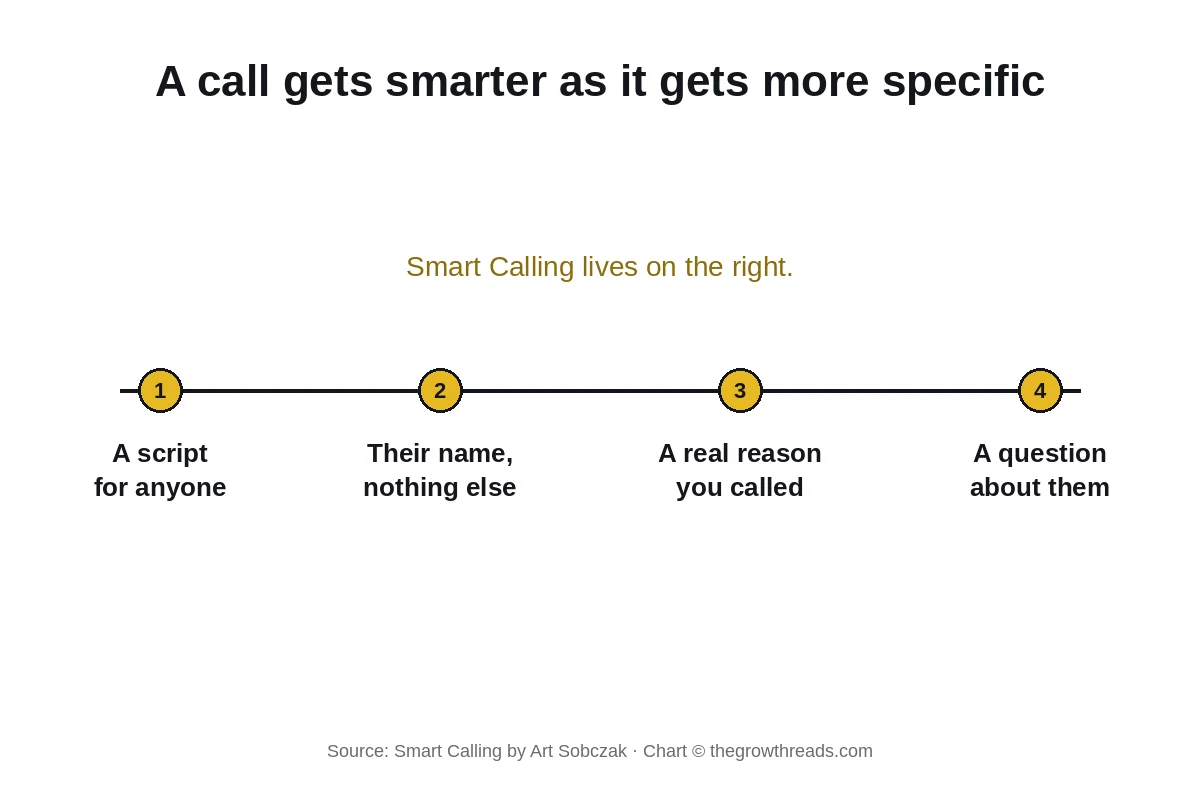
- Intelligence is the difference: a trigger, a role, or a public change makes the call about them. A swapped-in name does not.
- Retire the polite traps: “How are you today?” and “Did I catch you at a bad time?” announce that you did not prepare.
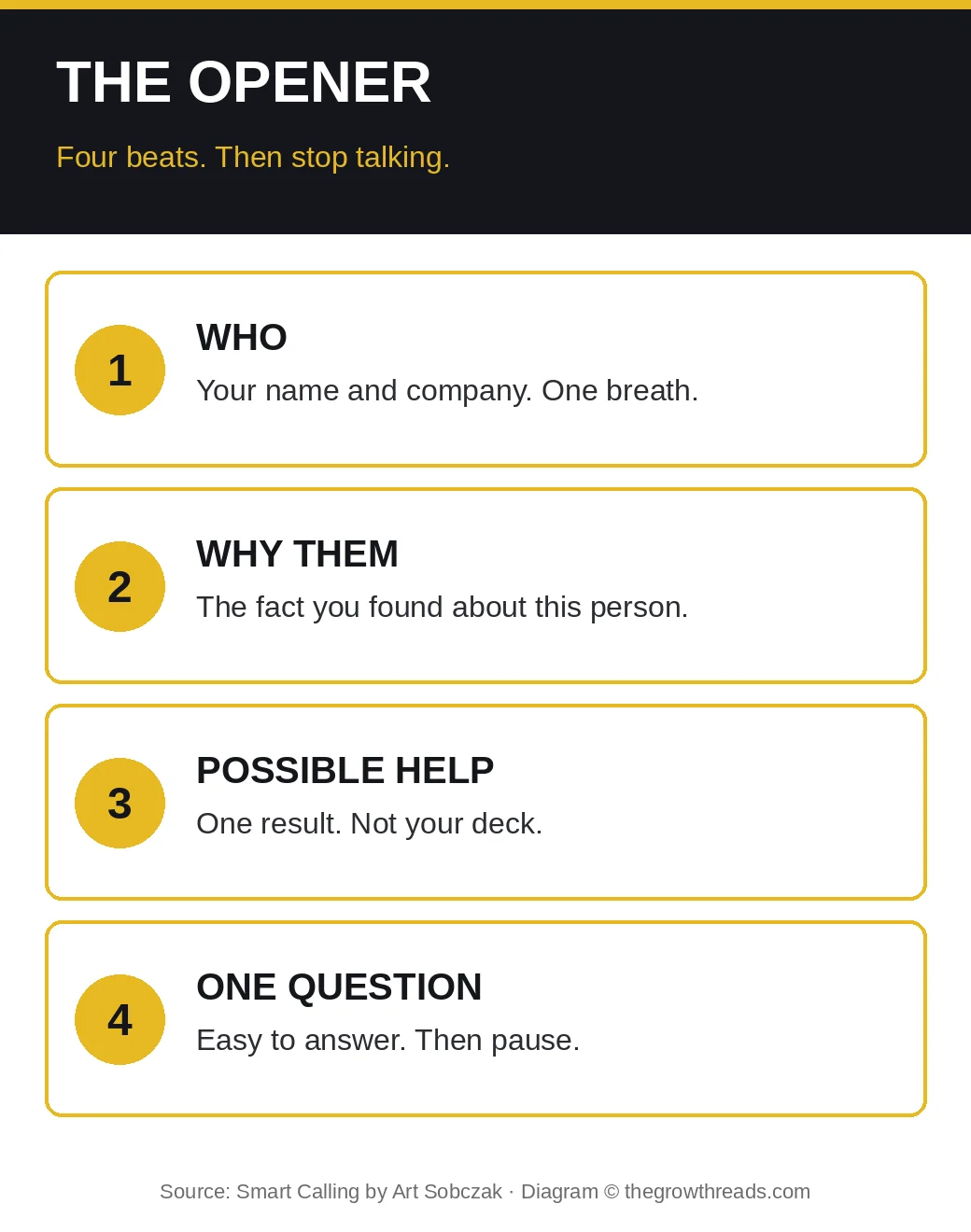
- Four beats, then a pause: who you are, why this person, one possible result, one question.
- Listen for their words: the pause after a real question is the point. Their terminology becomes your next sentence.
- Early resistance is feedback on the opener: “not interested” often means they heard a pitch, not a verdict on the offer.
- Voicemail uses the same reason: one fact, one result, one question. A miniature pitch does not get the callback.
What is Smart Calling about?
Smart Calling is Art Sobczak’s field guide to prospecting by phone without sounding scripted. You gather a reason to call this specific person, open with that reason and a possible result, then ask before you recommend. Wiley’s June 2020 edition covers the opener and the voicemail that follows.
About the author
Art Sobczak has spent decades teaching people to prospect by phone without sounding like a stranger reading a script. He founded Business By Phone, a training practice built around live calls, and he has coached teams whose week rises or falls on the first ten seconds. Smart Calling drew a wide sales audience around 2010. This review follows the third edition, published by Wiley in June 2020 (288 pages), which keeps the method and refreshes the examples for buyers who also live in email and on social feeds. Explore all Art Sobczak book summaries →
His premise is practical. Prospecting stays necessary. An unprepared interruption is what produces the fear and the hang-up. He is a trainer, not a public figure with a useful photo, so this page leaves the portrait empty. The sequence is the point: a reason for this person, an opener that earns the next sentence, and questions before any recommendation.
Key concepts at a glance
| Concept | What it means | Use it when |
|---|---|---|
| Smart Call | A prospecting call placed only after you know why this person should care. | You are about to dial someone who did not ask for you. |
| Cold call | A script you could read to anyone, with the name swapped in. | You want to spot the habit you are about to repeat. |
| Possible Value Proposition | One result they might want, in their words, before you describe your offer. | You keep talking about your product and losing the room. |
| Intelligence gathering | A trigger, a role, or a public change that belongs to this account. | The opener still works if you change the name. |
| Interest-creating opener | Who, why them, possible help, one question. Then silence. | The first sentence is where calls die. |
| Openers to retire | “How are you?”, “bad time?”, apologies, and early asks for a decision. | People exit before you have said anything true. |
| Assumptive problem question | A question that assumes a tension your result would touch, and lets them correct you. | You need a real problem, not a tour of their org chart. |
| Smart voicemail | The same reason and the same question, left in under half a minute. | You reach a recording more often than a person. |
Why cold calling feels dumb
Sobczak separates prospecting, which he treats as necessary, from cold calling, which he treats as an unprepared script. The phone is not the problem. A blank opener is. Teams that ban the phone often ban the only motion that starts new conversations, then wonder why the pipeline is people who already know them.
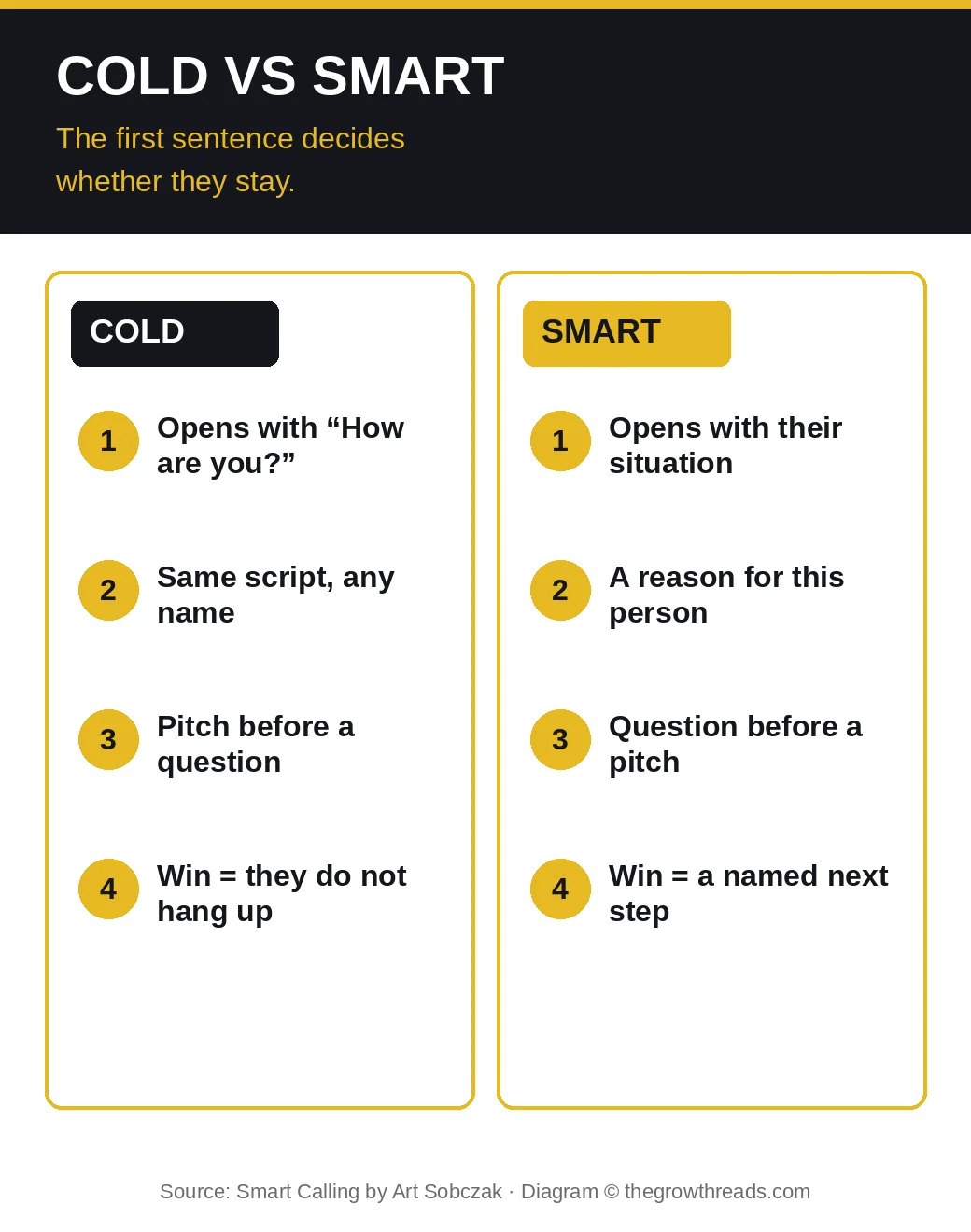
The fear is a design problem. “How are you today?” asks a stranger for warmth you have not earned. “Did I catch you at a bad time?” offers the exit before the reason. An apology for calling tells them the interruption was unjustified. If you would hate to receive the line, the dial will feel like a rejection machine.
The familiar claim that nobody answers is not what he sees. People who still prospect, and who sound prepared, still book conversations. Buyers got fast at spotting a recycled call. Read your opener with the name removed. If it still fits the next twenty accounts, it is a cold call.
TGR Note: Pair this with Fanatical Prospecting. Blount tells you to make the calls. Sobczak tells you what the first sentence must contain. Volume on a cold opener mostly adds hang-ups.
Build the call before you dial
The Possible Value Proposition is possible value, not a promise, and it is about them. Name one result a person in this role might want: fewer missed handoffs, a shorter vacancy, a cleaner close. If you cannot say it without your product name, you are not ready to dial. Pain and gain change the sentence, and so does the title. A clinic owner and a front-desk lead can share a building and still want different outcomes from the same tool.
Intelligence is the other half. You need one timely fact: a hire, a new site, a public complaint, a line from a recent interview. “I noticed your impressive background” is “how are you” in a nicer coat. If you would wince saying the fact out loud, do not build the opener on it. One true detail beats a dossier you will not use.
Before a block of calls, write three lines per name: the fact, the result, and the question that result implies. Fifteen minutes for eight names is enough. A sentence you can say when they pick up beats a folder of unused profiles.
TGR Note: The question half of this prep rhymes with The Mom Test. Rob Fitzpatrick’s rule is to ask about their life, not “would you use my idea?” Sobczak’s Possible Value Proposition gives you the topic. The Mom Test keeps you from turning that topic into a pitch disguised as curiosity. Use both when the person on the phone is also the user.
Open like a peer, then ask
The opener is not there to close. It earns a few more seconds. Calls die here because of the rep’s words. Script it from their fact, so a nervous version of you still has something true to say. A script that ignores the person is the problem.
Four beats: who you are, why this person, a hedged result, one question, then a pause. If you are still talking past twenty seconds, you started a presentation they did not agree to hear. Cut “just,” “a quick second,” and any early ask for a meeting. Say unusual names calmly. “How are you today?” stays retired even when you deliver it warmly. Warmth does not add information they can use.
Example. You sell scheduling software, and a dental group is hiring two front-desk people. “This is Priya Shah at Northline. You are hiring two front-desk people at the new Midtown office, which usually means the phones are already heavy. We help groups in that spot cut the after-hours backlog. Are the new chairs mostly covering calls you are already missing?” Then stop. A correction is a conversation. A monologue about your product is not.
TGR Note: When you need the words that ask permission without begging, read Exactly What to Say next to this chapter. Phil M. Jones is about the phrase. Sobczak is about the reason the phrase is attached to. A clever line on top of “how are you” is still a cold call. Once you are inside a longer discovery, switch to the question sequence in SPIN Selling.
Questions, voicemail, and the next step
Questions should fall out of the possible result, not out of a laminated list. An assumptive problem question names a tension and invites a correction: “When the front desk is short, do the providers end up returning routine calls at night?” Skip the lines that announce an old sales book, especially “what keeps you up at night?” with no context, and “what do you like best about your current vendor?”
The first answer is only the tip. Ask how often, what it costs, and what they already tried. If they say “the night list,” your next question contains those words. The pause lets them talk. Filling it with a credential pulls the call back to you.
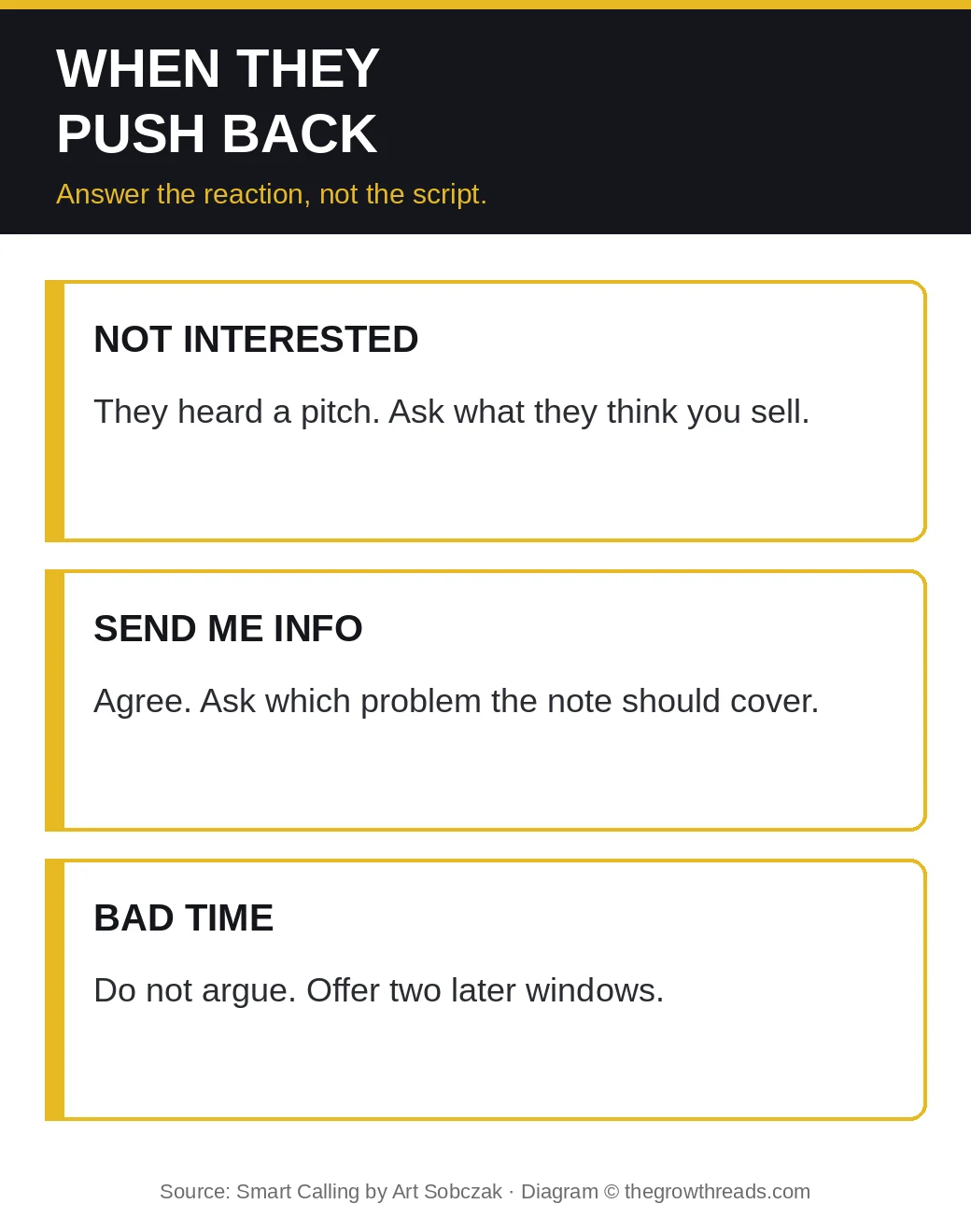
“I’m not interested” often means they heard a pitch. Ask what they thought you were selling. “Send me information” can be made real if you agree and then ask which problem the note should cover. “Bad time” is sometimes true. Offer two later windows. Do not argue someone into staying. Voicemail uses the same shape, cut down: one fact, one result, one question, your number. The email that follows should match. A win is a next step both sides can repeat.
TGR Note: If the person would only take the call because they already trust you, you are in The Trusted Advisor territory, not in an opener problem. Sobczak gets you into the conversation without pretending to be their counsel. Maister, Green, and Galford tell you how not to spend that trust once you have it. To Sell Is Human is the wider frame when the “call” is a colleague you need to move, not a name on a list.
Who is Smart Calling best for — and who should read something else first?
Read this if you reach people who have not raised their hand: SDRs, account executives who still source meetings, founders doing the first fifty customers, and recruiters. It helps most when you already know the offer and the first sentence is the weak part. The book will not invent the offer. It stops you hiding it behind a fake greeting.
Read something else first in three cases. If your deals die in a long discovery with several buyers, start with SPIN Selling and come back for the opener. If you are avoiding the phone entirely and calling it brand work, Fanatical Prospecting is the harder and more useful nudge. If you already have the relationship and you keep spending it on premature pitches, read The Trusted Advisor before you add more technique. The full productivity shelf is on our best productivity books pillar.
Questions to reflect on
- Read your current opener with the name deleted. How many other accounts could hear the same words?
- What is one possible result you can state without saying your product’s name?
- Which line do you still use because a trainer once called it polite — “how are you,” “bad time,” or an apology?
- On your last five conversations, who talked more, and what did you do with the first pause?
- When someone said “send me info,” did you learn which problem the note was supposed to solve?
🔥 Ready to place calls that sound prepared?
Rebuild one opener around a real fact, then use it on the next live dial before you highlight a second chapter.
How to apply Smart Calling (7-day plan)
- Day 1 — One result: Write a Possible Value Proposition for your main buyer in a single sentence that does not name your product. If you cannot, you are not ready to tweak openers.
- Day 2 — Eight facts: Pick eight names you already intended to call. For each, write one timely fact you could say out loud without wincing.
- Day 3 — The four beats: Draft the opener: who, why them, possible help, one question. Read it aloud. Cut every “just,” “quick,” and apology.
- Day 4 — Voicemail twin: Shorten that opener into a voicemail under thirty seconds, and write the email so it says the same thing. Do not invent a second story.
- Day 5 — Live asks: Place the calls. Ask the question and count to three before you speak again. Write down their nouns, not your rebuttal.
- Day 6 — Resistance reps: For every “not interested,” “send info,” or “bad time,” use the matching repair once. Log whether you got a real sentence back.
- Day 7 — Keep or retire: Review the eight. Keep the openers that earned a correction or a detail. Retire any line that still works if you swap the name.
Frequently asked questions
What is Smart Calling by Art Sobczak?
Smart Calling is a prospecting method for people who reach buyers that do not know them yet. Sobczak treats prospecting as necessary work and an unprepared interruption as the part that creates the hang-up. A Smart Call starts before the dial. You learn one real thing about this person, you name a result that might matter, and you open with that reason instead of a generic greeting. Wiley published the third edition in June 2020, with the same sequence and newer examples. The book is a field manual for the phone, the voicemail, and the note that follows, not a theory of personality.
Is Smart Calling the same as cold calling?
No. Prospecting is necessary. An unprepared cold call is the part that creates the hang-up. In Sobczak’s usage, a cold call is a script you could read to anyone: a fake greeting, a product description, and a hope they stay on the line. A Smart Call is placed only after you can say why this person, this week. The opener uses that fact, offers one possible result, and asks a question you can pause after. The fear drops because you are no longer pretending to know them. You still have to dial. The book replaces the blank script. It does not replace the phone with a slogan.
What should you say in the first ten seconds?
Use four beats, then stop. Say who you are, why you called this person, one result that might help, and one question. Sobczak’s point is that most prospecting calls die in those first seconds, and that the cause is usually the caller’s words. Retire “How are you today?”, “Did I catch you at a bad time?”, and any apology for calling. Those lines hand over an easy exit and announce that the call was not prepared. Read the opener aloud. If it still works when you swap the name for a stranger’s, it is not a Smart Call yet. Homework is the difference.
Does Smart Calling still work with email and LinkedIn?
Yes. The failure mode did not move when the channel did. Buyers still decide quickly whether you did any work before reaching out. The third edition keeps the phone at the center and treats email and social research as homework, not as a substitute for a conversation. A note that opens with “I came across your profile” is the new “how are you.” Use the same four beats in writing: who you are, the fact that made you write, one possible result, and one question. Then call. A prepared voice still beats a polished sequence that never risks a live answer. The message still has to be about them.
Who is Smart Calling best for?
Read it if you reach people who have not asked to hear from you: SDRs, account executives, founders doing early calls, recruiters, and agency owners. It helps most when you already know your offer and you still sound like everyone else on the phone. It is a weaker first book if the deal is a long discovery with several buyers. Start with SPIN Selling for that hour, then come back and fix the opener. If the relationship itself is what you sell, read The Trusted Advisor beside this one. Smart Calling is short on purpose. The practice is the next ten dials, not another pass through the highlighter.
How is Smart Calling different from SPIN Selling?
They solve different minutes of the same conversation. Neil Rackham’s SPIN Selling is a question sequence for a complex sale: situation, problem, implication, and need-payoff. Sobczak spends his pages on the minutes before those questions can happen: the homework, the first sentence, the voicemail, and the early brush-off. Use Smart Calling to earn the conversation. Use SPIN once you are in it and the deal has more than one issue. SPIN alone leaves a strong diagnosis attached to an opener that still sounds cold. Smart Calling alone leaves a good first minute and a thin second half. The two books stack cleanly.
How long does it take to apply Smart Calling?
You can rebuild one opener in a sitting and hear the difference on the next live call. The harder change is the habit under it: fifteen minutes of homework before a block of dials, instead of one script reused all afternoon. Give the method a week. Day one is the possible result, written as their outcome. The middle days are real calls where you ask one question and pause. The last day is a review of which openers earned a real sentence back. The book changes nothing on the shelf. The fear shrinks after a prepared call lands, not after you finish highlighting the chapter.
Related summaries
- Fanatical Prospecting — the activity system that makes a prepared opener worth building.
- SPIN Selling — the question sequence once the call is actually a conversation.
- Exactly What to Say — short phrases for permission, after you have a real reason to call.
- The Trusted Advisor — what to do when the relationship, not the opener, is the constraint.
- Best productivity books — the shelf this summary sits on.
How we analyze books: we read for the argument, the evidence, and the action a reader can take this week. Read our full methodology.