

★★★★½ 4.5/5 — A research-backed sales stack: teach a reframe, tailor it to the room, then take control of the next step.
Best for: Knowledge workers in complex B2B who already “build relationships” and still watch deals stall in consensus.
Reading time: ~6 hrs (guide: 13 min)
Difficulty to apply: Easy to write one insight tonight; honest on holding constructive tension instead of smoothing it away.
The Challenger Sale in one minute
Being liked is not the same as winning a complex deal. Matthew Dixon and Brent Adamson’s The Challenger Sale (Portfolio, 2011) is the CEB study turned into a playbook: star reps in hard B2B don’t mainly nurture; they teach a point of view, tailor it to stakeholders, and take control of the conversation. If you take one move from this Challenger Sale summary, pick one live opportunity, write the insight that would make the buyer pause, and name the next step before you walk in.
Key takeaways
- Five profiles, not one personality: Hard Worker, Challenger, Relationship Builder, Lone Wolf, Reactive Problem Solver. You can coach the Challenger moves.
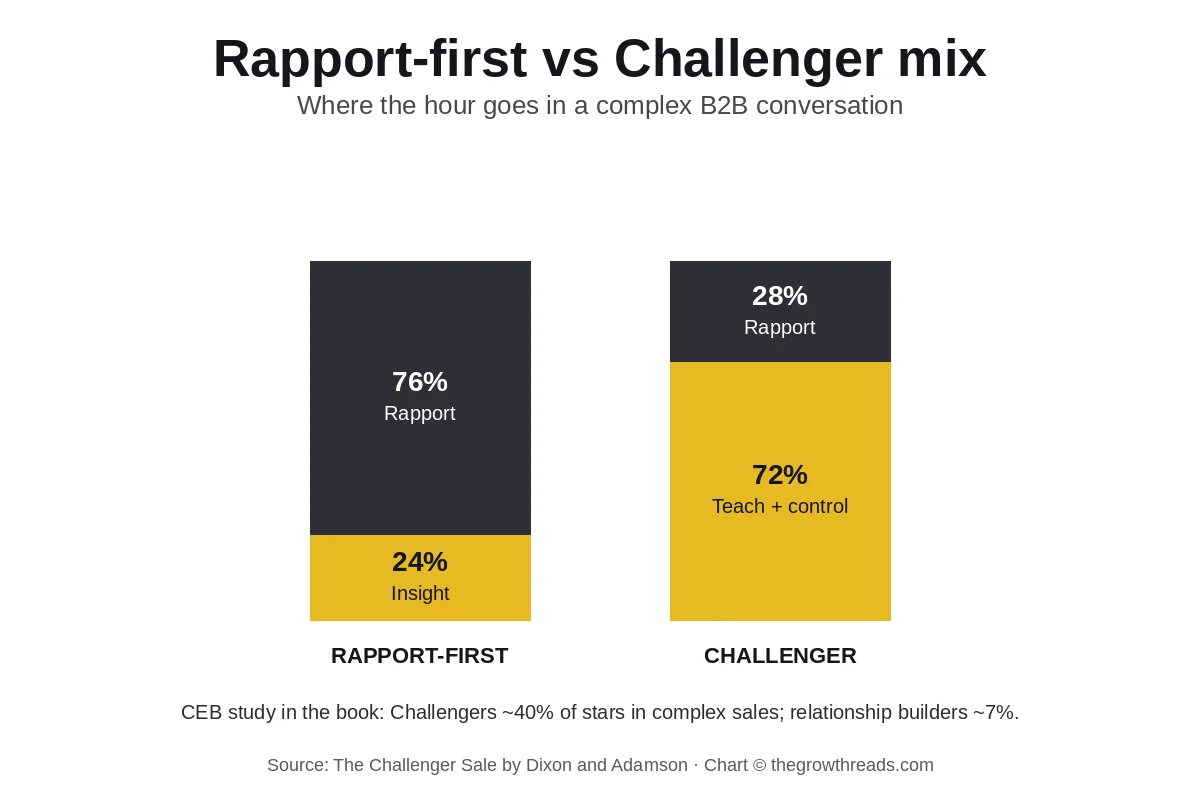
- Complexity changes the ranking: In simple sales, several profiles work. In complex sales, Challengers dominate the star group; relationship builders almost vanish from it.
- Solution selling is late: Customers already have information. They need a unique commercial teaching, not a better brochure.
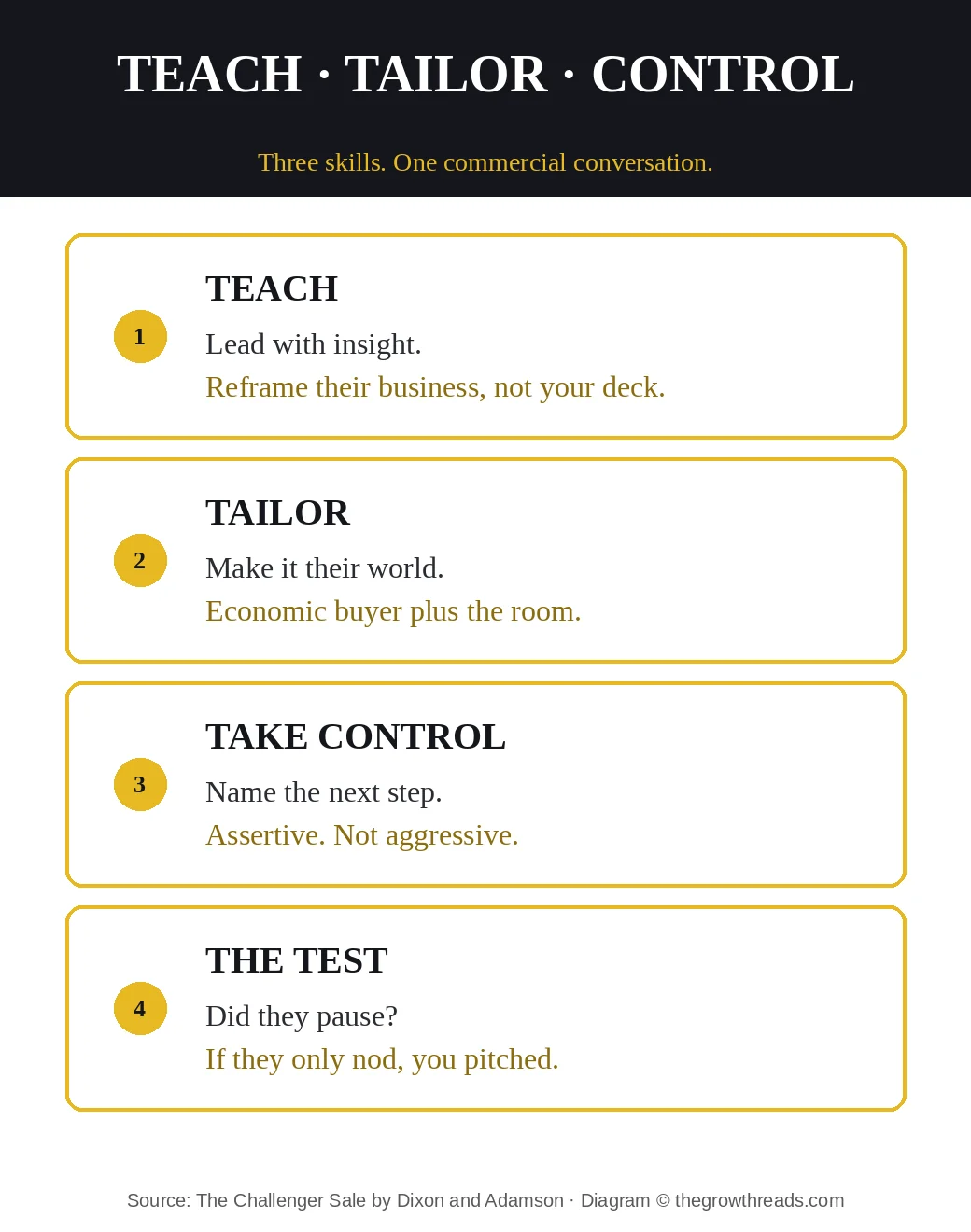
- Teach first: Lead with a reframe of their business. If the first slide is your product, you already pitched.
- Tailor on purpose: The economic buyer and the rest of the room do not need the same sentence.
- Take control: Assert the next step, the timeline, and the price discussion. Assertive is not aggressive.
- Tension is a tool: A useful pause beats a comfortable nod. Comfort is not loyalty.
- Managers build Challengers: Don’t wait to hire unicorns. Coach teach, tailor, and control on live deals.
What is The Challenger Sale about?
The Challenger Sale is Dixon and Adamson’s playbook, drawn from a large CEB study of sales reps, for winning complex B2B deals by teaching a commercial insight, tailoring it to each stakeholder, and taking control of the conversation instead of relying on rapport. The usable residue is one reframe, a room map, and a next step you name before the meeting starts.
About the author
Matthew Dixon and Brent Adamson wrote The Challenger Sale inside Corporate Executive Board’s Sales Executive Council, the research shop later folded into Gartner. Dixon went on to co-found DCM Insights and to write follow-on books on effortless experience and, later, how rainmakers actually activate. Adamson stayed in the research lane as a Gartner distinguished vice president and co-authored The Challenger Customer. The through-line is not charisma. It is evidence: thousands of reps, five profiles, and a stubborn finding that in complex deals the people who teach a point of view outperform the people who mainly stay liked. This book is the flagship of that finding. They are asking you to stop confusing a warm account with a won one. Explore all Brent Adamson book summaries →
Key concepts at a glance
| Concept | What it means | Use it when |
|---|---|---|
| Five profiles | Hard Worker, Challenger, Relationship Builder, Lone Wolf, Problem Solver | You treat “good seller” as one personality |
| Challenger | Teaches, tailors, takes control | The deal is complex and consensus-heavy |
| Relationship Builder | Rapport, yield, access | You are stalling in “great relationship, no decision” |
| Commercial teaching | A reframe of their business, not a pitch | The first slide is still your product |
| Tailoring | Different sentences for different stakeholders | One deck is doing every job |
| Taking control | Assert next steps, timing, and money talk | You wait for them to “think it over” |
| Constructive tension | A useful pause, not a fight | Nods feel like progress and nothing moves |
| Solution selling’s end | Buyers already have information | You still lead with capabilities |
Part 1 — Five profiles and the relationship-builder myth
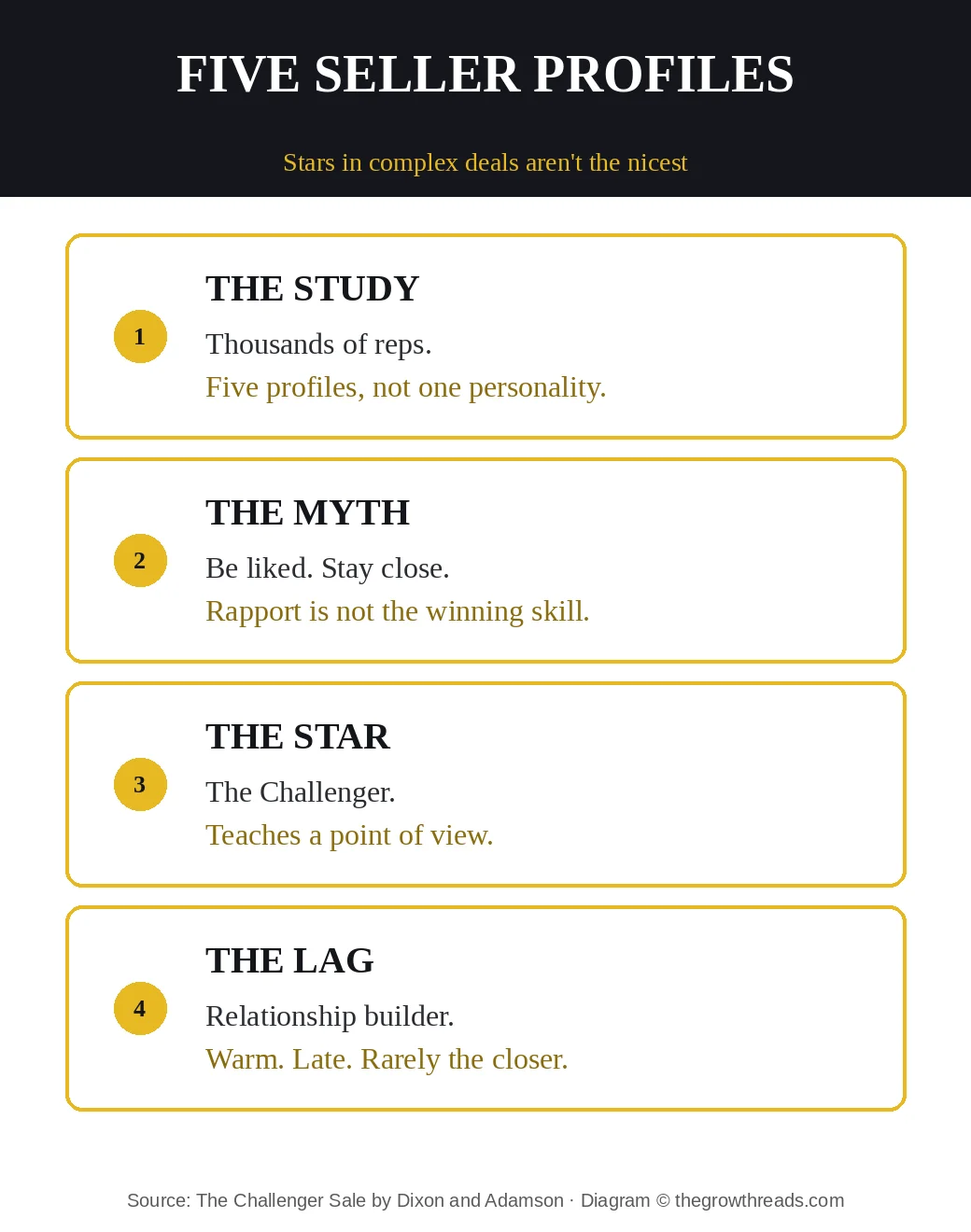
Dixon and Adamson start with a study, not a pep talk. CEB looked at thousands of salespeople across companies and found five clusters of behavior, not a single “hunter” type. The Hard Worker shows up, puts in the hours, and goes the extra mile. The Challenger pushes the customer’s thinking. The Relationship Builder gets access and keeps the peace. The Lone Wolf follows instinct and breaks process. The Reactive Problem Solver is reliable, detail-heavy, and late to the conversation because they are busy fixing what already broke.
The finding that made the book famous is ranking, not labeling. In transactional, simpler sales, several profiles can be stars. In complex B2B — long cycles, several buyers, a solution that has to be assembled — the star group is full of Challengers and almost empty of Relationship Builders. Rapport still matters as table stakes. It is not the skill that separates the top of the complex funnel. The myth the book is retiring is “if they like us, they will buy.” Plenty of liked vendors lose to a supplier who made the room think.
Tonight, score five live conversations: did you teach something they did not already believe, or mainly stay pleasant? If four are pleasant, you are running a relationship-builder week inside a complex problem. The numbers are a warning light, not a personality test. You need a different first move, not a different personality.
TGR Note: SPIN Selling is Neil Rackham on letting the buyer name the need through Situation–Problem–Implication–Need-payoff questions. Use Rackham when the stall is discovery: you still do not know what hurts. Use Dixon and Adamson when you already know the problem and the room is still collecting vendors. SPIN gets you to the need. The Challenger Sale gets you to a point of view. They stack. They are not the same meeting.
Part 2 — Teach: commercial insight, not a prettier pitch
The middle of the book is the teaching pitch. Challengers do not open with “let me tell you about us.” They open with a unique view of the customer’s business — a cost they are undercounting, a risk they have normalized, a comparison they have not run. The goal is a reframe: the buyer should leave with a different picture of their own world, then see your capability as the logical next move. If the insight only works if they already want your product, it is a pitch wearing a hat.
Teaching is not a white paper dump, fear for its own sake, or one more ROI calculator. It has a plot: what they think is true, what the industry data shows, the cost of the old play, and a different way to spend the next dollar. A useful off-balance is the start of a deal, not a failure of rapport.
Make it physical. Pick one live opportunity. On a single page, write: the belief they hold, the evidence that belief is expensive, and the new frame in one sentence a CFO could repeat. Do not open the slide software yet. If you cannot say the reframe in the hallway, you do not have teaching. You have a deck. Then cut until a colleague pauses. Nods are cheap. A pause means the picture moved.
TGR Note: Contagious is Jonah Berger on why ideas travel: social currency, triggers, emotion, public, practical, stories. Use Berger when the stall is the idea itself — it is not sticky enough to leave the room. Use Dixon and Adamson when the idea is already sharp and you are still leading with features. Stickiness gets the insight remembered. Challenger teaching gets it into the budget conversation. Both are arguing that information without a point of view is wallpaper.
Part 3 — Tailor: one room, several conversations
Teaching that is generic is still a brochure. Tailoring is the second Challenger skill: make the insight land for the person in front of you. The economic buyer cares about a different risk than the user, the technical evaluator, or the procurement lead. Dixon and Adamson want you to map the organization the way it actually decides, not the way the org chart is drawn. A single “value slide” that tries to thrill everyone thrills no one. The Challenger walks in with one core reframe and several on-ramps.
Relationship-building still earns its keep as intelligence, not as the close. You need access to know what each person is measured on. You do not need to yield the point of view to keep that access. If you cannot say, in one sentence, what would make this person look good if the deal works, you are broadcasting.
List four names on the live opportunity. Write the insight in each language: the operator’s delay, the finance lead’s variance, the sponsor’s political risk, the user’s Tuesday. If two sentences match, rewrite. Use the shortest sentence in the room first.
TGR Note: To Sell Is Human is Daniel Pink on attunement, buoyancy, and clarity for people who do not have “sales” in the title. Use Pink when the stall is human: you are talking at the room, not with it. Use Dixon and Adamson when you are already attuned and still not moving a complex deal. Pink makes selling feel like helping. The Challenger Sale makes helping feel like teaching. If you only attune and never reframe, you have used Pink. If you only reframe and never hear the room, you have used neither.
Part 4 — Take control, then coach it
The last movement is control, which the authors are careful not to confuse with aggression. Taking control means you are willing to talk about money, to push back on a bad process, to request the right people in the room, and to leave a next step in writing. Relationship builders often yield here: they do not want to “pressure.” Challengers treat pressure as a service when the alternative is a deal that dies in consensus. The customer is busy. If you do not steer, the calendar will.
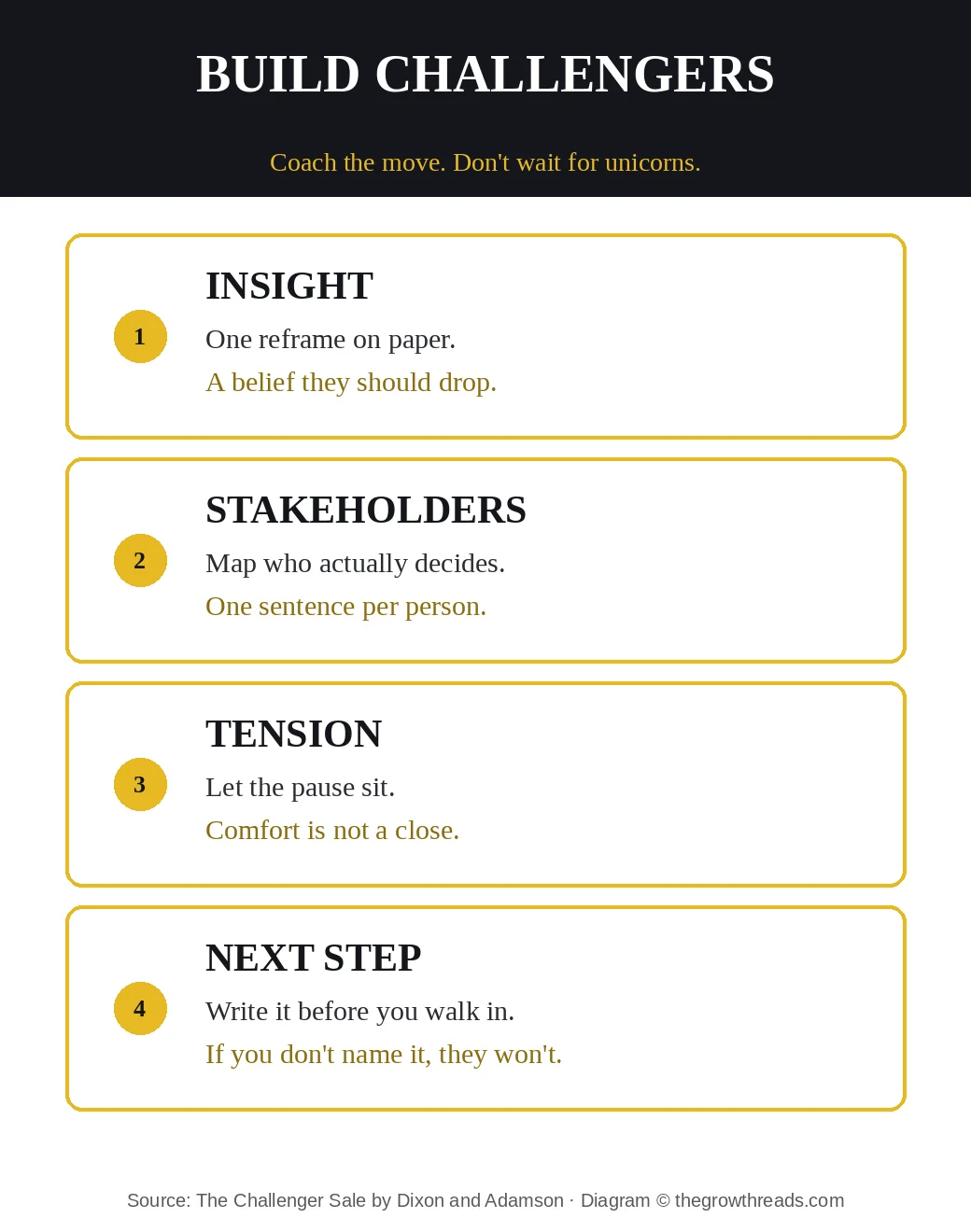
Managers stop hiring only for the unicorn. Coach the three skills on live deals. Ride along for the teaching moment, not just the forecast. Reward a useful pause, not only a signature. Lone Wolves can post a number and still be uncoachable. Problem Solvers can be loved internally and still arrive after the customer has framed the problem. Scale the insight, the map, and the next step into the weekly rhythm.
This week’s card: one reframe, four stakeholder sentences, one next step written before the meeting, one debrief after. Pitch Anything holds you when status collapses in the first five minutes. Rackham holds you when you still need the questions. Dixon and Adamson still start by asking whether yesterday’s meeting taught anyone anything new.
TGR Note: Pitch Anything is Oren Klaff on owning the frame so the room does not own you. Use Klaff when status and attention collapse in the first minutes. Use Dixon and Adamson when you already have the room’s attention and you are still running a tour of capabilities. Frame control gets you heard. Challenger control gets a next step on the calendar. If you only take the frame and never teach, you have a performance. If you only teach and never ask for the step, you have a seminar.
Who is The Challenger Sale best for — and who should read something else first?
Best for people who sell or sponsor complex things: multi-stakeholder software, professional services, industrial solutions, internal transformations that need budget. Especially useful if your notes say “great relationship” and the close date keeps slipping. It is a productivity book in the literal sense: it changes how a knowledge worker spends the hour in the room.
Read something else first if you do not yet know how to find the need — start with SPIN Selling, then come back to teach. If you are not in a commercial role and mainly need permission to persuade at work, start with To Sell Is Human. If the stall is the first five minutes of status, use Pitch Anything. Come to this book when the bottleneck is a complex deal that is friendly and stuck.
Questions to reflect on
- Which live opportunity is “a great relationship” and still has no next step on the calendar?
- What belief does the buyer hold that is quietly expensive — written in one sentence, not “in the deck”?
- Which stakeholder would need a different sentence than the one you keep repeating?
- Where did you yield this month — price, process, or people in the room — to keep things comfortable?
- Can you walk the teaching once with the laptop closed, and where does it become a pitch again?
🔥 Ready to teach the next meeting instead of pitching it?
Pick one live opportunity, write the reframe, and name the next step before you walk in.
How to apply The Challenger Sale (7-day plan)
- Day 1 — Score the week. Five live conversations. Mark teach / tailor / control / none. Do not open a methodology slide. Just mark.
- Day 2 — Write the reframe. One opportunity. Belief they hold, evidence it is expensive, new frame in one hallway sentence.
- Day 3 — Map four names. Economic buyer, user, blocker, champion. One tailored sentence each. If two match, rewrite.
- Day 4 — The pause test. Say the insight to a colleague with the laptop closed. Cut until they pause. Nods do not count.
- Day 5 — Name the next step. Write it before the meeting: who, what, by when. If you cannot, the meeting is a tour.
- Day 6 — Hold one tension. When they smooth it over, ask the implication once more. Do not pile on. Let the pause sit.
- Day 7 — Run it live. Teach, tailor, ask for the step. Debrief in four lines: what they believed, what moved, who still needs a sentence, what is on the calendar.
Frequently asked questions
What is The Challenger Sale about?
The Challenger Sale is Dixon and Adamson’s CEB-backed playbook for complex B2B. They found five rep profiles and showed that in hard, multi-stakeholder deals, stars teach a commercial insight, tailor it to the room, and take control of next steps — they do not mainly win by being liked. The usable residue is not a new personality. It is one reframe the buyer did not already believe, a map of who actually decides, and a next step you name before you walk in. It sits next to SPIN Selling: Rackham finds the need; this book supplies a point of view once the need is known.
What is a Challenger seller?
A Challenger is the profile that wins more often in complex sales: they offer a unique view of the customer’s business, tailor that view to each stakeholder, and are willing to take control of the conversation — including money and process — without turning it into a fight. They are not the loudest person in the room and they are not the one who always yields to keep rapport. In the CEB study they make up a large share of high performers when the deal is complex, while relationship builders almost disappear from that star group. You coach the three moves; you do not wait to be born one.
Is The Challenger Sale worth reading if I already read SPIN Selling?
Yes if your discovery is fine and the deal still dies in consensus. SPIN Selling is Rackham on questions that let the buyer name the need. The Challenger Sale is Dixon and Adamson on what to do once everyone already knows the problem and vendors are still interchangeable. Use Rackham when you are guessing at pain. Use this book when you can describe the pain and you are still leading with capabilities. They stack. If you have never asked a proper implication question, start with SPIN, then write the reframe.
How is The Challenger Sale different from To Sell Is Human?
To Sell Is Human is Daniel Pink on attunement, buoyancy, and clarity for people whose job is influence even when it is not called sales. The Challenger Sale is a B2B research book about a specific profile in complex deals. Pink makes selling feel like helping. Dixon and Adamson make helping feel like teaching a point of view. Use Pink when you are talking at people. Use this book when you are already in the room and the friendly deal will not move. If you only attune, you stay liked. If you only challenge, you lecture. The TGR stack is attune, then teach, then name the step.
Who should read The Challenger Sale?
People who live in complex conversations: enterprise reps, founders selling to committees, consultants, product leads who have to win budget, anyone whose notes say “great relationship” while the date slips. It is useful if you have outgrown “just add more touches” and need permission to lead with insight. Skip it as a first persuasion book if you do not yet know how to find a need; go to SPIN Selling, then return. Skip it if your world is truly transactional — several profiles work there, and this book’s ranking is about complexity. Come here when the bottleneck is a stuck, friendly, multi-threaded deal.
How long is The Challenger Sale and how should I read it?
The Portfolio hardcover runs about 240 pages; most readers need five to seven hours. Do not collect every CEB chart as a poster. Read for three jobs: score last week’s conversations against teach-tailor-control, write one reframe for a live opportunity, and walk into one meeting with the next step already written. Then debrief whether the room paused. If you highlight “Challenger” and never change the first five minutes of a call, you have bought a label. If you land a hallway sentence, four stakeholder lines, and a dated next step by Friday, you have used the book.
Does The Challenger Sale mean I should stop being nice?
No. It means niceness is not the closing skill in a complex deal. Dixon and Adamson still want access, listening, and a human tone. They do not want you to yield the point of view, the price conversation, or the next step in order to keep the mood even. Constructive tension is a pause after a reframe, not a dunk on the buyer. If the room only feels soothed, you have relationship-built. If the room thinks differently and knows what happens Tuesday, you have challenged. Stay decent. Stop confusing comfort with progress.
Related summaries
- SPIN Selling — let the buyer name the need
- To Sell Is Human — attunement for people who influence
- Pitch Anything — own the frame in the first minutes
- Contagious — make the insight travel
- More on the best productivity books pillar
How we analyze books: we read for application, not for a takedown — then we add a plan you can run this week. Read our full methodology.