

★★★★⅗ 4.6/5 — the field guide for moving people without turning into a closer.
Best for: Knowledge workers, founders, teachers, and managers who spend the week asking for time, budget, or a yes — and still flinch at the word “sales”
Reading time: ~7 hours (272 pages) · this guide ~12 min
Difficulty to apply: Easy to count how often you already sell — harder to replace a pitch with a problem and an off-ramp
To Sell Is Human in one minute
You already sell. Not because you carry a quota sheet, but because every week you ask someone to trade attention, trust, or money for something you believe is better. Pink’s claim is that this is now most of modern work — and that Always Be Closing is the wrong map once a buyer can check your claim in ten seconds.
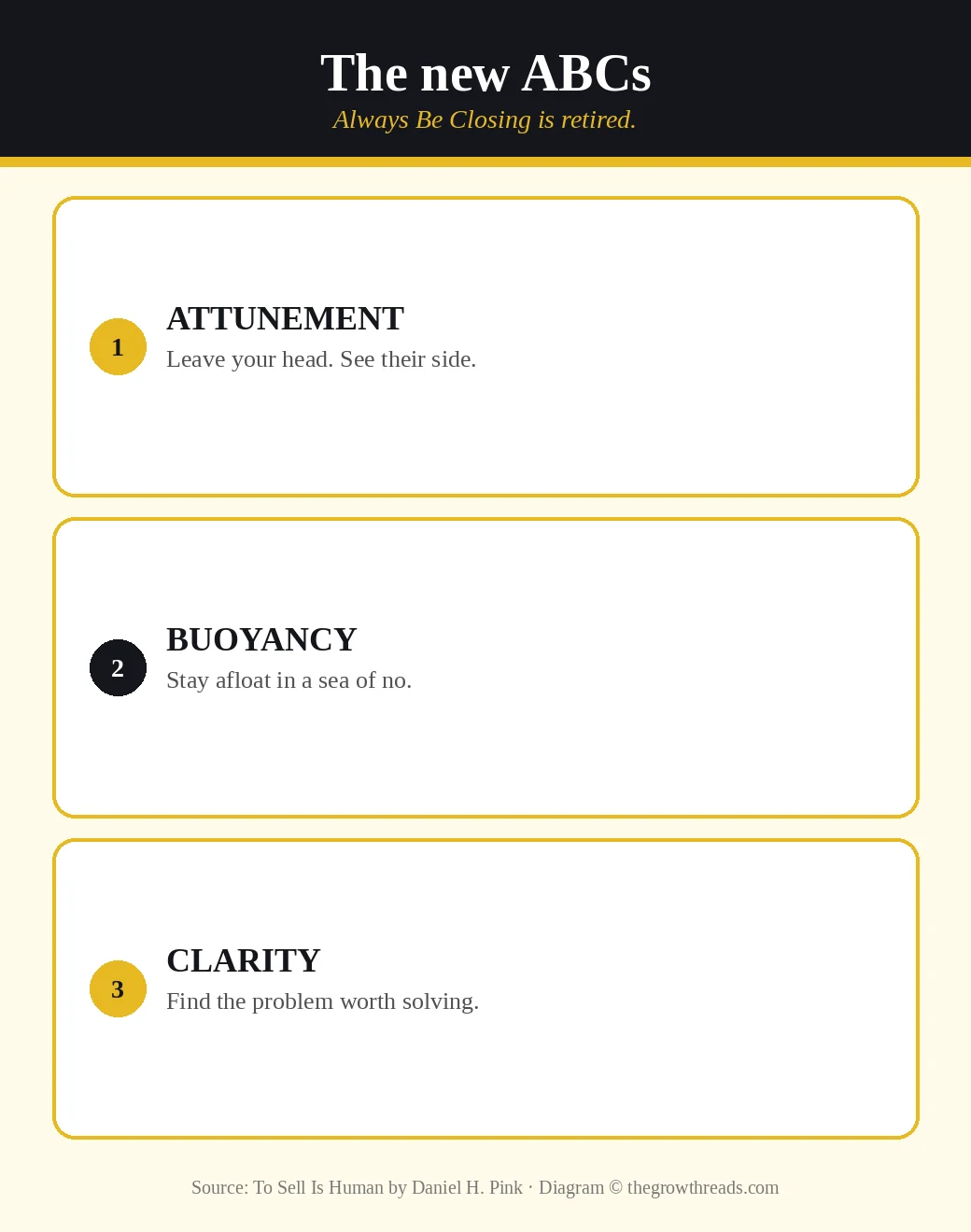
The replacement is a craft: attunement (get out of your own head), buoyancy (stay afloat in a sea of no), and clarity (find the right problem, then make the next step obvious). Then pitch in six short forms, improvise like a partner, and serve. Read it to stop treating persuasion as a personality type.
Key takeaways
- We’re all in sales now: One in nine Americans works in sales. The other eight still spend a large slice of the week in “non-sales selling” — moving people who do not report to you.
- Information parity killed the trick: When the buyer can see what you see, caveat emptor becomes caveat venditor. Honesty is not a nicety. It is the only stable strategy.
- New ABCs: Attunement, Buoyancy, Clarity replace Always Be Closing. Skill beats volume of talk.
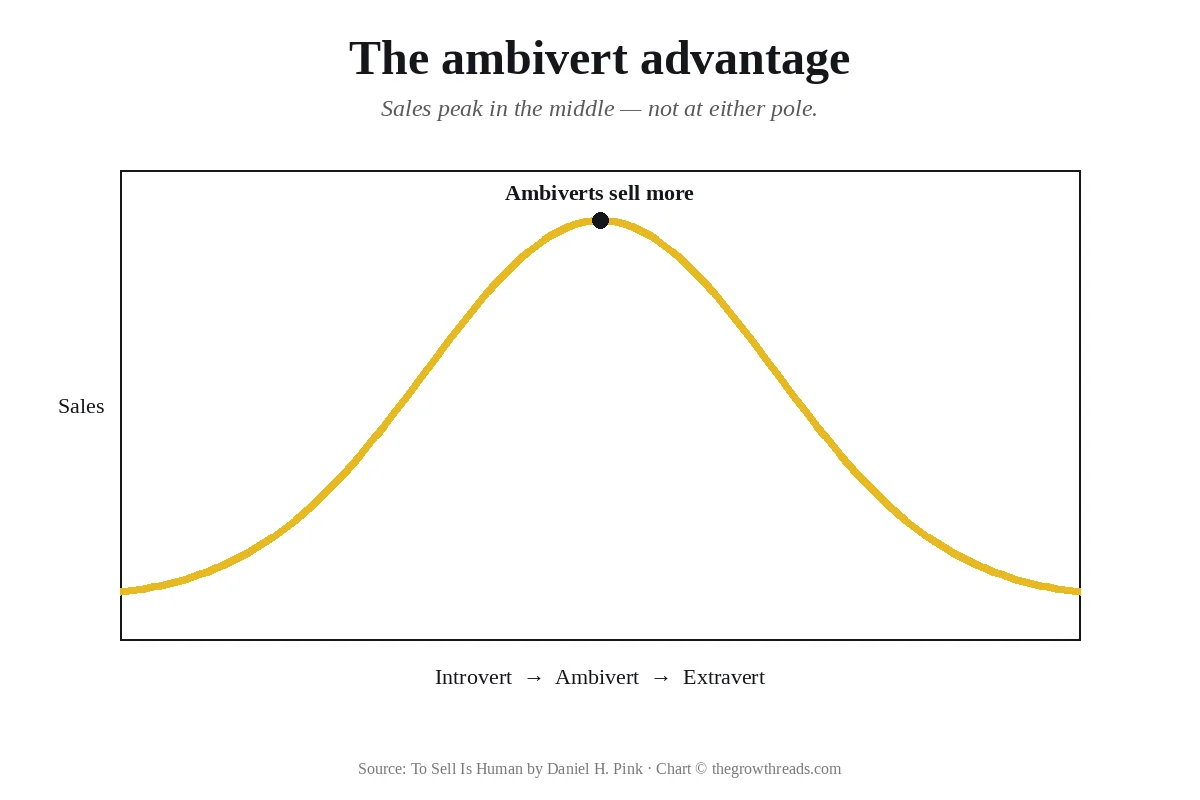
- Ambiverts outperform extraverts: The sales curve is an inverted U. The middle — people who can talk and listen — beats either pole.
- Ask, don’t declare: Interrogative self-talk (“Can I do this?”) beats pep-talk declarations because the question pulls reasons into view.
- Find problems, don’t just solve them: In a world of cheap answers, the scarce skill is naming the problem the other person has not quite seen.
- Six successors to the elevator pitch: One-word, question, rhyming, subject-line, Twitter-length, and Pixar. Short beats theatrical.
- Improv is a sales skill: Hear offers, say “yes and,” make your partner look good. Scripts stall the moment the other person goes off-book.
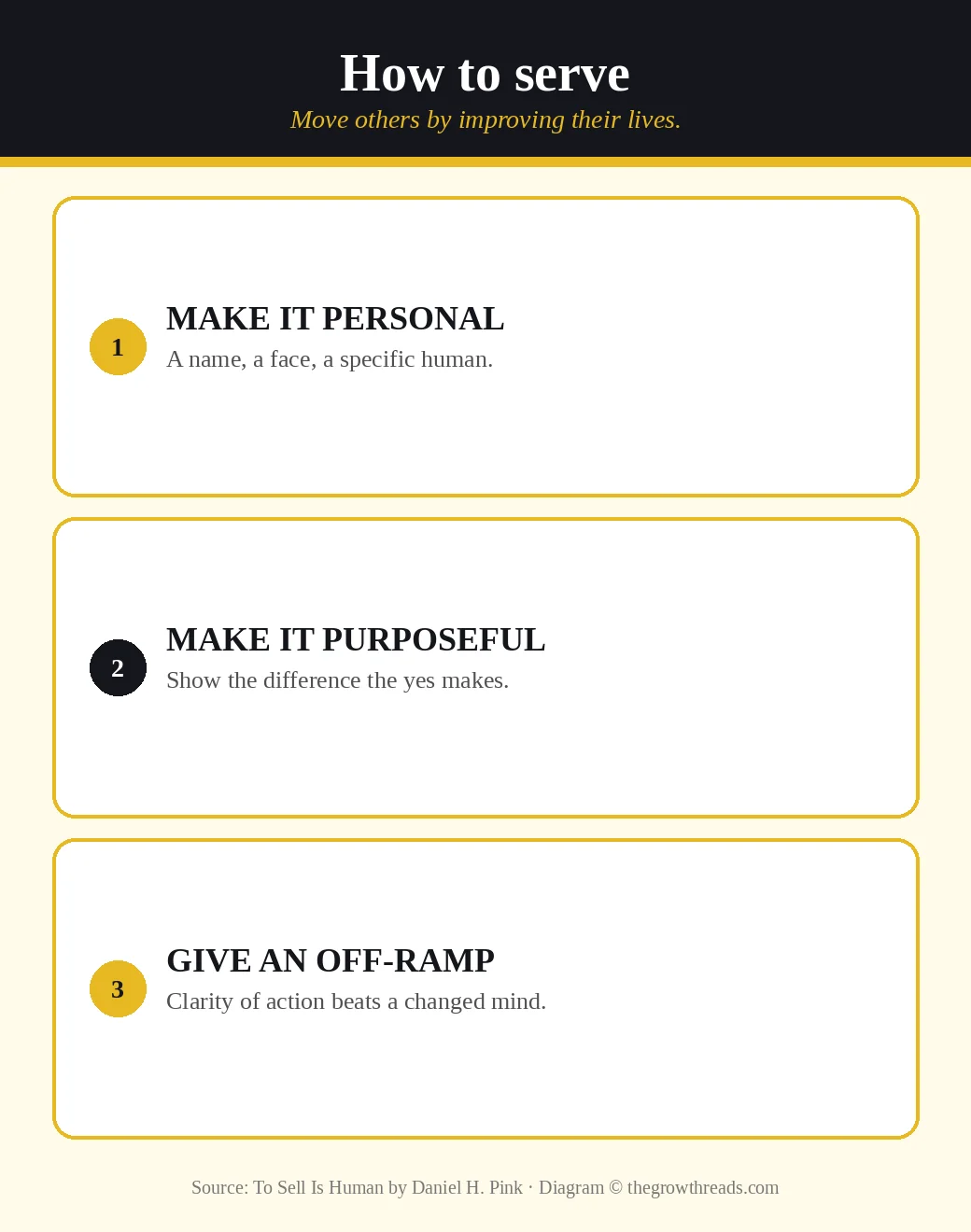
- Serve, then ask: Make it personal and purposeful, then give a clear off-ramp for the yes. Moving others is how you improve their life, not how you empty their wallet.
What is To Sell Is Human about?
To Sell Is Human argues that moving others — pitching ideas, asking for resources, enrolling people who do not have to say yes — is now a core job skill, not a specialist’s. Pink replaces Always Be Closing with attunement, buoyancy, and clarity, then shows how to pitch, improvise, and serve so the other person can actually act.
About the author
Daniel H. Pink spent the 1990s in politics and speechwriting, including a stint as chief speechwriter for Vice President Al Gore, before turning to books about how work actually feels from the inside. Drive mapped autonomy, mastery, and purpose. A Whole New Mind named the Conceptual Age. When treated timing as a design problem. To Sell Is Human (Riverhead, 2012) sits in that same lane: he reads the social-science stack, then hands you a practice you can run on Tuesday. He is not a career salesperson writing a war story. He is a translator who noticed that most of us already sell and have never been taught how. Explore all Daniel H. Pink book summaries →
Key concepts at a glance
| Concept | What it means | Use it when |
|---|---|---|
| Non-sales selling | Moving others when no one is buying a product | You need a yes for time, budget, or attention |
| Elasticity / Ed-Med | Jobs now mix skills; education and health keep growing | Your title is not “sales” and the week still is |
| Caveat venditor | Seller beware — the buyer can check you | You are tempted to shade a claim they can Google |
| Attunement | Perspective-taking from their side of the table | Your pitch is about you, and they have gone quiet |
| Ambivert advantage | The inverted-U: middle beats loud or silent | You assume extraverts naturally close |
| Buoyancy | Interrogative self-talk + a 3-to-1 positivity mix | One no has already written the rest of the day |
| Clarity | Problem finding, frames, and a usable off-ramp | They agree in the room and do nothing after |
| Six pitches | One-word through Pixar — short forms that travel | Your “elevator pitch” takes the whole elevator |
| Serve | Personal + purposeful, then a next step | The ask is abstract and the human is missing |
Part 1: We’re all in sales now — elasticity, Ed-Med, seller beware
Pink opens with a number most readers want to argue with. About one in nine American workers has a sales job. Then he reports what the other eight actually do: they enroll clients, talk a VP into a pilot, recruit a volunteer, or talk a teenager into homework. He calls that slice non-sales selling. You can dislike the word. You still live in the activity.
Two labor-market facts make it larger. Elasticity means fewer jobs are one skill — the designer sells the mockup; the nurse sells the discharge plan. Ed-Med (education and health) keeps adding roles whose product is moving someone toward a better state they did not request this morning.
The old sales story assumed information asymmetry: the seller knew, the buyer guessed. Pink’s 2012 claim, louder now, is information parity. Reviews and alternatives sit in the same pocket as the pitch. Honesty is not a nicety. It is the only move that survives a second meeting. He flips the warning: caveat venditor — seller beware. The rest of the book is the skill, not a pep rally.
TGR Note: If what you are really selling is your art — the thing only you would make — pair this chapter with our Linchpin summary. Godin wants you indispensable. Pink wants you able to enroll the room without turning the enrollment into a performance. Do not collect both as a personality upgrade. Pick one live ask this week and run it through seller-beware: would this sentence survive a search?
Part 2: Attunement — get out of your own head
Attunement is perspective-taking that is physical as much as mental. Leave your own case long enough to sit on their side of the table — sometimes literally. People negotiate more fairly from the other chair; a little mimicry (pace, not parody) raises trust. The point is not to become a copy. It is to stop broadcasting from inside your own skull.
Power is the enemy. The more status you feel, the worse you get at seeing their map. If you are the founder or the expert, you are the person most likely to pitch the product you love instead of the problem they have. Ask one more question than feels efficient. Repeat their constraint in their words before you speak yours.
Then the finding that made the book famous. Extraverts do not automatically close. Plot performance against extraversion and you get an inverted U. Introverts listen and stall; extraverts talk and miss the cue. Ambiverts sit at the peak. You need a range, not a transplant: speak when the room is stuck, shut up when they are about to name the real objection.
Treat extraversion as a dial, not a brand. Block recovery after a high-talk day. Put a listening meeting next to a presenting one.
TGR Note: Adam Grant’s Give and Take is the other half of this chapter. Givers who never attune become doormats; takers who never attune become noise. After your last ask, did you talk more than half the time? If yes, cut the next pitch in half and spend the minutes on their constraint.
Part 3: Buoyancy and clarity — stay afloat, then name the problem
Rejection is the weather. Buoyancy is how you stay in the water. Before: interrogative self-talk — “Can I do this?” beats “I can do this,” because the question recruits reasons. During: enough constructive emotion that the conversation does not collapse into threat. After: explain the no as specific and temporary, not as a verdict on you. Some positivity-ratio citations have been debated since 2012; keep the interrogative. Questions produce plans. Slogans produce adrenaline.
Clarity is the chapter knowledge workers skip, then need. In a world drowning in answers, the scarce skill is problem finding. Anyone can ship a solution to the problem as stated. The person who gets the yes restates it until it is the one that actually hurts. Frames help: contrast the experience, name the potential, apply a label, surface a blemish (which can raise trust), or show less so the choice is choosable.
The last mile is not a changed mind. It is an off-ramp. “Think about it” is not one. “Reply with a time that works Thursday” is.
TGR Note: If the thing you cannot start is the work itself, not the ask, read Drive first — Pink’s earlier map of autonomy, mastery, and purpose. To Sell Is Human assumes you already have something worth moving. Drive asks whether the work is even designed to be done. Do not use a better pitch to sell a job you secretly hate. And if the stall is the clock, not the ask, our When summary is later Pink: when to send the pitch, not how to write it.
Part 4: Pitch, improvise, serve
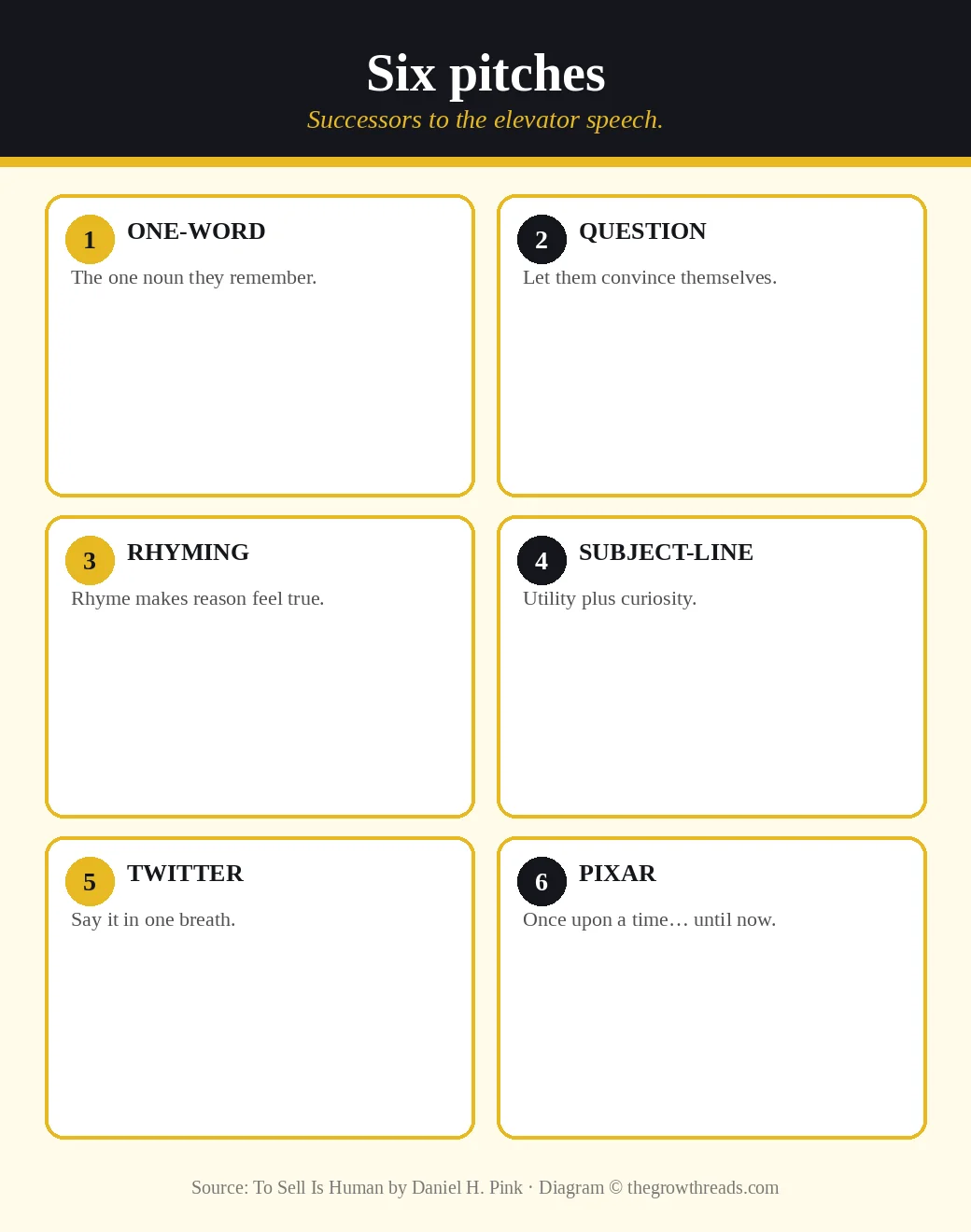
Pink retires the elevator speech and offers six short successors for a world that will not give you twenty minutes. The one-word pitch is the noun you want in their head. The question pitch lets them talk themselves toward your view. The rhyming pitch is sticky because rhyme still feels like reason. The subject-line pitch pairs utility with curiosity. The Twitter-length pitch is a breath test: if you cannot say it in one breath, you do not yet know it. The Pixar pitch is a six-beat story: once upon a time, every day, until one day, because of that, because of that, until finally.
When they leave the script — and they will — borrow from improvisation. Hear offers (their line is material, not interruption). Say “yes and” (add, don’t block). Make your partner look good. The win is a shared scene, not a takedown.
The last chapter is the ethic that keeps the rest from becoming a trick. Before you ask: is this personal (a named human) and purposeful (a yes that improves their life in a sentence you can say out loud)? If you cannot pass both, wait, rewrite, or walk away. Moving others is how humans coordinate. Do it as a service and the ABC skills have somewhere decent to live.
Who is To Sell Is Human best for — and who should read something else first?
Best for people whose week is unofficial asks: a roadmap, a scope, a tired classroom, a hire on a messy mission. If you flinch at “sales,” you are the intended reader. The book gives you a craft instead of a costume.
Read something else first if the problem is not the ask. If you cannot start the work, The Practice or The War of Art is closer. If you need a tiny behavior installed, Atomic Habits will move faster. If you need the fuel inside one person, start with Drive, then come back to move the people around that work.
Questions to reflect on
- Where in the last five workdays did you ask someone for time, trust, or money — and pretend it was “just communication”?
- In your last pitch, what percentage of the minutes did you talk? What would attunement require you to cut?
- What is the actual problem the other person has, not the problem your product already solves?
- Can you say the ask in one breath? If not, which of the six pitches is it really?
- Is the next yes personal and purposeful — and is there an off-ramp, or only a vibe?
🔥 Ready to move someone without becoming a closer?
Get To Sell Is Human, then run the 7-day plan on one live ask you already have this week — not on a hypothetical quota.
How to apply To Sell Is Human (7-day plan)
- Day 1 — Count the unofficial asks. For one workday, tally every time you tried to move someone who did not have to say yes. No judgment. Just a number. That number is your real sales job.
- Day 2 — Sit on their side. Before one meeting, write their constraint in one sentence they would recognize. Open with that sentence, not yours. Talk less than half the time.
- Day 3 — Interrogative self-talk. Before one hard ask, write three questions: Can I do this? Why might they say no? What would make the next step easy? Take the answers into the room.
- Day 4 — Find the problem. Take one stalled request. Rewrite it as the problem they actually have, not the solution you already built. Send that version only.
- Day 5 — One pitch, six ways. Shrink the same ask into a one-word pitch, a question pitch, and a one-breath pitch. Use the shortest one that still feels true.
- Day 6 — Yes, and. In one live conversation, treat their first objection as an offer. Add to it. Do not block. Make them look good in front of whoever else is listening.
- Day 7 — Personal, purposeful, off-ramp. Rewrite one outstanding ask with a name, a human consequence, and a single next step (a time, a reply, a file). Send it. Stop there.
Frequently asked questions
What is To Sell Is Human about in one paragraph?
To Sell Is Human is Daniel H. Pink’s 2012 argument that moving others is now a core job skill, not a specialist’s. One in nine Americans works in sales; the other eight still spend large slices of the week asking for time, trust, or budget. Information parity killed the old closer’s tricks, so Pink replaces Always Be Closing with attunement, buoyancy, and clarity. The second half of the book is practice: six short pitches, improvisation when the other person leaves the script, and a serve test — make the ask personal and purposeful, then give a clear next step.
What are the new ABCs of selling in To Sell Is Human?
Pink retires Always Be Closing and offers Attunement, Buoyancy, and Clarity. Attunement means leaving your own case long enough to see their map — questions, their chair, a little less power in the room. Buoyancy is how you stay in a sea of no: interrogative self-talk before the ask, enough constructive emotion during it, and a specific, temporary story after a rejection. Clarity is naming the problem that actually hurts, framing it so it can be chosen, and handing over an off-ramp so agreement can become motion instead of a polite nod.
What is an ambivert, and why does Pink say they sell better?
An ambivert sits in the middle of the introvert–extravert spectrum: able to talk when the room is stuck and able to listen when the other person is about to name the real objection. Pink reports an inverted-U: extraverts do not automatically close, and introverts do not automatically fail. Performance peaks in the middle. The practical reading is not a personality label. Treat extraversion as a dial. After a high-talk day, recover. In the next ask, aim to speak less than half the time and spend the saved minutes on their constraint.
What are the six pitches in To Sell Is Human?
Pink replaces the single elevator speech with six short forms. The one-word pitch is the noun you want living in their head. The question pitch lets them talk themselves toward your view. The rhyming pitch is sticky because rhyme still feels like reason. The subject-line pitch borrows email research: utility plus curiosity. The Twitter-length pitch is a breath test — if you cannot say it in one breath, you do not yet know it. The Pixar pitch is a six-beat story: once upon a time, every day, until one day, because of that, because of that, until finally.
Is To Sell Is Human still worth reading in 2026?
Yes, with a small translation. The labor-market chapters (elasticity, Ed-Med, information parity) have only gotten louder in a world of reviews, comparison tabs, and first emails written in a hurry. The ABC skills and the six pitches still earn their keep on a Tuesday. Treat the positivity-ratio citations as a reminder, not a law — some of that research has been debated since 2012. The interrogative self-talk, the ambivert curve, problem finding, and the serve test (personal, purposeful, off-ramp) are the parts that still change how an ask is written.
How is To Sell Is Human different from Drive?
Drive is about the fuel inside one person: autonomy, mastery, and purpose, and why carrot-and-stick rewards fail for complex work. To Sell Is Human is about the space between people: how you enroll someone who does not report to you. Read Drive when the work itself is badly designed or unmotivating. Read To Sell Is Human when the work is worth doing and the stall is the yes you still need from a colleague, a client, a hire, or a room. They stack. They are not substitutes. Start with the one that names this week’s actual friction.
What is the fastest way to apply To Sell Is Human this week?
Pick one live ask, not a hypothetical quota. Write the other person’s constraint in one sentence they would recognize. Shrink your pitch to one breath. Add a name (personal), a human consequence (purposeful), and a single next step (off-ramp). Before you send it, ask “Can I do this?” and jot the reasons that come back — that interrogative is the buoyancy move. Send it. Do not add a second paragraph of justification. If they object, treat the objection as an offer and add to it instead of blocking. That is the whole book in one cycle.
Related summaries
- A Whole New Mind — earlier Pink: the six senses that make you worth moving toward
- When — later Pink: when to send the ask, not how to write it
- Give and Take — who rises: givers who attune, not takers who perform
- Linchpin — become hard to replace, then enroll the room
- Best productivity books — the full silo list
How we analyze books: every book on The Growth Reads is read cover to cover, summarized in thousands of words of original analysis, and rated against our five-criteria rubric (lasting impact, evidence quality, practical application, writing & originality, external consensus). Read our full methodology.