

★★★★☆ 4.4/5 — A 31-day lab for people whose mornings already get a vote.
Best for: high performers who still bargain the start and quit at the first comfortable stop.
Reading time: ~4.5 hours (272 pages) · this guide ~12 min
Difficulty to apply: Medium. Keep one rule. Do not copy the whole camp.
Living with a SEAL in one minute
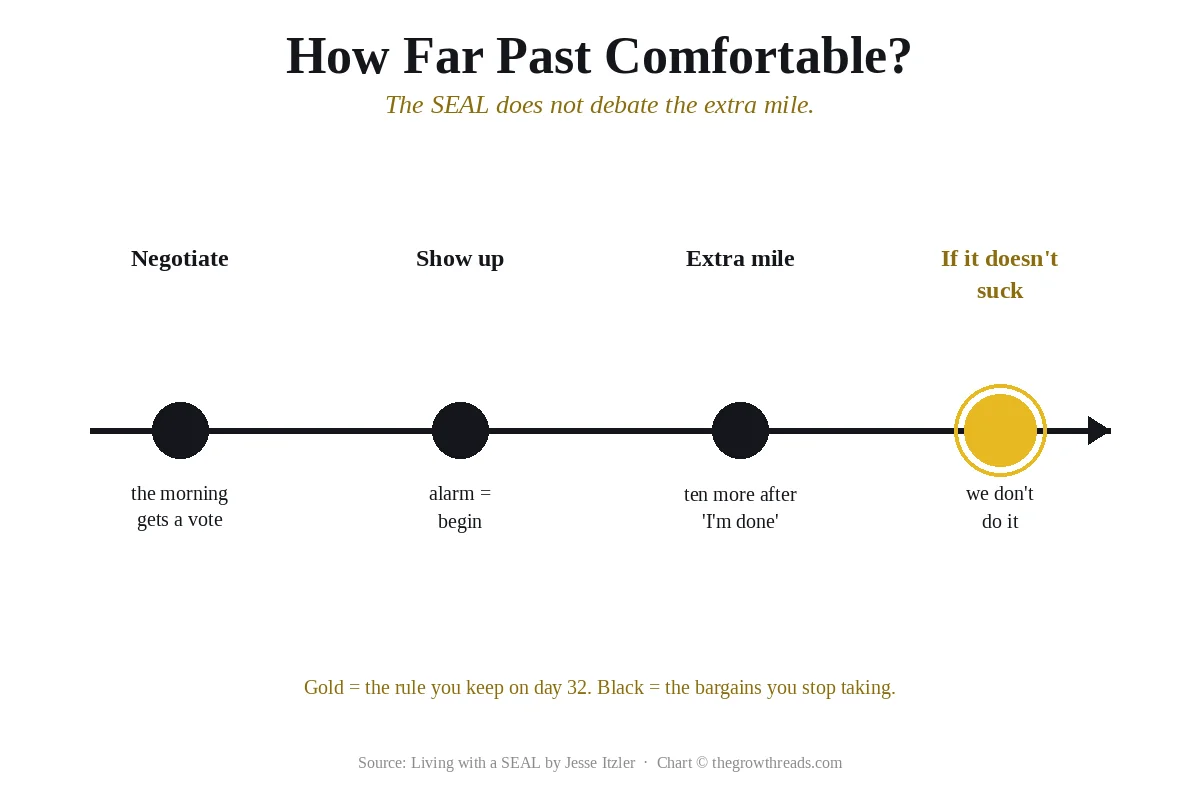
You already know the work. The leak is the meeting you hold with the alarm. Jesse Itzler is a founder with jets, coconut water, and an NBA stake. He still negotiates the morning. So he invites a Navy SEAL — later identified as David Goggins — to live in the house for 31 days and run the training. The SEAL does not debate the wakeup. He does not stop at the planned mile. His line is blunt: if it doesn’t suck, we don’t do it. The book is funny, physical, and easy to binge. The useful steal is smaller than the workouts. Stop arguing with a start you already chose. Add one more after you wanted to quit. When the house guest leaves, keep one rule — not the costume.
Write tomorrow’s start tonight. When it hits, begin. After you want to stop, add ten honest minutes. That is the whole entry fee.
Key takeaways
- Invite a standard you cannot talk down: A roommate, a clock, a written start. Comfort is persuasive in the first person.
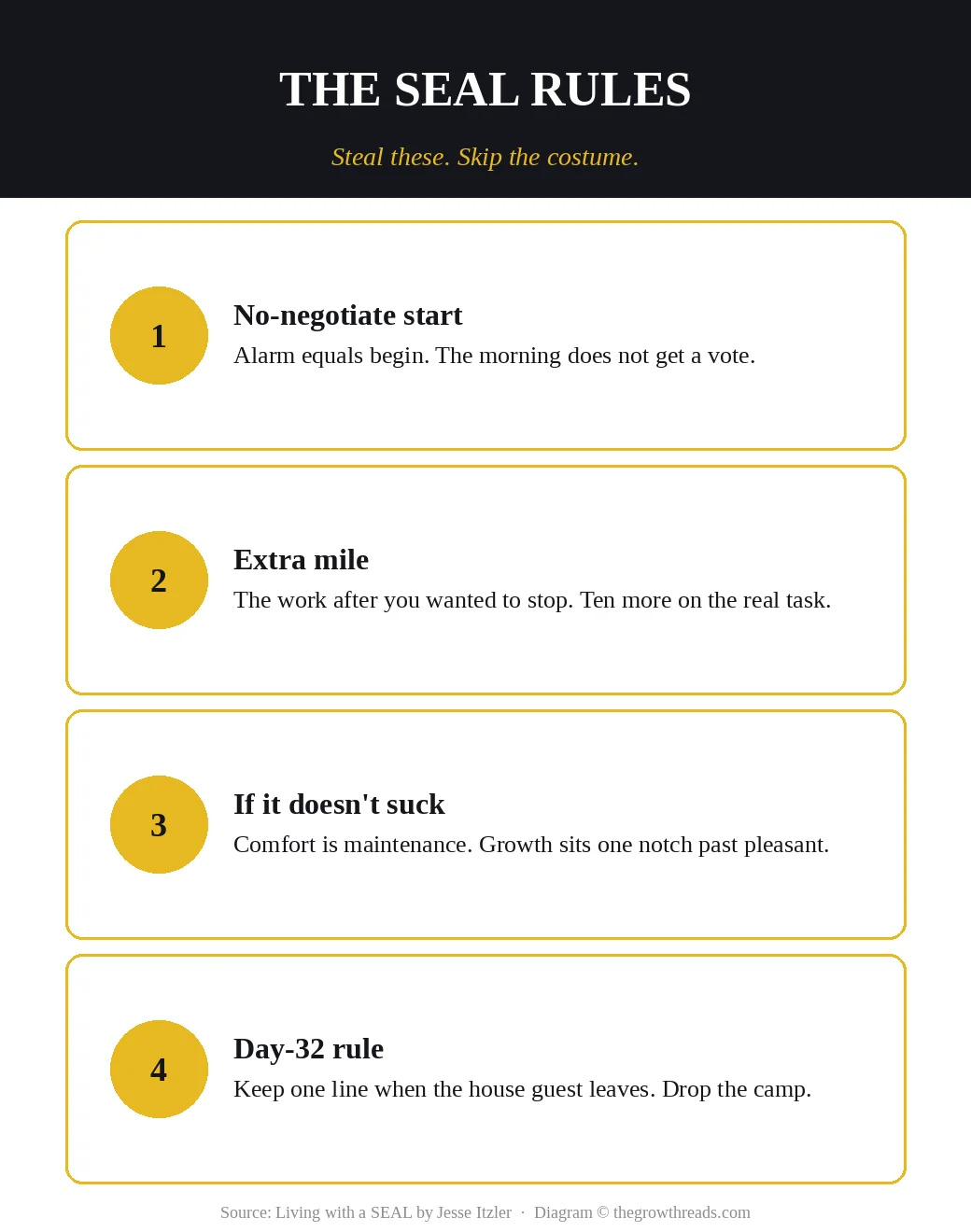
- Do not negotiate the start: The SEAL does not take a meeting with the alarm. Neither should the block you already booked.
- The extra mile is after you wanted to stop: Planned work is the floor. The gift is the next ten minutes.
- If it doesn’t suck, we don’t do it: Comfortable work is maintenance. Growth lives one notch past pleasant.
- Sameness beats a new sport: Same wakeup. Same door. Novelty is how the old bargaining returns in costume.
- The house is the lab, not the life: 31 days is a crash. Day 32 is one rule you can still run on a calendar.
- Count the bargains: Each “I’ll start after inbox” is a meeting the SEAL would not take.
- Keep one rule, drop the costume: The mile times are his. The no-negotiate start can be yours.
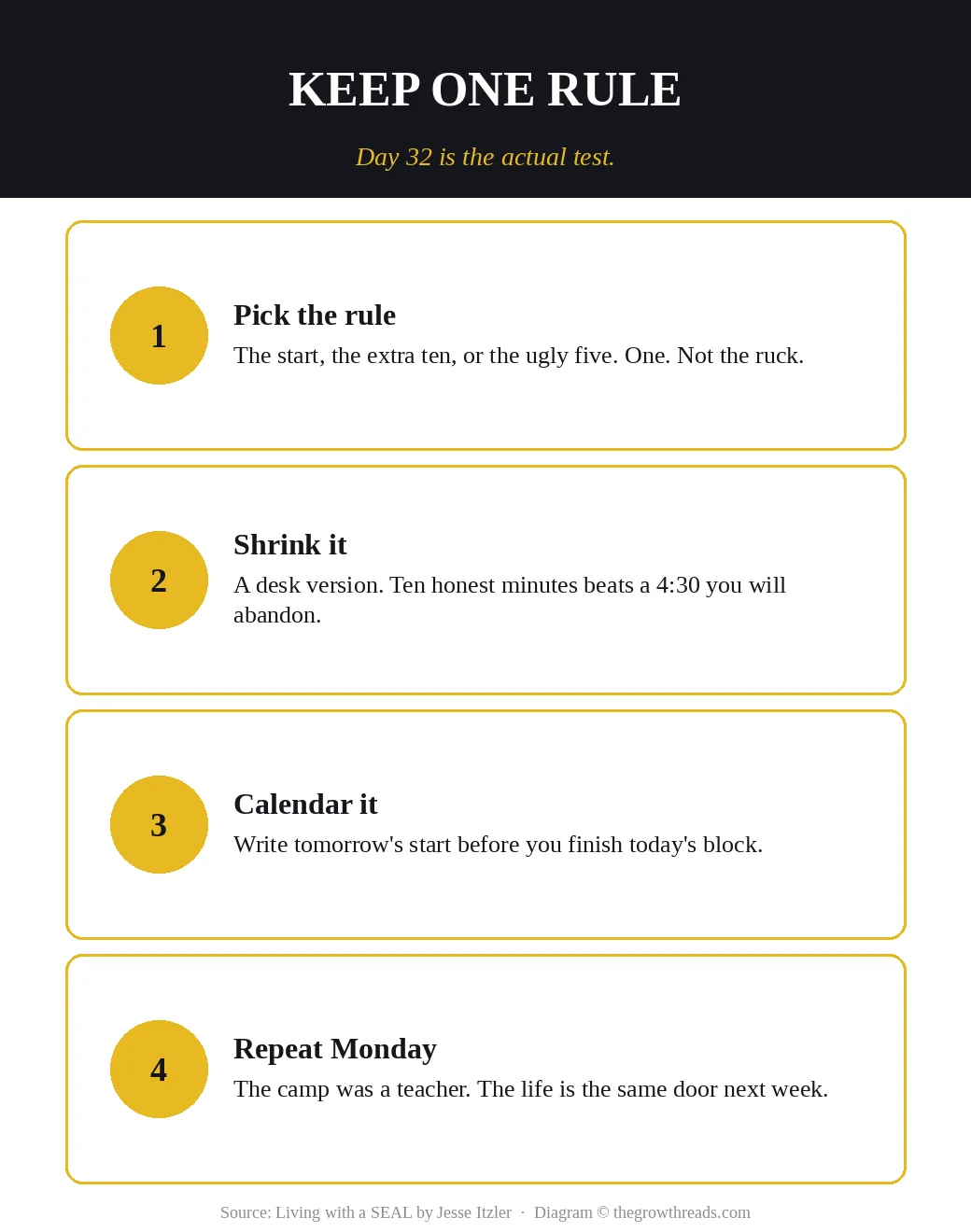
- The desk is a field: Extra ten minutes on the real document. Not a 4:30 ruck you will abandon by Thursday.

What is Living with a SEAL about?
Living with a SEAL is Jesse Itzler’s 2015 memoir of moving a Navy SEAL into his house for 31 days of training. The transferable idea is a start you do not debate, an extra mile after you wanted to stop, and one rule you keep when the experiment ends.
About the author
Jesse Itzler (born 1968) is an American entrepreneur, author, and former rapper. He co-founded Marquis Jet, later partnered in Zico Coconut Water, and is part of the Atlanta Hawks ownership group. Living with a SEAL (Center Street, 2015) is the field notebook from a month of letting a Navy SEAL run the mornings of a life that already looked won. Later he wrote Living with the Monks and built The 100 Mile Group around the same experimenter’s streak: put an extreme standard in the house and see what of your calendar survives. The voice is founder-plus-dad. Jokes. Hotel carpets. Kids in the next room. Read him when you want the civilian translation of SEAL heat — not the SEAL’s autobiography. Explore all Jesse Itzler book summaries →
Key concepts at a glance
| Concept | What it means | Use it when |
|---|---|---|
| Invited standard | A clock or person you cannot talk down. | Comfort always wins the inner debate. |
| No-negotiate start | Alarm equals begin. No weather report. | The morning already gets a vote. |
| Extra mile | The work after you wanted to stop. | You quit at the planned finish line. |
| If it doesn’t suck | Growth sits one notch past pleasant. | Your week is only comfortable tasks. |
| Sameness | Same door, same time. Not a new sport. | You reinvent the workout instead of starting. |
| Bargain count | Tally the meetings you take with the start. | You think you are disciplined and still stall. |
| Day-32 rule | Keep one rule when the camp ends. | You binge intensity, then return to the old morning. |
| Desk extra ten | Ten honest minutes on the real document. | You confuse a ruck with a work block. |
Part 1: The dare — invite a standard you cannot talk down
Itzler’s opening move is not a new gym. It is a guest. He is already successful, already busy, already “on it” in the way founders mean when the calendar is full and the body is a little soft. The SEAL is a standard that does not attend the inner meeting. You cannot charm him into a later wakeup. You cannot reframe the extra mile as optional. That is the point of the dare. Comfort is eloquent in the first person. An invited standard is shorter. Itzler is not pretending he lacked goals. He lacked a morning that survived contact with his own excuses.
Desk translation is the same shape without the house guest. A written start time is a small SEAL. A calendar block with a door that does not get a vote is a small SEAL. If Atomic Habits is identity through a tiny cue, this chapter is identity through a standard you are slightly afraid of. If Mini Habits is shrinking the start so it always happens, Itzler is raising the start so bargaining looks ridiculous. You do not need both on day one. You need one door that does not take a meeting.
TGR Note: The roommate later named himself in Can’t Hurt Me. Read that when you want the SEAL in the first person. Stay here when you want the civilian lab: a founder who still has kids, flights, and a calendar. If the remaining leak is small-unit habits without the miles, Make Your Bed is McRaven’s quieter door.
Part 2: The first week — comfort files a complaint
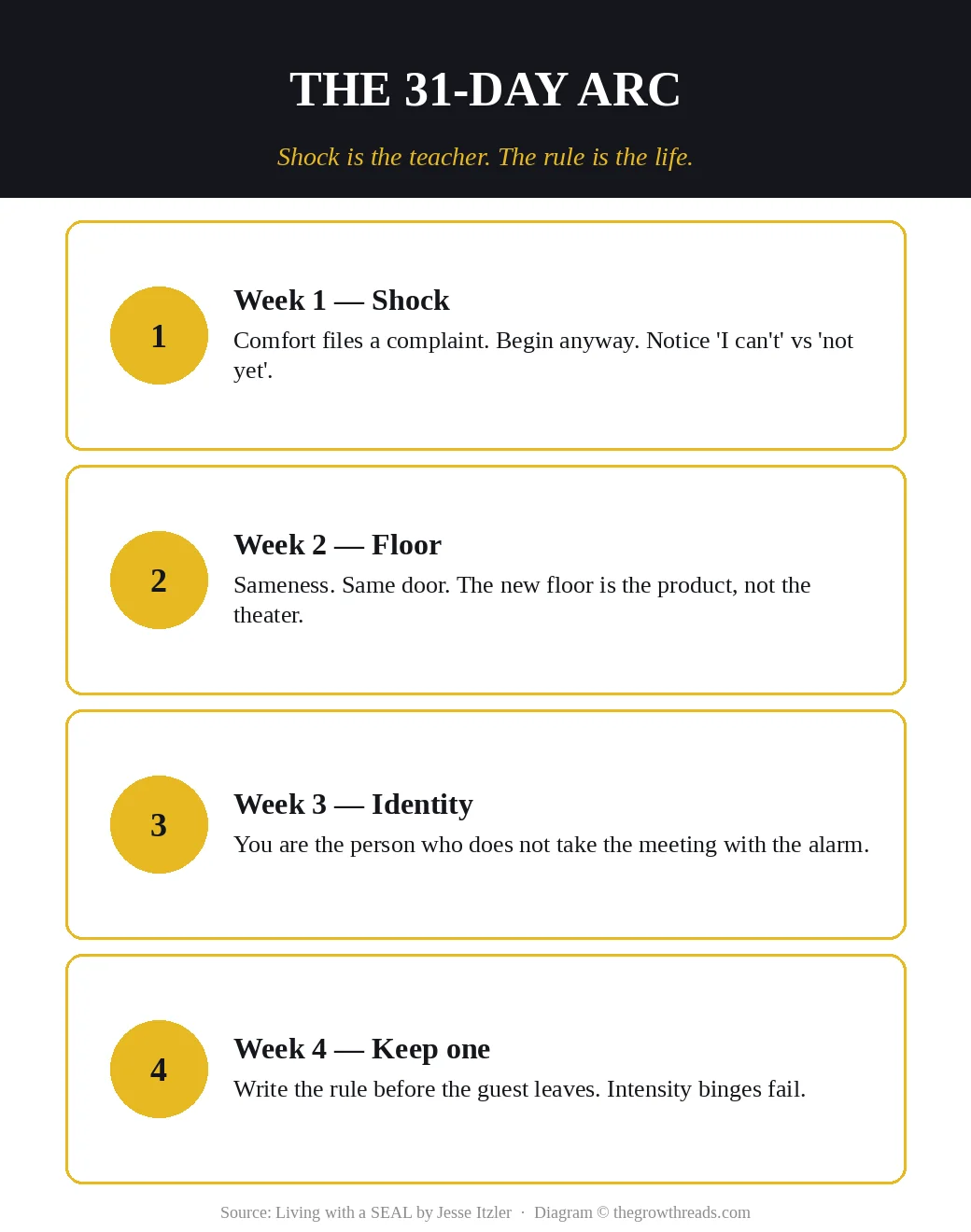
Week one is comedy because it is true. The body files a complaint. The family watches. The hotel carpet becomes a pull-up bar. Itzler wants to negotiate: tomorrow, after the meeting, maybe a shorter loop. The SEAL’s answer is to begin. Shock is the point of a crash. It is not the point of a life. What the first week installs is a new floor — not a new personality. You learn how much of “I can’t” was “I would rather not start yet.” That distinction is the whole book in street clothes. The workouts are the theater. The floor is the product.
Steal the floor, not the theater. For seven days, do not add a sport. Protect one start. Notice the complaint without holding a committee. If Discipline Equals Freedom is Jocko’s no-debate morning as a way of life, this chapter is the same refusal seen from the civilian couch. If Relentless is Grover’s heat as a costume, Itzler is heat as a 31-day rental. You are allowed to find it funny. You are not allowed to use the joke as the bargain.
TGR Note: If the remaining leak after the shock is noticing discomfort instead of adding miles, Do Hard Things is the better language. If the remaining leak is a missing deep-work door, close it with Deep Work — a no-negotiate start still needs a room the phone cannot enter.
Part 3: The SEAL rules — don’t negotiate, add one more
The middle of the month is where the rules get plain. Do not negotiate. Add one more. If it doesn’t suck, we don’t do it. Sameness. The extra mile is not the planned last lap. It is the lap after the mind said done. Itzler learns that “done” was a feeling with a lawyer. The SEAL does not hire that lawyer. You will not live like this at 4:30 a.m. forever, and the book does not need you to. You need the extra ten minutes on the real document after you wanted to check mail. That is the desk version of the extra mile. Planned work is hygiene. The gift is the notch past pleasant.
Write the rules where the start happens. Alarm equals begin. After the want-to-stop, ten more. One ugly five-minute task before the comfortable ones. If Chop Wood Carry Water is loving the ordinary rep, this chapter is refusing to skip the ordinary rep because it is ordinary. If The Motivation Myth is start-first, Itzler is start-without-a-vote. Motivation can ride along. It does not get the gavel.
TGR Note: If the remaining leak is the voice that turns the extra ten into a story about you, The Champion’s Mind is the talk track. If the remaining leak is too many yeses, stay with Essentialism. The extra mile only works on the one block you kept.
Part 4: Day 32 — keep one rule, not the whole camp
The last movement is the one most readers skip because the stories are funnier. The SEAL leaves. The house is quiet. The old lawyer comes back. Day 32 is the actual test. Itzler does not need you to keep the 4:30 ruck. He needs you to keep a piece of the standard: a start that does not get a vote, or an extra ten, or one daily thing that still sucks a little. Intensity binges fail the way crash diets fail. The camp was a teacher. The life is a rule. Write the rule before the guest leaves — which, for you, means before the week of pretending you live with a SEAL ends.
Steal the ending. Finish this week with one line on a card: the start, the extra ten, or the ugly five. Put next week’s hardest block on the calendar tonight. If Grit is passion plus perseverance toward a long goal, this chapter is the morning that goal still has to survive. If Inner Excellence is present attention under pressure, Itzler is the body showing up before attention has a chance to shop. You do not graduate. You run one rule again on a smaller field.
TGR Note: If after day 32 you still wait to feel ready, stay with The Motivation Myth. If you need identity through a tiny cue, stay with Atomic Habits. Living with a SEAL is the rented standard those two books can hang on when the morning already knows the work and still wants a meeting.
Who is Living with a SEAL best for — and who should read something else first?
Best for people whose calendar already looks full and whose morning still gets a vote: founders, operators, parents, anyone who can narrate discipline and still bargain the start. If you want the SEAL in the first person, go to Can’t Hurt Me. If you want small-unit habits without the miles, start with Make Your Bed. If you want locker-room heat as a way of life, start with Relentless or Discipline Equals Freedom.
Read something else first if you need a tiny start or a cue. Begin with Mini Habits or Atomic Habits. If you want toughness as noticing discomfort, start with Do Hard Things. If you want the inner coach without the rucks, start with The Champion’s Mind. Come to Living with a SEAL when you can already work and the remaining failure mode is negotiating the start and quitting at the first comfortable stop.
Questions to reflect on
- How many meetings did your last hard block take with the start before it actually began?
- Where is the extra mile on your desk — the ten minutes after you wanted to stop?
- What comfortable task is pretending to be growth because it does not suck?
- If the house guest left tonight, which one rule would still be on the calendar tomorrow?
- Are you collecting a costume, or installing a start that does not get a vote?
🔥 Ready to stop negotiating the extra mile?
One start. Ten more minutes. One rule you keep on day 32.
How to apply Living with a SEAL (7-day plan)
- Day 1 — One start you will not debate. Pick one already-scheduled hard block. Write the start time. When it hits, begin. No vote.
- Day 2 — Same time, same door. Repeat yesterday’s start. The SEAL’s first gift is sameness, not a new sport.
- Day 3 — The extra ten. After you want to stop, add ten honest minutes of the same work. That is the extra mile.
- Day 4 — If it doesn’t suck, add one. Pick one five-minute uncomfortable task you have been delaying. Do it first.
- Day 5 — Write tomorrow before you finish. Before you close the block, write tomorrow’s start time. Do not leave it to morning-you.
- Day 6 — Count the bargains. Tally how many times you tried to renegotiate. Each one is a meeting the SEAL would not take.
- Day 7 — Keep one rule. Choose the one rule you will still run on day eight: the start, the extra ten, or the ugly five. Drop the costume.
Frequently asked questions
What is Living with a SEAL about?
Living with a SEAL is Jesse Itzler’s 2015 memoir of inviting a Navy SEAL to live in his house for 31 days and run the training. The SEAL later identified as David Goggins does not bargain the wakeup, the extra mile, or the ugly set. Itzler is already a successful founder; the leak is a negotiated morning. The book is funny and physical. The transferable idea is smaller: stop arguing with the start, add one more after you wanted to quit, and keep one rule when the house guest leaves. Read it as a 31-day lab, not a lifelong boot camp you copy on a knowledge-work calendar.
How long does it take to read Living with a SEAL?
The Center Street edition is about 272 pages. Most readers finish in four to five hours. This summary is a twelve-minute pass: the invite, the first-week shock, the SEAL rules, and a seven-day plan that keeps one rule instead of the whole camp. If you only have lunch, pick one already-scheduled hard block, write a start time you will not renegotiate, and add ten honest minutes after you wanted to stop. Come back to the hotel-room and pushup stories once that block exists. The book is a lab notebook, not a new identity by Friday.
Is Living with a SEAL only for athletes or extreme people?
The training is extreme on purpose. The mechanism is not. Anyone whose morning already gets a vote — founders, operators, parents, writers — can steal the no-negotiate start and the extra mile without rucking at 4:30. If you want SEAL culture as the whole meal, Make Your Bed and Extreme Ownership stay in that world. If you want the inner game without the miles, The Champion’s Mind or Inner Excellence is quieter. Come here when the remaining leak is bargaining with a start you already chose. You do not need their VO2 max. You need their refusal to hold a meeting with the alarm.
Who is the SEAL in Living with a SEAL?
Itzler leaves the roommate unnamed in the original telling. The SEAL later identified himself as David Goggins — the ultrarunner whose own book, Can’t Hurt Me, is the inner sequel. You do not need that reveal to use this summary. The roommate is a standard Itzler cannot talk down: earlier wakeup, extra distance, no self-negotiation. If you want Goggins in the first person, go there after this. If you want the civilian translation — a busy founder who still has kids, flights, and a calendar — stay with Itzler. The value is watching a high performer get his morning back, not collecting the SEAL’s resume.
How is Living with a SEAL different from Can’t Hurt Me or Make Your Bed?
Can’t Hurt Me is Goggins writing the inner war in his own voice. Make Your Bed is Admiral McRaven’s small-unit discipline as life advice. Living with a SEAL is the civilian field notes: a founder who already won still bargains the start, then lives with a standard that does not bargain. The jokes and the hotel stories are the delivery. The drill is the extra mile you do not debate. Relentless is Grover’s heat. Do Hard Things is noticing discomfort and choosing. This one is 31 days of someone else holding the line until you can hold one line yourself.
Who should read something else before Living with a SEAL?
If you still need a two-minute start, begin with Mini Habits. If you need a cue-and-identity install, begin with Atomic Habits. If the leak is a missing deep-work door, Deep Work closes it without a ruck. If you want toughness as noticing rather than adding miles, start with Do Hard Things. Come to Living with a SEAL when you can already work and the remaining failure mode is negotiating the start and quitting at the first comfortable stop. Grit is the long goal. This is the morning that goal still has to survive.
What should I do on day one with Living with a SEAL?
Do not invent a 31-day camp. Pick one hard thing that is already on tomorrow’s calendar. Write a start time. When the time hits, begin — no vote, no weather report, no ‘I’ll start after inbox.’ After you want to stop, add ten honest minutes of the same work. That is the extra mile at a desk. Write the rule you will keep on day eight before you finish today’s block. The SEAL’s gift is not his workout. It is the refusal to hold a meeting with the part of you that wants a softer morning.
Related summaries
- Can’t Hurt Me — the SEAL in the first person; Itzler is the civilian lab.
- Make Your Bed — small-unit discipline without the extra miles.
- Do Hard Things — toughness as noticing, then choosing.
- Discipline Equals Freedom — the no-debate morning as a way of life.
- Best productivity books — the full Productivity silo.
How we analyze books: every book on The Growth Reads is read cover to cover, summarized in thousands of words of original analysis, and rated against our five-criteria rubric (lasting impact, evidence quality, practical application, writing & originality, external consensus). Read our full methodology.