

★★★★☆ 4.4/5 — Greatness is the residue of loving the unglamorous daily work, not a podium you wait to deserve.
Best for: athletes, makers, and professionals who romanticize the outcome and resent the reps that actually build it.
Reading time: ~3 hours (130 pages) · this guide ~12 min
Difficulty to apply: Easy to understand, hard to live — you have to fall in love with Tuesday.
Chop Wood Carry Water in one minute
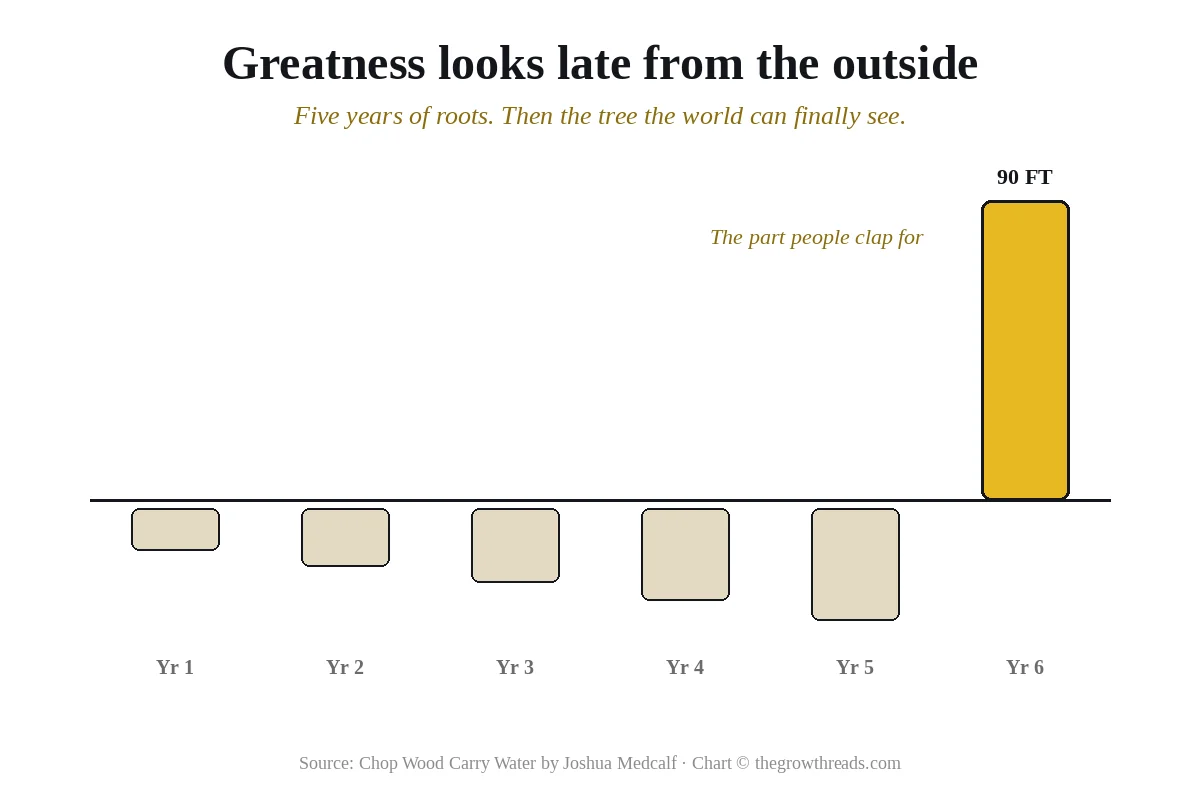
You do not become great on the day people clap. You become great on the days nobody is in the room. Joshua Medcalf’s fable follows John, who wants to be a samurai archer and instead gets an axe and a bucket. His teacher, Akira, will not let him skip the work that looks like delay and is the training: chop wood, carry water. Rankings sit outside your grip. Character, effort, and attitude do not. Comparison is a leak. Inputs — what you watch, read, listen to, who you sit with, how you talk to yourself, what you picture — are fuel. Bamboo can spend five years looking like nothing, then shoot ninety feet. Fall in love with becoming. The process is the only hour you own.
Key takeaways
- The work is the path: chopping wood and carrying water is not a delay before training. It is the training.
- You are always building a house: care you bring to any task is poured into you, not just into the task.
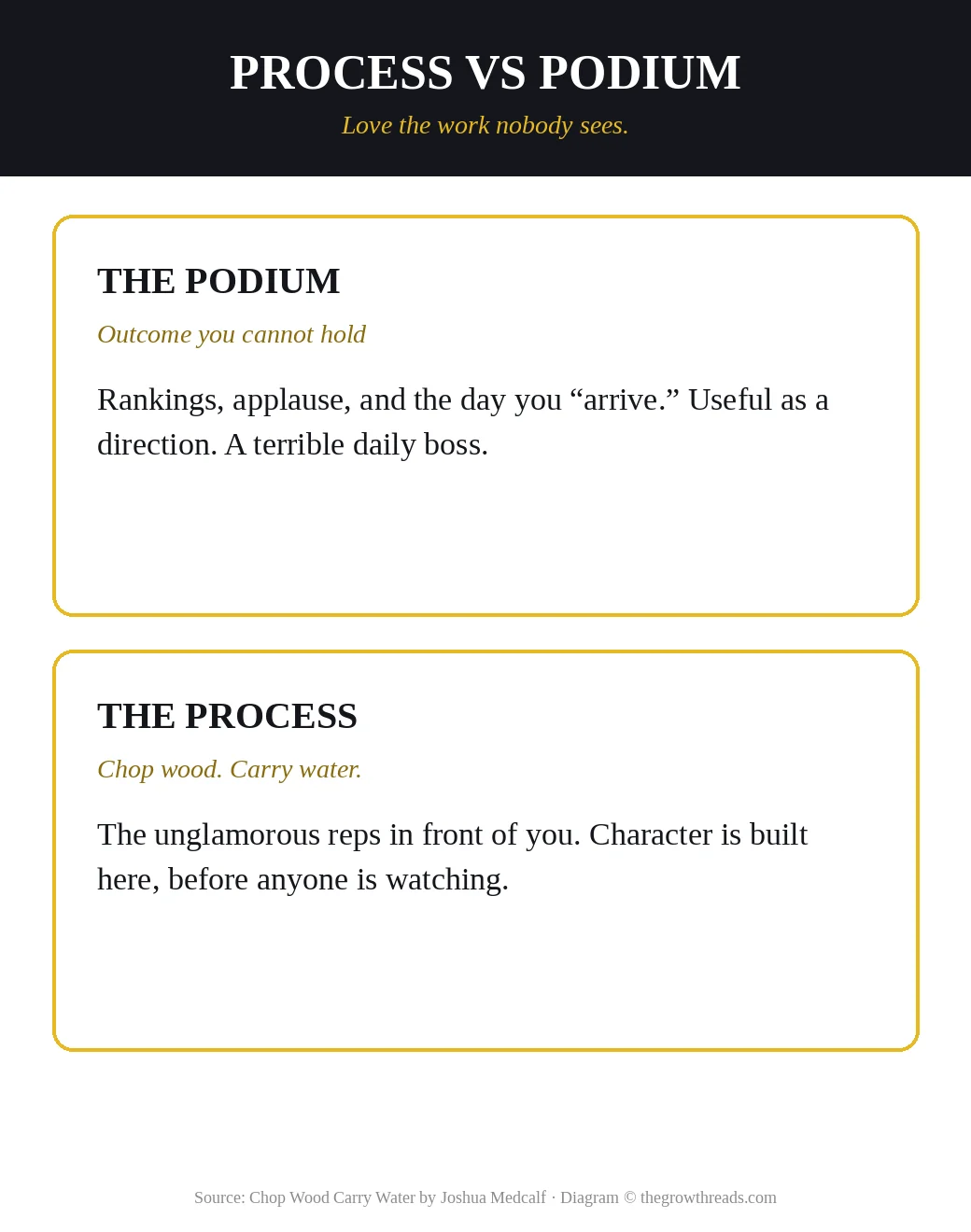
- Process beats podium: outcomes can be blocked. Who you become while working cannot.
- Bamboo is the honest timeline: years of unseen roots, then a shoot the world mistakes for overnight.
- Water your own grass: comparison is a tax on the hour that would have compounded.
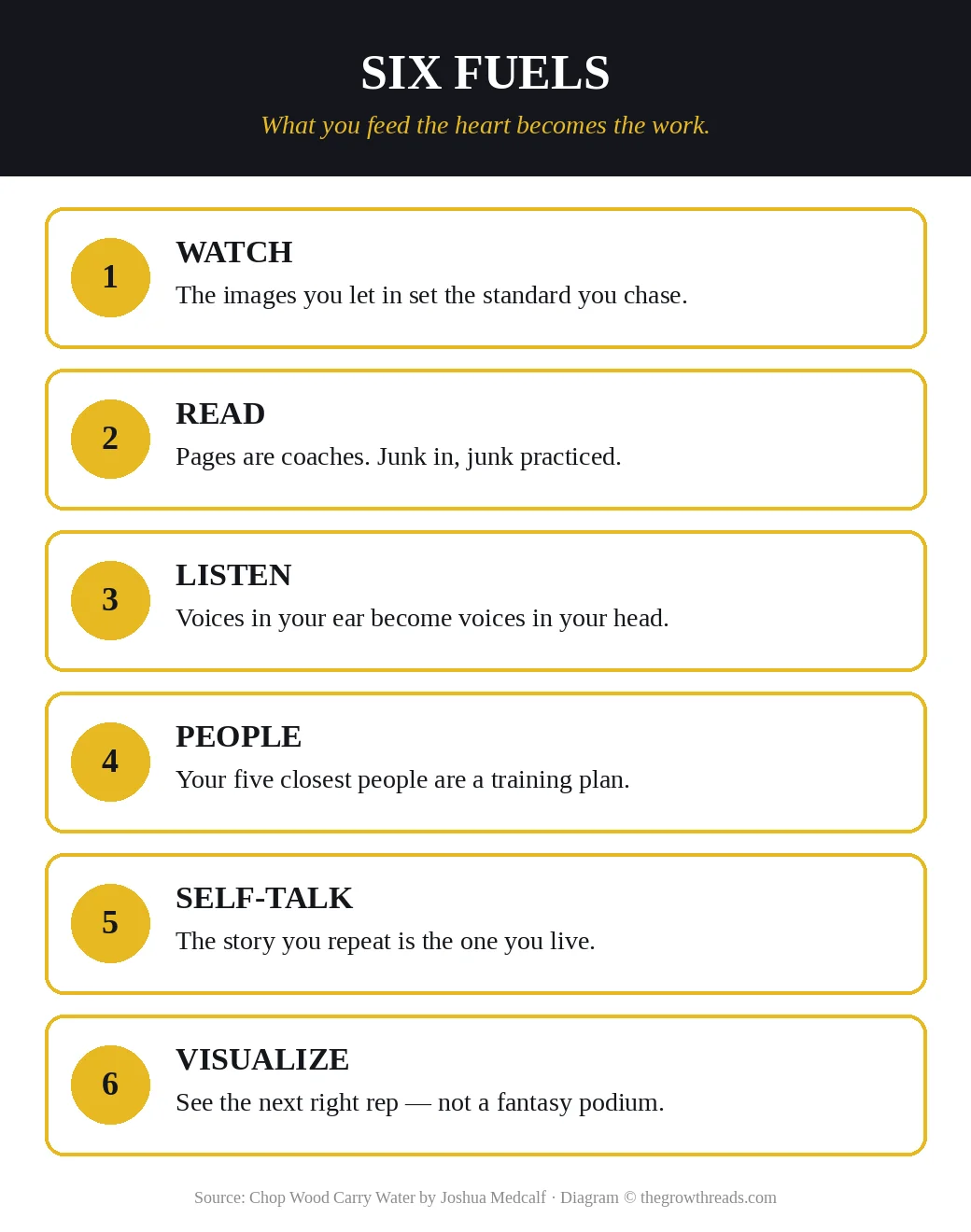
- Six fuels feed the heart: watch, read, listen, people, self-talk, visualization.
- Goals can be stolen: a mission — becoming a certain kind of person — cannot.
- Own two dials: effort and attitude. Surrender the scoreboard.
- Positive self-talk is a practice: the story you repeat is the one your hands will live.
- Love Tuesday: if the daily work feels beneath you, the podium will stay a poster.
What is Chop Wood Carry Water about?
Chop Wood Carry Water is Joshua Medcalf’s parable about falling in love with the daily work of becoming great. Through John and his teacher Akira, it argues that character is built in unglamorous reps and that a mission you control beats a goal someone else can block.
About the author
Joshua Medcalf is a mental performance coach and the founder of Train to be CLUTCH, a company that works with athletes, teams, and high performers on the inner game behind skill. Chop Wood Carry Water (CreateSpace, 2015) is the book that carried his process-over-podium message out of locker rooms and into a wider productivity audience — a short fable, not a lab monograph. He has also written companion titles such as Pound the Stone, Hustle, and Finish Empty. He is not a university researcher and does not pretend to be one. The useful credential is simpler: he has spent years sitting with people who already train hard and still lose the day to comparison, outcome-obsession, and a story in their head. This book is that conversation turned into a story you can reread in an afternoon. Explore all Joshua Medcalf book summaries →
Key concepts at a glance
| Concept | What it means | Use it when |
|---|---|---|
| Chop wood, carry water | The unglamorous daily work is the path, not a chore before the path. | You keep waiting to “start the real work.” |
| Building your house | Care you bring to a task is poured into your character. | You treat boring work as beneath the person you want to be. |
| Bamboo tree | Years of unseen roots, then a shoot the world calls overnight success. | You are tempted to quit because nobody is clapping yet. |
| Water your grass | The grass is greener where you water it — not next door. | Your feed is a highlight reel of other people’s year six. |
| Six fuels | Watch, read, listen, people, self-talk, visualize. | Your inputs are junk and you still expect a clean output. |
| Process vs podium | Love becoming. The ranking is a lagging souvenir. | A missed result ruins a week of honest work. |
| Goal vs mission | A goal can be blocked. A mission is who you are becoming. | An opponent, algorithm, or boss can steal the finish line. |
| Controllables | Effort and attitude are the job. The rest is weather. | You are rehearsing a speech about luck instead of the next rep. |
Part 1: The work nobody applauds
John arrives wanting a bow. He gets wood and water. That joke is the whole productivity problem in one scene. We apply for the identity — writer, founder, athlete, “disciplined person” — and treat the unglamorous hour as a queue we should be allowed to skip. Medcalf’s teacher will not skip it. Chopping wood and carrying water look like delay because we have already decided what “real training” is supposed to look like. The book’s first correction is that the mundane repetition is not a prelude. It is where the nervous system, the patience, and the standard get installed. If you cannot bring care to the bucket, you will not magically bring it to the arena.
This is why the fable belongs in a productivity silo even though nobody opens a Kanban board. Most stalled weeks are not missing a new app. They are missing respect for the hour that does not photograph well. Inbox, scales, drills, pages — the work that looks like chores is often the only work that compounds. Waiting for a cinematic assignment is a way to stay a tourist in your own craft. Akira’s assignment is rude on purpose. It removes the costume. You either fall in love with the next ordinary load, or you keep auditioning for a role that was never going to be handed to you at the gate.
Name the wood and water in your actual week: the ugly draft, the footwork, the follow-up, the review. If that list feels “beneath” the goal, the goal is still a poster. Greatness here is not a personality you discover. It is a relationship with repetition.
TGR Note: If you want the same idea without the samurai costume, start with our The Practicing Mind summary — Sterner is the process manual in plain clothes. For the creative version of “do the boring hour,” see The War of Art.
Part 2: You are always building your house
Medcalf’s second move is a metaphor you can take into a kitchen. You are always building your own house. The care you bring to a task does not only improve the task. It is poured into you. Sloppy wood-chopping is not a victimless shortcut. It is a vote for the kind of person who lives in the house later. That is why “good enough for now” is rarely just about now. It is rehearsal. The book is not asking you to romanticize busywork. It is asking you to stop treating the present hour as a waiting room for a more important self.
Comparison is the leak in that house. John wants to know where he stands. The feed, the locker room, the colleague who shipped faster — these are year-six bamboo photos. You do not see the roots. Medcalf’s line that the grass is greener where you water it is proverb-simple and operationally sharp. Watering someone else’s lawn with your attention does not make your plot grow. It just guarantees you will call your own plot a failure on a day it was quietly rooting. The bamboo story is here for people who are doing the work and getting no external proof yet. Five years underground is not a motivational poster. It is a warning against using applause as a leading indicator.
Pick a plot. Water it on a calendar, not when you feel chosen. If you cannot name the plot, you are browsing. Patience without a plot is delay with better branding. Medcalf wants both: a mission specific enough to return to tomorrow, and a willingness to look unimpressive while the roots work.
TGR Note: Compounding without drama is the same physics in The Compound Effect and The Slight Edge. If you want the science of why designed hours beat “talent,” pair this fable with Talent Is Overrated.
Part 3: Fuel the heart
Akira will not let John pretend the inner life is a side quest. Medcalf lists six fuels: what you watch, what you read, what you listen to, who you surround yourself with, how you talk to yourself, and what you visualize. That list is not a wellness add-on. It is the training environment. A person who consumes panic, comparison, and junk story for four hours and then tries to “be clutch” for forty minutes is not mysteriously inconsistent. They are well trained — just not for the thing they say they want.
Self-talk gets special weight because it is the fuel you cannot put down. The story you repeat while carrying water is the story that will be in your mouth when the bow is finally in your hands. Medcalf is not asking for fake cheer. He is asking for a refusal to narrate yourself as a finished failure during an unfinished root year. Visualization, in this frame, is not a fantasy podium montage. It is seeing the next right rep clearly enough that your body has something to aim at besides dread.
People are the multiplier most of us pretend we can out-think. Your closest humans are a practice plan whether you designed them or not. If they water comparison, you will practice comparison. Notice who is in the room while you decide what “normal” looks like. Inputs are curriculum, not vibes.
TGR Note: Environment-as-curriculum is the same lever in Atomic Habits and Mini Habits — they shrink the first rep until the room can carry it. Medcalf is telling you the room includes your feeds and your sentences, not just your shoes.
Part 4: Mission over goal
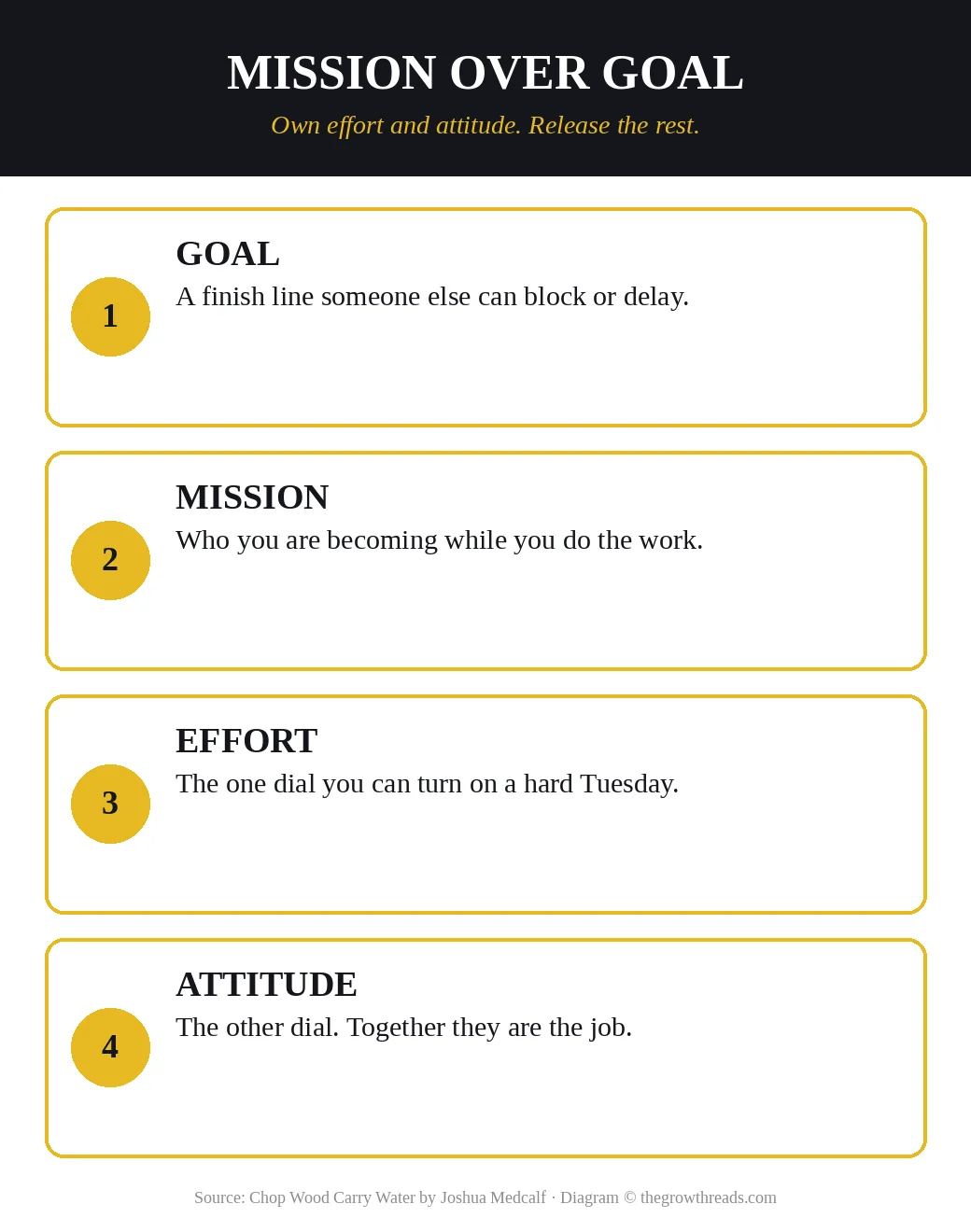
A goal, in Medcalf’s telling, is a finish line an opponent, a committee, or the weather can move. A mission is who you are becoming while you chop. That distinction is the book’s most useful productivity tool. “Make varsity,” “hit the number,” “get the title” can all be blocked. “Become the kind of person who does the work with care” cannot. You still want the goal. You just stop letting it be the boss of Tuesday. Effort and attitude are the two dials you can actually turn. Everything else is a report.
This is not an excuse to ignore results. A mission without a scoreboard can become a mood. Medcalf’s point is narrower: when the scoreboard is ugly, you still have a job — effort, attitude, the next load of wood. When the scoreboard is pretty, you still have the same job, because the pretty day is not a new identity. The people who stay great after a win are the ones who never outsourced their standard to the clap. The people who collapse after a loss outsourced it years earlier.
Surrendering the outcome is putting the bow down and picking up the bucket again. You do not stop aiming. You stop making your nervous system depend on a result you do not hold. That is how you stay in the work long enough for the bamboo to grow. After any enlightenment, you still chop wood and carry water. The work does not graduate you. It is the life.
TGR Note: For a harsher, military cut of “own what you can own,” see Discipline Equals Freedom. For the version that treats suffering as a training partner, Can’t Hurt Me and Relentless are the louder cousins. Medcalf is the gentler parable that still will not let you skip the bucket.
Who is Chop Wood Carry Water best for — and who should read something else first?
Read this if you already know how to work and still resent the unglamorous hour — especially if comparison is leaking your week, or if a missed result keeps rewriting your identity. It is a fast reread for athletes and makers who need the process put back in charge of the podium. It is a good companion when you are in a root year and the feed is full of other people’s year six.
Read something else first if you need a system, not a fable — go to Atomic Habits or Getting Things Done. If you want the lab on deliberate practice, start with Peak or Talent Is Overrated. If you cannot start at all, Mini Habits is the on-ramp. Medcalf will not build your capture system. He will tell you why the hour you already have is the path.
Questions to reflect on
- What, in your actual week, is the wood and the water you keep treating as a delay?
- Where are you watering someone else’s grass with your attention?
- Which of the six fuels is currently junk — watch, read, listen, people, self-talk, visualize?
- If the goal were stolen tomorrow, what mission would still give Tuesday a job?
- What would “loving the process” look like on a day with no audience and no proof?
🔥 Ready to fall in love with the hour nobody claps for?
Pick one load of wood this week. The podium is a lagging souvenir.
How to apply Chop Wood Carry Water (7-day plan)
- Day 1 — Name your wood and water. Write the unglamorous daily work you keep treating as a delay. If you cannot name it, you do not have a process yet.
- Day 2 — Audit comparison. List the three feeds, chats, or scoreboards that steal the hour. Mute one for seven days.
- Day 3 — Score the six fuels 1–5. Circle the weakest. Change only that input tomorrow morning.
- Day 4 — Rewrite the goal as a mission: “Become the kind of person who ___.” Put it above the scoreboard.
- Day 5 — Run the wood-and-water session before any podium-looking work. Stop when the load is honest, not heroic.
- Day 6 — Practice the two dials: after the session, write one line on effort and one on attitude. No line about the ranking.
- Day 7 — Write the root-year version. If nobody claps for ninety days, what still gets done on Tuesday? Block that version on next week’s calendar.
Frequently asked questions
What is Chop Wood Carry Water about in one paragraph?
Chop Wood Carry Water is Joshua Medcalf’s fable about falling in love with the process of becoming great. John wants to be a samurai archer; his teacher hands him an axe and a bucket. The unglamorous daily work is not a delay before training — it is the training. Comparison leaks your hours. Inputs fuel the heart. A mission you control beats a goal someone else can block. Effort and attitude are the job. The scoreboard is only a delayed report.
Is this a sports book or a productivity book?
Both, which is why it sits in this silo. The costume is archery and samurai training. The application is any craft that tempts you to skip the boring hour: writing, sales, coding, training, leading a team. Athletes found it first because they already live inside reps. Knowledge workers need it for the same reason they avoid it — their “wood” looks like email and drafts, so they keep waiting for a more cinematic assignment. If you do work that compounds in private, this is a productivity book.
How is this different from Atomic Habits or The Practicing Mind?
Atomic Habits gives you laws, cues, and identity loops you can run on a Tuesday. The Practicing Mind is a technician’s guide to staying with the current repetition. Chop Wood Carry Water is a parable that puts process in charge of the podium and tells you to watch your inputs. Read Clear to install a system. Read Sterner when you cannot stay with the rep you already started. Read Medcalf when the system exists and you still resent the hour because it does not look like winning yet.
Is the bamboo story literal science?
Treat it as a picture, not a botany exam. Some bamboo species really do spend a long time establishing roots before a dramatic shoot; Medcalf is not running a greenhouse study. The useful claim is psychological: unseen work can look like nothing from the cheap seats, then look like overnight success to people who never watched the roots. If you need lab evidence for designed practice, go to Peak or Talent Is Overrated. If you need permission to keep watering a quiet plot, the bamboo is the right metaphor.
What does “mission over goal” mean at work?
A goal is “ship the feature,” “hit quota,” “get the title.” Those can slip because of a client, a budget, or a reorg. A mission is “become the person who does careful work on time and does not outsource my standard to the dashboard.” You still track the goal. You just do not let a blocked finish line cancel Tuesday’s effort and attitude. The mission gives the day a job when the scoreboard is ugly — and keeps you honest when the scoreboard is pretty and you want to coast.
Can I use this if I am already burned out?
Yes, with a smaller axe. The book is not a demand to add a heroic second job. It is a demand to respect the load you already have instead of waiting for a more impressive one. If you are depleted, shrink the wood: one honest session, cleaner inputs, less comparison. Burnout often comes from chasing a podium with a process you secretly hate. Loving a smaller process is the repair. If you cannot do even that, rest is part of carrying water — not a loophole, a prerequisite.
Should I read Can’t Hurt Me or Discipline Equals Freedom instead?
Read those if you want volume, military bluntness, and a louder voice in your ear. Goggins and Jocko will not let you negotiate with the alarm. Medcalf will not either, but he does it as a story about a bucket. They nest. Use Medcalf when you need to fall back in love with the ordinary hour. Use Jocko when love is not the missing piece and you just need to move. Use Goggins when the story in your head is the obstacle and you want it challenged at full volume.
Related summaries
- The Practicing Mind — stay with the current rep without living in the finish line.
- Talent Is Overrated — designed practice, not a gift you wait to feel.
- Atomic Habits — the operating system for making the daily work automatic.
- Discipline Equals Freedom — own the hour when the parable is not enough.
- Best productivity books — the full Productivity pillar.
How we analyze books: every book on The Growth Reads is read cover to cover, summarized in thousands of words of original analysis, and rated against our five-criteria rubric (lasting impact, evidence quality, practical application, writing & originality, external consensus). Read our full methodology.