

★★★★½ 4.5/5 — Own the frame, become the prize, then ask for a real decision.
Best for: Founders and sellers who already work the deck and still watch the room freeze in the first five minutes.
Reading time: ~5 hrs (guide: 14 min)
Difficulty to apply: Easy to try one frame this week; hard on the ego if you currently chase.
Pitch Anything in one minute
Most pitches die before the idea is even heard — not because the numbers are weak, but because the room already owns the meaning of the meeting. Oren Klaff’s Pitch Anything (McGraw-Hill, 2011) is a field manual for that first five minutes: the crocodile brain files a data dump as threat or boredom, the person with the stronger frame sets the status, and neediness broadcasts that they are the prize. If you take one move from this Pitch Anything summary, stop chasing. Set a frame, tell a short story with an open loop, and make them qualify to you once this week.
Key takeaways
- The croc brain goes first: Survival filter, not spreadsheet. If it feels like too much, a threat, or nothing new, the neocortex never clocks in.
- Frame control is the real meeting: The first strong frame to land owns the meaning. Do not submit to theirs. Replace it.
- Power, time, analyst, prize: Four frames you will hit. Name which one is running, then change it.
- Status is local: You do not need to be famous. You need to be the high-status person in this room, this hour.
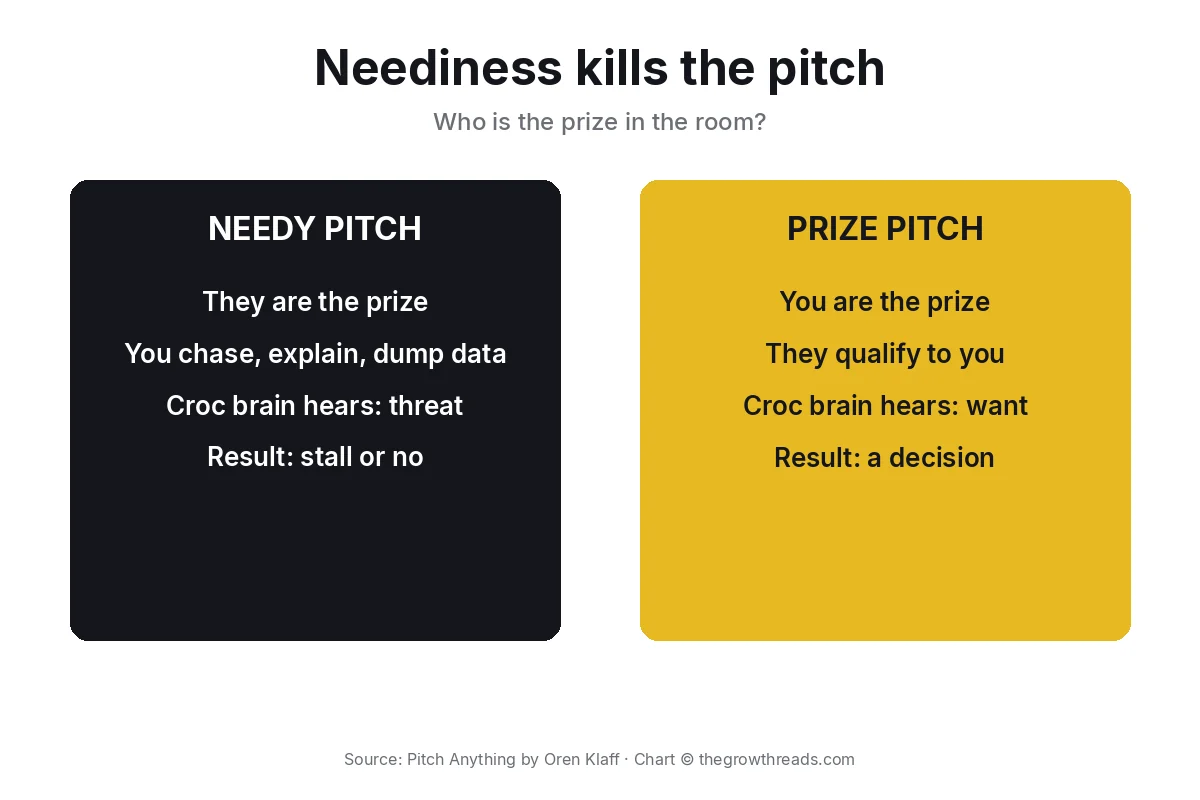
- Neediness is a frame: Chasing, over-explaining, and waiting around tell the croc you are prey.
- Prizing: You are the scarce asset. They qualify to you. You still know the numbers — you just do not lead with hunger.
- STRONG is a sequence: Frame, story, intrigue, prize, hookpoint, decision. Not a longer appendix.
- Hot cognition beats cold facts: They have to want in, not merely understand the model.
- Ask for a decision: A vague next step is a stall you helped create. Close the loop while the hook is still warm.
What is Pitch Anything about?
Pitch Anything is Oren Klaff’s method for presenting, persuading, and winning a deal by controlling the frame, passing the crocodile brain, and positioning yourself as the prize so the other person actually decides — not another meeting to “think about it.”
About the author
Oren Klaff raised more than four hundred million dollars for deals as a capital-markets specialist and later taught the method inside Intersection Capital. He is a working pitcher who got tired of watching smart people lose the room in the opening minutes, not a laboratory neuroscientist. Pitch Anything (2011) is the field book. Flip the Script (2019) is the sequel on reversing buyer control. He writes like a deal table: status, frames, and a decision before the coffee cools. The claim is simple — a better method beats a longer deck. Explore all Oren Klaff book summaries →
Key concepts at a glance
| Concept | What it means | Use it when |
|---|---|---|
| Crocodile brain | Survival filter that kills boring or threatening input | Your deck is smart and the room is gone |
| Frame control | Who owns the meaning of the meeting | They already set the rules before you speak |
| Power frame | Dominance as the context | They talk over you or seat you as the petitioner |
| Time frame | Whose clock the meeting runs on | They rush you or make you wait as a test |
| Analyst frame | More data as a stall | They ask for another forty slides |
| Prize / prizing | You are the scarce asset; they qualify to you | You hear yourself chasing after the call |
| STRONG | Frame, story, intrigue, prize, hook, decision | You have content and no sequence |
| Hookpoint | The moment they lean in | You keep talking past the yes-face |
Part 1 — Why the crocodile brain kills the pitch
Klaff’s opening claim is rude and useful: the person across the table is not a spreadsheet. The first brain in the room is the survival one — he calls it the crocodile brain — and it only wants to know three things. Is this a threat. Is this new. Can I understand it without drowning. A forty-slide market map fails all three. So the croc files you under “later,” which in a deal means never. The neocortex never gets the file.
He is popularizing a teaching cartoon, not publishing a fMRI study. You do not need the cartoon to use the rule. If the first three minutes are a data dump, you have already lost status. The fix is a smaller idea, a human story, and a reason they should want in before you prove you did the homework. Klaff’s credential is volume: more than four hundred million raised by pitching. He watched rooms freeze. Then he changed the opening.
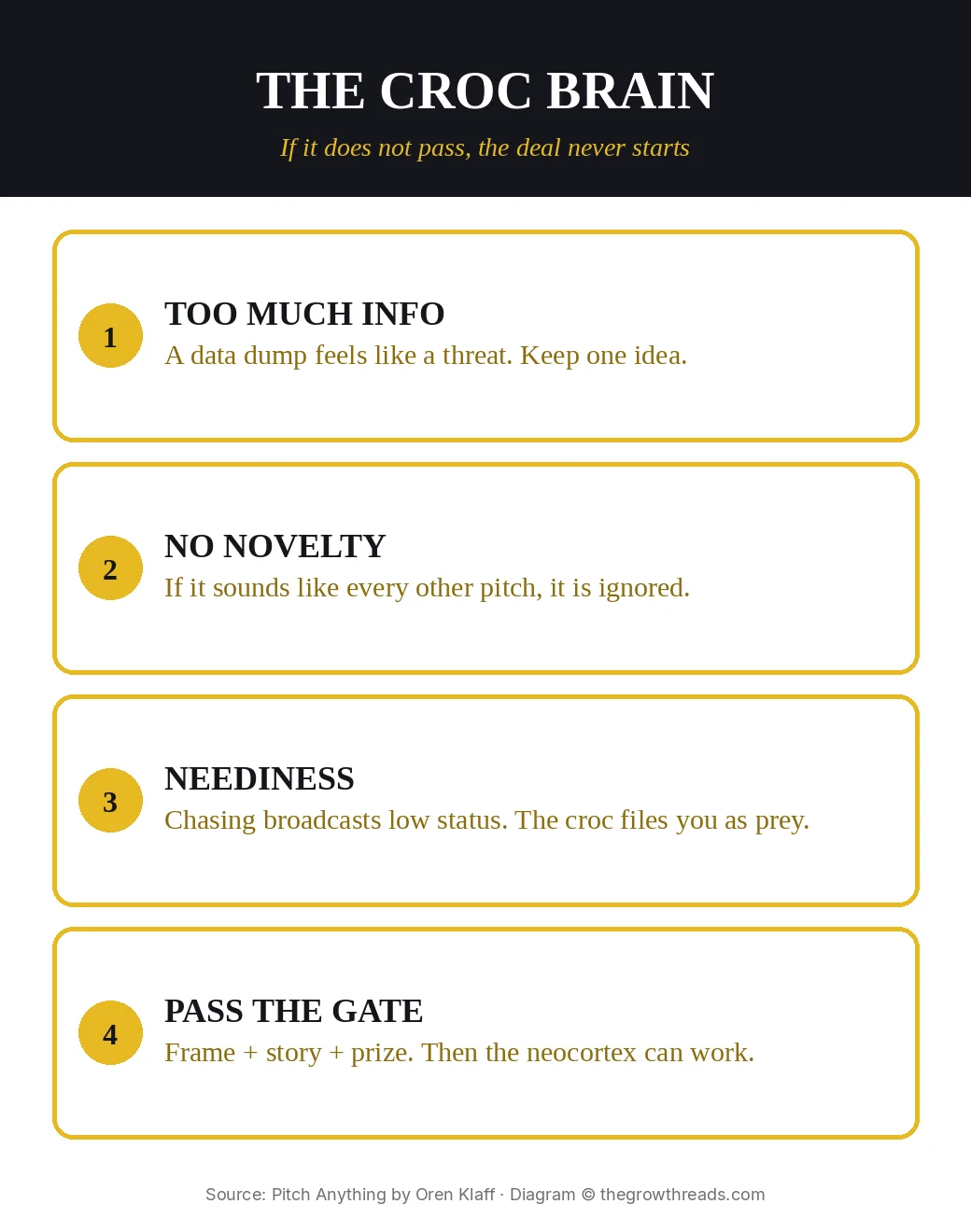
For a knowledge worker the drill is ugly and small. Take the next ask — a budget, a hire, a customer, a raise — and cut the opening to one sentence they can repeat. Then one story with a person in it. Then one number, not twelve. If you cannot say the idea without a laptop, the croc already won. Put the appendix in your pocket. It is there if they earn it.
TGR Note: Talk Like TED is Carmine Gallo on how an idea travels in eighteen minutes — emotion, novelty, a demo people retell. Made to Stick is the Heath brothers on SUCCESs: simple, unexpected, concrete. Use Gallo when the room is an audience. Use the Heaths when the idea has to survive without you in the room. Use Klaff when this is a live deal and the bottleneck is the first five minutes of status, not a missing anecdote.
Part 2 — Frame collisions: power, time, analyst
A frame, in this book, is the context that tells everyone what the meeting is about. It is not a slide title. If they keep you waiting, the frame is “your time is cheap.” If they say “you have twelve minutes,” the frame is their clock. If they ask for the model before they have heard why it matters, the frame is analysis as a stall. Klaff’s move is not to fight. You introduce a stronger frame and hold it without heat.
Power frame: they try to dominate. You do not submit and you do not tantrum. Redirect with a small status move — a light push-back, a joke that does not apologize, a willingness to leave. Time frame: they rush you or they make you wait. You have your own clock; scarcity goes both ways. Analyst frame: another forty pages is often a stall, not curiosity. Swap the stack for a story and one number that matters. Intrigue is the ally: an open loop they cannot close without staying in the conversation.
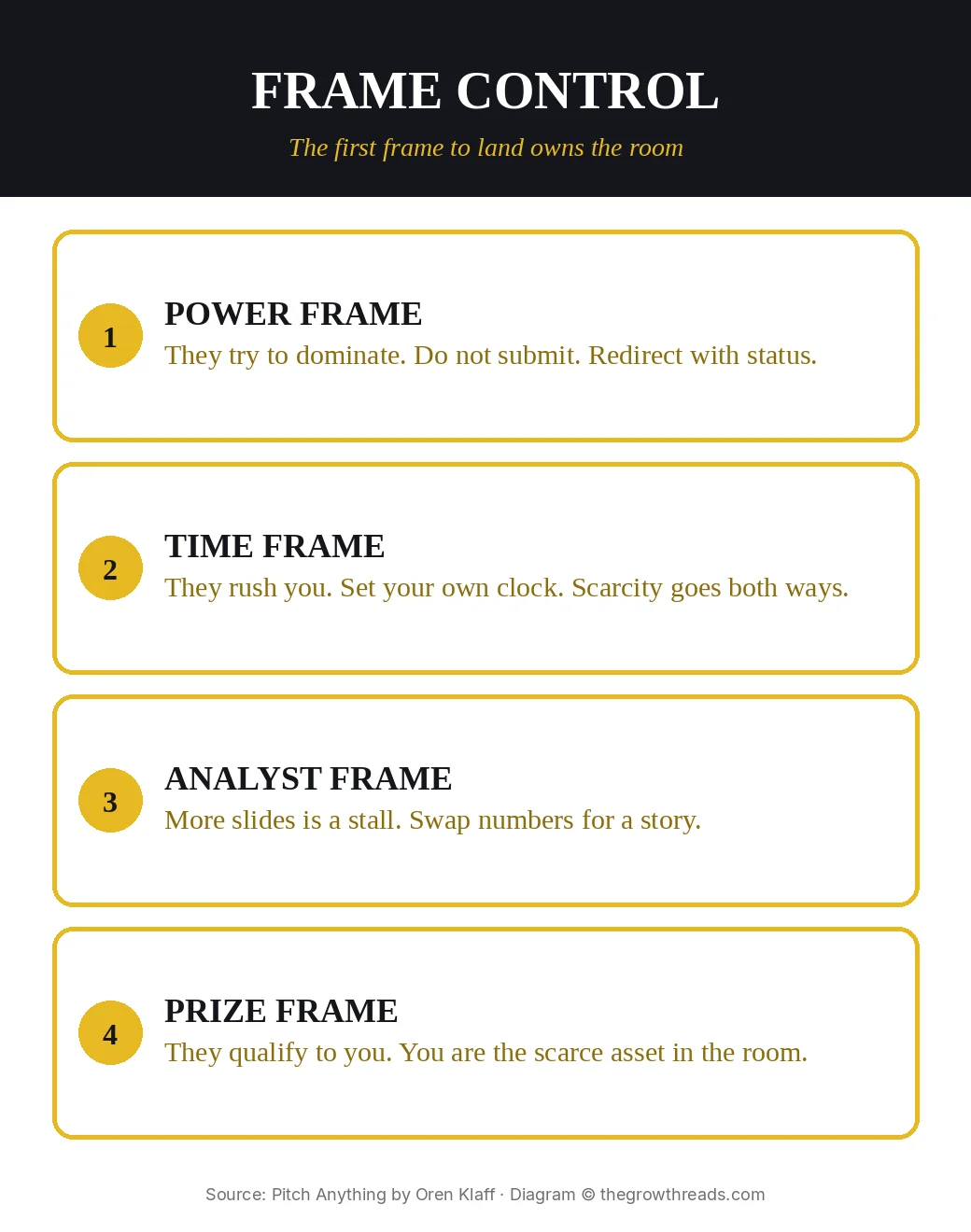
Try it in a Tuesday meeting you already have. Before you speak, write which frame is in the room. Then change one variable: your pace, who waits, or whether you answer the stall with more paper. If you always stay late to “just walk through a few more charts,” you are feeding the analyst frame. If you always accept the twelve-minute slot as a verdict on your worth, you are inside their time frame. Klaff would rather you be slightly less available than slightly more desperate.
TGR Note: The Mom Test is the opposite job: do not pitch at all until you have heard their life. Use Fitzpatrick when you are still discovering whether the problem is real. Use Klaff when you are actually in a pitch and the problem is already agreed. To Sell Is Human is Pink on moving others by serving — attunement, buoyancy, clarity — for the everyday ask that is not a boardroom. Stack them. Do not use Klaff’s status moves to skip customer truth.
Part 3 — Status, neediness, and prizing
Status in Pitch Anything is local. You do not need a magazine cover. You need to be the high-value person in this room for this hour. The usual mistake is to look globally impressive — credentials, logos, a thicker appendix — while broadcasting locally low status: arriving early, staying late, saying yes to every extra homework. The croc reads the local signal. Credentials are a slide. Neediness is a smell.
Neediness kills otherwise good deals. It sounds like a third follow-up the same afternoon, or answering a stall with more proof. Klaff’s counter is prizing: you are the prize, they qualify to you, you will not beg for a maybe. That is the same scarcity you already grant a specialist with a calendar, not contempt. If you cannot name another option you would actually take, the prize frame is a costume. Do the work so it is true, then hold it. Cold facts get a nod. Wanting gets a signature. You do not need a helicopter. You need one meeting this week where you do not chase the silence.
TGR Note: The Go-Giver is the other polarity — give more value than you take. Klaff is not asking you to become stingy. He is asking you not to fund a maybe with your self-respect. Use Burg and Mann when the stall is selfishness. Use Klaff when the stall is you performing hunger. Building a StoryBrand makes the customer the hero of the narrative. Klaff still wants you as the prize in the room. Those two can live together: they are the hero of their story, and you are not a vending machine.
Part 4 — STRONG, the hookpoint, and a decision
STRONG is the book’s working sequence. Setting the Frame — own the context before you share the idea. Telling the Story — a person, not a stack of facts. Revealing the Intrigue — an open loop they cannot close from slide one. Offering the Prize — they want in. Nailing the Hookpoint — they lean forward, and you do not talk past it. Getting a Decision — a yes, a no, or a dated next step with skin, not “let’s circle back.” If you skip frame and prize, the rest is still a data dump with better lighting.
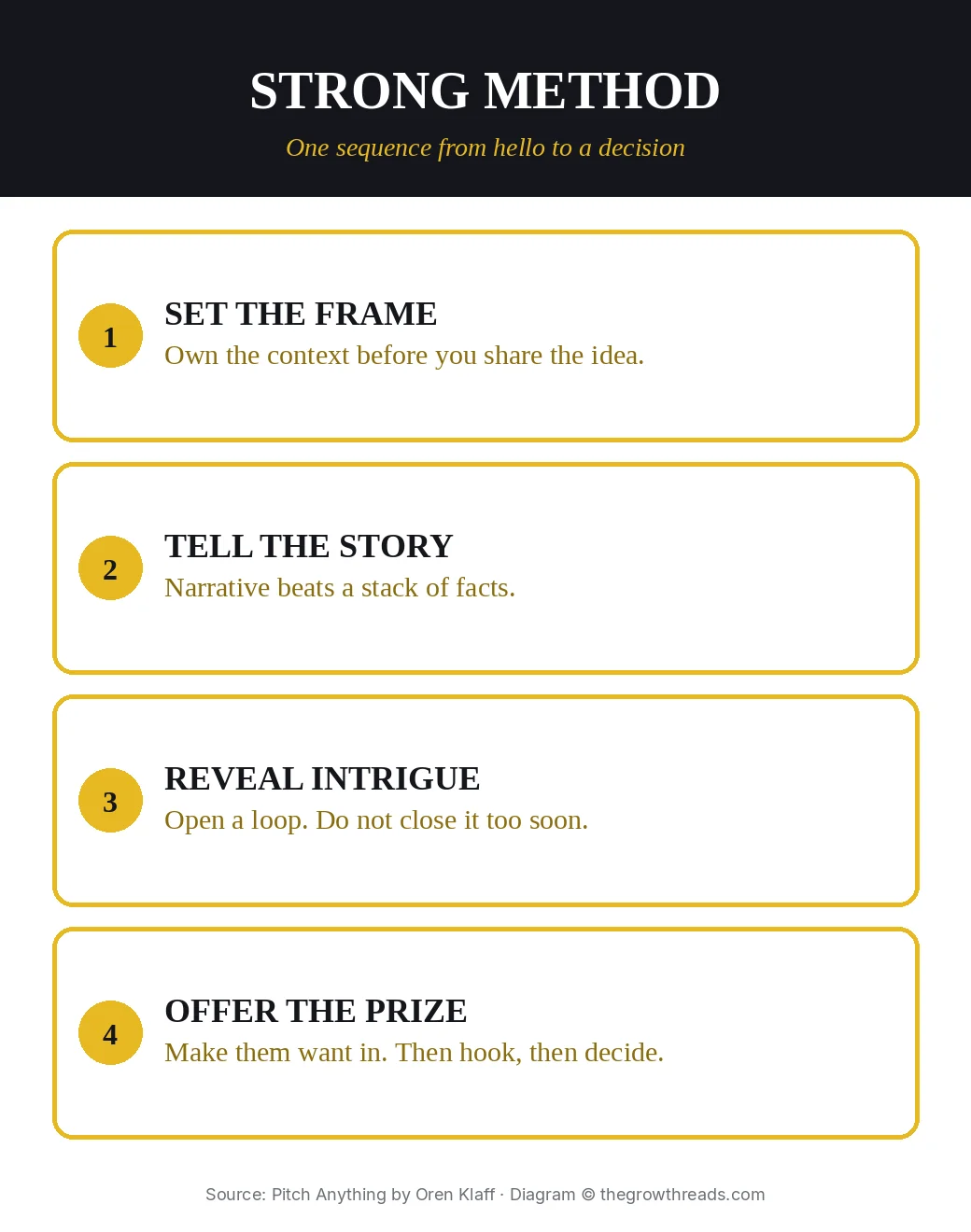
The hookpoint is the part most people miss because they love their own appendix. There is a moment when the other person is in — a question, a lean, a “how would that work for us.” That is the hook. You stop stacking and move to a decision. Talking for another twenty minutes is how a warm room becomes a stall. A clean no is a gift. A foggy maybe is work you will do again next month.
Put STRONG on a card for one live ask. Frame in one line. Story in four sentences. One open question you will not answer too soon. One prize. Watch for the hook, then ask in the same meeting. If you highlight the acronym and still send a fourteen-page follow-up that night, you have bought a poster. If you leave with a dated yes or a clean no, you have used the book.
TGR Note: The Presentation Secrets of Steve Jobs is Gallo on the keynote as theater — headline, demo, one more thing. Use it when the room is a stage. Use Klaff when the room is a table and someone has to sign. Contagious is Berger on why ideas spread after you leave. Klaff is why they say yes before you leave. If you need both a decision today and a story that travels tomorrow, read them as a pair, not a fight.
Who is Pitch Anything best for — and who should read something else first?
Best for people who already have a real offer — a product, a raise, a fundraise, a budget — and keep losing the first five minutes. Especially useful if you prepare like a specialist and then behave like a petitioner.
Read something else first if you do not yet know whether anyone has the problem: start with The Mom Test, then come back. If the job is a keynote, start with Talk Like TED or Building a StoryBrand. For everyday moving of colleagues, To Sell Is Human is broader. Come here when the bottleneck is status and decision, not a missing customer interview.
Questions to reflect on
- In your last pitch, who was the prize — you, or them?
- Which frame landed first: power, time, analyst, or prize?
- Where did you chase (extra email, extra slides, extra waiting) after the meeting?
- What one-sentence idea would the crocodile brain actually let through?
- What decision will you ask for while the hook is still warm?
🔥 Ready to own the next room?
Set one frame, stop chasing, and ask for a decision while the hook is warm.
How to apply Pitch Anything (7-day plan)
- Day 1 — Name the last frame. Write which frame ran your last important meeting. One sentence. No decorating.
- Day 2 — Cut the opening. Rewrite the first minute as one idea a croc brain could keep. Delete the rest from the open.
- Day 3 — One story. Add a person, a problem, and a turn. Four sentences. Not a case-study appendix.
- Day 4 — Prize check. List where you chased last week. Pick one place you will not chase again.
- Day 5 — Time frame. Put a real end on the next meeting. You also have a clock. Leave when it ends.
- Day 6 — Live STRONG. Run frame, story, intrigue, prize on a real ask. Watch for the hook. Stop talking when it lands.
- Day 7 — Ask for a decision. Yes, no, or a dated next step with skin. Do not fund a maybe with another deck that night.
Frequently asked questions
What is Pitch Anything about?
Pitch Anything is Oren Klaff’s 2011 method for presenting an idea so the other person actually decides. He argues most pitches die in the first seconds because the crocodile brain — the survival filter — files a data dump as too much information, a status threat, or boring. The usable residue is frame control, prizing (you are the scarce asset), and the STRONG sequence: set the frame, tell a story, reveal intrigue, offer the prize, nail a hookpoint, get a decision. If you take one move from this Pitch Anything summary, stop chasing. Make them qualify to you once this week.
What is frame control in Pitch Anything?
Frame control is Klaff’s name for who owns the meaning of the meeting. The first strong frame to land tends to hold: if they rush you, the meeting is about their clock; if they demand another forty slides, the meeting is about analysis as a stall; if they sit as the prize, you are the petitioner. You do not win by submitting. You introduce a stronger frame — often time, intrigue, or prize — and keep status without a fight. The TGR drill is to name the frame in the room before you speak, then change one thing: your pace, your ask, or who has to qualify.
What is the STRONG method in Pitch Anything?
STRONG is Klaff’s six-step pitch: Setting the Frame, Telling the Story, Revealing the Intrigue, Offering the Prize, Nailing the Hookpoint, Getting a Decision. It is a sequence, not a slide template. Frame first so the room is not already someone else’s. Story instead of a stack of facts. An open loop so attention stays. Prize so they want in. A hookpoint — the moment they lean forward — then a clear decision, not a vague next step. Use it on a real ask this week. If you only memorize the acronym and still chase after the meeting, you have not used the book.
What does prizing mean in Pitch Anything?
Prizing means you position yourself and the deal as the scarce thing in the room. They qualify to you. You do not qualify to them with a longer appendix. Klaff treats neediness as a frame that broadcasts low status — chasing, over-explaining, staying until they are bored. The practical version is small: you have a calendar, you have other options, you will not beg for a maybe. You still prepare. You still know the numbers. You just do not lead with hunger. If you cannot point to one moment this week where you let them come to you, you are still running the needy pitch.
Who should read Pitch Anything?
Founders, sellers, and anyone who needs a yes on an idea — a raise, a client, a budget — and currently dies in the first five minutes with slides. Useful if you already work the content and still watch rooms freeze. Skip it as a first book if you do not yet know whether the customer has the problem; start with The Mom Test, then come back when you are actually pitching. If you need a keynote spine, Talk Like TED or Building a StoryBrand will serve the stage. Come here when the bottleneck is status and decision, not a missing interview.
How is Pitch Anything different from Talk Like TED or To Sell Is Human?
Talk Like TED is how an idea travels in eighteen minutes — emotion, novelty, memorable demo. To Sell Is Human is Pink on moving others by serving: attunement, buoyancy, clarity. Pitch Anything is the status game inside a live deal: who owns the frame, who is the prize, and how you get a decision without chasing. Use Gallo when the room is an audience. Use Pink when the work is everyday persuasion without a boardroom. Use Klaff when you already have the story and the room still treats you like a petitioner. They stack. They are not the same job.
Is the crocodile brain real neuroscience?
Klaff popularizes a three-layer picture — crocodile brain, mid-brain, neocortex — that teachers have used for decades. Modern neuroscience is more networked than a stacked reptile. Treat the cartoon as a working metaphor, not a lab map. The practical advice is uncontroversial: a threatened, overloaded, or bored listener will not process your spreadsheet. Lead with a frame, a story, and a reason they want in. Do not use a brain cartoon as proof that your last deck failed. Use the next meeting as proof: shorter, higher status, a real decision.
Related summaries
- Talk Like TED — make the idea travel in eighteen minutes
- To Sell Is Human — move others by serving, every day
- The Mom Test — ask about their life before you pitch
- Made to Stick — the idea has to survive without you
- More on the best productivity books pillar
How we analyze books: we read for application, not for a takedown — then we add a plan you can run this week. Read our full methodology.