

★★★★½ 4.5/5 — a generosity operating system for people who flinch at the word networking.
Best for: Operators, job-changers, and founders who are good at the work and thin on people who will take the call
Reading time: ~10 hours (400 pages) · this guide ~12 min
Difficulty to apply: Medium — the work is a calendar of small gifts, not a new personality
Never Eat Alone in one minute
Your next job, client, or break will come through a person — and the worst day to meet them is the day you need them. Keith Ferrazzi, writing with Tahl Raz, grew up caddying for rooms he was not born into, then treated those rooms as a skill. The skill is not charm. It is generosity on a schedule. Do not keep score. Do homework before you shake a hand. Follow up within twelve hours. Ping people with something useful so you are not a stranger when a real ask finally arrives. Eat with people on purpose. Host the table instead of working the rope line. The expanded 2014 edition adds the digital layer: a feed can carry a ping, but it cannot replace the meal. If you only call when you are desperate, you have a crisis plan, not a network.
Key takeaways
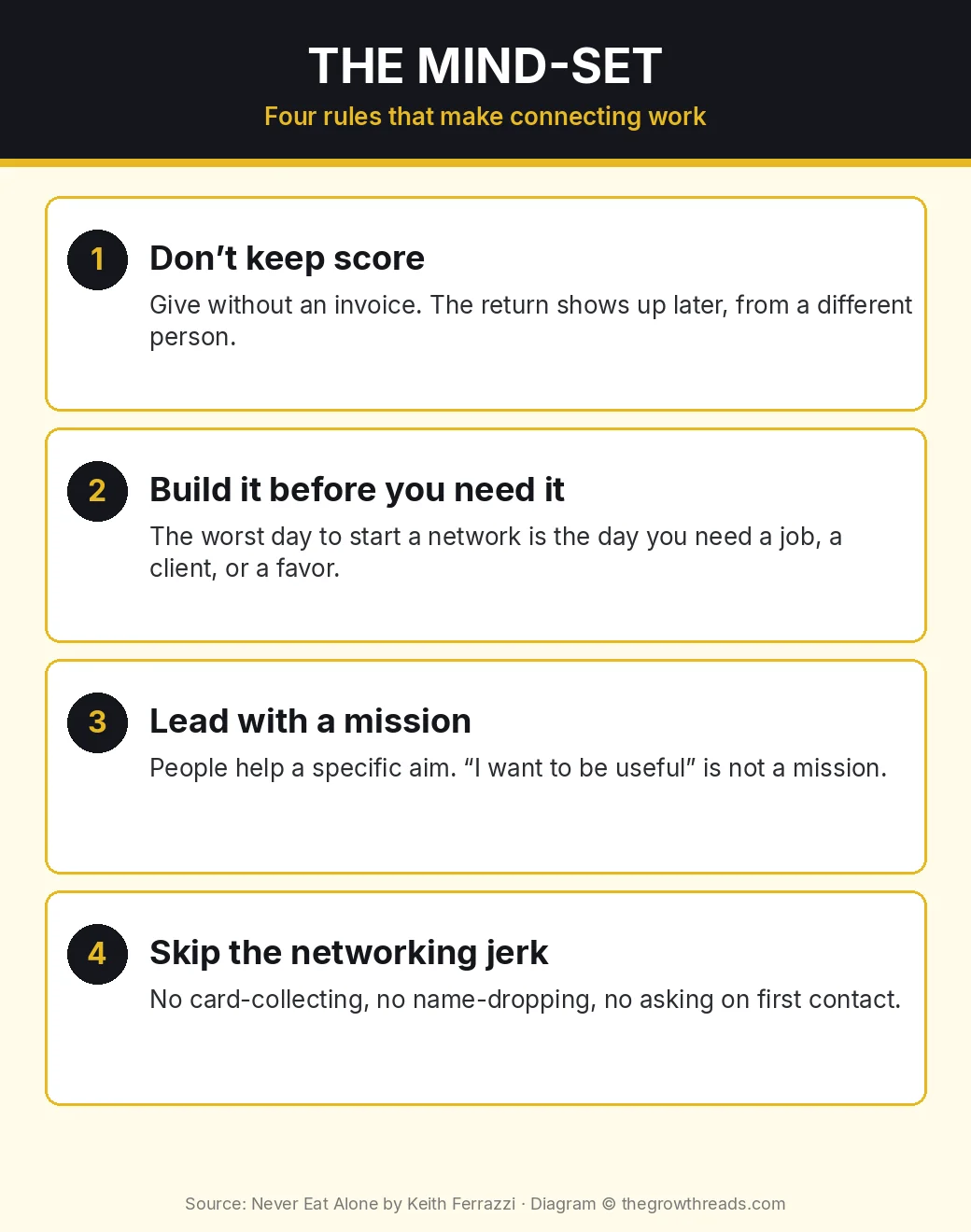
- Don’t keep score: give without an invoice. The return often comes from someone else, later.
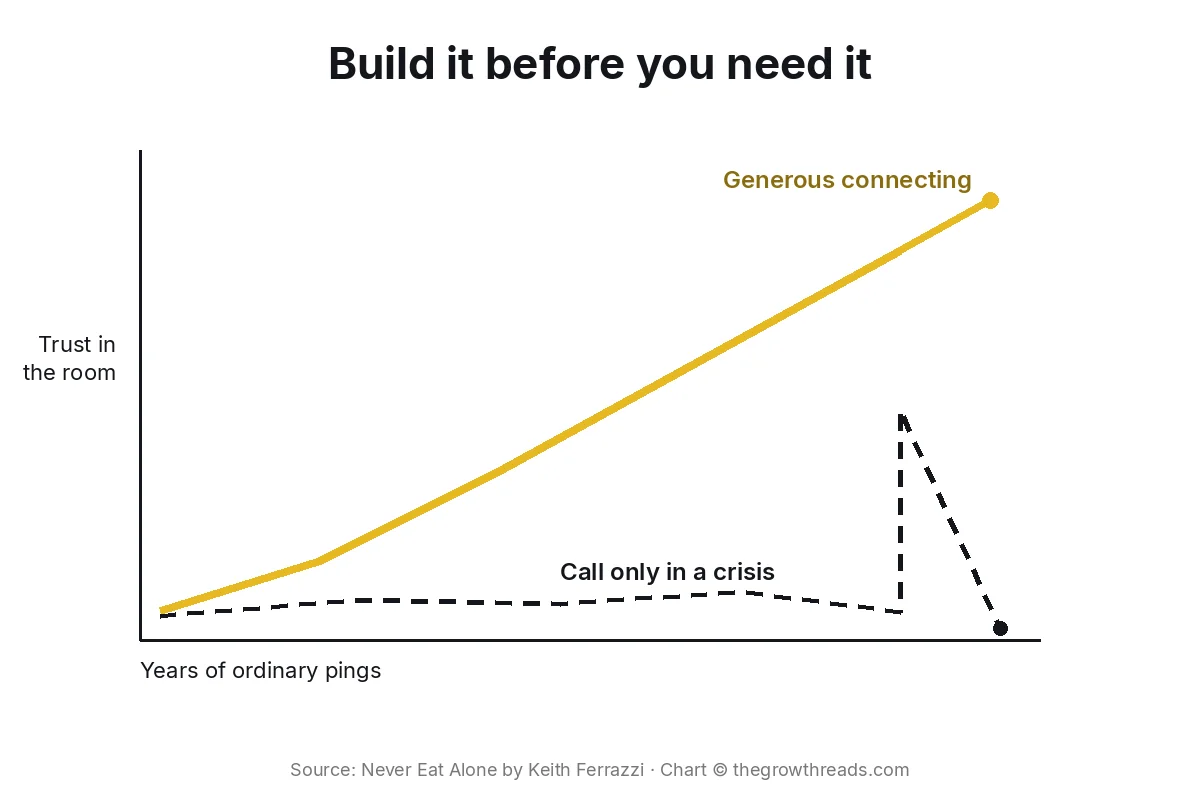
- Build it before you need it: relationship equity compounds in ordinary weeks. The emergency call is too late.
- Lead with a mission: people help a specific aim. “I want to be useful” is not a mission.
- Skip the networking jerk: no card-collecting, no name-dropping, no ask on first contact.
- Do the homework: know the person, the overlap, and one useful thing you can offer before you walk in.
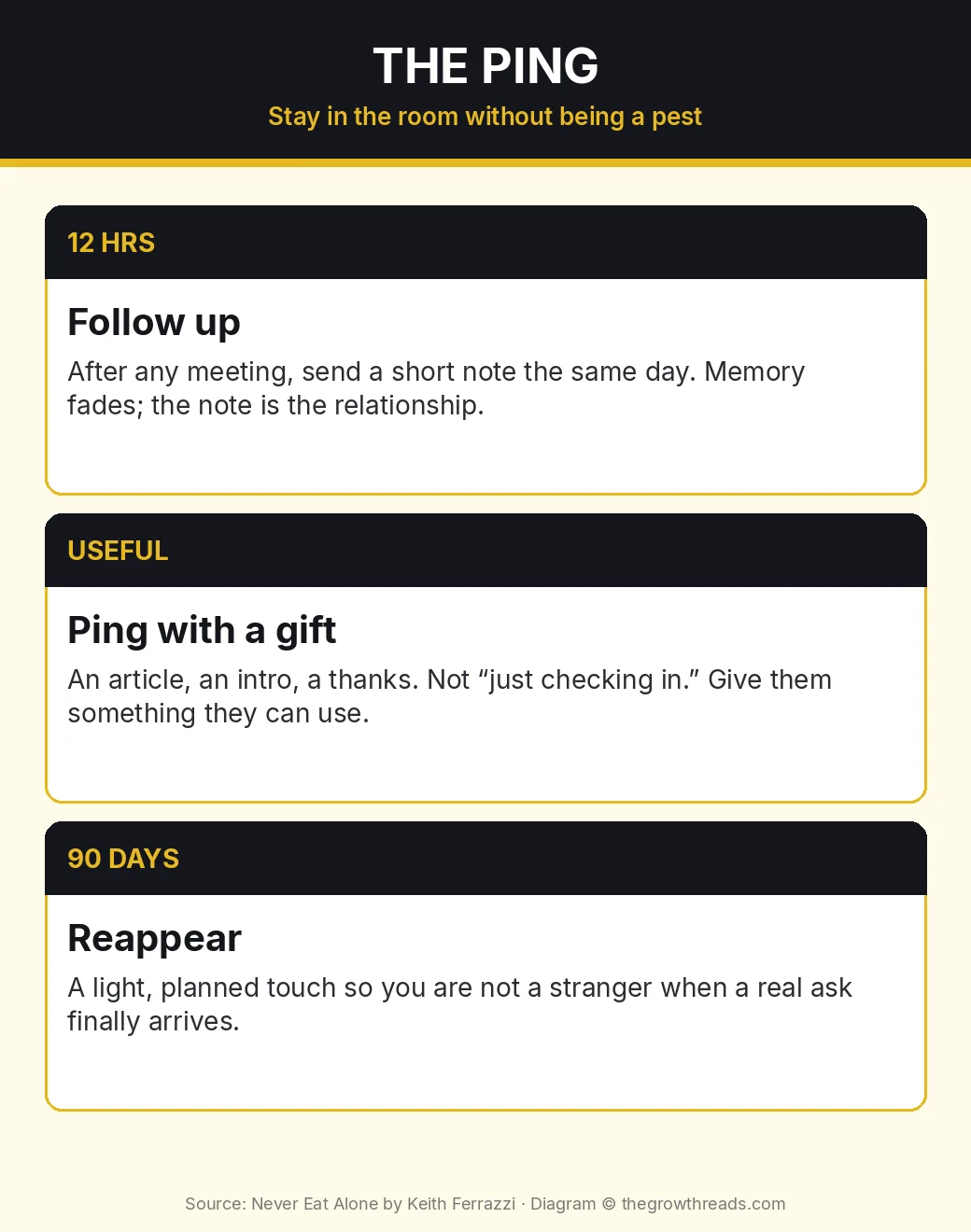
- Follow up in twelve hours: the note is the relationship. Memory fades by the next morning.
- Ping with a gift: an article, an intro, a thanks — not “just checking in.”
- Make the intro: connecting two people who should already know each other is the highest-value move.
- Meals are a venue: put people on the calendar. A feed is a ping channel, not a substitute for the table.
What is Never Eat Alone about?
Never Eat Alone is Keith Ferrazzi and Tahl Raz’s 2005 playbook (expanded 2014) for building a career through generous relationships: a mission, homework, twelve-hour follow-ups, planned pings, and meals as the default meeting instead of transactional card-collecting.
About the author
Keith Ferrazzi grew up in a working-class Pennsylvania family and learned rooms the hard way: caddying for people who already had them. He used those rooms — Yale, Harvard Business School, the youngest chief marketing officer at Starwood, a partner at Deloitte — then founded Ferrazzi Greenlight, a Los Angeles firm that coaches teams on collaboration. Never Eat Alone, written with journalist Tahl Raz, became the book that turned “who you know” into a practice instead of a pedigree. Raz later co-wrote Never Split the Difference with Chris Voss; the through-line is the same craft, different rooms: language that makes other people able to help you. Ferrazzi’s later work on co-elevation and teams sits on this foundation. The meal came first. Explore all Keith Ferrazzi book summaries →
Key concepts at a glance
| Concept | What it means | Use it when |
|---|---|---|
| Don’t keep score | Give without an invoice; returns arrive later, often from someone else | You are waiting to be owed before you help |
| Build it before you need it | Relationship equity is a slow curve, not a crisis spike | You only reach out when you want a job or a favor |
| Mission | A specific aim other people can actually assist | Your “networking” is wandering with a smile |
| Networking jerk | Card collector, name-dropper, first-meeting asker | You leave events with names and no relationships |
| Homework | Know the person and one useful overlap before you meet | You are “seeing what happens” in the room |
| Twelve-hour follow-up | A short, specific note the same day | Good conversations die by morning |
| The ping | A light, useful, planned touch — article, intro, thanks | You vanish for nine months, then need something |
| Conference commando | Arrive with a job: host, intro, follow up — don’t drift the booths | You treat events as a personality test |
Part 1: The mind-set — don’t keep score
Ferrazzi does not open with a banquet. He opens with a kid from Pennsylvania carrying bags for men who already belonged. Access is a skill you can practice, and the people who treat it as a personality usually inherited the room. He got into Yale, Harvard Business School, Starwood, and Deloitte the way people actually get in: someone walked him in, and he did not waste the walk.
The operating system is one sentence: do not keep score. Transactional networking is an invoice. Generous connecting is a surplus — you help because help is the job, and a living network routes the return from somewhere, not necessarily from the person you just helped. The people who keep a mental spreadsheet become exhausting to sit with.
Two rules sit under that. Build it before you need it: the day you are fired, launching, or ill is the worst day to start. And lead with a mission. “I want to meet interesting people” is fog. A mission is a sentence someone can act on — a product, a hiring problem, a piece of research, a city you are moving to. Without it, every coffee is improvisation. With it, people know how to be useful. The villain of the book is the networking jerk: the person who collects cards, asks on first contact, and treats names as inventory.
TGR Note: If your worry is that generosity gets you used, the research sibling is our Give and Take summary. Adam Grant maps givers, takers, and matchers, and why “otherish” givers last. Ferrazzi is the calendar; Grant is the diagnosis. For the value-first parable version, use The Go-Giver. Do not read all three as a way to delay the first useful ping.
Part 2: The skill set — homework, warmth, and the ping
The mind-set fails without mechanics. Ferrazzi’s mechanics are unromantic on purpose. Before you meet someone, do the homework: what they are building, where your missions overlap, one thing you can offer that is not a pitch. Warmth is not a speech. It is being more interested than interesting, sharing a real passion (food, a sport, a cause) so the meeting has a human handle, and refusing to perform status. Small talk is a door, not the house.
Then the part most people skip. Follow up within twelve hours, while the conversation still has a temperature. A short, specific note beats a polished essay next week. After that, ping. A ping is a light, useful touch — an article, an introduction, a thanks, a congratulations — on a cadence you can actually keep. Ferrazzi’s point is brutal and kind: if you only appear when you need something, you taught the room that you are a crisis. Ninety days of silence is how a warm meeting becomes a cold LinkedIn name.
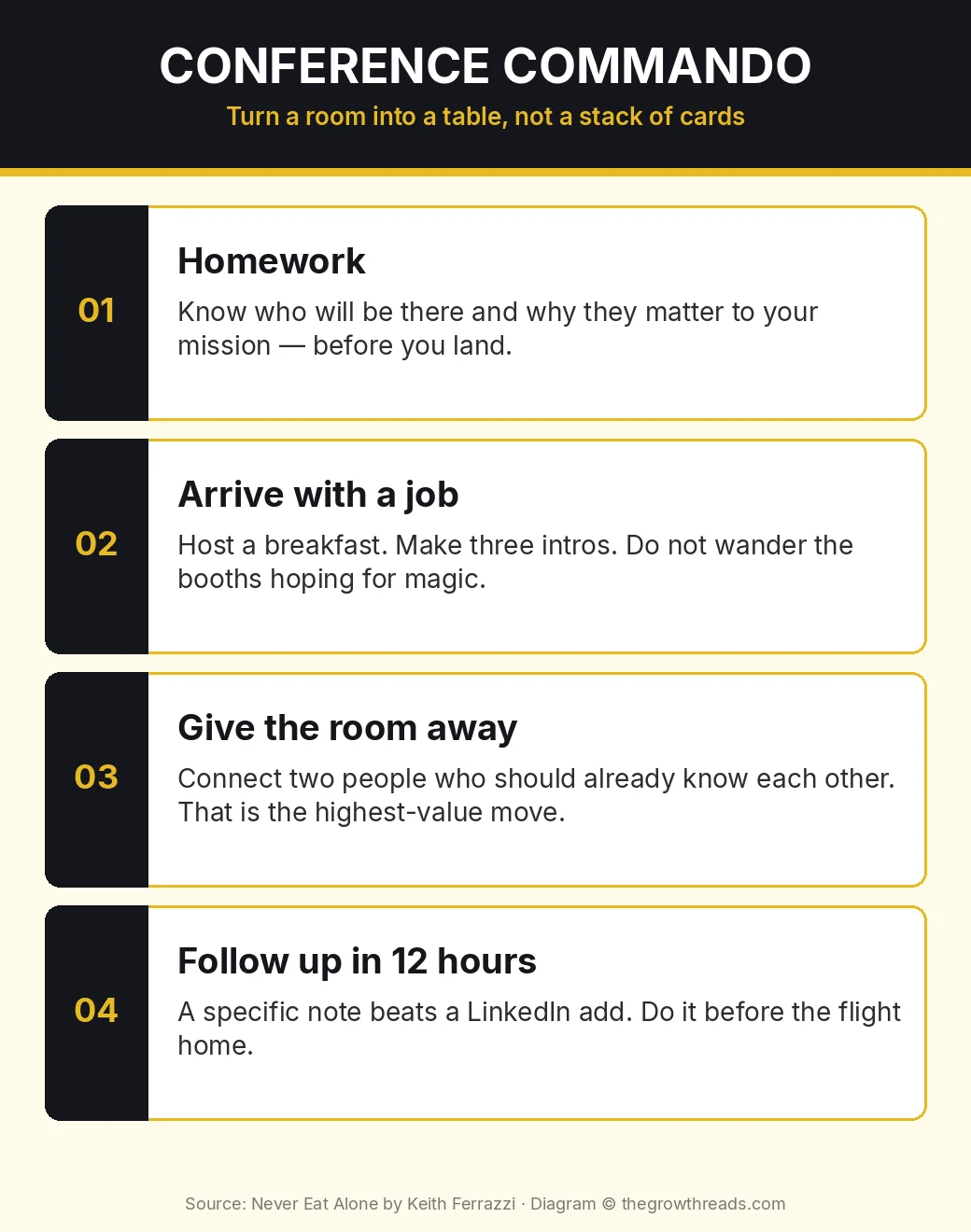
The title is a tactic. Meals — or a walk, or a coffee — are where attention is undivided. Put people on the calendar the way you put projects on it. Conference commando is the same muscle in a compressed room: know who will be there, arrive with a job, and follow up before the flight home.
TGR Note: If the freeze is not the calendar but the first two minutes of a conversation, start with How to Win Friends and Influence People or How to Talk to Anyone. Carnegie is the character layer. Ferrazzi assumes you can already be a person in the chair and need a system so the chair happens more than twice a year. For moving others without a used-car hangover, To Sell Is Human is the cousin on the pitch side.
Part 3: Turning the table into a life
Connecting is not a hobby you add after the “real work.” Ferrazzi treats health, job search, mentors, and reputation as the same circuit. Weak ties you have actually watered — the former colleague you pinged in April — are how jobs show up. Mentors are not a famous name you collect; they are a two-way relationship, and you should be a mentee and a mentor in the same season. Broadcasting a point of view (writing, speaking, a useful newsletter) is generosity at scale, not a personal brand costume.
The highest-value move in the book is almost never the ask for yourself. It is the introduction. Two people who should already know each other, put in the same thread with a clear why. You become infrastructure. That is why conference commando is not “work the room.” It is “give the room away.” Host the breakfast. Make the three intros. Leave with fewer cards and more people who would take your call because you made their week easier.
None of this requires a C-suite Rolodex. It requires a list of people who already exist in your life, a mission they can help, and the refusal to treat them as a vending machine.
TGR Note: If the missing piece is self-knowledge — what you should even be known for — our Managing Oneself summary is the quieter prequel. Drucker wants you to know your strengths before you collect rooms. Ferrazzi wants the rooms once you have a mission. For a daily habit OS so the ping actually happens, Atomic Habits is the cue-and-reward companion. Put the ping after an existing meal, not after a motivational speech.
Part 4: Connecting when the room is a screen
The expanded edition had to answer a fair objection: what if the room is Slack, a feed, a camera you can keep off. Ferrazzi’s answer is consistent. Digital tools are ping channels. They are excellent at the light touch, the article, the public congratulations, the warm DM that is really a handshake. They are terrible at substituting for undivided attention. A comment is not a meal. A connection request is not a follow-up. Content can be generosity at scale if it is actually useful; it is noise if it is a billboard for your need.
Remote work makes the crisis-only pattern worse. You can disappear for a year without even failing a lunch. The fix is the same cadence at a smaller size: a short video call with the camera on, a walking phone call, a quarterly coffee when the city allows it. The DM opens the door. The table is still the room.
Take the digital chapter as permission to ping from a laptop, not as permission to never sit with a person again. If every “relationship” in your week is a like, you have a scoreboard, not a network.
Who is Never Eat Alone best for — and who should read something else first?
Best for people whose work is already solid and whose bench of human beings is not. If you flinch at “networking,” this is the reframe: generosity plus a calendar. Job-changers, operators, consultants, and founders who only call when they need a round, a role, or a rescue will feel seen. The method transfers to a small city and a remote job. You still need a mission, a list, a ping, and a meal.
Read something else first if you freeze in the first two minutes — use How to Win Friends or How to Talk to Anyone. If you worry that giving is how you get emptied, start with Give and Take. If you do not yet know what you want to be known for, start with Managing Oneself. If you wanted a takedown of schmoozing, this is the wrong shelf — Ferrazzi is building a practice, not a roast.
Questions to reflect on
- Who would actually take my call this week — and who have I trained to hear from me only in a crisis?
- What is my mission in one sentence that another person could help on Tuesday?
- Where am I still keeping score (lunch, intros, “they never posted me back”) instead of running a surplus?
- What would a twelve-hour follow-up look like for the last useful conversation I had?
- Which two people in my world should already know each other, and why haven’t I introduced them?
🔥 Ready to build the table before you need a seat?
Get Never Eat Alone, then use the 7-day plan to send one useful ping and put one meal on the calendar.
How to apply Never Eat Alone (7-day plan)
- Day 1 — Write the mission. One sentence another person could help. Not “grow my network.” A project, a hire, a city, a question.
- Day 2 — List ten people you already know. Colleagues, former managers, the friend who always knows someone. No cold names yet.
- Day 3 — Send one useful ping. An article, a thanks, an intro. No ask. If you cannot name the gift, you are not ready to send.
- Day 4 — Follow up a conversation you already had. Twelve-hour rule, even if the meeting was last week and you missed the window. Specific, short.
- Day 5 — Put a meal or a twenty-minute call on the calendar. One person from the list. Camera on if it is video. Treat it as work, not leftover time.
- Day 6 — Make one introduction. Two people, a clear why, no spotlight on you. This is the highest-value move in the book.
- Day 7 — Set a 90-day ping cadence for ten names. A reminder, not a CRM novel. Review which ping actually felt like you. Keep that style. Drop the rest.
Frequently asked questions
What is Never Eat Alone about in one paragraph?
Never Eat Alone is Keith Ferrazzi’s playbook, written with journalist Tahl Raz, for treating relationships as career infrastructure rather than a personality trait. The load-bearing idea is generosity: you do not keep score, you do not wait until you need a favor, and you do not collect business cards like trophies. Meals, twelve-hour follow-ups, and planned pings are the mechanics. The 2014 expanded edition adds how to do this when half the room lives in a feed. This TGR summary turns that into a mind-set, a skill set, a concepts table, and a seven-day plan you can run without becoming a networking mascot.
Who should read Never Eat Alone?
Read it if you are competent at the work and still thin on people who will take your call, or if the word networking makes you flinch. Operators, job-changers, founders, and anyone who only reaches out in a crisis will recognize the trap. Skip it as a first book if you cannot yet hold a two-minute conversation — How to Talk to Anyone or How to Win Friends will help you show up as a person first. Skip it if you wanted a lab study of givers and takers; that is Give and Take. Ferrazzi is building a calendar of generosity, not a personality quiz.
How long does it take to read Never Eat Alone?
The expanded Currency edition is about four hundred pages — a comfortable week of forty-minute evenings, or roughly ten hours in a few sittings. It is a memoir-plus-playbook, not a dense textbook and not a parable you finish on a commute. This TGR guide is a twelve-minute reconstruction of the method, not a replacement for his stories. If you only have one evening, read the one-minute section, the key concepts table, and run Day 1 of the plan. Come back for the parts when you actually put a meal on the calendar.
Is Never Eat Alone just about networking events and schmoozing?
No. Conferences get a chapter because they are a compressed room, not because the book is a banquet-circuit manual. The real unit is the ordinary week: a meal, a useful ping, a follow-up within twelve hours, an introduction that helps two other people. Ferrazzi’s warning is the networking jerk — the person who collects names, asks on first contact, and keeps score. If your only picture of this book is a stack of business cards, you have the villain, not the method. The title is literal in one sense: meals are a venue. It is not literal permission to never sit with your own thoughts.
How is this different from How to Win Friends or Give and Take?
How to Win Friends is the character layer: warmth, names, genuine interest. Give and Take is the research layer: givers, takers, matchers, and how otherish givers avoid burnout. Never Eat Alone is the operating system: a mission, a list, a ping cadence, a follow-up rule, and the refusal to start the network on the day you need a job. They stack. Use Carnegie when you freeze in the room. Use Grant when you worry that generosity is being used. Use Ferrazzi when you already know you should be better at this and still have no calendar for it.
Does Never Eat Alone still work if you work remote or hate conferences?
Yes, with the expanded edition’s digital chapters taken seriously. A feed is a ping channel, not a substitute for the table. Comments, DMs, and posts can be generosity at scale; they do not replace a walk, a coffee, or a video call with a camera on. If you hate conferences, skip the commando chapter and keep homework, follow-up, and the ninety-day reconnect. Remote work makes the crisis-only pattern worse, not better — you vanish until you need something. The fix is still a short, useful, planned touch, not a louder profile.
What is the one idea to steal from Never Eat Alone this week?
Steal the ping, not a personality transplant. List ten people already in your life. Send one useful note today — an article, a thanks, an introduction — with no ask attached. Put a meal or a twenty-minute call on the calendar this week with one of them. Write a twelve-hour follow-up rule on a sticky note. Do not announce a networking era. Ferrazzi’s whole argument is that the table is built in ordinary weeks, and the worst day to start is the day you are desperate. Start while you do not need anything.
Related summaries
- Give and Take by Adam Grant
- The Go-Giver by Bob Burg and John David Mann
- To Sell Is Human by Daniel H. Pink
- Managing Oneself by Peter Drucker
- Best productivity books
How we analyze books: every book on The Growth Reads is read cover to cover, summarized in thousands of words of original analysis, and rated against our five-criteria rubric (lasting impact, evidence quality, practical application, writing & originality, external consensus). Read our full methodology.