

★★★★½ 4.6/5 — the conversation clinic for anyone still collecting compliments instead of facts.
Best for: Founders, PMs, and operators who talk to customers and need the next meeting to change what they build
Reading time: ~3 hours (136 pages) · this guide ~12 min
Difficulty to apply: Medium — the skill is not pitching when every nerve wants to
The Mom Test in one minute
If they are complimenting the idea, you have not learned anything yet. The Mom Test summary in one line is that: stop asking whether your business is a good idea. That question is broken. Everyone will lie at least a little — your mom because she loves you, a stranger because they want the meeting to end kindly. Rob Fitzpatrick’s 2013 field manual says the job is yours. Ask about their life, not your product. Ask about the last time the problem showed up. Talk less. Ignore compliments, fluff, feature ideas, and generics. Trust only what costs them something: time, reputation, or cash. You already know you should talk to customers. This is how those talks stop being a pep rally.
Key takeaways
- Never ask if the idea is good: that question forces a kind lie. Ask how they live now.
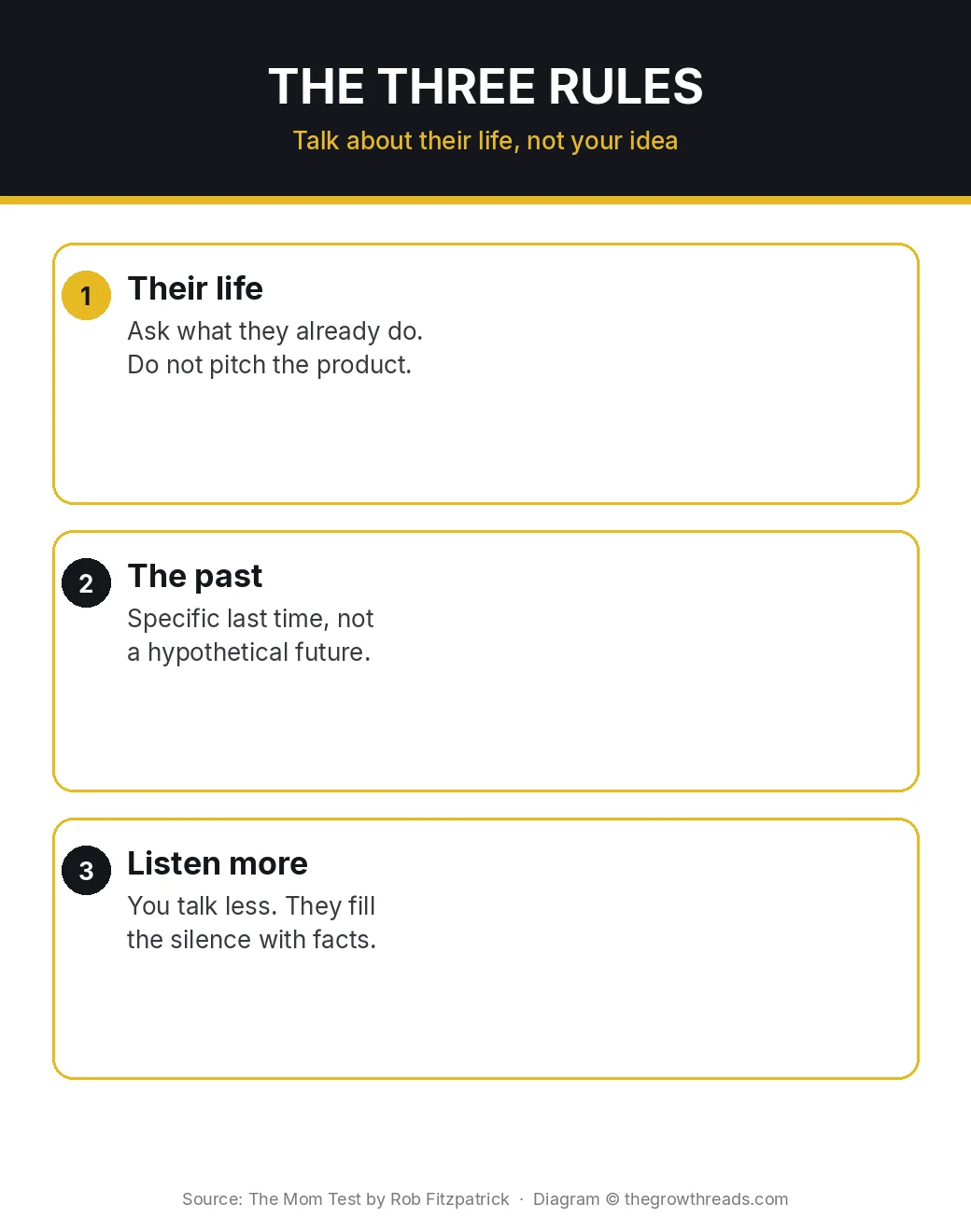
- Three rules: their life, not your idea; the past, not the future; you listen more than you talk.
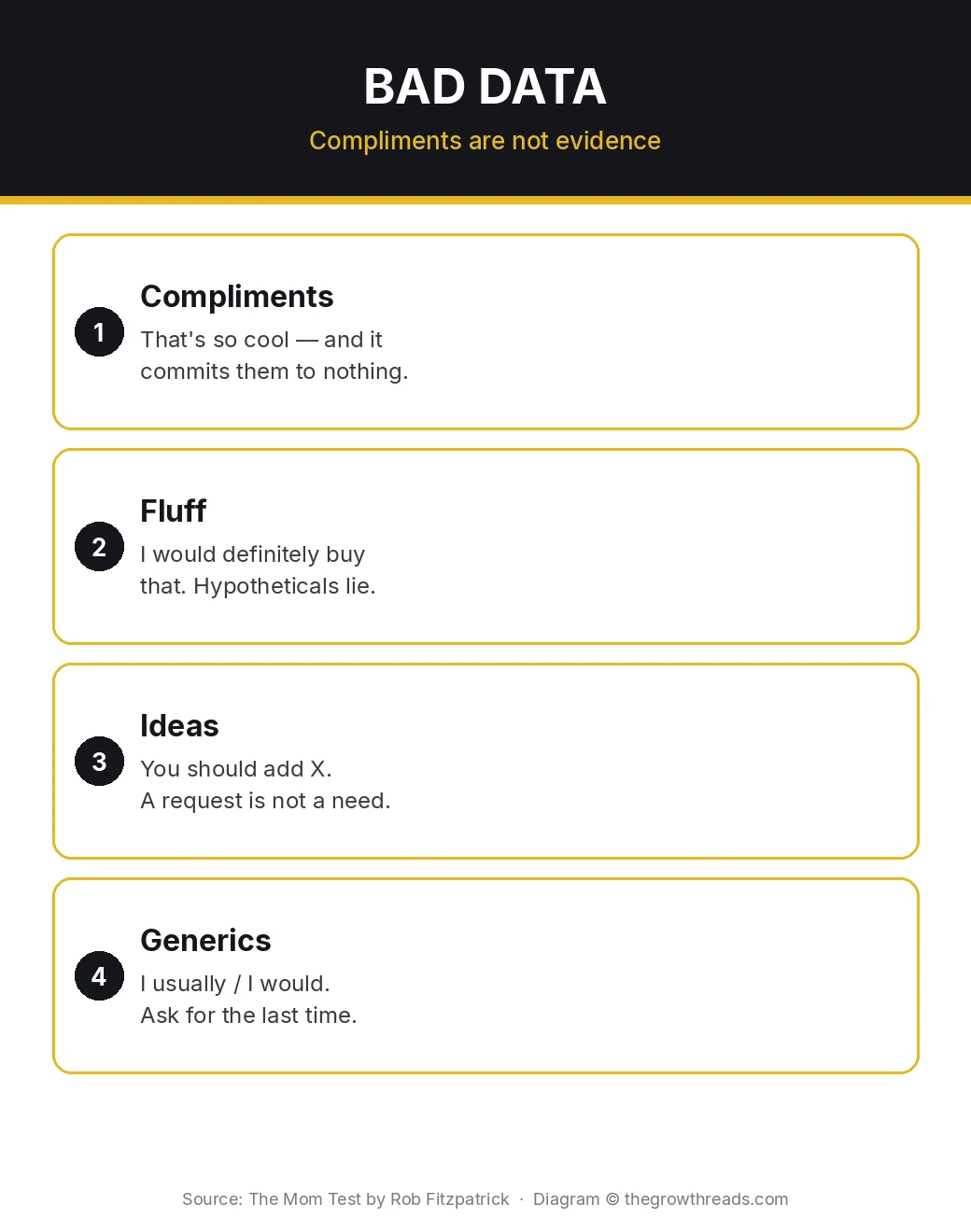
- Compliments are empty calories: “That’s so cool” commits them to nothing and feels like progress.
- Fluff is a hypothetical: “I would definitely buy that” is a mood, not a purchase.
- Ideas are not needs: a feature request can be a polite exit. Dig for the job underneath.
- Generics hide the truth: “I usually” and “I would” are fog. Ask for the last specific time.
- Commitment has a price: time, an intro, or money. Everything else is entertainment.
- Keep it casual: a formal pitch meeting makes people nicer and less honest.
- Prepare three questions: walk in knowing the facts you still lack, not the demo you want to give.
- Try to invalidate: a conversation that only confirms you is a conversation you steered.
What is The Mom Test about?
The Mom Test is Rob Fitzpatrick’s 2013 guide to customer conversations that collect facts instead of compliments: ask about their life and the last time a problem showed up, ignore fluff, and only trust commitments that cost time, reputation, or cash.
About the author
Rob Fitzpatrick is a founder who got tired of watching early-stage teams walk out of “customer interviews” glowing and no smarter. Someone described a product. Someone else said it sounded amazing. Nothing in the calendar changed. He wrote The Mom Test as a short manual you can finish in an evening and run on the next call. He later taught the method in founder workshops and wrote Write Useful Books. The through-line is evidence, not charisma. You may love the idea in private. In the conversation, you are a reporter looking for a Tuesday that already happened in their week. Explore all Rob Fitzpatrick book summaries →
Key concepts at a glance
| Concept | What it means | Use it when |
|---|---|---|
| The Mom Test | Ask about their life so even a kind person tells the truth | You are about to say “Would you use this?” |
| Bad question | Anything that asks them to judge your idea | The first sentence of the meeting is a pitch |
| Good question | A specific past event, a current workaround, a cost | You need a fact you can act on this week |
| Compliments | Warmth that feels like validation and is not | You leave smiling and cannot name a next step |
| Fluff | Hypotheticals and generics about a future self | You hear “I would” or “I usually” |
| Commitment | Time, reputation, or cash they actually spend | You are deciding whether the talk counted |
| Advancement | A next meeting that moves a real decision | The call ends with “keep me posted” |
| Casual framing | A chat, not a demo day, so they stop performing | They are being extra nice and extra vague |
Part 1: The Mom Test — stop asking if the idea is good
The title is a trap people walk into on purpose. They say you should not ask your mom whether the business is a good idea, because she loves you and will lie. Fitzpatrick’s point is sharper. You should not ask anyone that question. It puts the other person in a bind: tell the truth and hurt you, or be kind and send you home with a compliment. Most people pick kind. That is not a character flaw. It is the question doing its job badly.
The fix is not colder people. Change the subject from your idea to their life. What happened last time the problem showed up? What did they try, pay for, or abandon? Who else was in the room? How much time or money did it cost? Those answers exist whether or not you ever ship. Your mom will answer them honestly, because you are not asking her to grade a dream. You are asking what she already did on a Tuesday.
The three rules sit on one page and take a career to keep. Their life, not your idea. The past, not a hypothetical future. You listen more than you talk. The third rule is the one operators skip. Silence feels like failure, so they fill it with a feature list — a pitch wearing a question mark. If you are still explaining, you are not learning. When you hear “So what we do is,” stop. Ask what they did last month instead.
TGR Note: If the missing layer is a five-day prototype rather than a cleaner question, our Sprint summary is the lab. Knapp assumes you will talk to customers at the end of the week; Fitzpatrick is how those talks stay honest. For the older “build-measure-learn” loop filed in leadership, use The Lean Startup. A sprint that only collects compliments is a very expensive pep rally. Do not run both books as a way to delay the next specific question.
Part 2: Bad data — compliments, fluff, ideas, and generics
Once you stop asking the broken question, you still have to sort what comes back. Compliments are first because they feel like the meeting worked. “That’s so cool.” Smile, write nothing, and move on. A compliment is a fact about the mood in the room, not their world. If they can say it while holding a coffee and walking away, it does not count.
Fluff is the future self talking. “I would definitely buy that.” Hypotheticals cost no calendar and no budget. The escape hatch is always the same: when was the last time, what did they try, what did they pay? If they cannot point to a real episode, you have a kind person, not a customer. Generics sit next to fluff — “I usually,” “people like us.” Ask them to pick one Tuesday and stay there.
Ideas are the sneakiest category if you like building. “You should add Slack.” A request can be a gift. It can also be a polite exit. Dig for the job underneath. What were they doing? What happens if it never ships? If the answer is a shrug, it was social lubrication. Park the idea. Argue later, with the notes, when the compliment has worn off.
TGR Note: If the conversation is about moving someone toward a yes, our To Sell Is Human summary is the companion — Pink’s serving, not pushing. Fitzpatrick is earlier: you should not be selling until you know the job. For ideas that have to travel after the call, use Contagious. A STEPPS story still needs a real problem underneath. Do not use either book as a reason to skip the last-time question.
Part 3: Commitment and advancement — questions that cost them something
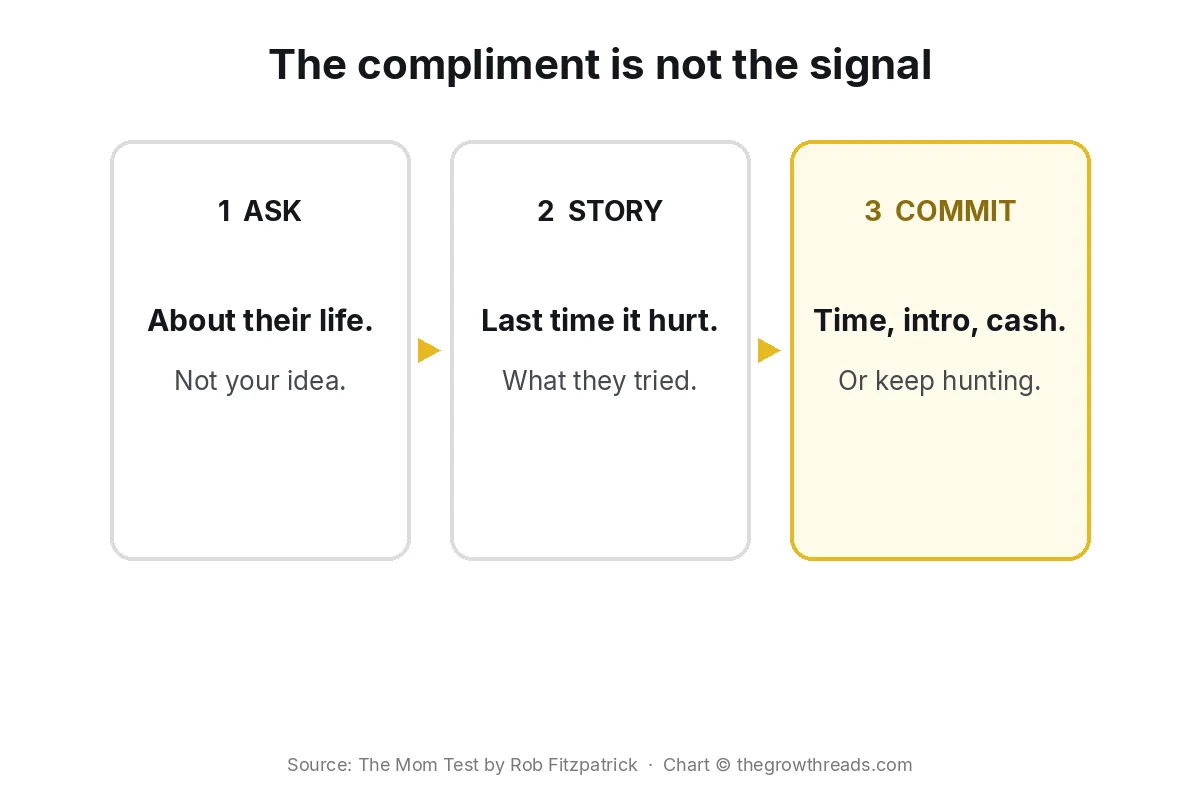
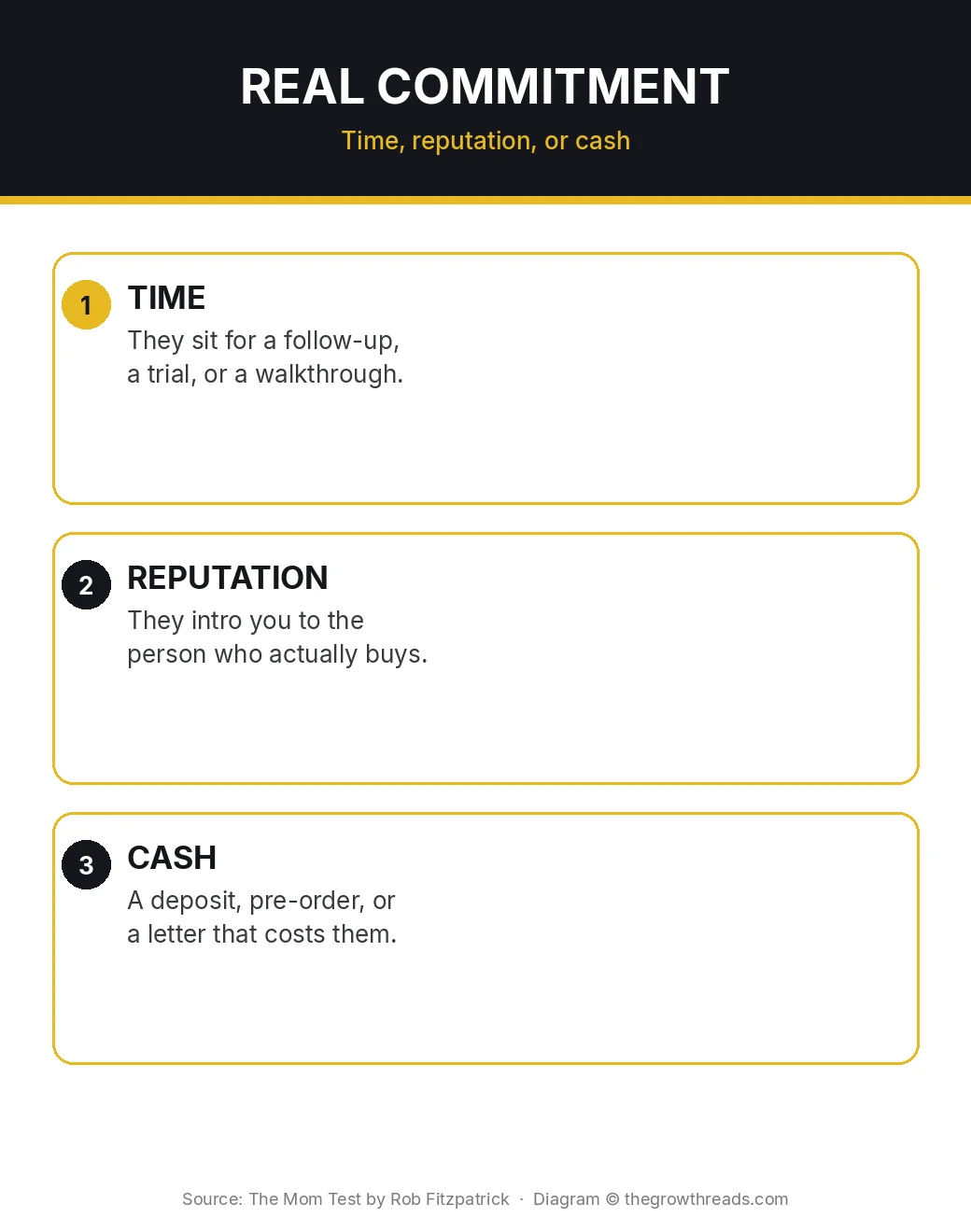
The middle of the book is the pass/fail test most teams never write down. Did this conversation cost them anything? Fitzpatrick names three currencies: time, reputation, and cash. Time is a follow-up they sit for, a trial, a walkthrough with the person who has the problem. Reputation is an intro or a forward that can come back to them. Cash is a deposit, a pre-order, a paid pilot. You do not need all three. You need one that is real.
A coffee is not automatically time. A coffee can be kindness. Advancement means the next meeting holds a decision, not a recap. “Keep me posted” is a compliment wearing a calendar. “Send a note to Priya — she owns this budget” is reputation. Write the currency you are listening for before you walk in. If you do not know what would count, every warm ending will feel like a win.
Plan the ask, not the pitch. What should they do if the story checks out — a second meeting, a look at last quarter’s workaround, a small deposit? Say it after you have listened. If they flinch, you learned more than another compliment would teach. If they say yes, you have a fact. The meeting that ends only with “this was great” is a meeting you still have to redo.
TGR Note: If you need a picture of how a large operator runs evidence before a bet, our Working Backwards summary is the Amazon-side process. Fitzpatrick is the conversation inside that process. For a calmer shop that still ships, Rework is the culture check — less theater, more product. Neither replaces a last-time question in a room with one human. Use them after you have a fact, not instead of hunting one.
Part 4: Keep it casual — notes, process, and the next conversation
Formal meetings make people nicer. A deck and a booked “customer interview” put the helpful face on. Fitzpatrick wants a chat — hallway, coffee, the last ten minutes of a meeting you already had. You are not hiding the company. You are refusing a performance. If they ask what you are building, say it in one sentence and return to their last Tuesday. The longer the pitch, the worse the data.
Warm intros beat “can I pick your brain about my startup.” Industry rooms work if you ask about their work, not your deck. The line that fails is the one that makes them responsible for your feelings. You are asking what already happened. That is a smaller ask, and it gets more yeses because it is easier to answer.
Notes are how the compliment dies overnight. Capture symptoms, workarounds, exact phrases, constraints, and who else is involved. Review the same day. Prepare three questions before the next talk — the facts you still lack, not the demo you still want to give. Then try to invalidate. If every conversation confirms you, you steered. The book is 136 pages. The loop is the product.
Who is The Mom Test best for — and who should read something else first?
Best for founders, product managers, and operators whose week already includes conversations with the people they hope to serve. If you keep leaving those talks energized and no smarter, this is the clinic. It is short enough to read before tomorrow’s call, and it transfers to discovery, a user interview, and the hallway chat you have been avoiding.
Read something else first if you do not yet have anyone to talk to — Who Not How is the people question. If you need a five-day build-and-test, start with Sprint. If the block is moving others after you already know the job, use To Sell Is Human. A full lean-startup OS or a negotiation manual is the wrong shelf — Fitzpatrick is the conversation habit. The Lean Startup and Never Split the Difference sit in leadership for a reason.
Questions to reflect on
- Which question did I ask last week that was really “do you like my idea?” in nicer clothes?
- What compliment am I still treating as a fact?
- When was the last time a customer spent time, reputation, or cash — not just kindness?
- What three facts do I still lack, and which conversation will get one of them this week?
- Where am I still pitching because silence feels like I am failing the meeting?
🔥 Ready to stop collecting compliments?
Get The Mom Test, then use the 7-day plan to run one conversation that costs them something real.
How to apply The Mom Test (7-day plan)
- Day 1 — Write the broken question. List the last three things you asked customers. Circle every item that is “would you / do you like / is this a good idea.” Do not schedule a new call yet. See the pattern on paper.
- Day 2 — Rewrite three questions. Turn each circled line into a last-time question: what happened, what they tried, what it cost. Put those three at the top of a blank notes doc.
- Day 3 — One casual conversation. No deck. Ten minutes. Their life only. You talk less than they do. If you pitch, you restart the clock.
- Day 4 — Sort the notes. Label each line compliment, fluff, idea, generic, or fact. Keep only facts. If the page is empty, that is the finding.
- Day 5 — Name the currency. For the next talk, write the commitment you are listening for: a follow-up, an intro, or a small yes that costs them. Say it out loud at the end.
- Day 6 — Try to invalidate. Ask the question that would make the idea weaker if answered honestly. Do not rescue the room.
- Day 7 — Ship one change. Change a sentence on a page, a question in the script, or a feature you were about to build. The loop is the product, not a new identity as a researcher.
Frequently asked questions
What is The Mom Test about in one paragraph?
The Mom Test is Rob Fitzpatrick’s 2013 field manual for customer conversations — the book people mean when they search for a The Mom Test summary. The load-bearing idea is that “is this a good idea?” is a broken question: everyone will lie a little, so you ask about their life and the last time the problem showed up. Compliments, fluff, ideas, and generics are bad data. Time, reputation, and cash are the commitments that count. This TGR guide turns that into rules, a filter, a commitment test, and a seven-day plan you can run on a conversation already on the calendar.
Who should read The Mom Test?
Read it if you already talk to customers, users, or buyers and those talks keep ending in warmth instead of facts: founders, PMs, consultants, anyone whose week includes discovery. Fitzpatrick is for people who need the next meeting to change the work, not for people hunting a personality transplant. Skip it as a first book if you have no one to call — Who Not How is the people question. Skip it if you need a five-day prototype lab; Sprint is that calendar. Negotiation and full lean-startup operating systems live on other shelves. The Mom Test is the conversation habit you run inside those systems.
How long does it take to read The Mom Test?
The CreateSpace paperback is about 136 pages — a single evening, or roughly three hours in two sittings. It is a field guide, not a dense textbook and not a parable you finish on a commute while taking no notes. Some process chapters you can skim once you have the three rules and the bad-data list. This TGR guide is a twelve-minute reconstruction of the method, not a replacement for his examples. If you only have one evening, read the one-minute section, the concepts table, and run Day 1 of the plan on the last three questions you actually asked.
Is The Mom Test still relevant in 2026?
Yes, more than the copyright page suggests. The broken question now arrives on Zoom, in a Slack huddle, and in a form that asks “how excited are you?” Compliments are faster than they were in 2013. Machine-written outreach makes the pitch even easier to dump into the first two minutes. Fitzpatrick’s test still holds: if they did not spend time, reputation, or cash, you learned a mood. What aged is some startup furniture, not the demand that a conversation produce a fact. Use this The Mom Test summary as the filter on whatever script you were about to read aloud — including the one a tool drafted.
How is this different from The Lean Startup or Sprint?
The Lean Startup is a company loop: build, measure, learn. Sprint is a five-day lab that ends in a Friday test. The Mom Test is the conversation inside those loops. Ries tells you to get out of the building. Knapp tells you to test a prototype. Fitzpatrick tells you how to stop the other person being kind instead of useful. They stack. Use Ries for the OS, Knapp for a week with a clock, Fitzpatrick the night before the interview. Do not read all three as a way to delay one last-time question.
Does The Mom Test help with sales calls and user interviews?
That is half the point. A discovery call that opens with a deck is a pitch. A user interview that asks “would you use this?” is a compliment trap. Fitzpatrick’s rules are the same in both rooms: their life, the past, you listen. Sales teams already know they should not talk the whole hour. This book names the data that still sneaks through when they do listen — fluff dressed as a verbal yes. The fix is not a better opener alone. Write three questions, sort the notes the same day, and only count a commitment that costs them. If the CRM says “interested,” ask what they scheduled.
What is the one idea to steal from The Mom Test this week?
Steal the last-time question, not a new identity as a researcher. Take one conversation you already have this week. Do not ask if they like the idea. Ask when the problem last showed up, what they did, and what it cost. Write the answer in their words. If they cannot name a Tuesday, you do not have a customer yet — you have a kind person. Then decide, before you hang up, what commitment would count: a follow-up, an intro, or a small yes that costs them. Fitzpatrick’s whole argument is that the truth is already in their life. Your job is to stop asking them to grade yours.
Related summaries
- Sprint by Jake Knapp
- To Sell Is Human by Daniel H. Pink
- Contagious by Jonah Berger
- Working Backwards by Colin Bryar & Bill Carr
- Best productivity books
How we analyze books: every book on The Growth Reads is read cover to cover, summarized in thousands of words of original analysis, and rated against our five-criteria rubric (lasting impact, evidence quality, practical application, writing & originality, external consensus). Read our full methodology.