

★★★★½ 4.5/5 — charisma is a skill you load, not a personality you wait for.
Best for: Managers, founders, and operators who freeze, over-talk, or vanish in rooms
Reading time: ~7 hours (273 pages) · this guide ~12 min
Difficulty to apply: Medium — the drills are small; the honesty about your internal state is not
The Charisma Myth in one minute
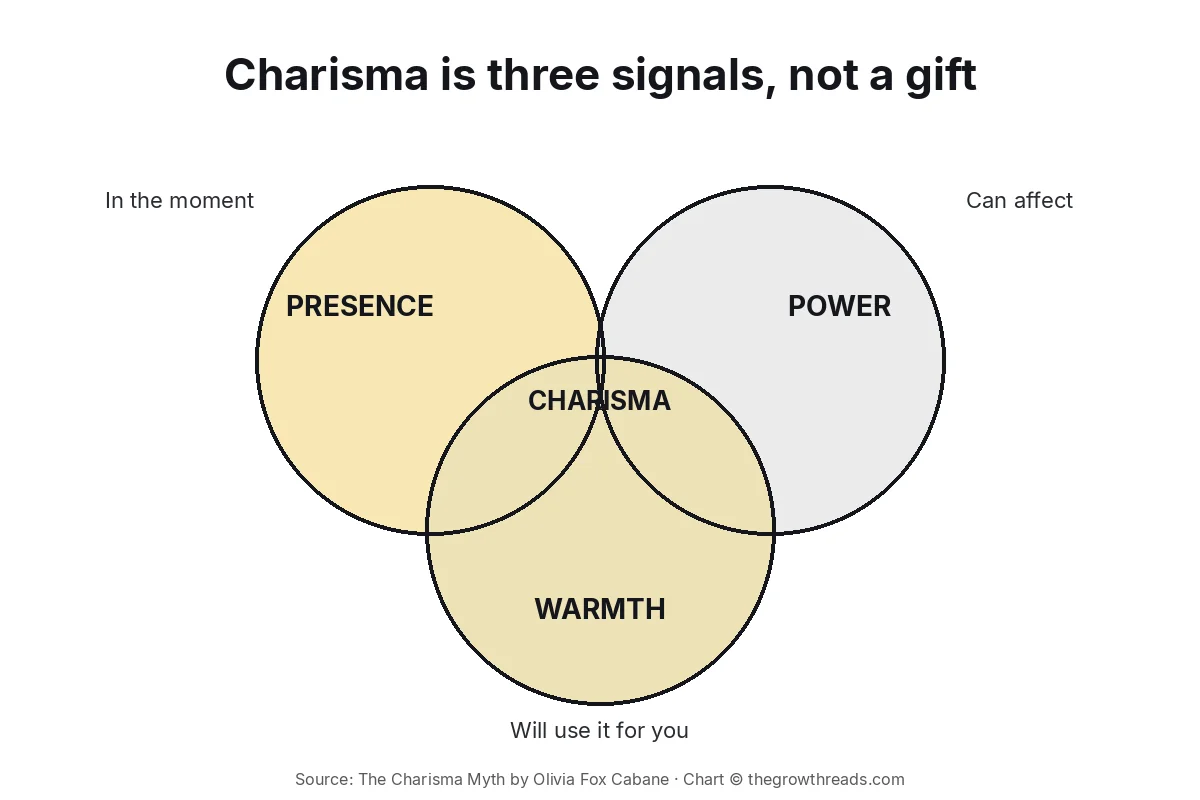
The myth is that some people walk in already magnetic. Olivia Fox Cabane’s argument is colder and more useful: what you call charisma is three signals people read in seconds — presence, power, and warmth — and those signals are behaviors you can load. Presence is being in the room instead of in your next line. Power is the sense you can affect the world. Warmth is the sense you will use that power for them, not on them. Drop one and the room reads you as distracted, threatening, or nice-and-forgettable. This TGR summary turns the book into a concepts table, three diagrams, and a seven-day plan you can run before a real meeting.
Key takeaways
- Charisma is a skill: it is a stack of behaviors, not a trait you either inherited or missed.
- Three signals: presence, power, and warmth. The room reads the missing one first.
- Incongruence kills tips: a “confident” pose with a panicked mind still reads as panic.
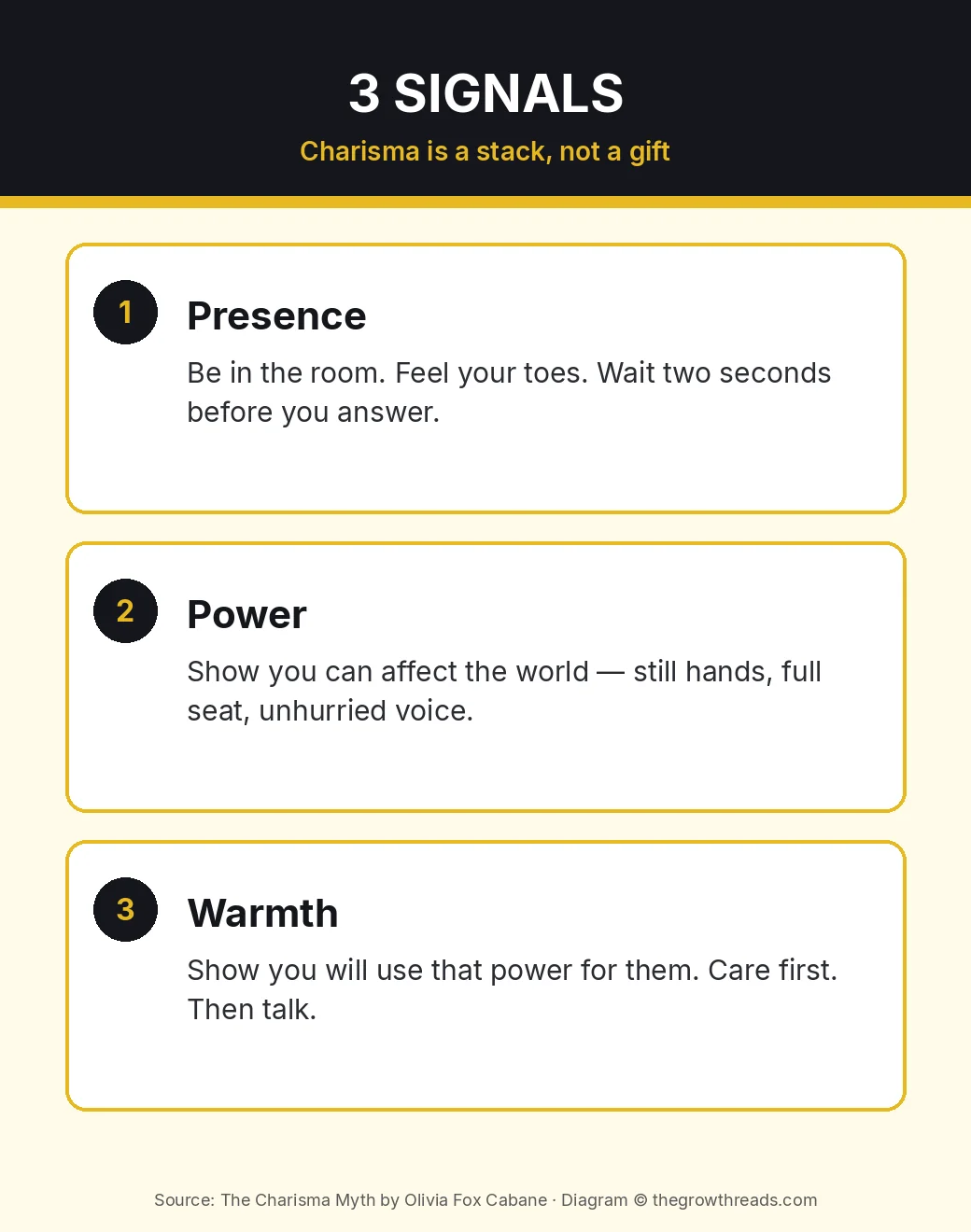
- Presence is the floor: feel your feet, wait two seconds, stop drafting the reply while they talk.
- Power without warmth is a threat: still hands and a slow voice only work if they believe you are for them.
- Discomfort broadcasts: heat, hunger, and self-attack leak into your face before your words do.
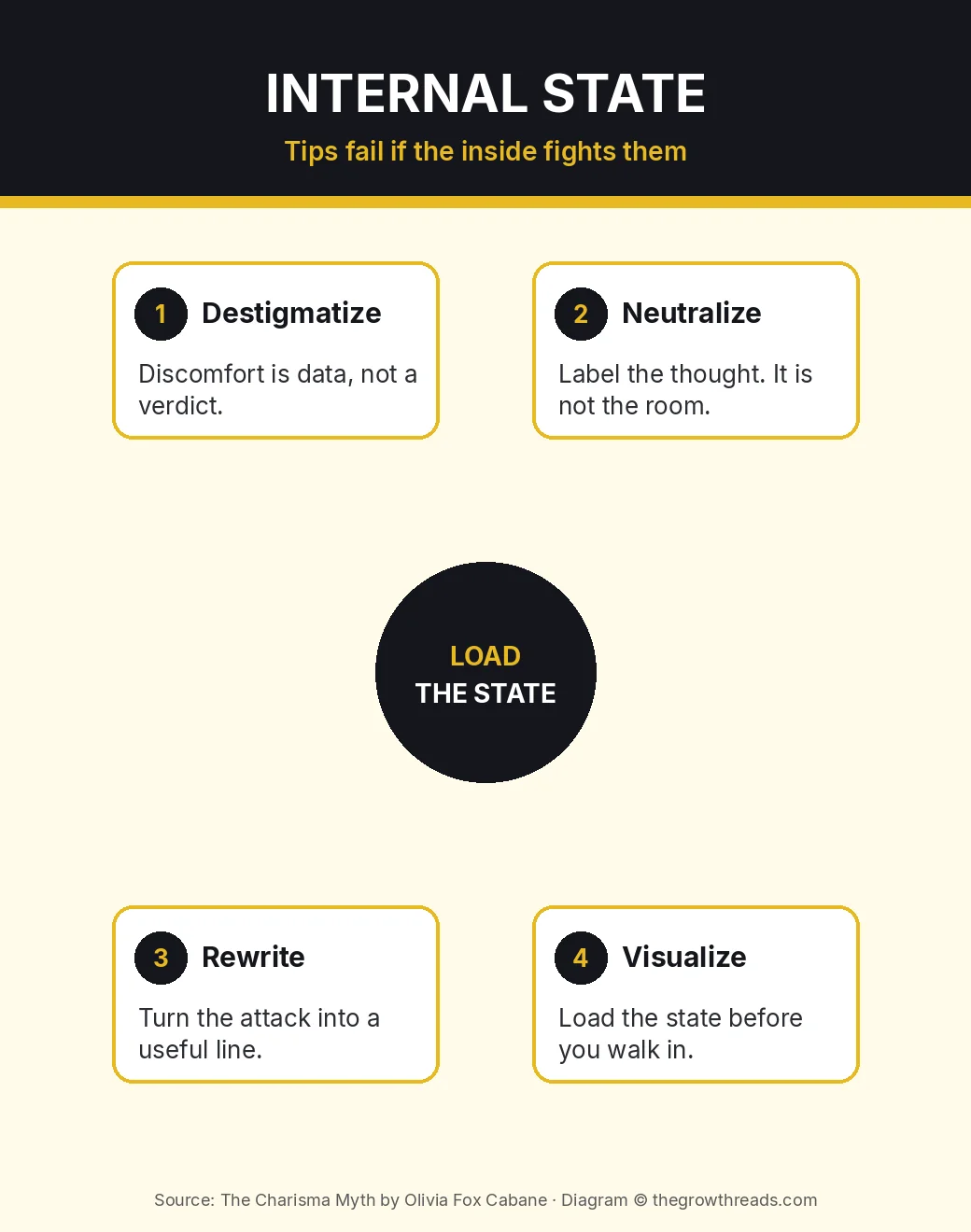
- Load the state: destigmatize, neutralize, rewrite, visualize — then walk in.
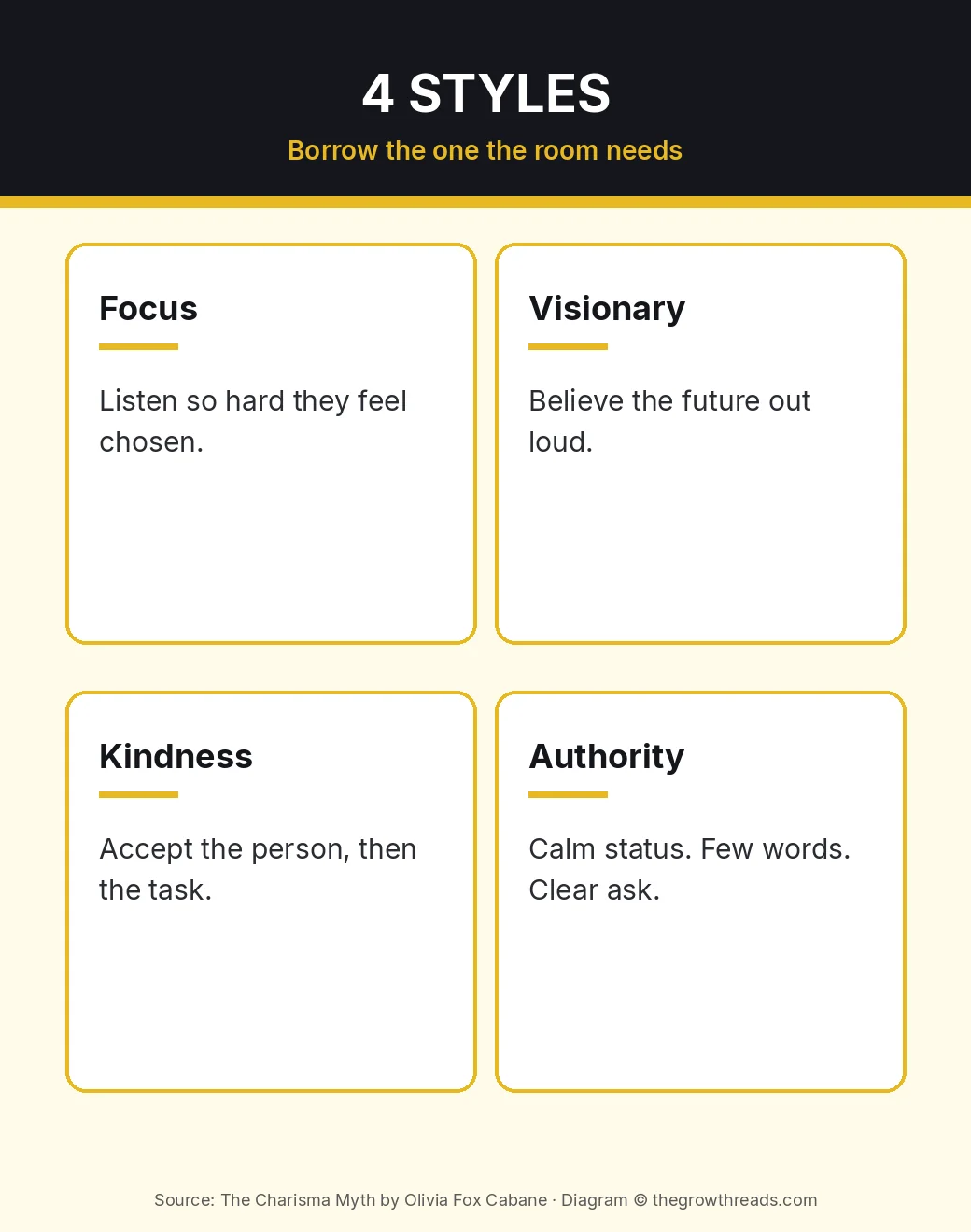
- Four styles: focus, visionary, kindness, authority. Borrow one for the room; do not collect all four as an identity.
- Listening beats performing: focus charisma is often the highest-leverage move in a one-to-one.
What is The Charisma Myth about?
The Charisma Myth is a 2012 practical book about personal magnetism as three learnable signals — presence, power, and warmth — plus the internal drills that make those signals believable in the next meeting, pitch, or hard conversation.
About the author
Olivia Fox Cabane is a French-American writer, speaker, and coach who treated charisma as a trainable leadership skill. She lectured at Stanford, Harvard, MIT, Yale, and the United Nations, and served as Director of Innovative Leadership for Stanford’s student accelerator StartX, where founders had technical brilliance and still lost rooms. She later co-founded The KindEarth.Tech Foundation and co-wrote The Net and the Butterfly. The Charisma Myth (Portfolio, 2012) made her core claim public: magnetism is a set of behaviors you can load, not a personality you wait to grow into. The drills come from coaching people who already knew the advice and still froze. Explore all Olivia Fox Cabane book summaries →
Key concepts at a glance
| Concept | What it means | Use it when |
|---|---|---|
| Presence | Attention that does not leak to your next line or your phone | You nod, then ask a question they already answered |
| Power | The sense you can affect outcomes — still body, unhurried voice | You know the material and still sound like you are asking permission |
| Warmth | The sense you will use power for them, not on them | People go quiet after you speak, or they over-explain |
| Incongruence | Body and mind broadcasting two different stories | You use a “power pose” and still feel the room pull away |
| Destigmatize | Treat discomfort as data, not a verdict on your worth | A hot room or a tight collar hijacks the first five minutes |
| Neutralize / rewrite | Label the attack-thought, then replace it with a useful line | You hear “they think I’m a fraud” and start performing |
| Four styles | Focus, visionary, kindness, authority — tools, not identities | You use the same intensity in a 1:1 that you use on a stage |
| Responsibility transfer | Hand the outcome to a larger purpose so your ego can sit down | You make the meeting about proving you, not serving the work |
Part 1: The myth — presence, power, and warmth
Cabane opens by killing the origin story most of us carry: that charismatic people were simply born with a glow, and the rest of us should stand closer to the wall. What the room actually reads is a cluster of behaviors. Some of those behaviors are microscopic — a two-second pause, eyes that stay, a mouth that is not already forming the rebuttal. Some are structural: do you take the chair as if you belong in it, or do you perch on the front edge like a guest who might be asked to leave?
The three-signal model is the spine of the book. Presence is the foundation because without it the other two look like acting. You cannot fake “I’m with you” while your attention is in a humiliation replay from this morning. Cabane’s first drill is almost insultingly physical: feel your toes, then wait two seconds before you answer. Power is not volume. It is the perception that you can affect the world — fewer fidgets, a voice that does not climb at the end of every sentence, a body that occupies the seat. Warmth is the permission slip for that power. Without it, the same stillness reads as predatory. With it, the same stillness reads as safety.
She is blunt about incongruence. People detect the gap between the script and the state. A list of “charismatic gestures” fails because you can open your palms and still be bracing for rejection. The work is internal first. Cabane writes that charisma is “the result of specific nonverbal behaviors, not an inherent or magical personal quality.” The rest of the book is how to make those behaviors true enough to use mid-sentence.
TGR Note: If your real leak is attention residue — you are still in the last tab while this human is talking — start with our Deep Work summary and park the previous task on paper. Cabane’s presence drill is the social version of that park. Atomic Habits is the daily version: make the two-second wait a tiny default, not a personality project.
Part 2: Obstacles and the internal toolkit
The second movement of the book is a relief for anyone who has tried to “be more confident” and then watched their face do something else. Cabane catalogs the obstacles as physical and mental, and she refuses to treat them as character flaws. A hot room, a tight waistband, low blood sugar, a buzzing phone in a pocket — all of it writes itself onto your forehead. The room does not know you are overheated. The room knows you look like you want to leave. Destigmatizing discomfort is the first move: this sensation is information, not a verdict that you do not belong here.
Mental obstacles are louder. Self-criticism, comparison, and the highlight reel of the last time you misspoke will steal presence faster than any rival in the room. Cabane’s sequence is destigmatize, neutralize, rewrite. Neutralize means labeling the thought as a thought — “this is the fraud story” — so it stops pretending to be the room’s opinion. Rewrite means swapping the attack for a line you can actually use: “I am here to make this decision easier,” not “I must impress them.” Visualization is the warm-up: you load the state in the corridor, the way a speaker checks a mic. Responsibility transfer is the ego-off switch — handing the outcome to the work, the team, or a purpose larger than your performance — so your nervous system can stop auditioning.
None of this is a request to become a different person by Friday. It is a request to stop sending the room a second message — usually “please like me” or “please don’t see that I am scared.” People can like you and still not follow you. They follow the person whose inside and outside tell the same short story.
TGR Note: Warmth without credibility is a pleasant stall. If people like you and still add extra checks, pair this chapter with our Speed of Trust summary — integrity, intent, capabilities, results. Cabane loads the signal in the room; Stephen M. R. Covey prices what happens when that signal is missing for a quarter. Do not use visualization as a substitute for a kept promise.
Part 3: Four charisma styles
Once the three signals are available, Cabane offers four mixes. Focus charisma is presence plus warmth aimed at one person: you listen so completely they feel chosen. It is the style of a great one-to-one, and it is the one most operators underuse because they think charisma means talking. Visionary charisma is belief you are willing to say out loud — a future described without apology. Kindness charisma is acceptance first. The person is not a problem to solve before they are a person. Authority charisma is calm status: fewer words, a still body, a request that does not trail off into a question mark.
The trap is treating a style as your new personality. Authority in a hurt conversation feels like a freeze. Kindness in a pricing meeting can sound like you will not choose. Cabane’s instruction is to pick the style the room is starving for, run it for one conversation, then drop it. You are borrowing a tool, not becoming “an authority person.”
TGR Note: If your default is taking the air, read Give and Take before you load more authority. Adam Grant’s otherish giver is warmth with a spine. Never Eat Alone is the generous-connecting version: the meal is the meeting, and scorekeeping kills the signal. Cabane tells you how you land in the minute; Ferrazzi and Grant tell you what the relationship is for after the minute.
Part 4: First impressions, rooms, and hard conversations
The last movement is application. First impressions are short, so Cabane treats clothing as a costume for the role. Handshake, eyes, the first ten seconds of stillness are the trailer for the three signals. Then she flips the usual advice: speaking with charisma is mostly listening with charisma. Focus is often the highest-leverage style in a one-to-one because almost nobody else is offering it. Voice work is simple: warmth in the tone, a pause long enough to be heard, less climbing at the ends of sentences.
Difficult situations get their own chapter because this is where the toolkit either pays or reveals that you only rehearsed the easy room. Delivering bad news needs presence plus warmth, then a clear ask — not a cushion of fifty words. An apology needs ownership without a speech about your intentions. Criticism you receive needs the neutralize-and-rewrite move so you do not defend your identity in real time. Crisis needs authority that is still warm: few words, a next action, no theatrical calm. The through-line is the same as Part 1. Load the state. Then use fewer, truer behaviors. The book’s gift is not a new personality. It is a pre-flight checklist you can run in a stairwell.
Used that way, the book stays a productivity tool: meetings cost less time because people stop decoding you. You are not collecting charm. You are removing friction from the next conversation.
Who is The Charisma Myth best for — and who should read something else first?
Best for managers, founders, and operators who already know the people-skills slogans and still freeze, over-talk, or disappear. If your week is full of rooms where the outcome depends on whether people feel you are here, capable, and on their side, this is the manual.
Read something else first if you still interrupt, forget names, and make every chat a pitch — start with How to Win Friends and Influence People. If you think charisma means taking the room, read Give and Take so you do not load power without warmth. If you cannot yet keep a visible promise, start with The Speed of Trust. If the issue is residue from the last tab, Deep Work will pay faster than a new handshake.
Questions to reflect on
- In your last important conversation, which signal leaked first — presence, power, or warmth?
- What physical discomfort do you treat as a personality problem instead of a fixable input?
- Which of the four styles do you overuse because it feels like “you”?
- What would change if you waited two seconds before every answer in tomorrow’s 1:1?
- Whose outcome are you willing to serve so your ego can sit down for one meeting?
🔥 Ready to load the state before the next room?
Get The Charisma Myth, then use the 7-day plan to pick one missing signal and run it in a real conversation.
How to apply The Charisma Myth (7-day plan)
- Day 1 — Presence. In one conversation, phone face-down. Feel your toes. Wait two seconds before you answer.
- Day 2 — Warmth. Ask one genuine question you do not turn into a pitch. Notice the urge to jump in, and don’t.
- Day 3 — Power. Sit fully in the chair. Slow the first sentence. Keep your hands still for the opening two minutes.
- Day 4 — Name the leak. After a meeting, write which signal dropped. One line. No autobiography.
- Day 5 — Load the state. Before one meeting, destigmatize one discomfort, neutralize one attack-thought, rewrite it.
- Day 6 — Borrow a style. Pick focus, visionary, kindness, or authority for one conversation the room is starving for.
- Day 7 — Hard room. Use the checklist on one difficult conversation: presence, then the missing signal, then a clear next ask.
Frequently asked questions
What is The Charisma Myth about in one paragraph?
The Charisma Myth is Olivia Fox Cabane’s field manual for treating personal magnetism as a set of behaviors instead of a birthday gift. People read three signals in seconds: presence (are you here), power (can you affect the world), and warmth (will you use that power for them). The book then shows why body-language tips collapse when your internal state fights them, how to destigmatize discomfort and load a useful state, and how to borrow four styles — focus, visionary, kindness, and authority — for the room in front of you. This TGR summary adds a concepts table and a seven-day plan.
Is charisma innate, or can you learn it?
Cabane’s whole premise is that you can learn it. What looks like a personality trait is a stack of nonverbal behaviors that broadcast presence, power, and warmth. You do not need a new childhood. You need a loadable state: feel your feet, still your hands, and decide the other person is safe with you before you speak. The skill is not a permanent costume. It is something you put on for the next conversation, the way an athlete warms up. People who seem “naturally” magnetic are usually people who have rehearsed those signals until they no longer look like rehearsal.
What do presence, power, and warmth actually mean?
Presence is attention that does not leak. The other person can feel when you are drafting your reply, scanning the door, or living in a humiliation replay. Power is the perception that you can change outcomes — not volume, not status props. Warmth is the perception that you will use that power in their interest. Drop presence and you read as fake. Drop power and you read as sweet and skippable. Drop warmth and you read as a threat. Charisma is the overlap. Cabane’s practical move is to pick the missing signal and load it on purpose, instead of trying to “be more charismatic” as a vague personality upgrade.
What are the four charisma styles in The Charisma Myth?
Focus charisma is listening so completely the other person feels chosen. Visionary charisma is unembarrassed belief in a future you can describe. Kindness charisma is acceptance first — the person, then the task. Authority charisma is calm status: fewer words, a still body, a clear ask. Cabane’s useful warning is that styles are tools, not identities. Authority in a hurt one-to-one feels like a freeze. Kindness in a decision meeting can sound like you will not choose. Pick the style the room is starving for, run it for one conversation, then drop it. Do not collect all four as a personality project.
How long does it take to apply The Charisma Myth?
You can run the first drill today. Presence is a two-second wait and a body check — toes, seat, breath — before you answer. Warmth is one genuine interest question you do not turn into a pitch. Power is sitting fully in the chair and slowing the first sentence. Cabane’s deeper work is the internal toolkit: destigmatize discomfort, neutralize the attack-thought, rewrite it, and visualize the state before you walk in. That is a week, not a personality transplant. The 7-day plan in this summary is built so each day has one small, visible move in a real room, not a journaling hobby.
How does The Charisma Myth compare with How to Win Friends?
Dale Carnegie’s How to Win Friends is the classic people-skills floor: remember names, be interested, let the other person talk. Cabane assumes you already know that advice and still freeze, over-perform, or vanish, because your body is broadcasting a different story than your words. She works the internal state that Carnegie leaves implied. If you interrupt, forget names, and make every chat a pitch, start with Carnegie. If you are already polite and the room still does not trust you, Cabane is the next book. They stack. They are not substitutes, and Cabane is not a takedown of the older title.
Who should read The Charisma Myth — and who should wait?
Read it if you lead meetings, pitch, negotiate, or do one-to-ones where the outcome depends on whether people feel you are here, capable, and on their side. It is especially useful for operators who hide in slides, founders who over-talk, and managers who confuse kindness with having no ask. Wait if you cannot yet keep a simple promise — start with The Speed of Trust — or if your real problem is attention residue between tasks, in which case Deep Work will pay faster. If you think charisma means taking the room, read Give and Take first so you do not load power without warmth.
Related summaries
- Never Eat Alone by Keith Ferrazzi
- Give and Take by Adam Grant
- The Go-Giver by Bob Burg and John David Mann
- The Speed of Trust by Stephen M. R. Covey
- Best productivity books
How we analyze books: every book on The Growth Reads is read cover to cover, summarized in thousands of words of original analysis, and rated against our five-criteria rubric (lasting impact, evidence quality, practical application, writing & originality, external consensus). Read our full methodology.