

★★★★½ 4.5/5 — Yes is the destination. No is how you get there. Collect the nos on purpose.
Best for: Sellers, founders, and anyone who coasts after a hot morning because the quota already looks safe.
Reading time: ~2 hrs (guide: 12 min)
Difficulty to apply: Easy to set a no-quota today; hard to keep asking after three yeses.
Go for No in one minute
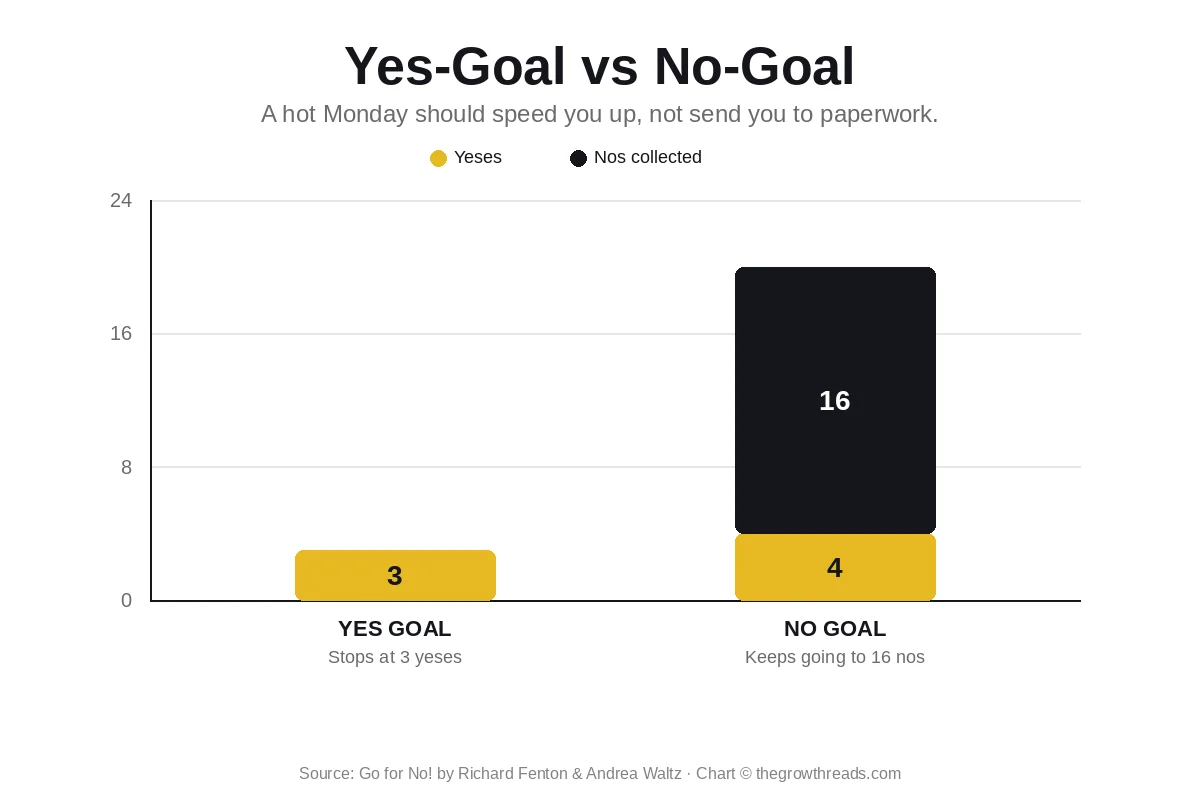
Stop chasing yes. Go for no. Richard Fenton and Andrea Waltz’s argument is a flip, not a pep talk. Most people set a goal for signatures, hit it, and reward themselves with paperwork. A no-quota keeps you in the conversation after a 3-for-3 Monday, because you are still behind on rejections. You control attempts. You do not control yes. The yeses ride along when the attempt rate stays high.
Go for No! (Courage Crafters, 2007) is an eighty-page parable: copier salesman Eric Bratton wakes up in a house that belongs to a future version of himself and learns why failing and failure are not the same word. It is not a close script. If you already know what to say and still treat the first no as a verdict, start here.
Key takeaways
- Yes is the destination: No is the path. You cannot skip the nos and keep the yeses.
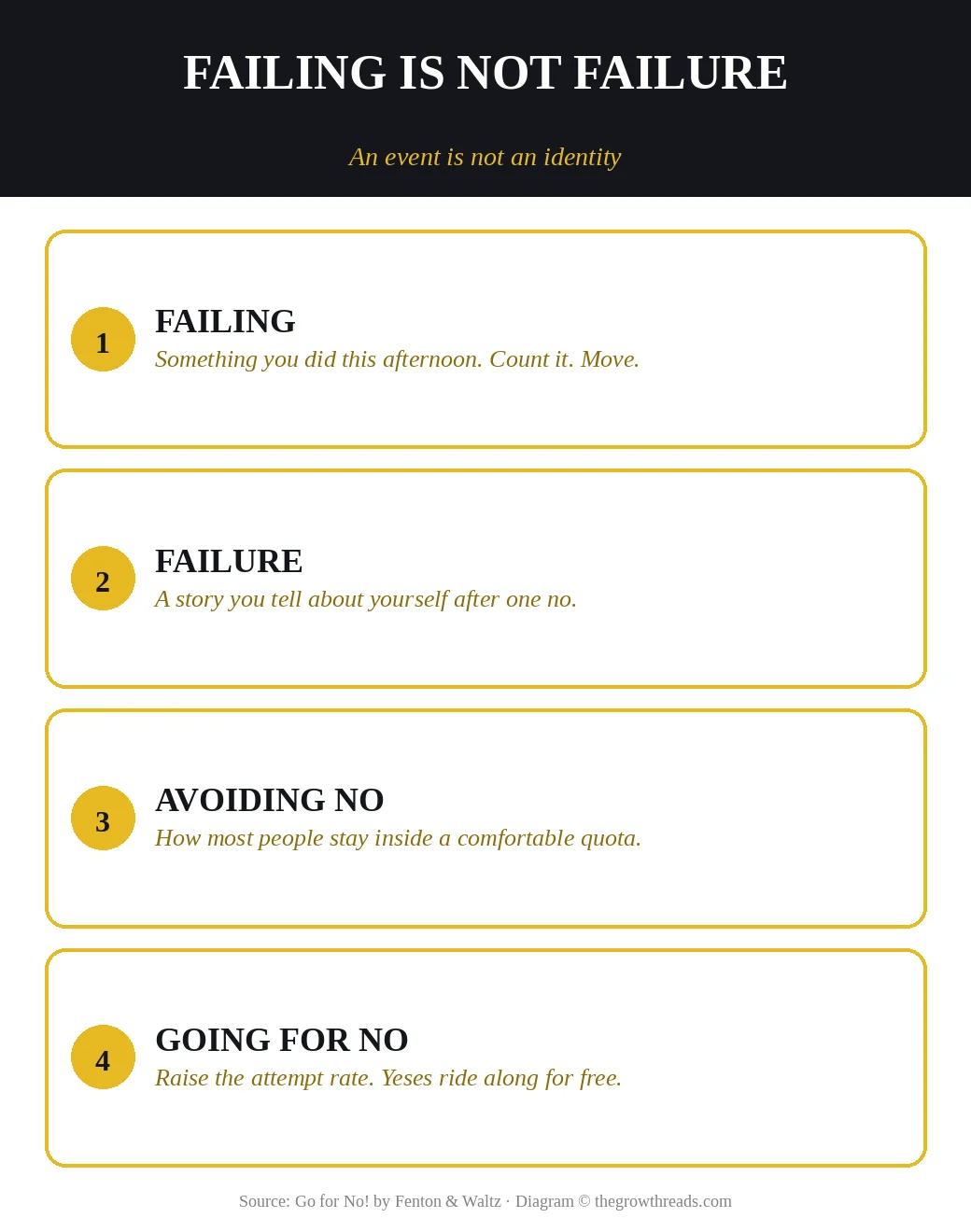
- Failing is not failure: Failing is an event. Failure is the story you tell after one rejection.
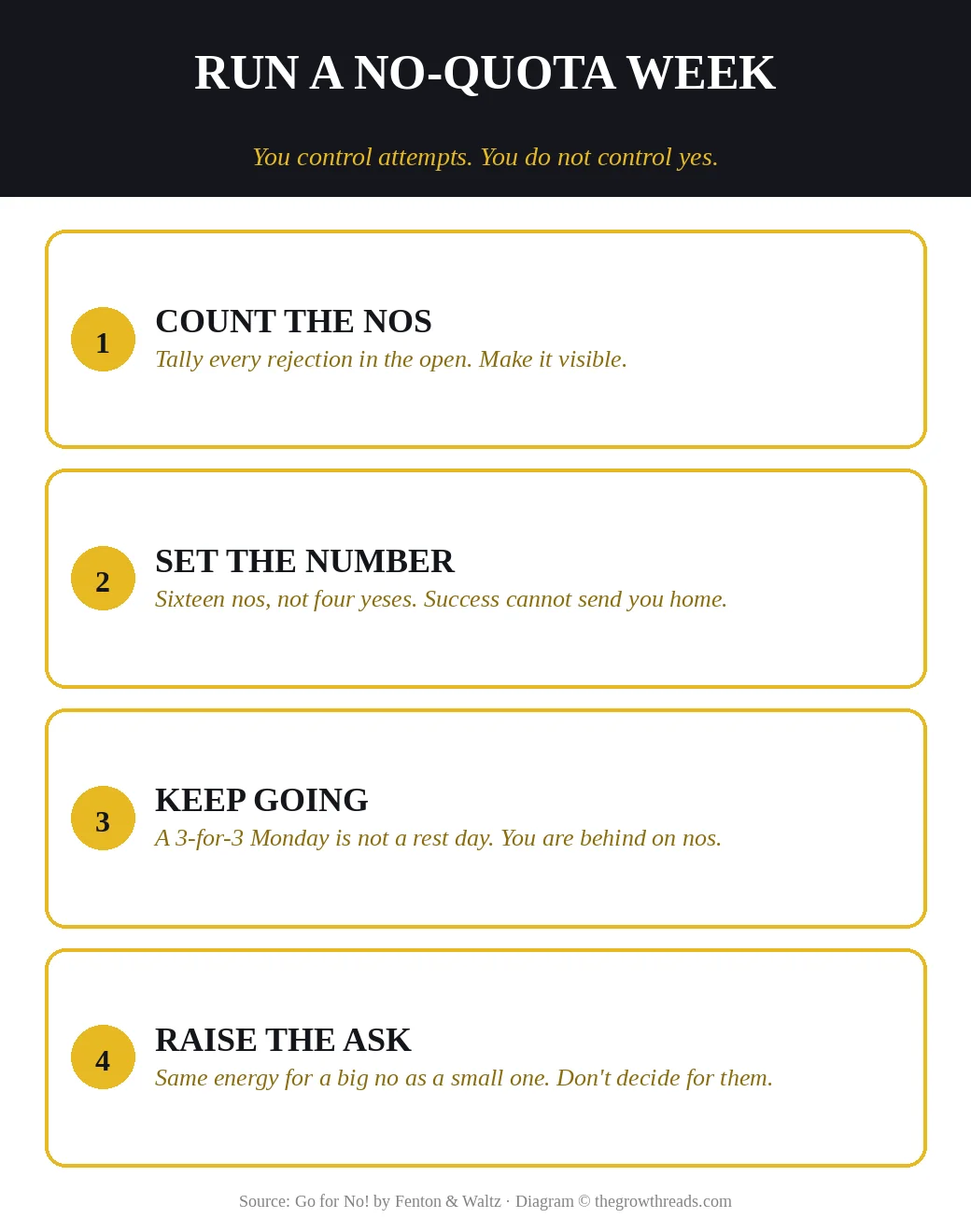
- Set a no-quota: Count rejections, not closes, so a hot morning cannot send you home.
- You control attempts: You do not control yes. Measure the thing you can actually do.
- Success can slow you down: Three yeses on Monday is how average weeks get built.
- Climb the five levels: Ability, willingness, wantingness, bigger/faster, then exponential with a team.
- Want the no: Tolerance still treats rejection as a tax. Wanting it is the shift.
- Raise the ask: Same energy for a large no as a small one. Do not decide for them.
- No means not yet: One no is data. Silence you never followed is a story.
- Teach the quota: Level five is a team that collects nos with you, not a hero who asks alone.

What is Go for No about?
Go for No is a short parable that trains you to collect rejections on purpose. Eric Bratton meets a future self who runs on a no-quota, five failure levels, and bigger asks. Yes is the destination. No is how you get there. It is a field book for anyone who stalls after a good morning.
About the author
Richard Fenton and Andrea Waltz founded Courage Crafters and the Go for No workshops behind this book. The spark is a floor story: as a young men’s-store clerk Fenton closed a huge sale, then a district manager asked what the customer had said no to. If nobody said no, how did you know they were done? That question became Eric Bratton, a copier salesman who always makes quota and never exceeds it. The pair keynote teams on raising the attempt rate instead of polishing the script. There is no usable Wikipedia page for either (the Richard Fenton article is a Welsh poet). Empty calendar: Fanatical Prospecting. Identity on the attempt: start here. Explore all Andrea Waltz book summaries →
Key concepts at a glance
| Concept | What it means | Use it when |
|---|---|---|
| Yes vs no | Yes is the destination. No is how you get there. | You treat every no as the end of the road. |
| Failing vs failure | Failing is an event. Failure is an identity. | One rejection becomes a story about who you are. |
| No-quota | A goal for rejections, not closes. | A hot Monday sends you to paperwork. |
| Attempt rate | You control asks. You do not control yes. | You judge the week by signatures you cannot force. |
| Five failure levels | Ability → willingness → wantingness → bigger/faster → exponential. | You “accept” no and still hate every one of them. |
| Wantingness | You start wanting the no because growth follows it. | Tolerance still feels like a tax. |
| Bigger ask | Same energy for a large no as a small one. | You only request what already feels safe. |
| No means not yet | One no is data. Follow-up is still an ask. | You bury a lead after the first shrug. |
Part 1 — Failing is not failure
Eric Bratton is the salesperson who looks fine on a dashboard. He can close. On the Monday we meet him he goes three for three, then lets the week dissolve into paperwork and the quiet reward of being “ahead.” The parable’s joke is useful: making quota is how he stays average. Future Eric lives in a house the younger man cannot explain, and the first lesson is language. Failing is something you did this afternoon. Failure is the identity you put on after one no so you never have to hear the next one.
Kids already know the difference. They hear no all day and ask again at dinner. Adults learn to stop, then call it professionalism. Fenton and Waltz want that persistence back — not as pestering, as a clean offer you are willing to repeat. Future Eric’s hinge is the whole book: you still think failing leads to failure. It does not. Avoiding the fail is what leads to a small week that looks busy. To outperform most people you do the thing they will not do after a no, which is continue.
That is why this is a productivity book as much as a sales book. The week is an attempt machine. If your identity cannot survive a rejection, you will fill the calendar with safe work that cannot say no to you. The 10X Rule is the ambition cousin: the target is too small. Go for No is the identity cousin. The target can be large and you will still hide if failing feels like becoming a failure.
TGR Note: Empty calendar: Fanatical Prospecting — prospect today so you eat in thirty days. Timid target: The 10X Rule. Fenton and Waltz sit in between: you will not collect enough attempts while failing still feels like a verdict.
Part 2 — Set a no-quota, not a yes-quota
Here is the inversion that makes the book worth an afternoon. Eric’s week is four closes. He usually sits in front of twenty people. That is sixteen nos hiding inside a “yes” goal. Hit three yeses on Monday and the yes-quota says you are ahead, so you slow down. Flip the goal to sixteen nos and Monday’s three yeses put you behind. You have to make more calls, not fewer. Success stops being a permission slip to disappear. Future Eric has not set a traditional results goal in years. He sets failure goals and trusts the yeses to show up as a byproduct of the attempt rate.
The authors’ own math is rude on purpose. If you need ten people at a meeting and about five percent say yes, you need 190 people to say no. That is a denominator, not a poster. Most of us manage the pretty yeses and then wonder why the week felt light. Count the nos in the open — notepad, clicker, shared channel. When the number is visible, a hot streak cannot pretend it is a finished week.
None of this asks you to be sloppy in the meeting. Quantity without a question sequence is still noise. SPIN Selling is what you do once you are in the chair. Go for No is why you are still booking chairs after lunch. Sell or Be Sold will not take the first stall as the truth. Fenton and Waltz will not take the first yes as a reason to stop. A sold person who hides after three closes is still unsold on the week.
TGR Note: In a live deal, SPIN Selling is the question sequence. If you fold at the first stall, Sell or Be Sold is the map. The no-quota is the week design: it decides whether you are still in those rooms on Thursday.
Part 3 — The five failure levels
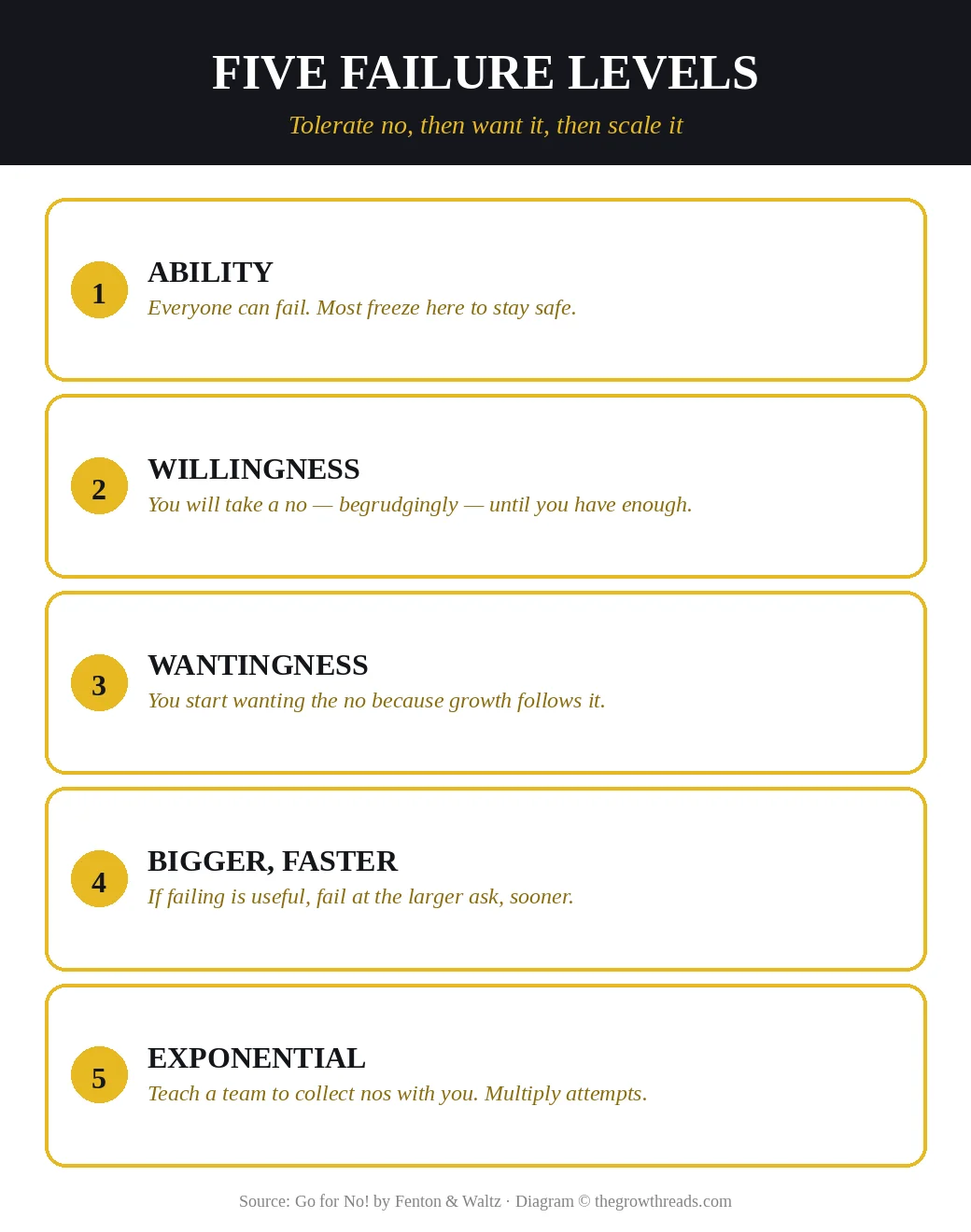
The memorable diagram in Go for No is a ladder, not a funnel. Level one is ability. Everyone can fail. Most people spend a career proving they will not — safe asks, safe clients, safe weeks. Level two is willingness. You will take a no if you must, the way you take a tax, then you retreat. A lot of “professional” selling lives here. It looks adult. It also caps the attempt rate the moment the quota is in reach.
Level three is the shift the book is for: wantingness. You start wanting the no because growth is on the other side of more attempts. Failure becomes useful, then — if you let it — almost fun, which is the part people quote and never practice. Level four is failing bigger and faster. If a no is useful, a larger no is a better use of the same afternoon. It takes no more breath to hear no on a bigger package. Level five is exponential: you teach other people to collect nos with you. A team with a no-quota multiplies attempts. A hero with a no-quota is still one calendar.
The honest self-test is which level you occupy when nobody is watching. Plenty of people claim level three and still celebrate a yes by hiding. That is level two with better language. Climbing is a week design: publish the tally, raise one ask, debrief the nos without turning them into identity. If your close rate sits comfortably above thirty percent, the book says you are probably not stretching the ask. Treat that as a prompt. Notice whether you only request what already feels safe.
TGR Note: Committee room: The Challenger Sale. If you still sound like a hunter, Ninja Selling is the attract layer. The five levels are not a pitch. They are how much rejection you will let into the week.
Part 4 — Fail bigger, then fail with a team
Two practical rules sit on top of the ladder. First: do not decide for the other person. We skip the larger package, the follow-up, the ask that would feel embarrassing. That is a no you issued on their behalf. The only way to find the line is to step over it now and then. A clean no on a bigger offer is information. A small yes you pre-negotiated with yourself is a story. Offer the thing. Let them speak.
Second: your reaction to yes and no should be closer than your nervous system wants. If a yes sends you to the moon and a no sends you to the sofa, the week steers toward fewer attempts. Count the no, say the value of it out loud (“that was one of sixteen”), and pick up the next name. No means not yet. Going for no is more attempts, not a louder attempt. Pushy is ignoring a boundary. Timid is never putting the offer down. This book is the second mistake.
Level five is the part most individuals skip. If failing is how you grow, a team that will not fail is a team that will not grow. Managers who shield people from nos are building a yes-quota culture with extra steps. Share the tally. Celebrate the large no in the same meeting as the close. To Sell Is Human is the gentler on-ramp if the word “sales” still makes you leave. The Go-Giver is the value layer: give more than you take, then still ask. Fenton and Waltz are the attempt layer. An ask without a no-quota is a good Monday and a quiet Thursday.
Who is Go for No best for — and who should read something else first?
Best for sellers, founders, and anyone who already has conversations and still treats a no as a verdict. It is also for managers whose team hits quota on Tuesday and vanishes. If you coast after a hot morning, this is the book.
Read something else first if your calendar has no conversations — start with Fanatical Prospecting. If you get in the room and cannot diagnose, start with SPIN Selling. If you flinch at price, Sell or Be Sold. If you reject the word “sales,” start with To Sell Is Human. Come back when access is not the issue — the week after the first no is.
Questions to reflect on
- After your last hot morning, did you make more asks or fewer?
- What number would a no-quota be this week, given your real yes-rate?
- Where did you last decide for someone — a package, a follow-up, an ask you never made?
- Which failure level do you occupy when nobody is watching: willingness, or wantingness?
- What large no are you avoiding because a small yes feels like enough?
🔥 Ready to collect the nos?
Set a no-quota this week so a hot Monday cannot send you home.
How to apply Go for No (7-day plan)
- Day 1 — Write the math. Last month’s yes-rate, this week’s yes-goal, the implied no-quota. Put the number on a card.
- Day 2 — Tally in the open. Every no gets a mark you can see. No burying.
- Day 3 — Do not coast. If you get two yeses before noon, make the next ask anyway.
- Day 4 — Raise one ask. Offer the larger version once. Let them say no. Do not pre-cut it.
- Day 5 — Follow one “not yet.” A last-week no gets a new reason to continue, not “just checking.”
- Day 6 — Equalize the reaction. After one yes and one no, write a line for each and notice the body.
- Day 7 — Review the tally. How many nos vs the quota? Where did success slow you down? Set next week’s number.
Frequently asked questions
What is Go for No about?
Go for No is a short parable about copier salesman Eric Bratton, who meets a future version of himself and learns to collect nos on purpose. Richard Fenton and Andrea Waltz argue that yes is the destination and no is how you get there. Most people set a yes-quota, hit it, and stop. A no-quota keeps you in motion after a hot morning, because you are still behind on rejections. Failing is an event. Failure is an identity. The book is eighty pages, not a close script. Read it when you already know what to say and still flinch at the first no.
Who wrote Go for No?
Richard Fenton and Andrea Waltz founded Courage Crafters and the Go for No workshops. The spark was a floor story: after a huge men’s-store sale, a district manager asked what the customer had said no to. If nobody said no, how did you know they were done? That question became the book — a weekend with future Eric, not a textbook. They keynote sales teams on raising the attempt rate instead of polishing the pitch. There is no Wikipedia page for either author; the Richard Fenton article is a Welsh poet. Start here for the no-quota. Pair it with Fanatical Prospecting when the calendar is empty.
What is a no-quota?
A no-quota is a goal for rejections, not closes. If you usually need twenty conversations for four yeses, your week is sixteen nos, not four signatures. Hit three yeses on Monday and a yes-quota says you are ahead, so you do paperwork. A no-quota says you are behind, so you keep asking. You control attempts. You do not control yes. Fenton and Waltz want the number high enough that a good morning cannot send you home. Count every no in the open. When the tally is public, a hot streak stops being a nap.
What are the five failure levels in Go for No?
Level one is ability: everyone can fail, and most people freeze there to stay safe. Level two is willingness: you will take a no, begrudgingly, until you have enough. Level three is wantingness: you start wanting the no because growth follows it. Level four is failing bigger and faster — same energy for a large ask as a small one. Level five is exponential: you teach a team to collect nos with you, so attempts multiply. The useful climb is from two to three. Tolerance still treats no as a tax. Wanting it is the identity shift the parable is for.
Is Go for No only for salespeople?
The lab is a copier quota because that is Eric’s job. The move is not. Hiring is a string of nos. A launch is a string of nos. Asking a partner to change the week is a no you are avoiding. Founders who say they are not salesy still need people to agree, and they still stop after a good morning. If you have no conversations, start with Fanatical Prospecting. If you already talk to people and still treat the first no as a verdict, this is the book. Going for no is not being rude. It is refusing to decide for the other person.
How is Go for No different from Fanatical Prospecting?
Fanatical Prospecting fills the chair. Jeb Blount’s rule is that you prospect today so you eat in thirty days. Go for No is what you do with the chair once fear of rejection starts steering the week. One book is volume of conversations. This one is the identity you bring to each attempt — failing versus failure, a no-quota instead of a yes-quota, a bigger ask instead of a safe one. You probably need both. Empty calendar: Blount. Full calendar and a habit of coasting after three yeses: Fenton and Waltz. Neither replaces a diagnosis in the meeting. That is still SPIN Selling.
Does Go for No mean being pushy?
No means not yet, not never — and it also means you heard them. Going for no is more asks, not a louder ask. You do not bully a card. You do not decide they cannot buy, cannot afford the larger package, or will hate a follow-up. You offer, you count the no, you ask the next person. Pushy is ignoring a clear boundary. Timid is never putting the offer on the table. The book is the second mistake. If you need questions in the meeting, read SPIN. Come back here when the problem is you stopping.
Related summaries
- Fanatical Prospecting Summary & Review — fill the empty chair first
- Sell or Be Sold Summary & Review — stay sold, then ask
- SPIN Selling Summary & Review — questions once the meeting exists
- The 10X Rule Summary & Review — bigger target, more attempts
- Best productivity books — the full Productivity silo
How we analyze books: we paraphrase arguments, add original application notes, and skip chapter-by-chapter reproduction. Read our full methodology.