

★★★★½ 4.5/5 — Stay on the straight line. Raise the three tens. Then ask.
Best for: Sellers, founders, and anyone who gets a meeting and then tours their own biography.
Reading time: ~4 hrs (guide: 12 min)
Difficulty to apply: Easy to score one call today; hard to stay on the line when they want a story.
Way of the Wolf in one minute
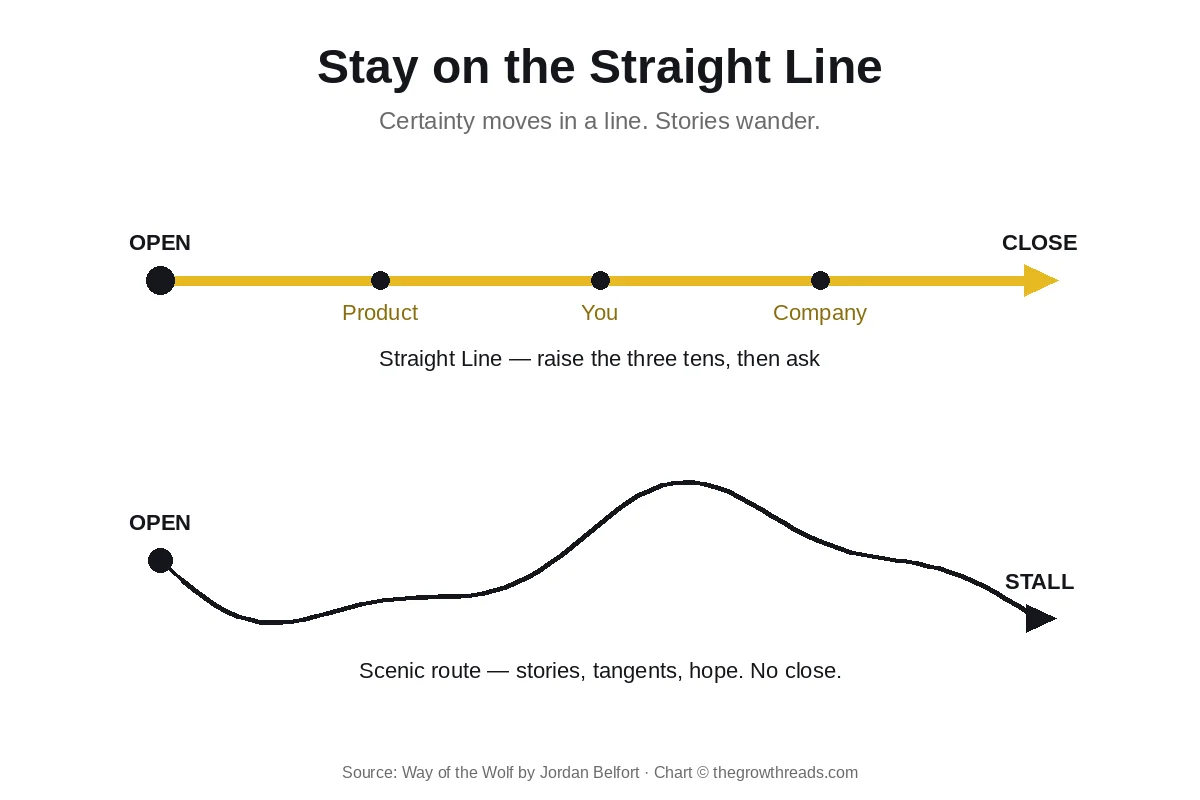
Stay on the straight line. Jordan Belfort’s argument is a geometry, not a pep talk. Every sale is a path from the open to the close. The prospect starts uncertain on three scales: the product, you, and the company. You cannot close a 7. You raise the low ten, then you ask. If they stall, they told you which ten dropped. You loop — you do not wander into a second meeting’s worth of stories.
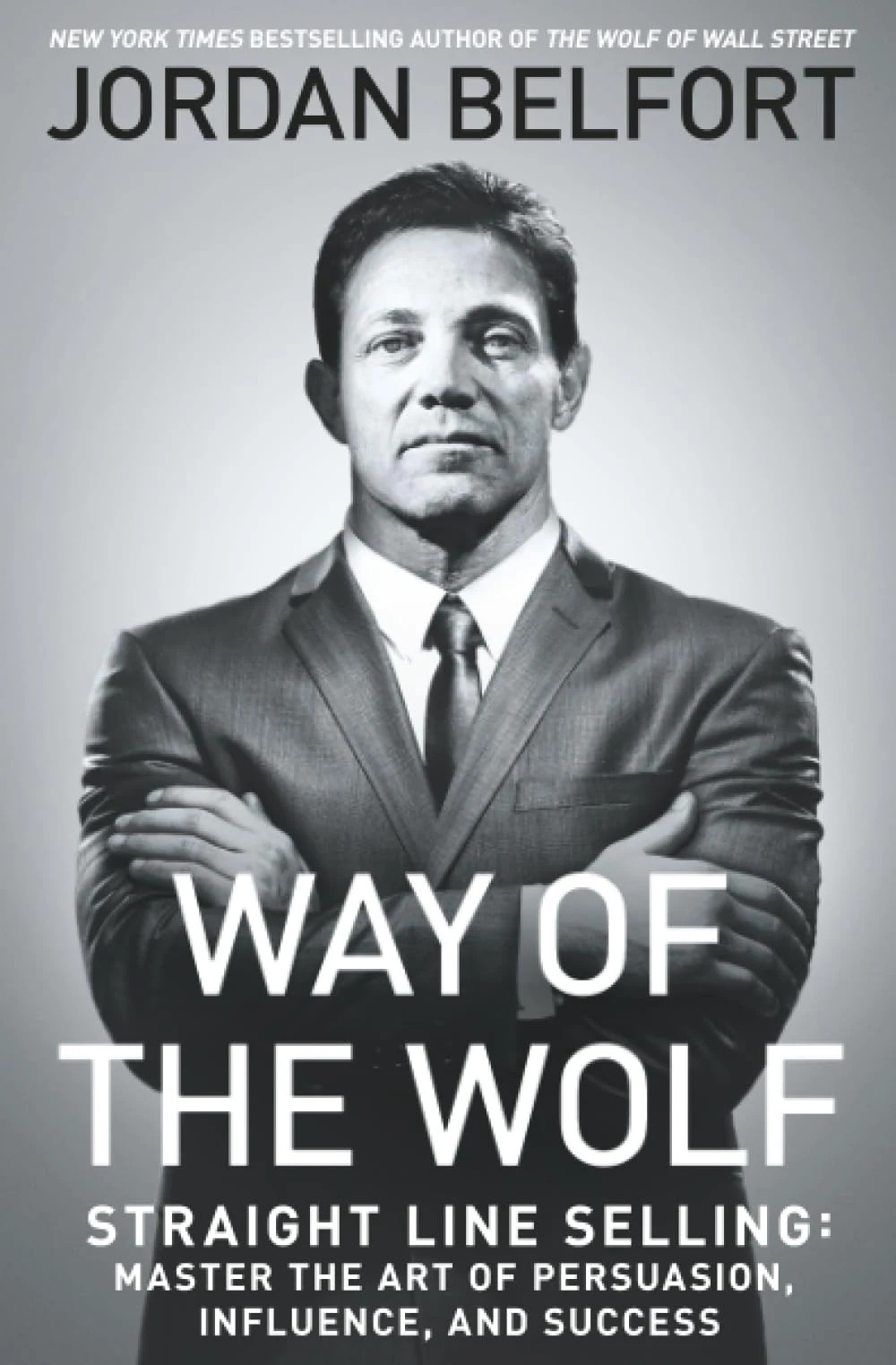
Way of the Wolf (Gallery Books, 2017) is the 256-page field manual for Straight Line Selling, the system Belfort taught sales teams after the memoir years. It is not the movie. If you already get conversations and still lose the close in a scenic route, start here.
Key takeaways
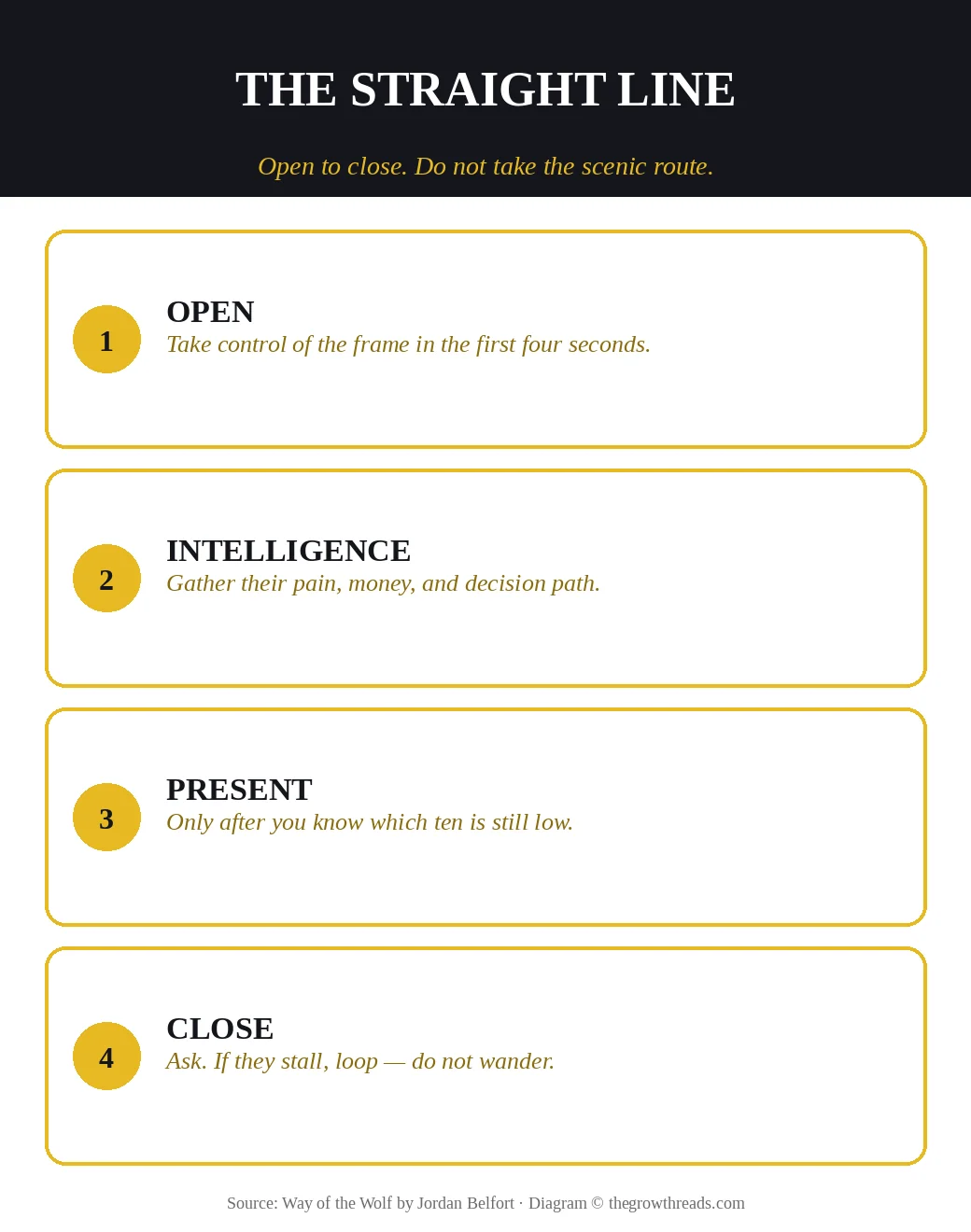
- A sale is a straight line: Open, intelligence, present, close. Detours feel busy and do not ask.
- Control the first four seconds: The frame of the call is set before the pitch starts.
- Gather intelligence first: Pain, money, and the decision path beat a rehearsed demo.
- The three tens: Certainty in the product, in you, and in the company. A 7 will stall.
- You cannot close a 7: Find the low ten and raise it. Then ask.
- A close is a temperature check: Asking is how you learn which ten is still low.
- Every objection is a ten: Price, time, spouse — loop that ten. Do not invent a new speech.
- Lower the action threshold: A smaller next step is still a close if certainty is moving.
- State is contagious: If you are uncertain, they borrow that number.
- Stay on the line: Stories, tangents, and hope are how good talkers finish with no ask.
What is Way of the Wolf about?
Way of the Wolf is a sales-productivity manual for staying on a straight line from the open to the close. Belfort trains you to raise three tens — product, you, company — then ask. If they stall, you loop the low ten. It is a field book for anyone who already talks to people and still wanders.
About the author
Jordan Belfort is the former Stratton Oakmont broker whose memoir became The Wolf of Wall Street. After that chapter closed, he spent the next decade teaching the Straight Line System to sales teams and founders — the same sequence of open, intelligence, present, and close, minus the memoir’s chaos. Way of the Wolf is that playbook: Gallery Books, 2017, 256 pages. The Wikipedia page is the right person. Empty calendar: Fanatical Prospecting. Diagnosis in the chair: SPIN Selling. The line itself: start here. Explore all Jordan Belfort book summaries →
Key concepts at a glance
| Concept | What it means | Use it when |
|---|---|---|
| Straight Line | Open → intelligence → present → close. No scenic route. | The call feels busy and never asks. |
| First four seconds | You take the frame before the pitch starts. | They interview you and you comply. |
| Intelligence step | Pain, money, decision path, before you present. | You demo before you know the job. |
| Three tens | Certainty in product, you, and the company, each 1–10. | You close a mixed 7 and call it grit. |
| Close as check | Asking reveals the low ten. It is not a speech. | You wait for a magical buying mood. |
| Loop | Lower the action threshold. Raise the stalled ten. Re-close. | Price, time, or spouse ends the call. |
| Action threshold | A smaller next step still moves the line. | You only ask for the whole deal. |
| State control | Your certainty is the number they borrow first. | You sound unsure and they match you. |
Part 1 — The sale is a straight line
Belfort’s first useful picture is not a wolf. It is a line. On the left is the open. On the right is the close. The prospect should feel they are moving forward along that line, not touring your origin story. Most people leave the line the moment the conversation gets human. They tell a long case study. They answer a curious side question with a twenty-minute demo. They hope rapport will do the asking. Rapport is not a close. A scenic route feels professional because it is full. It is also how a good talker finishes with no next step.
The open is shorter than ego wants. Take the frame in the first seconds: who you are, why this call exists, and that you will ask questions before you pitch. Then gather intelligence. Pain, money, who else decides, what they already tried. Present only after you know which ten is still low. Close while certainty is high, not after you have used every slide. If that sequence sounds obvious, watch a recorded call. Most of us invert it. We present to earn the right to ask questions, then never ask.
That is why this is a productivity book as much as a sales book. The week is a set of conversations that either move or stall. If your identity needs to be liked more than it needs a next step, you will fill the hour with stories that cannot say no to you. Pitch Anything is the frame cousin: status in the room. Way of the Wolf is the path cousin: once you have the frame, do not spend it on a tour.
TGR Note: Empty calendar: Fanatical Prospecting — prospect today so you eat in thirty days. Frame war: Pitch Anything. Belfort sits after both: you will not close a call you never steered onto a line.
Part 2 — The three tens
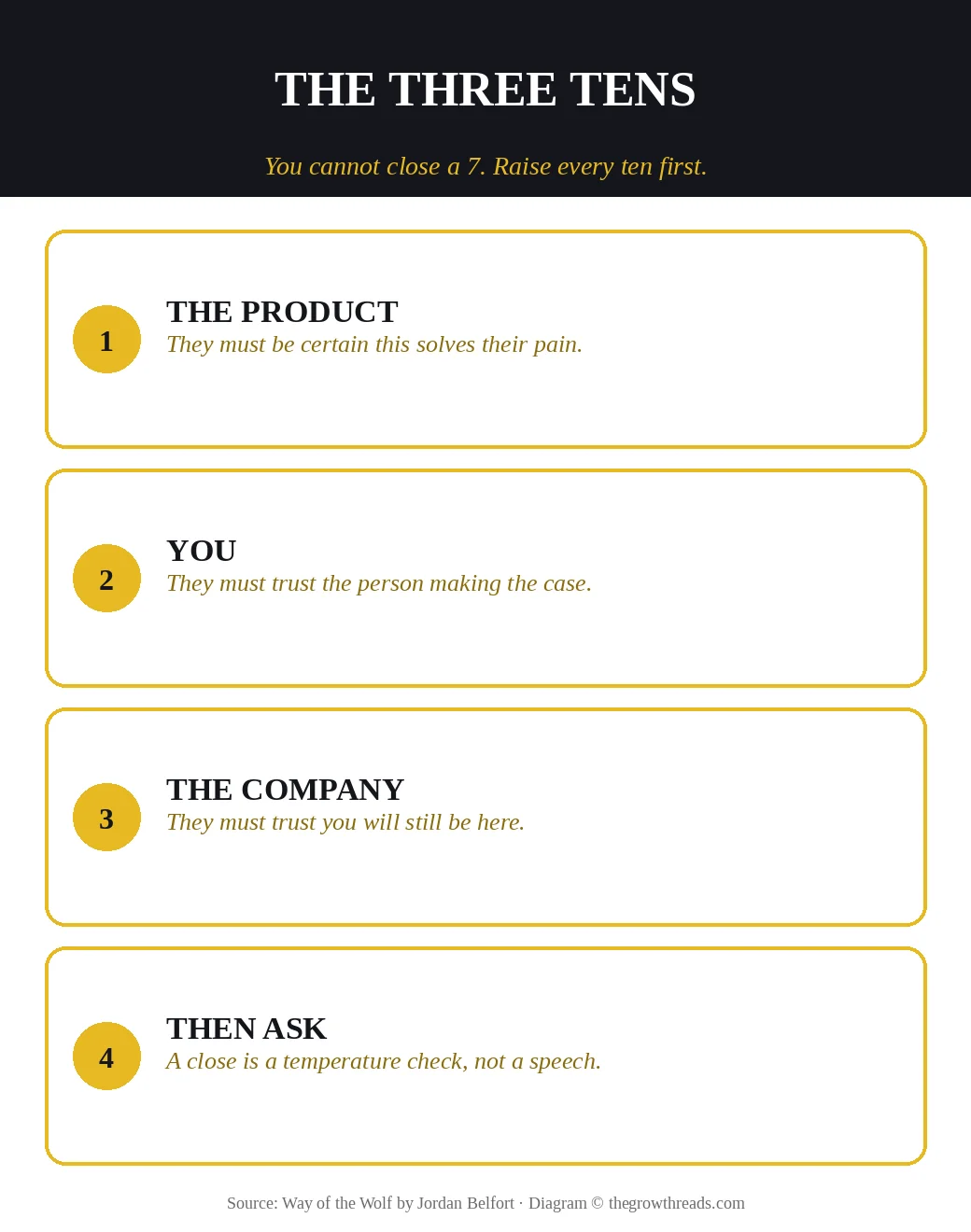
The memorable diagram in Way of the Wolf is three scales, not a funnel. Before anyone says yes they must be close to a 10 on the product, a 10 on you, and a 10 on the company. A 10-10-4 will stall on “I need to think” because they do not trust you will still be here. A 10-4-10 will stall because they like the thing and not the messenger. A 7-7-7 looks polite and never buys. You cannot close a 7 and call the stall mysterious. The stall is the score.
The body of the call is detective work. Which ten is low? If the product is low, stop charming. Show the pain more clearly, or a proof that fits their world. If you are the low ten, they need process, not volume — how you work, who else you have helped that looks like them, why you will not vanish. If the company is the low ten, they need a reason this is not a one-person burst. Then you ask. The ask is how you take the temperature. A yes means the tens are high enough. A stall means you guessed wrong, which is useful. A speech you never ended with an ask taught you nothing.
None of this replaces a diagnosis. Quantity of certainty language without a question sequence is still noise. SPIN Selling is what you do in the chair to find the problem worth solving. The three tens are why you are allowed to present after you found it. Sell or Be Sold will not take the first stall as the truth. Belfort will not take a mixed 7 as a close you just need to push harder. You raise the number. Then you ask again.
TGR Note: In a live deal, SPIN Selling is the question sequence. If you fold at the first stall, Sell or Be Sold is the map. The three tens are the scoreboard: they decide whether a close is earned or hoped for.
Part 3 — State, then the loop
Belfort is blunt about inner state because the prospect borrows it. If you are at a 6 on your own product, they will not invent a 10 for you. Certainty here is not shouting. It is a body that has already decided this is the right next step, plus a voice that does not apologize for asking. Tonality does more of the first four seconds than the script. Practice the open out loud. Record one. If you sound like you are requesting permission to exist, the tens start at 5 before you have asked a single intelligence question.
When they object, they are rarely giving you a new topic. They are reporting a ten that dropped. “I need to talk to my partner” is often the company ten or the you ten — they do not yet trust the process enough to put it in front of someone else. “It is too expensive” is often the product ten still sitting at 7, dressed as math. The loop is the move: lower the action threshold so the next yes is smaller, raise the stalled ten with one proof, and close again. You do not start a second presentation. You do not punish them for the stall. You treat it as data and stay on the line.
A smaller next step is still a close. A paid pilot, a second meeting with the decider, a date to review the agreement. The action threshold is the height of the step, not the existence of a step. People who only ask for the whole deal train themselves to wait for a magical mood. People who never ask train themselves to tour. The loop sits between those mistakes.
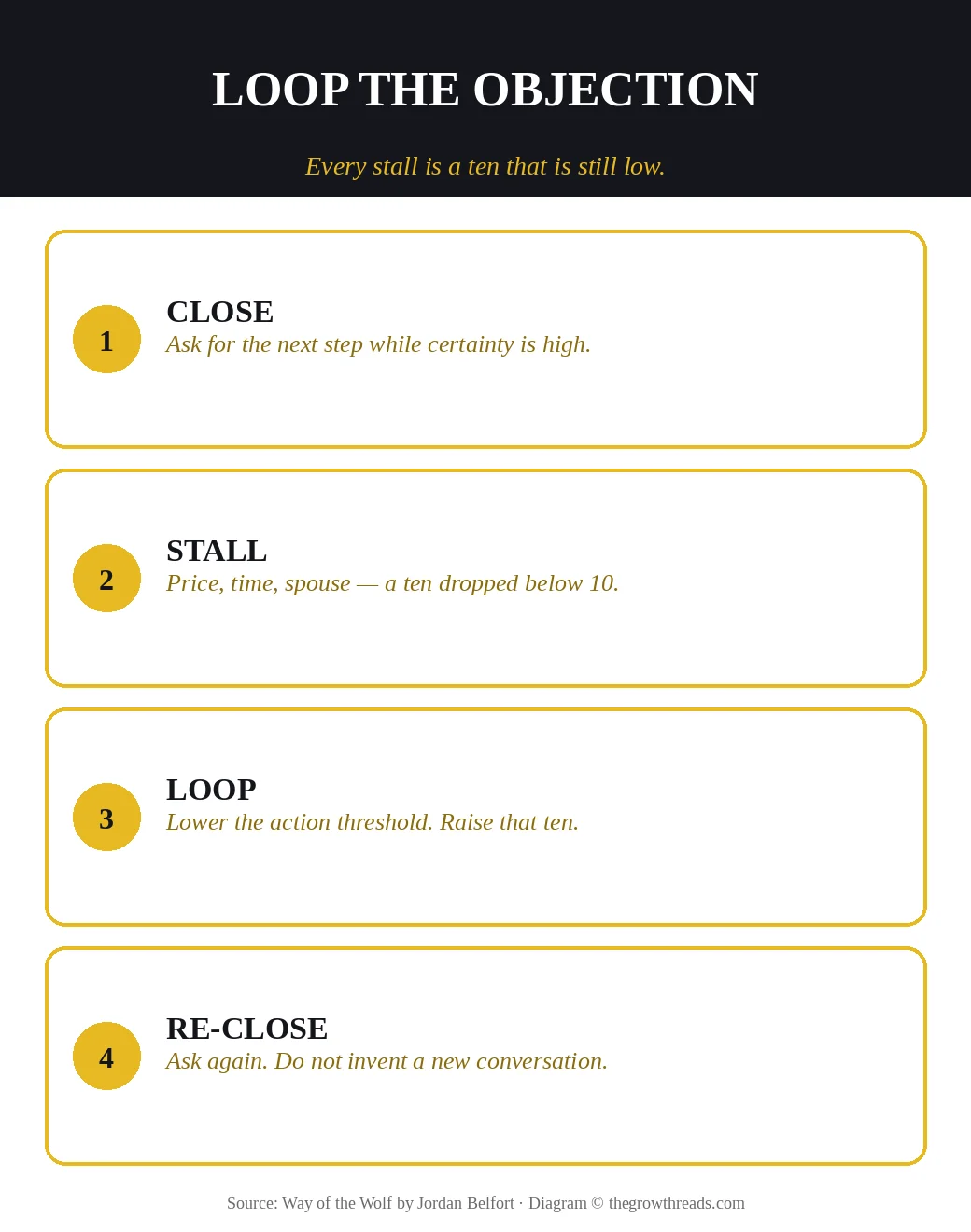
TGR Note: Committee room: The Challenger Sale. If you still sound like a hunter, Ninja Selling is the attract layer. The loop is not a pitch. It is how you stay on the line after the first no.
Part 4 — Ask, then keep the week on the line
Two practical rules sit on top of the geometry. First: do not decide for the other person. We skip the close because it would feel embarrassing. That is a no you issued on their behalf. The only way to find the line is to put a next step down and let them speak. A clean no on a real ask is information. A maybe you protected by never asking is a story. Offer the thing. Let them score the tens out loud.
Second: your reaction to yes and no should be closer than your nervous system wants. If a yes sends you to the moon and a stall sends you into a twenty-minute rescue speech, the week steers toward fewer clean asks. Count the stall, name the ten (“that was the company ten”), loop once, and if it is still a no, pick up the next name. Going for the line is more precise asks, not a louder ask. Pushy is ignoring a boundary. Timid is never putting the next step on the table. This book is the second mistake.
The week design is where Straight Line becomes productivity. Score three calls. If you only present, you will see it. If you never close, you will see it. If every stall ends the meeting, you will see it. Go for No is the attempt cousin: collect nos so a hot morning cannot send you home. To Sell Is Human is the gentler on-ramp if the word “sales” still makes you leave. Belfort is the line. An ask without a line is a good story and a quiet Thursday.
Who is Way of the Wolf best for — and who should read something else first?
Best for sellers, founders, and anyone who already has conversations and still wanders once they are in them. It is also for managers whose team demos beautifully and never asks. If you tour your biography and hope they will buy, this is the book.
Read something else first if your calendar has no conversations — start with Fanatical Prospecting. If you get in the room and cannot diagnose, start with SPIN Selling. If the room is a status fight, Pitch Anything. If you flinch at the first stall, Sell or Be Sold. If you reject the word “sales,” start with To Sell Is Human. Come back when access is not the issue — the line after the open is.
Questions to reflect on
- On your last call, where did you leave the line — a story, a demo, a hope?
- Which of the three tens was actually low, and which one did you keep talking about?
- When they stalled, did you loop that ten or start a new speech?
- What smaller next step would have lowered the action threshold without dropping the ask?
- If you scored your own certainty on the product, what number would the prospect have borrowed?
🔥 Ready to stay on the line?
Score one call on the three tens this week so a story cannot replace the ask.
How to apply Way of the Wolf (7-day plan)
- Day 1 — Score one call. Product / you / company, 1–10. Circle the low ten. Do not rewrite history.
- Day 2 — Write a four-second open. Who you are, why this exists, that you will ask before you pitch. Say it out loud twice.
- Day 3 — Intelligence before slides. Three questions on pain, money, and who else decides. Present only after you have answers.
- Day 4 — Close once while it is early. Ask for a next step before you have used every proof. Note what happens.
- Day 5 — Loop one stall. Name the ten, add one proof, lower the action threshold, ask again.
- Day 6 — Record the open. Thirty seconds. If you sound like you are apologizing, rewrite the first sentence.
- Day 7 — Review three calls. Where did you leave the line? Set next week’s rule: no scenic route before an ask.
Frequently asked questions
What is Way of the Wolf about?
Way of the Wolf is Jordan Belfort's field manual for Straight Line Selling. Every sale is a straight line from the open to the close. The prospect starts uncertain on three scales: the product, you, and the company. You cannot close until those three tens are high. If they stall, you loop — lower the action threshold, raise the low ten, and ask again. The book is the training Belfort used to teach sales teams after the memoir years, not a recap of the film. Read it when you already get conversations and still wander once you are in them.
Who wrote Way of the Wolf?
Jordan Belfort is the former Stratton Oakmont broker whose memoir became The Wolf of Wall Street. After that chapter, he spent years teaching the Straight Line System — open, intelligence, present, close — to sales teams and founders. Way of the Wolf (Gallery Books, 2017) is the 256-page playbook, not the movie. The Wikipedia page is the right person. Start here for the three tens. Pair it with Fanatical Prospecting when the calendar is empty, and with SPIN Selling once you are already in the chair.
What is the Straight Line System?
The Straight Line System is a geometry for a conversation. You open, you gather intelligence, you present only what raises the low ten, and you close. The prospect should feel they are moving forward, not touring your biography. A scenic route — stories, tangents, hope — feels busy and does not ask. Belfort's claim is that control of the frame in the first seconds, plus a tight intelligence step, is what lets a close land without theatrics. If you leave the line, loop back. Do not invent a second meeting's worth of content in the first one.
What are the three tens in Way of the Wolf?
The three tens are certainty scores from 1 to 10: certainty in the product, certainty in you, and certainty in the company. A prospect at 7-7-7 will stall. A prospect at 10-10-4 will stall on trust. You cannot close a 7 and call it persistence. The work of the call is to find the low ten and raise it — proof, a story that fits their pain, a process they can see. Then you ask. If they object, they told you which ten dropped. Loop that ten. Do not answer a price stall with a longer product speech.
How long does it take to read Way of the Wolf?
About four hours for the 256-page Gallery Books edition, or a couple of evenings. The TGR guide is twelve minutes. The useful unit is not a chapter recap. It is one recorded call scored on the three tens, plus one loop you actually run. If you only highlight the movie origin story, you will finish informed and still wander on the next demo. Read it when you have conversations this week. If you do not, start with Fanatical Prospecting, then come back with a chair to sit in.
Is Way of the Wolf worth reading if I already know SPIN Selling?
Yes, because they do different jobs. SPIN is the question sequence once you are in the chair — situation, problem, implication, need-payoff. Way of the Wolf is the line you stay on so those questions have somewhere to go, and the close you run when a ten is high. Pitch Anything is the frame war. Fanatical Prospecting fills the chair. Go for No keeps you asking after a hot morning. If your problem is diagnosis, stay with Rackham. If your problem is wandering, stalling, or never asking, this is the book.
What should I read after Way of the Wolf?
If the calendar is empty, Fanatical Prospecting. If you get in the room and cannot find the pain, SPIN Selling. If the room is a status fight, Pitch Anything. If you fold at the first stall, Sell or Be Sold. If you stop after three yeses, Go for No. If you reject the word sales, To Sell Is Human, then come back. Way of the Wolf is the line and the three tens. The other books fill a chair, diagnose, or keep you from hiding. Pick the gap you actually have this week, not a longer stack.
Related summaries
- Fanatical Prospecting Summary & Review — fill the empty chair first
- SPIN Selling Summary & Review — questions once the meeting exists
- Pitch Anything Summary & Review — take the frame, then stay on it
- Go for No Summary & Review — keep asking after a hot morning
- Best productivity books — the full Productivity silo
How we analyze books: we paraphrase arguments, add original application notes, and skip chapter-by-chapter reproduction. Read our full methodology.