

★★★★½ 4.5/5 — If you aren’t sold, no one else will be. Get sold first, then make the ask.
Best for: Founders, sellers, and anyone who still treats “salesy” as an insult while needing people to say yes.
Reading time: ~4.5 hrs (guide: 13 min)
Difficulty to apply: Easy to name the four stalls today; hard to stay sold after a week of no’s.
Sell or Be Sold in one minute
Every outcome you want is a sale you make first. Grant Cardone’s argument is blunt on purpose. People do not fail because the script is weak. They fail because they are not sold — on the product, the price, or themselves — so the buyer feels the gap and stalls. Selling is how you get your way without waiting to be picked, not a costume for quota week.
Sell or Be Sold (Greenleaf Book Group Press, 2012) is the practical companion to the 10X manifesto. That book says the target is too small. This one says why the conversation dies: four reasons people don’t buy, a price objection that is usually a cover, and a close that is a decision. Then the second sale — they stay, use it, send someone. If you work hard and still leave rooms without an ask, start here.
Key takeaways
- Be sold first: Certainty transfers. If you flinch, they will too.
- Selling is a life skill: Hiring, fundraising, and changing the week are sales. Waiting to be picked is a slow strategy.
- Four reasons they don’t buy: No money, no need, no hurry, no trust. Name the real bucket.
- Buyers hide the reason: The first sentence is often cover. Stay until the true constraint shows up.
- Never be sold on price: Cheap is a story you bought. Show the cost of waiting, then ask.
- Closing is an ask: A decision with a date. Polite interest with no next step is an unnamed no.
- Follow up on purpose: One no is data. Silence is not a verdict until you ask again with a reason.
- Make the second sale: After they buy, sell them on staying, using it, and sending people.
- Massive action still needs a mouth: Volume without a sold seller is noise.
What is Sell or Be Sold about?
Sell or Be Sold is Grant Cardone’s system for getting a yes by selling yourself first, handling the four reasons people stall, and closing without treating price as the truth. The second sale after the signature is how the business compounds. It is a field book for anyone who needs agreement and still flinches.
About the author
Grant Cardone is an American sales trainer and real-estate investor, best known for The 10X Rule and a high-volume public persona around massive action. He got sober at 25 after a lost stretch in his twenties, rebuilt in automotive sales, then turned that floor into Cardone Enterprises and later Cardone Capital, a multifamily investment firm. Sell or Be Sold (2012) is the close-up version of the same career: not the size of the goal, but the conversation that funds it. Wikipedia files him as a financial influencer. For the ambition layer, start with The 10X Rule. For the ask, the stall, and the follow-up, start here. Explore all Grant Cardone book summaries →
Key concepts at a glance
| Concept | What it means | Use it when |
|---|---|---|
| Be sold first | You cannot transfer certainty you do not have. | You hear yourself hedging in the first two minutes. |
| Selling as a life skill | Every yes you need is an ask, not a personality type. | You say “I’m not salesy” and then wait to be picked. |
| Four reasons they don’t buy | No money, no need, no hurry, no trust. | You keep answering the first excuse and losing the week. |
| Hidden stalls | The stated reason is often cover for the real one. | They say “let me think” and you pack up. |
| Price is a story | Cheap is what an unsold seller offers. Value is a result plus a date. | You discount before they have named a problem. |
| The close | A decision, a next step, a yes or a named no. | The meeting ends in “sounds great” and nothing on the calendar. |
| Follow-up | Persistence with a reason to continue, not nagging for sport. | You send one note, get silence, and call the lead dead. |
| The second sale | After they buy: stay, use, repeat, refer. | You vanish after the contract and wonder why the well is dry. |
Part 1 — The most important sale is you
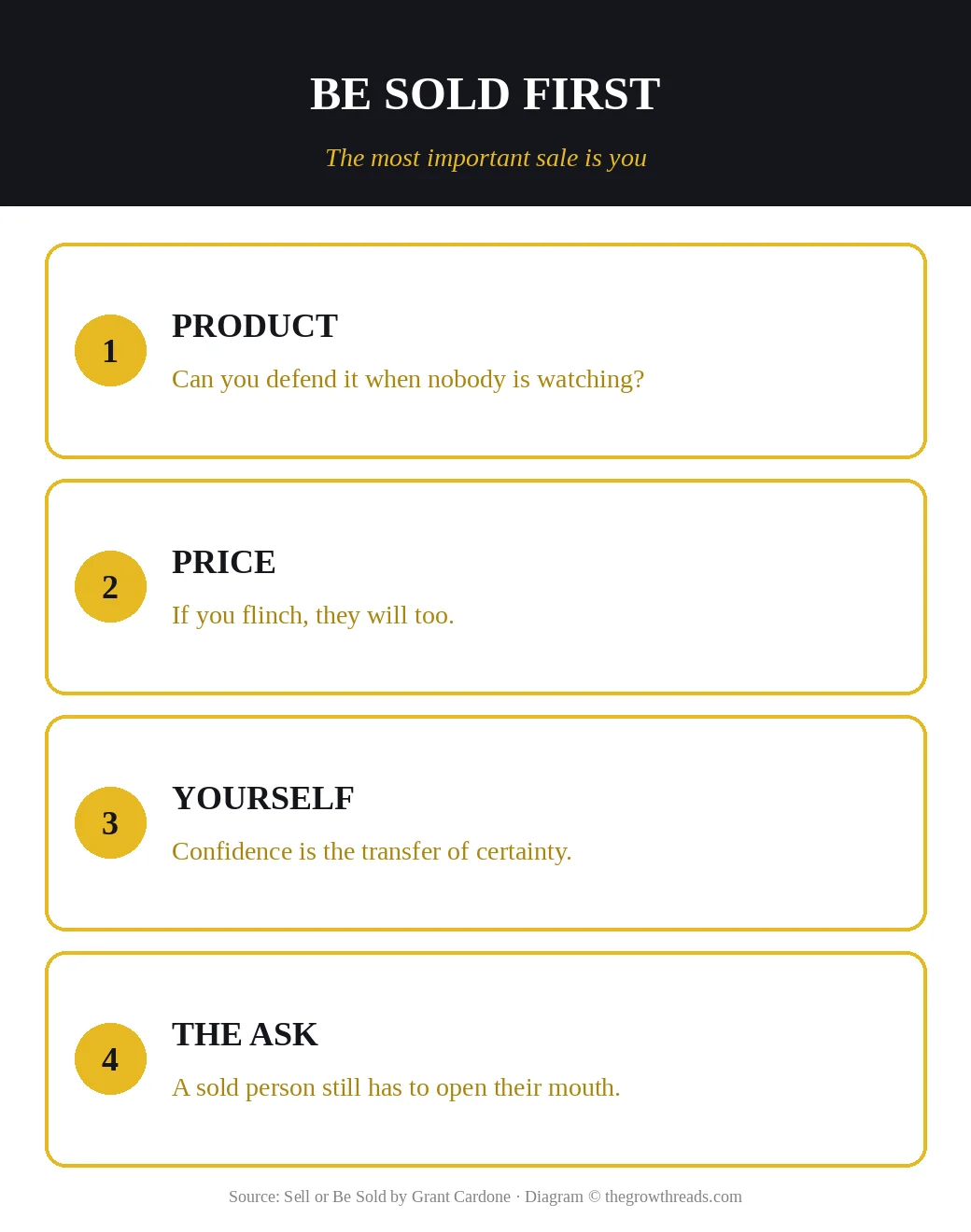
Cardone opens on a myth: selling is a talent, like pitch or height. His career says otherwise. He got sober, took a floor job, and learned that the person who could not look a customer in the eye was already defeated before the numbers came out. The most important sale is the one you make to yourself — product, price, and the right to ask. If any of those three is mush, the buyer feels it faster than a slide can cover it.
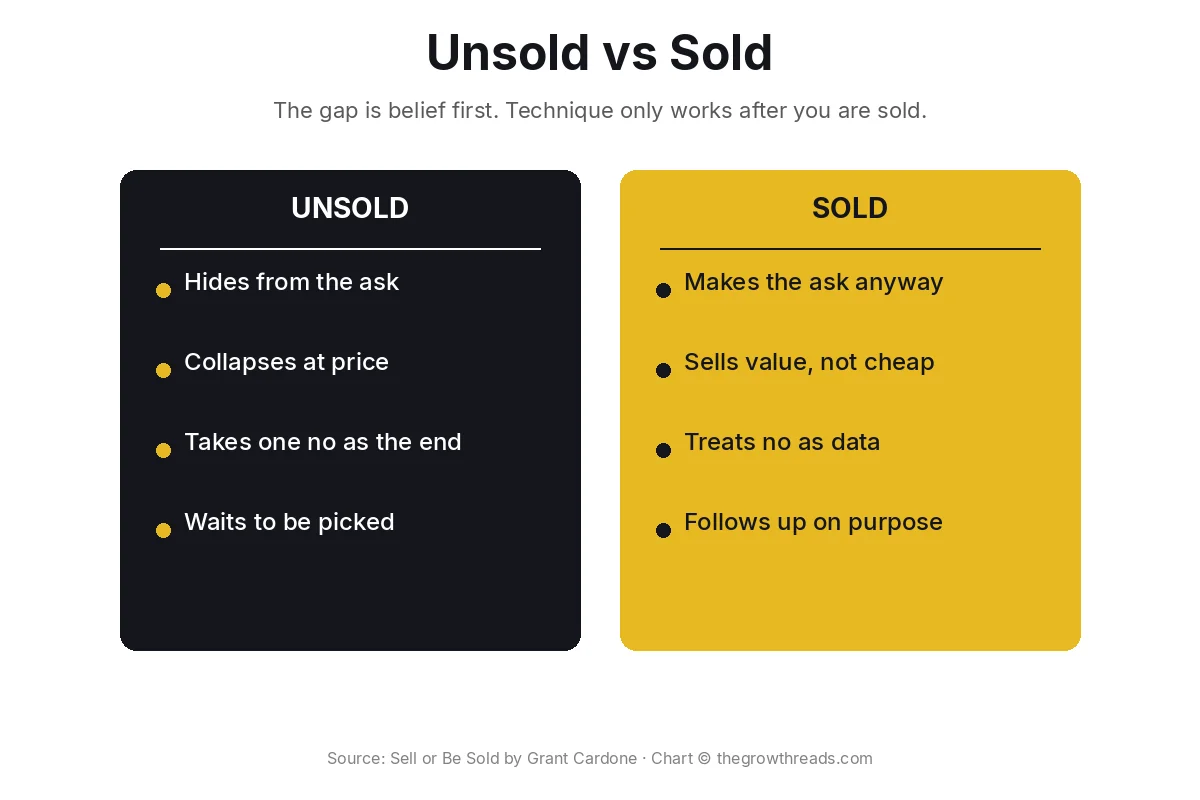
That is why “I’m not salesy” is not humility. It tells the room you would rather be liked than agreed with. Cardone treats selling as the highest-paying hard work and the lowest-paying easy work. Easy selling is waiting, discounting, and hoping activity hides the missing ask. Hard selling is staying in the conversation when it gets quiet because you are actually sold.
Being sold is a private test, not hype. Can you defend the offer when nobody is watching? If you would not buy it at this price, you will telegraph that on the first objection. Finish that argument at the desk. The 10X layer sits underneath: if the target is tiny, you will not stay sold when a week goes cold. A sold person still has to open their mouth. Certainty without a question is a diary.
TGR Note: The ambition book is still The 10X Rule — same author, bigger target. If the word “sales” makes you leave, To Sell Is Human is the gentler on-ramp. Cardone is what you read when you already need a yes and still flinch at the ask.
Part 2 — Four reasons they don’t buy
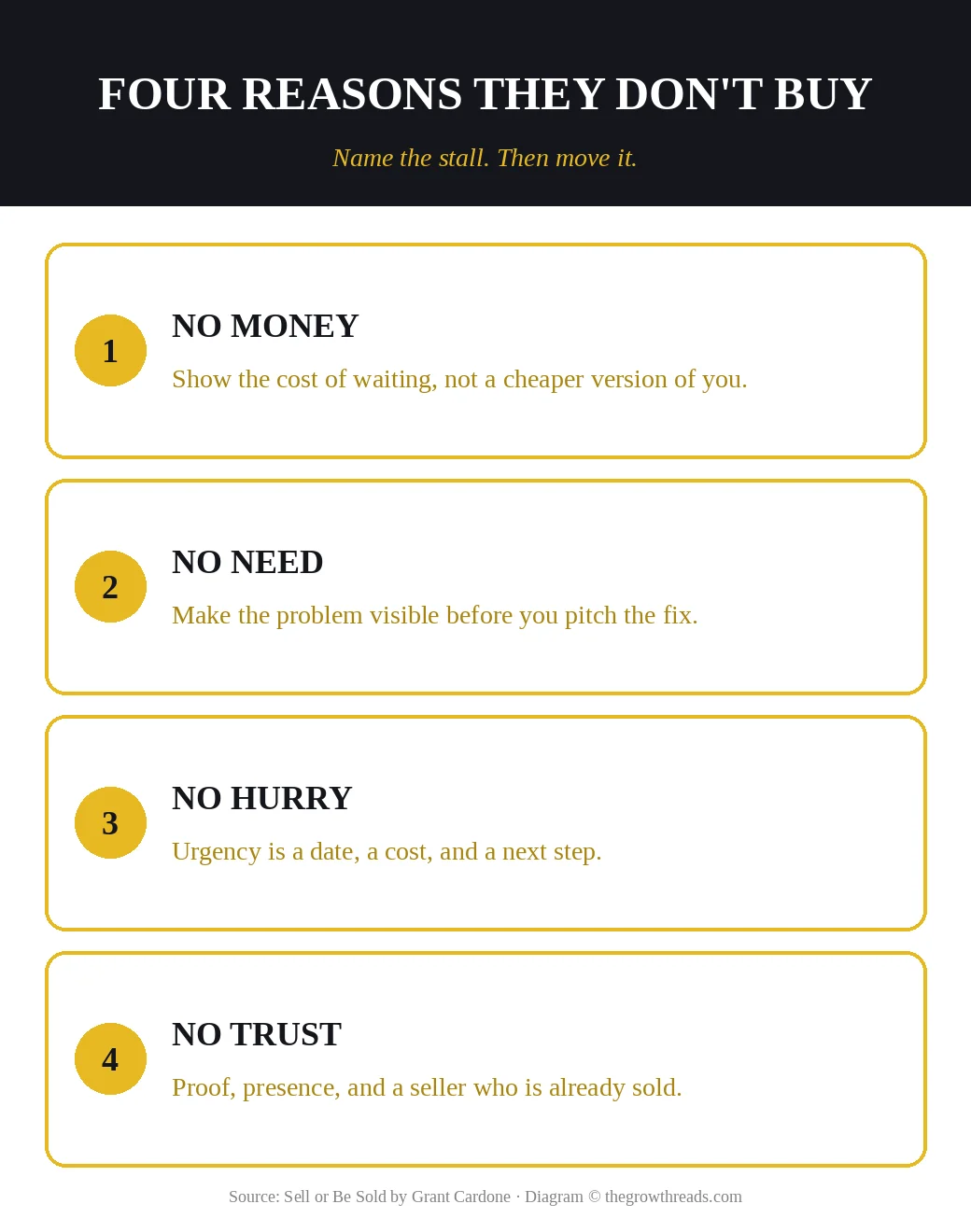
Cardone’s most useful tool is a map of stalls. People don’t buy because they have no money, no need, no hurry, or no trust. Every long “let me think about it” is one of those four wearing a polite coat. The amateur argues with the coat. The sold professional names the bucket and works that one. Money talk is often fear of wasting what they have. No need is a problem not yet said out loud. No hurry is a missing date and a missing cost of waiting. No trust is you — plus no proof.
Buyers hide the reason because “I don’t trust you yet” feels rude and “I don’t want to spend this” feels exposing. So you get process, timing, a spouse who is not in the room. Stay with the stall. Ask what would have to be true, and what happens if they wait ninety days. That is the same implication move SPIN Selling trains in a longer investigation. Cardone just refuses to let the first sentence end the meeting.
Use the four buckets on live conversations this week. After each call, write which one it actually was. You will notice a pattern: fighting price because you are unsold, or hearing “not now” because delay has no cost. The map is not a trap. When they can name the real constraint, you may present. Until then you are still gathering — the patience The Mom Test demands when people are too nice to tell you the truth.
TGR Note: Once you are in a live deal, SPIN Selling is the question sequence for the meeting. If people compliment you instead of telling the truth, The Mom Test keeps you in their life. Cardone’s four reasons are the identity layer: you will not fold at the first stall.
Part 3 — Never be sold on price
Price is where unsold sellers leak. Cardone’s rule is personal first: do not be sold on price yourself. If you secretly think the offer is expensive, you will hear “how much” as a verdict and start cutting. Discounting before they have named a problem is not generosity. The buyer did not need a cheaper you. They needed a clearer result and a reason the wait costs more than the invoice.
Value here is the outcome plus the time you save plus the risk you remove. No hurry collapses when waiting has a number. No money changes shape when the alternative is a slower leak. Stay honest — if they cannot buy, do not bully a card. Do not treat every price question as poverty either. Often it is a test: are you sold enough to hold the line?
Agreement is the other half. Small yeses that lead to a decision beat a performance of rapport. “Does this solve the thing you named?” is a better line than a new feature. If they agree on the problem and the fit, the close is the next sentence. If they do not, you are still in part two. Pitch Anything is the frame-control version: do not chase status in the room. Cardone’s version is simpler. Hold the price because you are sold. Then ask.
TGR Note: If the calendar is empty, Fanatical Prospecting fills the chair. If you get the meeting and still sound like a hunter, Ninja Selling is the attract layer. Cardone sits between them: create conversations, then do not fold them on price because you never sold yourself.
Part 4 — Close, then make the second sale
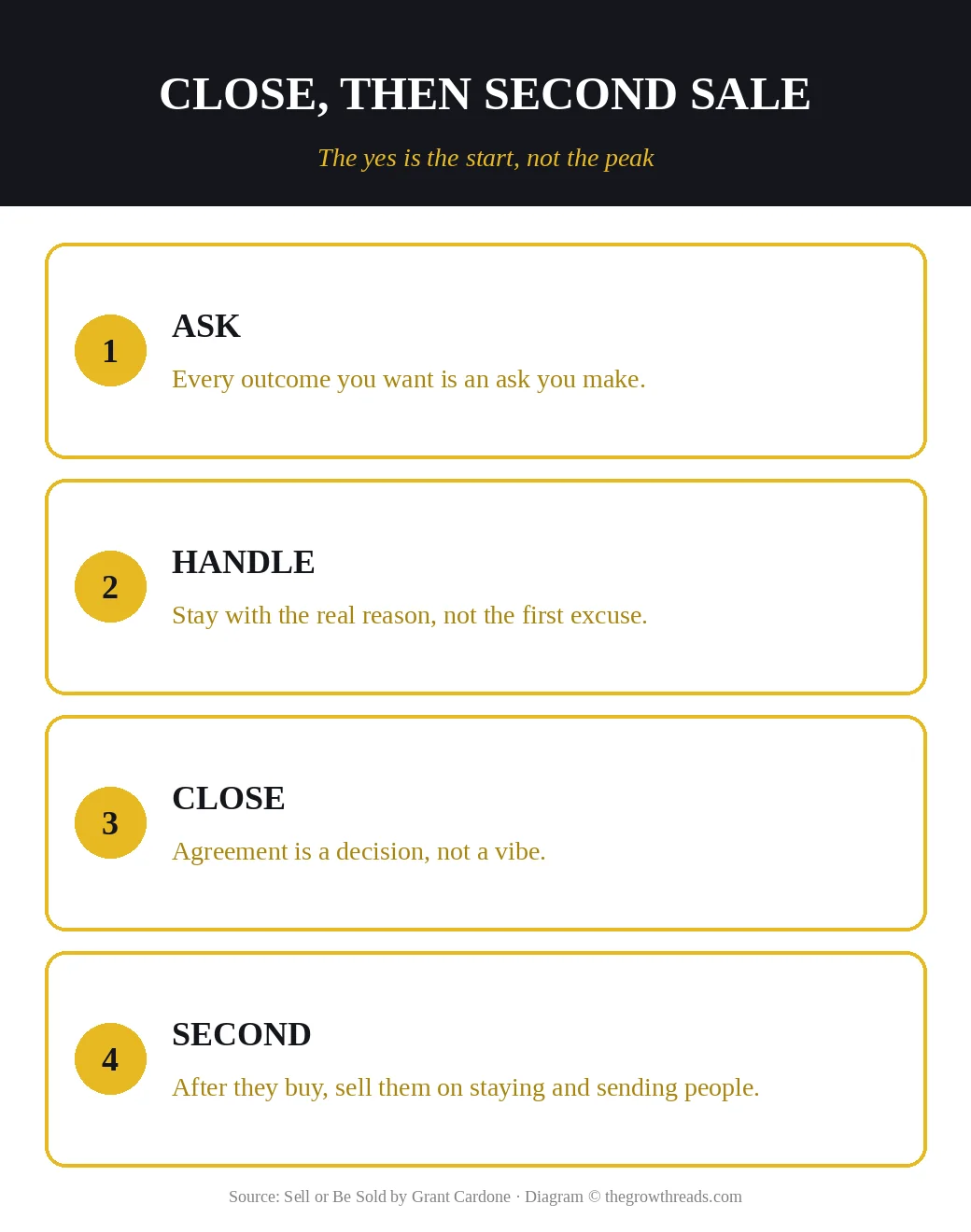
Closing, for Cardone, is not a trick at minute fifty-eight. It is asking for a decision when the problem is named and the fit is clear. “Sounds great” is not a close. A date, a signature, a next step, or a named no is. Unnamed nos eat weeks. A clean no can be worked. Warm fog cannot. Always be closing, here, means always be willing to ask — in the meeting, in the follow-up, in the week after they go quiet.
Follow-up is where most people quietly quit. One email, one silence, a story that they were not interested. Persistence is professional when you bring a reason to continue: a cost of waiting, a proof point, a question you skipped. Nagging for sport is not the lesson. Disappearing after the first shrug is. Book the next contact while you still have the room. That is the same discipline as a money hour in Ninja Selling, aimed at the ask rather than the drip.
The second sale is what people skip because the deal already closed. After they buy, sell them on the decision, on using the thing, on staying long enough to get the result, and on sending a name. A one-time close is expensive. A quiet client is a future no. Service is still an ask — how’s it going, here’s the next step, who else should see this — not a disappearing act. If the business only works when you hunt strangers, you built a treadmill. Let this week’s asks serve a book of people who already said yes.
Who is Sell or Be Sold best for — and who should read something else first?
Best for founders, advisors, and anyone with an offer who still flinches at the ask. It is also for sellers who live on discounting and call it listening. If you need people to say yes and you have been waiting to be picked, this is the book.
Read something else first if your calendar has no conversations — start with Fanatical Prospecting. If you get in the room and cannot diagnose, start with SPIN Selling. If the room is a committee, The Challenger Sale is the teach-and-take-control layer. If you reject the word “sales,” start with To Sell Is Human. Come back to Cardone when access is not the issue — belief, price, and the ask are.
Questions to reflect on
- Where did you last flinch — product, price, or the right to ask?
- On your last stalled deal, which of the four reasons was real, not the first sentence?
- What would you charge if you were fully sold, and what are you charging instead?
- Which silent lead did you bury after one follow-up that still has a real problem?
- After your last close, what second sale did you make — stay, use, or a name — besides a thank-you note?
🔥 Ready to get sold first?
Name the stall, hold the price, and ask for a decision this week.
How to apply Sell or Be Sold (7-day plan)
- Day 1 — Sell yourself on paper. Eight lines on why the offer is worth the price. If you cannot, fix the offer before you talk.
- Day 2 — Score three live stalls. After each conversation, mark money, need, hurry, or trust — not “they need to think.”
- Day 3 — Hold the price once. On one real ask, do not discount. Show the cost of waiting.
- Day 4 — Ask for a decision. End one meeting with a date, a yes, or a named no.
- Day 5 — Follow up with a reason. One silent lead gets a cost, a proof, or a question — not “just checking in.”
- Day 6 — Make one second sale. After a past yes, ask how it is going, then for the next step or a name.
- Day 7 — Review the week. Where did you hide, cut price, or skip the ask? Book next week’s first three asks.
Frequently asked questions
What is Sell or Be Sold about?
Sell or Be Sold is Grant Cardone’s field book for treating every yes you need as a sale. The first sale is to yourself: product, price, and the person making the ask. Then you handle the four reasons people stall — no money, no need, no hurry, no trust — without taking the first excuse as the truth. Closing is a decision you ask for, and the second sale starts after they buy: they stay, they use it, they send people. Read it when you already have something worth offering and still flinch at the ask.
Who is Grant Cardone?
Grant Cardone is a sales trainer, real-estate investor, and the author of The 10X Rule. He got sober at 25, rebuilt around selling cars and later training, and built Cardone Capital into a large multifamily portfolio plus a loud media presence. Sell or Be Sold (Greenleaf Book Group Press, 2012) is the practical companion to the 10X manifesto: how you actually get a yes once the target is huge. Wikipedia lists him as a financial influencer. Start with The 10X Rule if you need ambition. Start here if the problem is the conversation, the price flinch, and the follow-up you keep postponing.
What are the four reasons people don’t buy?
Cardone groups stalls into four buckets: they do not have the money, they do not see a need, they feel no hurry, or they do not trust you. The useful move is not to argue with the first sentence they give you. Money talk is often fear of wasting what they have. No need is often an unnamed problem. No hurry is a missing date and a missing cost of waiting. No trust is a seller who is not sold, plus no proof. Name the real bucket, then move that one. Five live conversations this week will teach you more than a new deck.
How is Sell or Be Sold different from The 10X Rule?
The 10X Rule is the target and the volume: set a goal ten times larger and take action that looks excessive from the outside. Sell or Be Sold is the conversation that turns that volume into agreements. One book says you are underestimating the effort. This one says you are unsold, so every no feels personal and every price feels high. You probably need both. 10X without a close is busy. A close without 10X is a small practice that still hates the phone. If you already work hard and still lose the room, start here.
Is Sell or Be Sold only for salespeople?
The stories are quotas, showrooms, and closed deals, because that is Cardone’s lab. The moves are not. Hiring is a sale. A product launch is a sale. Asking a partner to change how the week works is a sale. Founders who say they are “not salesy” still need people to say yes, and they still stall on the same four reasons. If you have no conversations at all, start with Fanatical Prospecting. If you already talk to people and still leave without an ask, this is the book. Selling here means getting your way without waiting to be picked.
What is the second sale in Sell or Be Sold?
The first sale is the signature. The second is everything after: they stay, they use what they bought, they buy again, they send a name. Cardone treats the post-yes window as the real business, because a one-time close is expensive and a quiet client is a future no. You sell them on the decision they already made, then on the next step, then on introducing you. That is why disappearing after the contract is so costly. The ninja version of this is service. Cardone’s version is still an ask. Both refuse to treat the close as the peak of the relationship.
Should I read SPIN Selling or Sell or Be Sold first?
If the problem is the meeting itself — you get in the room and cannot diagnose — start with SPIN Selling. If the room is a committee that needs a teachable insight, The Challenger Sale is the better in-deal book. If the problem is you, start here: you are not sold, you flinch at price, you take the first no, you do not follow up. Cardone is the identity and the objection map. Rackham is the question sequence once a live deal exists. Many people need this book on Monday morning and SPIN on the actual call. Do not make it an either/or.
Related summaries
- The 10X Rule Summary & Review — same author, bigger target
- Fanatical Prospecting Summary & Review — fill the empty chair first
- SPIN Selling Summary & Review — questions once the meeting exists
- To Sell Is Human Summary & Review — moving others without the costume
- Best productivity books — the full Productivity silo
How we analyze books: we paraphrase arguments, add original application notes, and skip chapter-by-chapter reproduction. Read our full methodology.