

★★★★☆ 4.0/5
One-liner: A distilled collection of Naval Ravikant’s sharpest insights on building wealth and finding happiness through first-principles thinking.
Best for: Aspiring entrepreneurs, independent thinkers, and anyone who wants a philosophical framework for wealth and contentment.
Reading time: ~3 hours (242 pages)
Difficulty to apply: Low to moderate — the principles are clear, but the mindset shifts take years to internalize.
The Almanack of Naval Ravikant in one minute
Wealth isn’t about working harder — it’s about knowing what to do, who to do it with, and when to do it. This book compiles Naval Ravikant’s most influential ideas on wealth creation and happiness from his tweets, podcasts, and essays into a single, dense volume. Naval argues that specific knowledge, leverage, and accountability are the three pillars of wealth — and that none of them require you to rent out your time. On the happiness side, he treats peace of mind as a skill you train, not a destination you arrive at. The book is structured as two halves — wealth and happiness — and reads less like a traditional book and more like a collection of razor-sharp aphorisms backed by first-principles reasoning. Eric Jorgenson curated and organized the material; the voice and ideas are entirely Naval’s.
Key takeaways
- Seek wealth, not money or status: Wealth is assets that earn while you sleep. Money is how we transfer time and wealth. Status is your rank in the social hierarchy — a zero-sum game.
- Build specific knowledge: The knowledge that cannot be trained for — it’s built through genuine curiosity and obsessive interest, not formal education.
- Use leverage: Code, media, and capital let you multiply your output without multiplying your hours. Of the three, code and media are the most accessible and democratic.
- Take accountability: Society rewards people who take risks under their own name. Accountability is how you earn equity and trust.
- Play long-term games with long-term people: All returns in life — wealth, relationships, knowledge — come from compound interest.
- Happiness is a choice and a skill: It’s not something you achieve after enough success. It’s a default state you return to by shedding desires and training your mind.
- Desire is a contract to be unhappy: Every desire you hold is an agreement with yourself to be dissatisfied until you get what you want.
- Read what you love until you love to read: Naval reads obsessively but never forces himself through books he doesn’t enjoy. The habit matters more than any single title.
- The most important skill is judgment: Knowing the long-term consequences of your actions is more valuable than any technical skill.
- Earn with your mind, not your time: If you can’t earn while you sleep, you’ll work until you die. Set up systems, businesses, or assets that generate income independent of your presence.
What is The Almanack of Naval Ravikant about?
The Almanack of Naval Ravikant is a curated collection of Naval’s wisdom on two themes: building wealth and finding happiness. Compiled by Eric Jorgenson from Naval’s tweets, podcast appearances, and essays, it distills decades of thinking into actionable principles built on first-principles reasoning, covering specific knowledge, leverage, accountability, judgment, and the internal work required for lasting contentment.
About the author
Naval Ravikant is an Indian-American entrepreneur and angel investor best known as the co-founder of AngelList, the platform that transformed startup fundraising. Born in New Delhi and raised in New York City, Naval grew up in modest circumstances and developed a voracious reading habit that shaped his autodidactic approach to business and philosophy. He was an early investor in companies including Twitter, Uber, and Notion. Beyond investing, Naval became widely influential through his tweetstorms and podcast appearances, where he synthesized ideas from physics, economics, and Eastern philosophy into practical frameworks for modern life. Eric Jorgenson, a writer and startup operator, spent two years compiling Naval’s public wisdom into this book, which Naval endorsed and made freely available online. Explore all Naval Ravikant book summaries →
Key concepts at a glance
| Concept | What it means | Use it when |
|---|---|---|
| Specific Knowledge | Skills built through curiosity and apprenticeship that can’t be outsourced or automated | Choosing what to learn next or evaluating your competitive edge |
| Leverage | Using code, media, or capital to decouple income from hours worked | Deciding between a salary job and building assets |
| Accountability | Taking business risk under your own name to earn equity and outsized returns | Considering whether to start a company or build a personal brand |
| Judgment | Understanding long-term consequences; the highest-paid skill | Making career decisions with 10-year time horizons |
| Productize Yourself | Turn your unique combination of skills and interests into a product or service | Finding your niche at the intersection of passion and market demand |
| Desire Is Suffering | Each unfulfilled want is a contract with unhappiness | Feeling restless despite external success |
| Happiness as a Skill | A trainable default state, not a reward for achievement | Building daily practices for mental peace |
| Compound Interest | Applies to relationships and knowledge, not just money | Evaluating whether to switch careers, friendships, or cities |
Part 1: Building wealth
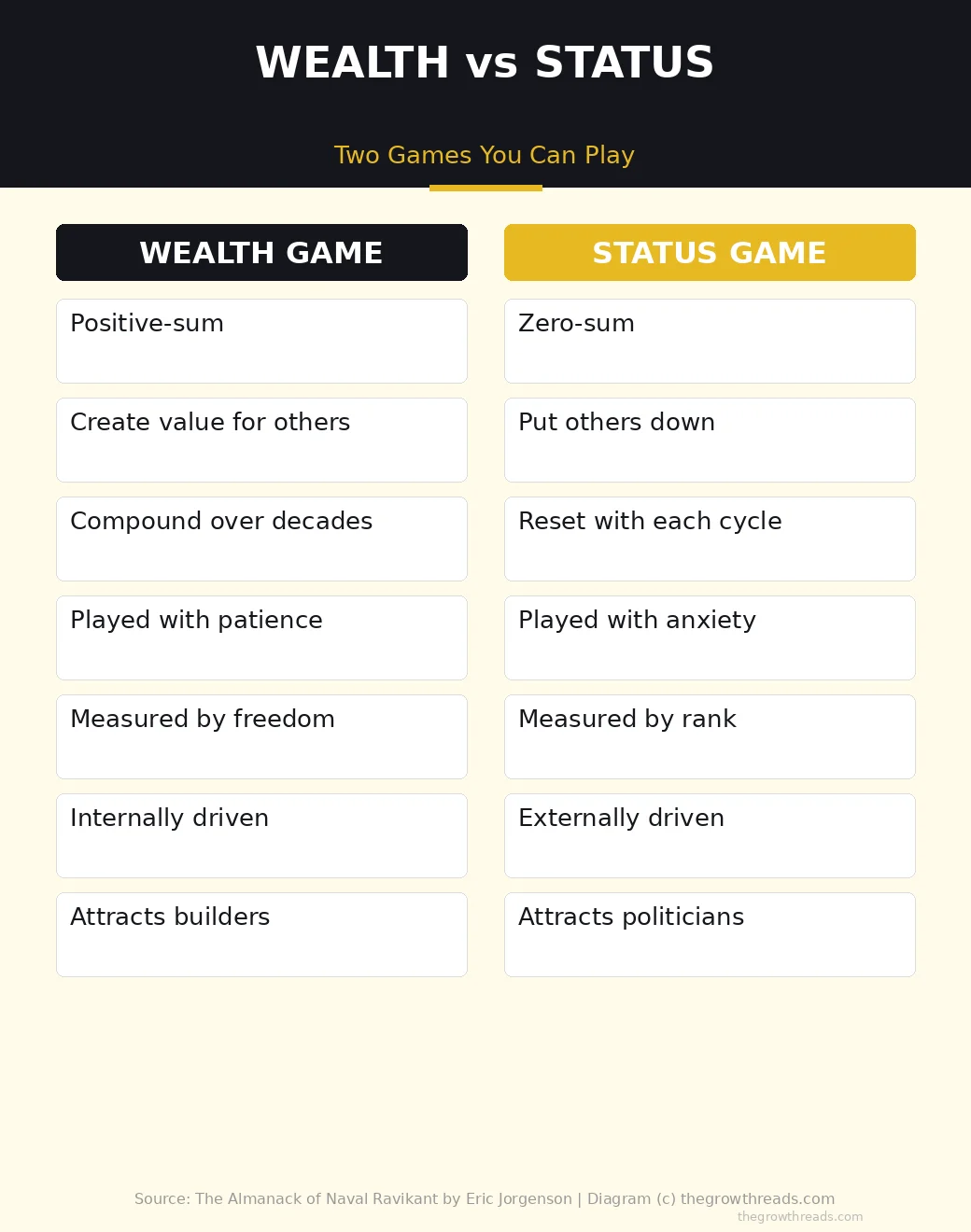
The first half of the Almanack is devoted to Naval’s framework for building wealth — not just money, but assets that generate income independent of your direct labor. Naval draws a critical distinction between wealth, money, and status. Wealth is owning businesses, assets, or intellectual property that earn while you sleep. Money is the medium of exchange. Status is your position in the social hierarchy. The key insight: people who play status games actively attack people who play wealth games, because wealth creation is positive-sum (everyone can win) while status is zero-sum (for you to go up, someone else must go down).
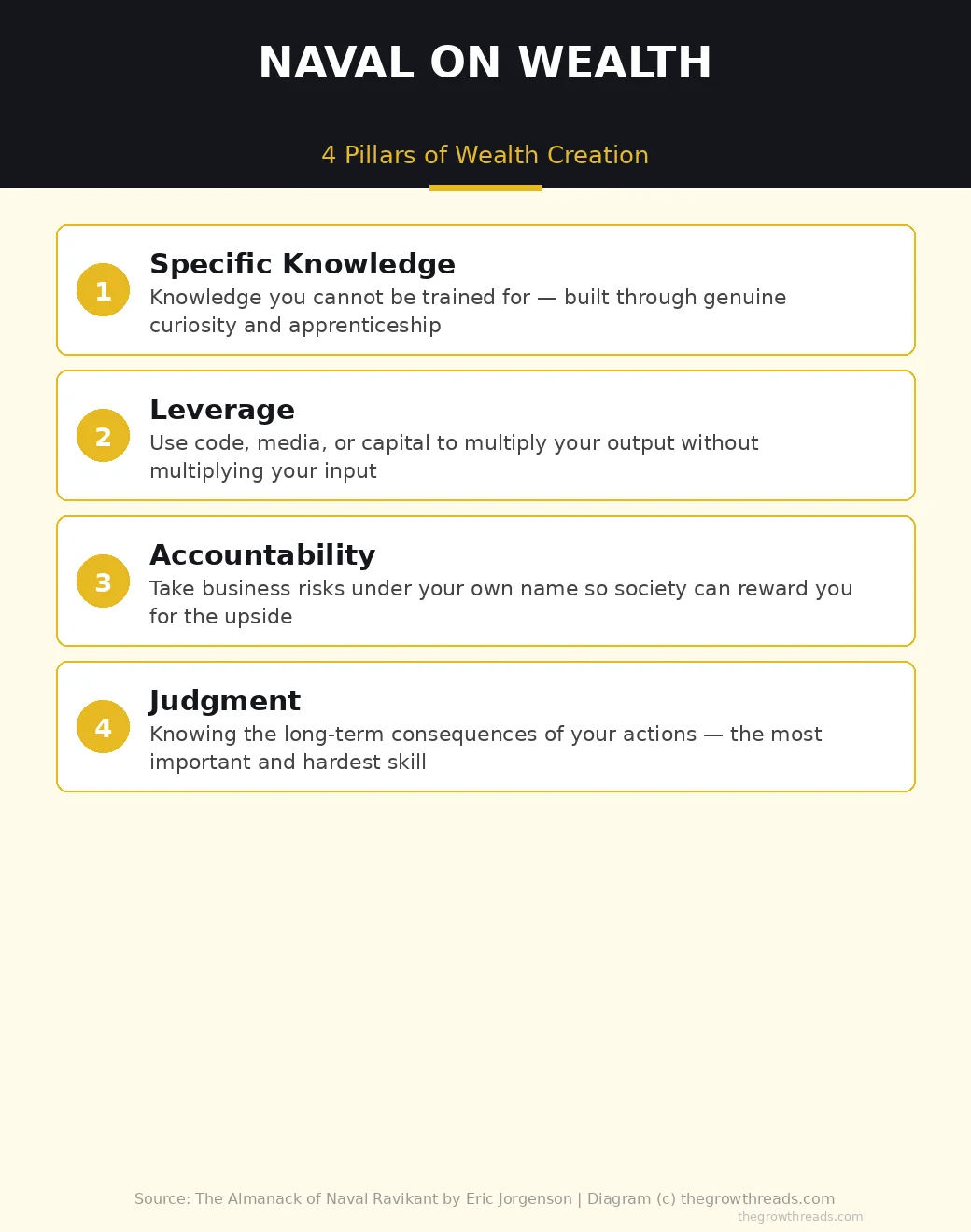
Naval’s wealth-creation framework rests on four pillars. The first is specific knowledge — the kind of knowledge that feels like play to you but looks like work to others. It’s not taught in schools; it’s built through genuine curiosity and apprenticeship. If you can be trained for it, someone else can be trained to replace you. The second is accountability — taking business risk under your own name. Society rewards people who take on risk and bear consequences; this is how you earn equity rather than a salary. The third is leverage, which comes in three forms: labor (other people working for you), capital (money working for you), and products with no marginal cost of replication (code and media). Of these, code and media are the most powerful because they require no one’s permission. The fourth is judgment — knowing the long-term consequences of your actions, which Naval calls the most valuable and hardest-to-teach skill of all.
Naval condenses his entire wealth philosophy into a single directive: “productize yourself.” Find the intersection of what you’re uniquely good at (specific knowledge), what you can’t be trained for, and what can be leveraged through code or media — then package it into a product or service. The most important concept in his wealth section might be the simplest: play long-term games with long-term people. All returns in life come from compound interest, and compound interest requires time and trust. Switching partners, industries, or cities every few years resets the clock.
Part 2: Building judgment
Naval devotes a significant section to how judgment is built, treating it as the meta-skill that determines how effectively you deploy your specific knowledge and leverage. His core claim: judgment comes from experience, but it can be accelerated through mental models. He advocates collecting mental models from every discipline — evolution, thermodynamics, game theory, microeconomics, psychology — and applying them as lenses to every decision.
On decision-making, Naval offers several counterintuitive principles. First, if you can’t decide between two options, choose the path that’s harder in the short term. Easy choices lead to hard lives; hard choices lead to easy lives. Second, avoid making decisions out of anger, fear, or any intense emotional state. Third, when you have too many options, the decision doesn’t matter — just pick one and commit. Analysis paralysis is itself a decision to stay stuck.
Reading is Naval’s primary tool for building judgment. He reads voraciously — 60+ books at a time, picking up and dropping books freely. His approach is radically different from most productivity advice: read what you love until you love to read. He prioritizes foundational texts (science, philosophy, mathematics) over business books, arguing that the fundamentals compound while trendy advice expires. He also advocates rereading: if a book is good enough to finish, it’s good enough to read twice.
Part 3: Finding happiness
The second half of the book shifts from external wealth to internal peace, and Naval’s philosophy here draws heavily from Buddhism, Stoicism, and his own hard-won experience. His foundational claim is provocative: happiness is the absence of desire. Every desire you hold is a contract with yourself to be unhappy until you get what you want. The more desires you carry, the less room there is for contentment.
Naval treats happiness as a skill, not a circumstance. Just as you can train your body at the gym, you can train your mind to default to peace rather than anxiety. His practical toolkit includes meditation (he practices both vipassana and transcendental meditation), walking without podcasts or music, journaling, and deliberate solitude. He also emphasizes physical health as a prerequisite — without a healthy body, a healthy mind is nearly impossible to sustain.
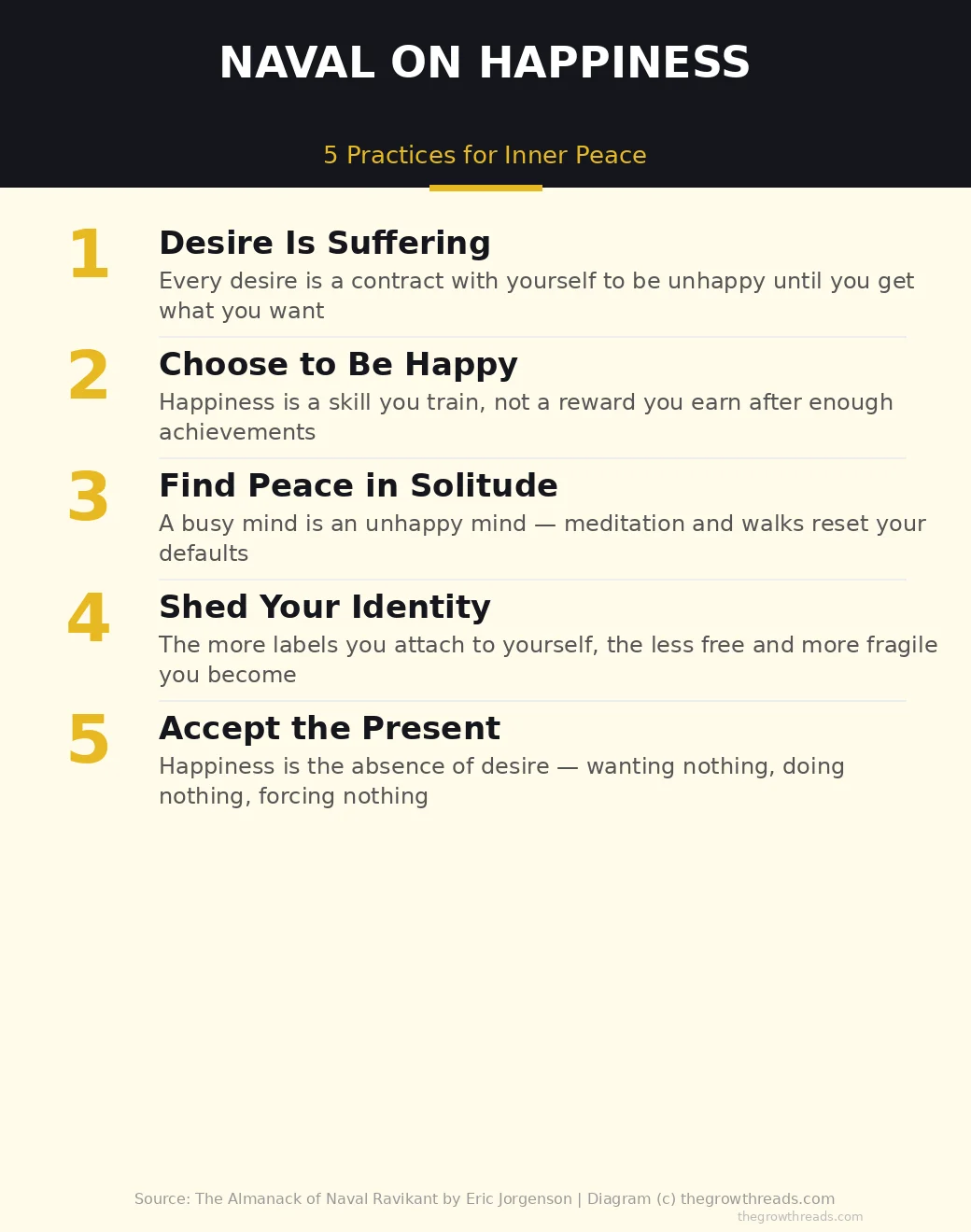
One of his most striking ideas is about identity. Naval argues that the more labels you attach to yourself — liberal, conservative, founder, athlete, victim — the less free you become. Every identity is a cage. When something threatens a label, you react emotionally rather than rationally, because an attack on your identity feels like an attack on your existence. The fewer identities you carry, the freer and more adaptable you are.
Naval also introduces a personal rule he calls “the five-year test”: when making any decision, he asks whether it will matter in five years. If not, he doesn’t let it bother him today. This connects to his broader philosophy of presence — most suffering comes from mentally living in the past (regret) or the future (anxiety) rather than the present moment. He’s not prescribing a life without ambition; he’s arguing that ambition and peace can coexist if you learn to want what you already have while working for more.
Part 4: Philosophy and principles
The final section of the Almanack covers Naval’s personal operating principles — the rules he lives by. He advocates for radical honesty, arguing that telling the truth is not just morally right but strategically optimal: liars need to remember their lies, while honest people carry no such burden. He also argues for being selective with your time to the point of seeming antisocial. Most meetings, events, and obligations aren’t worth attending. If you can’t say “hell yes” to something, say no.
On the question of meaning, Naval takes a deliberately secular position. He doesn’t believe in inherent cosmic meaning but argues that this is liberating rather than nihilistic: if there’s no grand plan, you’re free to create your own meaning and live by your own principles. He sees death as the ultimate motivator — knowing that life is finite makes every day more precious and every petty conflict less important.
Naval also shares his views on health as the foundation of everything. He follows a low-carb, intermittent-fasting approach, exercises daily, prioritizes sleep, and treats his body with the same rigor he applies to investing. His logic is characteristically direct: a healthy body is the best investment you can make, because without it, nothing else matters.
Who is The Almanack of Naval Ravikant best for — and who should read something else first?
This book is ideal for aspiring entrepreneurs, independent thinkers, and anyone who feels the pull of building something but hasn’t found the right framework. If you’re early in your career and trying to figure out what to build your life around, Naval’s principles on specific knowledge and leverage are genuinely clarifying. It’s also valuable for people who’ve achieved financial success but still feel restless — the happiness section addresses that gap directly.
If you’re looking for a step-by-step financial plan, this isn’t it — try I Will Teach You to Be Rich by Ramit Sethi instead. If you want research-backed investing principles, The Psychology of Money by Morgan Housel is more rigorous. And if the philosophical tone feels too abstract, The Millionaire Fastlane by MJ DeMarco covers similar wealth-creation ideas with more tactical detail.
Questions to reflect on
- What is your specific knowledge — what feels like play to you but looks like work to others?
- Are you currently playing a wealth game (positive-sum, building assets) or a status game (zero-sum, seeking rank)?
- What desires are you holding right now that are making you unhappy? Would you be willing to drop any of them?
- If you had to “productize yourself” — turn your unique skills into a product — what would that product be?
- Which identities are you clinging to that might be limiting your freedom and adaptability?
🔥 Ready to build wealth from first principles?
Naval’s distilled wisdom on wealth creation, happiness, and living deliberately.
How to apply The Almanack of Naval Ravikant (7-day plan)
- Day 1 — Identify your specific knowledge: Write down three things you’re genuinely curious about that others find tedious. These are clues to your specific knowledge.
- Day 2 — Audit your leverage: List your current income sources. For each, ask: “Does this earn while I sleep?” If the answer is no for all of them, brainstorm one asset (code, content, or investment) you could start building this month.
- Day 3 — Play the wealth game: Identify one area where you’re playing a status game (seeking approval, chasing titles, comparing yourself). Consciously redirect that energy toward creating something of value.
- Day 4 — Drop a desire: Pick one thing you’ve been wanting that’s been making you anxious. Experiment with accepting that you may never get it. Notice how your mood shifts.
- Day 5 — Read for curiosity: Pick up a book from a field you know nothing about — physics, philosophy, biology. Read for 30 minutes with no goal other than following your curiosity.
- Day 6 — Practice solitude: Take a 30-minute walk with no phone, no music, no podcast. Let your mind wander. Journal about what surfaced afterward.
- Day 7 — Productize yourself: Write a one-paragraph description of a product or service that combines your specific knowledge with leverage (code or media). Share it with one trusted person for feedback.
Frequently asked questions
What is the main message of The Almanack of Naval Ravikant?
The book’s central message is that wealth and happiness are skills you can develop, not outcomes you chase. Wealth comes from building specific knowledge, applying leverage (code, media, capital), taking accountability, and exercising good judgment. Happiness comes from reducing desires, training your mind through meditation and presence, and shedding the identities that keep you reactive rather than free. Naval argues both can be pursued simultaneously and that one without the other is incomplete.
Is The Almanack of Naval Ravikant worth reading?
Yes, particularly if you’re in the early-to-middle stages of your career and want a philosophical framework for building wealth and living well. The book’s strength is its density — nearly every page contains an idea worth reflecting on. It’s not a step-by-step financial guide, so pair it with something tactical like I Will Teach You to Be Rich. The book is also available for free on navalmanack.com, so there’s no risk in trying it. Most readers who connect with Naval’s thinking style find it transformative.
What does Naval mean by “specific knowledge”?
Specific knowledge is the type of knowledge that cannot be trained for in a classroom or replicated by following a procedure. It’s built through genuine curiosity, apprenticeship, and deep obsession with a domain. If society can train you for a skill, it can train someone else to replace you — and eventually, it will. Specific knowledge often feels like play to the person who has it but looks like work to everyone else. Examples include a natural talent for sales, an intuitive understanding of a market, or a unique ability to combine ideas from different fields.
What are Naval’s three types of leverage?
Naval identifies three forms of leverage: labor (having other people work for you), capital (having money work for you), and products with no marginal cost of replication, which means code and media. Labor is the oldest form but requires managing people. Capital requires someone else’s permission (investors, banks). Code and media are what Naval calls “permissionless leverage” — anyone can write a blog post, build an app, or record a podcast without asking for approval. He considers code and media the most powerful leverage available today because they scale infinitely at near-zero cost.
What does Naval say about happiness?
Naval defines happiness as the absence of desire — a state of peace rather than excitement or pleasure. He treats it as a skill that can be trained through practices like meditation, walking in solitude, and deliberately dropping desires that create inner tension. He also argues that shedding identity labels (political affiliation, career titles, group memberships) is essential because each label creates a vulnerability. His philosophy blends Buddhist concepts of non-attachment with Stoic principles of focusing only on what you can control, all filtered through a secular, practical lens.
How long does it take to read The Almanack of Naval Ravikant?
The book is 242 pages and takes about three hours for the average reader. However, many readers report that the density of ideas makes it worth reading much more slowly — absorbing one section per sitting rather than racing through. The audiobook runs approximately three hours and 11 minutes. Naval’s own advice would be to read it however you want: skip around, reread favorite sections, and abandon it if it stops being interesting. The book is also available for free at navalmanack.com.
Who actually wrote The Almanack of Naval Ravikant?
Eric Jorgenson compiled and organized the book from Naval Ravikant’s public tweets, podcast interviews, and essays over approximately two years. The ideas and voice are Naval’s; Jorgenson’s contribution was curation, structure, and editorial coherence. Jack Butcher designed the illustrations, and Tim Ferriss wrote the foreword. Naval endorsed the final product and agreed to make it freely available online. It’s best understood as a curated collection rather than a traditional authored book — similar in format to Poor Charlie’s Almanack about Charlie Munger.
Related summaries
If The Almanack of Naval Ravikant resonated with you, explore these related summaries in the Money silo:
- The Psychology of Money Summary — Morgan Housel on why financial success is more about behavior than intelligence.
- The Millionaire Fastlane Summary — MJ DeMarco on building wealth through entrepreneurship, not saving pennies.
- Rich Dad Poor Dad Summary — Robert Kiyosaki on the mindset shift from employee to investor.
- Die With Zero Summary — Bill Perkins on spending your wealth optimally across your lifetime.
→ See all: Best Money Books