

★★★★ 4.3/5 — the book that founded the entire success-literature genre, still worth reading for its core insight: achievement starts in the mind, then demands relentless action.
Best for: anyone who wants the original blueprint behind modern goal-setting and wealth psychology · Reading time: ~5 hours (this guide: 16 min) · Difficulty to apply: Moderate — the ideas are simple; the persistence is the test
Think and Grow Rich in one minute
Wealth, Napoleon Hill argues, begins as a state of mind before it becomes a state of your bank account. Written in 1937 after two decades studying 500 of America’s most successful people — Andrew Carnegie, Henry Ford, Thomas Edison — the book distills their common patterns into 13 principles. Its central claim is that a definite, burning desire, backed by unshakable faith, a concrete plan, and refusal to quit, sets in motion the actions and opportunities that produce riches. Strip away the 1930s mysticism and you find the ancestor of nearly every goal-setting, visualization, and mindset book written since: decide exactly what you want, commit to it emotionally, plan it, and persist past the point where most people give up. It is less a get-rich scheme than a psychology of relentless purpose.
Key takeaways
- Desire is the starting point: not a wish or a hope, but a definite, specific, burning want backed by a plan and a deadline.
- Definiteness of purpose: most people drift; the successful fix on one clear aim and organize their lives around it.
- Faith is a state you cultivate: belief in your goal, reinforced by repetition, is what moves you to act as if success is inevitable.
- Autosuggestion programs the subconscious: repeating your goal with emotion feeds it into the subconscious, which quietly reshapes your behavior.
- Specialized knowledge beats general knowledge: what matters is knowledge organized and directed toward your definite aim, not raw intelligence.
- Imagination is the workshop: every fortune begins as an idea; you must picture the thing before you can build it.
- Organized planning turns desire into action: a specific plan, revised whenever it fails, is the bridge between wanting and having.
- Decision defeats procrastination: successful people decide quickly and change slowly; the indecisive are swept along by others.
- Persistence is the everyday miracle: most people quit at the first defeat. Sustained effort past failure is what separates the rich from the rest.
- The Master Mind multiplies you: a coordinated group of trusted minds working toward your goal creates power no individual can match alone.
What is Think and Grow Rich about?
Think and Grow Rich is a 1937 personal-success book by Napoleon Hill that distills the habits and mindset of 500 wealthy achievers into 13 principles. Its argument is that riches begin with a definite desire, sustained by faith, planning, and persistence — that thought, directed and disciplined, is the true origin of wealth.
About the author
Napoleon Hill (1883–1970) was an American author who, by his own account, was commissioned by steel magnate Andrew Carnegie to spend two decades interviewing the most successful people of his era and distilling a “philosophy of achievement.” Published in 1937, at the depth of the Great Depression, Think and Grow Rich offered a hopeful, actionable message to a country desperate for one, and became one of the best-selling books of all time. Hill’s earlier work The Law of Success laid the groundwork, but Think and Grow Rich made his ideas permanent. While some historians have questioned aspects of Hill’s biography and his relationship with Carnegie, the practical framework he assembled — desire, planning, persistence, and mastermind collaboration — went on to shape virtually every self-improvement author who followed, from Earl Nightingale to Tony Robbins. Explore all Napoleon Hill book summaries →
Key concepts at a glance
| Principle | What it means | Use it when |
|---|---|---|
| Definite desire | A specific goal with a deadline | You feel vague or aimless |
| Faith | Cultivated belief in the outcome | Doubt is stalling you |
| Autosuggestion | Repeating goals to the subconscious | Building daily conviction |
| Organized planning | A concrete, revisable plan | Turning a goal into steps |
| Decision | Deciding fast, changing slowly | You keep procrastinating |
| Persistence | Continuing past defeat | You’ve hit a setback |
| Master Mind | A team aligned to your goal | You’ve outgrown solo effort |
Part 1: Thoughts are things — desire as the starting point
Hill opens with the line that became the book’s creed: “Thoughts are things.” He does not mean that wishing makes it so; he means that every tangible achievement — every business, invention, and fortune — began as a specific, sustained thought in someone’s mind. The distinction he hammers is between a wish and a burning desire. Everyone would like to be rich; almost no one holds a definite, emotionally charged, deadline-bound intention to become so. Hill’s most famous illustration is the story of Edwin Barnes, who wanted not just to work for Thomas Edison but to be his business partner. Barnes had no money and no connections, but he arrived at Edison’s lab with a fixed intention and stayed, taking a menial job, until the opportunity to prove himself finally came. His desire was so definite that he had “burned his ships” — left himself no retreat.
To convert desire from a feeling into a force, Hill offers a concrete six-step method — arguably the most practical passage in the book.
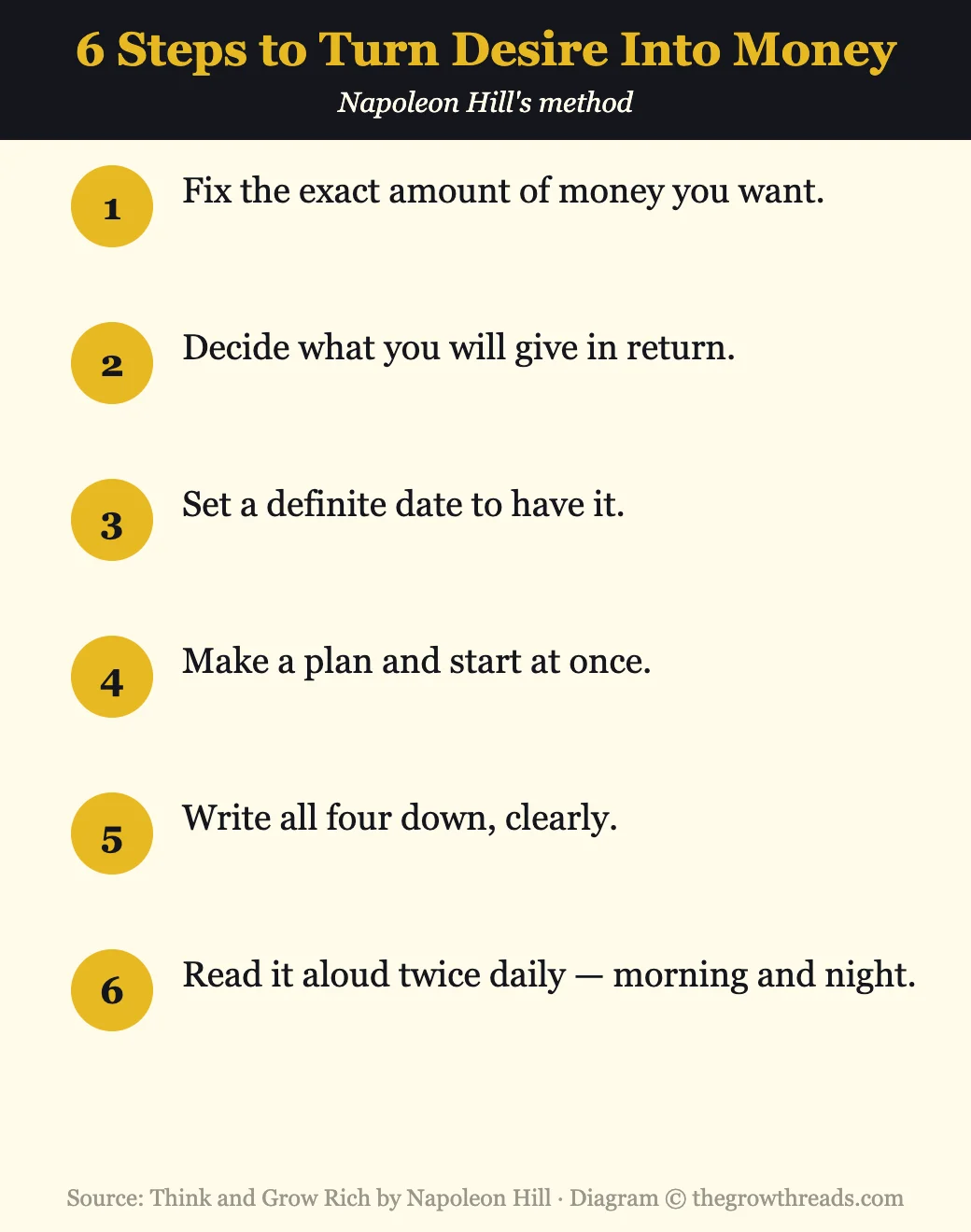
The steps look almost too simple: name the exact amount, decide what you will give in return, set a date, form a plan and begin immediately, write it all down, and read it aloud morning and night. But the mechanism is psychological. By repeating a vivid, specific goal with emotion, you keep it in front of your conscious attention and, Hill argues, plant it in the subconscious, which begins steering your choices toward it. This is definiteness of purpose in action — the antidote to the aimless drifting that defines most people’s relationship with their goals.
TGR Note: Hill’s insistence on a single definite aim prefigures the modern productivity gospel of focus. The One Thing by Gary Keller makes the same case with better evidence — that extraordinary results come from narrowing to one priority — while Atomic Habits adds the piece Hill underrates: goals set the direction, but daily systems are what actually get you there.
Part 2: Faith, autosuggestion, and the subconscious
If desire is the fuel, faith is the ignition. Hill uses “faith” not in a religious sense but as a cultivated state of confident expectation — the settled belief that your goal is achievable and, in fact, already on its way. He argues this belief is not something you either have or lack, but something you can build deliberately through autosuggestion: the disciplined repetition of your goal, spoken with feeling, until the subconscious accepts it as fact. A belief held long enough and vividly enough, Hill claims, begins to translate into the confident, persistent action that makes success far more likely.
Modern readers can hear this in two registers. The mystical register — that the subconscious mysteriously attracts opportunity — is where the book shows its age. But the practical register holds up well: what you repeatedly tell yourself shapes your expectations, your expectations shape your behavior, and your behavior shapes your results. A person who genuinely believes they can succeed asks for the sale, makes the call, and endures the setback that a doubter avoids. Hill’s autosuggestion is, in plain terms, deliberate self-talk aimed at building the courage to act.
TGR Note: Hill’s “faith you can cultivate” is an early, intuitive version of what Carol Dweck later proved with data in Mindset: believing ability can grow changes how hard you try and how you handle failure. Where Hill asks you to affirm the outcome, Dweck refines it — affirm the process and your capacity to improve, and the results follow more reliably.
Part 3: The doing — knowledge, planning, decision, and persistence
Hill is often caricatured as a “positive thinking” author, but the middle of the book is relentlessly practical about action. Specialized knowledge, he argues, matters more than general brilliance: Henry Ford was mocked as ignorant, yet he knew how to organize the specialized knowledge of others toward his aims, which is the only knowledge that pays. Imagination is the “workshop” where that knowledge is shaped into plans, and organized planning is the discipline of building a specific route to your goal — and, crucially, revising it every time it fails rather than abandoning the goal. Hill notes that temporary defeat usually means the plan was faulty, not the aim.
Two traits, he says, separate achievers from everyone else. The first is decision: after studying hundreds of wealthy people, Hill found they reached decisions quickly and changed them slowly, while those who failed did the reverse, forever swayed by others’ opinions. The second, and the one he calls almost synonymous with success, is persistence.
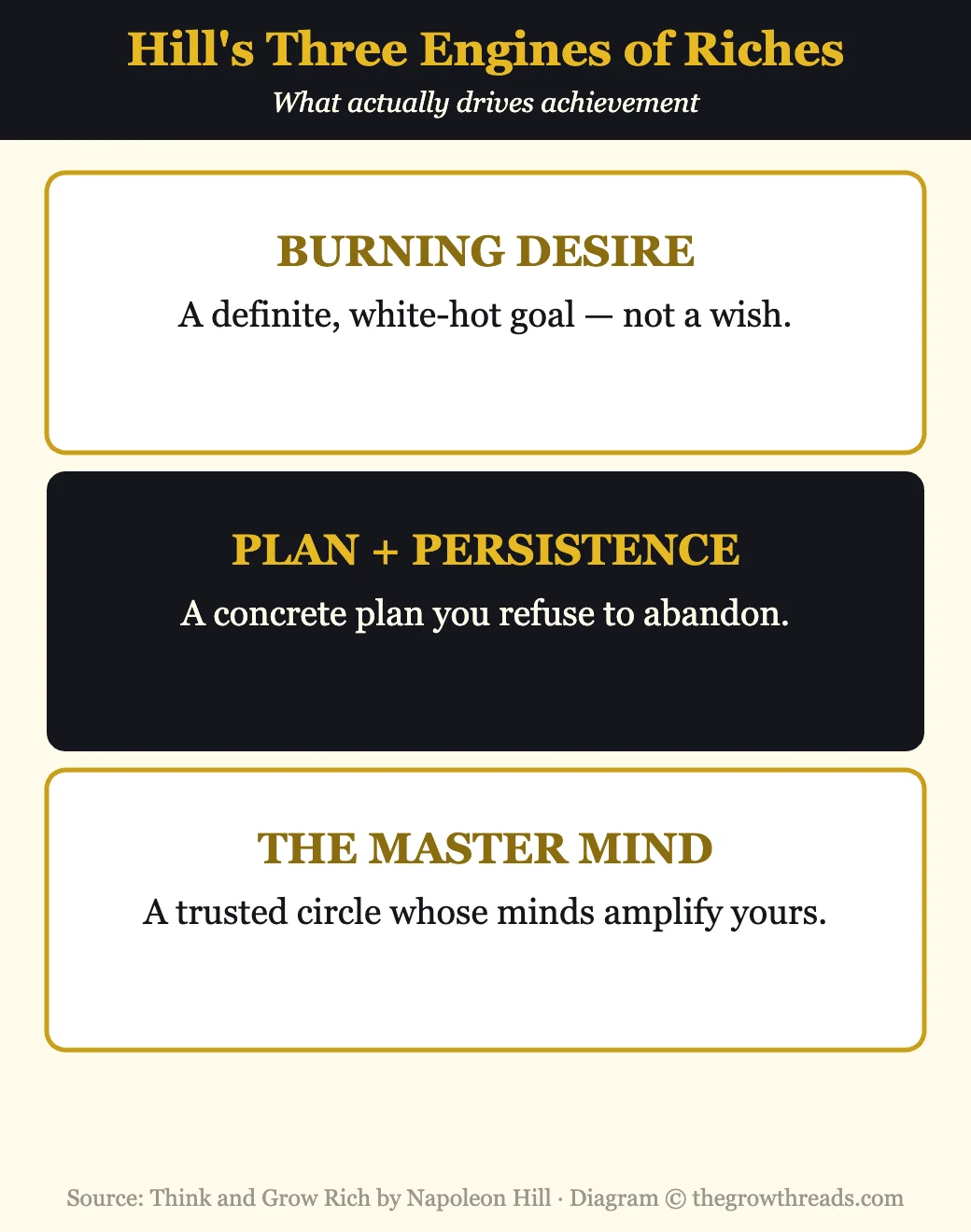
Persistence is the plain, unglamorous engine underneath the whole system. Hill’s most cited example is that of R.U. Darby, whose uncle quit gold mining “three feet from gold” — stopping just before a vein a later buyer struck by digging a little further. Most people, Hill warns, give up at the first sign of defeat, never knowing how close they were. Desire lights the fire, a definite plan gives it direction, but persistence is what keeps you digging when results are invisible — the same back-loaded patience that all durable achievement requires.
Part 4: The Master Mind and the higher principles
Hill’s most enduring contribution may be the concept of the “Master Mind”: a group of two or more people working in perfect harmony toward a definite purpose. He observed that when minds coordinate around a shared aim, they generate an energy and a flow of ideas that no individual could produce alone — Ford, Edison, and Firestone, for instance, were close friends who sharpened one another. The practical lesson is that you should deliberately surround yourself with capable, aligned people rather than trying to succeed in isolation. Your circle, Hill insists, becomes part of your mind.
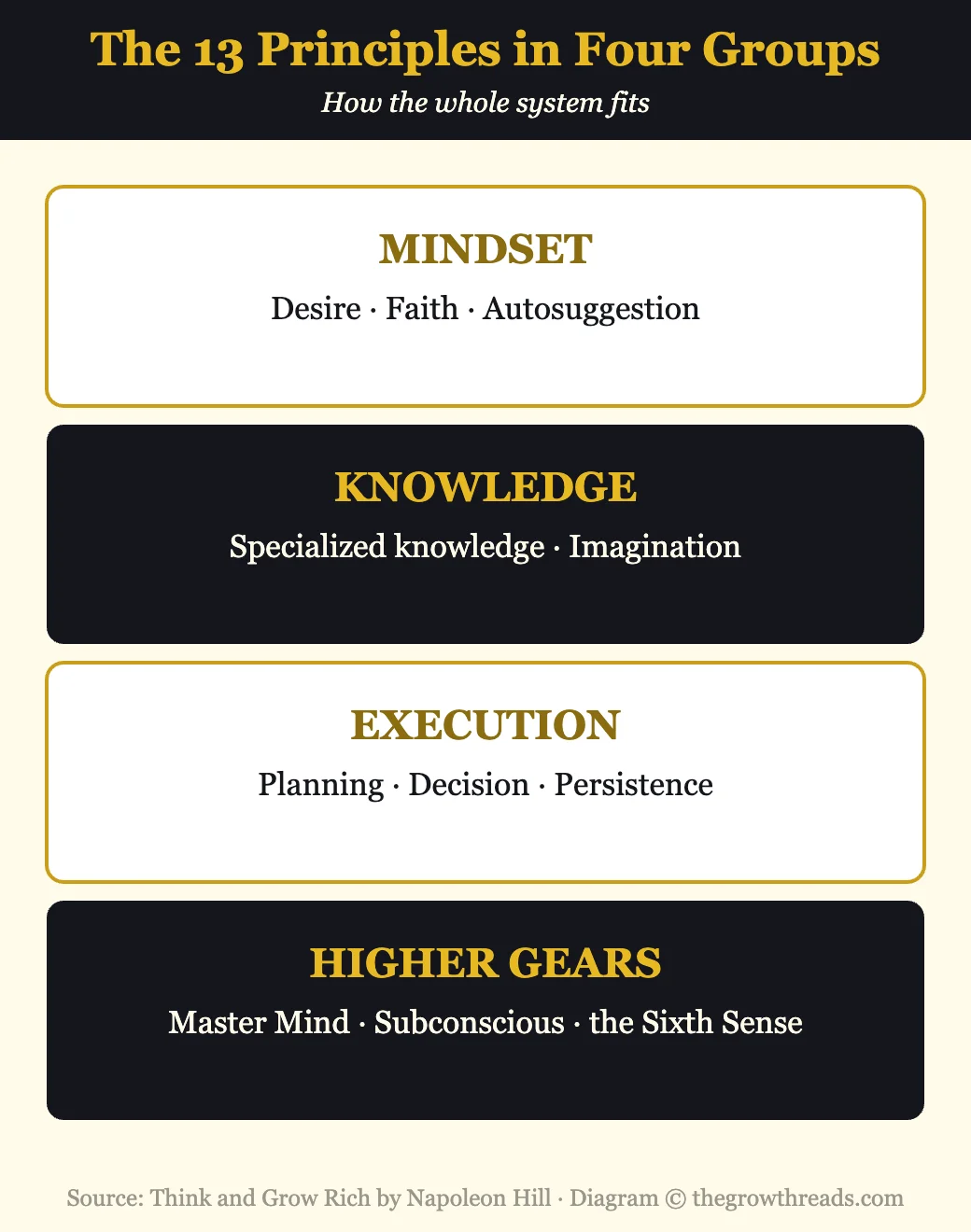
The final principles venture further into Hill’s era-specific ideas — the “transmutation” of drive into creative energy, the role of the subconscious, and a “sixth sense” of intuition. Read charitably, these describe real phenomena: channeling restless energy into work, trusting hard-won instinct, and letting a well-fed subconscious surface solutions. Read literally, they are the most dated part of the book. Either way, the through-line is consistent — Hill believes success is a discipline of directed thought, and he grouped his thirteen principles to be practiced as a system, not sampled at random.
TGR Note: Hill supplies the mindset of wealth; two modern books supply what he lacks. The Psychology of Money replaces his mysticism with behavioral evidence — that patience and a high savings rate, not affirmations, build fortunes — while Rich Dad Poor Dad adds the missing mechanics of assets and income. Read Hill for the fire, the others for the fuel.
Who is Think and Grow Rich best for — and who should read something else first?
This book is ideal for anyone who wants to understand the roots of modern success literature, or who needs a jolt of definite purpose and persistence. Its motivational power is real, and its six-step method is genuinely useful. It is not a practical money guide — it will not tell you how to budget, invest, or build assets. For those mechanics, start with I Will Teach You to Be Rich or The Psychology of Money. And if the 1930s mysticism grates, read it alongside a modern, evidence-based companion so you keep the timeless parts — desire, planning, persistence — without swallowing the dated ones whole.
Questions to reflect on
- What is the one definite goal you could write down today — with an exact figure and a deadline?
- Where have you been holding a vague wish instead of a burning, specific desire?
- What plan of yours failed, and did you abandon the plan — or the goal?
- Who would belong in your Master Mind, and have you actually asked them?
- Where in your life are you “three feet from gold,” about to quit just before the breakthrough?
🔥 Ready to turn desire into a plan?
This guide is the map — Hill’s stories and exact wording are what make the principles stick.
How to apply Think and Grow Rich (7-day plan)
- Day 1 — Write your definite aim. Name one specific goal, the exact amount or outcome, and a deadline. Vague goals stay vague.
- Day 2 — Do the six steps. Write what you’ll give in return, your date, and your first plan, then read it aloud morning and night.
- Day 3 — Build faith by evidence. List three times you achieved something you once doubted. Belief grows from a track record.
- Day 4 — Identify your specialized knowledge. Name the one skill most tied to your goal and one way to deepen it this month.
- Day 5 — Make one fast decision. Choose something you’ve been deferring and decide it today. Practice deciding quickly.
- Day 6 — Recruit your Master Mind. Ask one aligned, capable person to be a regular sounding board for your goal.
- Day 7 — Plan your persistence. Decide in advance how you’ll respond to the next setback, so a defeat revises the plan, not the goal.
Frequently asked questions
Is Think and Grow Rich worth reading?
Yes, with the right expectations. As the book that founded modern success literature, it is worth reading both for its historical importance and for its genuinely useful core: define a specific goal, plan it, and persist. Some of its 1930s framing about the subconscious and a “sixth sense” feels dated, and it is light on practical money mechanics. But the six-step desire method and its emphasis on definiteness of purpose and persistence remain influential for good reason. Read it as a mindset primer rather than an investing guide.
What is the main message of Think and Grow Rich?
That achievement begins in the mind. Hill argues that a definite, burning desire — backed by faith, a concrete plan, decisive action, and relentless persistence — sets in motion the behavior and opportunities that create wealth. The message is not that thinking alone makes you rich, but that directed, disciplined thought is the starting point that most people skip, drifting through vague wishes instead of committing to a specific aim.
Are the ideas in Think and Grow Rich scientifically proven?
Partly. Some of Hill’s language about the subconscious “attracting” wealth and a mystical sixth sense is not scientific. However, the practical core aligns with well-supported psychology: specific goals outperform vague ones, self-belief affects effort and persistence, and sustained action past failure predicts success. Historians have also questioned aspects of Hill’s biography and his claimed relationship with Andrew Carnegie. The sensible approach is to keep the evidence-based principles and treat the mysticism as a product of its era.
How long does it take to read Think and Grow Rich?
The book is around 230–320 pages depending on the edition, and most readers finish it in about five hours. Because it is organized around 13 self-contained principles, it is easy to read a chapter at a time. Our summary above captures the essential framework in roughly 16 minutes, though the book’s stories and repetition are part of what makes its lessons memorable.
What are the 13 principles of Think and Grow Rich?
They are: desire, faith, autosuggestion, specialized knowledge, imagination, organized planning, decision, persistence, the Master Mind, the mystery of sex transmutation, the subconscious mind, the brain, and the sixth sense. Hill intended them to be practiced together as a system rather than picked individually — beginning with a definite desire and building through planning and persistence toward the collaborative power of a Master Mind.
Is Think and Grow Rich good for beginners?
Yes, as an entry point to the mindset side of success. It is motivational, readable, and requires no background. Beginners should pair it with a practical money book, since Think and Grow Rich teaches the psychology of achievement but not the mechanics of budgeting or investing. Used together with a modern guide, it gives beginners both the drive and the tools.
Does Think and Grow Rich actually help you make money?
Indirectly. The book will not hand you a business model or an investment strategy, but its core disciplines — setting a definite goal, planning, deciding quickly, persisting through failure, and building a strong network — are the behaviors that underlie most financial success. Readers who treat it as a call to purposeful, persistent action often find it valuable; those expecting a literal money formula are usually disappointed. It works best as a motivational foundation beneath practical financial skills.
Related summaries
- The Psychology of Money Summary — the behavioral, evidence-based counterpart to Hill’s mindset.
- Rich Dad Poor Dad Summary — the missing mechanics of assets and income.
- I Will Teach You to Be Rich Summary — a practical, modern money system.
- The Millionaire Next Door Summary — the data on how wealth is really built.
- Browse all our best money books.
How we analyze books: We work from the full book — reconstructing its core arguments in our own words, adding commentary that connects it to related research and other books in our library, and pressure-testing the advice against how it plays out in real life. We never reproduce the text; we synthesize it. Read our full methodology.
Disclosure: The Growth Reads is reader-supported. When you buy through links on our site we may earn an affiliate commission at no extra cost to you. We only recommend books we believe are worth your time, and our summaries and opinions are written independently.