

★★★★ 4.1/5 — a landmark, research-based debunking of what real wealth looks like. The data is decades old, but its core lessons on frugality and living below your means are timeless.
Best for: anyone who assumes wealth means big houses and luxury cars, and wants to know how millionaires are actually made · Reading time: ~6 hours (this guide: 15 min) · Difficulty to apply: Easy to grasp — living below your means is the lifelong discipline
The Millionaire Next Door in one minute
Most real millionaires don’t look rich — they look like your ordinary neighbor, because they got wealthy by living below their means, not by flaunting it. Thomas Stanley and William Danko spent years surveying and interviewing America’s millionaires, and their findings overturned the stereotype. The typical millionaire, they discovered, doesn’t live in a mansion or drive a new luxury car; they live in a modest home, drive a used vehicle, budget carefully, and quietly build wealth over decades. The people who look rich — with the big house, the flashy car, the designer wardrobe — are often “under accumulators of wealth” with high incomes but little net worth, a state the authors memorably call “big hat, no cattle.” True wealth, the book shows, is the result of frugality, discipline, financial independence valued over social status, and steady investing — not high income or an impressive lifestyle. It is the data behind a now-familiar truth: wealth is what you don’t see.
Key takeaways
- Wealth is what you keep, not what you earn: a high income does not make you wealthy; accumulated net worth does.
- Millionaires live below their means: the typical millionaire is frugal, budgets carefully, and spends far less than they could.
- “Big hat, no cattle”: many people who look rich have high incomes but little actual wealth.
- PAWs vs UAWs: Prodigious Accumulators of Wealth build far more than their income predicts; Under Accumulators build far less.
- The wealth formula: expected net worth ≈ your age × your pre-tax income ÷ 10 — beat it to be a wealth-builder.
- Play good defense: controlling spending and budgeting (defense) matters as much as earning (offense).
- Value independence over status: millionaires prioritize financial freedom over displaying wealth.
- Avoid “economic outpatient care”: giving adult children ongoing financial gifts tends to weaken their own wealth-building.
- Many millionaires are self-employed: a large share own ordinary, often unglamorous businesses.
- Choose your occupation and habits wisely: steady earning plus disciplined saving, over decades, is how ordinary people become wealthy.
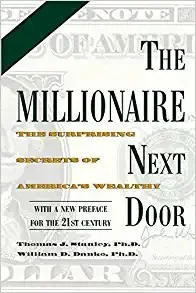
What is The Millionaire Next Door about?
The Millionaire Next Door is a personal-finance book by Thomas Stanley and William Danko based on research into America’s wealthy. It reveals that most millionaires are frugal, ordinary-seeming people who built wealth by living below their means, budgeting, and investing steadily — not by earning huge incomes or living luxuriously — and it identifies the shared habits behind their success.
About the authors
Thomas J. Stanley was an American researcher and author who spent much of his career studying the habits and characteristics of the affluent, conducting surveys, interviews, and focus groups with thousands of millionaires. William D. Danko is a professor of marketing who collaborated with Stanley on the research. Published in 1996, The Millionaire Next Door distilled their findings into a surprising and influential portrait of American wealth that became a long-running bestseller and reshaped popular understanding of who the rich really are. Stanley continued exploring the topic in follow-up books like The Millionaire Mind. What gives this book its authority is that it is grounded in empirical research rather than opinion or anecdote: the authors are reporting what they actually found when they studied real millionaires, and the reality turned out to be strikingly at odds with the cultural image of wealth.
Key concepts at a glance
| Concept | What it means | Use it when |
|---|---|---|
| Live below your means | Spend far less than you earn | Every spending decision |
| PAW | Prodigious Accumulator of Wealth | The goal to aim for |
| UAW | Under Accumulator of Wealth | The trap to avoid |
| The wealth formula | Age × income ÷ 10 | Checking your progress |
| Big hat, no cattle | Looks rich, isn’t wealthy | Judging real vs apparent wealth |
| Economic outpatient care | Subsidizing adult children | Deciding how to help family |
Part 1: The surprising truth about millionaires
The book’s central revelation is that the popular image of a millionaire is almost entirely wrong. When Stanley and Danko actually studied people with a net worth over a million dollars, they did not find a class of Ferrari-driving mansion-dwellers. They found, overwhelmingly, ordinary-looking people living unremarkable lives: modest homes in middle-class neighborhoods, used cars, off-the-rack clothes, and careful spending.
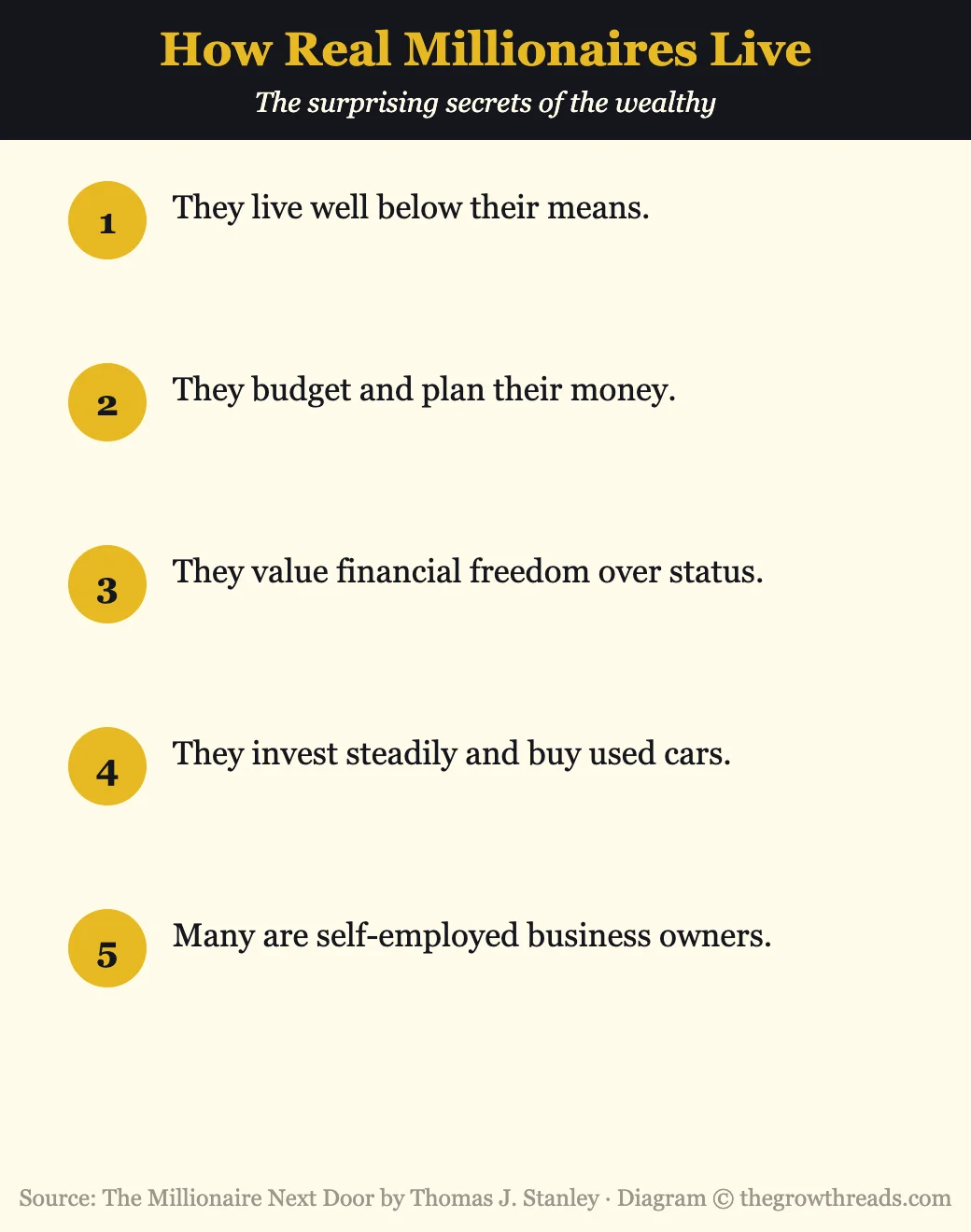
The defining characteristic of these millionaires is that they live well below their means. They are frugal, they budget, and they consistently spend far less than they could afford, channeling the difference into savings and investments over many years. Crucially, the people who display wealth — the big house, the luxury car, the expensive vacations — are frequently not wealthy at all. The authors coined the phrase “big hat, no cattle” for those who look rich but have little net worth behind the appearance. This leads to the book’s foundational distinction: income is not the same as wealth. Wealth is what you accumulate and keep, not what you earn and spend. Many high earners are, financially, running on a treadmill — their expensive lifestyles consume their large incomes, leaving them with surprisingly little. The quiet millionaire next door, by contrast, has turned a modest lifestyle into a substantial fortune.
Part 2: Accumulators, under-accumulators, and the wealth formula
To make this concrete, the authors divide people into two categories based on how effectively they turn income into wealth.
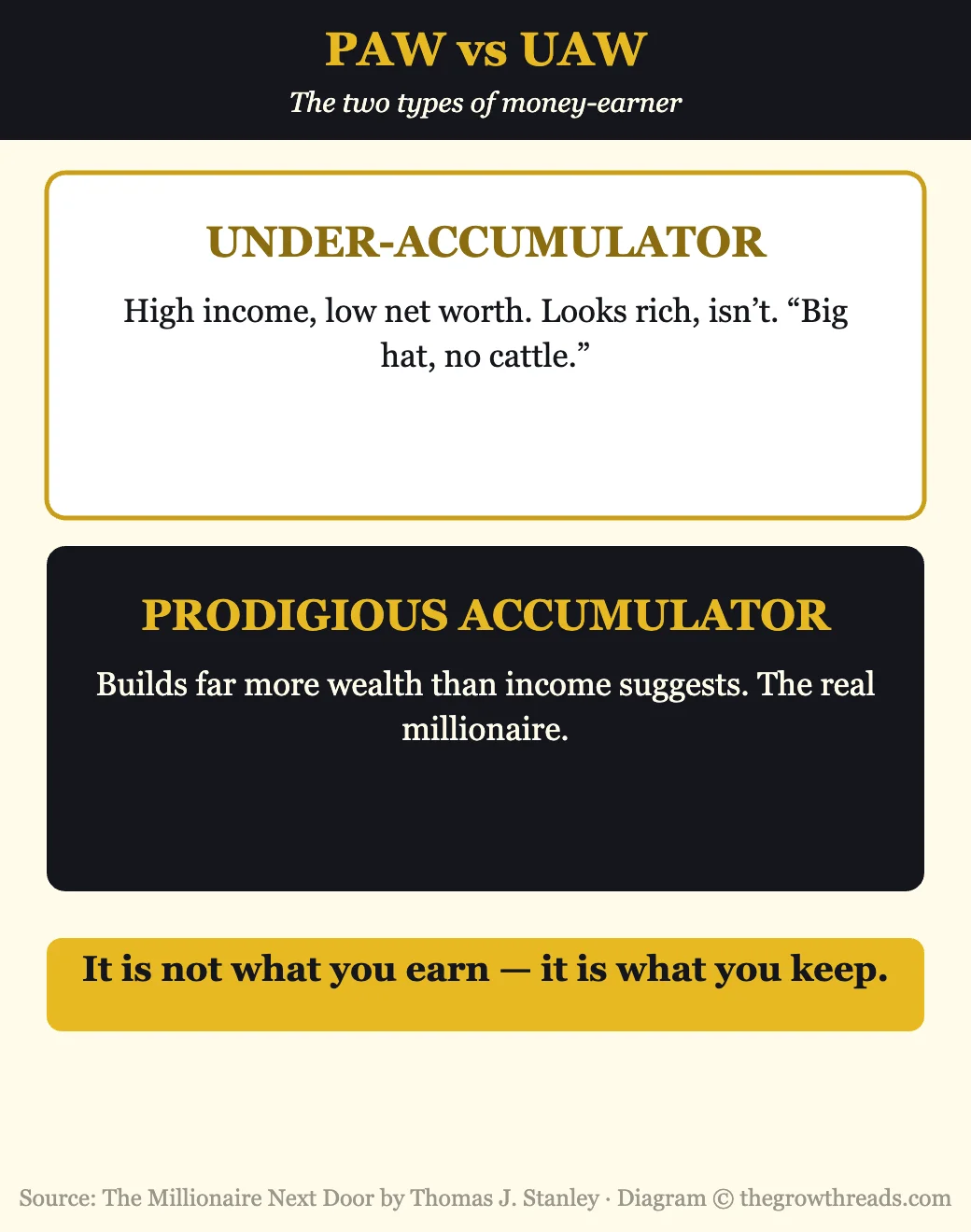
Prodigious Accumulators of Wealth (PAWs) build far more net worth than their income would predict — they are efficient at converting earnings into wealth through frugality and investing. Under Accumulators of Wealth (UAWs) do the opposite, building far less net worth than their income should allow, because they spend most of what they make. Two people with identical incomes can end up worlds apart in net worth depending on which category they fall into. To let readers assess themselves, the authors provide a rough wealth formula.
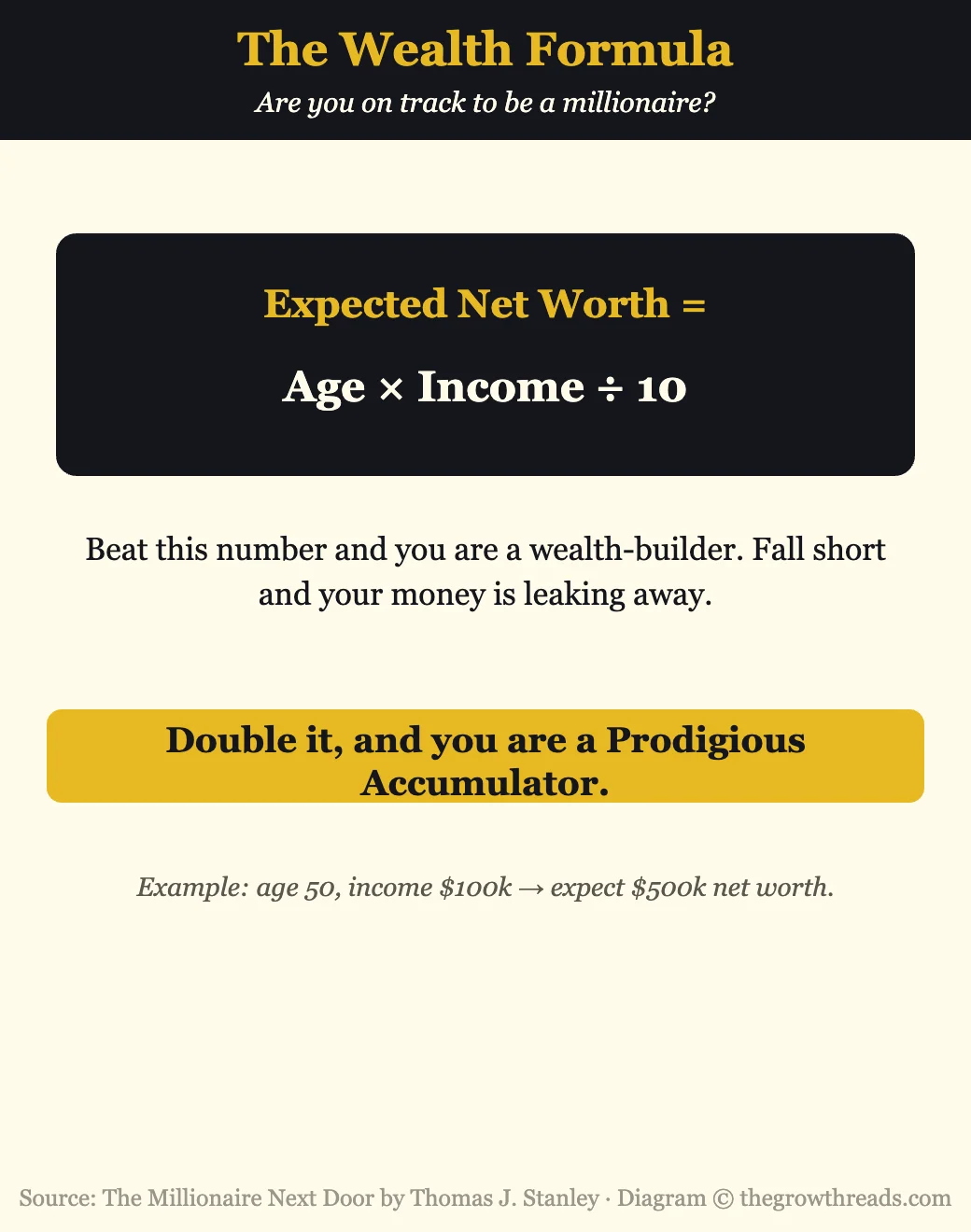
Your expected net worth, they suggest, is approximately your age multiplied by your annual pre-tax income, divided by ten. If your actual net worth is well above that figure, you are a strong accumulator (a PAW); if it is well below, you are an under-accumulator (a UAW). The formula is admittedly crude — it works poorly for the very young or those early in high-earning careers — but as a directional gut-check it drives the point home: whether you are building wealth depends far more on your habits than on your salary. Underlying the PAW/UAW distinction is the idea of financial “offense” and “defense”: offense is how much you earn, defense is how well you control spending and manage what you keep. The book’s data suggests that defense — living below your means — is at least as important as offense, and that most people over-focus on earning more while neglecting the discipline that actually builds wealth.
TGR Note: The Millionaire Next Door is the empirical bedrock beneath The Psychology of Money‘s most famous line — “wealth is what you don’t see.” Stanley and Danko provide the data (real millionaires drive used cars and live modestly) that Morgan Housel later turned into behavioral wisdom. And where I Will Teach You to Be Rich automates the frugality, this book proves why it works.
Part 3: The seven factors of wealth-building
From their research, Stanley and Danko distilled a set of shared characteristics that distinguish the wealthy. They live well below their means, as we’ve seen — the non-negotiable foundation. They allocate their time, energy, and money efficiently, in ways deliberately conducive to building wealth, often spending significant time planning their finances and investments. They value financial independence far more than displaying social status; the security of not needing to work matters more to them than impressing others, which frees them from the “keeping up with the Joneses” spending that traps so many high earners. And they became economically self-sufficient largely on their own, without ongoing financial subsidies from their parents.
The remaining factors concern the next generation and how wealth is chosen. Millionaires tend to raise adult children who are themselves economically self-sufficient, rather than dependent on family money. They are proficient at targeting market opportunities — spotting and seizing chances to earn and invest. And they chose the right occupation, which for many of them meant self-employment or business ownership. Together these seven factors paint a coherent picture: wealth is the product of disciplined, consistent habits practiced over a long time, oriented around frugality, planning, independence, and self-reliance. None of them require a spectacular income or a lucky break; all of them are, in principle, available to ordinary people willing to adopt the mindset.
Part 4: Economic outpatient care and the shape of real wealth
One of the book’s most provocative and enduring sections concerns what the authors call “economic outpatient care” — the substantial financial gifts and support that many affluent parents give their adult children. Counterintuitively, the data suggests this help often harms the recipients’ own ability to build wealth. Adult children who receive ongoing subsidies tend to accumulate less wealth themselves, spend more, save less, and remain dependent, because the safety net erodes the very frugality and self-reliance that create wealth in the first place. The truly wealthy, the authors found, more often raised children to be financially independent, teaching discipline rather than providing a cushion — a challenging lesson for well-meaning parents.
The book also examines occupation and finds that a striking proportion of American millionaires are self-employed business owners, frequently in mundane, unglamorous industries rather than flashy ones. Owning a business that you control, combined with the frugal, wealth-accumulating habits described throughout, proved to be a common path to affluence. In the end, the portrait that emerges is quietly radical: the road to wealth for most people is not a high-status career or a lavish lifestyle, but the unglamorous combination of living below your means, budgeting and investing consistently, valuing independence over appearances, and staying self-reliant across generations. The book’s obvious limitation is its age — the research dates to the 1990s, some figures and examples feel dated, and it can be repetitive and dry — but its central findings have aged remarkably well, and it remains one of the most clarifying correctives to our confused cultural picture of what it actually means to be rich.
Who is The Millionaire Next Door best for — and who should read something else first?
This book is ideal for anyone who wants a reality check on what wealth actually looks like, and who is motivated by evidence rather than hype — especially those tempted to equate a big lifestyle with financial success. Its core lessons on frugality and living below your means are foundational. It is not for you if you want practical, step-by-step instructions on how to invest or budget (it’s descriptive, not a how-to), or if you’re put off by dated 1990s data and a somewhat dry, academic style. For the actionable system, read I Will Teach You to Be Rich; for the behavioral wisdom this data inspired, read The Psychology of Money.
Questions to reflect on
- Are you building wealth or just earning a high income and spending it?
- Using the formula (age × income ÷ 10), are you a PAW or a UAW?
- Where in your life are you paying for “big hat” — appearing wealthy — instead of being wealthy?
- Is your financial “defense” (spending discipline) as strong as your “offense” (income)?
- Do you value financial independence more than looking successful to others?
🔥 Ready to become the millionaire next door?
This guide is the map — the book’s data is what makes the case impossible to argue with.
How to apply The Millionaire Next Door (7-day plan)
- Day 1 — Calculate your wealth number. Use age × income ÷ 10 and compare it to your actual net worth.
- Day 2 — Play defense. Review last month’s spending and cut one status expense you don’t truly value.
- Day 3 — Spot your “big hat”. Identify one purchase you make mainly to look successful, and reconsider it.
- Day 4 — Make a budget. Create a simple plan that spends less than you earn and directs the rest to investing.
- Day 5 — Automate saving. Set up an automatic transfer to investments so wealth-building is consistent.
- Day 6 — Value independence. Define what financial freedom would mean for you, beyond appearances.
- Day 7 — Teach self-reliance. If you support others financially, consider how to build their independence instead.
Frequently asked questions
Is The Millionaire Next Door worth reading?
Yes, as a foundational reality check on wealth. Its central, research-backed finding — that most real millionaires are frugal, ordinary-looking people who live below their means rather than flashy big spenders — is genuinely eye-opening and has aged well. It is especially valuable for anyone who equates a lavish lifestyle with being rich. The caveats are that the data dates to the 1990s and some examples feel dated, and the style is more descriptive and academic than practical, so it explains what the wealthy do without giving a step-by-step how-to.
What is the main message of The Millionaire Next Door?
That wealth is built through frugality and discipline, not high income or a luxurious lifestyle. The authors’ research found that most millionaires live below their means, budget carefully, value financial independence over status, and invest steadily over decades, while many people who look rich have high incomes but little net worth. The core lesson is that wealth is what you accumulate and keep, not what you earn and spend — and that ordinary habits, not extraordinary income, are what make ordinary people wealthy.
What is the difference between a PAW and a UAW?
PAW stands for Prodigious Accumulator of Wealth and UAW for Under Accumulator of Wealth. A PAW builds far more net worth than their income would predict, efficiently converting earnings into wealth through frugality and investing. A UAW does the opposite, accumulating far less than their income should allow because they spend most of what they earn. Two people with the same salary can end up with vastly different net worths depending on which they are — proof that wealth depends more on habits than on income.
What is the wealth formula in The Millionaire Next Door?
It is a rough rule of thumb for estimating whether you’re building wealth effectively: your expected net worth is approximately your age multiplied by your annual pre-tax income, then divided by ten. If your actual net worth is well above that figure you’re a strong accumulator (a PAW); if it’s well below, you’re an under-accumulator (a UAW). The formula is imperfect — it doesn’t work well for the very young or those early in high-earning careers — but it’s a useful directional gut-check on your financial habits.
What is “economic outpatient care”?
It is the authors’ term for the ongoing financial gifts and support that affluent parents give their adult children. Their research found, counterintuitively, that this help often harms rather than helps: adult children who receive regular subsidies tend to accumulate less wealth, spend more, and save less, because the financial cushion erodes the self-reliance and frugality that build wealth. The truly wealthy more often raised children to be financially independent. It’s a challenging lesson for well-meaning parents about how generosity can undermine the very outcomes they intend.
How long does it take to read The Millionaire Next Door?
The book is around 270 pages and most readers finish it in about six hours. Because it centers on research findings and repeats its main themes across chapters, some readers move through the statistics and case studies quickly. Our summary above captures the core findings and their implications in roughly 15 minutes, which is enough to grasp the key lessons about how wealth is really built without wading through all the survey detail.
Is The Millionaire Next Door still relevant today?
Its core lessons are, even if some specifics aren’t. The data comes from research in the 1990s, so particular figures, examples, and some details feel dated, and the modern economy differs in important ways. However, the central principles — live below your means, value net worth over income, prioritize financial independence over status, and build wealth through consistent frugality and investing — remain as true as ever, and are echoed by more recent finance writers. Read it for the timeless behavioral insights rather than the specific 1990s statistics.
Related summaries
- The Psychology of Money Summary — the behavioral wisdom this data inspired.
- I Will Teach You to Be Rich Summary — the practical system for living below your means.
- Rich Dad Poor Dad Summary — the mindset of assets and independence.
- Think and Grow Rich Summary — the classic on wealth psychology.
- Browse all our best money books.
How we analyze books: We work from the full book — reconstructing its core arguments in our own words, adding commentary that connects it to related research and other books in our library, and pressure-testing the advice against how it plays out in real life. We never reproduce the text; we synthesize it. Read our full methodology.
Disclosure: The Growth Reads is reader-supported. When you buy through links on our site we may earn an affiliate commission at no extra cost to you. We only recommend books we believe are worth your time, and our summaries and opinions are written independently. This is general information, not personalized financial advice.