

⭐⭐⭐⭐ 4.2 / 5 — A compelling case for intellectual humility, with practical frameworks for rethinking your own beliefs and helping others rethink theirs.
Best for: Leaders, managers, and anyone whose effectiveness depends on updating their thinking — especially those who pride themselves on being right and suspect that pride may be costing them.
Reading time: ~7 hours (320 pages)
Difficulty to apply: Moderate — the concepts are intuitive but overcoming the emotional attachment to existing beliefs requires deliberate, repeated practice.
Think Again in one minute
The world rewards people who think fast and hold firm convictions, but the most successful thinkers are the ones who know when to slow down, doubt themselves, and change their minds. Adam Grant, an organisational psychologist at Wharton, argues that we spend too much time in preacher, prosecutor, and politician modes — defending our beliefs, attacking others’ beliefs, or seeking approval — and too little time in scientist mode, where we form hypotheses, test them, and update our conclusions. The book maps this rethinking skill across three levels: individual (how to update your own views), interpersonal (how to open others’ minds through motivational interviewing rather than debate), and collective (how to build learning cultures in organisations). Grant draws on research from psychology, behavioural economics, and negotiation science, illustrated with stories from superforecasters, debate champions, and organisations like NASA and Pixar.
Key takeaways
- Think like a scientist: Form hypotheses, run experiments, and update your beliefs based on evidence rather than defending your existing position like a preacher, prosecutor, or politician.
- Confident humility is the sweet spot: Have strong opinions held loosely — enough conviction to act, enough openness to revise when new evidence arrives.
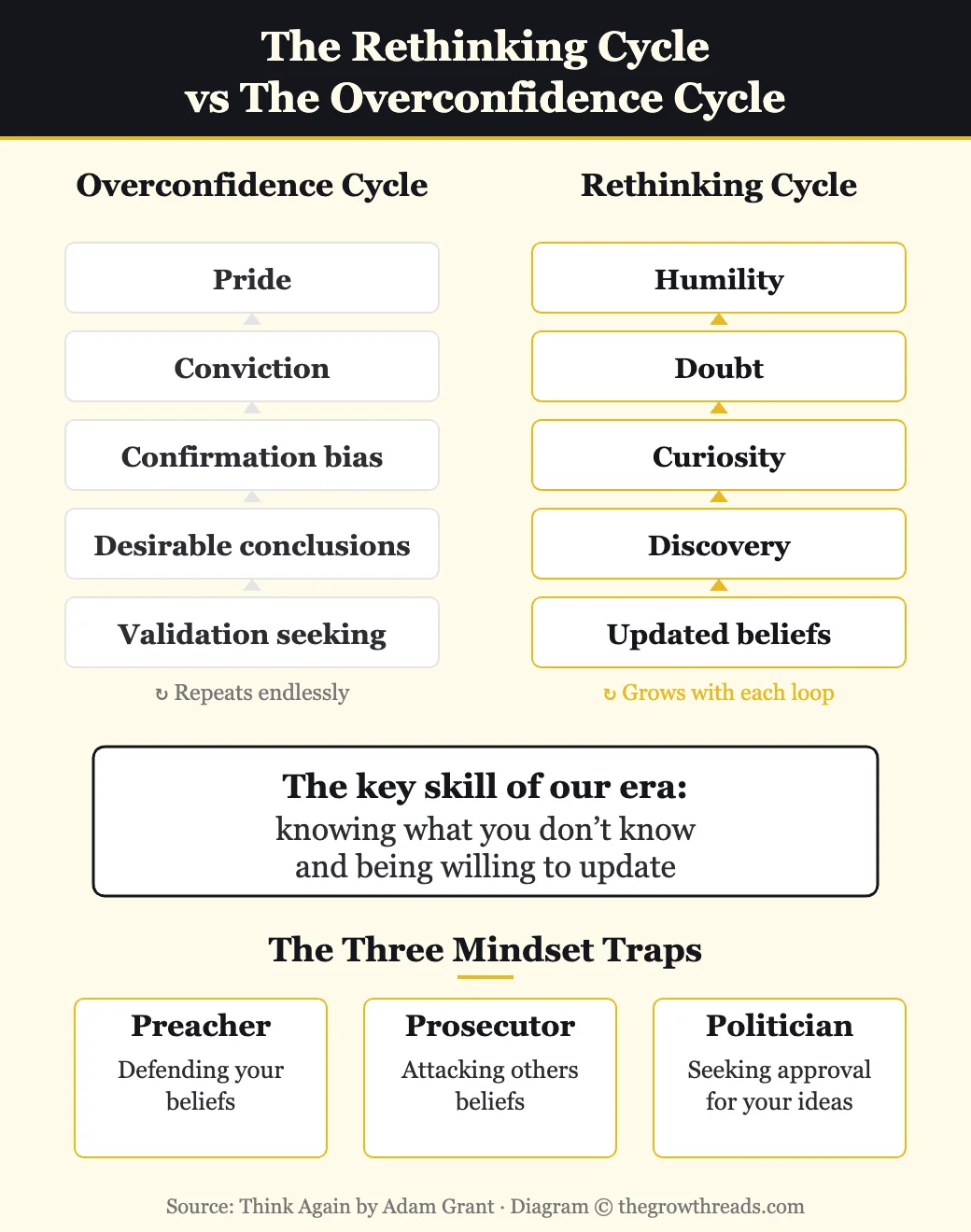
- The rethinking cycle beats the overconfidence cycle: Humility leads to doubt, which sparks curiosity, which drives discovery — a virtuous loop that compounds over time.
- Debate to learn, not to win: The best negotiators and persuaders focus on finding truth, not on scoring points — and they are more effective because of it.
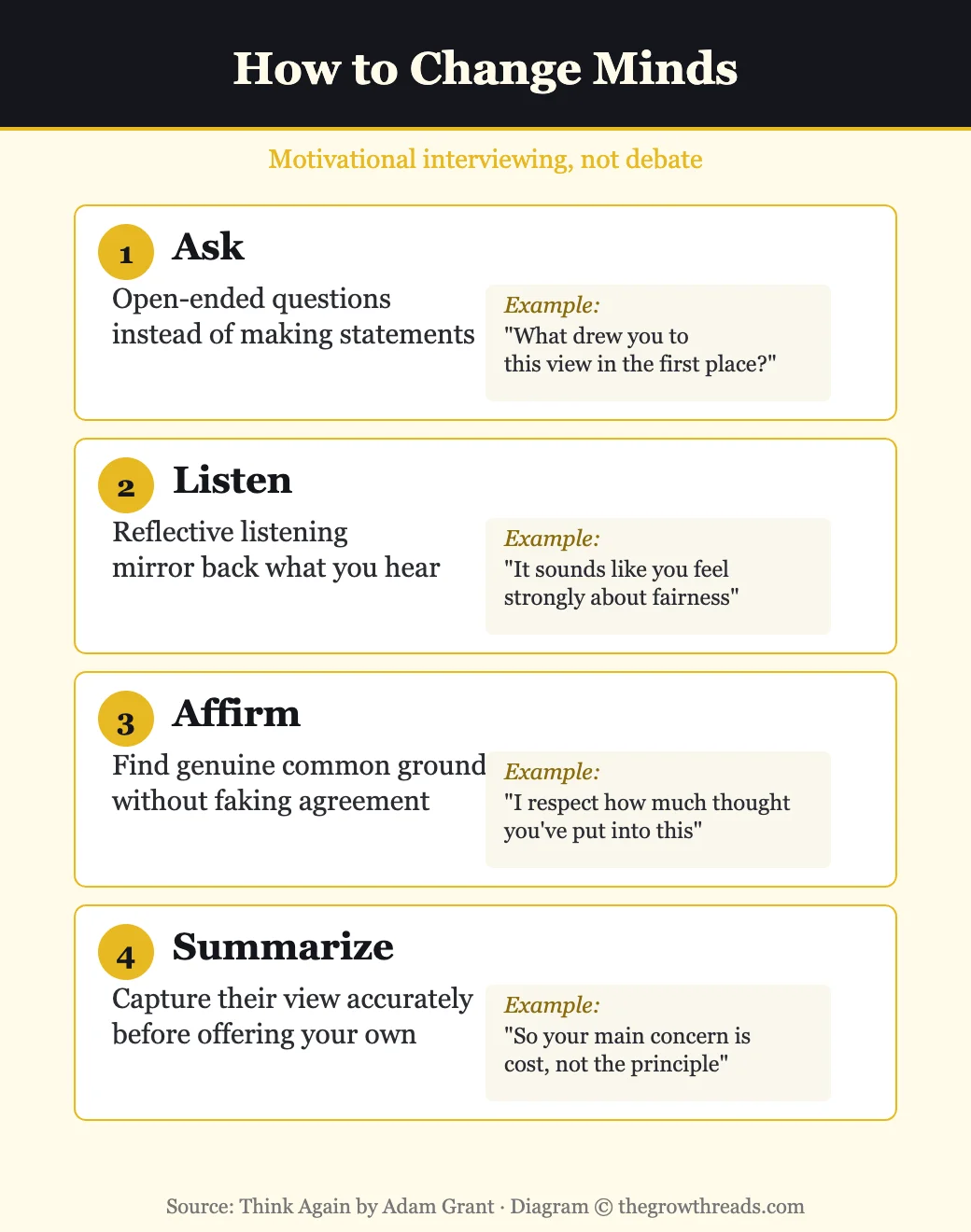
- Motivational interviewing outperforms arguing: Asking open-ended questions and listening reflectively is far more likely to change minds than presenting logical arguments.
- Build a challenge network: Surround yourself with disagreeable givers — people who care enough about you to tell you when you are wrong, not just people who affirm your views.
- Complexity is more persuasive than simplicity: Presenting the nuance and trade-offs in your position signals intellectual honesty and makes you more credible, not less.
- Identity foreclosure is dangerous: When beliefs become central to your identity, changing your mind feels like losing yourself — detach opinions from identity to stay flexible.
- Process accountability over outcome accountability: Reward people for how well they think, not just whether their conclusions turned out to be right.
- Rethinking is a skill, not a trait: Like any skill, it can be developed with practice — and the people who practice it outperform those who do not.
What is Think Again about?
Think Again explores the science of rethinking — the ability to question your existing beliefs, update your opinions based on new evidence, and help others do the same. Grant argues that in a rapidly changing world, the ability to unlearn and relearn is more valuable than raw intelligence, and he provides practical frameworks for developing this skill at the individual, interpersonal, and organisational level.
About the author
Adam Grant is an organisational psychologist at the Wharton School of the University of Pennsylvania, where he has been the top-rated professor for seven consecutive years. He is the author of several bestselling books including Give and Take, Originals, and Hidden Potential. His TED talks have been viewed more than 30 million times, and he hosts the podcast ReThinking. Grant’s research focuses on motivation, generosity, and how people can find meaning in their work. He has consulted for organisations including Google, the Gates Foundation, and the U.S. military. Explore all Adam Grant book summaries →
Key concepts at a glance
| Concept | What it means | Use it when |
|---|---|---|
| Scientist mode | Forming hypotheses, testing them, and updating beliefs based on evidence | You catch yourself defending a position out of habit rather than evidence |
| Preacher/Prosecutor/Politician | Three ego-driven modes that block rethinking | You notice you are arguing to win rather than to learn |
| Confident humility | Strong convictions held loosely — acting decisively while staying open | You need to lead while remaining flexible to new information |
| Rethinking cycle | Humility → doubt → curiosity → discovery → updated belief | You want to build a lifelong learning habit |
| Motivational interviewing | Asking questions and reflecting rather than arguing or persuading | You want to help someone reconsider without creating defensiveness |
| Challenge network | Disagreeable givers who push back on your thinking constructively | You suspect your inner circle is too agreeable |
| Process accountability | Evaluating the quality of thinking, not just the outcome | Building a team culture that rewards learning over being right |
Part 1 — Individual rethinking: updating your own mind
Grant opens by identifying the three mental modes that prevent rethinking. In preacher mode, we deliver sermons to protect our sacred beliefs. In prosecutor mode, we marshal arguments to prove the other side wrong. In politician mode, we campaign for approval rather than seeking truth. The alternative is scientist mode: treating every belief as a hypothesis to be tested. Grant profiles superforecasters — people who consistently outperform experts at predicting world events — and finds that their advantage is not intelligence but intellectual humility. They update their predictions frequently, seek disconfirming evidence, and treat being wrong as information rather than failure.
The chapter on confident humility introduces what Grant considers the optimal psychological stance. Arrogance ignores uncertainty and prevents learning. Imposter syndrome acknowledges uncertainty but generates paralysis. Confident humility sits between them: you believe in your ability to learn and improve while acknowledging that your current knowledge may be incomplete. Grant cites research showing that people with confident humility outperform both the arrogant and the insecure because they seek feedback, adapt faster, and make better decisions over time.
Part 2 — Interpersonal rethinking: opening other people’s minds
The second section tackles the challenge of helping others rethink. Grant’s central insight is counterintuitive: the more logical and evidence-heavy your argument, the more likely the other person is to dig in. This is because people experience strong arguments as a threat to their identity, triggering what psychologists call the righting reflex — the instinct to defend their position. The alternative is motivational interviewing, a technique developed in clinical psychology. Instead of making arguments, you ask genuine, open-ended questions. Instead of rebutting, you reflect back what the other person has said. Instead of pushing, you affirm their autonomy to decide for themselves.
Grant illustrates this through the story of a black musician who convinced more than 200 members of the Ku Klux Klan to give up their robes — not through debate but through patient curiosity and genuine listening. He also profiles expert negotiators who win by finding common ground rather than by overwhelming opponents with logic. A key finding is that presenting complexity — acknowledging the trade-offs and limitations of your own position — is more persuasive than presenting a simple, confident case. Nuance signals intellectual honesty, which builds trust, which opens the door to rethinking.
Part 3 — Collective rethinking: building learning cultures
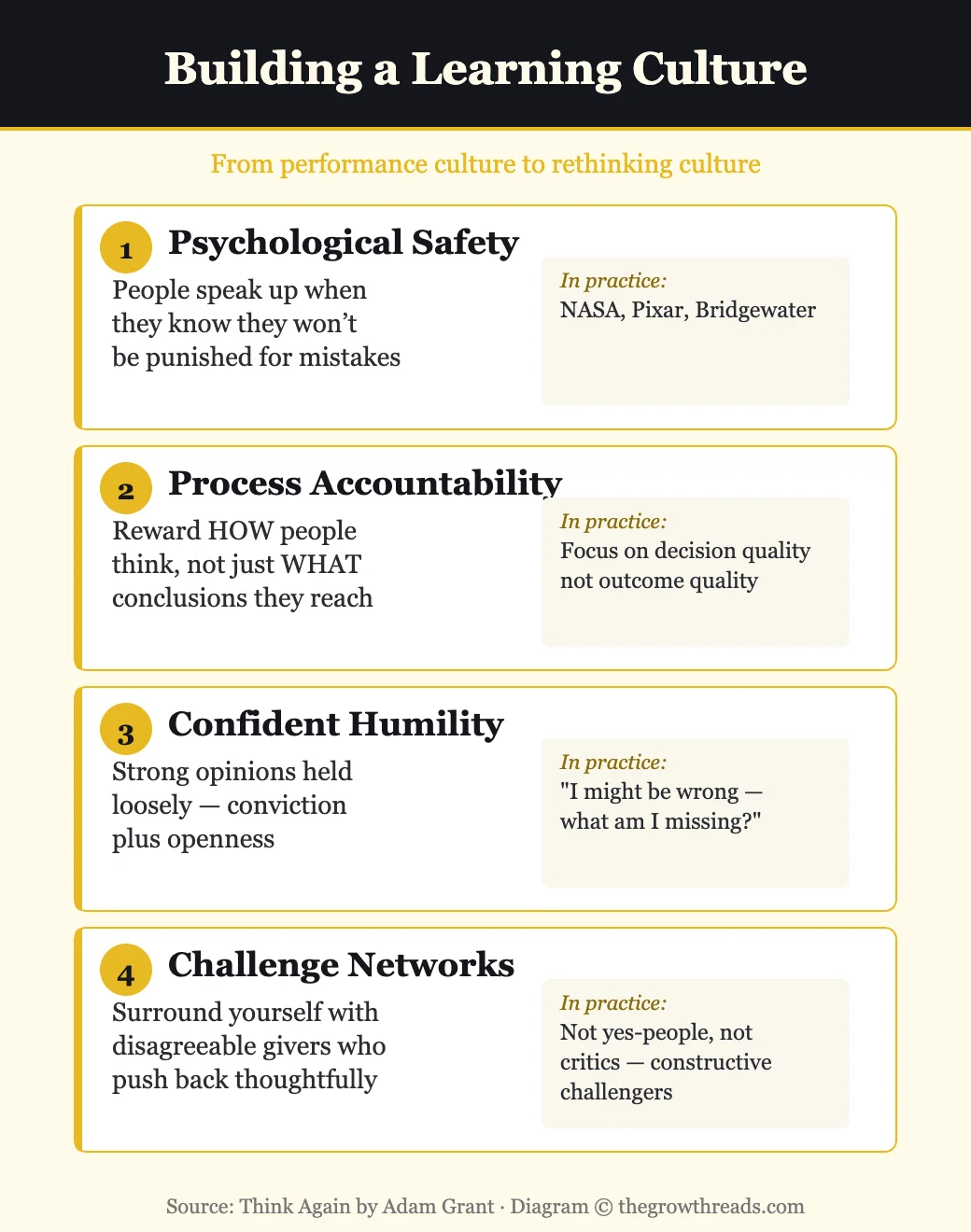
The final section scales rethinking to organisations. Grant contrasts performance cultures — where people are rewarded for being right — with learning cultures, where people are rewarded for the quality of their thinking process regardless of whether the outcome turns out well. He profiles Pixar’s BrainTrust, where filmmakers receive brutally candid feedback in a psychologically safe environment, and Bridgewater Associates, where radical transparency means anyone can challenge anyone else’s ideas regardless of rank.
The chapter on psychological safety adds important nuance to the concept popularised by Google’s Project Aristotle. Grant argues that safety alone is not enough — it must be paired with accountability. Teams need both the permission to speak up and the expectation that they will. He also introduces the idea of process accountability: instead of evaluating decisions by their outcomes (which are partly determined by luck), evaluate them by the quality of the thinking process. Did the person consider alternative viewpoints? Did they seek disconfirming evidence? Did they update their plan when new information arrived? This approach rewards rethinking directly and creates organisational muscle memory for intellectual humility.
Who is Think Again best for — and who should read something else first?
This book is ideal for leaders and managers who make decisions under uncertainty, lead teams, or need to influence stakeholders — anyone whose impact depends on the quality of their thinking rather than just the speed of their execution. It is also valuable for anyone who recognises that they have become intellectually rigid in some area of their life. If you are looking for a more tactical negotiation framework, start with Never Split the Difference. If you want the team-culture angle specifically, The Culture Code goes deeper on building psychological safety. If you want the decision-making science without the persuasion angle, Thinking in Bets by Annie Duke is the tighter read.
Questions to reflect on
- When did you last change your mind about something important — and what prompted the shift?
- Are you currently holding any belief in preacher, prosecutor, or politician mode that might benefit from scientist mode instead?
- Who in your life functions as a disagreeable giver — someone who cares enough to tell you when you are wrong?
- In your last disagreement, did you try to win or did you try to learn? What would have changed if you had switched modes?
- Does your team reward people for the quality of their thinking process, or only for getting the right answer?
🔥 Ready to master the skill of knowing what you don’t know?
Think Again will transform how you form opinions, change minds, and build teams that learn.
How to apply Think Again (7-day plan)
- Day 1 — Catch your mode: Throughout the day, notice when you slip into preacher, prosecutor, or politician mode. Each time, pause and ask: “What would a scientist do here?”
- Day 2 — Practice confident humility: In one meeting, say “I might be wrong about this” before sharing your view. Notice whether it weakens or strengthens your credibility.
- Day 3 — Seek disconfirming evidence: Pick one strongly held belief and spend 15 minutes searching for the best arguments against it. Write down the two strongest.
- Day 4 — Try motivational interviewing: In a disagreement today, ask three genuine questions before making a single argument. Listen to understand, not to rebut.
- Day 5 — Identify your challenge network: List three people who regularly push back on your thinking. If you cannot name three, identify one person you trust enough to invite into that role.
- Day 6 — Evaluate process, not outcome: Review one recent decision. Grade it on the quality of your thinking process, not on whether the outcome was good. What would you improve?
- Day 7 — Update one belief: Based on this week’s practice, identify one opinion you held at the start of the week that you have now refined. Write the old version and the new version side by side.
Frequently asked questions
What is the main idea of Think Again?
The central argument is that intelligence is not just the ability to think and learn — it is also the ability to rethink and unlearn. Grant identifies three ego-driven modes (preacher, prosecutor, politician) that prevent rethinking and advocates for scientist mode, where beliefs are treated as hypotheses to be tested. The book maps this skill across individual thinking, interpersonal persuasion, and organisational culture.
What are preacher, prosecutor, and politician modes?
These are three mental modes that block rethinking. In preacher mode, you deliver sermons to protect your beliefs. In prosecutor mode, you build cases to prove others wrong. In politician mode, you campaign for approval by telling people what they want to hear. All three prioritise being right over learning, which is why Grant advocates switching to scientist mode — testing hypotheses and updating based on evidence.
What is confident humility?
Confident humility is the psychological sweet spot between arrogance and imposter syndrome. You have enough confidence to act and make decisions, but enough humility to acknowledge that your current knowledge may be incomplete. Research shows that people with confident humility seek more feedback, adapt faster, and outperform both the overconfident and the chronically self-doubting.
What is motivational interviewing in Think Again?
Motivational interviewing is a technique from clinical psychology that Grant applies to everyday persuasion. Instead of making arguments, you ask genuine open-ended questions. Instead of rebutting, you reflect back what the other person says. Instead of pushing your view, you affirm their autonomy to decide. Research shows this approach is significantly more effective at changing minds than logical argumentation.
What is a challenge network?
A challenge network is a group of people who care enough about you to disagree with you openly. Grant calls them disagreeable givers — they push back on your ideas not to score points but to help you think better. Most people surround themselves with agreeable supporters, but Grant argues that a challenge network is more valuable for growth because it surfaces blind spots that supporters will never mention.
How long does it take to read Think Again?
The book is approximately 320 pages and reads in about 7 hours. Grant’s writing style is engaging and story-driven, mixing research with vivid case studies. For a quicker overview, the prologue and epilogue summarise the core framework in about 30 pages, and the one-page cheat sheet in the appendix captures the actionable takeaways.
How is Think Again different from other Adam Grant books?
Give and Take focuses on generosity and reciprocity styles. Originals explores how non-conformists move the world. Hidden Potential examines underestimated achievers. Think Again is specifically about the meta-skill of rethinking — how to update your beliefs, open other people’s minds, and build cultures where learning is valued over being right. It is his most practical book for leaders and decision-makers.
Related summaries
- Thinking, Fast and Slow by Daniel Kahneman — the cognitive science behind why rethinking is so hard
- Never Split the Difference by Chris Voss — tactical empathy as a persuasion and negotiation tool
- The Culture Code by Daniel Coyle — building psychological safety in teams
- Principles by Ray Dalio — radical transparency and idea meritocracy at Bridgewater