

★★★★☆ 4.2 / 5 — A dense, systematic guide to decision-making and organisational design from the founder of the world’s largest hedge fund — part autobiography, part operating manual for life and work.
Best for: Leaders, managers, and entrepreneurs who want a repeatable system for making better decisions, building transparent cultures, and learning from mistakes.
Reading time: ~14 hours (592 pages) | This summary: ~22 min
Difficulty to apply: Moderate to high — the principles are clear but require significant cultural buy-in to implement in organisations.
Page and product links in this article may earn us a small commission at no extra cost to you.
Principles in one minute
Life is a series of decisions, and the quality of your decisions determines the quality of your life — so build a system for making them well. Ray Dalio distils forty years of running Bridgewater Associates — the world’s largest hedge fund — into a framework of explicit principles for life and work. The core insight is that most situations you face are “another one of those” — recurring patterns that can be handled with pre-made decision rules rather than improvised each time. Part One tells Dalio’s story: how repeated failures taught him that pain plus reflection equals progress. Part Two covers Life Principles — radical open-mindedness, the 5-Step Process for getting what you want, and understanding your own mental wiring. Part Three covers Work Principles — how to build an “idea meritocracy” where the best ideas win regardless of who proposes them, using radical truth and radical transparency.
Key takeaways
- Write down your principles: Explicit decision rules, tested against reality and refined over time, are more reliable than intuition or ad-hoc judgement.
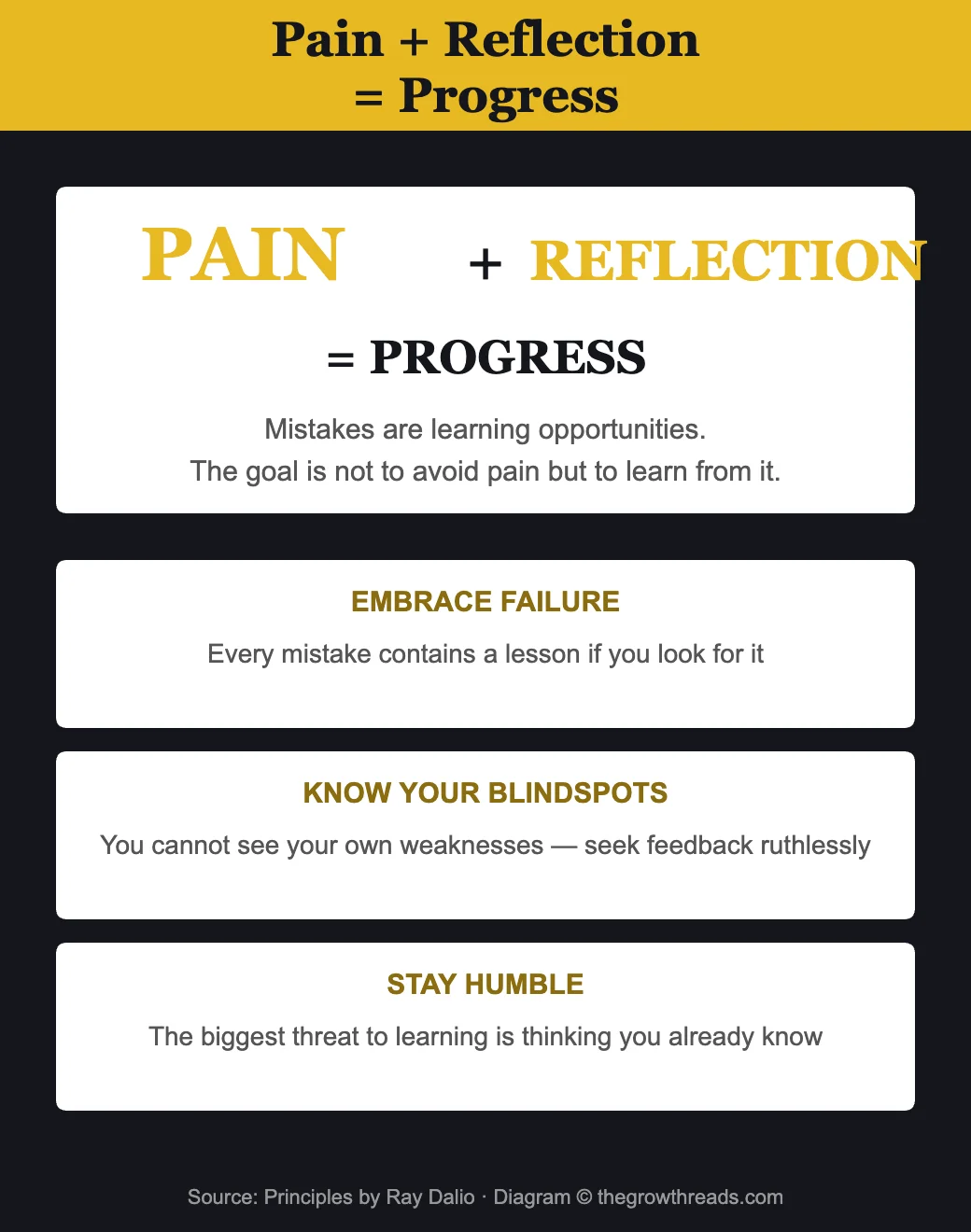
- Pain + Reflection = Progress: Mistakes are inevitable; the question is whether you learn from them. Treat every failure as a puzzle to diagnose, not a verdict on your character.
- Radical open-mindedness beats being right: Your biggest risk is not being wrong — it is being wrong and not knowing it. Actively seek out people who disagree with you.
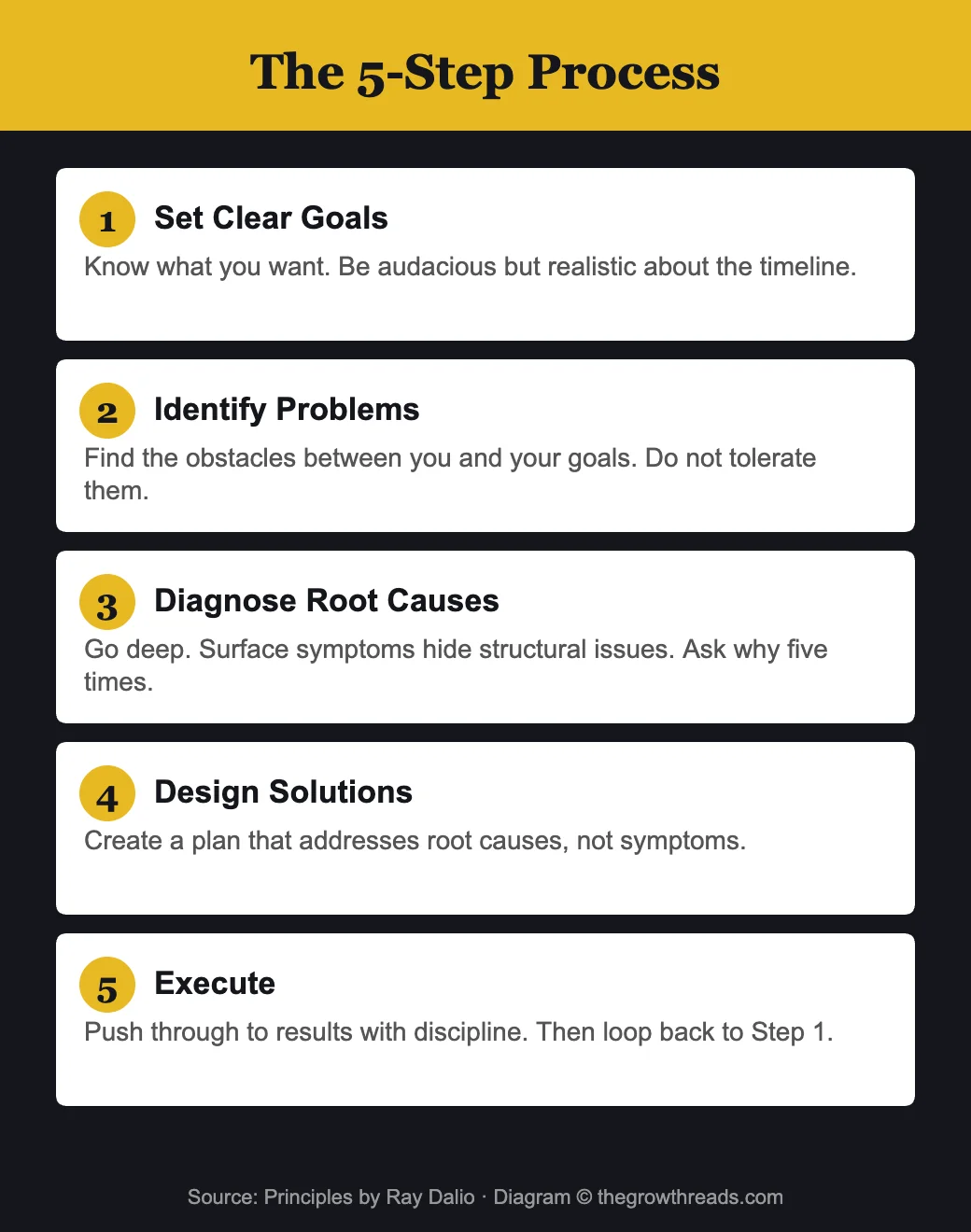
- The 5-Step Process works for any goal: Set goals → identify problems → diagnose root causes → design solutions → execute. Then loop back and repeat.
- Know your own weaknesses: Everyone has blind spots. The key is to identify yours and compensate — either by building skills or by surrounding yourself with people whose strengths complement your gaps.
- Build an idea meritocracy: The best organisations let the best ideas win, regardless of who proposes them. This requires radical truth, radical transparency, and believability-weighted decision-making.
- Believability-weighted voting beats consensus: Not all opinions are equal. Weight decisions toward people with demonstrated track records in the relevant area.
- Radical transparency builds trust: Recording meetings, sharing information openly, and letting people see how decisions are made creates accountability and reduces politics.
- Most situations are “another one of those”: Pattern recognition is the foundation of good decision-making. Build a library of principles so you handle recurring situations consistently.
- Embrace reality and deal with it: Wishing things were different is the enemy of progress. See the world as it is, accept it, and work with reality rather than against it.
What is Principles about?
Principles presents Ray Dalio’s systematic approach to decision-making and organisational design. It combines autobiography with explicit life and work principles — covering goal-setting, learning from failure, radical transparency, idea meritocracy, and building cultures where the best ideas win regardless of hierarchy.
About the author
Ray Dalio founded Bridgewater Associates in 1975 from his two-bedroom apartment. Over four decades, he built it into the world’s largest hedge fund, managing over $150 billion in assets. His investment approach — based on systematic, principle-driven decision-making — produced one of the best track records in hedge fund history. Dalio grew up middle-class on Long Island, started investing at age twelve, and earned his MBA from Harvard Business School. After a catastrophic failed prediction in 1982 that nearly bankrupted him, he rebuilt Bridgewater around the principles of radical transparency and idea meritocracy that became the book’s foundation. He has been named to Time’s list of the 100 most influential people and Forbes’ list of the wealthiest Americans. Explore all Ray Dalio book summaries →
Key concepts at a glance
| Concept | What it means | Use it when |
|---|---|---|
| Pain + Reflection = Progress | Every painful mistake contains a lesson; the discipline is to reflect systematically rather than emotionally | You have failed at something and are tempted to move on without analysing why |
| 5-Step Process | Goals → Problems → Root causes → Solutions → Execution, repeated as a continuous loop | You want a structured approach to achieving any goal |
| Radical open-mindedness | Actively seeking out disagreement and being more interested in learning than in being right | You catch yourself defending a position rather than testing it |
| Idea meritocracy | An organisation where the best ideas win regardless of rank, enabled by radical truth and transparency | You are building or leading a team and want to reduce politics |
| Believability-weighted decisions | Weighting opinions by the track record and expertise of the person offering them | A group decision is deadlocked and you need a principled way to break the tie |
| Radical transparency | Recording meetings, sharing information widely, and making decision processes visible | You want to build trust and accountability in a team |
| Machine metaphor | Viewing your organisation (or life) as a machine with inputs, processes, and outputs that can be designed and improved | You want to diagnose why results are falling short of goals |
Part 1: Where Dalio came from — and what failure taught him
The autobiographical section establishes Dalio’s credibility and, more importantly, his humility. He does not present himself as a genius who always gets it right. He presents himself as someone who has been spectacularly wrong, learned from it, and built systems to reduce the damage of future errors. The pivotal moment came in 1982 when he publicly predicted a depression that never arrived. He lost everything — clients, money, reputation. He had to borrow $4,000 from his father to pay family bills.
This failure forced a choice: he could protect his ego and avoid future risks, or he could face reality, figure out what went wrong, and build a better decision-making process. He chose the second path. The result was a fundamental shift in how he approached every decision: instead of trusting his gut, he would write down the logic behind every call, test it against data, seek out people who disagreed, and refine his reasoning over time. These written rules became his principles — and the basis for Bridgewater’s culture of radical transparency.
The formula he extracted is deceptively simple: Pain + Reflection = Progress. Most people experience pain (failure, criticism, loss) and either deny it, blame others, or push through without analysing what happened. Dalio argues that the few who pause, reflect honestly, and extract a principle from the experience compound their learning over decades. The pain does not go away, but it becomes productive.
Part 2: Life Principles — getting what you want from life
The Life Principles section centres on two frameworks: radical open-mindedness and the 5-Step Process. Radical open-mindedness is not simply being willing to listen — it is the active, disciplined practice of seeking out disagreement. Dalio argues that the two biggest barriers to good decision-making are ego (the need to be right) and blind spots (the inability to see your own weaknesses). The antidote is to treat every conversation as a potential source of information that could change your mind, and to value being accurate more than being vindicated.
The 5-Step Process is Dalio’s universal algorithm for getting what you want. Step one is to set clear goals — ambitious but realistic, with defined timelines. Step two is to identify the problems standing between you and those goals, without tolerating them or pretending they do not exist. Step three is to diagnose the root causes of those problems — going deep enough to find structural issues rather than surface symptoms. Step four is to design solutions that address the root causes. Step five is to execute the plan with discipline. Then you loop back to step one with updated goals informed by what you learned.
Critically, Dalio notes that most people are not equally good at all five steps. Some are great at setting audacious goals but terrible at diagnosing problems. Others excel at execution but struggle with design. The key insight is self-awareness: know which steps are your strengths and which are your weaknesses, and find people who complement you. No one succeeds alone, and the fastest way to fail is to insist on doing everything yourself.
Part 3: Work Principles — building an idea meritocracy
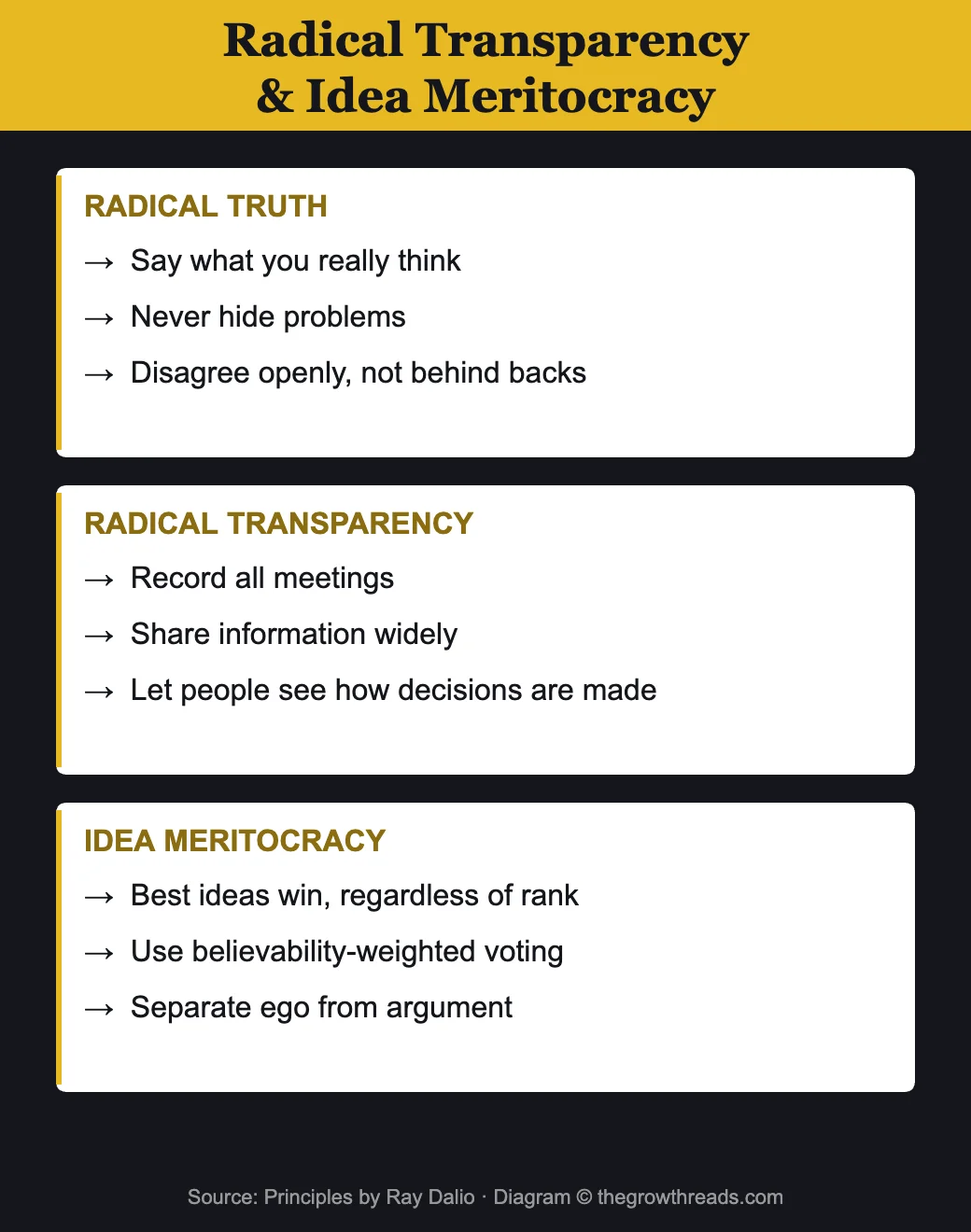
The Work Principles section translates Dalio’s personal framework into an organisational operating system. The central concept is the idea meritocracy — a culture where the best ideas win regardless of who proposes them. This sounds obvious until you try to implement it, because it requires two things most organisations resist: radical truth (people saying what they actually think, directly and in real time) and radical transparency (recording meetings, sharing feedback openly, making decision processes visible to everyone).
At Bridgewater, every meeting is recorded. Employees rate each other’s performance in real time using an app called Dots. Disagreements are resolved not by seniority but by believability-weighted voting — a system where the opinions of people with demonstrated track records in the relevant domain count more than those of people without. A junior analyst with a strong track record on a specific type of trade carries more weight in that discussion than a senior manager who has never traded it.
Dalio acknowledges that this system is intense and not for everyone. Many people leave Bridgewater in the first eighteen months because they cannot handle the level of direct feedback. But those who stay report that the transparency eliminates politics, reduces misunderstandings, and creates a learning environment where mistakes are treated as puzzles rather than career-enders. The machine metaphor runs throughout: your organisation is a machine with inputs, processes, and outputs. When outputs fall short of goals, you diagnose the machine, not blame the people — and then you redesign the process.
Who is Principles best for — and who should read something else first?
Principles is ideal for founders, executives, and senior managers who want a systematic framework for decision-making and organisational design. It is also valuable for anyone in a leadership role who wants to build a culture of honest feedback and continuous learning. The Life Principles section is accessible to any reader; the Work Principles section is most useful if you manage people.
If you want a shorter, more narrative take on leadership through adversity, Extreme Ownership by Jocko Willink is a faster read. If feedback and candour are your primary interest, Radical Candor by Kim Scott is more immediately actionable. And if you want the mindset foundation before the organisational layer, Mindset by Carol Dweck is the essential primer.
Questions to reflect on
- What are the 3–5 principles you already live by, even if you have never written them down? Would they hold up if you tested them against your recent decisions?
- Think of a recent painful failure. Did you reflect on it systematically, or did you move on? What principle could you extract from it?
- Where in the 5-Step Process are you strongest — and where are you weakest? Who in your life could compensate for your gaps?
- How radically transparent is your team or organisation? If you recorded your last meeting and played it back, would people be surprised by the gap between what was said and what was thought?
- Are important decisions in your organisation made by the most believable people on the topic, or by the most senior person in the room?
🔥 Ready to build a system for better decisions?
Get Principles and start turning pain into progress — in life and work.
How to apply Principles (7-day plan)
- Day 1 — Write your first principles: List 5 decision rules you already follow (even unconsciously). For each, ask: has this served me well? Would I recommend it to someone else?
- Day 2 — Run the 5-Step Process on one goal: Pick your most important current goal. Write down the problems blocking it, diagnose their root causes, and design one solution.
- Day 3 — Practise radical open-mindedness: In your next disagreement, pause before responding. Ask: what might this person see that I am missing? Genuinely consider their position before defending yours.
- Day 4 — Do a Pain + Reflection exercise: Write about a recent failure. What happened? Why? What was the root cause? What principle can you extract to handle similar situations better?
- Day 5 — Map your strengths and weaknesses: Across the 5-Step Process, rate yourself 1–10 on each step. Ask two people who know you well to rate you too. Compare and discuss the gaps.
- Day 6 — Increase transparency in one area: Share a decision process with your team — explain not just what you decided but how and why. Invite feedback on the process itself.
- Day 7 — Create your principle journal: Start a running document where you record new principles as they emerge from experience. Review it monthly. This is the beginning of your personal operating system.
Frequently asked questions
Is Principles only useful for hedge fund managers?
Not at all. While Dalio draws heavily from his experience at Bridgewater, the Life Principles section applies universally — to careers, relationships, health, and personal growth. The Work Principles are most relevant for people who lead teams, but the underlying ideas (transparent feedback, meritocratic decision-making, learning from mistakes) are valuable at any organisational level. Teachers, doctors, nonprofit leaders, and freelancers have all reported finding the book useful.
Is the book too long?
At 592 pages, Principles is a commitment. Dalio acknowledges this and suggests that readers start with Part Two (Life Principles) if they want the most universally applicable material. Part One (autobiography) provides context and motivation. Part Three (Work Principles) is most relevant for leaders and managers. Many readers skim Part Three and return to specific chapters as organisational challenges arise. Our summary and 7-day plan distil the essentials.
What is radical transparency and can it really work?
Radical transparency means recording meetings, sharing feedback openly, and making decision processes visible to everyone in the organisation. At Bridgewater, it works — but it creates an intense culture that is not for everyone. About 30% of new hires leave within the first 18 months. For teams that adopt even a partial version (sharing decision rationale, giving direct feedback, running post-mortems openly), the benefits in trust and learning can be significant without the full Bridgewater intensity.
What is believability-weighted decision-making?
Instead of one-person-one-vote or deferring to the most senior person, believability-weighted decision-making assigns more weight to the opinions of people with demonstrated expertise in the relevant area. A junior analyst with a strong track record on a specific topic carries more weight than a senior executive without one. Dalio uses a tool called Dot Collector to rate contributions in real time. Even without the software, the principle — weight opinions by track record, not rank — can improve any team’s decisions.
How is Principles different from Good to Great?
Good to Great by Jim Collins identifies what separates exceptional companies from average ones through historical analysis. Principles is prescriptive: it gives you a specific operating system to implement. Collins tells you what great companies look like; Dalio tells you how to build one, day by day and decision by decision. They complement each other — Collins for pattern recognition, Dalio for execution framework.
Can I apply these principles without changing my entire organisation?
Absolutely. The Life Principles (open-mindedness, the 5-Step Process, Pain + Reflection) are individual practices you can start today. Even within a team, you can adopt selective transparency (explaining your reasoning, inviting disagreement) without overhauling the company culture. Dalio himself recommends starting small: pick one principle, test it, refine it, and expand from there. Cultural change happens incrementally.
What should I read after Principles?
For leadership through adversity, try Extreme Ownership by Jocko Willink. For a more accessible feedback framework, Radical Candor by Kim Scott is excellent. For team dynamics, The Five Dysfunctions of a Team by Patrick Lencioni provides the diagnostic. And for the growth mindset that underlies all of Dalio’s thinking, Mindset by Carol Dweck is essential reading.
Related summaries
- Radical Candor by Kim Scott — The manager-level companion to Dalio’s radical transparency.
- Good to Great by Jim Collins — What separates exceptional organisations from average ones.
- Extreme Ownership by Jocko Willink — Leadership through accountability and adversity.
- Best Leadership Books — Our full ranked guide to the leadership shelf.
This article contains affiliate links to Amazon and Bookshop.org. If you buy through these links, we may earn a small commission at no extra cost to you. This never influences our reviews — we only recommend books we have read and believe in. See our full disclosure.