

⭐⭐⭐⭐ 4.2/5 — A former poker champion shows why the quality of your decisions matters more than the quality of your outcomes.
Best for: Anyone who makes decisions under uncertainty — professionals, investors, managers, and anyone who wants to stop confusing luck with skill.
Reading time: ~5 hours (288 pages)
Difficulty to apply: Medium — the concepts are intuitive, but rewiring how you evaluate outcomes takes consistent practice.
Thinking in Bets in one minute
Every decision you make is a bet on the future — and most of us are terrible at separating the quality of our decisions from the quality of our outcomes. Annie Duke, a former professional poker player turned decision strategist, argues that “resulting” — judging a decision by how it turned out rather than by the process behind it — is the single biggest error in human judgment. The fix is to treat every belief as a probability, seek out disconfirming evidence, build a truthseeking group that rewards accuracy over ego, and mentally time-travel to your future self before committing to a choice.
Key takeaways
- Life is poker, not chess: Chess is a game of perfect information; life involves hidden variables, luck, and incomplete data. Treat decisions accordingly.
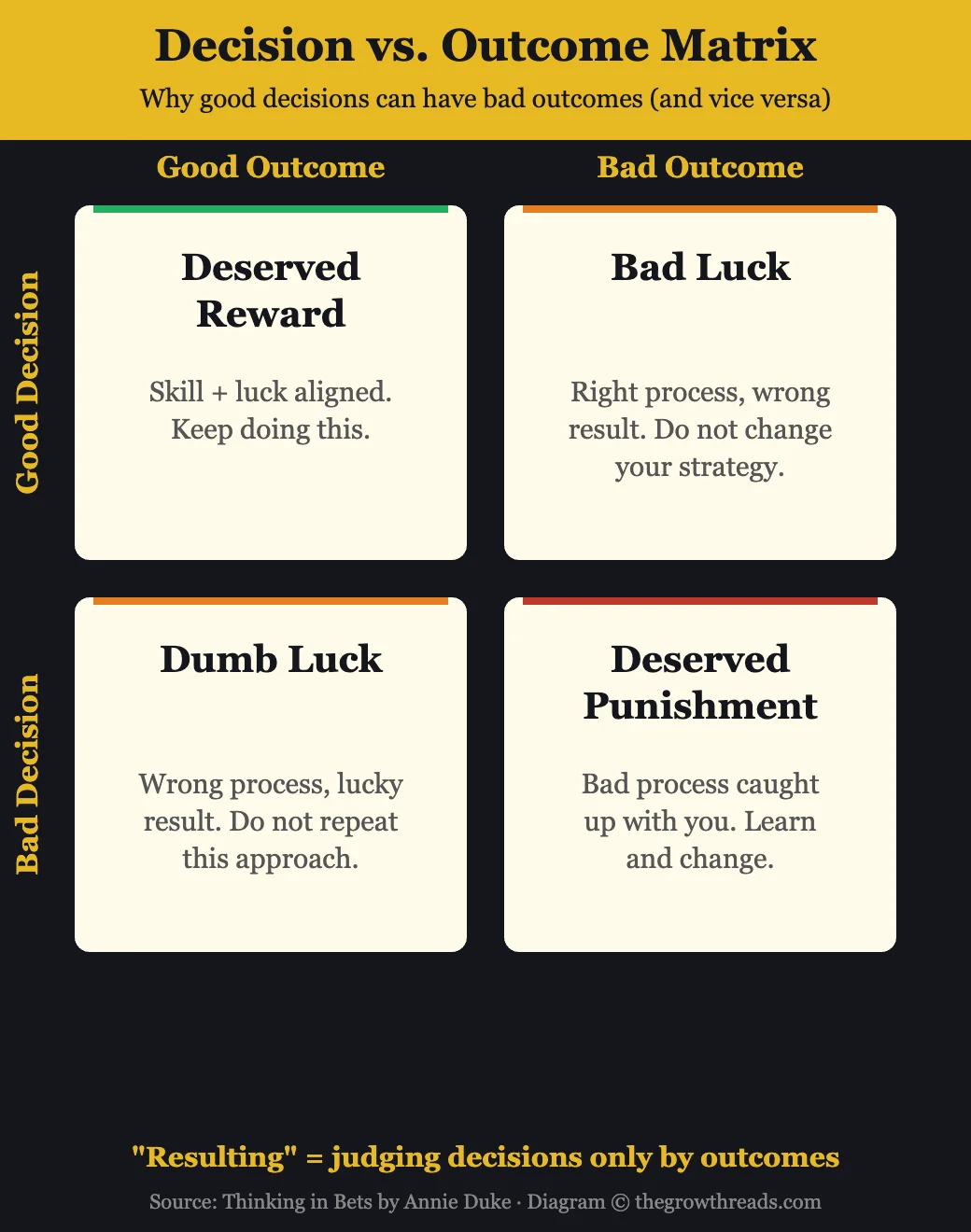
- Resulting is the enemy: Judging decisions only by their outcomes teaches you the wrong lessons — a bad strategy can get lucky, and a good one can hit bad variance.
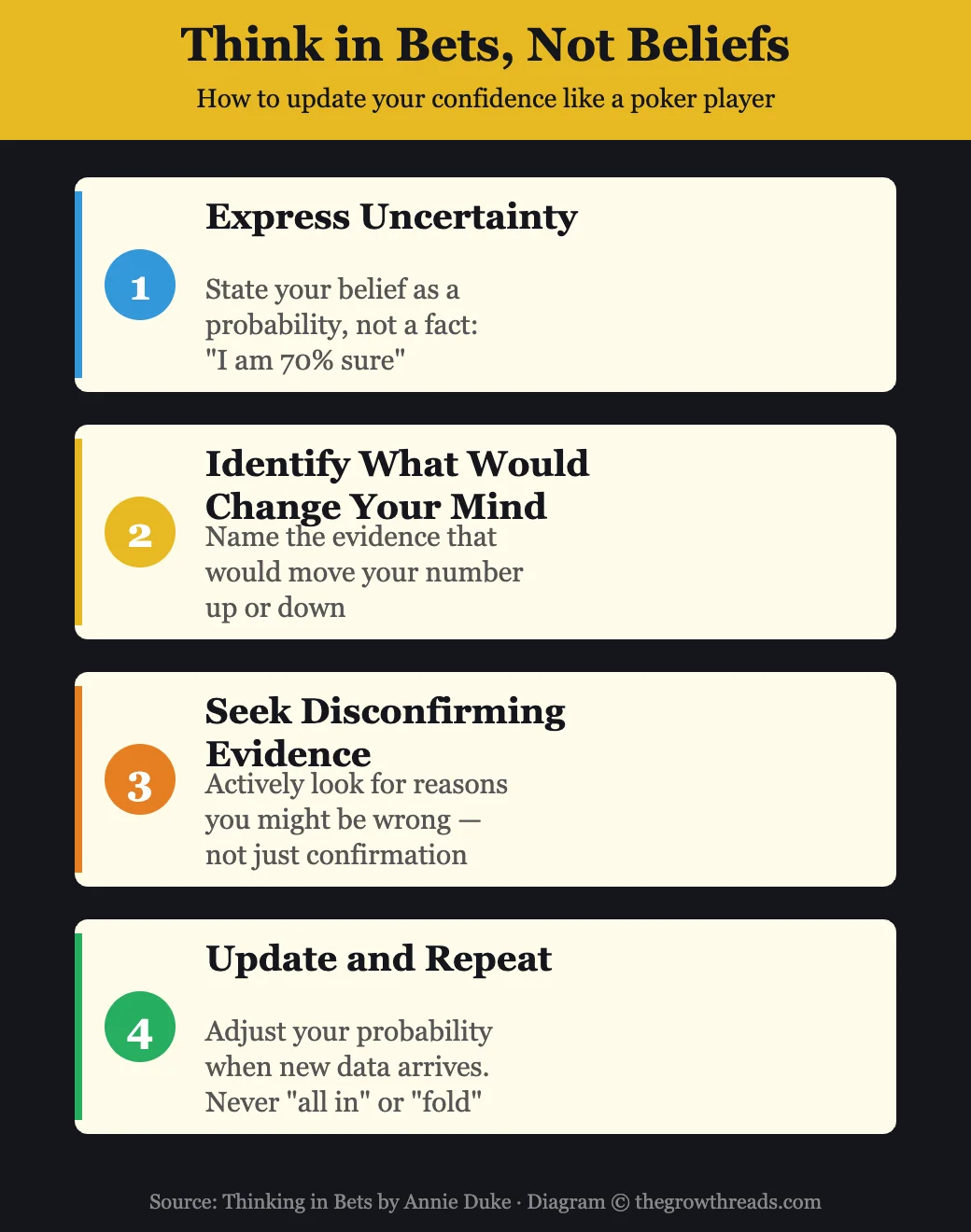
- Beliefs are bets: Every opinion you hold is a wager on what is true. Express your confidence as a percentage (“I am 75% sure”) rather than a certainty.
- Outcome fielding: After every result, ask: “Was this outcome due to my decision quality or to luck?” Sorting correctly prevents the wrong lessons from sticking.
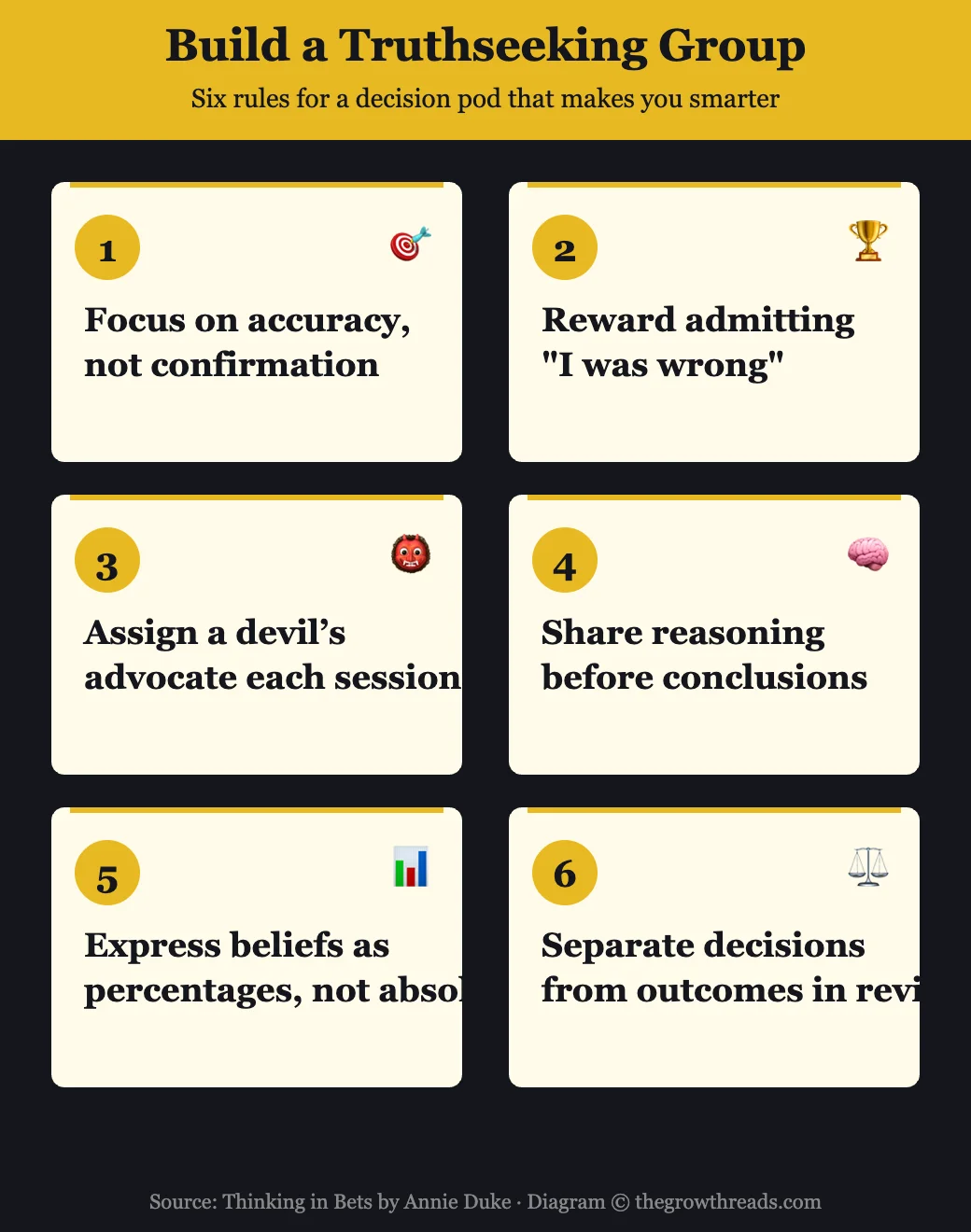
- Truthseeking groups beat solo thinking: A small group committed to accuracy — not confirmation — will catch your blind spots faster than you ever will alone.
- The Mertonian norms: Duke borrows from sociology: communism (share information), universalism (evaluate ideas without regard to source), disinterestedness (prioritize accuracy), and organized skepticism (default to questioning).
- Mental time travel: Before making a decision, ask your future self — 10 minutes, 10 months, 10 years from now — how they would feel about this choice.
- Backcasting: Imagine the goal achieved, then work backward to identify what steps made it happen. This reveals paths that forward planning misses.
- Premortems prevent disaster: Imagine the decision has already failed. What went wrong? This surfaces risks that optimism conceals.
- Winning is a long game: Good decision-making does not guarantee good results on any single bet, but over hundreds of decisions it creates a massive edge.
What is Thinking in Bets about?
Thinking in Bets is a decision-making guide that uses poker as a metaphor for life. Annie Duke teaches readers to separate luck from skill, express beliefs as probabilities rather than certainties, and build feedback systems that improve judgment over time — especially in situations where outcomes are uncertain and information is incomplete.
About the author
Annie Duke is a former professional poker player who won a World Series of Poker gold bracelet and the 2004 Tournament of Champions. She holds a master’s degree in cognitive psychology from the University of Pennsylvania, where she studied under decision scientist Barbara Tversky. After retiring from poker, Duke became a corporate speaker, decision-strategy consultant, and author. Her follow-up book How to Decide expanded the framework with practical exercises. She is a cofounder of the Alliance for Decision Education and has advised organizations from the NFL to JPMorgan Chase on improving their decision processes. Explore all Annie Duke book summaries →
Key concepts at a glance
| Concept | What it means | Use it when |
|---|---|---|
| Resulting | Judging a decision by its outcome rather than the quality of the process | You catch yourself saying “that was a bad decision” after a bad outcome |
| Outcome fielding | Sorting each result into the skill bucket or the luck bucket | Reviewing past choices to extract the right lessons |
| Beliefs as bets | Expressing confidence as a probability rather than a binary certainty | Any time you form an opinion or make a prediction |
| Truthseeking group | A small peer group that values accuracy over agreement | You need feedback that challenges rather than confirms |
| 10-10-10 rule | Imagining how you will feel about this decision in 10 minutes, 10 months, 10 years | Emotions are running high and clouding your judgment |
| Premortem | Imagining the decision has already failed and asking what went wrong | Before committing to any high-stakes plan |
| Backcasting | Imagining success achieved and working backward to find the path | Goal-setting and strategic planning |
| Motivated reasoning | Unconsciously bending evidence to fit what you already believe | You notice only seeking out confirming evidence |
Part 1: Why outcomes are a terrible teacher
Duke opens with a provocative claim: the way most people learn from experience is fundamentally broken. We look at what happened, assume the outcome reveals the quality of the decision, and update accordingly. Won the client? Great strategy. Lost the deal? Bad call. But this is exactly the error poker players learn to avoid, because in poker the feedback loop is mercilessly clear — you can play a hand perfectly and still lose to a lucky river card.
She calls this error “resulting” and traces it to two well-documented cognitive biases: hindsight bias (once we know the outcome, the decision seems obvious in retrospect) and self-serving bias (good outcomes are skill, bad ones are luck). Together they create a learning system that reinforces the wrong lessons.
Duke illustrates with the 2015 Super Bowl, where Seattle Seahawks coach Pete Carroll called a pass play instead of a run on the goal line. The pass was intercepted, and Carroll was vilified. But Duke shows that the decision was statistically sound — interception rates on short passes were extremely low, and a pass created an extra down if incomplete. The play failed, but the decision was good. Resulting caused millions of people to learn the wrong lesson from that play.
The practical takeaway is a habit Duke calls “outcome fielding” — after every significant result, asking two questions: “Was this outcome largely due to my decision process, or to factors outside my control?” and “What would I do differently if I could replay this decision with the same information I had at the time?” This separates signal from noise and prevents lucky wins from breeding overconfidence.
Part 2: Beliefs are bets
The second major idea is that every belief you hold is functionally a bet — a wager that something is true, placed with your time, money, reputation, or emotional energy. Most people treat their beliefs as binary (true or false), but Duke argues this is a catastrophic simplification. Instead, you should assign a confidence level: “I am 80% sure this marketing strategy will work” is a fundamentally different mental state from “This strategy will work,” even though they sound similar.
Why does this matter? Because when you hold a belief at 80%, you leave room for new evidence to move the number. You can update to 85% if confirming data arrives, or drop to 60% if a trusted colleague raises a strong counterpoint. Binary beliefs, by contrast, trigger motivated reasoning — once you have committed to “true,” every piece of new information gets filtered through a confirmation-biased lens.
Duke draws on research by Philip Tetlock, whose studies on superforecasters showed that the best predictors in the world share one trait: they express their beliefs in fine-grained probabilities and update them constantly. The worst predictors are the ones who speak in certainties and rarely change their minds. This is not about being wishy-washy — it is about calibrating your confidence to the actual strength of your evidence.
A practical exercise Duke recommends is “belief calibration”: when you catch yourself stating an opinion as fact, pause and ask, “What percentage confident am I, really?” Then ask, “What evidence would move that number?” This two-question habit alone can transform how you process information and argue with others.
Part 3: Building a truthseeking group
Duke argues that individual rationality has hard limits — our brains are wired for self-serving bias, confirmation bias, and tribalism. The most effective countermeasure is not more willpower but better social architecture: a small group of people (three to five) committed to helping each other think more clearly.
She calls this a “truthseeking group” and borrows its operating norms from sociologist Robert K. Merton’s norms of science: communism (share all relevant information, even if it hurts your position), universalism (evaluate ideas on merit, not on who proposed them), disinterestedness (prioritize group accuracy over personal ego), and organized skepticism (default to questioning rather than accepting).
In practice this means: when someone in the group shares a decision, the others do not start with “Here is why you are right.” They start with “What are you not seeing?” The group rewards people for changing their minds when presented with better evidence and penalizes people for defending positions out of ego. Duke notes that this is the opposite of how most workplaces and friend groups operate, which is why most feedback is useless — it confirms rather than challenges.
She also warns against two failure modes: “confirmatory drift” (the group gradually converges on a shared bias) and “echo-chambering” (members selected for agreement rather than diversity of thought). The antidote is to rotate a formal devil’s advocate role and to periodically invite an outsider to stress-test the group’s assumptions.
Part 4: Mental time travel and premortems
The final section introduces two future-oriented tools for better decisions: mental time travel and the premortem.
Mental time travel uses a simple framework Duke calls “10-10-10”: before making a decision, ask yourself how you will feel about it in 10 minutes, 10 months, and 10 years. This technique, originally developed by business writer Suzy Welch, counteracts the emotional intensity of the present moment. When you are about to fire off an angry email, your 10-minute self might feel satisfied, but your 10-month self would cringe. When you are procrastinating on a difficult conversation, your 10-minute self is relieved, but your 10-year self wishes you had acted sooner.
The premortem, adapted from psychologist Gary Klein, flips the usual planning approach. Instead of starting from the present and asking “How do we succeed?”, you start from a hypothetical future where the project has already failed and ask “What went wrong?” This reframe exploits hindsight bias for good — by placing the failure in the past (even an imaginary past), your brain generates risk scenarios it would normally suppress. Studies show that premortems can increase the ability to identify reasons for failure by 30 percent compared to traditional prospective planning.
Duke pairs the premortem with “backcasting” — the optimistic mirror image. Imagine success already achieved, then trace backward: what steps got you there? Backcasting reveals the most likely path to a goal, while the premortem reveals the landmines along the way. Used together, they create a decision framework that is both ambitiously optimistic and rigorously cautious.
Who is Thinking in Bets best for — and who should read something else first?
This book is ideal for professionals who make decisions under uncertainty (investors, managers, founders, strategists), people who struggle with hindsight bias and regret, and anyone who wants a practical alternative to gut-feel decision-making. The poker metaphor makes abstract decision science feel tangible and actionable.
If you want a deeper dive into the cognitive biases behind poor decisions, start with Thinking, Fast and Slow. If your challenge is more about interpersonal decisions and negotiation, Never Split the Difference may be more immediately useful. And if you prefer a workbook-style approach to decision-making, Duke’s own follow-up How to Decide translates these concepts into step-by-step exercises.
Questions to reflect on
- Think of a recent decision that turned out well — how much of that outcome was due to your process versus luck?
- What belief do you currently hold at “100% certain” that might actually be closer to 70 or 80%?
- Who in your life would be honest enough to join a truthseeking group with you?
- When was the last time you changed your mind about something important — and what evidence made you update?
- If you ran a premortem on your biggest current project, what is the most likely cause of failure you are not talking about?
🔥 Ready to make smarter bets?
Thinking in Bets teaches you to separate signal from noise, skill from luck, and decisions from outcomes — so every choice gets sharper over time.
How to apply Thinking in Bets (7-day plan)
- Day 1 — Catch yourself resulting: After every significant event today (a meeting that went well, a pitch that fell flat), write down whether you are judging the decision or the outcome. Separate the two.
- Day 2 — Calibrate one belief: Pick an opinion you hold strongly and assign it a percentage confidence. Then write down what evidence would move that number up or down by 10 points.
- Day 3 — Practice outcome fielding: Review three past decisions. For each, sort the result: Was it mostly skill or mostly luck? What would you do differently with the same information?
- Day 4 — Run a premortem: Take your biggest active project. Imagine it has already failed. Write down the three most likely reasons. Address the top one today.
- Day 5 — Use the 10-10-10 rule: For every decision today — big or small — ask: How will I feel about this in 10 minutes, 10 months, 10 years? Notice how it changes your choices.
- Day 6 — Recruit your truthseeking group: Identify 2–3 people who would be willing to challenge your thinking honestly. Reach out and propose a monthly decision-review session.
- Day 7 — Backcast one goal: Pick a goal you want to hit in 6 months. Imagine you have already achieved it. Work backward: what were the 5 steps that got you there? Schedule the first one.
Frequently asked questions
What is the main idea of Thinking in Bets?
The main idea is that every decision is a bet on an uncertain future, and most people make the mistake of judging decisions by their outcomes rather than by the quality of the reasoning behind them. Annie Duke calls this error “resulting” and provides a framework for separating luck from skill, expressing beliefs as probabilities, building truthseeking feedback loops, and using mental time travel to improve future choices.
What does “resulting” mean in Thinking in Bets?
Resulting is the tendency to judge the quality of a decision based solely on its outcome. If a decision led to a good result, we assume it was a good decision; if it led to a bad result, we assume it was bad. Duke argues this is a fundamental error because luck and uncertainty play a huge role in outcomes. A perfectly sound decision can produce a bad result due to variance, and a terrible decision can get lucky. Learning from outcomes alone teaches the wrong lessons.
Is Thinking in Bets only for poker players or gamblers?
Not at all. While Duke uses poker as the central metaphor, the book’s principles apply to any domain where decisions are made under uncertainty — which is essentially every domain. Business strategy, career choices, investing, parenting, and relationships all involve hidden information and probabilistic outcomes. The poker framework simply makes these abstract concepts concrete and memorable. No knowledge of poker is required to benefit from the book.
What is a truthseeking group?
A truthseeking group is a small circle of people (ideally three to five) who commit to helping each other make better decisions by prioritizing accuracy over agreement. Members follow norms borrowed from scientific practice: share all relevant information, evaluate ideas on merit rather than source, prioritize group accuracy over individual ego, and default to questioning rather than accepting. The group works because it provides the external perspective and constructive challenge that individual thinking cannot.
What is the 10-10-10 rule?
The 10-10-10 rule is a mental time travel exercise: before making a decision, ask yourself how you will feel about it in 10 minutes, 10 months, and 10 years. This technique counteracts the emotional intensity of the present moment by forcing you to consider the long-term consequences. It is especially useful when emotions are running high — anger, excitement, fear — and threatens to override your rational process.
What is a premortem and how do you use it?
A premortem is a planning technique where you imagine that your project or decision has already failed, then work backward to identify what went wrong. Unlike a postmortem (which happens after failure), a premortem happens before you commit, allowing you to surface risks and blind spots while there is still time to address them. Research by psychologist Gary Klein shows that premortems improve risk identification by approximately 30 percent compared to traditional forward-looking planning.
How does Thinking in Bets compare to Thinking, Fast and Slow?
Thinking, Fast and Slow by Daniel Kahneman provides the deep cognitive-science research behind decision-making biases — System 1 vs. System 2 thinking, prospect theory, and anchoring effects. Thinking in Bets builds on this foundation but is more practically oriented: Duke takes the biases Kahneman identified and provides concrete tools (outcome fielding, truthseeking groups, premortems) for counteracting them in daily life. Kahneman gives you the diagnosis; Duke gives you the treatment plan.
Related summaries
- Thinking, Fast and Slow Summary & Review — The cognitive science behind decision biases
- Predictably Irrational Summary & Review — How hidden forces shape every choice
- Blink Summary & Review — When snap judgments beat analysis
- Principles Summary & Review — Ray Dalio’s system for radical transparency in decisions
- Best Psychology Books — Our complete ranked guide