

⭐⭐⭐⭐ 4.4/5 — A deeply researched, story-driven guide to building team cultures where people feel safe, connected, and driven by shared purpose.
Best for: Leaders, managers, coaches, and anyone responsible for group performance who wants to understand exactly what makes some teams click.
Reading time: ~5 hours (304 pages)
Difficulty to apply: Medium — the principles are clear, but changing group dynamics requires sustained effort and modeling from the top.
The Culture Code in one minute
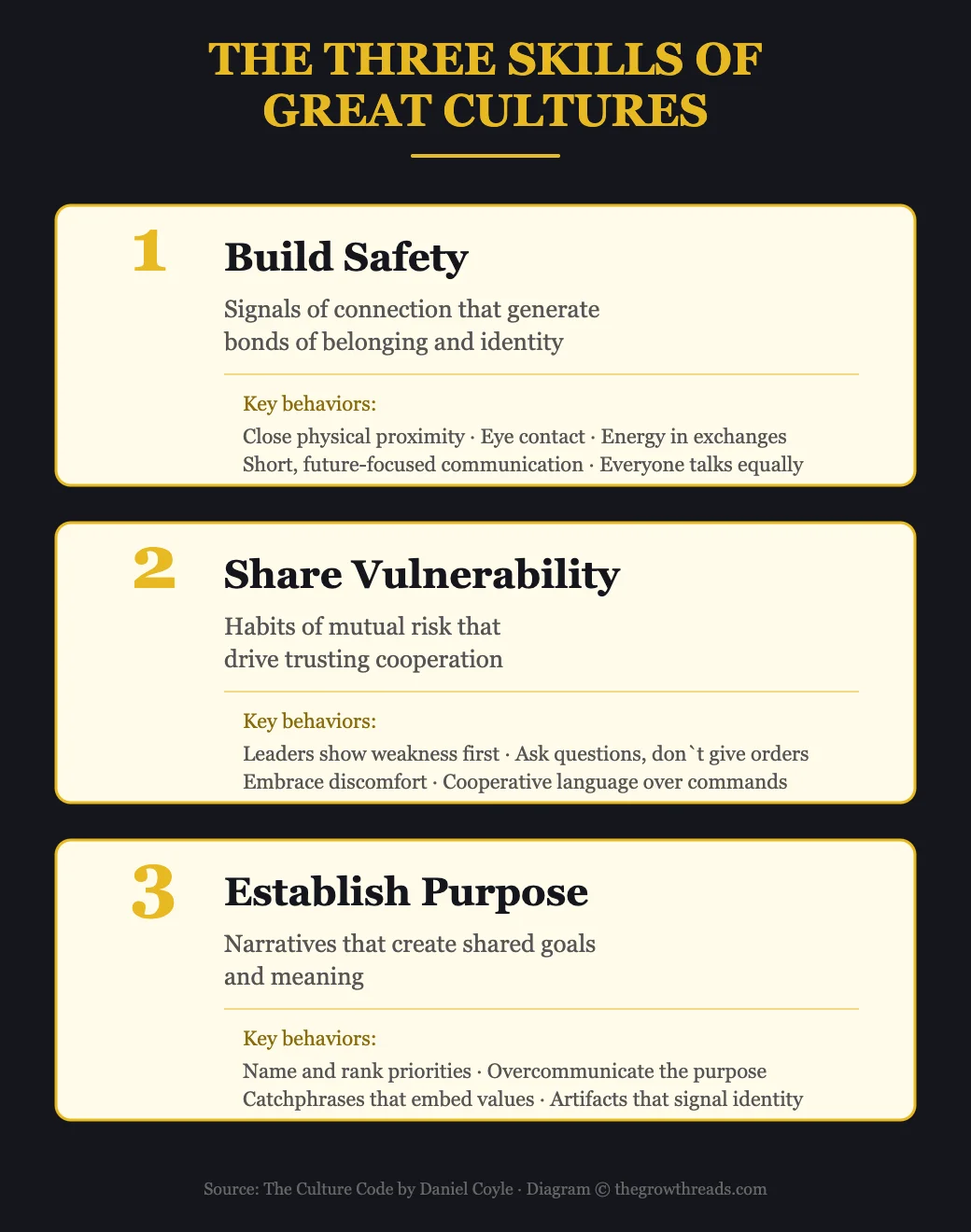
Great group cultures are not born — they are built through specific, learnable skills. Daniel Coyle spent four years embedded with some of the world`s most successful teams — Navy SEALs, Pixar, the San Antonio Spurs, IDEO, and others — and distilled what they share into three core skills: build safety, share vulnerability, and establish purpose. The book shows that culture is not about perks or slogans; it is about a continuous stream of small signals that tell people they belong, they are trusted, and their work matters. Coyle provides both the science and the practical playbook for any leader who wants to transform a group of individuals into a high-performing team.
Key takeaways
- Safety is the foundation: Before any team can perform, its members need to feel psychologically safe — belonging cues are the tiny signals (eye contact, body language, turn-taking) that generate this safety.
- Vulnerability drives trust: Trust is not a prerequisite for vulnerability — vulnerability comes first. Leaders who show weakness first create permission for everyone else to do the same.
- Purpose needs constant reinforcement: High-purpose environments flood the zone with signals that connect present effort to future meaning. Purpose is not a one-time speech; it is a repeated drumbeat.
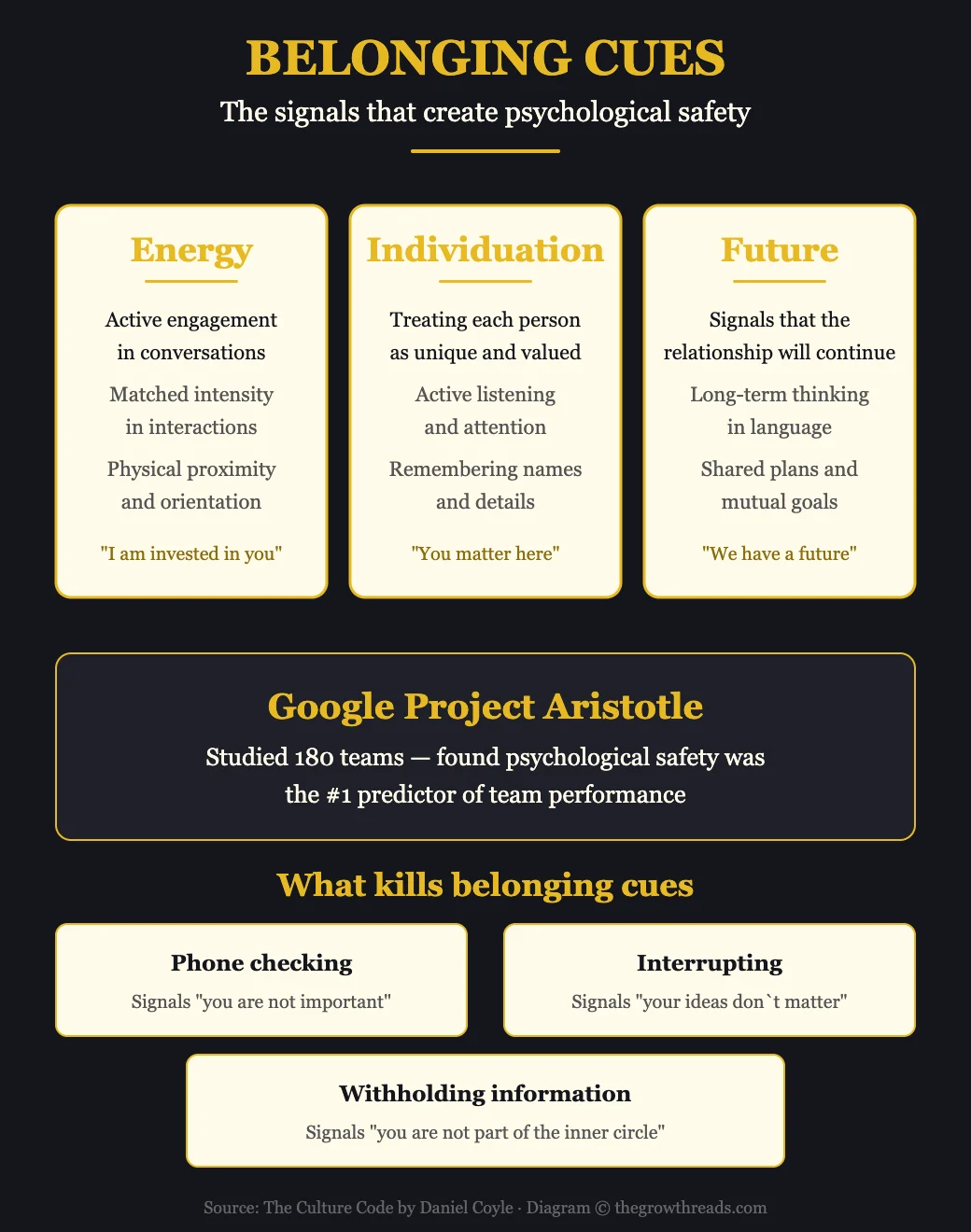
- Belonging cues communicate three things: You are safe here, we share a future together, and you matter as an individual.
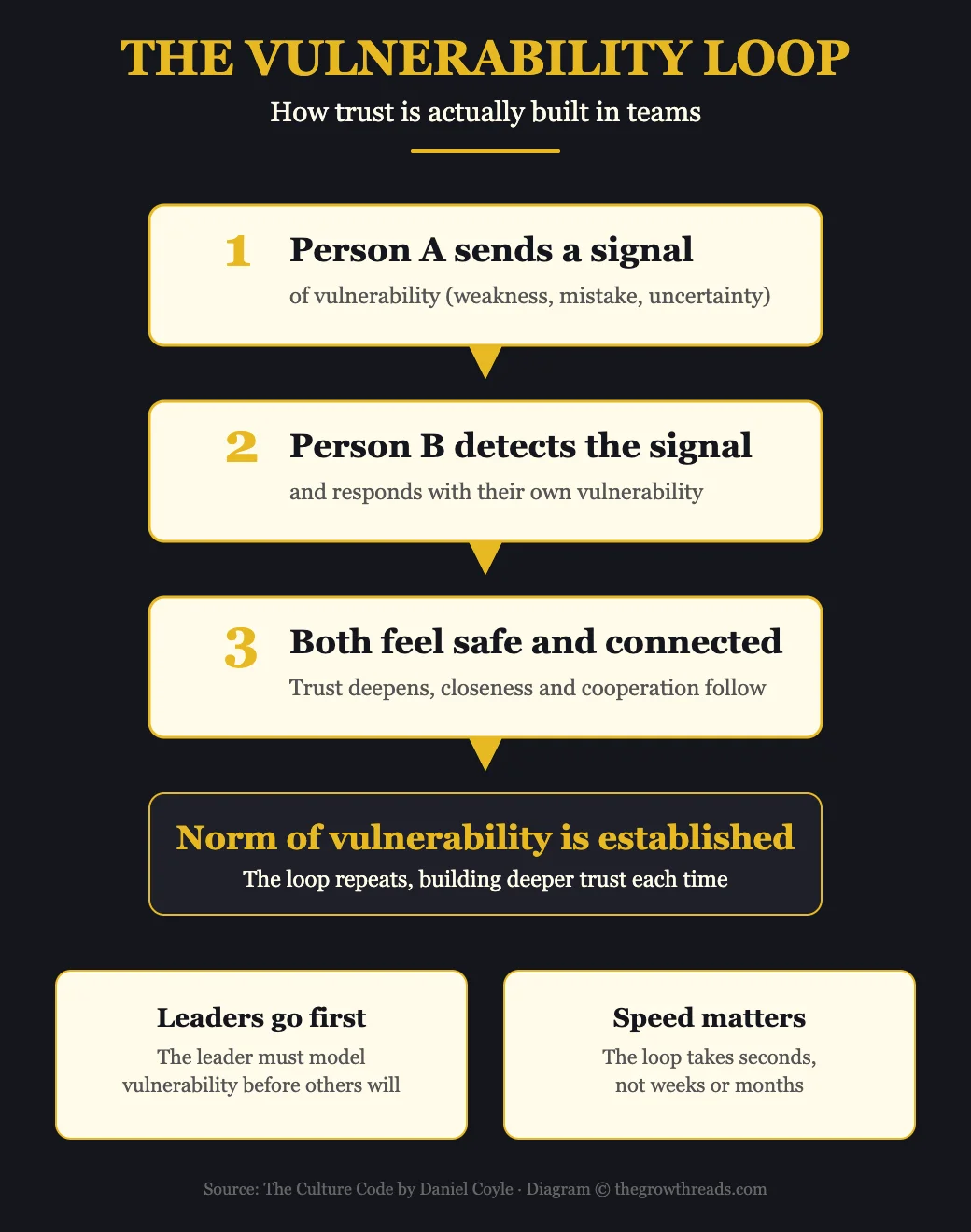
- The vulnerability loop is the mechanism of trust: Person A shares weakness, Person B responds with their own vulnerability, and both feel closer — this loop repeats and deepens over seconds, not months.
- Bad apple behavior is contagious: One negative person can drag an entire group`s performance down by 30-40%. But a skilled “connector” can neutralize bad apples with warmth and inclusion.
- Overcommunicate priorities: Great cultures rank their priorities explicitly and repeat them until everyone can recite them from memory.
- Catchphrases are tools: Simple, repeated phrases (“Work hard, be nice,” “Pound the rock”) embed cultural values more effectively than mission statements.
- Feedback works best in a frame of high standards + belief: The most effective feedback formula is: “I`m giving you this because I have high standards and I believe you can reach them.”
- Culture is a living process: It requires constant attention, intentional design, and leaders who model the behaviors they want to see.
What is The Culture Code about?
The Culture Code reveals the three essential skills that make groups successful: building safety, sharing vulnerability, and establishing purpose. Daniel Coyle studied elite teams — from Navy SEALs to Pixar — and found that great cultures are not about individual talent but about creating environments where people feel they belong, can take risks, and are connected to a meaningful shared mission.
About the author
Daniel Coyle is a bestselling author and journalist whose work focuses on the science of talent, performance, and group dynamics. His previous book, The Talent Code, explored how deep practice and myelin growth create extraordinary skill. Coyle spent years as a contributing editor at Outside magazine and has taught at top sports organizations. For The Culture Code, he embedded himself with Navy SEAL Team Six, Pixar`s Braintrust, the San Antonio Spurs, IDEO, and several other high-performing groups over four years, combining immersive observation with interviews and research from organizational psychology and neuroscience. Explore all Daniel Coyle book summaries →
Key concepts at a glance
| Concept | What it means | Use it when |
|---|---|---|
| Belonging Cues | Small behaviors that signal safety, connection, and future together | Onboarding new team members or resetting team dynamics |
| The Vulnerability Loop | Reciprocal sharing of weakness that builds trust in seconds | Breaking through team stiffness or lack of candor |
| Bad Apple Experiment | One toxic person can reduce group output by 30-40% | Diagnosing sudden drops in team performance |
| Overcommunication | Repeating priorities and purpose far more than feels necessary | Aligning a team around what matters most |
| High-Purpose Environments | Spaces flooded with signals connecting effort to meaning | Designing workspaces, rituals, and communications |
| Magical Feedback | “I have high standards and I believe you can reach them” | Giving critical feedback that motivates rather than deflates |
| After-Action Reviews | Structured post-event debriefs focused on learning, not blame | Improving performance iteration by iteration |
| Catchphrases as Culture Tools | Simple repeated phrases that embed values in daily behavior | Scaling culture across growing or distributed teams |
Part 1: Build Safety — creating belonging
Coyle opens with a striking experiment. Teams of kindergartners were pitted against teams of business school students in a challenge to build the tallest structure from spaghetti, tape, and string. The kindergartners won — consistently. The MBA students wasted time jockeying for status, managing impressions, and figuring out who was in charge. The five-year-olds just tried things, failed, adjusted, and tried again. They did not have a strategy; they had psychological safety.
This leads Coyle to his first skill: Build Safety. He defines safety not as comfort or the absence of conflict, but as a set of signals — belonging cues — that tell each group member three things: you are safe here, we share a future, and you matter as an individual. These cues include close physical proximity, lots of eye contact, short and energetic exchanges, high levels of mixing (everyone talks to everyone, not just to the leader), and few interruptions.
Coyle visits Google`s Project Aristotle, the company`s massive study of 180 internal teams to determine what makes some high-performing and others mediocre. The answer was not talent, resources, or structure — it was psychological safety. Teams where members felt safe to take risks, admit mistakes, and ask for help outperformed every other configuration. The finding aligned perfectly with the belonging cues Coyle had been observing.
He also shares researcher Will Felps`s “bad apple” experiment, which showed that a single toxic individual — a slacker, a downer, or a dominator — can drag an entire group`s performance down by 30-40 percent. But there was a counterforce: in groups with a skilled “connector” who actively included others, maintained warmth, and deflected negativity, the bad apple`s effect was neutralized. The lesson is that belonging is not just about avoiding toxicity — it is about actively generating positive signals of connection.
Part 2: Share Vulnerability — building trust through exposure
Coyle`s second skill inverts a common assumption: most people believe trust must exist before vulnerability is possible. In reality, Coyle finds, vulnerability comes first. Trust is the result, not the prerequisite.
He illustrates this with the Vulnerability Loop — a mechanism that takes only seconds. Person A sends a signal of vulnerability (admitting a mistake, asking for help, expressing uncertainty). Person B detects the signal and responds with their own vulnerability. Both feel a surge of closeness. Repeat the loop enough times and a norm of candor and mutual risk-taking takes hold. The catch is that someone has to go first — and that someone is almost always the leader.
Coyle embeds with Navy SEAL Team Six and watches how they run After-Action Reviews (AARs) — brutally honest debriefs after every mission where rank dissolves and anyone can say what went wrong. “The most painful moments are the most important,” one SEAL tells him. Pixar`s Braintrust operates on the same principle: directors present rough cuts of their films to a group of trusted peers who dismantle the work with candid feedback. The critical norm is that feedback is about the project, never about the person — and the director has final say.
The difference between productive vulnerability and destructive conflict is the frame. When people share weakness within a context of belonging cues and mutual respect, it deepens trust. When they share weakness in an environment of competition and status-jockeying, it gets weaponized. Coyle emphasizes that leaders must model vulnerability consistently — not once, but as a daily practice. The most effective leaders he observed were the ones who said “I screwed that up” or “What am I missing?” most frequently.
Part 3: Establish Purpose — creating shared meaning
Safety and vulnerability create the conditions for great teamwork, but they are not enough on their own. Groups also need direction — a shared understanding of why they exist and what they are working toward. Coyle`s third skill, Establish Purpose, is about flooding the environment with signals that connect everyday actions to a larger meaning.
Coyle visits Johnson & Johnson and examines why their famous Credo — a set of principles written in 1943 — still drives decisions eight decades later. The answer is not that the Credo is particularly elegant; it is that J&J engages employees in regular “Credo Challenge” sessions where they debate, question, and recommit to the principles. Purpose is not set-and-forget; it is a living conversation.
He finds that high-purpose environments are visually, verbally, and behaviorally saturated with reminders of what matters. The San Antonio Spurs locker room is filled with quotes about teamwork. KIPP charter schools plaster catchphrases — “Work hard, be nice” — on every surface. Danny Meyer`s restaurant group uses the phrase “creating raving fans” so often that it becomes second nature for every waiter and host. These are not marketing slogans; they are cultural operating systems.
Coyle draws a distinction between two types of purpose: high-proficiency environments (where the goal is consistent execution of a known standard, like a restaurant kitchen) and high-creativity environments (where the goal is innovation, like Pixar). High-proficiency cultures need clear, measurable priorities and relentless rehearsal. High-creativity cultures need psychological safety for experimentation and a north star that is aspirational rather than prescriptive. The tools differ, but the underlying principle is the same: connect daily action to shared meaning, and do it constantly.
Who is The Culture Code best for — and who should read something else first?
The Culture Code is essential reading for anyone who leads or builds teams: managers, founders, coaches, military leaders, teachers, and nonprofit directors. It is particularly powerful for leaders who sense that something is “off” in their team`s dynamics but cannot pinpoint what. Coyle gives you the vocabulary and the diagnostic framework.
If you are looking for a more personal leadership development book rather than a team culture book, start with Dare to Lead by Brené Brown or Leaders Eat Last by Simon Sinek. If you need a structured team health diagnostic, The Five Dysfunctions of a Team by Patrick Lencioni is more prescriptive. And if your focus is on scaling culture in a fast-growing company, The Hard Thing About Hard Things by Ben Horowitz provides the startup-specific lens.
Questions to reflect on
- When was the last time you admitted a mistake or asked for help in front of your team — and what happened next?
- Which belonging cues does your team send consistently, and which are missing?
- If you asked every team member to name the group`s top three priorities, would they all give the same answer?
- Who is the “connector” in your group — the person who generates warmth and inclusion — and are you supporting them?
- What would change if you opened your next meeting by sharing something you are struggling with?
🔥 Ready to transform your team`s culture?
The Culture Code gives you the exact playbook used by Navy SEALs, Pixar, and the world`s best teams.
How to apply The Culture Code (7-day plan)
- Day 1 — Audit your belonging cues. In your next three interactions, consciously track: Am I making eye contact? Am I oriented toward the person? Am I checking my phone? Notice what signals you are sending.
- Day 2 — Go first with vulnerability. In a meeting or one-on-one, share one thing you are uncertain about or struggling with. Observe how others respond — does the loop start?
- Day 3 — Name your priorities. Write down your team`s top three priorities. Then ask three teammates to do the same. Compare lists. If they don`t match, you have a purpose problem.
- Day 4 — Create a catchphrase. Distill one core value into a short, memorable phrase your team can repeat. Start using it in meetings, Slack, and one-on-ones.
- Day 5 — Run a mini AAR. After your next project milestone, run a 15-minute After-Action Review: What worked? What did not? What will we do differently? Make it blame-free.
- Day 6 — Use the magical feedback formula. Give one piece of critical feedback today using the frame: “I`m giving you this feedback because I have high standards and I believe you can reach them.”
- Day 7 — Design one ritual. Create a recurring practice that reinforces belonging — a weekly shout-out, a monthly team meal, a standing debrief. The best rituals are simple, consistent, and slightly uncomfortable at first.
Frequently asked questions
What is the main idea of The Culture Code?
The main idea is that successful group cultures are not accidents of chemistry or talent — they are built through three specific, learnable skills: building safety (creating belonging cues), sharing vulnerability (modeling openness and trust), and establishing purpose (connecting daily actions to shared meaning). Coyle argues these skills can be practiced and improved by any leader, in any organization, regardless of size or industry.
What are belonging cues in The Culture Code?
Belonging cues are small, repeated behaviors that send three messages to group members: you are safe here, we share a future together, and you are valued as an individual. Examples include consistent eye contact, physical proximity during conversations, energetic interactions, turn-taking in discussions, and future-oriented language. Coyle found that successful teams generate these cues continuously and often unconsciously — but they can also be cultivated deliberately by leaders who understand their power.
What is the vulnerability loop?
The vulnerability loop is the mechanism through which trust is actually built in teams. It works in three steps: Person A sends a signal of vulnerability (admitting a mistake, asking for help), Person B detects the signal and responds with their own vulnerability, and both people feel closer and safer. The loop takes seconds, not months. The critical finding is that leaders must initiate the loop — trust is not a prerequisite for vulnerability; vulnerability creates trust.
How long does it take to read The Culture Code?
The Culture Code is 304 pages and takes most readers about 4.5 to 5.5 hours to read. Coyle writes in an accessible, narrative style that alternates between on-the-ground reporting (inside Navy SEAL training, Pixar`s Braintrust meetings, restaurant kitchens) and research summaries. The audiobook runs about 7 hours and 13 minutes. Many readers finish it in two or three sittings because the case studies are engaging enough to sustain momentum.
What teams did Daniel Coyle study for The Culture Code?
Coyle embedded with a wide range of high-performing groups over four years, including Navy SEAL Team Six, Pixar Animation Studios, the San Antonio Spurs basketball team, design firm IDEO, restaurant group Union Square Hospitality (Danny Meyer), Zappos, KIPP charter schools, the U.S. Women`s Soccer team, and several others. He also draws on research from Google`s Project Aristotle, which studied 180 internal teams, and Will Felps`s “bad apple” experiments in organizational behavior.
Is The Culture Code worth reading in 2026?
Absolutely. The Culture Code has become even more relevant as remote and hybrid work have disrupted the belonging cues teams used to generate naturally (proximity, eye contact, casual interactions). The book`s framework helps leaders understand exactly which signals are missing in distributed environments and how to deliberately recreate them. Its principles are also increasingly cited in the context of psychological safety research, making it a foundational read for modern team leadership.
What should I read after The Culture Code?
If you want the team diagnostic framework, read The Five Dysfunctions of a Team by Patrick Lencioni. For personal leadership growth in vulnerability and courage, try Dare to Lead by Brené Brown. If the purpose angle resonated, Start with Why by Simon Sinek goes deeper into how purpose drives organizational alignment. And for the feedback and candor aspects, Radical Candor by Kim Scott provides the tactical toolkit.
Related summaries
- The Five Dysfunctions of a Team by Patrick Lencioni — the pyramid of team health
- Dare to Lead by Brené Brown — courage and vulnerability in leadership
- Radical Candor by Kim Scott — giving feedback that builds trust
- Best Leadership Books — our full ranked list