

★★★★☆ 4.3 / 5
Actionability: 4.5 / 5 — Every chapter ends with a concrete willpower experiment
Evidence Quality: 4.5 / 5 — Grounded in peer-reviewed neuroscience and psychology studies
Readability: 4.5 / 5 — Warm, conversational tone with relatable student stories
Uniqueness: 4.0 / 5 — First popular book to treat willpower as a trainable biological system
Long-term Value: 4.0 / 5 — Strategies that compound over months of practice
One-liner: The science of self-control, turned into a 10-week training program you can start today.
Best for: Anyone who feels stuck in a loop of good intentions and broken promises
Reading time: ~6 hours (267 pages)
Difficulty to apply: Low to moderate — exercises are small, weekly, and stackable
The Willpower Instinct in one minute
Willpower is not a character trait you are born with — it is a biological function that can be trained, measured, and strengthened like a muscle. Stanford psychologist Kelly McGonigal designed a 10-week course called “The Science of Willpower” that became the most popular class ever offered through Stanford Continuing Studies. This book distils those lessons. The core argument: self-control operates through three distinct powers (I will, I won’t, I want), each rooted in a specific region of the prefrontal cortex. When you understand the biology — how stress depletes willpower, how sleep restores it, how dopamine hijacks your decisions — you stop blaming yourself and start designing your environment. Every chapter pairs research with a willpower experiment so you leave with a practice, not just a theory.
Key takeaways
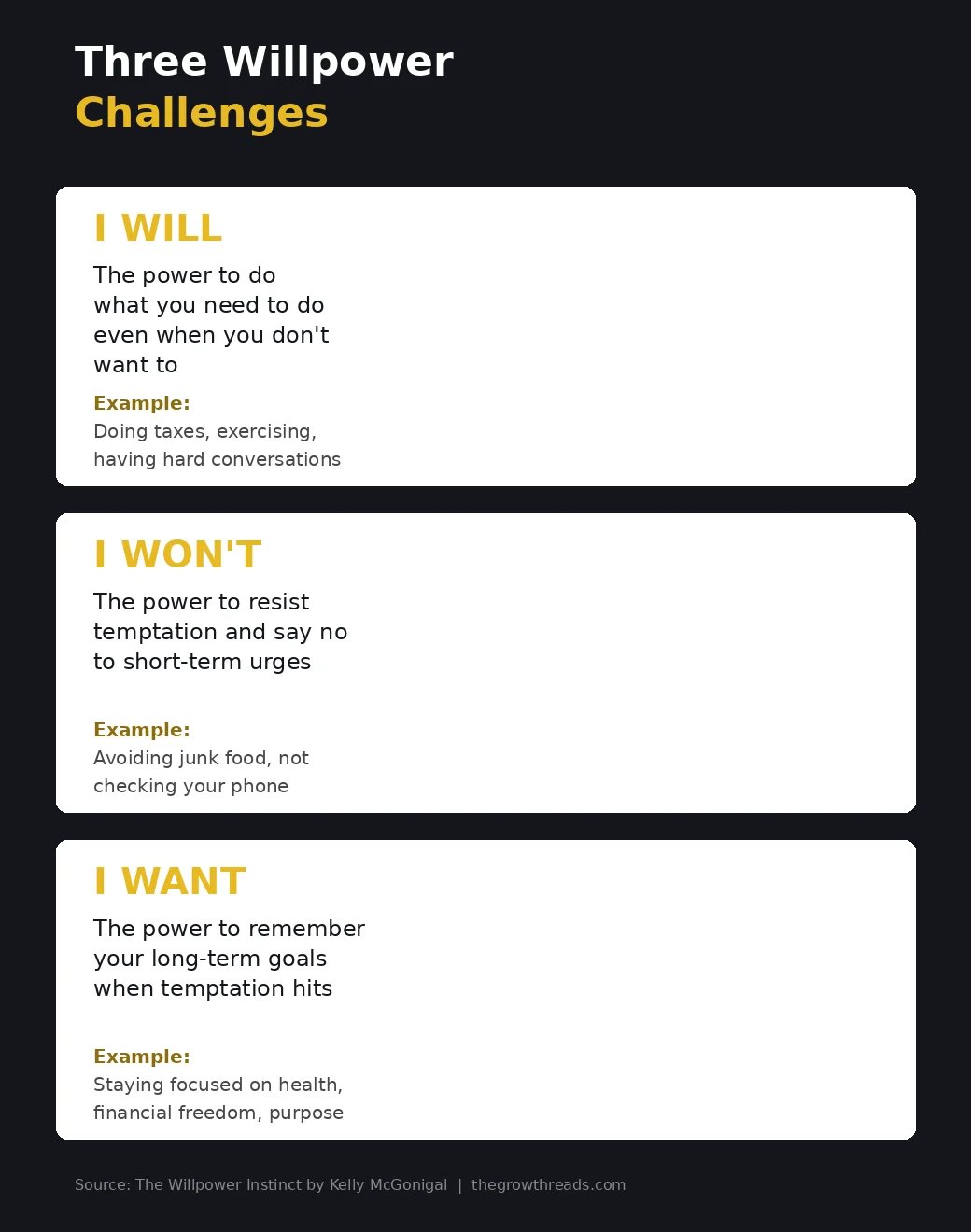
- Willpower has a biological basis: The prefrontal cortex manages three powers — I will (doing what is hard), I won’t (resisting temptation), and I want (remembering long-term goals). All three can be strengthened with practice.
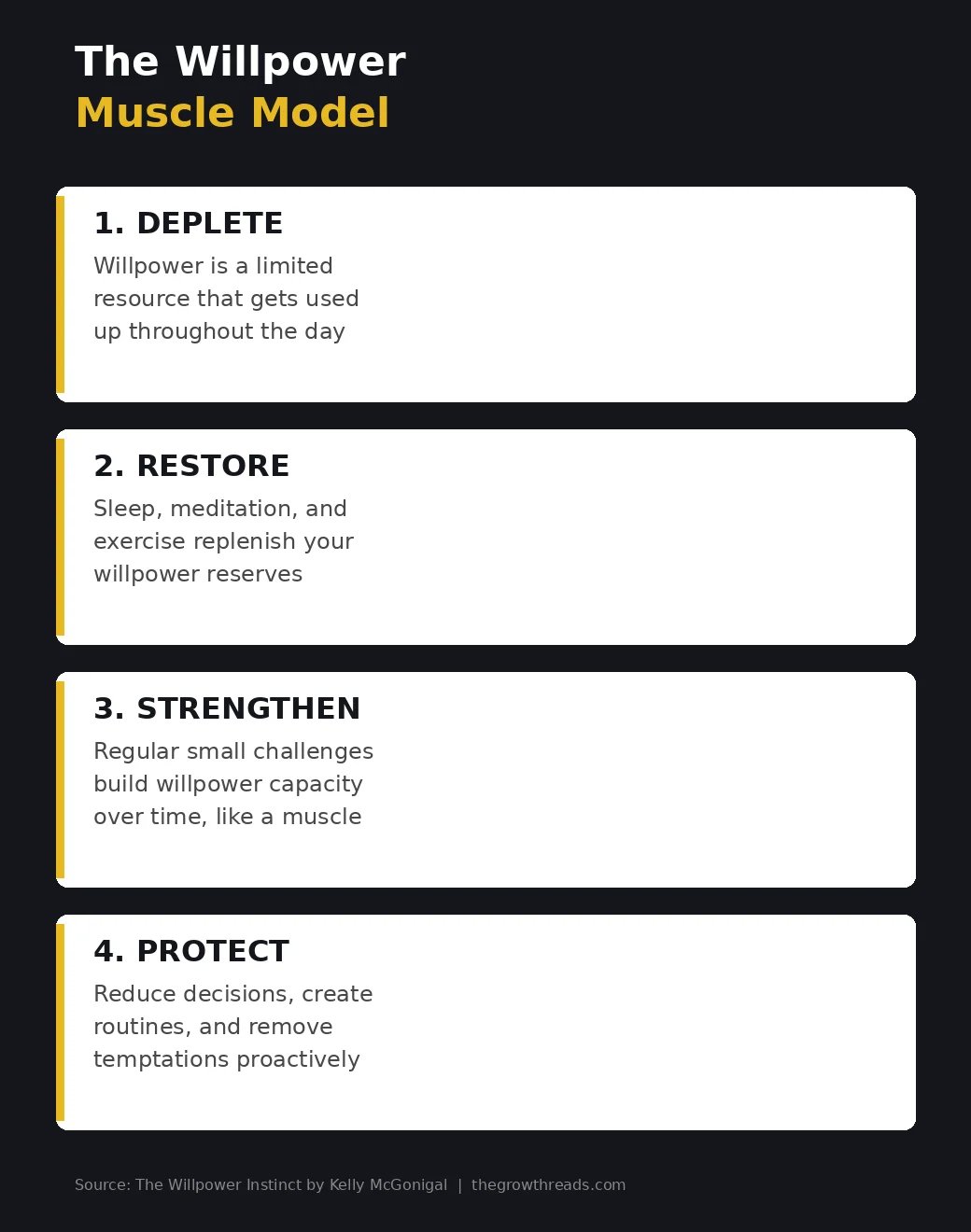
- Self-control is like a muscle: It fatigues with use but grows stronger with regular, small challenges. Training in one area of discipline creates spillover benefits in others.
- Stress is the enemy of willpower: When you are stressed, your brain shifts from the deliberate prefrontal cortex to the impulsive fight-or-flight system. Managing stress is managing willpower.
- Sleep is non-negotiable: Getting less than six hours per night impairs the prefrontal cortex so severely that it mimics mild intoxication. Even a short nap can restore self-control.
- Dopamine drives wanting, not happiness: Your brain confuses the promise of reward with actual satisfaction. Learning to distinguish between dopamine-driven desire and genuine enjoyment is a superpower.
- Moral licensing sabotages progress: After doing something “good,” your brain gives you permission to be “bad.” Progress should fuel commitment, not entitlement.
- Future-self thinking changes decisions: People who feel connected to their future selves make better choices today. Visualisation and letter-writing exercises strengthen this connection.
- Self-compassion beats self-criticism: Guilt and shame after a setback trigger more indulgence, not less. Treating yourself with kindness after failure leads to faster recovery and stronger resolve.
- Willpower is contagious: Self-control — and its absence — spreads through social networks. Surrounding yourself with disciplined people raises your own willpower baseline.
- Surfing the urge works better than fighting it: Rather than suppressing cravings, McGonigal teaches you to observe them like waves — they peak and pass within 15 minutes if you don’t act on them.
What is The Willpower Instinct about?
The Willpower Instinct is a science-based guide to understanding and strengthening self-control. Stanford psychologist Kelly McGonigal draws on neuroscience, psychology, and economics research to explain why willpower fails and how to train it. The book is structured as a 10-week course, with each chapter covering one key insight and ending with practical experiments readers can try immediately.
About the author
Kelly McGonigal is a health psychologist and lecturer at Stanford University, where she has taught courses on willpower, stress management, and mind-body science for over a decade. Her course “The Science of Willpower” became the most popular class ever offered through Stanford’s Continuing Studies programme, attracting students from all over the Bay Area. McGonigal holds a PhD in psychology from Stanford and is also a certified yoga and group fitness instructor — a combination that informs her holistic approach to behaviour change. Her TED talk “How to Make Stress Your Friend” has been viewed over 30 million times, and she is also the author of The Joy of Movement and The Upside of Stress. Explore all Kelly McGonigal book summaries →
Key concepts at a glance
| Concept | What it means | Use it when |
|---|---|---|
| I Will / I Won’t / I Want | Three distinct willpower powers, each mapped to a brain region | Diagnosing which type of self-control challenge you face |
| Willpower Muscle | Self-control depletes with use but strengthens with training | Designing small daily willpower exercises |
| Pause-and-Plan Response | The opposite of fight-or-flight — slowing down to make deliberate choices | You feel an urge and need to buy yourself a few seconds |
| Moral Licensing | Feeling virtuous gives your brain permission to indulge | You catch yourself thinking “I deserve this” after progress |
| Dopamine Trigger | The brain’s reward system motivates seeking, not satisfaction | Distinguishing wanting from genuine enjoyment |
| Terror Management | Anxiety about mortality or failure triggers impulsive comfort-seeking | Stress-driven indulgences like emotional eating or retail therapy |
| Future Self Continuity | Feeling connected to your future self improves present decisions | Making long-term financial, health, or career choices |
| Ironic Rebound | Trying to suppress a thought makes it come back stronger | You try not to think about a craving and it intensifies |
| Surfing the Urge | Observing cravings without acting lets them pass naturally | Breaking addictive or compulsive behaviour patterns |
Part 1: The biology of willpower
McGonigal opens by locating willpower in the brain. The prefrontal cortex — the region just behind your forehead — manages three jobs. The left side handles “I will” power (making yourself do hard things). The right side handles “I won’t” power (resisting temptation). And the lower-middle area handles “I want” power (remembering what you really care about when short-term urges strike).
This matters because it reframes willpower from a moral quality into a neurological function. People with prefrontal cortex damage — from injuries, strokes, or even severe sleep deprivation — lose self-control regardless of how “disciplined” they were before. The lesson: if your brain is impaired, your willpower is impaired. Full stop.
McGonigal introduces the “pause-and-plan” response as the biological opposite of fight-or-flight. When you face a threat, your body speeds up. When you face a temptation, your body needs to slow down. Heart rate variability (HRV) — the variation in time between heartbeats — is the best physiological marker of this response. Higher HRV means your body is better at switching from impulse to intention. And HRV can be improved through exercise, sleep, and even slow breathing (four to six breaths per minute).
The first willpower experiment: choose one “I will,” one “I won’t,” and one “I want” challenge for the week. Track which moments test each one. This simple act of self-monitoring — without even trying to change behaviour — has been shown in studies to improve outcomes.
Part 2: The willpower muscle and its limits
The most famous finding in willpower research is Roy Baumeister’s “ego depletion” model: people who resist one temptation show reduced self-control on a second, unrelated task. McGonigal presents the evidence carefully. In one study, subjects who resisted freshly baked cookies (eating radishes instead) gave up on a frustrating puzzle 60% faster than those who ate the cookies freely.
But McGonigal goes beyond Baumeister. She argues that the brain uses about 20% of the body’s total energy, and that demanding mental tasks — including self-control — consume measurably more glucose. Low blood sugar correlates with poorer self-control in dozens of studies. This is why dieters face a cruel paradox: the act of restricting food depletes the very resource (glucose) that willpower depends on.
The flip side is training. Just as muscles grow stronger with progressive resistance, willpower capacity expands through small, consistent challenges. McGonigal cites studies where subjects who committed to small acts of self-control — like using their non-dominant hand for everyday tasks, or tracking every penny they spent — showed improved willpower across unrelated domains within two weeks. The exercise did not need to be big. It just needed to be consistent.
Part 3: The dopamine trap and moral licensing
Chapters 5 and 6 contain what many readers consider the book’s most eye-opening material. McGonigal explains that dopamine — the neurotransmitter most people associate with pleasure — actually drives anticipation, not enjoyment. Your brain releases dopamine when it predicts a reward, not when you receive one. This is why scrolling social media, window-shopping, or snacking can feel compulsive even when none of these activities deliver lasting satisfaction.
Retailers and app designers exploit this loop deliberately. Variable rewards — like the unpredictable refresh of a news feed — are the most powerful dopamine triggers. McGonigal teaches readers to “dopamine-proof” their environment by asking a simple question: “Does this actually make me happy, or does it just promise happiness?” The distinction is surprisingly difficult to feel in the moment but becomes clearer with practice.
Moral licensing is equally insidious. In a study McGonigal describes, people who were praised for choosing a healthy menu item were more likely to then pick the least healthy option for their actual meal. The mere act of considering a virtuous choice made them feel entitled to indulge — even when they had not followed through. This extends beyond food: people who donate to charity subsequently cheat more in lab games, and dieters who celebrate a week of discipline frequently binge on the weekend.
McGonigal’s solution: stop framing choices as “good” or “bad.” Instead, focus on why you are making a choice. When you connect each decision to your deeper values rather than to a moral scoreboard, licensing loses its grip.
Part 4: Stress, self-compassion, and the social brain
The book’s final section tackles the three forces that most commonly derail willpower in the real world: stress, shame, and social influence.
Stress triggers what McGonigal calls “terror management” — when people feel anxious about mortality, failure, or loss, they seek immediate comfort. This is why bad news makes people eat more, spend more, and exercise less. The irony: the comfort behaviours people turn to (junk food, alcohol, shopping, social media) rarely reduce stress. In studies, the activities that actually relieve stress are exercise, reading, listening to music, spending time with friends, and meditation — yet people consistently underestimate how effective these are.
Self-compassion is the book’s most counterintuitive lesson. Most people believe that being hard on themselves after a failure will prevent future failures. Research shows the opposite. In one study, women who ate a doughnut and then received a self-compassion message (“everyone indulges sometimes; don’t be hard on yourself”) ate significantly less candy afterward than women who received no message. Self-criticism triggers the “what the hell” effect — once you feel bad about breaking a rule, you abandon the rule entirely.
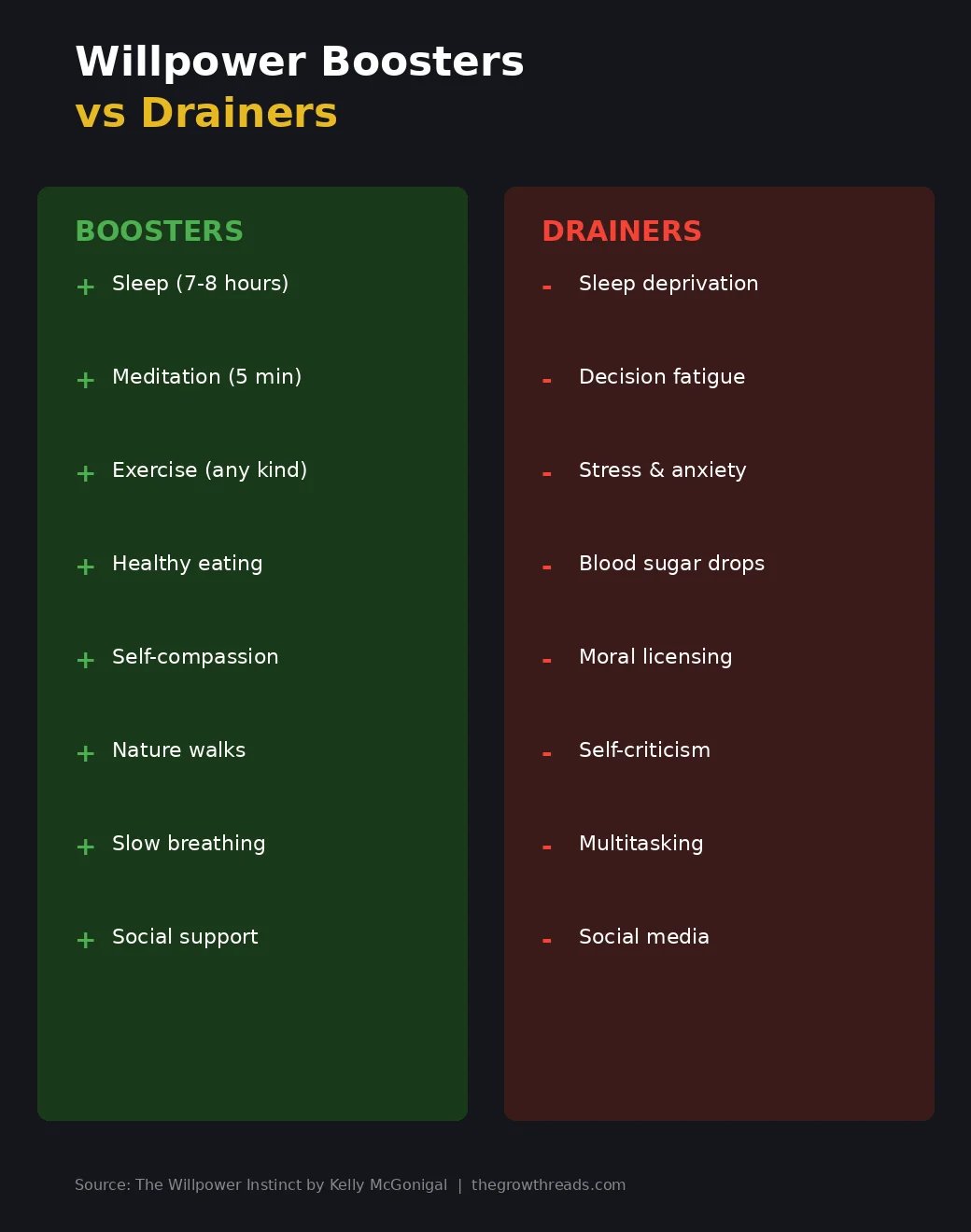
Finally, McGonigal presents evidence that willpower is contagious. Obesity, smoking cessation, and even happiness spread through social networks up to three degrees of separation. When your friend’s friend’s friend gains weight, your own risk of weight gain increases. The implication: your willpower environment includes the people around you, not just your physical surroundings. Joining a community of people who share your goals — whether a running group, a study circle, or an online accountability forum — measurably boosts your own self-control.
The book closes with “surfing the urge,” a mindfulness technique borrowed from addiction therapy. Instead of fighting a craving, you observe it: where do you feel it in your body? How intense is it on a scale of 1 to 10? What happens if you simply watch it without acting? In clinical trials, urge surfing has proven effective for smoking cessation, binge eating, and substance abuse. McGonigal argues it works for everyday temptations too — the key is accepting the urge without identifying with it.
Who is The Willpower Instinct best for — and who should read something else first?
This book is ideal for anyone who has tried to change a habit and failed — not because the advice was wrong, but because the underlying capacity for self-control was not there yet. If you have read Atomic Habits and implemented the systems but still find yourself overriding them, The Willpower Instinct fills the gap. It is also excellent for students, professionals facing decision fatigue, and anyone dealing with stress-driven indulgences.
If you are looking for a simpler, more tactical habit framework first, start with Tiny Habits by BJ Fogg. If your challenge is more about distraction than temptation, Deep Work by Cal Newport may be a better starting point. And if addiction or compulsive behaviour is the core issue, consider Dopamine Nation first.
Questions to reflect on
- Which of the three powers — I will, I won’t, or I want — is your biggest weakness right now? What specific situation triggers it?
- When was the last time you gave yourself “moral licence” to indulge after doing something good? What was the real cost?
- Think about a craving you experience regularly. Does satisfying it actually make you happier, or does it only promise happiness?
- How would your future self — ten years from now — feel about the choices you made this week? Would they thank you or wish you had chosen differently?
- Who in your social circle models the kind of self-control you want? How could you spend more time around them?
🔥 Ready to train your willpower like a muscle?
Get the full 10-week programme with all the willpower experiments.
How to apply The Willpower Instinct (7-day plan)
- Day 1 — Identify your three challenges: Write down one I will challenge (something you want to do more of), one I won’t challenge (something you want to stop), and one I want challenge (the long-term goal behind both). Post them where you will see them daily.
- Day 2 — Measure your pause-and-plan: Practice slow breathing (four to six breaths per minute) for five minutes. Notice how your body shifts from reactive to calm. Use this before any temptation moment today.
- Day 3 — Do a willpower workout: Choose one small act of discipline that is outside your normal routine — use your non-dominant hand for a task, sit up straight every time you notice yourself slouching, or say “yes” instead of “yeah.”
- Day 4 — Track your dopamine triggers: Every time you reach for your phone, open a snack, or browse a shopping site, pause and ask: “Am I seeking genuine satisfaction or just chasing the promise of reward?” Write down what you notice.
- Day 5 — Catch moral licensing: Watch for moments where you feel you “deserve” to indulge after doing something virtuous. When it happens, reconnect with the why behind your goal instead of treating it as a transaction.
- Day 6 — Practice self-compassion: If you slip on any of your challenges today, respond to yourself the way you would respond to a close friend who made the same mistake. Notice how this changes your next decision.
- Day 7 — Surf one urge: When a craving arises, set a timer for 10 minutes. Observe the urge without acting. Rate its intensity every two minutes. Notice how it peaks and fades on its own.
Frequently asked questions
Is The Willpower Instinct based on real science?
Yes. Kelly McGonigal is a Stanford psychologist who draws on peer-reviewed research in neuroscience, psychology, and behavioural economics throughout the book. Every major claim is supported by cited studies, from Baumeister’s ego depletion experiments to brain-imaging research on the prefrontal cortex. The book grew out of her Stanford course, which means the material was tested with real students and refined over several years before publication.
How long does it take to read The Willpower Instinct?
The book is 267 pages and takes most readers about six hours to finish. However, it is designed as a 10-week programme, with one chapter per week and willpower experiments to practice between chapters. Reading straight through is fine for understanding the concepts, but the real benefits come from spending a week with each chapter’s exercises.
What is the difference between The Willpower Instinct and Atomic Habits?
Atomic Habits by James Clear focuses on building habit systems — cue, craving, response, reward — so that good behaviours become automatic and require less willpower. The Willpower Instinct focuses on strengthening your raw capacity for self-control when habits alone are not enough. Think of Atomic Habits as the architecture and The Willpower Instinct as the foundation. You need both, and reading The Willpower Instinct first can actually make Atomic Habits more effective.
Does willpower really get depleted like a muscle?
This is one of the most debated questions in psychology. Baumeister’s original ego depletion studies have faced replication challenges, and some researchers argue the effect is smaller than initially claimed. McGonigal presents both sides and adds nuance: she argues that believing willpower is limited can itself become a self-fulfilling prophecy. Her practical approach treats depletion as real but trainable, which aligns with the strongest current evidence.
Can The Willpower Instinct help with addiction?
The book addresses addictive patterns, including the dopamine-driven reward cycle and urge surfing — a mindfulness technique used in clinical addiction treatment. For mild to moderate behavioural patterns like phone addiction, emotional eating, or compulsive shopping, the strategies are directly applicable. For serious substance addiction, the book provides useful context but should be used alongside professional treatment, not as a replacement.
What are the best willpower exercises from the book?
The top five exercises readers report as most effective are: slow breathing (four to six breaths per minute for five minutes), the five-minute meditation, the non-dominant hand challenge, the 10-minute urge surf, and future-self visualisation. McGonigal recommends trying one new exercise per week and keeping the ones that work. Most people find that two or three core practices, done consistently, create noticeable changes within a month.
Is The Willpower Instinct worth reading in 2026?
Despite being published in 2011, the book remains one of the most practical and well-researched guides to self-control available. The neuroscience has held up well, and more recent research has largely reinforced McGonigal’s core arguments about sleep, exercise, stress management, and self-compassion as willpower boosters. In an era of increasing digital distraction, the material is arguably more relevant now than when it was first published.
Related summaries
If you found this summary useful, you will also enjoy these related book reviews from The Growth Reads:
- Thinking, Fast and Slow Summary — Daniel Kahneman’s masterwork on the two systems that drive every decision you make
- Dopamine Nation Summary — Anna Lembke’s guide to finding balance in an age of overindulgence
- Flow Summary — Mihaly Csikszentmihalyi on the psychology of peak experience and optimal performance
- Best Psychology Books — Our full curated list of the most practical psychology books