

★★★★½ 4.5 / 5
One-liner: A Stanford behaviour scientist proves that lasting change does not require motivation or willpower — it requires making the new behaviour tiny, anchoring it to an existing routine, and celebrating immediately.
Best for: Anyone who has failed at habit change through willpower, people overwhelmed by ambitious goals, and readers who want the most research-backed habit framework available.
Reading time: ~6 hrs (guide: 24 min)
Difficulty to apply: Very Low (the entire point is making change easy)
Tiny Habits in one minute
Stop trying to motivate yourself — start making the behaviour so small you cannot fail. BJ Fogg, the founder of Stanford University’s Behavior Design Lab, has spent two decades studying why people change and why they do not. His conclusion dismantles the entire self-help industry’s obsession with motivation: behaviour happens when Motivation, Ability, and a Prompt converge (B = MAP), and the only variable you can reliably control is Ability — how easy the behaviour is to do. His method: (1) choose a behaviour you want, (2) make it tiny (two push-ups, not twenty; one sentence, not a chapter), (3) anchor it after an existing habit (“After I pour my coffee, I will…”), and (4) celebrate immediately to wire the positive emotion that turns repetition into automation. The result: a system for behaviour change that works precisely because it does not rely on the thing that always fails — willpower.
Key takeaways
- B = MAP is the universal behaviour model: Behaviour happens when Motivation, Ability, and a Prompt converge at the same moment. Remove any one element and the behaviour does not occur.
- Motivation is unreliable: Motivation fluctuates daily based on mood, energy, stress, and circumstances. Any system that depends on sustained high motivation will eventually fail.
- Ability is the master lever: The easier a behaviour is to do, the less motivation it requires. Making the behaviour tiny shifts the ability threshold so low that almost any level of motivation is sufficient.
- Start ridiculously small: Two push-ups, not twenty. One sentence, not a page. Floss one tooth, not all of them. The “tiny” version feels absurdly easy — that is the point. You can always do more, but you must always be willing to do only the tiny version.
- Anchor to an existing habit: The “After I…” recipe uses an established routine as the prompt for the new behaviour. This eliminates the need for reminders, alarms, or willpower — the existing habit triggers the new one automatically.
- Celebration is not optional — it is the mechanism: Positive emotion immediately after the behaviour is what wires the habit into neural circuitry. Without celebration, repetition produces compliance, not genuine automation.
- Habits grow naturally when rooted properly: A tiny habit that is well-anchored and celebrated will naturally expand over time. Two push-ups become five, then ten, then a full workout — not through forced escalation but through genuine wanting.
- Design, do not motivate: Instead of trying to psych yourself up, design the behaviour to fit your life: make it tiny, find the right anchor, remove friction, and celebrate. Behaviour design replaces motivation as the engine of change.
- You can change many behaviours simultaneously: Because tiny habits require almost no willpower, you can install multiple new habits at once — unlike traditional approaches that demand “one habit at a time.”
- Stop behaviours by redesigning, not resisting: To eliminate an unwanted habit, remove the prompt, increase the friction (make it harder), or replace it with a competing behaviour. Willpower-based resistance is the least effective strategy.
What is Tiny Habits about?
Tiny Habits presents the Fogg Behavior Model (B = MAP) and a practical system for creating lasting habits by making behaviours tiny, anchoring them to existing routines, and celebrating immediately. The book argues that motivation is unreliable and that behaviour design — not willpower — is the key to change.
About the author
BJ Fogg, PhD, is a behavioural scientist and the founder of the Behavior Design Lab at Stanford University, where he has taught and researched since 1998. His work on persuasive technology, behaviour change, and habit formation has influenced companies including Instagram (whose co-founders were his students), Google, and Apple. Fogg developed the Fogg Behavior Model (B = MAP) through two decades of academic research and has taught it to over 60,000 people through his free Tiny Habits programme. He is widely considered one of the most influential figures in behaviour design, and his framework has been adopted by health systems, education programmes, and product teams worldwide. Explore all BJ Fogg book summaries →
Key concepts at a glance
| Concept | What it means | Use it when |
|---|---|---|
| B = MAP | Behaviour = Motivation × Ability × Prompt — all three must converge | You want to understand why a behaviour is or is not happening |
| Tiny behaviour | The smallest possible version of the habit — so small you cannot fail | You struggle with consistency or feel overwhelmed |
| Anchor moment | An existing habit that serves as the prompt for the new behaviour | You need a reliable cue that requires no willpower |
| Celebration | A positive emotion generated immediately after the behaviour | You want to wire the habit into neural circuitry |
| Shine | The feeling of success and positivity that celebration produces | You want to understand why celebration works |
| Behaviour crafting | Designing behaviours to fit your life rather than forcing your life to fit behaviours | You have tried willpower-based approaches and failed |
| Pearl habits | Tiny habits that grew naturally into larger, meaningful practices | You want proof that starting small leads to big change |
Part 1 — The behaviour model
Fogg opens with the model that took him two decades to refine: B = MAP. Behaviour (B) happens when three elements converge at the same moment: Motivation (M), the desire to do the behaviour; Ability (A), how easy it is to do; and Prompt (P), the cue that triggers action. If any element is missing, the behaviour does not occur. You might be highly motivated to exercise (M is high) and physically capable (A is fine), but if nothing prompts you at the right moment (P is absent), you will not do it.
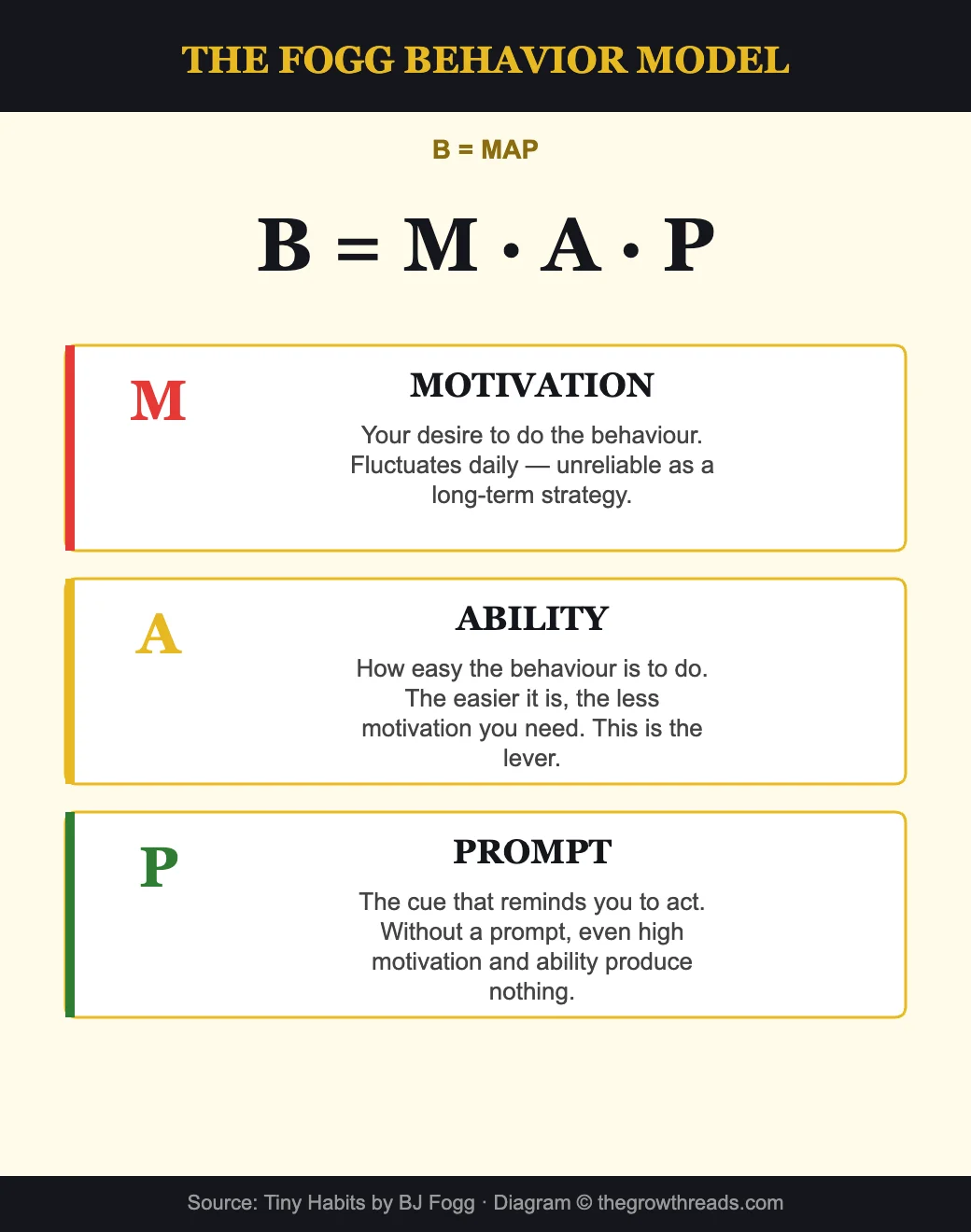
The critical insight is about which lever to pull. Most people (and most self-help books) focus on motivation: get inspired, find your why, pump yourself up. Fogg shows that motivation is the least reliable variable — it fluctuates with mood, energy, sleep, stress, and a hundred other factors. What you can reliably control is ability: how easy the behaviour is to perform. If you make the behaviour tiny enough — two push-ups instead of twenty, one deep breath instead of twenty minutes of meditation — the required motivation drops so low that almost any emotional state is sufficient to complete it. This is the paradigm shift: stop trying to boost motivation and start reducing the difficulty.
The prompt component explains a common mystery: why do you sometimes have both the motivation and the ability to do something but still do not do it? Because nothing triggered the behaviour at the right moment. Fogg’s solution is the “anchor moment” — an existing habit that serves as the prompt for the new one. “After I pour my morning coffee, I will write one sentence in my journal.” The coffee-pouring is something you already do every day without thinking; anchoring the new behaviour to it creates an automatic trigger that requires no willpower, no alarm, and no sticky note.
Part 2 — The Tiny Habits method
The practical system follows a three-step recipe: After I [anchor moment], I will [tiny behaviour]. Then: celebrate immediately. The anchor is an existing habit — something you do every day without conscious effort. The tiny behaviour is the smallest version of the habit you want: not the full version, not even a reasonable version, but the version that takes less than 30 seconds and requires near-zero effort.
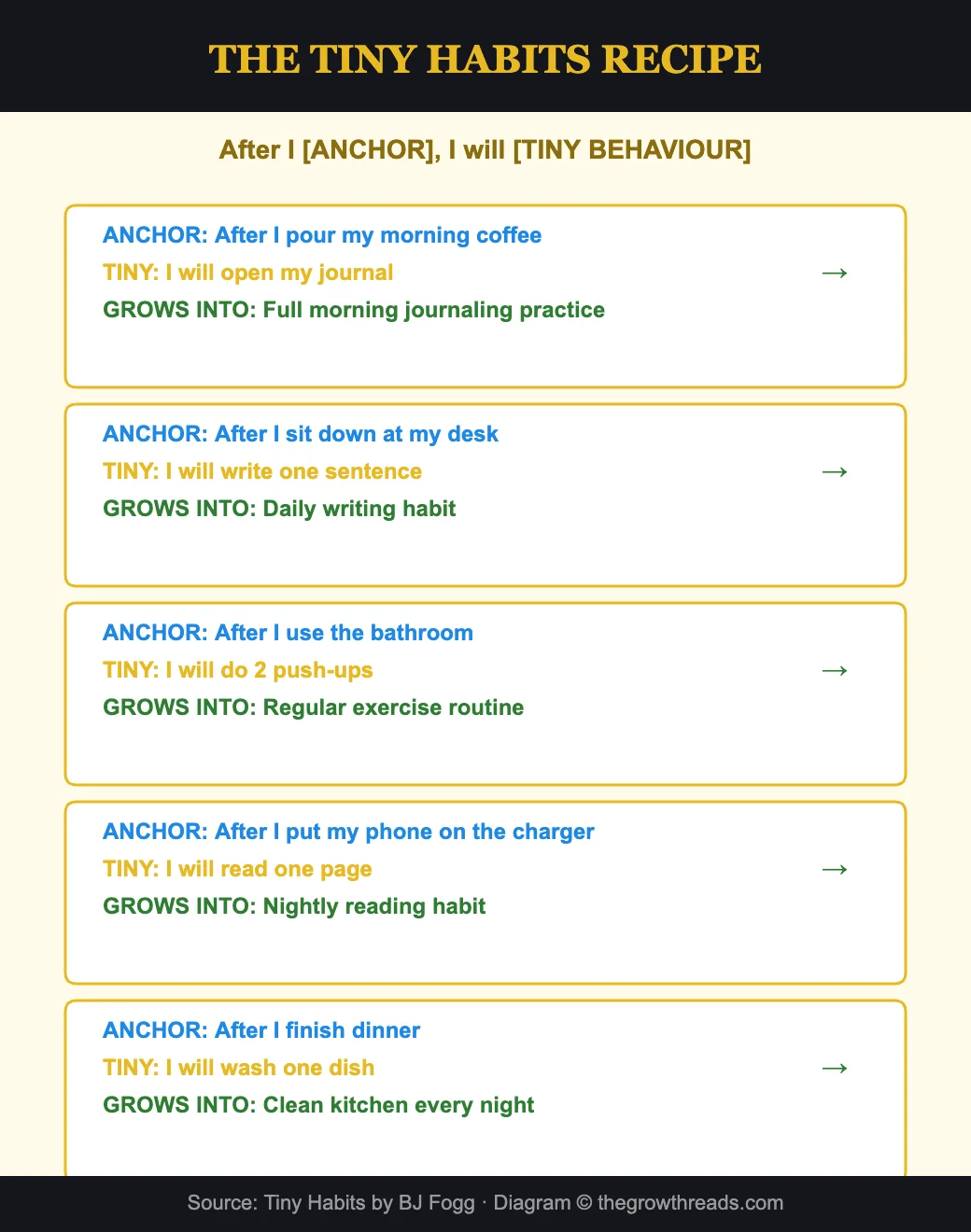
Fogg shares dozens of examples from the over 60,000 people who have completed his programme. “After I use the bathroom, I will do two push-ups.” “After I put my phone on the charger at night, I will read one page.” “After I sit down at my desk in the morning, I will write one sentence.” The absurd simplicity is deliberate: anyone can do two push-ups. Anyone can read one page. The behaviour is so easy that the concept of “not being in the mood” becomes irrelevant — and that is exactly the point. Once the tiny version is automatic, it naturally grows: two push-ups become five, then ten, then a full bodyweight routine — not because you forced it, but because the habit’s momentum carried you.
Fogg calls these naturally expanded habits “pearl habits” — like a pearl that forms around a tiny grain of sand, the full practice grows around the tiny seed. He is emphatic: do not force the growth. Do not scale up on a schedule. Let the natural expansion happen. If you only do two push-ups today, that is a success. If you end up doing twenty because you felt like it, also a success. The tiny version is always the baseline — you can do more, but you must always be willing to do only the minimum. This removes the all-or-nothing thinking that derails most habit attempts.
Part 3 — Celebration and emotion
The celebration chapter is the book’s most surprising and most important contribution. Fogg argues — with neuroscience backing — that it is not repetition that creates habits but positive emotion. When you feel good immediately after a behaviour, your brain tags that behaviour as worth repeating. When you feel neutral or negative, the behaviour does not wire in, no matter how many times you repeat it. This is why gym habits built on guilt and willpower rarely stick: even if you go every day for a month, the negative emotion (“I should go, I have to go, ugh”) prevents genuine automation.
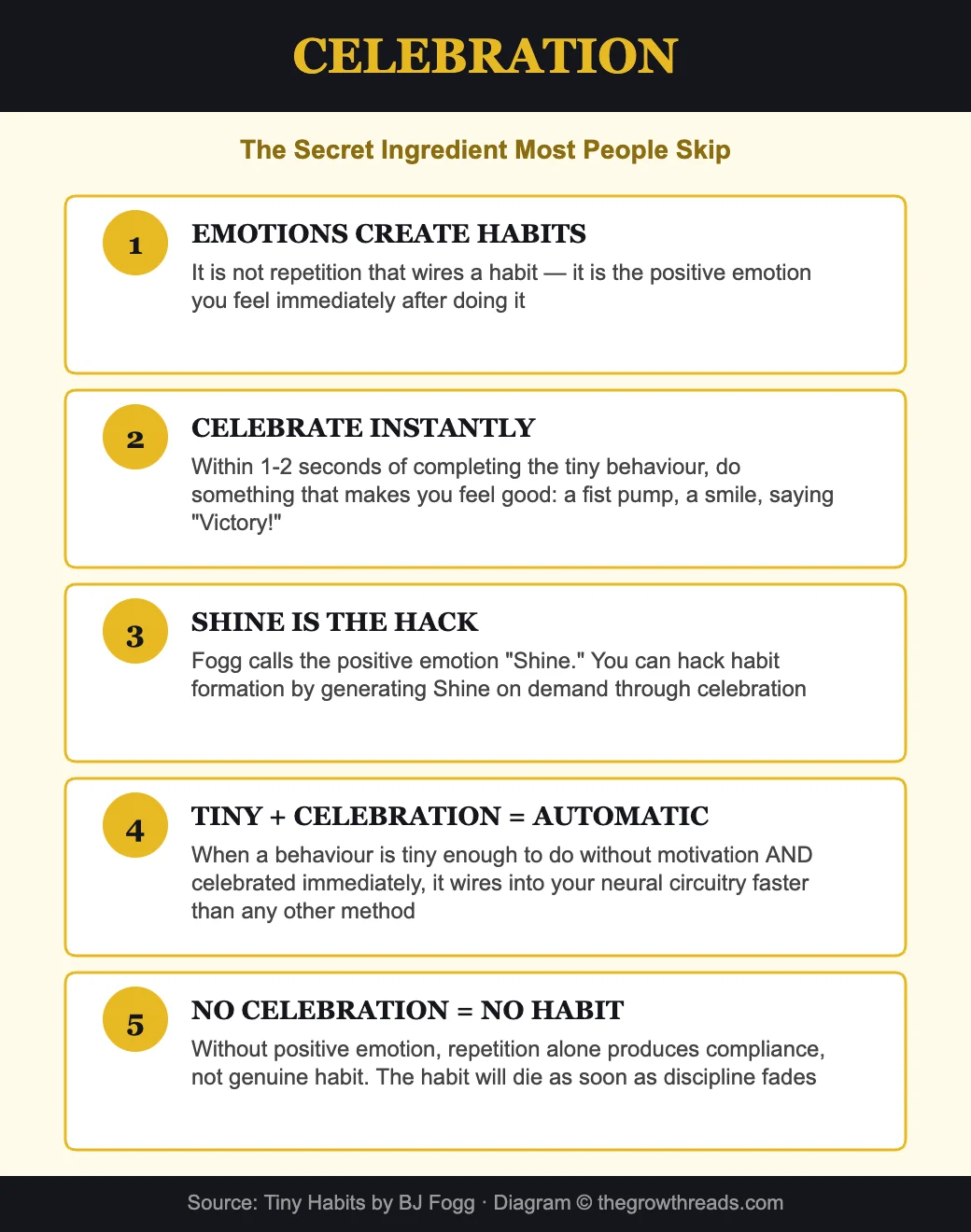
Fogg’s term for the positive emotion is “Shine” — a burst of feeling successful, proud, or happy that you generate deliberately after each tiny behaviour. The celebration can be anything that creates genuine positive feeling: a fist pump, saying “Victory!” out loud, doing a little dance, smiling at yourself in the mirror, or simply feeling a warm inner glow of accomplishment. The key is immediacy — the celebration must happen within 1–2 seconds of the behaviour, not at the end of the day. The timing allows the brain to associate the positive emotion with the specific behaviour rather than with something else.
This insight resolves one of the oldest puzzles in habit science: why do some behaviours wire in after just a few repetitions while others require months of grinding? The answer is emotion. Behaviours accompanied by strong positive emotion (your first kiss, scoring a goal, nailing a presentation) wire in almost instantly. Behaviours accompanied by neutral or negative emotion (filing taxes, cleaning the bathroom) never fully automate no matter how many times you do them. Celebration hacks this mechanism: by generating Shine on demand after every tiny behaviour, you can wire any behaviour into your neural circuitry at the speed that emotional memory allows.
Who is Tiny Habits best for — and who should read something else first?
This is the best book for anyone who has tried and failed at habit change — especially people who blame themselves for lacking willpower. Fogg’s framework is compassionate, practical, and designed specifically for people who are tired of white-knuckling their way through behaviour change. It is also excellent for parents, teachers, and managers who want to help others build habits without relying on external rewards or punishment.
If you want the broader habit science (including breaking bad habits and building identity), Atomic Habits covers more territory. If you are interested in the neuroscience of habit loops, The Power of Habit goes deeper on the brain mechanisms. But if you want the simplest, most immediately applicable system for creating new habits — start here. Fogg’s method can be implemented in literally five minutes.
Questions to reflect on
- Which habits have you tried to build through motivation alone — and how did that work out?
- If you made your desired habit tiny enough that you could do it even on your worst day, what would it look like?
- What existing habit could serve as the perfect anchor moment for the change you want to make?
- When was the last time you celebrated a small win — and how did that celebration affect your motivation?
- How would your approach to change shift if you stopped blaming yourself for lacking willpower and started designing for ease instead?
🔥 Ready to change your life two push-ups at a time?
Learn the only habit system that works precisely because it does not rely on willpower.
How to apply Tiny Habits (7-day plan)
- Day 1 — Choose your aspiration: Pick one area where you want to change (fitness, writing, mindfulness, nutrition). Write down your “golden behaviour” — the specific habit that would make the biggest difference.
- Day 2 — Make it tiny: Reduce your golden behaviour to its tiniest version — so small it takes under 30 seconds. “Exercise daily” becomes “do 2 push-ups.” “Meditate” becomes “take 3 deep breaths.” If it feels too easy, you have nailed it.
- Day 3 — Find your anchor: Identify an existing habit that happens reliably every day and fits naturally before your tiny behaviour. Complete the recipe: “After I [anchor], I will [tiny behaviour].” Write it down.
- Day 4 — Add celebration: After completing your tiny behaviour, celebrate immediately — within 1-2 seconds. Try a fist pump, a quiet “yes!”, a smile, or whatever makes you feel a genuine spark of positivity. This is the wiring mechanism.
- Day 5 — Run the recipe 3 times: Do your complete Tiny Habit recipe (anchor → tiny behaviour → celebrate) three times today — once for real, and twice as mental rehearsal. The rehearsal strengthens the neural pathway.
- Day 6 — Add a second tiny habit: Choose a different area and create a second recipe. You can run multiple tiny habits simultaneously because each one requires almost no willpower. Stack them at different anchor points throughout your day.
- Day 7 — Reflect and adjust: Which anchor felt most natural? Did the celebration generate genuine Shine? Did you naturally do more than the tiny version? Adjust any element that felt forced. The recipe should feel easy, not effortful.
Frequently asked questions
How is Tiny Habits different from Atomic Habits?
Both books address habit formation but from different angles. Tiny Habits focuses narrowly on creating new habits through the B = MAP model, the anchor-behaviour-celebration recipe, and the emphasis on making behaviours tiny. Atomic Habits covers a broader range: building good habits, breaking bad habits, identity-based change, and the compounding effects of small improvements. Fogg’s approach is more immediately actionable (you can start in five minutes); Clear’s is more comprehensive. Most readers benefit from both: start with Fogg for the simplest system, then read Clear for the broader framework.
Does making a habit tiny actually lead to doing more?
Yes, consistently. Fogg calls the naturally expanded habits “pearl habits.” The data from over 60,000 participants shows that people who start with two push-ups typically expand to a full exercise routine within weeks — not because they force themselves but because the momentum and positive emotion carry them. The tiny version is the seed; the full practice is the plant. Crucially, on bad days you only do the tiny version, which preserves the streak and prevents the all-or-nothing collapse that destroys most habit attempts.
Why is celebration so important?
Neuroscience shows that positive emotion is what wires behaviours into habit circuits — not repetition alone. When you feel good immediately after a behaviour, your brain releases dopamine and tags the behaviour as “worth repeating.” Without positive emotion, you may repeat the behaviour through discipline for weeks or months, but it never fully automates — and it collapses as soon as discipline wavers. Celebration hacks this process by generating positive emotion on demand, allowing any behaviour to wire in at the speed of emotional memory.
Can I use Tiny Habits to break bad habits?
Fogg addresses this but it is not the book’s primary focus. His approach to stopping behaviours uses the same B = MAP model in reverse: remove the prompt (make the cue invisible), increase the friction (make the behaviour harder to do), or reduce the motivation (reframe the behaviour’s appeal). He also recommends replacing the unwanted habit with a competing behaviour using the Tiny Habits recipe. For a more thorough treatment of breaking bad habits, pair this with Atomic Habits, which devotes equal attention to building and breaking.
Is this scientifically rigorous?
Yes. The Fogg Behavior Model is based on two decades of research at Stanford University and has been tested with over 60,000 participants in the Tiny Habits programme. The model’s components — motivation, ability, and prompts — are individually supported by extensive research in behavioural psychology. The celebration mechanism draws on established dopamine and reward-learning neuroscience. Fogg publishes in peer-reviewed journals and the model has been adopted by health systems, technology companies, and educational institutions. It is among the most empirically grounded habit frameworks available.
Can I install multiple tiny habits at once?
Yes — and this is one of the method’s distinctive advantages over traditional habit advice. Because each tiny habit requires near-zero willpower (it is tiny, prompted by an existing habit, and celebrated), you can run several simultaneously without overwhelming yourself. Fogg recommends starting with three tiny habits anchored to different parts of your day (morning, midday, evening). As each one becomes automatic, you can add more. Traditional “one habit at a time” advice exists because conventional habit-building requires significant willpower; Fogg’s method sidesteps this limitation.
What if the celebration feels awkward or fake?
This is the most common early objection, and Fogg addresses it directly. The celebration does not need to be dramatic — it just needs to generate genuine positive emotion. For some people, a fist pump works. For others, a quiet inner smile or a whispered “nice” is more natural. The key is finding YOUR authentic celebration — the one that produces a real spark of positivity, however small. Fogg suggests experimenting with different celebrations and keeping the one that produces the most natural Shine. It often feels awkward for the first few days and then becomes automatic.
Related summaries
- Atomic Habits by James Clear — The broader habit framework covering building, breaking, and identity-based change.
- The Power of Habit by Charles Duhigg — The neuroscience of habit loops: cue, routine, reward.
- Deep Work by Cal Newport — Building the focus habits that produce your most valuable output.
- The Compound Effect by Darren Hardy — How small, consistent actions produce extraordinary results over time.
- See all Productivity book summaries on our Best Productivity Books pillar page.