

★★★★✬ 4.5/5 — A paradigm-shifting exploration of why good people disagree so fiercely about politics, religion, and morality — grounded in evolutionary psychology and social intuition.
Best for: Anyone who wants to understand why moral and political disagreements feel so intractable — and how to have more productive conversations across divides.
Reading time: ~10 hours (448 pages)
Difficulty to apply: Medium — the frameworks are intellectually demanding but immediately useful in everyday disagreements.
The Righteous Mind in one minute
You do not reason your way to moral conclusions — you feel them first and then construct justifications afterward. Jonathan Haidt draws on two decades of moral psychology research to reveal three principles that explain why good people are divided by politics and religion. First, intuitions come first and strategic reasoning second — the rational mind is not the pilot but the press secretary. Second, morality is broader than harm and fairness — humans evolved at least six moral foundations, and different cultures and political groups weight them differently. Third, morality binds us into groups and blinds us to the perspectives of outsiders. Understanding these principles does not tell you who is right, but it transforms how you engage with people who disagree with you.
Key takeaways
- Intuitions come first, reasoning second: Moral judgments are made instantly by emotional intuition. Conscious reasoning comes afterward to justify what the gut already decided.
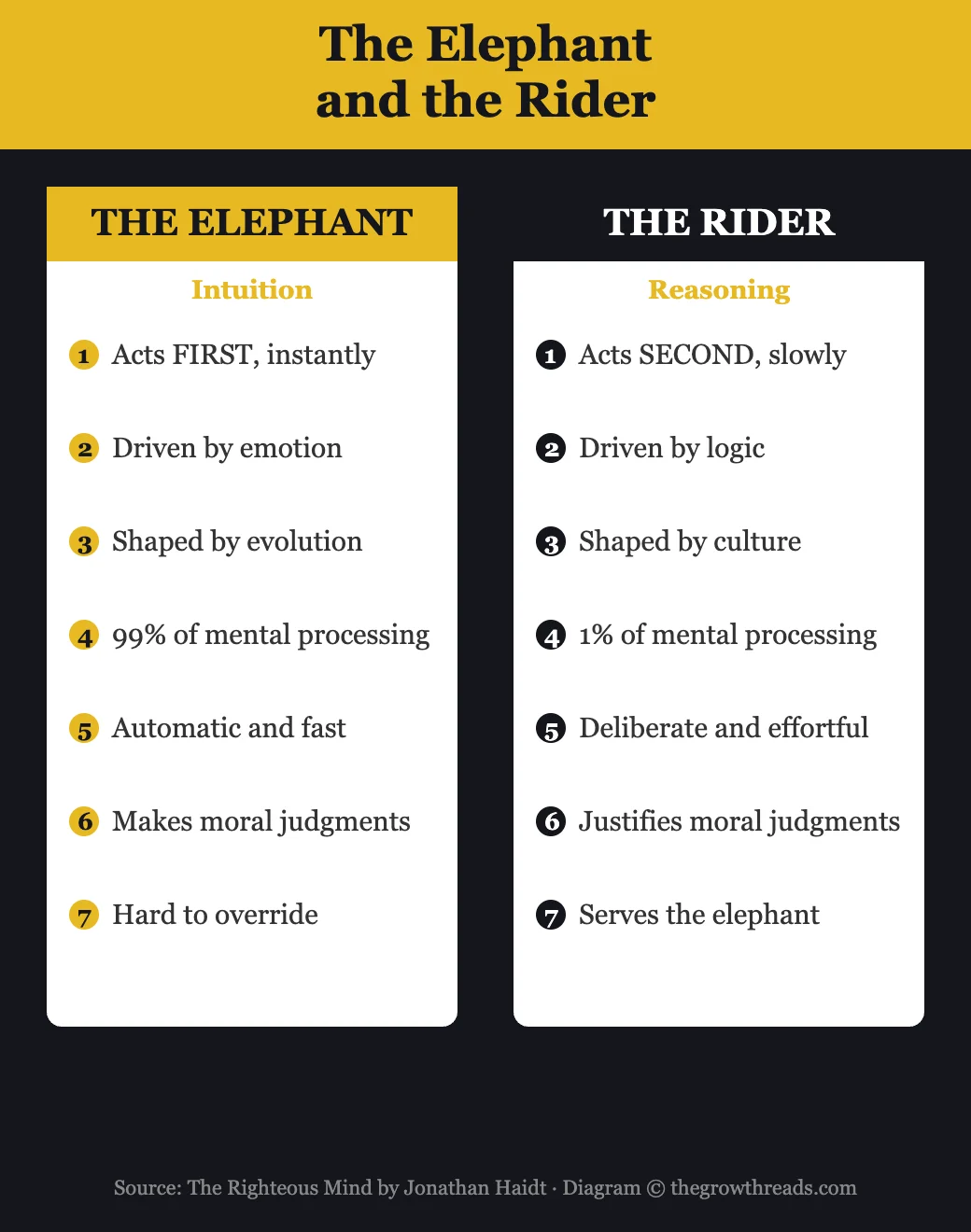
- The elephant and the rider: Haidt uses this metaphor to describe the relationship between automatic processes (the elephant) and controlled reasoning (the rider). The rider serves the elephant, not the other way around.
- Moral dumbfounding is real: People often cannot explain why they believe something is wrong — they just know it is. When pressed, they confabulate reasons rather than change their judgment.
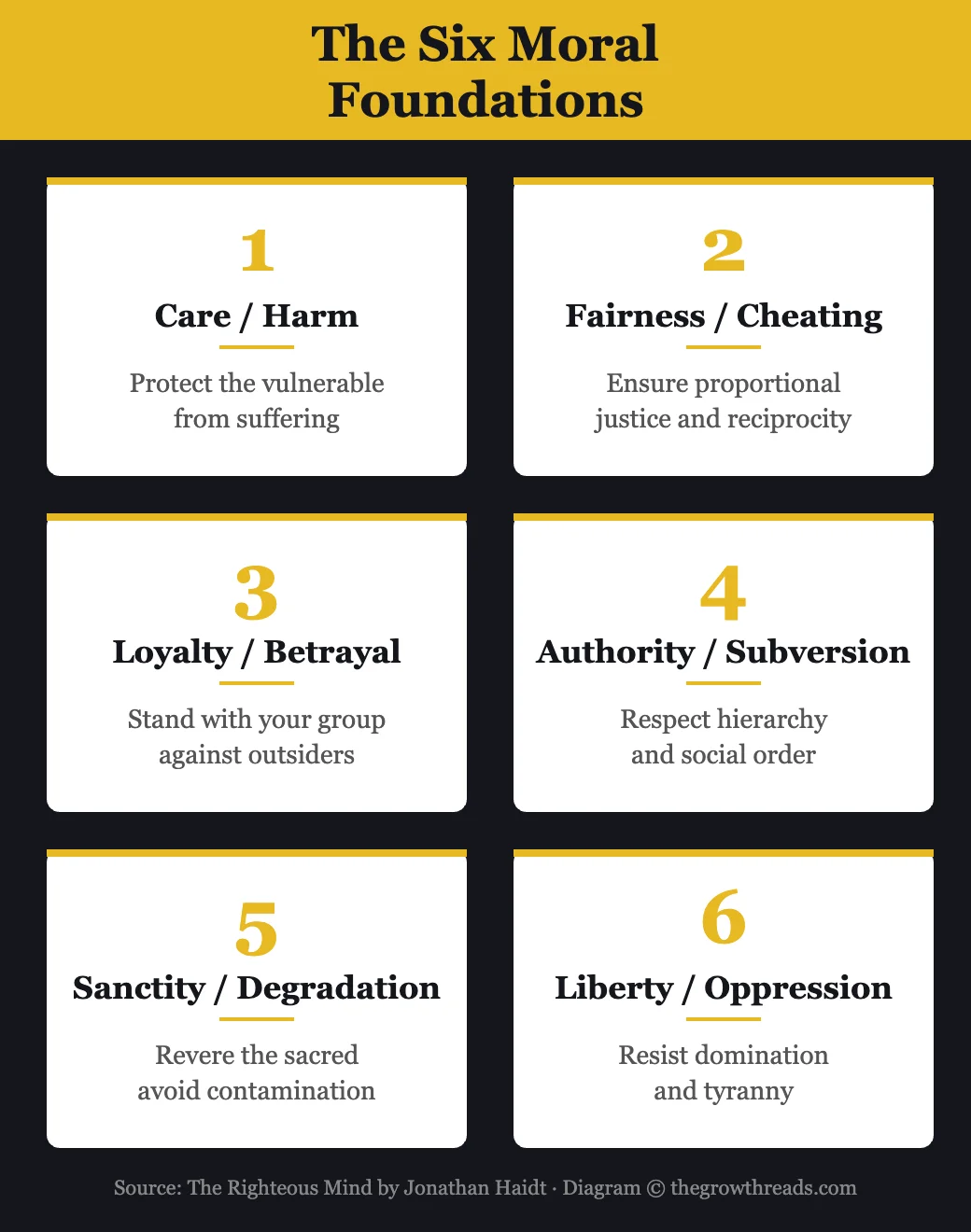
- There are six moral foundations: Care/Harm, Fairness/Cheating, Loyalty/Betrayal, Authority/Subversion, Sanctity/Degradation, and Liberty/Oppression. All human moralities draw from these foundations.
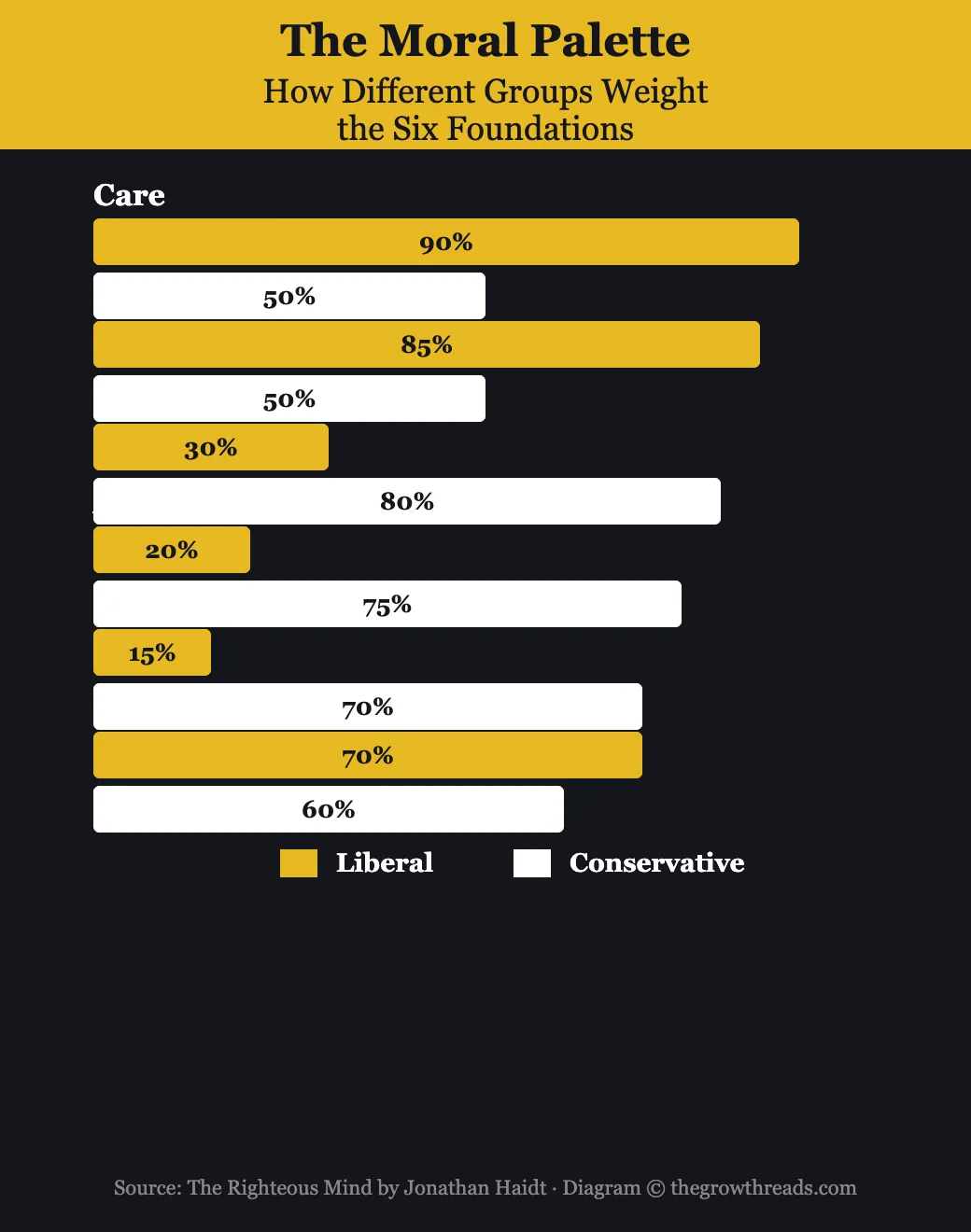
- Political differences are moral differences: Liberals rely heavily on Care and Fairness. Conservatives draw more evenly from all six foundations. Neither is irrational — they are prioritising different values.
- Morality binds and blinds: Shared moral frameworks create trust and cooperation within groups but make it nearly impossible to understand outsiders without deliberate effort.
- Moral matrices are like cuisines: Each culture develops its own distinctive blend of moral foundations, just as each cuisine combines basic tastes differently. No single blend is objectively correct.
- Reason alone cannot settle moral debates: Because moral intuitions are primary, presenting logical arguments rarely changes minds. Changing the intuition is what shifts beliefs.
- Groupishness is part of human nature: Humans evolved the capacity for intense group loyalty through cultural group selection. We are 90% chimp and 10% bee.
- Understanding is not agreeing: Seeing the moral logic behind views you oppose does not require endorsing those views — but it does make productive dialogue possible.
What is The Righteous Mind about?
The Righteous Mind presents a comprehensive theory of moral psychology built on three principles: moral intuitions precede reasoning, morality extends beyond harm and fairness to include loyalty, authority, sanctity, and liberty, and these moral foundations bind people into tribes while blinding them to opposing perspectives. Haidt uses this framework to explain political polarisation.
About the author
Jonathan Haidt is a social psychologist at New York University’s Stern School of Business, where he studies moral psychology, business ethics, and political polarisation. He spent sixteen years at the University of Virginia before moving to NYU. His research on moral foundations theory has been cited over 100,000 times. Haidt is also the co-author of The Coddling of the American Mind and the author of The Happiness Hypothesis and The Anxious Generation. He co-founded the Heterodox Academy, which promotes viewpoint diversity in universities, and the website YourMorals.org, which has collected moral foundations data from over 300,000 people worldwide. Explore all Jonathan Haidt book summaries →
Key concepts at a glance
| Concept | What it means | Use it when |
|---|---|---|
| Social intuitionism | Moral judgments arise from gut feelings, not deliberate reasoning | You want to understand why arguments rarely change minds |
| The elephant and the rider | Intuition (elephant) leads; reasoning (rider) follows and justifies | You notice yourself rationalising a position you already hold |
| Moral foundations | Six evolved psychological systems that generate moral intuitions | You want to decode why someone holds a view you find baffling |
| Moral matrix | A culture’s particular weighting of the six foundations | You encounter a moral system very different from your own |
| WEIRD morality | Western, Educated, Industrialised, Rich, Democratic societies emphasise autonomy | You assume your moral intuitions are universal |
| Groupish righteousness | Humans evolved to form cohesive moral communities | You see tribalism intensifying in politics or organisations |
| Hive switch | Experiences that dissolve the self into the group (ritual, dance, war) | You want to understand collective effervescence or team bonding |
| Moral capital | The shared norms, practices, and institutions that enable cooperation | You evaluate whether a proposed change might weaken social trust |
Part 1: Intuitions come first, strategic reasoning second
Haidt opens with a thought experiment that has become famous in moral psychology: a brother and sister decide to have consensual, protected sex during a holiday abroad. No one is harmed, no pregnancy results, and they never do it again. Most people instantly feel this is wrong — but when pressed to explain why, they struggle. They raise objections (genetic risks, emotional damage) that the scenario has already ruled out, yet they refuse to change their judgment. Haidt calls this moral dumbfounding, and it reveals something fundamental about how morality actually works.
Drawing on nearly two decades of experimental research, Haidt proposes the social intuitionist model of moral judgment. The model reverses the standard Western assumption — inherited from Plato and codified by Kant and Kohlberg — that reasoning drives moral conclusions. Instead, Haidt shows that moral judgments are made instantly by automatic, emotional processes. Conscious reasoning arrives afterward, acting not as a judge weighing evidence but as a lawyer building a case for a verdict already reached. He captures this with the metaphor of the elephant and the rider: the elephant is the vast, powerful set of automatic processes that make snap moral judgments; the rider is the small, conscious reasoning faculty that sits atop the elephant and serves as its press secretary, crafting post-hoc justifications.
The evidence for this model is extensive. Brain imaging studies show that moral judgments activate emotional processing areas milliseconds before reasoning areas engage. Patients with damage to the ventromedial prefrontal cortex — which integrates emotion into decision-making — can reason perfectly well but make catastrophically poor moral and social judgments. And in experimental settings, people can be induced to change their moral judgments by manipulating emotions (through hypnotic disgust cues, for example) without changing any of the relevant facts.
Part 2: There is more to morality than harm and fairness
Haidt’s second major insight is that Western moral philosophy has been operating with a dramatically incomplete map. Since at least the Enlightenment, Western thinkers have focused almost exclusively on two moral concerns: preventing harm and ensuring fairness. Haidt calls this the “WEIRD” bias — Western, Educated, Industrialised, Rich, and Democratic societies represent a tiny fraction of human moral diversity, yet their moral intuitions have been treated as universal.
Through cross-cultural fieldwork in India, Brazil, and the American South, Haidt discovered that most of the world’s moral systems care deeply about concerns that WEIRD morality ignores or actively rejects: loyalty to the group, respect for authority and tradition, and the sanctity of the body and sacred objects. A Brahmin in India who feels moral disgust at eating beef is not being irrational or primitive — he is drawing on a moral foundation (Sanctity) that is just as psychologically real as the Care foundation a secular Westerner draws on when condemning child abuse.
This research led to Moral Foundations Theory, which identifies six evolved psychological systems that generate moral intuitions across cultures: Care/Harm (protecting the vulnerable), Fairness/Cheating (ensuring proportional justice), Loyalty/Betrayal (standing with your group), Authority/Subversion (respecting hierarchy), Sanctity/Degradation (treating things as sacred), and Liberty/Oppression (resisting domination). Every human society uses these foundations, but different cultures — and different political orientations — weight them differently, like a chef combining the same basic ingredients into radically different dishes.
Part 3: Morality binds and blinds
The book’s third section explains why moral communities form — and why they so often fail to understand each other. Haidt argues that humans evolved a capacity for what he calls groupishness: the ability to transcend self-interest and merge identity with a group. He uses the metaphor of being “90% chimp and 10% bee” — most of the time we are competitive individuals pursuing our own interests, but under certain conditions we flip a “hive switch” and become capable of intense group loyalty, self-sacrifice, and collective action.
The hive switch can be triggered by synchronised movement (marching, dancing), shared rituals, collective threat, or psychedelic experiences. When activated, it produces what Durkheim called collective effervescence — the feeling of being part of something larger than yourself. This capacity is the evolutionary foundation of religion, patriotism, team spirit, and political movements. It is also, Haidt argues, the foundation of morality itself: shared moral frameworks create the trust and cooperation that allow groups to outcompete other groups.
But groupishness comes with a severe cost. The same moral matrices that bind people within a group blind them to the moral logic of outsiders. When your moral community tells you that loyalty and authority matter, and another community insists that only care and fairness matter, neither side can hear the other — not because either is stupid or evil, but because they are listening on different moral frequencies. This is why political polarisation feels so intractable: each side is genuinely moral, but operating from a different subset of the moral foundations.
Who is The Righteous Mind best for — and who should read something else first?
The Righteous Mind is essential reading for anyone who finds themselves bewildered or outraged by the moral views of people on the other side of political, cultural, or religious divides. It is particularly valuable for leaders, educators, and anyone in a role that requires bridging ideological gaps. If you primarily want practical communication techniques rather than deep psychological theory, start with Crucial Conversations or Nonviolent Communication. If you want a broader overview of cognitive biases before diving into moral psychology, begin with Thinking, Fast and Slow.
Questions to reflect on
- Which of the six moral foundations do you personally weight most heavily — and which do you tend to dismiss?
- Can you recall a time when you formed a moral judgment instantly and then searched for reasons to support it?
- When you encounter a political or cultural view that disgusts you, can you identify which moral foundation the other person is drawing on?
- How has being part of a moral community (political, religious, professional) both enriched and narrowed your perspective?
- If moral intuitions come first and reasoning follows, what does that mean for how you try to persuade others?
🔥 Ready to understand why good people disagree?
The Righteous Mind will permanently change how you see moral and political conflict.
How to apply The Righteous Mind (7-day plan)
- Day 1 — Take the moral foundations quiz: Visit YourMorals.org and complete the Moral Foundations Questionnaire. Note which foundations score highest and lowest for you — this is your moral profile.
- Day 2 — Catch your elephant: Throughout the day, notice moments when you form an instant moral reaction. Before constructing reasons, pause and acknowledge: this is my elephant speaking.
- Day 3 — Steelman an opposing view: Choose a political or social position you disagree with. Identify which moral foundations its advocates are drawing on and construct the strongest possible case for their position.
- Day 4 — Listen for foundations in conversation: In discussions today, listen for which moral foundations people invoke. Notice when someone appeals to loyalty, authority, or sanctity rather than care or fairness.
- Day 5 — Speak to the elephant: In a conversation where you want to persuade someone, lead with a story or example that connects to their moral foundations, not yours. Address their intuition before their reasoning.
- Day 6 — Examine your moral tribe: Identify the group whose moral matrix you share most closely. List three ways this membership helps you and three ways it might blind you to legitimate concerns from outsiders.
- Day 7 — Build a cross-cutting relationship: Reach out to someone whose moral or political worldview differs from yours. Ask genuine questions about what they value most — with the goal of understanding, not converting.
Frequently asked questions
Does The Righteous Mind say all moral views are equally valid?
No. Haidt’s framework is descriptive, not prescriptive — it explains why people hold the moral views they do, not which views are correct. He argues that understanding the psychological origins of opposing views is necessary for productive dialogue, but understanding is not the same as endorsing. The book gives you tools to evaluate moral claims more thoughtfully by recognising the foundations they rest on, which is different from claiming every moral position is equally defensible.
Is Haidt politically biased?
Haidt identifies as a liberal who came to appreciate conservative moral logic through his research. He has been criticised by some on the left for being too sympathetic to conservative moral foundations, and by some on the right for being a liberal academic. His stated goal is not to declare a winner but to help each side understand the other. He argues that both liberal and conservative moral matrices contain genuine moral insights and genuine blind spots, and that healthy societies need the tension between them.
How does Moral Foundations Theory relate to the Big Five personality traits?
Haidt shows that moral foundations correlate with personality traits. People high in openness to experience tend to weight Care and Fairness most heavily, while people high in conscientiousness tend to draw more evenly from all six foundations, including Loyalty, Authority, and Sanctity. This suggests that political orientation is partially rooted in stable personality differences, not just in different information or reasoning quality — which explains why moral debates so rarely result in conversion.
What is the hive switch?
The hive switch is Haidt’s term for the psychological mechanism that allows humans to temporarily transcend self-interest and merge with a group. It can be triggered by synchronised movement, shared rituals, psychedelics, or collective threat. When activated, people experience what Durkheim called collective effervescence — the feeling of being part of something larger than the self. Haidt argues this capacity evolved through cultural group selection and underlies religion, patriotism, and team cohesion.
Can you change someone’s moral intuitions?
Not through argument alone — Haidt’s central point is that reasoning follows intuition, not the other way around. However, intuitions can shift through relationship, experience, and narrative. If you want to move someone’s moral intuition, you are more likely to succeed by telling a compelling story that activates their existing moral foundations than by presenting logical arguments that address your own. Friendship across moral divides is the most reliable intuition-shifter Haidt identifies.
How does The Righteous Mind compare to Thinking, Fast and Slow?
Both books describe dual-process psychology — fast, automatic thinking versus slow, deliberate reasoning. Kahneman focuses on cognitive biases in judgment and decision-making across domains including economics, medicine, and statistics. Haidt narrows the lens to moral judgment specifically, showing that the automatic system is not just error-prone but is actually the primary engine of morality. Where Kahneman emphasises how System 1 leads us astray, Haidt argues that moral intuitions are often wise — they encode evolved solutions to social problems.
Is The Righteous Mind relevant outside of politics?
Absolutely. The frameworks apply to any domain where people with different values clash: workplace culture, family disagreements, religious communities, education policy, and cross-cultural collaboration. Understanding that your colleague who insists on following established procedures is drawing on the Authority foundation — not being obstinate — changes how you approach the conversation. The book is widely used in business schools, conflict resolution programs, and diversity training precisely because moral foundations theory extends far beyond electoral politics.
Related summaries
- Thinking, Fast and Slow by Daniel Kahneman — The foundational text on dual-process psychology that Haidt builds upon.
- Crucial Conversations by Kerry Patterson — Practical tools for navigating high-stakes conversations across moral divides.
- Influence by Robert Cialdini — How psychological triggers shape persuasion and compliance.
- The Laws of Human Nature by Robert Greene — A broader exploration of the forces driving human behaviour.
📚 Explore more in our Best Psychology Books guide.