

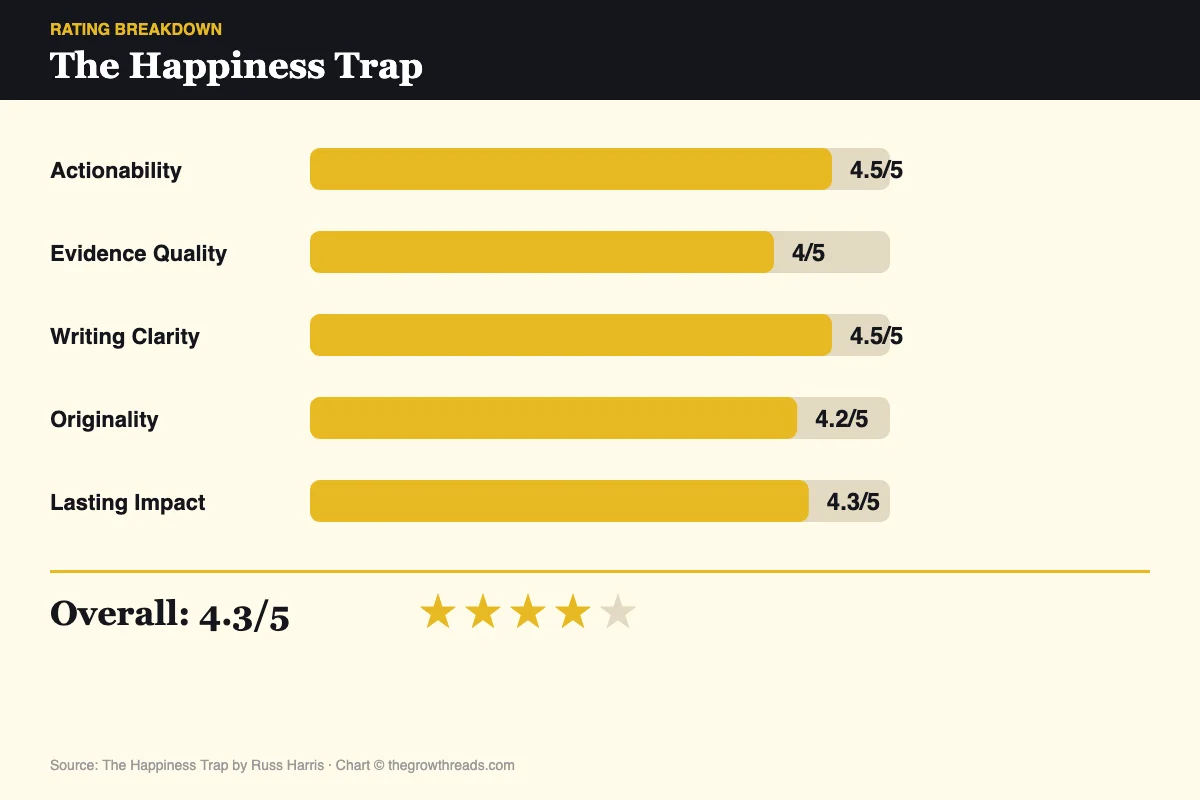
⭐⭐⭐⭐ 4.3/5 — A practical, science-backed guide to Acceptance and Commitment Therapy that replaces the exhausting pursuit of positive feelings with genuine psychological flexibility.
Actionability: 4.5/5 · Evidence Quality: 4.0/5 · Writing Clarity: 4.5/5 · Originality: 4.2/5 · Lasting Impact: 4.3/5
Best for: Overthinkers, chronic worriers, perfectionists, and anyone who has tried positive thinking but still feels stuck.
Reading time: ~6 hours (272 pages, 2nd edition)
Difficulty to apply: Moderate — the concepts are simple but require consistent practice over 4–8 weeks to rewire habitual responses.
The Happiness Trap in one minute
The relentless pursuit of happiness is itself the thing making you miserable. Russ Harris, drawing on the clinical framework of Acceptance and Commitment Therapy (ACT), argues that the Western obsession with feeling good creates a vicious trap: the more aggressively you try to eliminate negative emotions, the more power they gain over your life. The alternative is not resignation — it is psychological flexibility. Learn to observe difficult thoughts without obeying them (defusion), make room for uncomfortable feelings without fighting them (acceptance), connect with what genuinely matters to you (values), and take consistent action in those directions regardless of your internal weather. Harris distills a therapy backed by over 1,000 peer-reviewed studies into exercises anyone can practice at home, making ACT accessible without a therapist for the first time.
Key takeaways
- Happiness is not the default human state: Evolution wired the brain for threat detection, not contentment. Expecting constant happiness sets you up for chronic disappointment — and that disappointment becomes a second layer of suffering.
- Control is the problem, not the solution: The more you try to suppress, avoid, or argue with unwanted thoughts and feelings, the stronger and more frequent they become. Harris calls this the struggle switch.
- Thoughts are not facts: Defusion — the core ACT skill — means learning to observe thoughts as passing mental events rather than commands that must be obeyed. You do not need to believe, debate, or eliminate a thought to move past it.
- Acceptance is not approval: Making room for difficult emotions does not mean liking them, wanting them, or giving up. It means dropping the rope in the tug-of-war so you can redirect energy toward what matters.
- The observing self is always available: Behind every thought and feeling is a part of you that notices them — steady, unchanging, and unharmed. Accessing this perspective creates distance from overwhelming experiences.
- Values are directions, not destinations: A value like “being a loving partner” can never be checked off — it is a compass heading you walk toward every day. Goals end; values guide your life indefinitely.
- Committed action closes the gap: Psychological flexibility only matters if it leads to behavior change. ACT insists on concrete, values-driven actions — small steps taken consistently, even when motivation is low.
- The choice point is always now: At every moment you can move toward your values (even while feeling anxious, sad, or doubtful) or away from them (by defaulting to avoidance). Awareness of this choice is the foundation of change.
- Willingness is not wanting: You can be willing to experience discomfort without wanting it — the way you willingly go to the dentist. This distinction unlocks action in the presence of fear.
- ACT has over 1,000 peer-reviewed studies: This is not pop psychology — ACT has a robust evidence base for depression, anxiety, chronic pain, addiction, workplace performance, and more.
What is The Happiness Trap about?
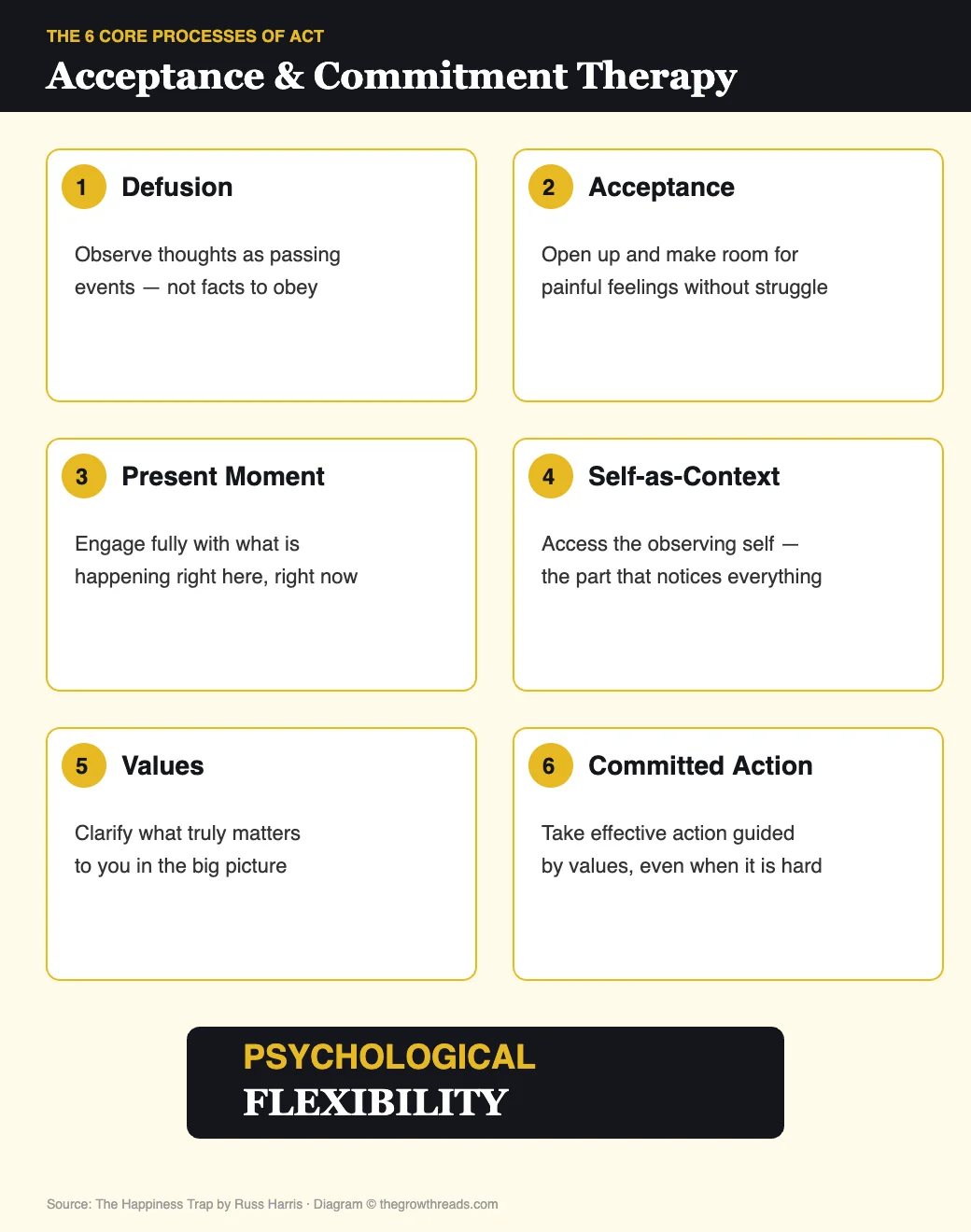
The Happiness Trap explains why the cultural pressure to feel happy actually increases suffering, then teaches six evidence-based skills from Acceptance and Commitment Therapy — defusion, acceptance, present-moment awareness, self-as-context, values clarification, and committed action — that together create psychological flexibility: the ability to handle difficult thoughts and feelings effectively and build a rich, meaningful life.
About the author
Russ Harris is a medical doctor turned psychotherapist and one of the world’s leading trainers of Acceptance and Commitment Therapy. Born and educated in England, Harris moved to Australia where he built a practice focused on making ACT accessible outside the therapy room. His workshops have trained over 50,000 health professionals across 30+ countries. The Happiness Trap, first published in 2007 and now in a substantially expanded second edition, has sold over one million copies worldwide and been translated into more than 30 languages. Harris’s gift is translating dense clinical science into plain-language exercises — a skill that distinguishes The Happiness Trap from most ACT textbooks. Explore all Russ Harris book summaries →
Key concepts at a glance
| Concept | What it means | Use it when |
|---|---|---|
| The Happiness Trap | The vicious cycle where pursuing positive feelings increases suffering | You notice yourself suppressing or avoiding emotions |
| Defusion | Observing thoughts as mental events, not truths | A negative thought feels overwhelming or all-consuming |
| Expansion (Acceptance) | Making room for uncomfortable feelings without fighting them | You feel the urge to numb, distract, or run from an emotion |
| The Observing Self | The steady awareness behind all thoughts and feelings | You feel completely identified with your pain or anxiety |
| Values Clarification | Identifying what genuinely matters to you as life directions | You feel lost, directionless, or stuck in autopilot |
| Committed Action | Taking concrete steps aligned with your values | You know what matters but are not acting on it |
| The Struggle Switch | The mental mechanism that amplifies suffering by fighting it | You notice a secondary emotion (anger about being anxious) |
| The Choice Point | The moment where you choose toward or away from values | You face a decision and feel pulled toward avoidance |
Part 1: How the trap works
Harris opens with a paradox: in the wealthiest, safest, most comfortable societies in human history, rates of depression, anxiety, and substance abuse are higher than ever. The reason, he argues, is not that modern life is uniquely stressful — it is that modern culture has convinced us happiness should be our default state, and that any deviation from it signals a deficiency in us.
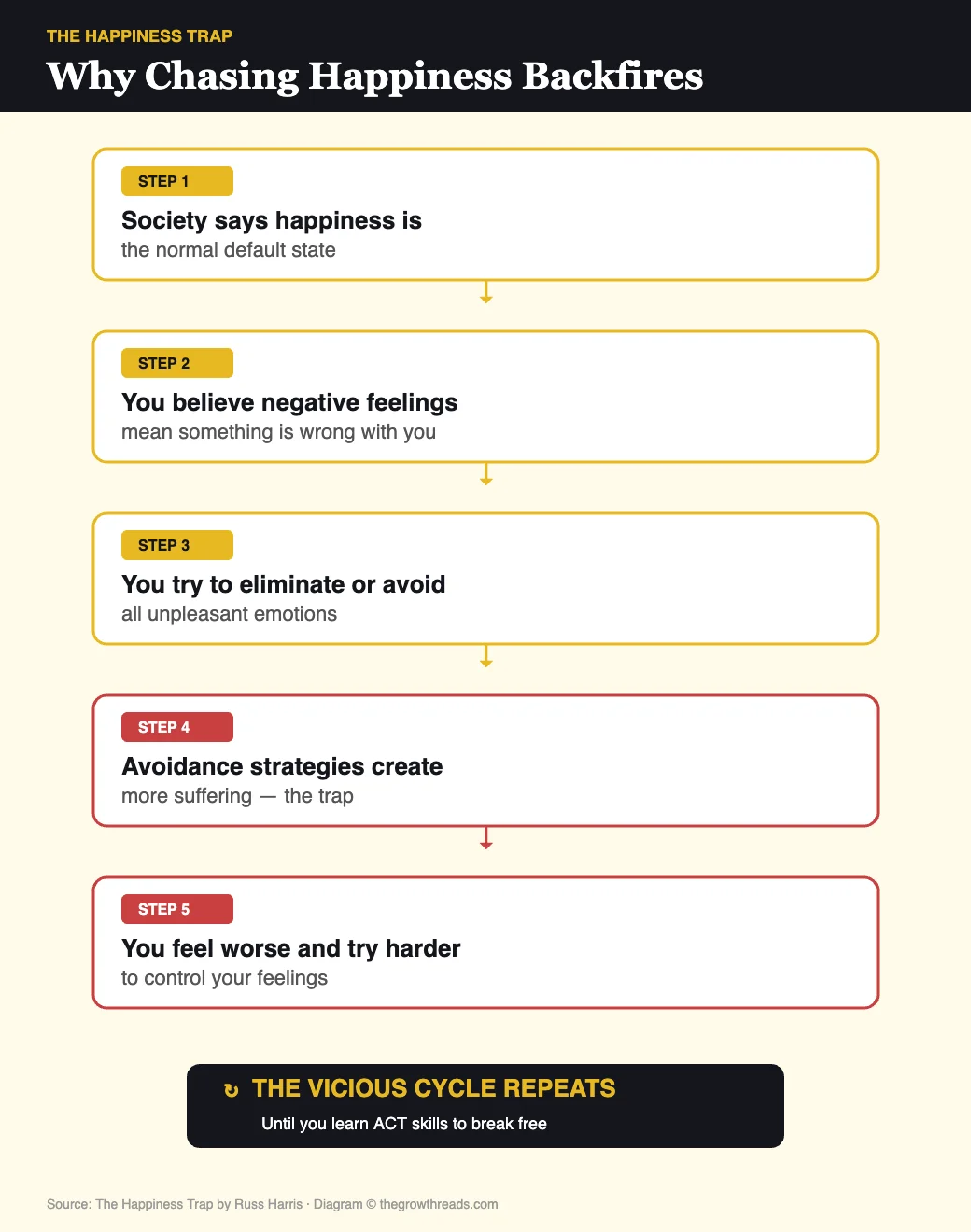
This creates what Harris calls the happiness trap: a self-reinforcing cycle where (1) you believe you should feel good most of the time, (2) you interpret normal negative emotions as problems to solve, (3) you deploy control strategies — distraction, suppression, rumination, substances, overwork — to eliminate those feelings, and (4) the strategies backfire, increasing suffering and triggering guilt about feeling bad about feeling bad. The clinical term for this second layer is experiential avoidance, and a landmark 2006 meta-analysis by Hayes et al. found it to be one of the single strongest predictors of psychopathology across diagnoses.
Harris uses a vivid metaphor: the struggle switch. Imagine a switch on the back of your mind. When it is ON, any discomfort gets amplified — you feel anxiety, then anxiety about the anxiety, then frustration about the frustration. When you learn to turn it OFF, you still feel the original pain, but without the cascading layers of resistance. The pain becomes manageable.
Part 2: Defusion — unhooking from your mind
The centerpiece of The Happiness Trap is cognitive defusion: the skill of separating yourself from your thoughts. Harris is careful to distinguish this from cognitive restructuring (the CBT approach of challenging and replacing negative thoughts). In ACT, you do not need to determine whether a thought is true, rational, or distorted. You simply need to notice it for what it is — a string of words produced by a pattern-matching organ — and choose whether acting on it would move you toward your values.
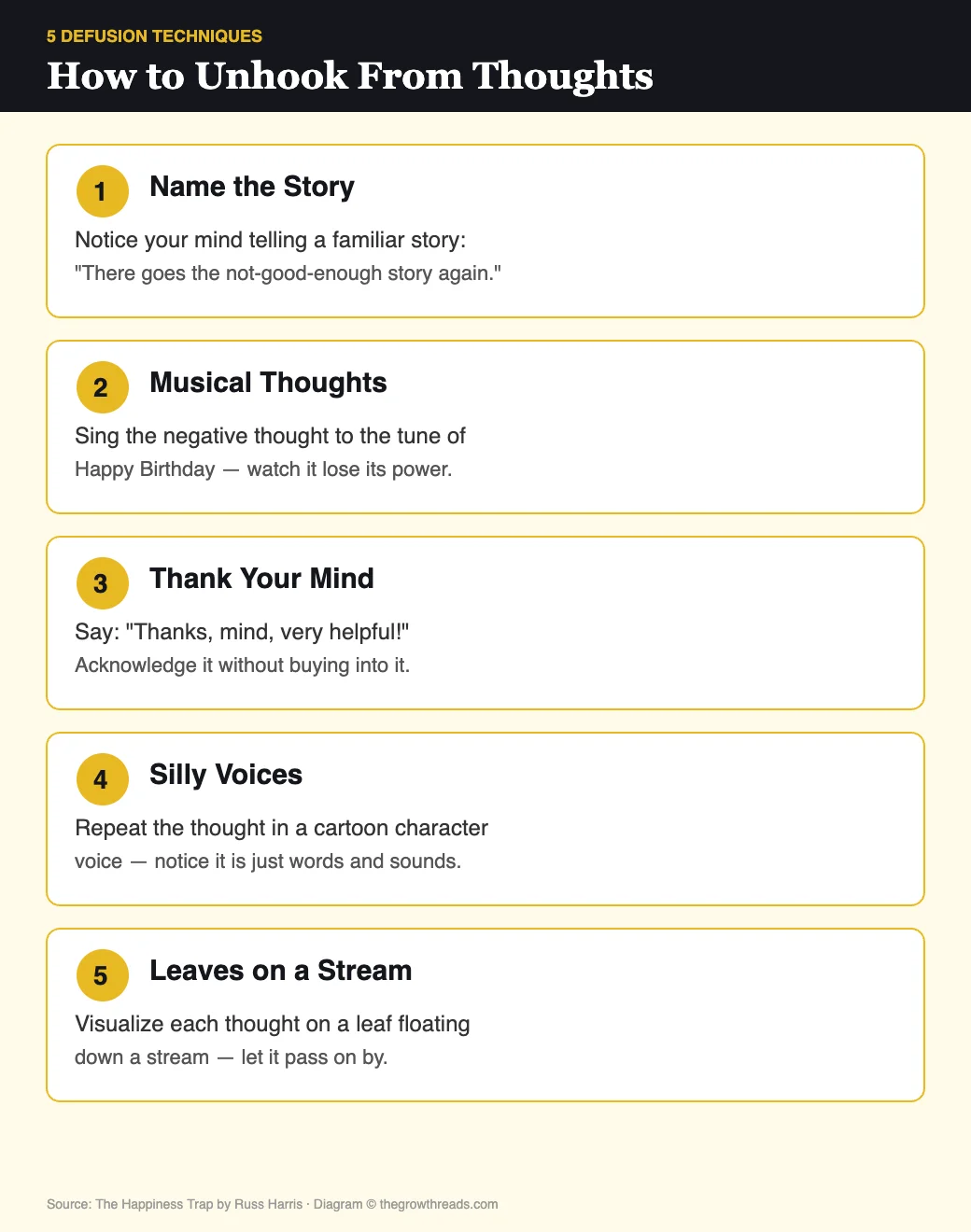
Harris provides over a dozen defusion techniques, each designed to create psychological distance between you and a thought. In “naming the story,” you notice recurring thought patterns and label them: “Ah, there is the not-good-enough story again.” The thought does not disappear, but your relationship to it shifts — from “I am not good enough” to “I am having the thought that I am not good enough.” That grammatical shift changes everything. In “musical thoughts,” you take a painful thought and sing it to the tune of Happy Birthday or a nursery rhyme. The content stays the same, but the emotional charge drops dramatically — revealing that the thought was never an emergency, just a mental event.
The crucial insight is that defusion is not about making thoughts go away. It is about reducing their ability to dictate your behavior. A thought can be present, loud, and even painful — and you can still choose to act in a direction that matters to you. Harris calls this the difference between “buying” a thought (treating it as truth and obeying it) and “holding it lightly” (seeing it as one of ten thousand thoughts your mind produces today).
Part 3: Acceptance, the observing self, and present-moment connection
Harris devotes the middle section of the book to three interconnected skills. Acceptance (which he prefers to call “expansion”) is the practice of making physical and emotional room for difficult feelings without trying to change them. He walks readers through a body-scan exercise: locate the feeling in your body, observe its shape, temperature, and movement, breathe into it, and allow it to be there. The counterintuitive result — confirmed by Levitt et al. (2004) and subsequent studies — is that emotions processed through acceptance typically diminish faster than emotions actively suppressed.
The observing self, borrowed from Relational Frame Theory (the language theory underlying ACT), is the part of you that notices all experiences without being damaged by them. Harris uses a chessboard metaphor: your thoughts and feelings are the pieces (black and white, battling), but you are the board itself — present for the entire game, unchanged by any single move. This perspective does not eliminate pain, but it prevents total identification with it. You shift from “I am anxious” to “I notice anxiety is here.”
Present-moment connection — the third pillar — is simply the practice of engaging fully with whatever you are doing right now instead of living in your head. Harris notes that research by Killingsworth and Gilbert (2010), published in Science, found that people spend approximately 47% of waking hours lost in thought — and that mind-wandering is consistently associated with lower happiness, regardless of what people are doing.
Part 4: Values, committed action, and the choice point
The final section is where The Happiness Trap shifts from internal skills to external behavior. Harris argues that defusion and acceptance without values-driven action is just sophisticated navel-gazing. Values are the “why” behind every meaningful action — not goals (which can be achieved and crossed off) but ongoing directions (which guide your life indefinitely). “Being a present father” is a value; “attending my daughter’s recital” is a goal that serves it.
Harris guides readers through a values clarification exercise across ten life domains: intimate relationships, family, friendships, career, education, recreation, health, spirituality, community, and environment. The exercise asks two questions per domain: “What kind of person do I want to be in this area?” and “What would I do differently if painful thoughts and feelings were no longer obstacles?” The second question is the ACT breakthrough — it surfaces how much of your current inaction is driven by experiential avoidance rather than genuine disinterest.
Committed action, the final ACT process, means taking concrete values-aligned steps even when — especially when — uncomfortable thoughts and feelings show up. Harris introduces the FEAR acronym (Fusion, Excessive expectations, Avoidance, Remoteness from values) to diagnose what is keeping you stuck, paired with the DARE antidote (Defusion, Acceptance, Realistic goals, Embracing values). The choice point model, expanded significantly in the second edition, maps every daily decision as a fork: toward values (with discomfort) or away from values (with temporary relief). The pattern of your choices, accumulated over weeks and months, becomes your life.
Who is The Happiness Trap best for — and who should read something else first?
This book is ideal for people who have tried positive thinking, affirmations, and motivational strategies and found they do not stick — because Harris explains why those approaches often backfire and offers a fundamentally different framework. It is particularly effective for chronic worriers, perfectionists, people with mild to moderate anxiety or depression, and anyone who feels trapped in their own head. Health professionals will find it a useful primer on ACT that they can recommend to clients.
If you prefer a more spiritual or philosophical approach to the same territory, consider The Power of Now by Eckhart Tolle or The Untethered Soul by Michael Singer. If you want the neuroscience of why your brain generates so much unhelpful chatter, Thinking, Fast and Slow by Daniel Kahneman provides the deeper cognitive architecture. And if you are dealing with clinical-level anxiety or depression, The Happiness Trap is a strong self-help complement to professional therapy — not a replacement for it.
Questions to reflect on
- What is the dominant “story” your mind tells you most often — and how would your behavior change if you stopped buying into it?
- In which of the ten life domains are you most clearly living by your values, and in which are avoidance patterns running the show?
- When you feel a strong negative emotion, what is your default control strategy — distraction, rumination, substances, overwork, or something else?
- If uncomfortable thoughts and feelings were no longer obstacles, what is one thing you would start doing this week?
- Can you recall a time when you “held a thought lightly” instead of treating it as an emergency — and what happened next?
🔥 Ready to escape the trap and start living by your values?
Harris’s evidence-based toolkit could be the thing that finally breaks the cycle of avoidance and overthinking.
How to apply The Happiness Trap (7-day plan)
- Day 1 — Catch the trap in action: Carry a small notebook today. Every time you notice yourself trying to push away, suppress, or distract from an uncomfortable feeling, write it down. Do not judge it — just notice. By evening you will have a map of your personal struggle switch patterns.
- Day 2 — Practice naming the story: Pick your most frequent negative thought pattern (the one from yesterday’s list that appeared most often). Give it a name: “the failure story,” “the not-enough story,” “the what-if story.” Every time it shows up today, say silently: “Ah, there is the [name] story again.” Notice what happens to its grip on you.
- Day 3 — Try expansion with one emotion: Choose one uncomfortable emotion you typically avoid. Set a timer for 5 minutes. Locate the feeling in your body, observe it with curiosity (shape, temperature, weight, movement), breathe into it, and allow it to be there without doing anything about it. Journal what you notice afterward.
- Day 4 — Musical defusion: Take the most painful version of yesterday’s thought and sing it slowly to the tune of Happy Birthday. Then try it in a cartoon character voice. Notice: did the thought’s content change? No. Did its emotional charge change? Usually yes. That gap is defusion.
- Day 5 — Values clarification (20 minutes): Pick three of the ten life domains (relationships, career, health, etc.). For each, write: “The person I want to be in this area is someone who…” and “If fear were not a factor, I would…” Compare your answers to your current behavior.
- Day 6 — One committed action: From yesterday’s values exercise, identify one small, concrete action you have been avoiding. Apply the 5-second countdown from The 5 Second Rule if needed: count 5-4-3-2-1 and do it. Notice that you can act with the discomfort, not after it disappears.
- Day 7 — The choice point audit: Review your week through the choice point lens. List three moments where you moved toward your values (even with discomfort present) and three where you moved away. No judgment — just data. Set one toward-values intention for next week and write it where you will see it daily.
Frequently asked questions
What is the main idea of The Happiness Trap?
The core argument is that the cultural pressure to feel happy creates a self-defeating cycle: the more you try to control, suppress, or avoid negative emotions, the more suffering you create. Russ Harris teaches six skills from Acceptance and Commitment Therapy — defusion, acceptance, present-moment awareness, the observing self, values clarification, and committed action — that together build psychological flexibility. This means learning to handle difficult thoughts and feelings effectively so you can focus your energy on building a rich, meaningful life aligned with your values rather than endlessly chasing positive emotions.
Is The Happiness Trap based on real science?
Yes. The book is grounded in Acceptance and Commitment Therapy (ACT), which has been validated by over 1,000 peer-reviewed studies across conditions including anxiety, depression, chronic pain, addiction, OCD, and workplace stress. ACT is classified as an empirically supported treatment by the American Psychological Association. The underlying theory, Relational Frame Theory, explains how human language creates psychological suffering — a mechanism unique to our species. Harris cites specific studies throughout the book, including the Killingsworth and Gilbert (2010) mind-wandering research published in Science.
How is ACT different from CBT?
Cognitive Behavioral Therapy (CBT) focuses on identifying and challenging distorted thoughts — replacing negative beliefs with more rational ones. ACT takes a fundamentally different approach: instead of changing the content of your thoughts, you change your relationship to them. In ACT, a thought does not need to be true or false, rational or irrational — it just needs to be recognized as a mental event that you can observe without obeying. Both approaches have strong evidence bases, but ACT tends to work better for people who have tried and struggled with thought-challenging techniques.
Can I use The Happiness Trap without a therapist?
Harris specifically designed the book to make ACT accessible without professional guidance. Each chapter includes exercises, worksheets, and step-by-step instructions that readers can practice independently. The second edition (2022) adds even more self-guided exercises and a significantly expanded choice point model. That said, if you are experiencing severe depression, suicidal thoughts, PTSD, or other clinical conditions, the book is best used as a complement to professional therapy rather than a replacement. Many therapists assign The Happiness Trap as homework between sessions.
What is cognitive defusion?
Cognitive defusion is the practice of creating psychological distance between you and your thoughts. Instead of being fused with a thought — treating it as literal truth and feeling compelled to act on it — defusion lets you step back and observe it as just a string of words or a mental event. Techniques include naming recurring thought patterns (“there goes the failure story”), singing the thought to a silly tune, saying “I notice I am having the thought that…” before the thought, and visualizing thoughts as leaves floating down a stream. The goal is not to eliminate thoughts but to reduce their power to control your behavior.
How long does it take for ACT techniques to work?
Many ACT exercises produce noticeable shifts within minutes — defusion techniques like musical thoughts or naming the story can reduce a thought’s emotional charge almost immediately. However, building consistent psychological flexibility as a life skill typically takes 4 to 8 weeks of regular practice, similar to building any habit. Harris recommends practicing one technique per week rather than trying to learn everything at once. Clinical studies show measurable improvements in anxiety and depression symptoms within 8 to 12 sessions of ACT therapy, and the self-help version follows a similar timeline.
Should I read the first or second edition of The Happiness Trap?
The second edition (2022) is the recommended version. Harris substantially expanded the choice point model, added new exercises, updated the science citations, and refined the language throughout. The core ACT framework is the same, but the second edition is clearer, more practical, and reflects 15 additional years of clinical experience and research. If you already own the first edition, the second is worth upgrading for the choice point material alone — it provides a simple visual framework that makes the entire ACT model easier to apply in real-time decisions.
Related summaries
If The Happiness Trap resonated, these summaries explore adjacent territory:
- The Power of Now Summary — Eckhart Tolle’s spiritual approach to present-moment awareness and releasing identification with thoughts.
- The Untethered Soul Summary — Michael Singer’s framework for observing the voice in your head and finding the awareness behind it.
- Thinking, Fast and Slow Summary — Daniel Kahneman’s deep dive into the cognitive systems that generate the automatic thoughts ACT teaches you to defuse from.
- The Gifts of Imperfection Summary — Brené Brown’s guide to letting go of who you think you should be and embracing who you are.
📚 Explore more Psychology book summaries
This review is part of our Best Psychology Books collection — a curated library of the most impactful books on how the mind works, with full summaries, key takeaways, and action plans for each.