

★★★★★ 4.5/5 — A transformative framework for expressing yourself honestly and hearing others with genuine empathy.
Best for: Anyone caught in blame-and-defend cycles, therapists and mediators seeking a structured empathy model, and parents who want to connect with children without punishment or rewards.
Reading time: ~5 hours (this summary: 18 min)
Difficulty to apply: High — the framework is simple but requires rewiring decades of habitual language patterns.
Nonviolent Communication in One Minute
Most interpersonal pain comes not from what people feel but from how they express it — and Nonviolent Communication offers a concrete alternative to the judgmental language most of us learned as children. Marshall Rosenberg developed a four-step process — observe without evaluating, name your feelings, identify the underlying need, and make a clear request — that replaces blame, criticism, and demands with honest self-expression and deep empathy. Used in couples therapy, conflict mediation, corporate training, and even international peace negotiations, NVC has proven its power across cultures and contexts for over five decades.
Key Takeaways
- All human actions are attempts to meet universal needs: Behind every behavior — even violent or destructive ones — is a person trying to meet a need for safety, autonomy, connection, meaning, or play.
- Judgments are tragic expressions of unmet needs: When you call someone “selfish” or “lazy,” you are describing your unmet need (for fairness, for support) in a way that guarantees the other person will not hear it.
- Observation and evaluation are different things: “You were late three times this week” is an observation. “You are irresponsible” is an evaluation. Mixing the two triggers defensiveness immediately.
- Feelings are different from thoughts: “I feel unappreciated” is a thought disguised as a feeling (it implies someone should appreciate you). “I feel sad” is a genuine feeling that opens dialogue.
- Needs are universal; strategies are negotiable: Everyone needs respect, but the strategy to meet that need differs. Focusing on needs instead of strategies unlocks creative solutions.
- Requests are not demands: A request becomes a demand the moment the other person believes they will be punished for saying no. True requests accept “no” as information, not rejection.
- Empathic listening means reflecting needs, not giving advice: When someone is in pain, they need to be heard — not fixed. Reflecting their feelings and needs is more powerful than any solution you can offer.
- Self-empathy comes first: You cannot offer genuine empathy to others while your own needs are screaming. NVC starts with compassionate self-connection.
- The process works in both directions: Use it to express yourself honestly (outward NVC) and to hear others empathically (inward NVC), even when they are not using NVC themselves.
- Anger is a signal, not a problem: Anger indicates an unmet need and a judgment about who is responsible. Translating the judgment back into a need dissolves the anger and opens the conversation.
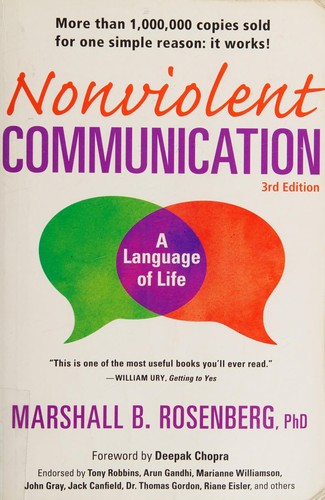
What Is Nonviolent Communication About?
Nonviolent Communication presents a four-component process — observation, feeling, need, and request — for replacing habitual patterns of blame, criticism, and demand with honest self-expression and deep listening. Developed by clinical psychologist Marshall Rosenberg over five decades, the framework has been used in couples therapy, schools, prisons, corporations, and international conflict mediation across more than 60 countries.
About the Author
Marshall B. Rosenberg, Ph.D. was an American psychologist who grew up in a turbulent Detroit neighborhood during the race riots of the 1940s. His early experiences with violence and prejudice drove him to study the roots of compassion and aggression under Carl Rogers at the University of Wisconsin. In 1984, he founded the Center for Nonviolent Communication, which now has trainers in over 60 countries. Rosenberg spent decades mediating conflicts in war zones including Rwanda, Israel-Palestine, and the Balkans, demonstrating that his process worked even in the most extreme conditions. He passed away in 2015, leaving behind a global movement. Explore all Marshall B. Rosenberg book summaries →
Key Concepts at a Glance
| Concept | What It Means | Use It When |
|---|---|---|
| Observation vs. Evaluation | Describing what happened without adding judgment or interpretation | A conversation starts with “You always…” or “You never…” |
| Feelings vs. Pseudo-Feelings | Genuine emotions (sad, afraid, joyful) versus judgments disguised as feelings (betrayed, ignored) | You say “I feel like you don’t care” instead of naming the real emotion |
| Universal Human Needs | Core needs shared by all people: autonomy, connection, safety, meaning, play, sustenance | A conflict seems unsolvable because both sides are arguing strategies, not needs |
| Requests vs. Demands | A request accepts “no” as valid information; a demand punishes refusal | You notice resentment building when someone declines your ask |
| Empathic Listening | Reflecting back the feelings and needs you hear, without advising or fixing | Someone is upset and you catch yourself planning your rebuttal instead of hearing them |
| Self-Empathy | Connecting with your own feelings and needs before engaging with others | You are too activated to listen and need to settle your own nervous system first |
| Jackal/Giraffe Language | Rosenberg’s metaphor for judgmental language (jackal) vs. compassionate language (giraffe) | You want a memorable shorthand for catching yourself in blame mode |
| Protective vs. Punitive Force | Using force to protect (stopping a child from running into traffic) vs. to punish (spanking) | You need to set a boundary and want to do so without violence |
Part 1: The Four Components — A New Language for Connection
Rosenberg structures the entire NVC process around four components that work in sequence. Each addresses a specific failure mode of conventional communication.
Observation without evaluation: The first component asks you to describe what you see or hear as a camera would record it — without adding judgment, interpretation, or generalization. “The report was submitted three days after the deadline” is an observation. “You are unreliable” is an evaluation. Rosenberg cites research by communication scholars showing that when people hear an evaluation, their immediate response is self-defense. When they hear a factual observation, they remain open. The distinction seems simple but is remarkably hard in practice because English makes it easy to embed judgment inside observation: “You ignored my message” contains an attribution of intent that “I sent a message yesterday and have not received a reply” does not.
Naming feelings honestly: The second component requires identifying and expressing your genuine emotional state. Rosenberg draws a crucial distinction between feelings (emotions you experience in your body — sadness, fear, frustration, joy) and what he calls “pseudo-feelings” or “faux feelings” — thoughts disguised as feelings. “I feel abandoned” is not a feeling; it is a judgment about what the other person did. “I feel scared” is a genuine feeling. The distinction matters because genuine feelings invite empathy while pseudo-feelings invite argument.
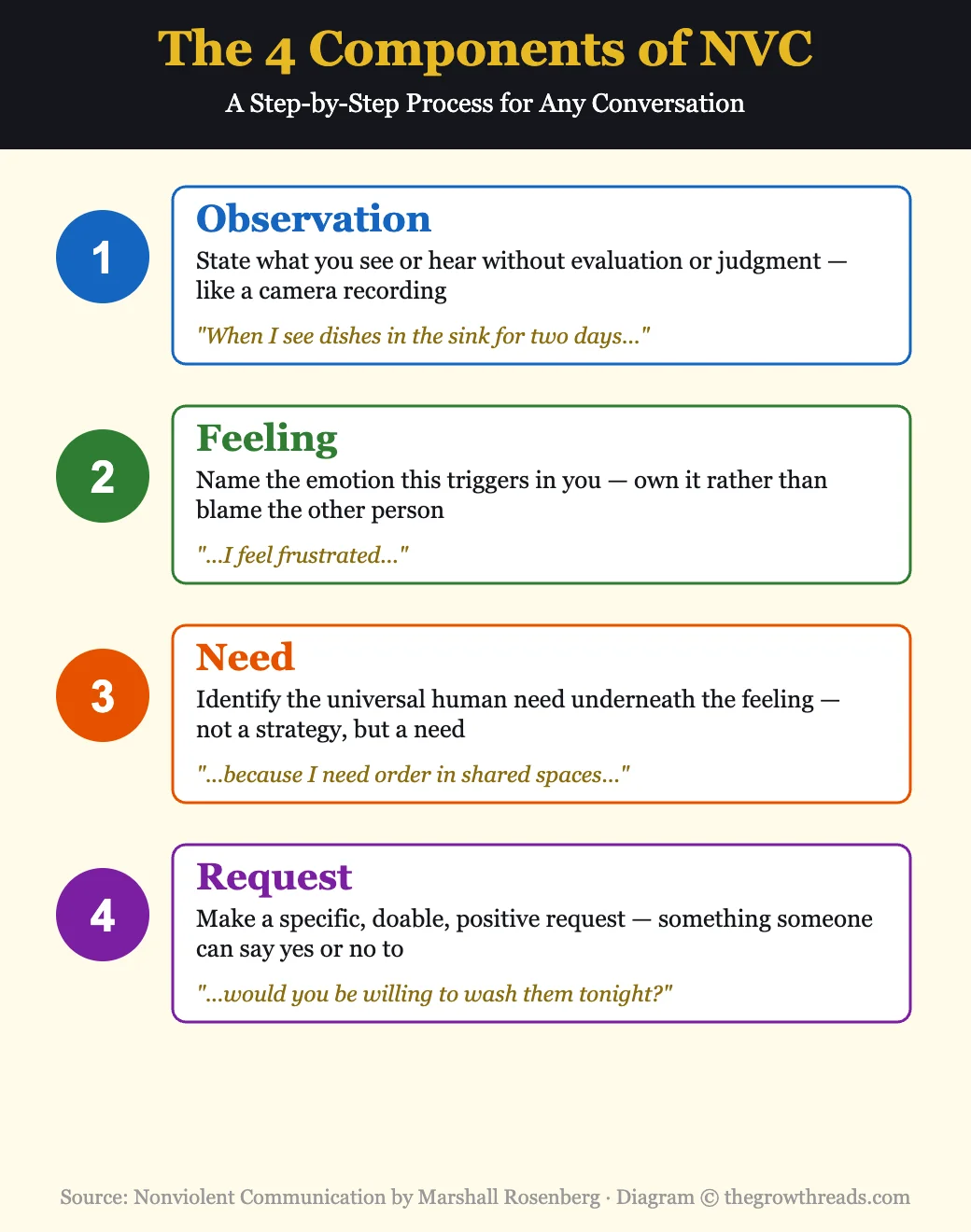
Connecting feelings to needs: The third component is the heart of NVC. Rosenberg argues that feelings are never caused by other people’s actions — they are caused by your own met or unmet needs. When you say “I feel angry because you came home late,” you are implicitly blaming the other person for your emotion. When you say “I feel anxious because I need reassurance about our connection,” you take ownership of the feeling and open the door to problem-solving. The list of universal human needs includes autonomy, celebration, integrity, interdependence, physical nurturance, play, and spiritual communion — needs shared by every human being regardless of culture.
Making requests, not demands: The fourth component translates your observation, feeling, and need into a specific, actionable, positive request. “Would you be willing to text me when you’ll be more than 30 minutes late?” is a request. “Stop being so inconsiderate” is a demand wrapped in judgment. The critical test: a request remains a request only when you are genuinely willing to hear “no” and treat it as information rather than rejection.
Part 2: Jackal and Giraffe — Two Languages, Two Worlds
Rosenberg uses a vivid metaphor to make NVC memorable and teachable, especially with children and in cross-cultural settings. “Jackal language” represents the judgmental, blame-oriented communication most people default to — it classifies people as right or wrong, good or bad, and uses guilt, shame, and obligation to control behavior. “Giraffe language” represents NVC — it observes without evaluating, connects through feelings and needs, and makes requests rather than demands. The giraffe was chosen because it has the largest heart of any land animal and its height provides a wide perspective.
The distinction is not about being “nice” versus “mean.” Giraffe language can deliver extremely tough messages — it simply does so in a way that maintains connection rather than severing it. “I feel frightened when I see you driving 90 miles per hour because I need safety. Would you be willing to stay under the speed limit?” is honest, direct, and clear. It is also far more likely to produce behavior change than “You’re going to kill us, you reckless idiot.”
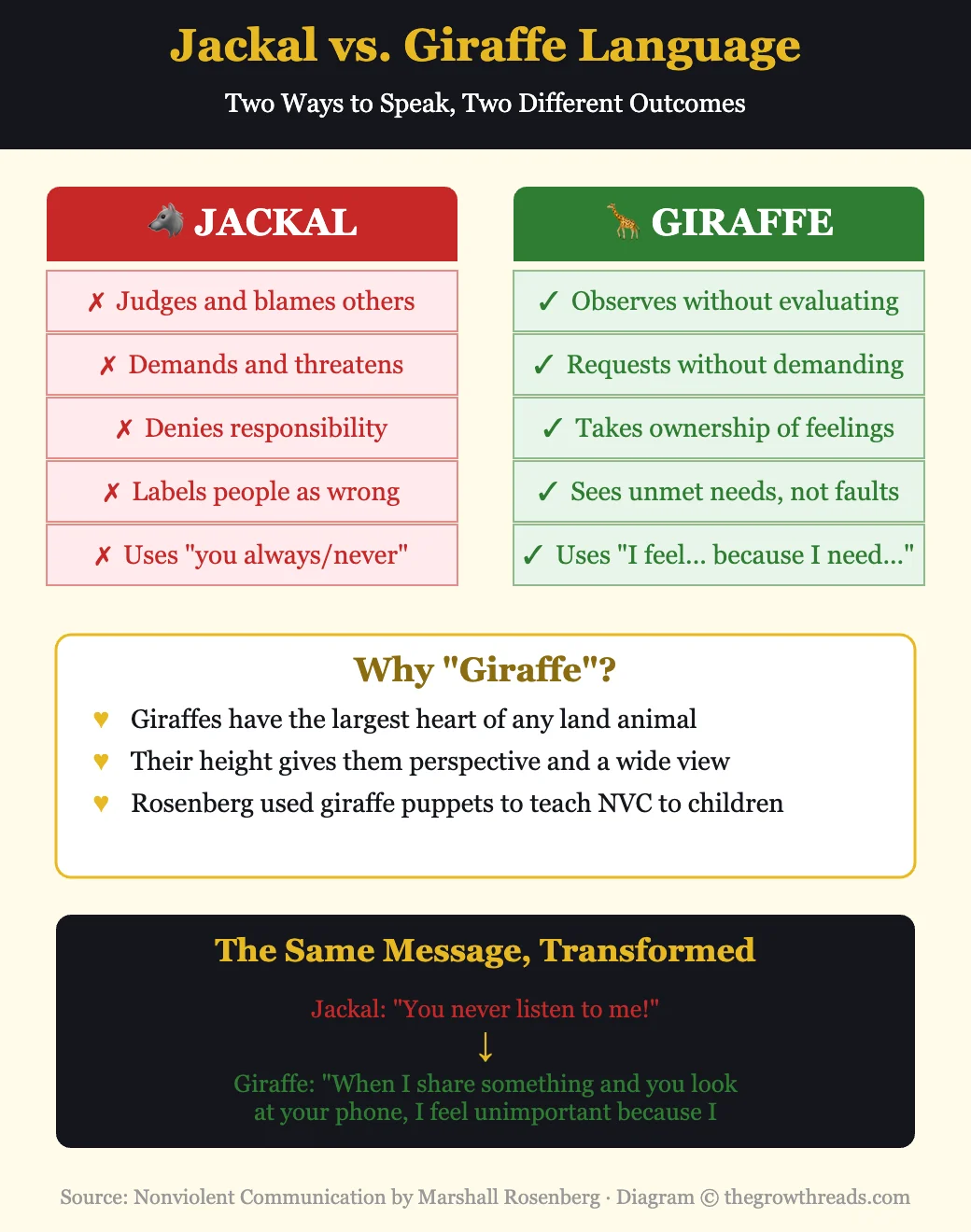
Rosenberg demonstrates through dozens of real examples how the same message can be delivered in jackal or giraffe language, with dramatically different outcomes. A parent saying “Clean your room or no dinner” (jackal) versus “When I see toys across the floor, I feel overwhelmed because I need order. Would you be willing to put the toys in the bin before we eat?” (giraffe) transmits identical information but creates entirely different emotional climates. The child in the second scenario learns that their parent has needs, that those needs are valid, and that cooperation is a choice — not a submission to authority.
Part 3: Empathic Listening — Hearing What People Actually Need
The second half of the NVC framework shifts from expressing yourself (speaking giraffe) to hearing others (listening giraffe). Rosenberg argues that empathic listening is the most powerful — and most underused — tool in human relationships. It requires hearing the feelings and needs behind whatever someone says, even when they are expressing themselves in jackal language.
When a partner says “You never help around the house!”, an untrained listener hears an attack and prepares a defense. A trained NVC listener hears an unmet need for support and a feeling of exhaustion. The response shifts from “That’s not true, I did the dishes yesterday!” to “It sounds like you’re feeling exhausted because you need more help with the housework. Is that right?” The second response does not concede guilt — it simply reflects the feeling and need accurately, which is usually enough to de-escalate the conversation completely.
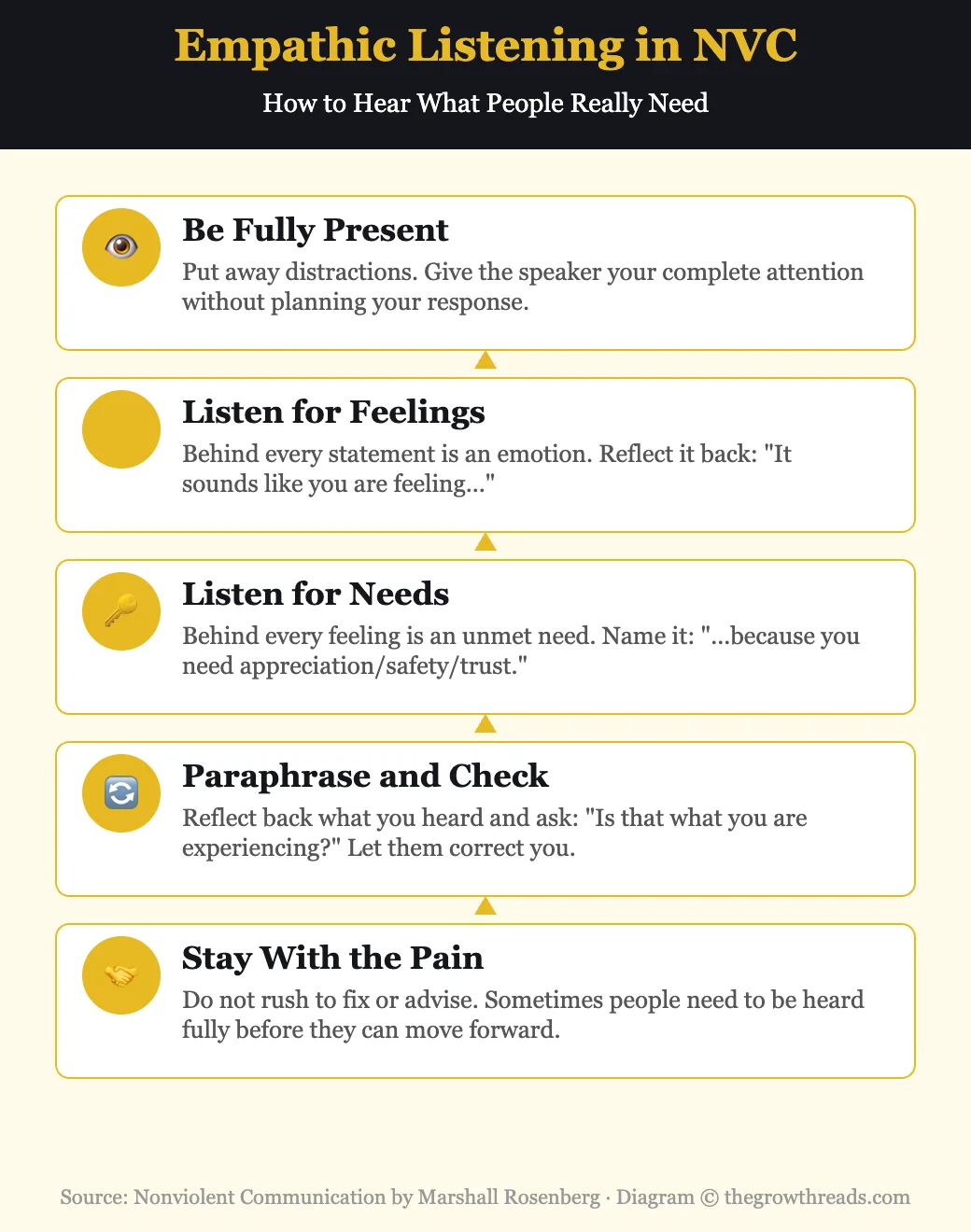
Rosenberg is emphatic about what empathic listening is not. It is not sympathizing (“Oh, you poor thing”), advising (“What you should do is…”), one-upping (“That’s nothing, let me tell you what happened to me”), educating (“This could turn into a valuable experience for you”), or consoling (“It wasn’t your fault”). All of these responses, however well-intentioned, shift the attention away from the speaker and block the healing process. True empathy stays with the other person’s experience until they signal — usually through a visible release of tension — that they feel fully heard.
Part 4: Self-Empathy, Anger, and Applying NVC in the Real World
Rosenberg dedicates significant attention to self-empathy — the practice of turning the NVC process inward before attempting to use it with others. When you are triggered, flooded with anger, or caught in a self-critical spiral, you cannot offer genuine empathy to anyone else. Self-empathy means pausing to ask: “What am I feeling right now? What need of mine is unmet?” The practice transforms self-judgment (“I’m so stupid for losing my temper”) into self-understanding (“I’m feeling ashamed because I need integrity in how I treat people”).
His chapter on anger is particularly powerful. Rosenberg reframes anger not as a problem to be managed but as a valuable signal. Anger always contains two elements: an unmet need and a judgment about who is to blame for the unmet need. The NVC approach to anger is to fully feel it, identify the judgment it contains, translate that judgment back into the underlying need, and then express that need directly. “I’m furious because you promised to pick up the kids and didn’t” becomes “I’m feeling scared because I need to be able to rely on agreements we make. When you didn’t pick up the kids after saying you would, I felt like I couldn’t count on you.”
The final chapters of the book address real-world applications: using NVC to resolve conflicts between groups, to express appreciation without manipulation, and to challenge systems of domination. Rosenberg distinguishes between “protective force” (using power to prevent harm, like pulling a child away from a hot stove) and “punitive force” (using power to make someone suffer for what they did). NVC supports the former and replaces the latter with empathy-based accountability.
Who Is Nonviolent Communication Best For — and Who Should Read Something Else First?
NVC is ideal for couples therapists and their clients, parents who want to discipline without punishment, mediators, HR professionals handling conflicts, and anyone who grew up in a household where feelings were suppressed or weaponized. It is especially powerful for people who recognize that they default to blame, criticism, or passive aggression and want a structured alternative.
If your primary challenge is high-stakes workplace conversations rather than emotional intimacy, Crucial Conversations may be a more practical starting point — it covers similar ground with more corporate-friendly language. If you want to understand why certain relationship patterns keep repeating, Attached provides the attachment-theory context that helps explain why NVC works. And if you are looking for a broader personal philosophy rather than a communication technique, The Four Agreements offers complementary wisdom about not taking things personally.
Questions to Reflect On
- Think about the last time you were angry at someone. What judgment were you making about them? What unmet need was underneath that judgment?
- Can you identify a recurring “pseudo-feeling” you use — something like “I feel ignored” or “I feel unappreciated”? What is the genuine feeling (sad, scared, frustrated) hiding beneath it?
- When was the last time someone told you about a problem and you jumped straight to advice? What might have happened if you had simply reflected their feelings and needs instead?
- Do your requests at home and work pass Rosenberg’s test — would you genuinely accept “no” without punishment or withdrawal?
- If you translated your harshest self-criticism into NVC format (observation, feeling, need, request), what would it sound like? How does that feel different?
🔥 Ready to transform how you speak and listen?
Nonviolent Communication gives you a proven four-step process to replace blame with connection in every relationship.
How to Apply Nonviolent Communication (7-Day Plan)
- Day 1 — Catch your judgments: Carry a small notebook and write down every evaluative statement you make or think about others today (“She’s so controlling,” “He’s lazy”). At the end of the day, translate each judgment into the unmet need behind it.
- Day 2 — Practice pure observation: Describe three situations today using only camera-observable facts — no interpretation, no “always” or “never.” Notice how hard it is to separate observation from evaluation.
- Day 3 — Build a feelings vocabulary: Download a feelings list (NVC websites offer them free). Throughout the day, check in every two hours and name the specific emotion you are experiencing. Move beyond “fine,” “good,” and “stressed.”
- Day 4 — Identify your top three needs: Review the NVC needs inventory. Identify three needs that are most alive for you right now. Journal how those needs show up in your daily interactions and conflicts.
- Day 5 — Make one NVC request: Choose a low-stakes situation. Express yourself using all four components: “When I [observation], I feel [feeling], because I need [need]. Would you be willing to [request]?” Notice the other person’s response.
- Day 6 — Practice empathic listening: In one conversation today, commit to reflecting the other person’s feelings and needs before responding with your own perspective. Use the formula: “Are you feeling [feeling] because you need [need]?”
- Day 7 — Self-empathy session: Spend 15 minutes with your journal. Write about a situation that still stings. Apply the four components to yourself: what did you observe, what did you feel, what need was unmet, and what do you want to request of yourself going forward?
Frequently Asked Questions
What are the four components of Nonviolent Communication?
The four components are observation (stating what you see or hear without judgment), feeling (naming the genuine emotion you experience), need (identifying the universal human need connected to that feeling), and request (asking for a specific, doable action). The process works in both directions — you can use it to express yourself honestly or to hear others empathically by listening for their observations, feelings, needs, and requests behind whatever they say.
What is the difference between a request and a demand?
A request becomes a demand the moment the other person believes they will be punished — through guilt, shame, withdrawal, or retaliation — for saying no. In NVC, a genuine request requires you to be willing to hear “no” and treat it as valuable information about the other person’s needs, not as a personal rejection. If you cannot hear “no” without resentment, you are making a demand, no matter how politely it is worded.
What is jackal and giraffe language?
Rosenberg used animal metaphors to teach NVC: jackal language represents judgmental, blame-oriented communication (criticizing, demanding, denying responsibility), while giraffe language represents compassionate communication (observing, expressing feelings and needs, making requests). The giraffe was chosen because it has the largest heart of any land mammal and its height provides broad perspective. Rosenberg often used hand puppets in workshops to make the distinction vivid and memorable for all ages.
Does NVC mean you can never be angry?
No. NVC does not suppress or dismiss anger — it reframes anger as a valuable signal. Anger always contains two elements: an unmet need and a judgment about who is to blame. The NVC approach is to fully feel the anger, identify the judgment, translate it back into the underlying need, and express that need directly. This dissolves the anger without suppressing it and opens a path to genuine resolution rather than escalation or resentment.
Can NVC work if only one person uses it?
Yes, and this is one of the framework’s greatest strengths. Even if only one person in a conversation uses NVC, the dynamic shifts. When you empathically hear someone’s needs behind their jackal language, they often soften. When you express your own needs without blame, the other person is less likely to become defensive. Rosenberg demonstrated this repeatedly in mediations between warring factions where he was the only person using NVC, and the conflicts still moved toward resolution.
How is NVC different from other communication frameworks?
NVC’s unique contribution is the explicit needs layer. While frameworks like Crucial Conversations focus on safety and facts-first dialogue, NVC insists that every feeling traces back to a universal human need. This focus on needs — rather than positions, strategies, or solutions — is what allows NVC to work across cultures and even in extreme conflict zones. It also places equal weight on self-empathy (understanding your own needs) and empathy for others, making it both a communication tool and a personal development practice.
What should I read after Nonviolent Communication?
For high-stakes professional conversations, pair NVC with Crucial Conversations by Kerry Patterson, which adds decision-making frameworks and corporate applications. For understanding the emotional attachment patterns that NVC helps you navigate, read Attached by Amir Levine. For a complementary philosophy about not internalizing others’ behavior, try The Four Agreements by Don Miguel Ruiz. And for the neuroscience of why habitual language patterns are so hard to change, Atomic Habits by James Clear explains the reward loops you will be rewiring.
Related Summaries
- Crucial Conversations Summary — Master high-stakes dialogue with the STATE framework
- Attached Summary — Understand the attachment patterns that drive your communication
- The 5 Love Languages Summary — Express love in the language your partner actually understands
- Best Relationship Books — Our complete guide to the top books on love, communication, and connection
How we analyze books: We read every book cover to cover, cross-reference key claims with peer-reviewed research, and distill the most actionable ideas into frameworks you can apply immediately. Our infographics are original, and our 7-day plans are designed for real-world implementation. Read our full methodology.