Psychology
The Coddling of the American Mind Summary & Review: Prepare the Child for the Road
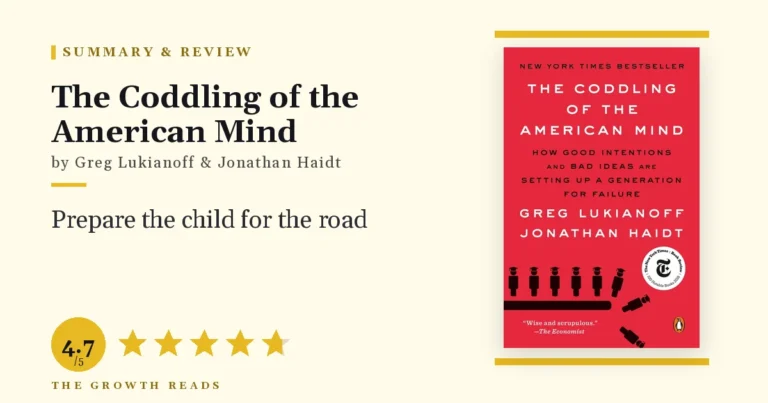
The Coddling of the American Mind summary: three untruths that make kids fragile, and a Tuesday plan to practise antifragility instead of…
Read Summary →
"The NYU moral psychologist who explained why good people across the political spectrum see morality so differently."
Jonathan Haidt is an American social psychologist and professor at NYU Stern School of Business whose research spans moral psychology, political polarization, and the effects of technology on mental health. His books "The Happiness Hypothesis" and "The Righteous Mind" drew on both ancient wisdom and modern research to explain why people across the political spectrum reason so differently about morality, arguing that moral judgments are typically driven by intuition first, with reasoning constructed afterward to justify them. "The Righteous Mind," published in 2012, became particularly influential for its account of the different moral "foundations" that liberals and conservatives emphasize, offering a framework for understanding political disagreement without dismissing the other side as simply wrong or immoral.
Our in-depth summaries and reviews of his work
The Coddling of the American Mind summary: three untruths that make kids fragile, and a Tuesday plan to practise antifragility instead of…
Read Summary →
Jonathan Haidt's The Anxious Generation traces the sharp rise in teen anxiety and depression to the shift from play-based to phone-based childhood.…
Read Summary →
Jonathan Haidt's The Righteous Mind reveals why good people disagree about politics and religion. Six moral foundations, the elephant-rider metaphor, and how…
Read Summary →
Jonathan Haidt tests ancient wisdom from Buddha, the Stoics, and Confucius against modern psychology. The happiness formula and elephant-rider metaphor explained.
Read Summary →Haidt argues people form moral judgments quickly and intuitively, then construct reasoning afterward to justify what they already felt.
Shared moral values unite people into strong groups, but that same binding also blinds each group to the legitimate concerns of the other side.
In "The Happiness Hypothesis," Haidt argues happiness can't be pursued directly—it emerges when internal coherence and external relationships are aligned, then you wait.
Overprotection trains fragility. Antifragile systems — children included — get stronger because of some load, not despite it.
A feeling is data, not proof. Catch the sentence “I feel it, therefore it is true,” then check a fact.
"Morality binds and blinds. It binds us into ideological teams that fight each other as though the fate of the world depended on our side winning each battle."— The Righteous Mind
"The human mind is a story processor, not a logic processor."— The Righteous Mind
"Love and work are to people what water and sunshine are to plants."— The Happiness Hypothesis
"Happiness is not something that you can find, acquire, or achieve directly. You have to get the conditions right and then wait."— The Happiness Hypothesis
"Prepare the child for the road, not the road for the child."— The Coddling of the American Mind
"Safetyism is a belief system. It valorizes safety, including emotional safety, as a sacred value."— The Coddling of the American Mind
The Coddling of the American Mind summary: three untruths that make kids fragile, and a Tuesday plan to practise antifragility instead of safetyism at home.
Jonathan Haidt's The Anxious Generation traces the sharp rise in teen anxiety and depression to the shift from play-based to phone-based childhood. Here's the full summary, key takeaways, and a 7-day plan to apply it.
Jonathan Haidt's The Righteous Mind reveals why good people disagree about politics and religion. Six moral foundations, the elephant-rider metaphor, and how morality binds and blinds.
Jonathan Haidt tests ancient wisdom from Buddha, the Stoics, and Confucius against modern psychology. The happiness formula and elephant-rider metaphor explained.