

★★★★☆ 4.3/5 — A structured, energizing blueprint for morning routines that can reshape your entire day.
Best for: Anyone who wants to stop hitting snooze and start each morning with intention, energy, and personal growth.
Reading time: ~4 hrs (guide: 18 min)
Difficulty to apply: Low to moderate — the framework is simple but requires consistency.
The Miracle Morning in one minute
Your morning routine determines the trajectory of your entire day. Hal Elrod argues that by dedicating your first waking hour to six specific personal development practices — Silence, Affirmations, Visualization, Exercise, Reading, and Scribing (SAVERS) — you can dramatically improve every area of your life. The book grew out of Elrod’s own recovery from a devastating car accident and near-death experience, which taught him that our potential is not defined by our circumstances but by our daily habits. Whether you are a CEO, a stay-at-home parent, or a student, the Miracle Morning offers a repeatable system for leveling up before most people have even opened their eyes.
Key takeaways
- The 95% reality gap: Most people settle for far less than they truly want because they never commit to consistent personal development.
- Mornings set the tone: How you start your day creates a ripple effect that influences your energy, focus, and decision-making for every hour that follows.
- The SAVERS framework: Six practices — Silence, Affirmations, Visualization, Exercise, Reading, and Scribing — form a complete personal development system.
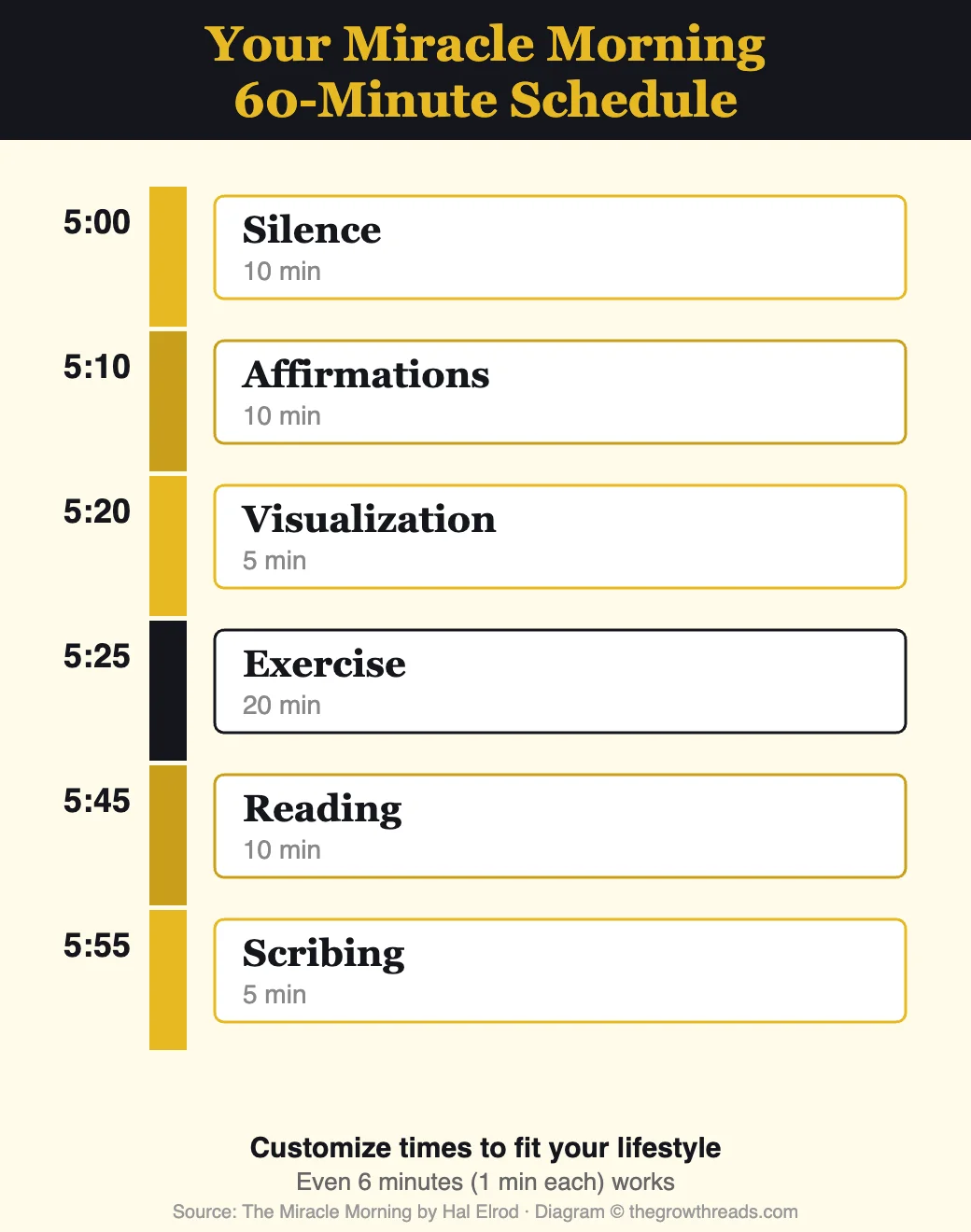
- Even six minutes works: You can compress the entire routine into just six minutes (one per practice) on busy days and still benefit.
- Your past does not equal your future: Elrod recovered from clinical death, broke bones, permanent brain damage, and financial ruin to build a thriving life — proof that circumstances do not define outcomes.
- Affirmations must be active: Effective affirmations focus on what you are committed to doing, not passive wishes about who you want to be.
- Snooze is a symptom: Hitting snooze signals that you are not excited about your life, and fixing that starts with designing a morning worth waking up for.
- The 30-day challenge: New habits follow a predictable pattern — unbearable (days 1-10), uncomfortable (11-20), and unstoppable (21-30).
- Accountability accelerates results: Partnering with someone or joining a community makes the habit stick far faster than going solo.
- Customization is key: The SAVERS order and duration should be adapted to your personality, schedule, and season of life.
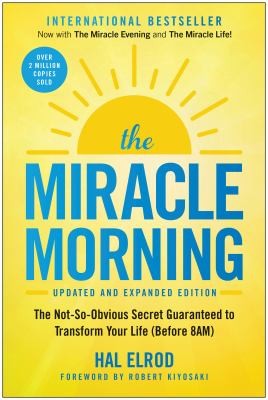
What is The Miracle Morning about?
The Miracle Morning is a personal development book that presents a six-step morning routine called SAVERS — Silence, Affirmations, Visualization, Exercise, Reading, and Scribing — designed to help readers achieve extraordinary results in every area of life by dedicating their first hour to intentional growth practices.
About the author
Hal Elrod is an author, keynote speaker, and ultramarathon runner whose life story reads like a Hollywood script. At age 20, he was hit head-on by a drunk driver at 70 mph, declared clinically dead for six minutes, and told he would never walk again. He defied those predictions, walked within weeks, and went on to become a top sales representative at Cutco. When the 2008 financial crisis wiped out his income and savings, Elrod turned to running and personal development to rebuild. That journey led him to create the Miracle Morning routine, which became a global movement with over three million practitioners. His books have sold millions of copies worldwide and been translated into more than 35 languages. Explore all Hal Elrod book summaries →
Key concepts at a glance
| Concept | What it means | Use it when |
|---|---|---|
| SAVERS | Six morning practices forming a complete growth system | You want a structured daily routine |
| The 95% Reality Gap | Most people never reach their potential due to lack of daily development | You feel stuck or underperforming |
| Level 10 Life | Rating every life area 1-10 to identify where to focus | You need clarity on priorities |
| The Snooze-Proof Wake-Up | Five-step strategy to get out of bed without hitting snooze | You struggle with early mornings |
| 6-Minute Miracle Morning | Compressed version doing one minute per SAVERS practice | You are extremely time-pressed |
| 30-Day Habit Mastery | Three phases: unbearable, uncomfortable, unstoppable | You want to lock in a new habit |
| Accountability Partner | A committed partner who does the routine alongside you | You need external motivation |
| Not-So-Obvious Secret | Personal development is the key differentiator between average and extraordinary | You want a mindset shift |
Part 1: The wake-up call — why most people settle
Elrod opens with a confronting statistic: roughly 95 percent of people are living far below their potential. Not because they lack talent or opportunity, but because they have never committed to a structured program of daily personal development. He calls this the “95 percent reality gap” — the distance between the life you are living and the life you are capable of creating.
The root cause, Elrod argues, is what he calls “rearview mirror syndrome.” Most of us make decisions about what is possible based on who we have been rather than who we could become. We replay old failures, old labels, and old limitations, and unconsciously cap our ambition at a level that feels safe. The result is a life of quiet mediocrity — comfortable enough to avoid crisis, but not extraordinary enough to feel truly alive.
Elrod experienced this gap firsthand. After being declared clinically dead following a catastrophic car accident at age 20, he was told he would never walk again. Within weeks he was on his feet. Years later, when the 2008 recession destroyed his finances, he fell into depression — until he discovered that a structured morning routine could pull him out of any downward spiral. The lesson was clear: circumstances do not determine outcomes; daily habits do.
Part 2: The SAVERS — your morning personal development system
The heart of the book is the SAVERS framework: six practices that, performed in sequence each morning, create a comprehensive personal development routine. Elrod did not invent any of these practices individually — meditation, affirmations, visualization, exercise, reading, and journaling have each been recommended by countless experts. His contribution is packaging them into a single, memorable acronym and a repeatable daily ritual.
Silence begins the morning with stillness. Whether through meditation, prayer, deep breathing, or simple quiet reflection, the goal is to calm the mind before the noise of the day floods in. Elrod recommends starting with just five minutes of focused breathing, which research has linked to reduced cortisol levels and improved emotional regulation.
Affirmations are the second practice, but Elrod’s approach differs from the passive “I am rich and successful” style popularized in earlier self-help literature. He advocates action-oriented affirmations that state what you are committed to doing and why it matters. An effective affirmation might be: “I am committed to waking at 5 AM because it gives me time to grow before the world demands my attention.”
Visualization follows, where you mentally rehearse both the process and the outcome of your most important goals. Elrod emphasizes visualizing the specific actions you will take, not just the end result — a technique supported by performance psychology research showing that process visualization outperforms outcome-only visualization.
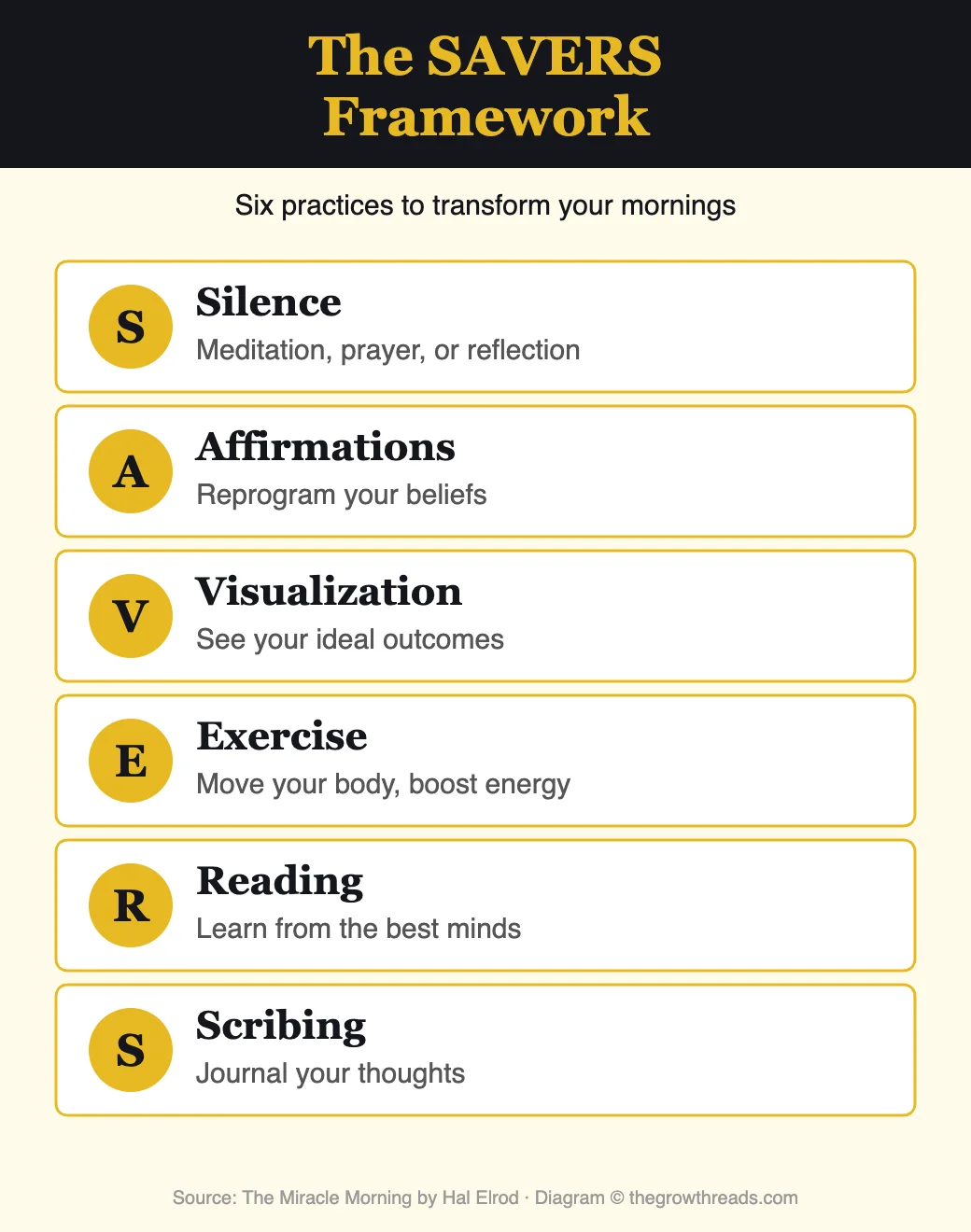
Exercise is the fourth practice and arguably the most immediately impactful. Even a brief session — seven minutes of bodyweight exercises, a brisk walk, or a yoga flow — floods the brain with endorphins, increases blood flow, and dramatically boosts morning alertness. Elrod does not prescribe a specific workout; the point is simply to move.
Reading is the fifth element. Elrod recommends a minimum of ten pages per day of a personal development or professional growth book. At that pace, you will finish roughly 18 books per year — an amount that puts you in the top percentile of adult readers and exposes you to an enormous range of ideas and strategies.
Scribing (journaling) closes the routine. Writing clarifies thinking, captures insights, and creates a record of your growth over time. Elrod suggests a simple format: what you are grateful for, what you learned, and what you are committed to today.
Part 3: Engineering your wake-up — the snooze-proof strategy
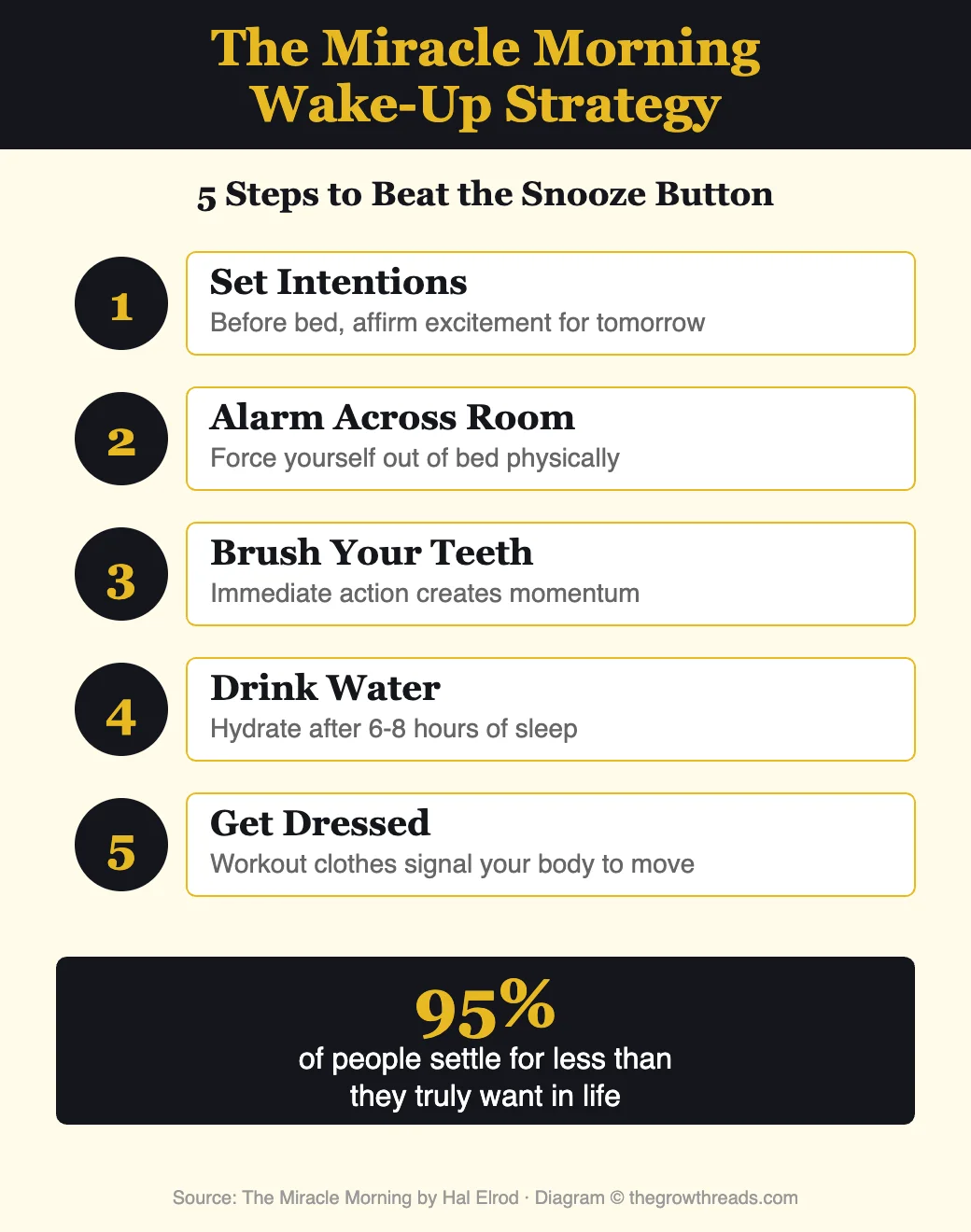
The most common objection to the Miracle Morning is simple: “I am not a morning person.” Elrod tackles this head-on with a five-step snooze-proof wake-up strategy that he argues can turn even the most committed night owl into an early riser within days.
The process starts the night before. Step one is to set your intentions before bed. Elrod cites research suggesting that your last thought before sleep influences your first thought upon waking. If you go to bed dreading the alarm, you will wake up dreading it. If you go to bed affirming that tomorrow morning is an opportunity, your brain processes that expectation overnight.
Step two is placing your alarm across the room. This forces you to physically stand up to turn it off, which immediately increases your wakefulness score. Step three is brushing your teeth immediately — the act of standing at the sink with mint in your mouth sends a powerful “the day has started” signal to your nervous system. Step four is drinking a full glass of water, since dehydration after six to eight hours of sleep is a major contributor to morning grogginess. Step five is putting on your workout clothes, which primes your body for the exercise component of SAVERS.
Elrod also introduces the concept of the “wake-up motivation level.” On a scale of one to ten, most people wake up at a one or two — barely conscious and desperate to return to sleep. The five-step strategy is designed to raise that level to a five or six within the first few minutes, at which point the desire to go back to bed fades naturally. He notes that you do not need to feel excited about waking up; you just need to get past the first five minutes.
Part 4: Making it stick — the 30-day transformation
Elrod dedicates the final section to habit formation, arguing that any new behavior follows a predictable three-phase arc over 30 days. Days one through ten are “unbearable” — your body and mind actively resist the change, and every morning feels like a battle. Days 11 through 20 are “uncomfortable” — the resistance fades but the routine does not yet feel natural. Days 21 through 30 are “unstoppable” — the habit becomes part of your identity, and skipping it feels stranger than doing it.
This framework serves as both a prediction and a promise. By telling readers exactly what to expect — including the urge to quit around day five or six — Elrod normalizes the struggle and reduces the likelihood of abandonment. He also recommends several strategies for surviving the first phase: finding an accountability partner, joining the Miracle Morning Community online, and tracking your streak visually (a technique psychologists call “don’t break the chain”).
The updated and expanded edition adds new material on customizing the routine for different life stages — parents with young children, shift workers, frequent travelers — and introduces the concept of the “Miracle Evening,” a simplified bedtime routine designed to set up the next morning for success. Elrod also shares data from a survey of over 100,000 Miracle Morning practitioners, showing that 92 percent reported improved happiness and 87 percent reported increased productivity within 30 days of starting.
Who is The Miracle Morning best for — and who should read something else first?
The Miracle Morning is ideal for people who feel stuck in a reactive daily pattern — checking email before their feet hit the floor, rushing through mornings without intention, and ending each day wondering where the time went. It is particularly effective for anyone who has tried individual practices like meditation or exercise but struggled to maintain them in isolation; the SAVERS framework bundles them into a single non-negotiable block that is easier to protect.
If you already have a strong morning routine and are looking for deeper work on a specific habit, you may benefit more from Atomic Habits (systems thinking) or Deep Work (cognitive focus). If your challenge is less about mornings and more about finding meaning in your daily actions, start with Man’s Search for Meaning instead.
Questions to reflect on
- If you rated every major area of your life on a scale of 1-10 right now, which area has the biggest gap between where you are and where you want to be?
- What is the first thing you currently do each morning — and does that action move you closer to your goals?
- Which of the six SAVERS practices would be most uncomfortable for you, and what does that discomfort reveal about a growth area?
- If you committed to the Miracle Morning for 30 days, what specific outcome would make the effort feel worthwhile?
- Who in your life could serve as an accountability partner for a morning routine challenge?
🔥 Ready to transform your mornings?
Start waking up with purpose and build momentum before the world demands your attention.
How to apply The Miracle Morning (7-day plan)
- Day 1: Set your alarm 30 minutes earlier than usual. Place it across the room. Do just one SAVERS practice — five minutes of Silence (deep breathing with eyes closed).
- Day 2: Add Affirmations. Write three action-oriented statements about what you are committed to, and read them aloud after your Silence session.
- Day 3: Add Visualization. Spend three minutes mentally rehearsing your ideal day, focusing on the specific actions you will take.
- Day 4: Add Exercise. Do a seven-minute bodyweight workout (push-ups, squats, planks) or a brisk walk around your block.
- Day 5: Add Reading. Read 10 pages of a personal development book immediately after exercise.
- Day 6: Add Scribing. Spend five minutes journaling — write what you are grateful for, one insight from your reading, and your top priority for the day.
- Day 7: Run the full SAVERS sequence for 60 minutes. Evaluate which practices felt most impactful and adjust the time allocation to suit your needs.
Frequently asked questions
What time should I wake up for the Miracle Morning?
Elrod does not prescribe a universal wake-up time. The key principle is waking up early enough to complete your SAVERS routine before your daily obligations begin. For most people, this means setting the alarm 30 to 60 minutes earlier than their current wake-up time. If you currently wake at 7 AM, starting at 6 AM gives you a full hour. The specific time matters less than the consistency — pick a time you can sustain seven days a week and protect it fiercely.
Do I have to do all six SAVERS practices every morning?
No. Elrod explicitly addresses busy days with the “6-Minute Miracle Morning” — one minute per practice. He also encourages experimentation with the order and duration. Some practitioners skip or combine practices depending on their current focus. The framework is a menu, not a rigid prescription. That said, Elrod believes the full six-practice version delivers the strongest results because each practice targets a different dimension of personal development.
What if I am not a morning person?
Elrod argues that “not a morning person” is a story, not a fixed trait. He was not a natural early riser either. The five-step snooze-proof strategy — setting bedtime intentions, placing the alarm across the room, brushing teeth, drinking water, and getting dressed — is specifically designed to override the biological resistance you feel in the first five minutes. Most practitioners report that the discomfort fades within the first two weeks.
How is The Miracle Morning different from other morning routine books?
Several books advocate for morning routines — Robin Sharma’s The 5 AM Club, Tim Ferriss’s morning protocols in Tools of Titans, and Benjamin Spall’s My Morning Routine. The Miracle Morning’s unique contribution is the SAVERS acronym, which packages six well-researched practices into a single memorable system. It also provides a more structured on-ramp (the 30-day challenge) and a larger community (over three million practitioners) than most alternatives.
Can I do the Miracle Morning if I have young children?
Yes. The updated edition specifically addresses parents. Elrod recommends waking before your children, even if that means starting at 4:30 or 5 AM. For parents of infants with unpredictable sleep schedules, he suggests a flexible approach: do whatever SAVERS practices you can during the first quiet window of the day, even if it is only six minutes. Some parents also report doing the routine during nap time rather than early morning.
How long does it take to see results from the Miracle Morning?
Most practitioners report noticeable improvements in energy and mood within the first week. Elrod’s survey of over 100,000 practitioners found that 92 percent experienced improved happiness and 87 percent increased productivity within 30 days. Deeper life changes — career shifts, improved relationships, significant health improvements — typically emerge over three to six months of consistent practice. The first 10 days are the hardest; persistence through this phase is the strongest predictor of long-term success.
Is The Miracle Morning backed by scientific research?
Each individual SAVERS practice has substantial research support. Meditation reduces cortisol and improves emotional regulation. Visualization improves performance in athletic and professional contexts. Exercise boosts BDNF and mood-regulating neurotransmitters. Reading increases neuroplasticity. Journaling reduces anxiety and clarifies thinking. The specific combination of all six into a single morning block has not been studied in a controlled trial, but the individual components are well-established in peer-reviewed literature.
Related summaries
- Atomic Habits Summary & Review — The system for building any habit, one percent at a time.
- The 5 AM Club Summary & Review — Robin Sharma’s case for owning the first hour of your day.
- Deep Work Summary & Review — Cal Newport on protecting focused time in a distracted world.
- Best Productivity Books — Our complete guide to the top books on focus, habits, and getting things done.
How we analyze books: Every summary on The Growth Reads is built from a close reading of the full text, cross-referenced with the author’s published interviews, peer-reviewed research where applicable, and reader feedback from multiple platforms. We focus on extracting actionable frameworks rather than abstract theory. Read our full methodology.