

★★★★ 4.3/5 — a profound (and polarizing) spiritual guide to freeing yourself from the tyranny of your own thinking. Abstract and repetitive, but genuinely transformative for many.
Best for: anyone exhausted by an overactive, anxious mind and drawn to a spiritual approach to peace · Reading time: ~5 hours (this guide: 15 min) · Difficulty to apply: Moderate — the concept is simple; sustaining presence is a lifelong practice
The Power of Now in one minute
Most of your suffering is created by your own mind — its endless replaying of the past and worrying about the future — and freedom is found by returning, again and again, to the present moment. Eckhart Tolle’s spiritual classic argues that we are not our thoughts; we are the awareness behind them. The incessant voice in the head, which most people mistake for their self, generates a constant stream of judgment, anxiety, and discontent, and identifying with it is the root of our unhappiness. The Now — this present moment — is the only place life ever actually happens, and it is where peace, or what Tolle calls “presence,” can be found. By learning to observe your thinking rather than being swept along by it, to feel the aliveness in your body, and to accept what is instead of resisting it, you step out of the mind’s grip. The book is repetitive, abstract, and unmistakably spiritual, and it is not for everyone — but for readers ready for it, it offers a genuine path to inner calm.
Key takeaways
- You are not your mind: you are the awareness that observes your thoughts, not the thoughts themselves.
- The mind creates suffering: compulsive thinking about past and future is the source of most psychological pain.
- The Now is all there is: the past and future exist only as thoughts; life only ever happens in the present moment.
- Watch the thinker: observing your thoughts without judgment creates a gap between you and them, and in that gap is freedom.
- The ego is mind-identification: the false self is built from thought, memory, and story, and it feeds on drama and problems.
- The pain-body: accumulated past emotional pain lives in you and periodically takes over; presence dissolves it.
- Presence brings peace: deep, alert attention to the present moment is the doorway to stillness and joy.
- Surrender to what is: accepting the present moment as it is, rather than resisting it, ends inner struggle.
- Feel your inner body: placing attention on the aliveness within anchors you in the Now.
- Psychological time is an illusion: use clock time for practical life, but stop living in the mind’s past and future.
What is The Power of Now about?
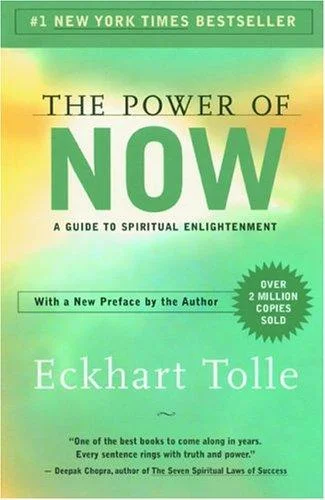
The Power of Now is a spiritual self-help book by Eckhart Tolle about freeing yourself from compulsive thinking and living in the present moment. It teaches that you are not your mind but the awareness behind it, that most suffering comes from dwelling on past and future, and that presence — deep attention to the Now — is the path to inner peace.
About the author
Eckhart Tolle is a German-born spiritual teacher and author. By his own account, he spent his twenties in deep anxiety and depression, until, at the age of 29, he experienced a sudden and profound inner transformation one night at the depths of despair — a dissolving of his suffering self that left him in a state of lasting peace. He spent the following years understanding and integrating that shift, and eventually began teaching. Published in the late 1990s, The Power of Now grew slowly by word of mouth into a global bestseller, later amplified when Oprah Winfrey championed his follow-up, A New Earth. Tolle’s teaching is deliberately non-denominational, drawing on Buddhism, Christian mysticism, Zen, and Sufism without belonging to any of them. The book is written partly in a question-and-answer format, echoing the voice of a teacher responding to a seeker, and its aim is not intellectual understanding but a direct shift in consciousness. Explore all Eckhart Tolle book summaries →
Key concepts at a glance
| Concept | What it means | Use it when |
|---|---|---|
| You are not your mind | You are the awareness behind thought | Thoughts are spiraling |
| The Now | The only moment life happens in | You’re lost in past or future |
| Watch the thinker | Observe thoughts without judgment | Anxiety is rising |
| The pain-body | Stored past emotional pain | Old pain takes you over |
| Surrender | Accept what is, stop resisting | You’re fighting reality |
| Inner body | Feel the aliveness within | Anchoring in the present |
Part 1: You are not your mind
Tolle’s foundational claim is startling in its simplicity: you are not your mind. Most people, he says, are so completely identified with the constant stream of thinking in their heads — the inner voice that comments, judges, worries, and never stops — that they take it to be their very self. But that compulsive thinking, he argues, is precisely the source of our suffering. The mind is a useful tool for practical tasks, but it has taken over, running continuously and dragging us through anxiety about the future and regret about the past, unable to be still.
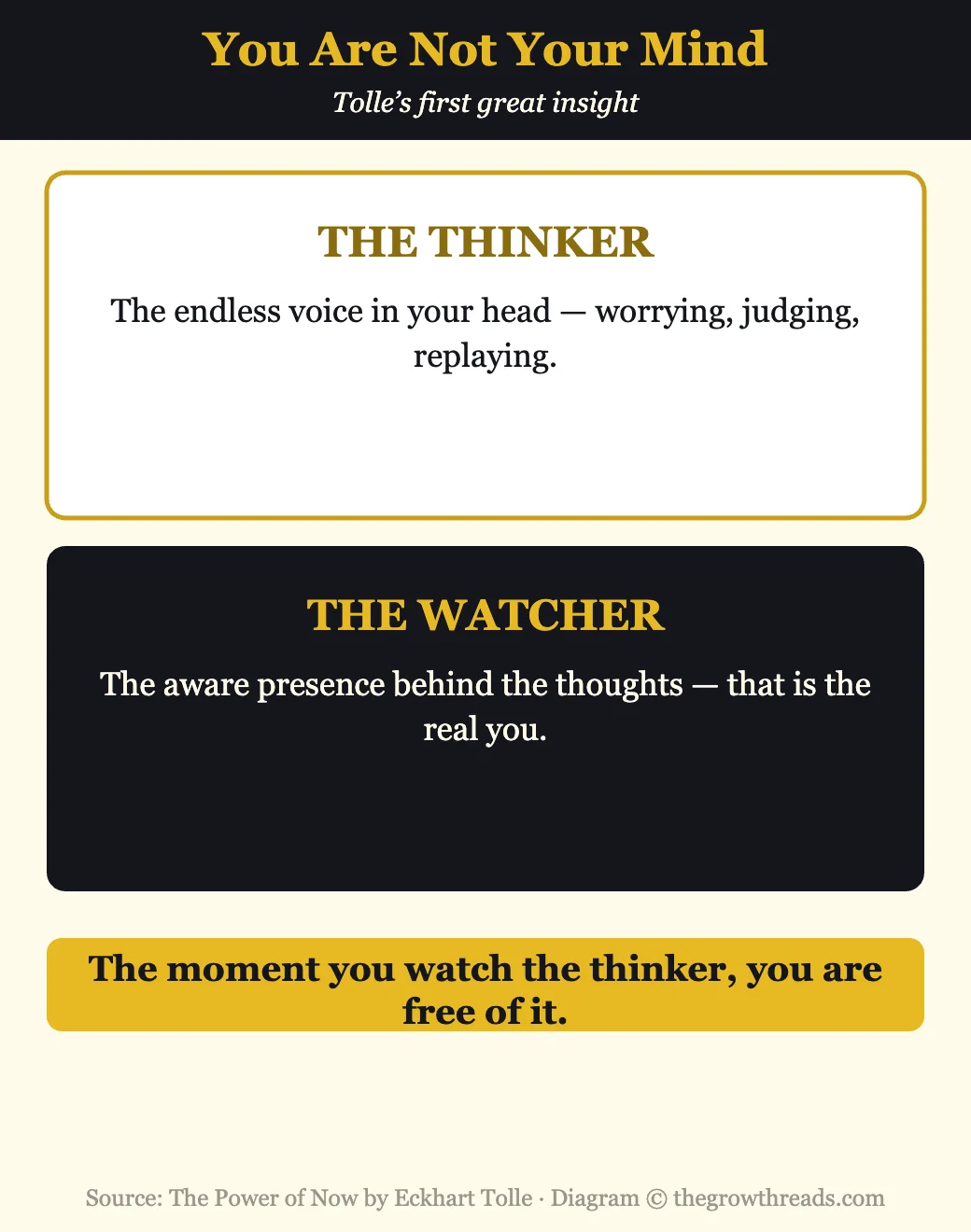
The key move is to realize that if you can observe your thoughts, then you cannot be your thoughts — you must be the awareness that is watching them. Tolle calls this “watching the thinker”: simply noticing the voice in your head as it arises, without judgment. The instant you do this, a shift occurs; a space opens between you and the thought, and you begin to sense a deeper dimension of yourself that is aware, present, and at peace, underneath all the mental noise. This awareness is who you really are. From this follows his account of the ego: the false self constructed entirely out of thought, memory, and story. The ego needs constant thinking to sustain itself and feeds on problems, grievances, and drama, which is why the mind resists the stillness of the present. Freeing yourself begins with disidentifying from the thinking mind and recognizing the aware presence behind it.
Part 2: The present moment is all there is
If the mind is the problem, the present moment is the solution, because thinking pulls us out of the Now and into mental time. Tolle draws a sharp distinction between two kinds of time. “Clock time” is practical and necessary — appointments, plans, learning from the past. “Psychological time,” by contrast, is the mind’s compulsive dwelling in past and future, and it is the source of our discontent.
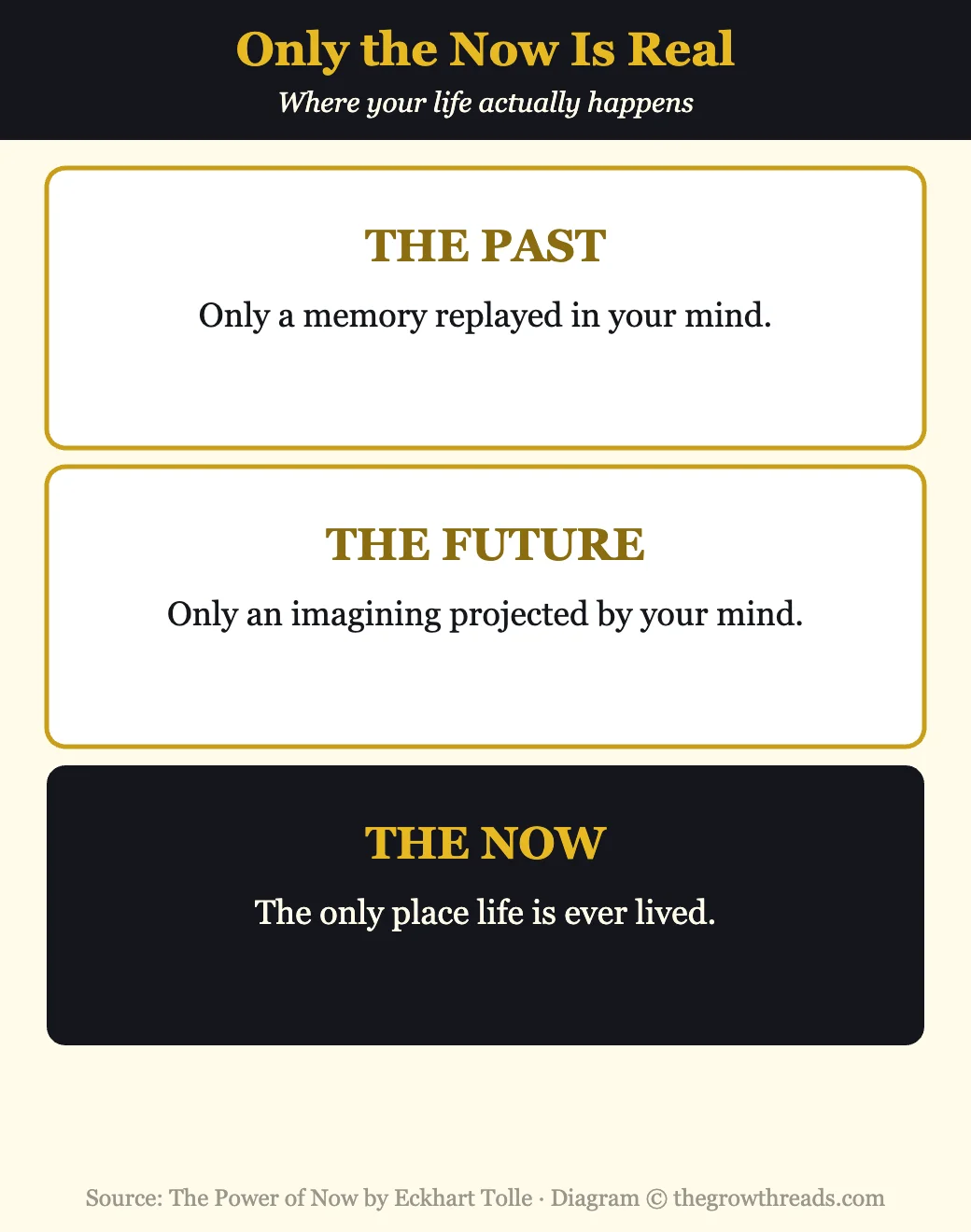
His central insight is that the past and the future have no reality of their own; the past is only a memory arising in the present, and the future is only an imagining arising in the present. The Now is the only moment that is ever actually real — life always happens now, and it never happens at any other time. Yet we spend our lives mentally somewhere else, treating the present as a mere stepping-stone to some future moment when things will finally be okay. Tolle’s radical suggestion is to make the present moment the primary focus of your life. When you give your full, alert attention to the Now — really being here, in this moment, rather than thinking about it — the mental noise quiets and a deep sense of peace becomes available. Problems, he points out, cannot exist in the present moment; they exist only as thoughts about the past or future. In the Now, there is only the situation you are dealing with, which you can act on, or accept.
TGR Note: Tolle’s “life only happens now” is the spiritual version of the closing message of The Courage to Be Disliked — that life is a series of present moments and you can be at peace now — and it echoes the Japanese ichi-go ichi-e celebrated in Ikigai: treasure this moment, for it will never return. Three very different books, one insistence on presence.
Part 3: The pain-body and the ego
Tolle introduces one of his most distinctive ideas: the “pain-body.” Over a lifetime, he argues, we accumulate emotional pain that is not fully faced and released — old hurts, grief, anger, and trauma — and this residue forms a kind of semi-autonomous energy field within us. The pain-body lies dormant much of the time, but it periodically awakens and takes us over, and when it does, it actively seeks out more pain to feed on, provoking conflict, replaying old wounds, and generating negative emotion, because it sustains itself on suffering. Much of the drama in our lives and relationships, in this view, is the pain-body feeding.
The way to dissolve the pain-body is not to fight it, analyze it, or act it out, but to bring the light of presence to it. When you feel the pain-body rising — a wave of old, disproportionate emotion — you observe it, feel it fully as an energy in the body, and stay present with it without identifying with it or letting it think through you. This conscious attention, Tolle says, breaks the cycle: the pain-body cannot survive being watched, because your presence is a higher state of consciousness that it cannot feed on. This is deeply connected to the ego, which is also sustained by unconsciousness and thought. Both the ego and the pain-body thrive when you are lost in your mind, and both weaken when you become present. The practical upshot is that the same simple act — bringing alert, non-judgmental awareness to the present moment and to your inner state — is the master key that loosens the grip of compulsive thinking, ego, and stored pain alike.
Part 4: Surrender and presence — the practices
The book’s later chapters turn toward practice and toward its subtlest idea: surrender. By surrender, Tolle does not mean passivity, resignation, or giving up. He means the inner acceptance of what is — ceasing to resist the present moment as it actually is, right now.
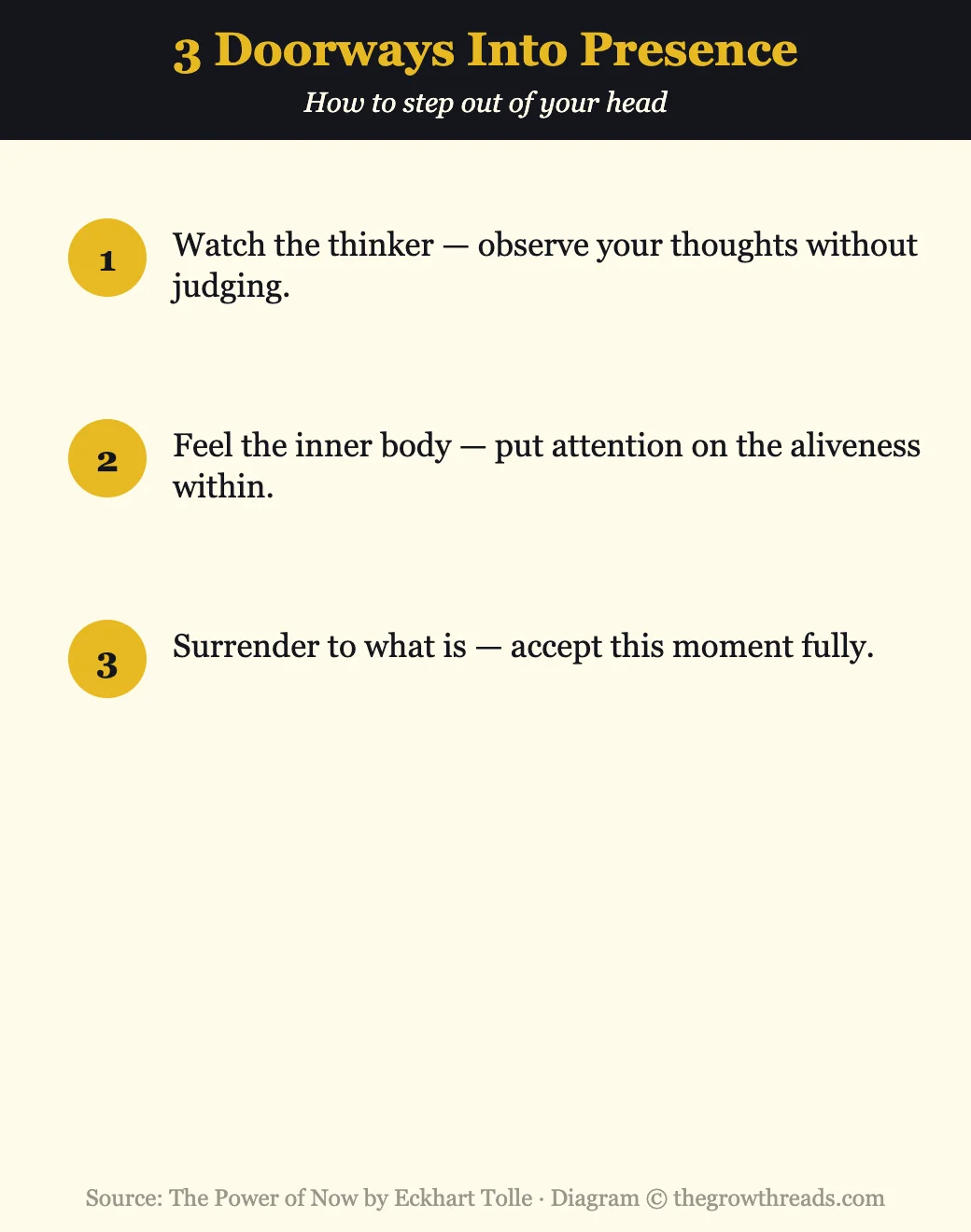
So much of our suffering, he argues, comes not from our circumstances themselves but from our mental resistance to them — the endless “this shouldn’t be happening.” When you drop that resistance and fully accept the present moment, an inner struggle ends, and you can then respond to the situation from a place of clarity and peace rather than reactive negativity. Crucially, surrender to the present does not mean you cannot act to change your circumstances; it means you act without the toxic inner opposition that clouds judgment. He offers concrete doorways into presence for daily life: watch the thinker, observing your thoughts as they arise; feel the “inner body,” directing attention to the subtle aliveness within your hands, limbs, and whole body, which instantly anchors you in the Now; and practice acceptance of whatever the present moment contains. Presence, he suggests, can be brought to any activity, however mundane — washing dishes, walking, listening — transforming ordinary life into a spiritual practice. The writing is undeniably repetitive and abstract, and skeptical readers may find its claims unfalsifiable and its tone grandiose. But the core practice it teaches — stepping out of the compulsive mind and into aware presence — is simple, real, and, for a great many readers, life-changing.
Who is The Power of Now best for — and who should read something else first?
This book is ideal for anyone worn down by an anxious, overthinking mind who is open to a spiritual, rather than clinical, path to peace, and for readers drawn to mindfulness and presence. Its central practice is genuinely powerful. It is not for you if you want practical, evidence-based psychology or find abstract, repetitive, spiritual language off-putting — many readers bounce off its tone. If you want a more grounded route to the same present-moment calm, a secular mindfulness practice may suit you better, and for the philosophy of living in the now without the metaphysics, try The Courage to Be Disliked.
Questions to reflect on
- How much of your day is spent lost in thought about the past or future rather than in the present?
- Can you catch the “voice in your head” right now — and notice that you are the one hearing it?
- What are you resisting about this present moment that you could instead accept?
- When does your “pain-body” — a wave of old, disproportionate emotion — tend to take you over?
- What ordinary daily activity could you turn into a practice of presence?
🔥 Ready to step out of your head?
This guide is the map — Tolle’s teaching is meant to be felt, not just understood.
How to apply The Power of Now (7-day plan)
- Day 1 — Watch the thinker. Several times today, simply notice the voice in your head without judging it.
- Day 2 — Feel the inner body. Close your eyes and place attention on the aliveness in your hands, then your whole body.
- Day 3 — Anchor in the Now. Pick one routine task and do it with complete, present attention.
- Day 4 — Notice psychological time. Catch yourself replaying the past or worrying about the future and return to now.
- Day 5 — Practice surrender. Take one thing you’re resisting and fully accept it as it is, then respond calmly.
- Day 6 — Meet the pain-body. When a wave of old emotion rises, feel it as energy and stay present with it.
- Day 7 — Presence in the ordinary. Turn one everyday activity — a walk, a meal — into a moment of pure presence.
Frequently asked questions
Is The Power of Now worth reading?
For the right reader, yes — many describe it as life-changing. Its central teaching, that you are not your compulsive thinking and that presence in the Now is the path to peace, is simple, profound, and genuinely useful for an anxious, overactive mind. The important caveat is that it is a spiritual book: it is abstract, repetitive, and non-scientific in tone, and readers who want practical, evidence-based psychology often find it vague or grandiose. If you are open to a mindfulness-based, spiritual approach, it can be transformative; if not, it may frustrate you.
What is the main message of The Power of Now?
That most human suffering is self-created by the mind’s compulsive dwelling on the past and future, and that freedom and peace are found by living in the present moment. Tolle teaches that you are not your thoughts but the awareness behind them, and that by observing your thinking, feeling your inner aliveness, and accepting the present as it is, you can step out of the mind’s grip into a state of deep presence and stillness. The Now, he insists, is all there ever is.
What does “you are not your mind” mean?
It means that the constant stream of thoughts in your head is not your true self. Tolle argues that if you can observe your thoughts, you must be something other than them — you are the awareness that watches the thinking. Most people are so identified with this inner voice that they mistake it for who they are, and that identification is the root of their suffering. Recognizing yourself as the aware presence behind thought, rather than the thought itself, is the first step toward inner freedom.
What is the pain-body in The Power of Now?
The pain-body is Tolle’s term for the accumulation of unresolved past emotional pain that lives on within us as a kind of semi-autonomous energy. It lies dormant much of the time but periodically awakens and takes us over, and when active it seeks out more suffering to feed on — provoking conflict and negative emotion. Tolle says the way to dissolve it is not to fight or analyze it but to bring present, non-judgmental awareness to it, because the pain-body cannot survive the light of your conscious presence.
Is The Power of Now religious?
Not in a denominational sense. Tolle draws on ideas from Buddhism, Zen, Christian mysticism, Sufism, and other traditions, but he does not belong to or promote any particular religion, and the book is better described as spiritual than religious. Its focus is on a direct shift in consciousness — becoming present — rather than on beliefs, doctrines, or worship. Readers of any faith or none can engage with its core practice, though those who dislike spiritual or mystical language may find the framing difficult regardless.
How long does it take to read The Power of Now?
The book is around 230 pages and most readers finish it in about five hours, though its dense, meditative style leads many to read it slowly and revisit sections. Some treat it less as a book to finish and more as a practice to return to. Our summary above captures the core teaching in roughly 15 minutes, which is a useful way to understand the ideas, though the book itself aims at an experience rather than mere comprehension.
Can The Power of Now help with anxiety?
Many readers find its practices — watching the thinker, feeling the inner body, returning to the present — genuinely calming, since anxiety is largely fueled by the mind’s projection into an imagined future, and presence interrupts that. However, the book is a spiritual guide, not a clinical treatment, and it should not replace professional help for significant anxiety, depression, or other mental health conditions. Used as a complement to appropriate care, its emphasis on present-moment awareness overlaps with well-established mindfulness approaches.
Related summaries
- The Courage to Be Disliked Summary — living in the now, philosophically.
- Ikigai Summary — treasuring the present moment.
- The Subtle Art of Not Giving a F*ck Summary — acceptance over resistance.
- Browse all our best psychology books.
How we analyze books: We work from the full book — reconstructing its core arguments in our own words, adding commentary that connects it to related research and other books in our library, and pressure-testing the advice against how it plays out in real life. We never reproduce the text; we synthesize it. Read our full methodology.
Disclosure: The Growth Reads is reader-supported. When you buy through links on our site we may earn an affiliate commission at no extra cost to you. We only recommend books we believe are worth your time, and our summaries and opinions are written independently.