

★★★★½ 4.5/5 — a fascinating, story-driven investigation into how habits work and how to change them, spanning individuals, companies, and whole societies.
Best for: anyone who wants to understand the science of habit before trying to change one · Reading time: ~7 hours (this guide: 16 min) · Difficulty to apply: Moderate — the loop is simple to grasp; diagnosing your own cues takes work
The Power of Habit in one minute
Habits aren’t destiny — once you understand the loop that drives them, you can rebuild them. Journalist Charles Duhigg explains that every habit runs on a three-part neurological loop: a cue that triggers the behavior, a routine you perform, and a reward that satisfies a craving and teaches your brain to repeat the loop. Because roughly 40% of our daily actions are habits rather than decisions, understanding this loop is enormously powerful. The key to change, Duhigg argues, is the “Golden Rule”: you can’t erase a habit, but you can keep the same cue and reward while swapping the routine in the middle for a better one. He then widens the lens dramatically, showing how “keystone habits” cascade into broad life change, how the same principles transformed companies like Alcoa and Starbucks, and how habits shape social movements. Blending compelling stories with real science, it is less a step-by-step manual than a deep, illuminating tour of why we do what we do.
Key takeaways
- The habit loop: every habit is a loop of cue, routine, and reward — understanding it is the key to changing any habit.
- Craving drives habits: the loop becomes automatic when your brain starts anticipating the reward, creating a craving.
- The Golden Rule of habit change: keep the same cue and reward, but replace the routine in the middle.
- Habits are never erased, only overwritten: old habits lurk and can resurface, so new routines must be practiced and believed.
- Belief helps change stick: especially in groups, believing change is possible makes new habits durable.
- Keystone habits cascade: some habits (like exercise) trigger a chain of other positive changes.
- Willpower is a keystone habit: it works like a muscle that strengthens with practice but tires with overuse.
- Organizations run on habits: companies have institutional routines, and changing one keystone habit can transform a business.
- Businesses exploit your habits: from Febreze to Target, companies engineer cues and rewards to shape consumer behavior.
- You are responsible for your habits: once you know a habit exists and how it works, you have the power — and the responsibility — to change it.
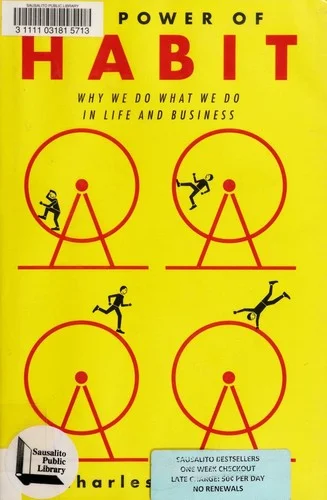
What is The Power of Habit about?
The Power of Habit is a book by Charles Duhigg about the science of how habits form and how they can be changed. It introduces the “habit loop” of cue, routine, and reward, and explores how habits operate not just in individuals but in organizations and societies, drawing on research and vivid real-world stories.
About the author
Charles Duhigg is an American journalist and author who spent years as a reporter for The New York Times, where he was part of a team that won a Pulitzer Prize. He specializes in translating complex research in psychology, neuroscience, and business into gripping narrative nonfiction. Published in 2012, The Power of Habit was his first book and became a major international bestseller, helping to spark the wave of popular interest in habit science that later books built upon. Duhigg went on to write Smarter Faster Better and Supercommunicators. His signature style is on full display here: each idea is anchored by a memorable story — a Febreze marketing turnaround, a hospital’s fatal routine, a civil-rights boycott — so that the science arrives wrapped in a narrative you don’t want to put down. He writes as an investigator and storyteller rather than a self-help coach, which gives the book its depth and credibility. Explore all Charles Duhigg book summaries →
Key concepts at a glance
| Concept | What it means | Use it when |
|---|---|---|
| The habit loop | Cue, routine, reward | Analyzing any habit |
| Craving | The anticipation that drives the loop | Understanding why a habit sticks |
| Golden Rule | Keep cue and reward, change routine | Breaking a bad habit |
| Keystone habit | A habit that triggers others | Choosing where to start |
| Willpower | A muscle-like keystone habit | Building self-discipline |
| Institutional habits | An organization’s routines | Changing a team or company |
Part 1: The habit loop — how habits work
Duhigg’s central discovery, drawn from neuroscience, is that habits are stored deep in a part of the brain called the basal ganglia, and that they follow a consistent three-step loop. First comes a cue — a trigger that tells your brain to go into automatic mode and which habit to use. Then comes the routine — the physical, mental, or emotional behavior itself. Finally comes the reward — which helps your brain decide whether this particular loop is worth remembering.
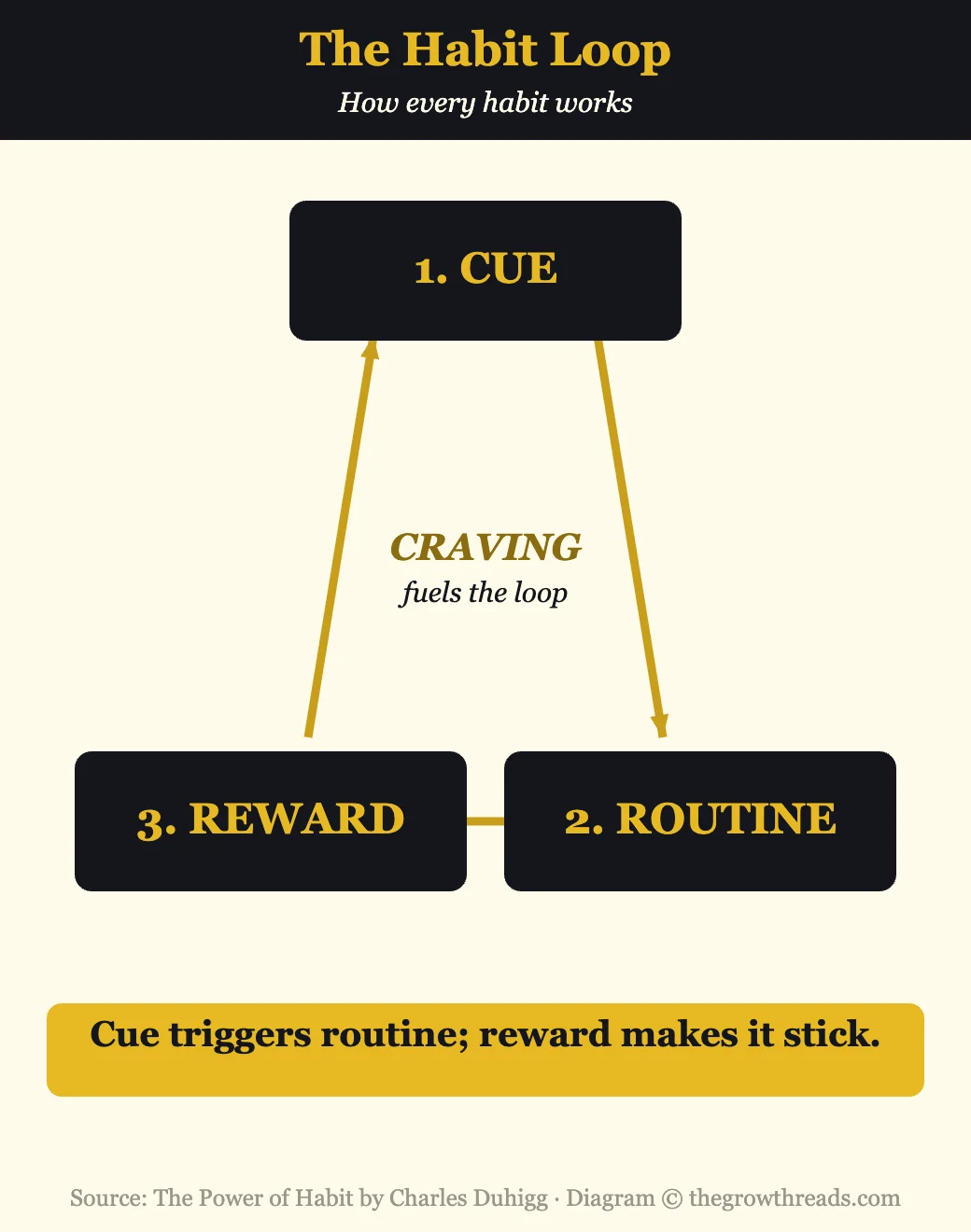
Over time, this loop becomes so automatic that the cue and reward become intertwined and a powerful sense of anticipation and craving emerges — the real engine that makes a habit compulsive. Duhigg illustrates all this with the story of how a marketing pioneer made Pepsodent toothpaste a national habit by creating a craving (a tingling, clean feeling) tied to a cue (the film on your teeth), and how, decades later, a similar craving rescued the failing product Febreze. Understanding this architecture is the foundation of change, because once you can identify the cue and the reward driving an unwanted habit, you can apply the book’s key practical tool.
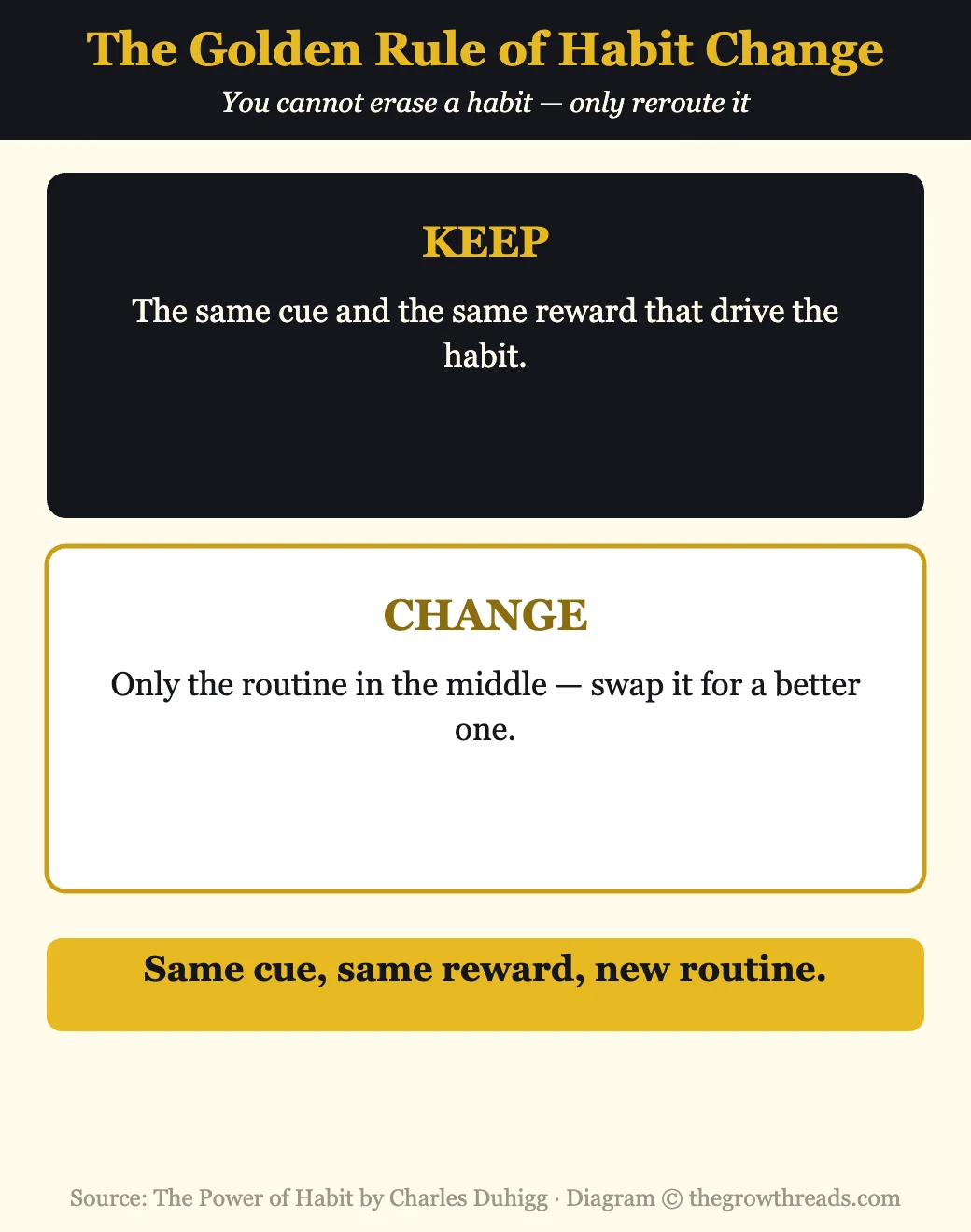
That tool is the Golden Rule of Habit Change: you cannot truly extinguish a habit, but you can change it by keeping the same cue and the same reward while inserting a new routine in the middle. If stress (cue) sends you to the vending machine for a candy bar (routine) to get a moment’s break and comfort (reward), you can keep the cue and the reward — the break, the comfort — but swap the routine for a walk or a chat. Duhigg notes, using the example of how Alcoholics Anonymous works, that this substitution is far more powerful when paired with belief, especially the support of a community that believes change is possible. Old habits are never fully deleted, so the new routine must be practiced until it, too, becomes automatic.
TGR Note: The Power of Habit is the science; Atomic Habits is the system built on top of it. James Clear takes Duhigg’s cue-routine-reward loop, refines it into cue-craving-response-reward, and turns it into a step-by-step method for designing habits. Read Duhigg to understand why habits work, then Clear for exactly how to install them.
Part 2: Keystone habits and willpower
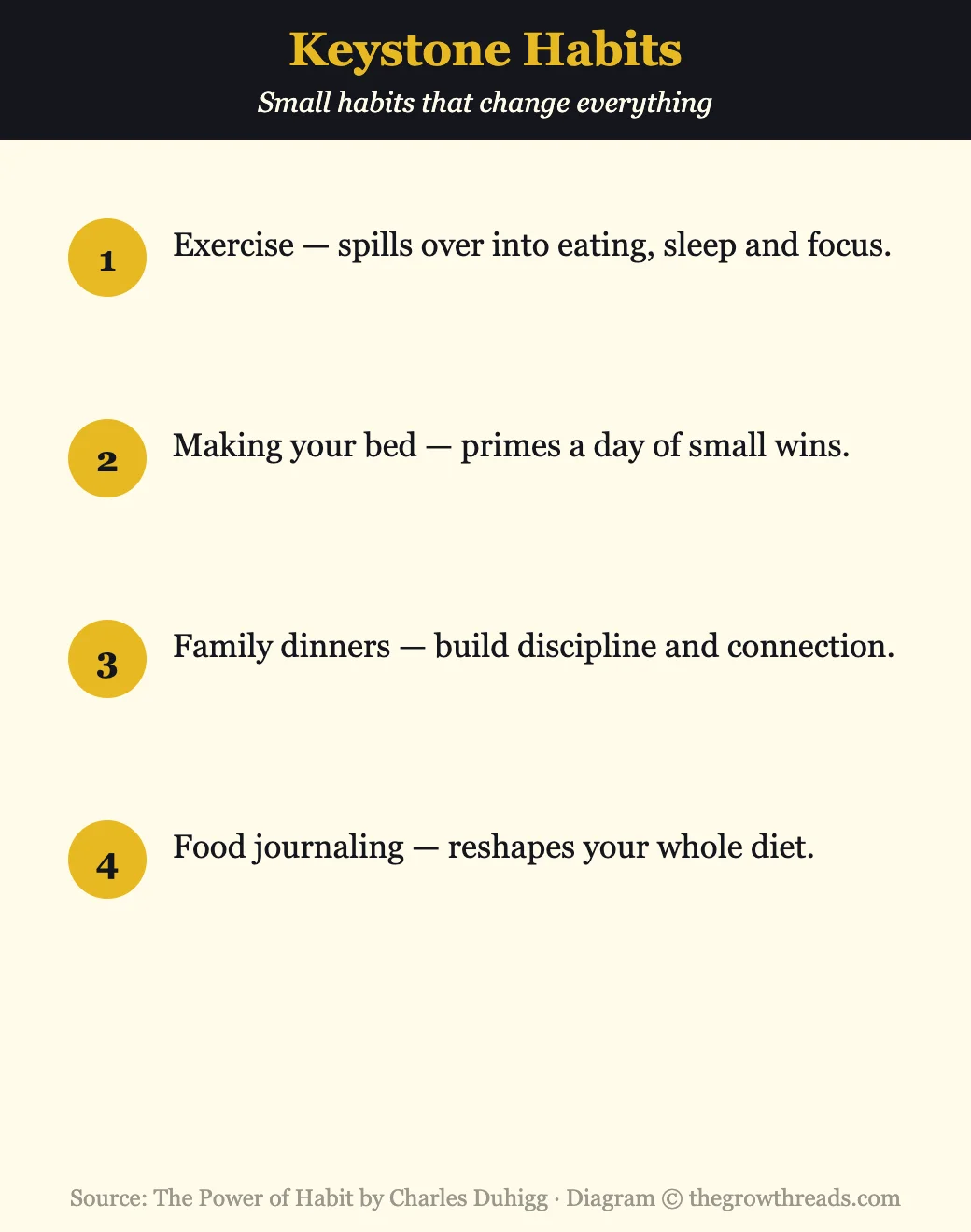
Not all habits are created equal. Duhigg introduces the powerful idea of “keystone habits” — certain habits that, when changed, set off a chain reaction that shifts many other behaviors. Exercise is a classic example: people who start exercising regularly often, without intending to, begin eating better, smoking less, procrastinating less, and feeling more patient with their families. The keystone habit creates small wins and a new self-image that ripple outward. This is why change efforts should focus not on tackling everything at once, but on identifying the one keystone habit that will pull others along with it. He shows the same principle at the organizational level, most memorably in the story of Paul O’Neill, who turned around the aluminum giant Alcoa by relentlessly focusing on a single keystone habit — worker safety — which forced improvements in communication, processes, and culture that ultimately transformed the whole company’s performance.
Duhigg singles out one keystone habit as especially important: willpower. Drawing on research, he describes willpower as behaving like a muscle — it can be strengthened through practice, but it also fatigues with use, so a day of resisting temptations leaves less self-control for the evening. Crucially, he shows that willpower can be made habitual and more resilient by planning in advance for moments of difficulty — deciding ahead of time how you will respond to a specific cue, so that self-control does not depend on in-the-moment effort. Companies like Starbucks, he notes, built their training around teaching employees willpower habits for handling stressful moments. The lesson is that discipline is not just an innate trait you either have or lack; it is a keystone habit you can deliberately build, and doing so pays dividends across your entire life.
TGR Note: Duhigg’s keystone-habit idea explains why The 5 AM Club and The 7 Habits both bet everything on one or two foundational routines. Change the right keystone — a morning routine, “put first things first” — and the rest of your life reorganizes around it. It is the same leverage from three different angles.
Part 3: The habits of successful organizations
The book’s second act argues that organizations, like people, are governed by habits — the institutional routines that determine how a company actually behaves, often far more than its official policies do. Duhigg shows how these institutional habits can be dangerous when they go unexamined: he recounts how a hospital’s ingrained routines and hierarchies contributed to a catastrophic surgical error, and how firms can drift into disaster because “that’s how we’ve always done it.” But he also shows their upside. Beyond the Alcoa turnaround, he explores how a moment of crisis can become the opening to reset an organization’s bad habits, because disruption temporarily loosens the grip of routine and lets a leader install better ones.
He also turns to how businesses exploit our personal habits with unsettling sophistication. In one of the book’s most talked-about sections, he describes how the retailer Target used shopping-data analysis to identify customers’ habit patterns — even predicting, from subtle shifts in purchases, which shoppers were likely pregnant — so it could target them with advertising at the exact life moment when their buying habits were most malleable. The larger point is that companies understand the habit loop intimately and design cues and rewards to shape what we buy, listen to, and do, frequently without our awareness. Understanding the science of habit, then, is not only a tool for self-improvement but a form of literacy that helps you see, and resist, the ways your habits are being engineered by others.
Part 4: The habits of societies — and free will
In its final act, Duhigg zooms out to the largest scale: the habits of whole societies. His centerpiece is the Montgomery bus boycott that ignited the American civil-rights movement, which he analyzes not just as a moral awakening but as a social phenomenon driven by habit and social ties. He argues that movements grow through a specific pattern: they start with the strong ties of close friendship (Rosa Parks was deeply embedded in her community), spread through the weak ties of acquaintance and peer pressure, and endure when leaders give participants new habits and a new sense of identity that let the movement sustain itself. Social habits, in other words, follow their own version of the loop.
He closes with a thoughtful meditation on free will and moral responsibility. If so much of what we do is automatic, are we responsible for our habits? Duhigg contrasts two real cases — a man who committed a terrible act while sleepwalking, and a woman who gambled away a fortune — to explore where habit ends and choice begins. His conclusion is a hopeful and demanding one: while habits operate automatically, once you become aware that a habit exists and understand its loop, you gain both the power and the responsibility to change it. Awareness converts an automatic behavior back into a choice. This is the book’s ultimate message: habits are powerful and pervasive, running individuals, companies, and societies, but they are not fixed. With knowledge of how the loop works, and the effort to rebuild it, transformation is always possible. The book is more explanatory than prescriptive — you may finish it understanding habits deeply but still wanting a concrete plan — but as a rich, science-backed account of why we do what we do, it is outstanding.
Who is The Power of Habit best for — and who should read something else first?
This book is ideal for curious readers who want to understand the science and stories behind habit — including how habits shape business and society — before or alongside trying to change their own. Its narrative style makes it a genuine page-turner. It is not the best choice if you want a lean, step-by-step how-to manual, since it is more explanatory than tactical and ranges far beyond personal habits. For a practical system to actually build and break habits, read Atomic Habits, which pairs perfectly with this book — Duhigg for the why, Clear for the how.
Questions to reflect on
- Take one bad habit — what is its cue, and what reward is it really giving you?
- What new routine could deliver the same reward in response to the same cue?
- What one keystone habit, if you built it, might cascade into other good changes?
- When is your willpower most depleted, and how could you plan for those moments in advance?
- Where are companies engineering your habits — and are you aware of it as it happens?
🔥 Ready to rewrite your habit loops?
This guide is the map — Duhigg’s stories are what make the science unforgettable.
How to apply The Power of Habit (7-day plan)
- Day 1 — Map a habit loop. Pick one habit and identify its cue, routine, and reward.
- Day 2 — Find the real reward. Experiment to learn what craving your habit actually satisfies.
- Day 3 — Isolate the cue. Notice what reliably triggers the habit — time, place, emotion, people, or preceding action.
- Day 4 — Apply the Golden Rule. Keep the cue and reward, but design a better routine to swap in.
- Day 5 — Choose a keystone habit. Pick one habit likely to cascade — often exercise — and start small.
- Day 6 — Plan for willpower dips. Decide in advance how you’ll respond to one tempting cue.
- Day 7 — Recruit belief. Share your change with a supportive person or group to make it stick.
Frequently asked questions
Is The Power of Habit worth reading?
Yes. It is one of the most engaging and influential books on how habits work, blending solid science with unforgettable stories from business, medicine, and history. If you want to genuinely understand the mechanics of habit — and how habits operate not just in you but in companies and societies — it is excellent and hard to put down. The one caveat is that it is more explanatory than prescriptive: you finish it understanding habits deeply, but wanting a step-by-step plan you may need to get elsewhere. As an education in why we do what we do, it is outstanding.
What is the habit loop in The Power of Habit?
The habit loop is Duhigg’s three-part model of how every habit works: a cue triggers the brain to run an automatic routine, the routine is the behavior itself, and the reward satisfies a craving and teaches the brain to repeat the loop. Over time the brain begins anticipating the reward, creating a craving that makes the habit compulsive. Understanding these three components — and especially identifying the cue and the reward — is the essential first step to changing any habit.
What is the Golden Rule of habit change?
It is Duhigg’s core practical principle: you cannot erase a habit, but you can change it by keeping the same cue and the same reward while replacing the routine in the middle with a new behavior. If a cue like stress leads to a routine like snacking for the reward of a mental break, you keep the stress cue and the break reward but swap snacking for a walk. Duhigg adds that this substitution works best when combined with belief, particularly the support of a community that believes change is possible.
What are keystone habits?
Keystone habits are habits that, when you change them, set off a chain reaction that shifts many other behaviors. Exercise is the classic example: people who start exercising often begin eating better, sleeping more, and procrastinating less without consciously trying. Keystone habits create small wins and a new self-image that spread to other areas of life. Duhigg argues change is most effective when you focus on one keystone habit rather than trying to overhaul everything at once, and he shows the same principle transforming organizations.
How is The Power of Habit different from Atomic Habits?
They are complementary. The Power of Habit, published first, is a science-and-story exploration of how habits work in individuals, organizations, and societies — it is broader and more explanatory. Atomic Habits, by James Clear, is narrower and more practical, offering a step-by-step system for building and breaking personal habits. Duhigg explains why habits function the way they do; Clear tells you exactly what to do about it. Many readers get the most value from reading both, using Duhigg for understanding and Clear for implementation.
How long does it take to read The Power of Habit?
The book is around 370 pages and most readers finish it in about seven hours, helped along by its narrative, story-driven style. It is easy to read in sections since each chapter centers on a self-contained story. Our summary above captures the core framework and its main applications in roughly 16 minutes, which is enough to understand the habit loop and start applying it before diving into the full stories.
Does The Power of Habit tell you how to break a bad habit?
It gives you the key principle — the Golden Rule of keeping the cue and reward while changing the routine — and the diagnostic method of identifying your habit’s cue, routine, and reward. That framework genuinely helps you understand and target a bad habit. However, the book is more focused on explaining the science and telling illustrative stories than on providing a detailed, step-by-step change program. Readers who want a more tactical, exercise-driven approach often pair it with a dedicated how-to habit book.
Related summaries
- Atomic Habits Summary — the step-by-step system built on the habit loop.
- The 7 Habits Summary — foundational, principle-centered habits.
- Deep Work Summary — building a keystone focus habit.
- The One Thing Summary — the single habit that makes the rest easier.
- Browse all our best productivity books.
How we analyze books: We work from the full book — reconstructing its core arguments in our own words, adding commentary that connects it to related research and other books in our library, and pressure-testing the advice against how it plays out in real life. We never reproduce the text; we synthesize it. Read our full methodology.
Disclosure: The Growth Reads is reader-supported. When you buy through links on our site we may earn an affiliate commission at no extra cost to you. We only recommend books we believe are worth your time, and our summaries and opinions are written independently.