

⭐⭐⭐⭐⭐ 4.7 / 5 — A Holocaust survivor’s profound testament that meaning can be found in any circumstance — and that this search for meaning is humanity’s primary drive.
Best for: Anyone going through suffering, searching for purpose, or wanting to understand the deepest question of human existence: why we are here.
Reading time: ~4 hours (this guide: 14 min)
Difficulty to apply: Medium — the concepts are philosophically rich but the core practice (choosing your attitude in any situation) begins with a single decision.
Man’s Search for Meaning in one minute
Everything can be taken from a person except one thing: the freedom to choose one’s attitude in any given set of circumstances. Viktor Frankl, an Austrian psychiatrist who survived Auschwitz and three other concentration camps, wrote this book to answer a question that consumed him: why do some people survive unimaginable suffering while others give up? His answer — which became the foundation of logotherapy, the “Third Viennese School of Psychotherapy” — is that humans are driven above all by a search for meaning. Those who found meaning in their suffering (through love, creative work, or choosing a courageous attitude) survived; those who lost their sense of purpose perished. The book is half memoir, half psychology — and wholly transformative. It has sold over 16 million copies and consistently ranks among the most influential books of the twentieth century.
Key takeaways
- Meaning is the primary human motivation: Frankl argues that the will to meaning — not Freud’s will to pleasure or Adler’s will to power — is the fundamental driving force in human life.
- You always have a choice: Even in the most horrific circumstances, you retain the freedom to choose your attitude. This inner freedom cannot be taken by any external force.
- Suffering without meaning is despair: Suffering itself is not the problem — meaningless suffering is. When you can assign purpose to your pain, you can endure almost anything.
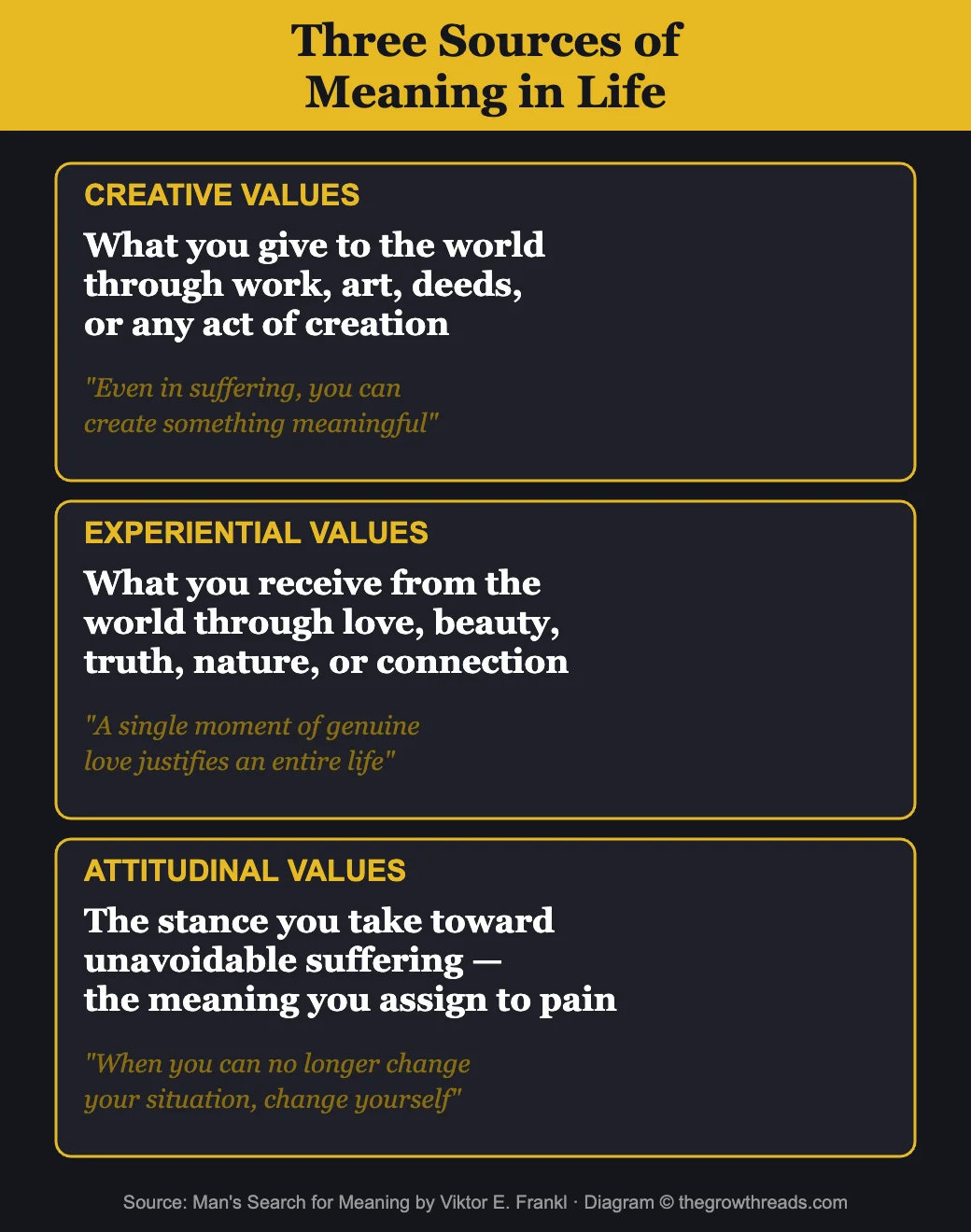
- Three sources of meaning exist: You find meaning through creative values (what you give to the world), experiential values (what you receive from the world through love and beauty), and attitudinal values (the stance you take toward unavoidable suffering).
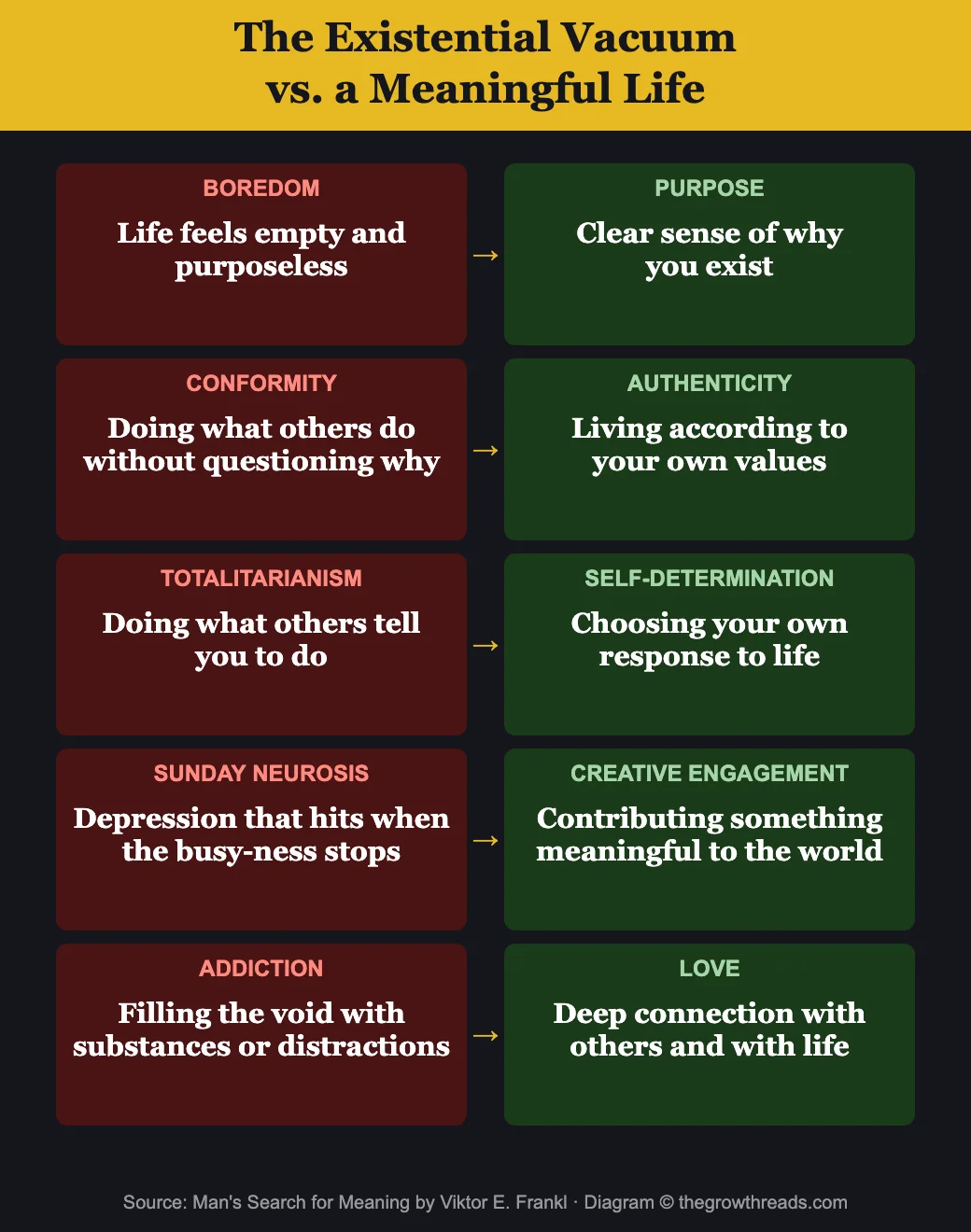
- The existential vacuum causes modern misery: Boredom, addiction, conformity, and depression often stem from a lack of meaning — an “existential vacuum” that no amount of pleasure or material success can fill.
- Don’t ask what life owes you: Instead, ask what life is asking of you. Meaning comes from responding to life’s demands, not from demanding that life satisfy you.
- Love transcends everything: Frankl discovered that even in the camps, the thought of his wife sustained him. Love is the highest goal to which a person can aspire.
- Humor is a survival weapon: Even in Auschwitz, Frankl and fellow prisoners used humor as a soul-preserving mechanism. The ability to laugh at absurdity is a uniquely human form of detachment.
- Logotherapy looks forward, not backward: Unlike Freudian psychoanalysis (which digs into the past), logotherapy focuses on the future — on the meaning yet to be fulfilled.
- Anticipatory anxiety creates what you fear: Frankl introduced “paradoxical intention” — deliberately intending the thing you fear — as a therapeutic technique that short-circuits anxiety spirals.
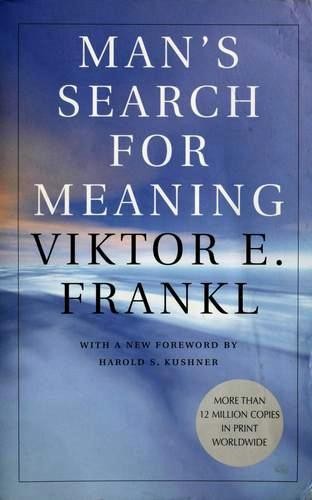
What is Man’s Search for Meaning about?
Man’s Search for Meaning is part memoir and part introduction to logotherapy, a form of psychotherapy founded by Viktor Frankl. The first half describes his experiences as a prisoner in Nazi concentration camps and the psychological observations he made about survival. The second half presents his argument that the search for meaning is the primary human motivation and outlines the therapeutic approach he developed from this insight.
About the author
Viktor Emil Frankl (1905–1997) was an Austrian neurologist, psychiatrist, and Holocaust survivor who founded logotherapy, considered the “Third Viennese School of Psychotherapy” after Freud’s psychoanalysis and Adler’s individual psychology. He earned medical and philosophy doctorates from the University of Vienna, where he studied under Freud and Adler before developing his own approach. During World War II, Frankl spent three years in four concentration camps, including Auschwitz and Dachau. His parents, brother, and pregnant wife were killed. After liberation, he wrote Man’s Search for Meaning in nine days. He went on to hold professorships at the University of Vienna and several American universities, publish 39 books translated into 50 languages, and lecture across the globe until his death at 92. The Library of Congress named Man’s Search for Meaning one of the ten most influential books in America. Explore all Viktor Frankl book summaries →
Key concepts at a glance
| Concept | What it means | Use it when |
|---|---|---|
| Logotherapy | Therapy through meaning — finding purpose as the path to psychological health | You feel empty, lost, or unsure why you exist |
| Will to Meaning | The primary human drive is to find meaning, not pleasure or power | Pleasure and achievement feel hollow |
| Attitudinal Values | Finding meaning through the stance you take toward unavoidable suffering | You face a situation you cannot change |
| Existential Vacuum | The emptiness that comes from having no clear purpose or meaning | You feel bored, restless, or purposeless despite comfort |
| Paradoxical Intention | Deliberately intending the feared outcome to break anxiety spirals | Anxiety about anxiety is making things worse |
| The Last Freedom | The freedom to choose your attitude in any circumstance | External circumstances feel overwhelming |
Part 1: Experiences in the concentration camps — the psychology of survival
Frankl approaches his camp experiences not as a memoirist but as a psychiatrist observing the psychological phases of camp life. He identifies three phases: admission (shock and disbelief), camp routine (apathy and emotional death as a survival mechanism), and liberation (the paradoxical difficulty of re-entering normal life).
During the admission phase, prisoners experienced the “delusion of reprieve” — the irrational hope that somehow they would be spared. This was followed by a radical stripping of identity: names replaced by numbers, possessions confiscated, hair shaved, dignity systematically destroyed. Frankl noticed that prisoners who clung to their former identity collapsed first; those who quickly adapted to the new reality survived.
The routine phase revealed the most critical psychological insight: apathy was not weakness but a necessary survival mechanism. Emotional numbness protected the psyche from the constant horror. But within this protective shell, the prisoners who maintained an inner life — who held onto love, humor, beauty (a sunset glimpsed through barbed wire), or a sense of purpose — fared dramatically better than those who surrendered all inner life.
Frankl describes watching prisoners decide to die. They would refuse to get up, refuse to work, refuse to eat. When asked what happened, the answer was always the same: they had lost their reason to live. Without meaning, the body followed the soul’s surrender. This observation — that meaning is literally a matter of life and death — became the empirical foundation of logotherapy.
Part 2: Logotherapy — finding meaning as therapy
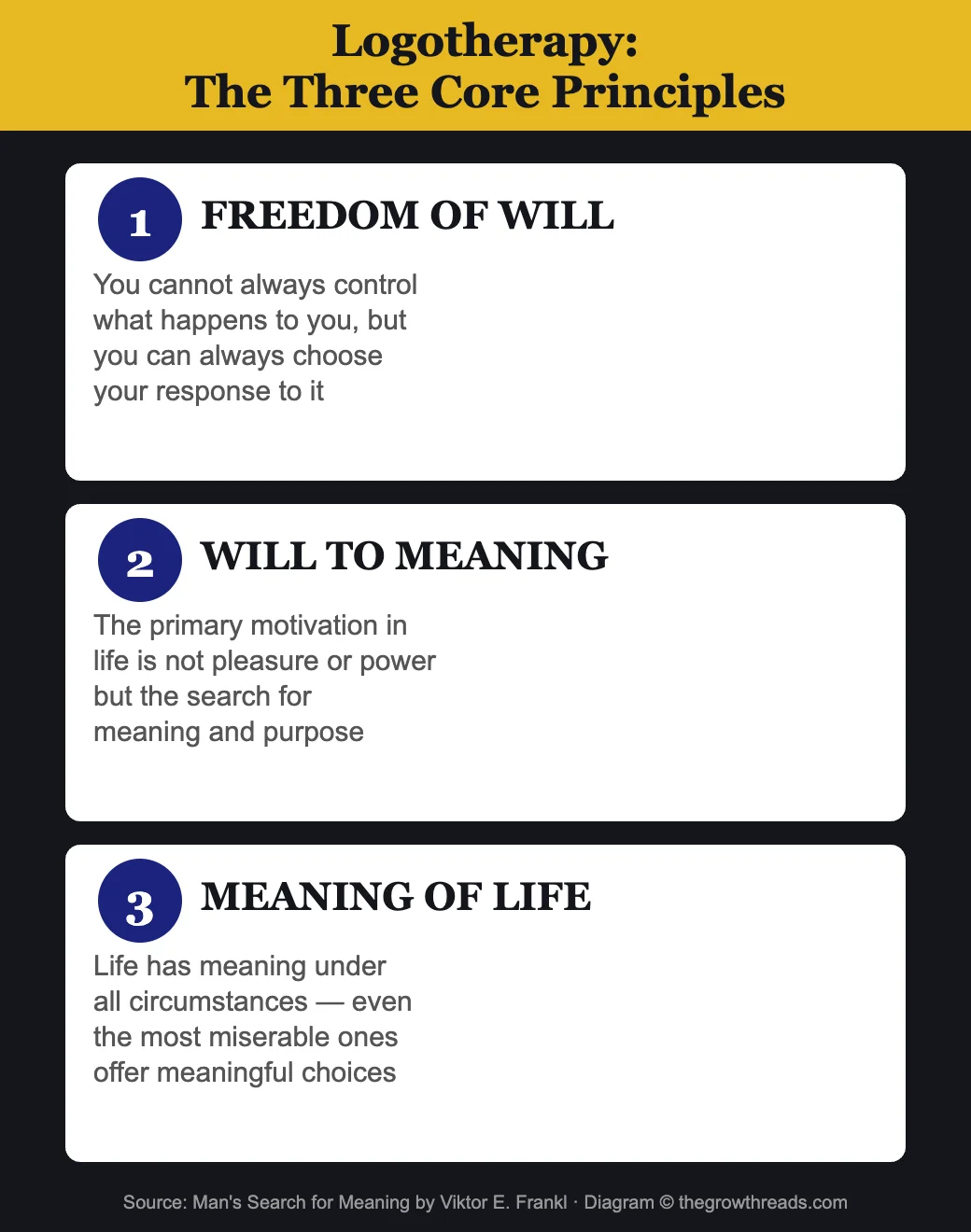
The second half of the book presents logotherapy as a formal psychological framework. Unlike Freud (who believed humans are driven by pleasure) and Adler (who believed humans are driven by power), Frankl argues that the primary human motivation is the will to meaning — the drive to find purpose and significance in life.
Frankl identifies three pathways to meaning. Creative values come from what you give to the world: your work, your art, your contributions. Experiential values come from what you receive from the world: love, beauty, truth, humor, or the experience of nature. Attitudinal values — the highest form — come from the stance you take toward unavoidable suffering. When you can no longer change your situation, you can still choose how you respond to it.
The existential vacuum is Frankl’s term for the widespread modern condition of meaninglessness. Without clear purpose, people fill the void with pleasure-seeking (hedonism), power-seeking (workaholism), or conformity (doing what everyone else does). These strategies produce temporary relief but deepen the emptiness over time. The symptoms of the existential vacuum — boredom, addiction, aggression, depression — are, in Frankl’s view, not diseases to be medicated but signals that meaning is missing.
Part 3: The last freedom — choosing your attitude
The most quoted passage from the book — “Everything can be taken from a man but one thing: the last of the human freedoms — to choose one’s attitude in any given set of circumstances, to choose one’s own way” — encapsulates Frankl’s central philosophical contribution. This is not naive optimism; it was forged in the most brutal conditions of the twentieth century.
Frankl gives concrete examples. A prisoner who knew his wife was almost certainly dead could still find meaning by continuing to love her in his imagination. A doctor who could no longer practice medicine found meaning in comforting dying prisoners. An elderly man grieving his wife’s death found relief when Frankl asked him: “What would have happened if you had died first and your wife had to survive you?” The answer — that his wife would have suffered terribly — reframed his grief as a meaningful sacrifice: by surviving her, he spared her that suffering.
This “reframing” power is the practical core of logotherapy. It doesn’t eliminate suffering but transforms it from meaningless agony into purposeful endurance. The suffering isn’t changed; the sufferer’s relationship to it is changed. And this change, Frankl argues, can transform a person’s entire psychological landscape.
Part 4: Paradoxical intention and practical applications
Frankl introduces several practical techniques. Paradoxical intention involves deliberately intending the thing you fear. An insomniac is told to try to stay awake as long as possible. A person with a sweating phobia is told to try to sweat as much as they can. By intending the feared outcome, the anticipatory anxiety that feeds the cycle is broken. Clinical studies have validated this approach for anxiety disorders, insomnia, and phobias.
Dereflection is another technique: when someone is too focused on themselves or their symptoms, Frankl redirects their attention toward a meaningful task or another person. By shifting focus from self to meaning, the symptoms often resolve on their own because they were being maintained by excessive self-observation.
The book closes with a call that resonates powerfully today: “For the meaning of life differs from man to man, from day to day and from hour to hour. What matters, therefore, is not the meaning of life in general but rather the specific meaning of a person’s life at a given moment.” You don’t discover the meaning of life through abstract philosophy — you discover it through the concrete demands each day makes of you.
Who is Man’s Search for Meaning best for — and who should read something else first?
This book is for everyone — but it’s especially transformative during periods of suffering, transition, or existential questioning. If you’re facing a crisis you can’t control, dealing with loss, or simply wondering “What’s the point of all this?”, Frankl’s answer will give you perspective that few other books can match. It’s one of those rare works that genuinely changes how you see the world.
If you want a more practical, day-to-day application of meaning-driven living, The Power of Now addresses present-moment awareness, while 12 Rules for Life provides structure for finding order in chaos. For understanding how grit and purpose interact, Grit builds on Frankl’s insight that purpose-driven effort sustains through adversity.
Questions to reflect on
- What is the specific meaning of YOUR life at this particular moment — what is life asking of you right now?
- When you face unavoidable suffering, do you assign it meaning or let it become meaningless despair?
- Are you filling an existential vacuum with pleasure, busyness, or conformity — and what would genuine meaning feel like instead?
- What would you do if you knew you had only one year to live — and what does that answer tell you about your current priorities?
- Can you think of a time when choosing your attitude transformed a difficult situation — even though nothing external changed?
🔥 Ready to discover what gives your life meaning?
A book that has helped 16 million people find purpose in even the darkest circumstances.
How to apply Man’s Search for Meaning (7-day plan)
- Day 1 — Ask the question. At the end of today, ask yourself: “What did life ask of me today — and how did I respond?” Write the answer in a journal.
- Day 2 — Find creative meaning. Identify one way you contributed something meaningful today — a piece of work, a kind act, a problem solved. If you can’t find one, create one deliberately tomorrow.
- Day 3 — Find experiential meaning. Notice one moment of genuine beauty, love, or truth today. A sunset, a conversation, a piece of music. Be fully present in that moment.
- Day 4 — Practice attitudinal values. Identify one situation you cannot change. Instead of resisting it, ask: “What attitude can I choose that would give this difficulty meaning?”
- Day 5 — Examine your existential vacuum. List the activities you use to avoid boredom or emptiness. For each, ask: “Am I doing this because it’s meaningful, or because I’m avoiding the question of meaning?”
- Day 6 — Try paradoxical intention. Identify one small fear or anxiety. Instead of trying to suppress it, deliberately intend it: “I will try to be as anxious as possible.” Notice what happens to the anxiety.
- Day 7 — Write your meaning statement. In one paragraph, answer: “The specific meaning of my life right now is…” Don’t aim for a permanent answer — aim for what’s true today.
Frequently asked questions
What is logotherapy?
Logotherapy is a form of psychotherapy founded by Viktor Frankl that focuses on finding meaning as the path to psychological health. The word comes from the Greek “logos” (meaning). Unlike Freudian psychoanalysis (which looks backward at past trauma) or behavioral therapy (which modifies observable behavior), logotherapy looks forward — helping patients discover the meaning that is waiting to be fulfilled in their specific life circumstances. It’s considered the “Third Viennese School of Psychotherapy” after Freud and Adler.
What is the main message of the book?
The central message is that meaning can be found in any circumstance — even the most terrible — and that this search for meaning is the primary driving force in human life. Frankl argues that when you find a reason to live (through creative work, love, or choosing your attitude toward suffering), you can endure almost any hardship. The freedom to choose your attitude is the one freedom that can never be taken from you, regardless of external circumstances.
What are the three sources of meaning?
Frankl identifies three pathways: Creative values (what you give to the world through work, art, or deeds), Experiential values (what you receive from the world through love, beauty, nature, or truth), and Attitudinal values (the stance you take toward unavoidable suffering). Attitudinal values represent the highest form because they remain available even when creative and experiential possibilities have been stripped away — as in the concentration camps.
What is the existential vacuum?
The existential vacuum is Frankl’s term for the widespread modern condition of meaninglessness — a deep sense of emptiness and purposelessness. He observed that many people in affluent societies suffer from boredom, addiction, aggression, and depression not because they lack comfort but because they lack meaning. The vacuum manifests as “Sunday neurosis” — the depression that hits when the busyness of the workweek stops and the question of meaning can no longer be avoided.
What is paradoxical intention?
Paradoxical intention is a logotherapeutic technique where you deliberately intend the thing you fear. An insomniac tries to stay awake as long as possible; a person afraid of blushing tries to blush as visibly as they can. By intentionally pursuing the feared outcome, the anticipatory anxiety that feeds the cycle is broken. The technique works because anxiety often persists through avoidance — confronting the fear directly, even humorously, dissolves its power.
Is this book depressing to read?
Despite describing some of the worst conditions in human history, most readers describe Man’s Search for Meaning as profoundly uplifting. The camp experiences are described with clinical detachment rather than graphic detail, and the overall message is deeply hopeful: meaning exists in all circumstances, love transcends suffering, and you always retain the freedom to choose your attitude. Many readers call it the most inspiring book they’ve ever read.
How long does it take to read?
The book is approximately 184 pages and takes about 4 hours to read. Frankl writes with remarkable clarity and economy — every sentence carries weight. The first half (the camp memoir) reads quickly due to its narrative power. The second half (the logotherapy introduction) is more conceptual but equally concise. The audiobook runs about 5 hours and is deeply moving in audio format.
Related summaries
If you enjoyed this summary, explore more from our best psychology books collection:
- The Power of Now Summary — finding meaning in present-moment awareness.
- The Courage to Be Disliked Summary — Adlerian psychology for everyday courage.
- The Subtle Art Summary — choosing what matters in a world of infinite choices.
- 12 Rules for Life Summary — finding order and meaning in chaos.