

⭐⭐⭐⭐ 4.3/5
One-liner: A data-driven deep dive into the traits, habits, and choices that separate self-made millionaires from everyone else.
Best for: Anyone curious about what actually drives wealth accumulation beyond earning a high income.
Reading time: ~6 hrs (416 pages)
Difficulty to apply: Moderate — the principles are simple but require long-term consistency.
The Millionaire Mind in one minute
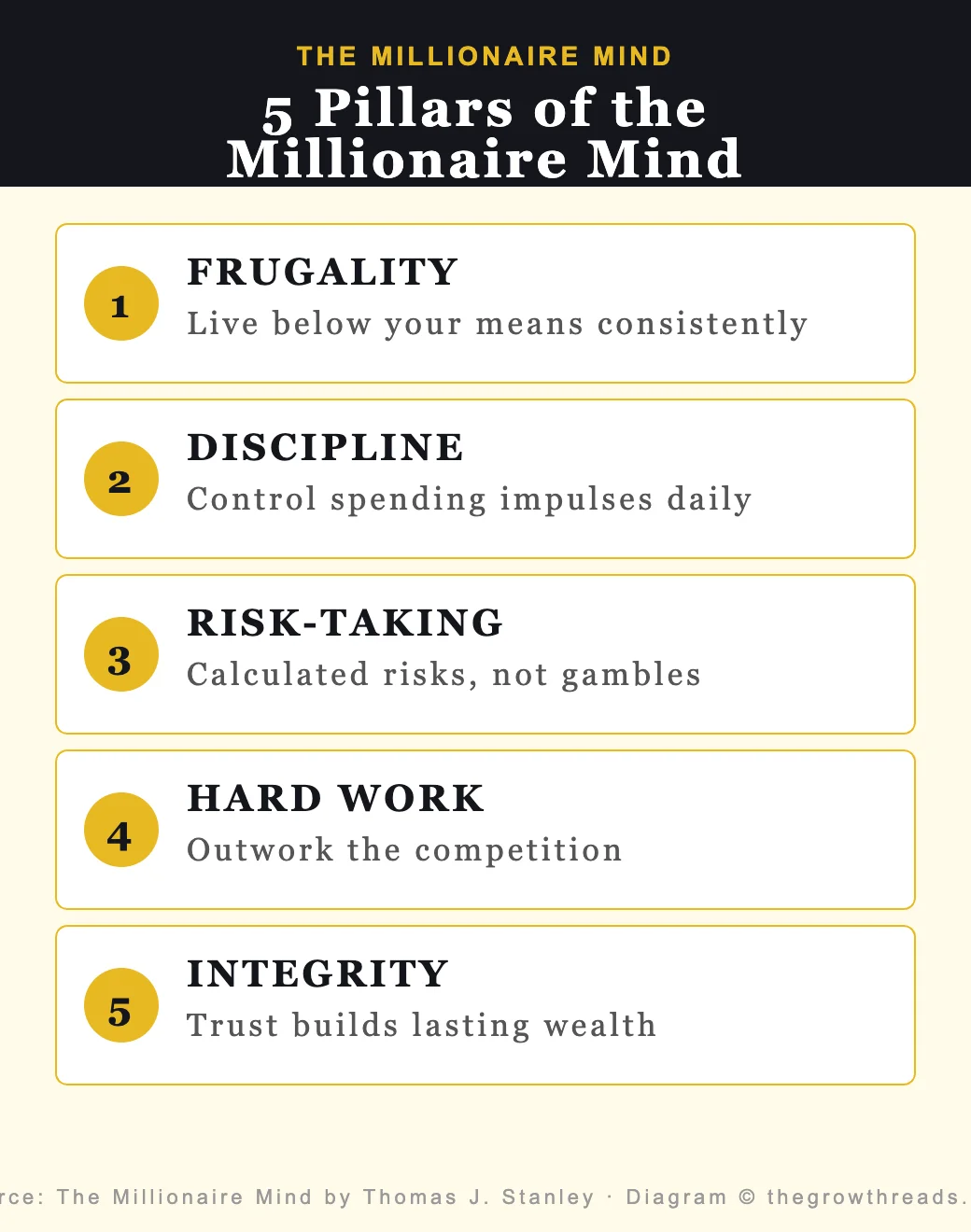
Most millionaires don’t look like millionaires. Thomas Stanley surveyed over 1,300 millionaires and found a pattern that contradicts almost everything popular culture teaches about wealth. The typical millionaire lives in a modest home, drives a reliable car, avoids status purchases, and built wealth through discipline rather than inheritance or a massive salary. They chose careers they love, married supportive spouses, took calculated risks, and lived well below their means for decades. The Millionaire Mind is the companion volume to The Millionaire Next Door, going deeper into the psychology and decision-making frameworks that produce lasting financial independence.
Key takeaways
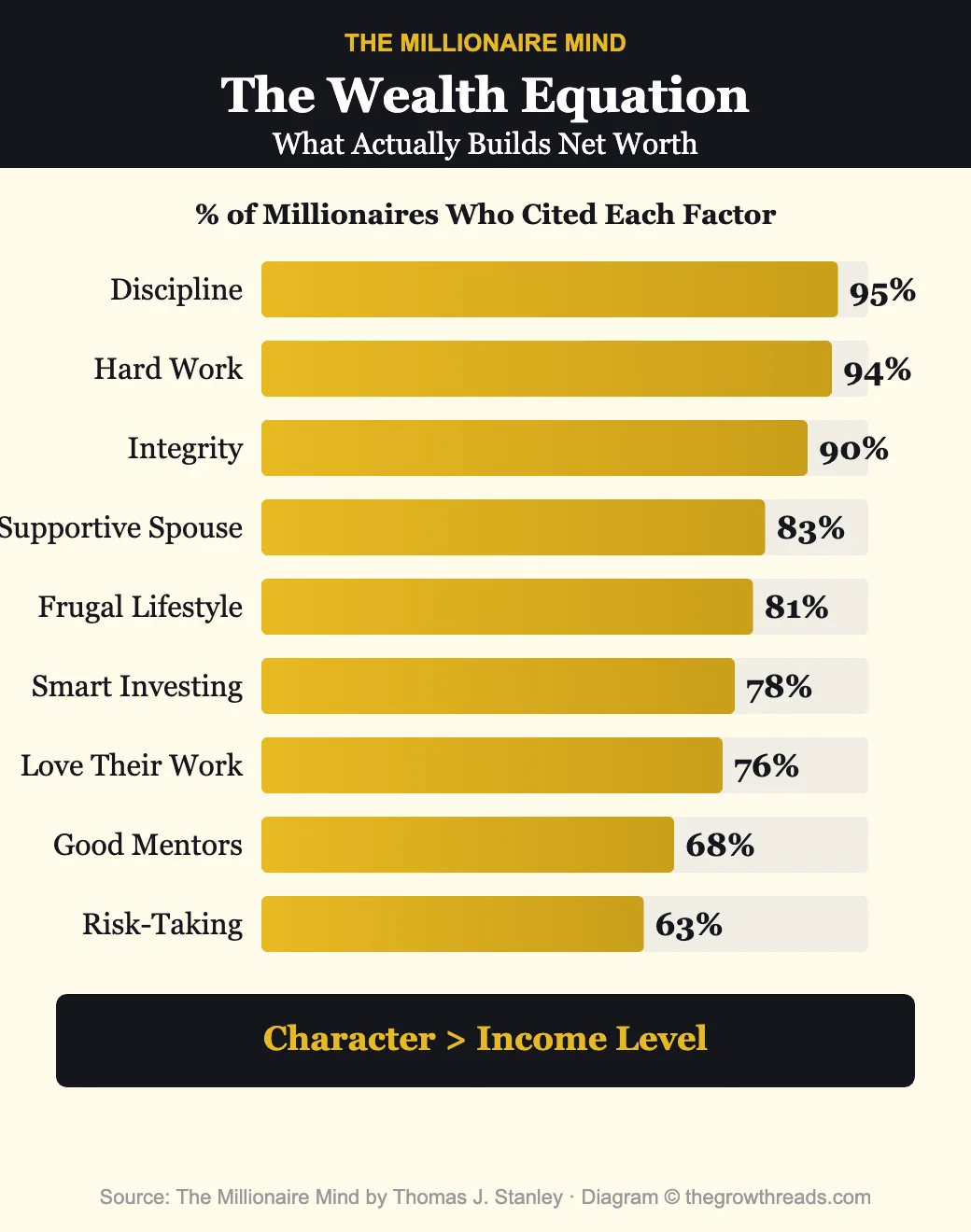
- Discipline beats income: 95% of millionaires cited self-discipline as a key factor in their success, ranking it above investment returns or career choice.
- Frugality is a lifestyle, not a phase: Wealthy individuals consistently spend below their means throughout their entire lives, not just while building wealth.
- Education matters, but not how you think: Most millionaires were not top students — they credit real-world skills, tenacity, and social intelligence over GPA.
- Spouse selection is a financial decision: 83% of millionaires said a supportive, frugal spouse was critical to their wealth building.
- Risk is calculated, not reckless: Millionaires take risks, but only after thorough research and preparation — they are not gamblers.
- They love what they do: 76% of millionaires said passion for their work was a major wealth-building factor.
- Integrity compounds: Honesty and fair dealing create long-term business relationships that generate wealth over decades.
- They think differently about money: Millionaires see money as a tool for independence, not for displaying status.
- Home purchases are strategic: Most millionaires buy homes well below what they could afford, freeing capital for investments.
- They invest time in financial planning: Millionaires spend significantly more hours per month planning their finances than non-millionaires.
What is The Millionaire Mind about?
The Millionaire Mind examines the attitudes, beliefs, and behaviors of over 1,300 self-made millionaires in America. Through extensive survey data and interviews, Thomas Stanley reveals that lasting wealth comes from character traits like discipline, integrity, and calculated risk-taking rather than high incomes or lucky breaks. The book provides a research-backed roadmap for building financial independence through mindset and habit changes.
About the author
Thomas J. Stanley, Ph.D. (1944–2015) was a researcher and author who spent over 30 years studying the wealthy. He held a doctorate in business administration from the University of Georgia and taught marketing at Georgia State University before dedicating himself full-time to researching affluent Americans. His groundbreaking book The Millionaire Next Door (co-authored with William Danko) sold over four million copies and permanently shifted how Americans think about wealth. Stanley’s research methodology — large-scale surveys combined with personal interviews — gave his findings a rigor that self-help finance books rarely match. Explore all Thomas J. Stanley book summaries →
Key concepts at a glance
| Concept | What it means | Use it when |
|---|---|---|
| Economic Outpatient Care | Financial gifts to adult children that weaken their independence | Deciding how to support grown children financially |
| The Frugality Factor | Living well below your means as a permanent lifestyle | Setting your household spending budget |
| Vocation Selection | Choosing work you love increases both effort and earnings | Making career decisions or changing fields |
| Social Indifference | Ignoring what neighbors buy and refusing to keep up | Feeling pressure to upgrade your lifestyle |
| The Spouse Factor | Marital alignment on money is a wealth multiplier | Having financial conversations with your partner |
| Calculated Risk | Betting big only after deep research and preparation | Evaluating a business opportunity or investment |
| Integrity Capital | Honest dealing compounds into referrals and repeat business | Negotiating deals or building business relationships |
| Mental Toughness | Handling rejection and setbacks without quitting | Facing business failure or market downturns |
Part 1: The Millionaire Profile — Who They Really Are
Stanley opens by demolishing stereotypes. His survey of 1,300+ millionaires reveals a portrait that bears no resemblance to the flashy rich of television. The median millionaire in his study lives in a home valued at roughly $400,000, has been married to the same spouse for over 25 years, and drives a car that is at least two years old. Only a small minority inherited significant wealth — the vast majority are first-generation affluent who built their net worth from scratch.
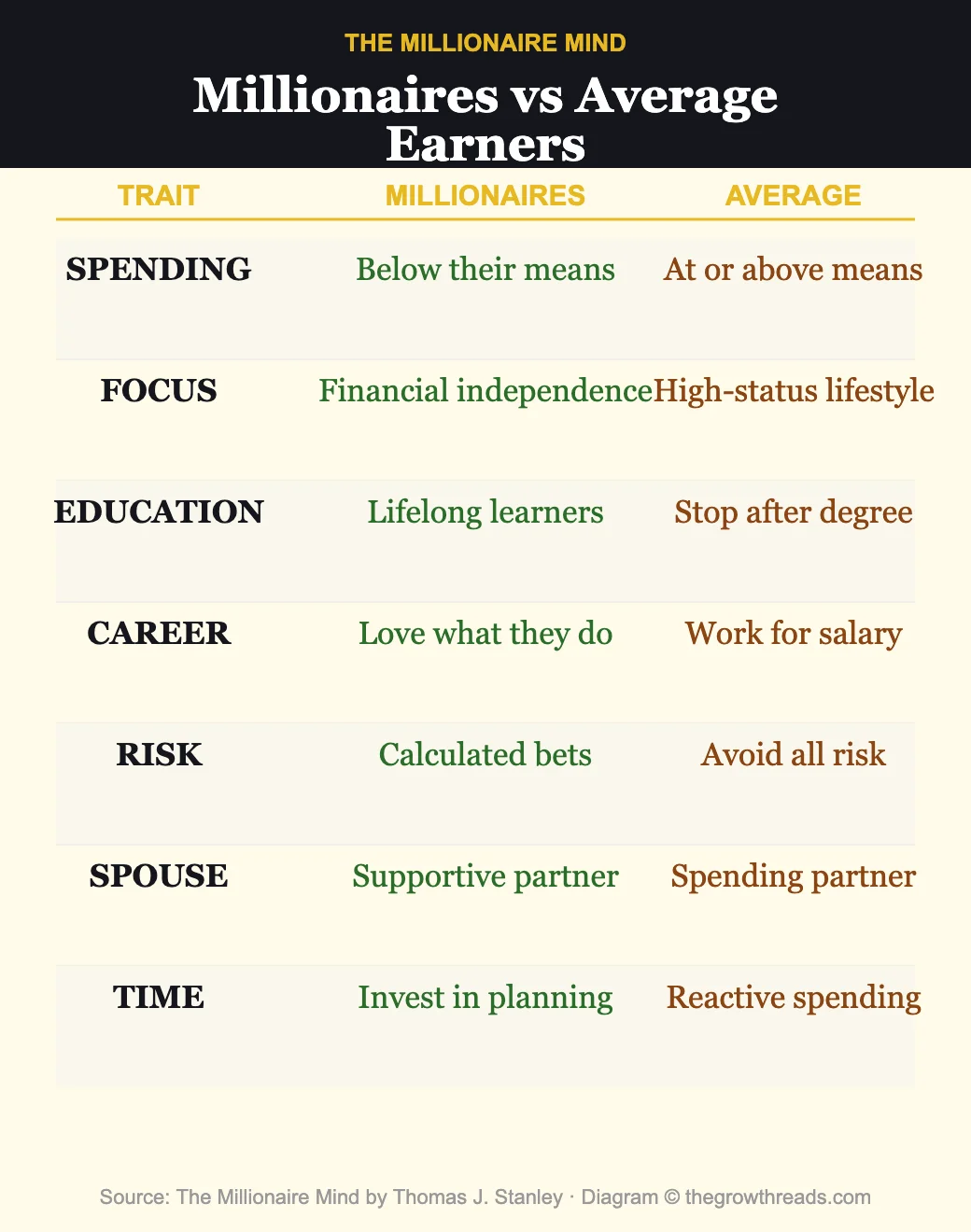
The data shows that occupation matters less than attitude. Millionaires come from hundreds of different careers: business owners, engineers, accountants, teachers who invested wisely, farmers who saved relentlessly. What they share is not a common profession but a common psychology. They define wealth not by what they consume but by what they accumulate. A doctor earning $300,000 who spends $295,000 is poorer in Stanley’s framework than a plumber earning $80,000 who invests $25,000 annually.
Stanley introduces the concept of “net worth expectation” — a formula (age × pre-tax income ÷ 10) that estimates where your wealth should be. Those who exceed this are “Prodigious Accumulators of Wealth” (PAWs); those below are “Under Accumulators of Wealth” (UAWs). The distinction almost always comes down to spending habits, not earning power.
Part 2: The Education of Millionaires — Street Smarts Over School Smarts
One of Stanley’s most counterintuitive findings is that academic performance is a weak predictor of wealth. The average GPA of the millionaires in his study was not remarkable. Many described themselves as average or even below-average students who compensated with tenacity, people skills, and a willingness to outwork their peers.
This does not mean education is irrelevant. Most millionaires completed college, and many hold advanced degrees. But they viewed education as a credential and a thinking framework, not as a guarantee of success. The millionaires in Stanley’s study disproportionately credited mentors, real-world apprenticeships, and self-education over formal classroom instruction.
Stanley identifies specific skills that correlated strongly with wealth accumulation: the ability to sell, to negotiate, to read people, and to manage conflict. These interpersonal competencies — rarely taught in schools — turned out to be far more predictive of financial success than SAT scores or class rank. Many millionaires reported that early experiences of rejection or failure (being cut from a team, fired from a job, rejected by a prestigious school) actually strengthened their resolve and resilience.
The takeaway is not anti-education but pro-adaptability. The millionaire mind treats every experience — formal or informal, successful or failed — as a learning opportunity. They are voracious readers, attend seminars, and seek out advisors, but they filter everything through a practical lens: “How can I use this?”
Part 3: The Lifestyle — Frugality as a Wealth Strategy
Stanley devotes significant attention to how millionaires spend — or rather, how they choose not to. The typical millionaire in his study has never spent more than $400 on a suit, $140 on a pair of shoes, or $30,000 on a car. They shop sales, use coupons, and actively resist the social pressure to display wealth through consumption.
This frugality is not born from deprivation but from a specific value system. Millionaires in the study consistently reported that financial independence provides more satisfaction than any status purchase. They derive pleasure from watching their investment portfolios grow, not from showing off to neighbors. Stanley calls this “social indifference” — the ability to ignore what others buy and consume without feeling deprived.
The role of the spouse emerges as a critical factor. In 83% of millionaire households, both partners share frugal values. Stanley found that marriages where one partner is a spender and the other a saver rarely produce millionaires. The most successful couples operate as a “wealth-building team,” with explicit financial goals, regular money conversations, and mutual accountability.
Housing decisions illustrate the millionaire mindset perfectly. While they could afford much more, most millionaires buy homes in middle-class neighborhoods and stay there for decades. This single decision has a cascading effect: lower property taxes, less pressure to furnish lavishly, less temptation to match the spending of wealthy neighbors, and more capital available for investment.
Part 4: The Wealth-Building Engine — Risk, Vocation, and Integrity
The final section of the book examines the three engines that drive wealth creation: calculated risk-taking, vocation selection, and business integrity.
Stanley’s millionaires are not timid. Over 60% reported that taking calculated risks was important to their financial success. But “calculated” is the operative word. Before making any major financial move, they research exhaustively, consult advisors, and develop contingency plans. They distinguish sharply between investing (where you can estimate outcomes) and gambling (where you cannot). Most millionaires never gamble recreationally, and they avoid speculative investments without a solid informational advantage.
Vocation selection proves to be another powerful wealth factor. 76% of millionaires said loving their work was essential to their success. When you love what you do, Stanley argues, you invest more hours, develop deeper expertise, and build stronger client relationships — all of which translate into higher earnings and longer career longevity. Many millionaires specifically chose businesses that are “dull-normal” — janitorial services, pest control, paving, rice farming — because these industries have less competition and more stable demand than glamorous fields.
Integrity functions as compound interest for reputation. Millionaires in Stanley’s research consistently cited honesty and ethical dealing as wealth builders. Repeat business, referrals, and long-term partnerships — all downstream effects of integrity — are far more profitable over a lifetime than any short-term gains from cutting corners. Stanley found that millionaires’ social networks are dominated by other trustworthy, financially responsible individuals, creating a reinforcing cycle of good values and good advice.
Who is The Millionaire Mind best for — and who should read something else first?
This book is ideal for anyone who wants to understand the psychology behind wealth accumulation, particularly readers who enjoyed The Millionaire Next Door and want to go deeper. It’s especially valuable for young professionals making early career and spending decisions, couples starting to align their financial goals, and business owners wondering whether their values match those of the financially successful.
If you prefer a more prescriptive, step-by-step financial system over research-driven profiles, start with The Total Money Makeover by Dave Ramsey. If you’re more interested in the emotional side of money decisions, The Psychology of Money by Morgan Housel covers similar territory with more storytelling flair. And if you want an investing-specific guide, The Simple Path to Wealth by JL Collins provides the tactical complement to Stanley’s strategic portrait.
Questions to reflect on
- Using Stanley’s formula (age × pre-tax income ÷ 10), are you a Prodigious Accumulator of Wealth or an Under Accumulator? What single change would move you in the right direction?
- Which of your current spending habits are driven by genuine value rather than social comparison?
- How aligned are you and your partner (or closest financial ally) on savings goals and spending boundaries?
- What calculated risk have you been avoiding that, with proper research, could meaningfully increase your earning potential?
- If you could choose any vocation based purely on passion and aptitude, would it change your current career trajectory?
🔥 Ready to unlock the millionaire mindset?
Discover the research-backed traits that separate the wealthy from the rest.
How to apply The Millionaire Mind (7-day plan)
- Day 1 — Calculate your wealth score: Use the formula (age × annual pre-tax income ÷ 10) to find your expected net worth. Compare it to your actual net worth. Write down the gap.
- Day 2 — Audit your spending for status: Review your last month’s expenses and flag every purchase motivated by social comparison rather than genuine need or enjoyment.
- Day 3 — Have the money talk: Sit down with your spouse or partner and discuss three shared financial goals for the next five years. Write them down together.
- Day 4 — Identify one calculated risk: List one business idea, investment, or career move you’ve been considering. Research three specific data points that would help you evaluate it properly.
- Day 5 — Adopt one frugality habit: Choose one recurring expense to reduce or eliminate. Redirect the savings to an investment account via automatic transfer.
- Day 6 — Build your integrity network: Reach out to one person you respect for their financial discipline and ask to meet for coffee. Millionaires surround themselves with like-minded people.
- Day 7 — Set a PAW target date: Based on your Day 1 calculation, set a specific date by which you intend to reach Prodigious Accumulator status. Break it into annual savings milestones.
Frequently asked questions
Is The Millionaire Mind the same as The Millionaire Next Door?
No. The Millionaire Next Door (1996), co-authored with William Danko, introduced the core concept of studying wealthy Americans through survey research. The Millionaire Mind (2000) is a standalone sequel by Stanley alone that goes deeper into the psychological traits, decision-making patterns, and belief systems behind wealth accumulation. If The Millionaire Next Door asks “who are the wealthy?” then The Millionaire Mind asks “how do they think?” Both are essential reading, but you can start with either.
What is the main message of The Millionaire Mind?
The central message is that wealth is primarily a product of mindset and behavior, not income level. Stanley’s research shows that self-discipline, frugality, integrity, spouse selection, calculated risk-taking, and loving your vocation are the real drivers of wealth accumulation. Most self-made millionaires live modestly, avoid status spending, and build wealth slowly through consistent habits rather than windfalls or extraordinary earning power.
Is The Millionaire Mind still relevant today?
The core principles remain highly relevant. While specific dollar figures from Stanley’s original surveys are dated (the book was published in 2000), the behavioral patterns he identified — living below your means, avoiding status spending, choosing vocation based on passion, and marrying a supportive partner — are timeless wealth-building strategies. Modern research in behavioral economics has only reinforced Stanley’s findings about the importance of financial discipline over earning power.
What is Economic Outpatient Care?
Economic Outpatient Care (EOC) is Stanley’s term for financial gifts from parents to adult children. His research found that adult children who receive regular financial support from their parents tend to accumulate significantly less wealth than those who are financially independent. EOC creates dependency, reduces motivation to save, and often subsidizes a higher-consumption lifestyle. Stanley recommends parents teach financial discipline rather than provide ongoing financial support.
How many pages is The Millionaire Mind?
The paperback edition is 416 pages. At an average reading pace, it takes approximately six hours to read. The book is structured around major themes (mindset, education, lifestyle, risk, spouse, vocation) with each chapter presenting survey data, case studies, and practical takeaways. Stanley’s writing is clear and data-heavy without being dry, making the length manageable for most readers.
What is a Prodigious Accumulator of Wealth (PAW)?
A PAW is someone whose actual net worth significantly exceeds their expected net worth (calculated as age multiplied by annual pre-tax income divided by ten). For example, a 50-year-old earning $100,000 per year has an expected net worth of $500,000. If their actual net worth is $1 million or more, they are a PAW. The opposite — someone whose net worth falls well below the expected figure — is an Under Accumulator of Wealth (UAW). PAW status comes from consistent saving and investing, not from high income alone.
Should I read The Millionaire Mind or The Psychology of Money?
Both books explore the behavioral side of wealth, but they approach it differently. The Millionaire Mind is empirical and survey-driven — Stanley studied over 1,300 real millionaires and reports what they actually do. The Psychology of Money by Morgan Housel is more philosophical and narrative, using stories and behavioral insights to explain why people make certain financial decisions. Stanley tells you what works; Housel tells you why your brain resists doing it. Ideally, read both. Start with whichever style appeals to you more.
Related summaries
- The Millionaire Next Door Summary — Stanley’s first and most famous book on wealthy Americans
- The Psychology of Money Summary — Modern behavioral insights into financial decision-making
- The Simple Path to Wealth Summary — The tactical investing guide that pairs with Stanley’s strategic portrait
- Rich Dad Poor Dad Summary — Another perspective on how mindset shapes financial outcomes
📚 Explore more in our Best Money Books collection.