

★★★★☆ 4.2/5 — A brash, contrarian blueprint for building wealth fast through entrepreneurship rather than decades of saving and investing.
Best for: Aspiring entrepreneurs, side-hustlers, and anyone frustrated with the “save 10 percent and retire at 65” narrative.
Reading time: ~7 hrs (guide: 20 min)
Difficulty to apply: High — requires building a business, not just changing habits.
The Millionaire Fastlane in one minute
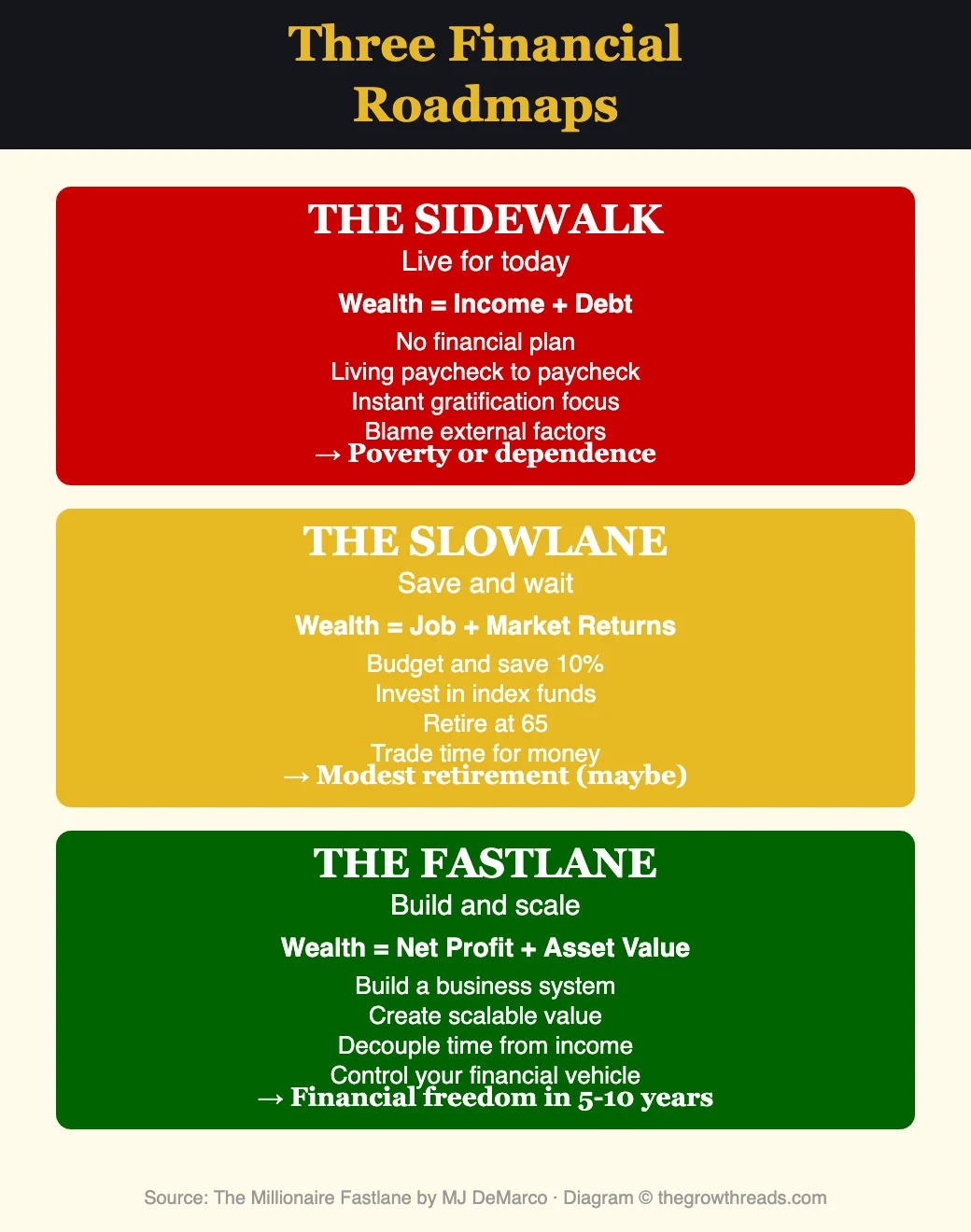
The conventional wealth formula — get a good job, save diligently, invest in index funds, retire at 65 — is not a plan for wealth; it is a plan for mediocrity on a timeline you might not survive to enjoy. MJ DeMarco argues that real wealth is built not by hoarding pennies over decades but by creating business systems that separate your income from your time. He categorizes all financial strategies into three “roadmaps”: the Sidewalk (live for today, spend everything), the Slowlane (save and invest over 40 years), and the Fastlane (build a scalable business that generates wealth in 5-10 years). The book is equal parts financial philosophy, entrepreneurship guide, and motivational wake-up call.
Key takeaways
- Three roadmaps, one choice: The Sidewalk leads to poverty, the Slowlane leads to a modest retirement (maybe), and the Fastlane leads to financial freedom — potentially within a decade.
- Wealth is not an event, it is a process: There is no lottery ticket, no lucky break, no single moment. Wealth is the result of a disciplined process executed over years.
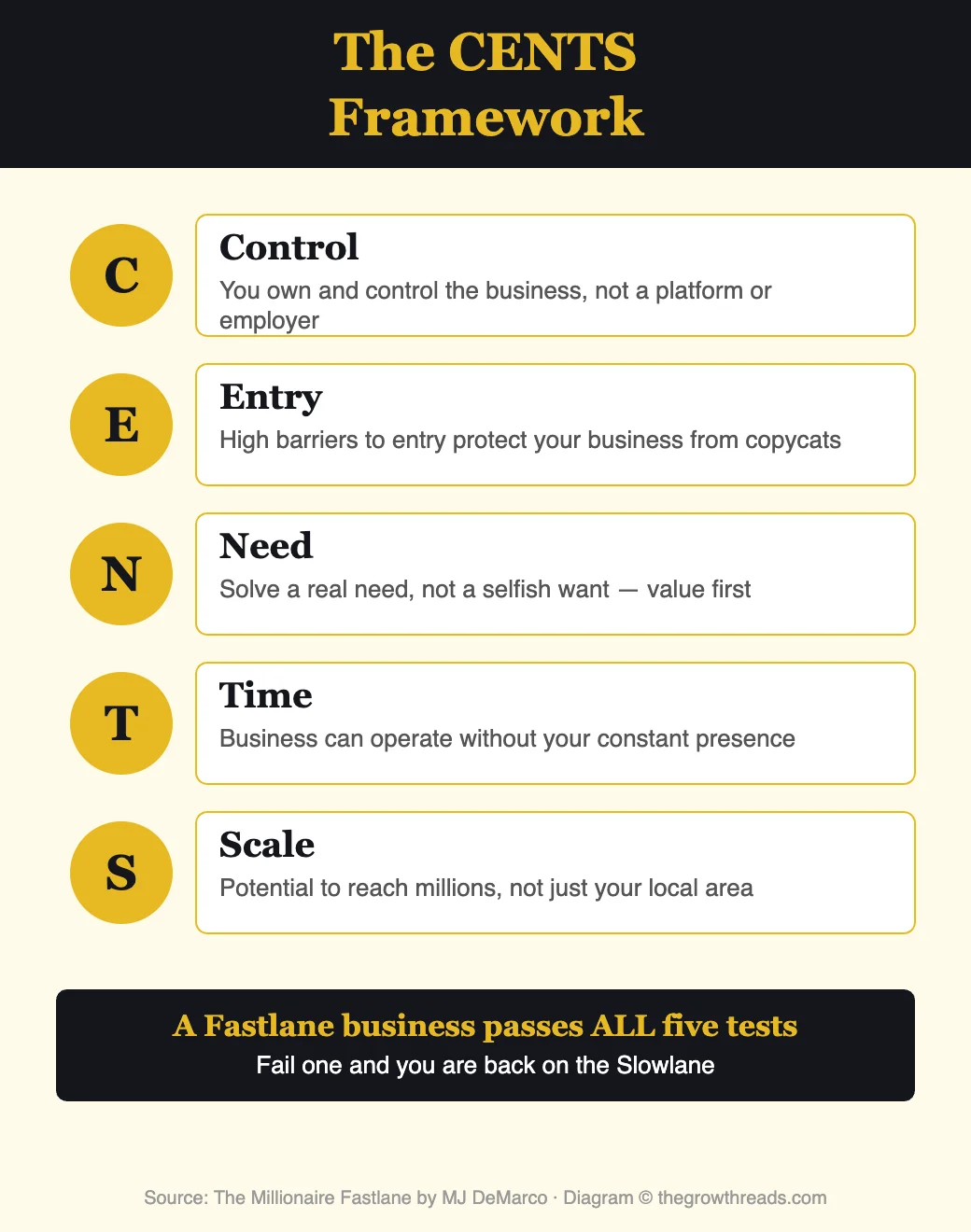
- The CENTS framework: A legitimate Fastlane business must pass five tests — Control, Entry barriers, Need fulfillment, Time separation, and Scale potential.
- Time is the ultimate wealth: DeMarco defines true wealth as having the freedom to do what you want, when you want, where you want, with whom you want.
- The Slowlane depends on hope: Hoping the market rises, hoping you stay healthy, hoping you live past 65 — too many variables outside your control.
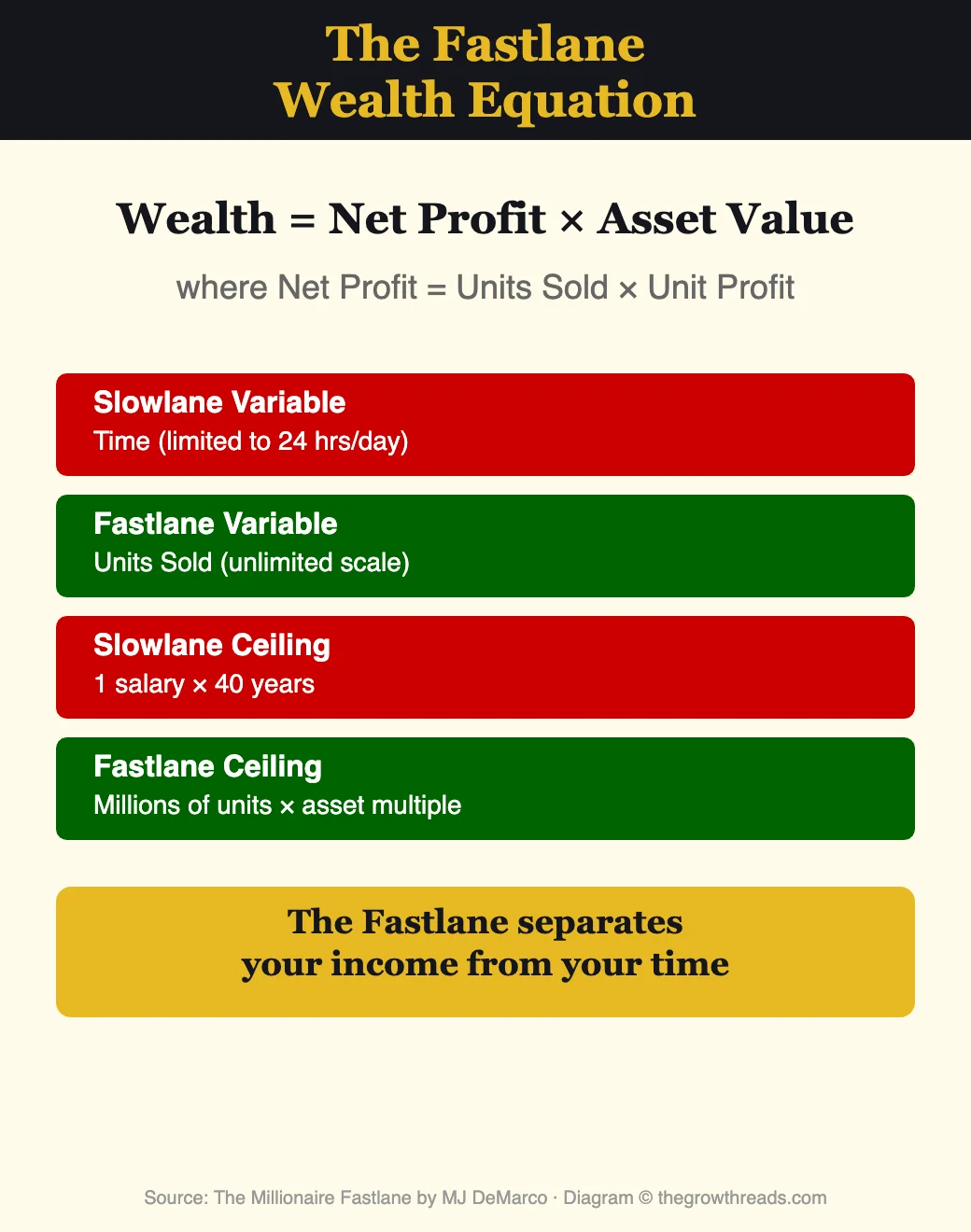
- Separate income from time: A job trades hours for dollars (limited). A business system trades value for dollars (unlimited). This is the fundamental Fastlane shift.
- Solve needs at scale: Every dollar you earn is a certificate of value you provided to someone. Want more dollars? Provide more value to more people.
- Process over events: The media shows the Lamborghini, not the 10,000 hours of work behind it. Wealth is the iceberg — you only see the tip.
What is The Millionaire Fastlane about?
The Millionaire Fastlane is an entrepreneurship and wealth-building book that argues conventional financial advice (save, invest, retire at 65) is fundamentally flawed, and that real wealth comes from building scalable business systems that decouple income from time using the CENTS framework.
About the author
MJ DeMarco is a self-made multimillionaire, entrepreneur, and author who made his fortune building and selling Limos.com, a limousine booking platform he started from his basement. After selling the company for millions, DeMarco experienced the lifestyle most people only dream about — then realized that the process of building the business had been more fulfilling than the proceeds. He self-published The Millionaire Fastlane in 2011, and despite no traditional publisher or marketing budget, the book became a worldwide bestseller through word-of-mouth and online communities. He later founded the Fastlane Forum, one of the largest entrepreneur-focused online communities, and wrote two follow-up books: Unscripted and The Great Rat Race Escape. Explore all MJ DeMarco book summaries →
Key concepts at a glance
| Concept | What it means | Use it when |
|---|---|---|
| The Sidewalk | No plan — live for today, spend everything | You recognize this pattern in yourself |
| The Slowlane | Save 10%, invest in index funds, retire at 65 | You follow conventional advice but feel trapped |
| The Fastlane | Build a scalable business, create wealth in years, not decades | You want to control your financial destiny |
| CENTS Framework | Control, Entry, Need, Time, Scale — five tests for a viable business | You are evaluating a business idea |
| The Wealth Equation | Wealth = Net Profit × Asset Value | You want to understand the math behind Fastlane wealth |
| The Law of Effection | Impact millions of lives to earn millions of dollars | You want a guiding principle for business design |
| Process vs Event | Wealth is built through process; the media only shows the event | You are tempted by get-rich-quick shortcuts |
Part 1: The three roadmaps — Sidewalk, Slowlane, and Fastlane
DeMarco structures his entire philosophy around three financial “roadmaps” that determine your wealth trajectory. The Sidewalk is the path of immediate gratification — no savings, no plan, living paycheck to paycheck regardless of income. Sidewalkers can earn six figures and still be broke because their spending always matches or exceeds their income. Their wealth equation is simple and dangerous: Wealth = Income + Debt.
The Slowlane is the conventional wisdom path taught by most financial advisors: get a good education, land a steady job, save 10 percent, invest in index funds, and retire comfortably at 65. DeMarco does not deny that this path can work mathematically — he argues that it demands decades of your prime years, depends on variables you cannot control (market returns, health, job security), and delivers freedom only when you are too old to fully enjoy it.
The Fastlane is DeMarco’s alternative: build a business system that creates significant value for a large number of people, separates your income from your time, and can be sold as an asset. The Fastlane wealth equation is fundamentally different: Wealth = Net Profit × Asset Value. Both variables can scale without limit, unlike a salary (which is capped by hours in a day) or market returns (which are out of your control).
Part 2: The CENTS framework — testing your business idea
The CENTS framework is the operational core of the book. DeMarco argues that not all businesses are Fastlane vehicles — only those that pass all five tests. Control means you own the business, the customer relationship, and the pricing. Businesses built on someone else’s platform (Amazon FBA, app stores, social media algorithms) fail this test because the platform can change the rules at any time.
Entry barriers matter because easy-entry businesses attract massive competition that drives margins to zero. If anyone with $100 and a weekend can copy your business, it is not a Fastlane vehicle. Need means solving a genuine pain point or desire — not building something you think is cool and hoping customers agree. Time means the business can eventually operate without your daily involvement through systems, automation, and team delegation. Scale means the business can potentially serve millions, not just your local neighborhood.
Part 3: The wealth equation and the law of effection
DeMarco’s wealth equation — Wealth = Net Profit × Asset Value — reveals why entrepreneurs can build wealth faster than employees. Net Profit is Units Sold × Unit Profit, and both variables can be amplified through scale and pricing power. Asset Value is the market value of the business itself, which in many cases exceeds the cumulative profits by a significant multiple (software companies, for example, often sell for 5-15x annual revenue).
The Law of Effection states that the more lives you affect in scale or magnitude, the richer you will become. Affect millions of lives with small value (a $1 app used by 10 million people) or affect fewer lives with enormous value (a $50,000 service used by 200 clients) — either path produces wealth. The key is that the value must be real and the delivery must be scalable.
Who is The Millionaire Fastlane best for — and who should read something else first?
This book is best for aspiring entrepreneurs who feel trapped by conventional financial advice and want a framework for evaluating business ideas with wealth-building potential. It is also excellent for anyone already running a small business who wants to assess whether their business model can scale.
If you are looking for practical personal finance guidance (budgeting, debt elimination, basic investing), start with Your Money or Your Life or I Will Teach You to Be Rich. If you need a more tactical guide to actually launching a startup, pair this book with The Lean Startup.
Questions to reflect on
- Which roadmap — Sidewalk, Slowlane, or Fastlane — most accurately describes your current financial path?
- Does your primary source of income pass the CENTS test? If not, which element fails?
- What problem could you solve that would positively impact millions of people — and how would you deliver that solution at scale?
- If you could not trade your time for money starting tomorrow, what would you build to generate income?
- What is the “event” you are secretly hoping for (inheritance, promotion, lottery) — and what process could replace that hope?
🔥 Ready to build your wealth vehicle?
Learn why entrepreneurship — not penny-pinching — is the real path to financial freedom.
How to apply The Millionaire Fastlane (7-day plan)
- Day 1: Honestly identify your current roadmap. Write down your monthly income, expenses, savings rate, and net worth. Are you on the Sidewalk, Slowlane, or Fastlane?
- Day 2: List 10 problems you encounter regularly — frustrations, inefficiencies, unmet needs. These are potential business opportunities. Circle the three with the largest potential audience.
- Day 3: Run each of your top three ideas through the CENTS framework. Score each on Control, Entry barriers, Need, Time separation, and Scale. Eliminate any that fail two or more tests.
- Day 4: For your highest-scoring idea, define the Fastlane wealth equation: What is the unit? What is the unit profit? How many units could you realistically sell? What would the asset be worth?
- Day 5: Research the market. Who else is solving this problem? What are they charging? Where are they falling short? Identify one gap you could fill better.
- Day 6: Design the simplest possible version of your solution — the MVP that could test demand this month, not next year. What could you build or offer in 2-4 weeks?
- Day 7: Take one concrete action toward launch: register a domain, set up a landing page, email five potential customers, or outline the product. Process over event — today is Day 1 of your Fastlane.
Frequently asked questions
Is DeMarco saying investing is a waste of time?
No. DeMarco invests heavily himself — he simply argues that investing should not be your primary wealth-building strategy. His critique is specifically about relying on market returns from a modest salary to fund your retirement over 40 years. He advocates building a business that generates significant income first, then investing those proceeds aggressively. The Fastlane and Slowlane are not mutually exclusive in practice — they are sequential. Build Fastlane wealth, then protect it with Slowlane investing.
What kinds of businesses qualify as Fastlane?
Software-as-a-service (SaaS), content platforms, e-commerce brands with proprietary products, franchise systems, intellectual property licensing, and service businesses that can be systematized and scaled all qualify — provided they pass the CENTS test. Notably, most freelancing and consulting businesses do NOT qualify because they fail the Time test (your income stops when you stop working) and the Scale test (you can only serve a limited number of clients). The distinguishing factor is whether the business can operate and grow without your daily involvement.
How is this different from other get-rich books?
DeMarco is blunt about what he is not: he is not selling a get-rich-quick scheme, a real estate seminar, or a passive income fantasy. His central message is that building wealth fast still requires years of intense work — typically five to ten years of focused entrepreneurship. The “fast” in Fastlane is relative to the Slowlane’s 40-year timeline, not relative to instant gratification. He is also unusually honest about failure: most businesses fail, and the Fastlane requires resilience, iteration, and the willingness to start over.
What is the Law of Effection?
The Law of Effection states that the more lives you positively impact — in either scale (number of people) or magnitude (depth of impact per person) — the more money you will earn. It is DeMarco’s fundamental principle for business design: stop thinking about what you want to sell and start thinking about what problem you can solve for the most people. A $10 product used by a million people and a $100,000 consulting engagement for 100 clients both follow the Law of Effection through different scale-magnitude combinations.
What does DeMarco think about real estate?
DeMarco considers real estate a potentially valid Fastlane vehicle if — and only if — it is treated as a business rather than a passive investment. Buying a single rental property and waiting for appreciation is Slowlane behavior. Building a real estate portfolio with systems for acquisition, management, and scaling — or developing a real estate technology platform — can be Fastlane. The key test is CENTS: do you have control, entry barriers, a genuine market need, time separation, and scale potential?
Can you be on the Fastlane while keeping a day job?
Yes, and DeMarco actually recommends it for most people. Keeping a day job while building a Fastlane business on the side reduces financial pressure and gives you runway to experiment. The day job becomes what he calls a “financial treadmill” — it keeps you alive while you build the vehicle that will eventually set you free. The key is not to mistake the job for the strategy. Your job funds your survival; your business builds your wealth.
Is The Millionaire Fastlane still relevant in 2026?
More relevant than ever. The internet economy has dramatically lowered the cost of starting a business, AI tools have made it possible for small teams to build products that previously required dozens of employees, and the creator economy has opened new Fastlane paths (digital products, SaaS, online education). The CENTS framework is timeless because it evaluates business fundamentals, not trends. Platform risk (DeMarco’s “Control” test) has become even more important as social media algorithms and app store policies have grown more unpredictable.
Related summaries
- The Lean Startup Summary & Review — Eric Ries on validating business ideas with minimum waste.
- Rich Dad Poor Dad Summary & Review — Robert Kiyosaki on the mindset shift between working for money and making money work for you.
- Think and Grow Rich Summary & Review — Napoleon Hill’s classic on the psychology of wealth creation.
- Best Money Books — Our complete guide to the top books on personal finance and wealth building.
How we analyze books: Every summary on The Growth Reads is built from a close reading of the full text, cross-referenced with the author’s published interviews, peer-reviewed research where applicable, and reader feedback from multiple platforms. We focus on extracting actionable frameworks rather than abstract theory. Read our full methodology.