

★★★★★ 4.6/5 — A slim, 140-page distillation of Toltec wisdom into four promises that quietly rewire how you take criticism, keep your word, and stop assuming the worst.
Best for: Anyone who over-apologizes, ruminates on other people’s moods, or wants one simple code of conduct for calmer relationships — with others and with yourself.
Reading time: ~2 hrs to read (140 pages) · TGR guide: ~12 min
Difficulty to apply: Easy to understand, moderate to practice — old habits of self-judgment take repetition to unlearn.
The Four Agreements in one minute
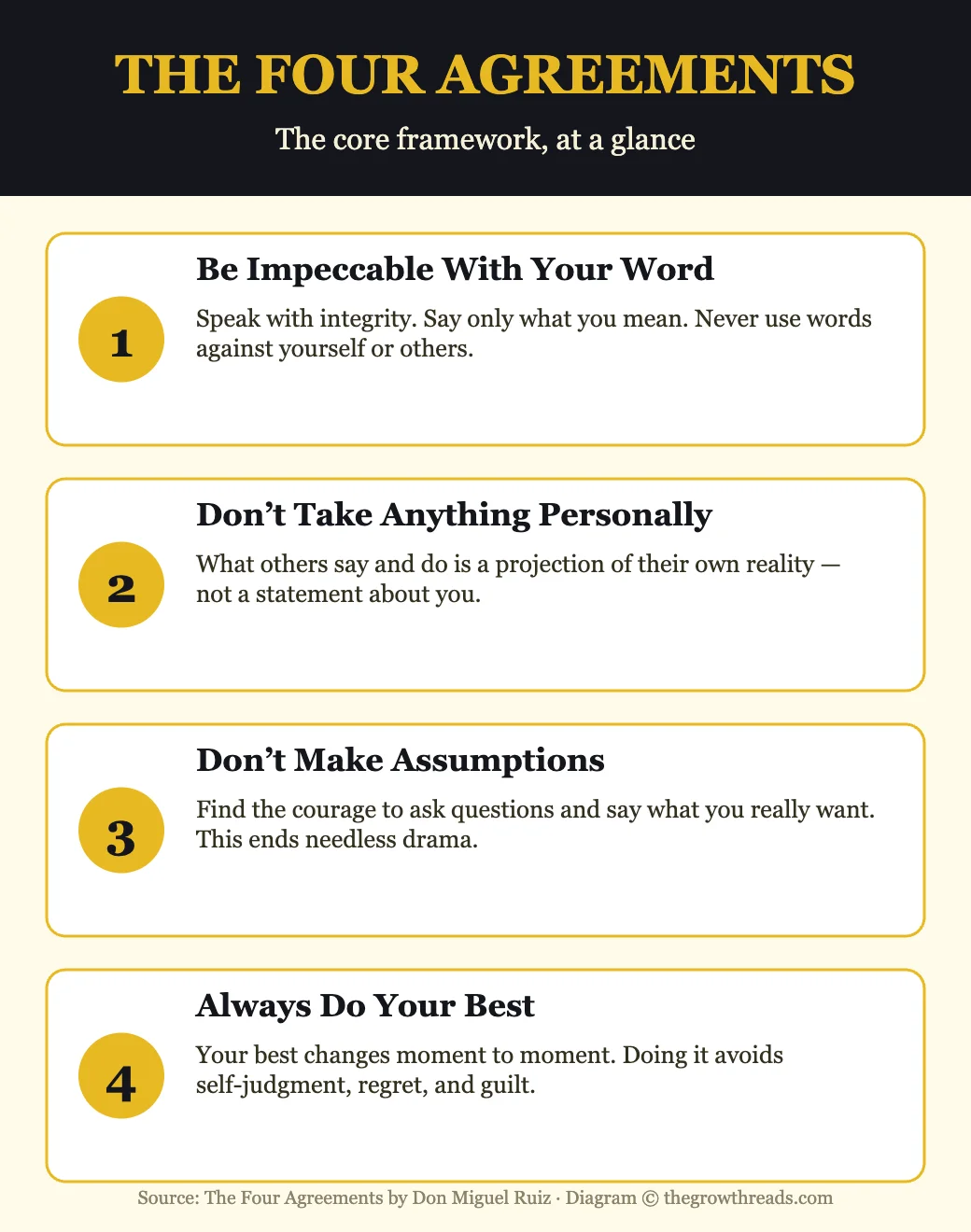
You already have a code of conduct — you just never chose it. That’s the provocation at the center of The Four Agreements. Don Miguel Ruiz, a Mexican Toltec teacher who trained first as a surgeon, argues that most of our suffering comes from a belief system installed in childhood through reward and punishment — a set of rules we absorbed but never actually agreed to. His fix is disarmingly simple: replace that inherited rulebook with four deliberate agreements you make with yourself. Be impeccable with your word. Don’t take anything personally. Don’t make assumptions. Always do your best. Together they form a portable ethic for how you treat yourself and everyone around you — at work, at home, and in the running commentary inside your own head.
Key takeaways
- Most emotional pain is self-inflicted: it comes from a belief system installed in childhood, not from the people around you today.
- Your word is a creative force: used against yourself through self-criticism, or against others through gossip, it does measurable damage.
- Nothing anyone says or does is actually about you: it’s a reflection of their own beliefs, mood, and pain.
- Taking things personally hands over your emotional remote control to whoever happens to be speaking.
- Most conflict starts with an assumption nobody bothered to check with a simple, direct question.
- Clear communication removes the majority of the drama that unverified assumptions create.
- “Your best” is not a fixed standard — it changes with your energy, health, and circumstances from one day to the next.
- Doing your best, and only your best, is the antidote to regret, self-judgment, and burnout.
- An inner “Judge” and inner “Victim” run a quiet trial in your head — the four agreements are designed to interrupt it.
What is The Four Agreements about?
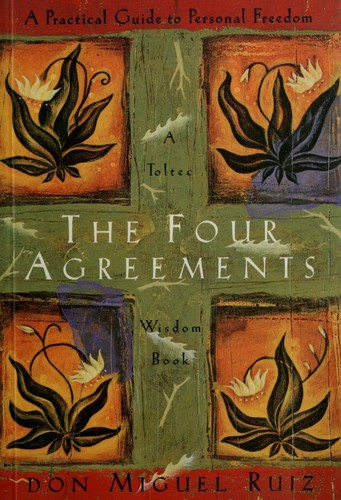
The Four Agreements is Don Miguel Ruiz’s 1997 distillation of Toltec wisdom into four practical commitments — be impeccable with your word, don’t take anything personally, don’t make assumptions, and always do your best — designed to dismantle self-limiting beliefs and build healthier, freer relationships with yourself and others.
About the author
Don Miguel Ruiz was born in rural Mexico into a family of healers — his mother a curandera (folk healer) and his grandfather a Toltec nagual, or master teacher. Ruiz initially left that lineage behind, training as a surgeon and practicing as a neurosurgeon in Tijuana. A near-fatal car accident in his twenties forced a reckoning: he abandoned medicine and returned to study under his mother, eventually becoming a nagual himself in the Eagle Knight lineage of Toltec teachers. Published in 1997 by Amber-Allen Publishing, The Four Agreements became a slow-building word-of-mouth bestseller, boosted by high-profile endorsements including Oprah Winfrey, and has been translated into dozens of languages. Ruiz went on to write companion works, including The Mastery of Love and The Fifth Agreement (co-written with his son, Don Jose Ruiz), and continues to teach today. Explore all Don Miguel Ruiz book summaries →
Key concepts at a glance
| Concept | What it means | Use it when |
|---|---|---|
| Domestication | Being programmed by reward and punishment into beliefs you never consciously chose | You’re not sure why a rule or fear feels so absolute |
| Book of Law | Your personal, unwritten rulebook of “shoulds” built during domestication | You notice a rigid “I have to” with no real reason behind it |
| The Judge | The inner voice that measures your every action against the Book of Law | Self-criticism spikes after a mistake |
| The Victim | The part of you that absorbs the Judge’s verdict as guilt and shame | You’re stuck replaying an old mistake |
| Impeccability of the word | Using speech only to build, never to wound yourself or others | Before you gossip, self-criticize, or make a promise |
| Personal importance | The belief that everything happening around you is about you | Someone’s mood or comment stings more than it should |
| Assumptions | Filling gaps in information with imagined, unverified meaning | Before reacting to an unclear text, tone, or silence |
| Mitote | Ruiz’s term for the inner chaos of a thousand conflicting voices in your head | Your mind feels loud, scattered, or self-contradictory |
Part 1: Where Our Beliefs Come From
Ruiz opens with a claim that sounds abstract until you sit with it: you were domesticated, the same way a dog or a farm animal is domesticated — through a system of reward and punishment. As a child, you were rewarded with approval when you conformed to the beliefs of your parents, teachers, and culture, and punished with disapproval, shame, or withdrawn affection when you didn’t. Repeat that process for a couple of decades and it hardens into what Ruiz calls your “Book of Law” — a private, mostly unexamined rulebook for how you’re supposed to think, act, and feel.
Two characters take up residence to enforce that book. The Judge evaluates everything you do against it, and — because the standards are usually impossible — finds you guilty almost constantly. The Victim is the part of you that accepts the verdict: guilt, shame, self-punishment, often for infractions no one else even noticed. Ruiz calls the resulting inner noise the mitote — a Toltec word for a marketplace with a thousand people talking at once, which is roughly what it feels like when the Judge and Victim are both running commentary at full volume.
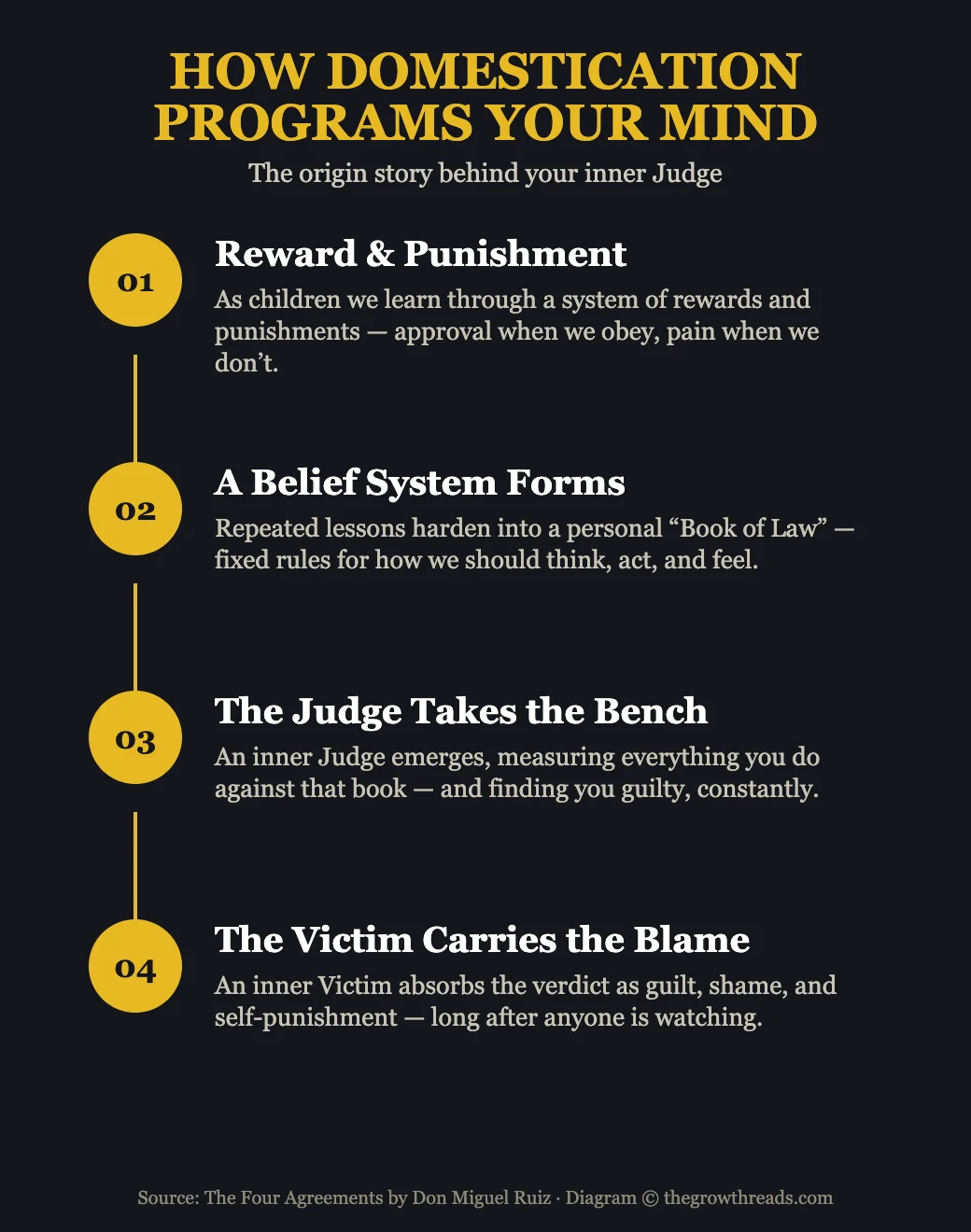
The point of naming this process isn’t to blame your upbringing — it’s to make an unconscious system visible enough to renegotiate. Ruiz’s entire framework rests on a simple mechanical idea: agreements you didn’t choose can be replaced with agreements you do choose. That reframe is what makes the rest of the book practical rather than merely inspirational.
TGR Note: If the idea of an inherited “rulebook” running your reactions resonates, our The Courage to Be Disliked summary covers similar ground from an Adlerian psychology angle — useful if you want the Western clinical framing alongside Ruiz’s Toltec one.
Part 2: The First Two Agreements
Agreement 1 — Be impeccable with your word. “Impeccable” comes from the Latin for “without sin,” and Ruiz uses word in the broadest sense: everything you say, and everything you say to yourself. Gossip, self-criticism, exaggeration, and broken promises are all ways the word is used against its own power. Used well, your word becomes a tool for stating truth, expressing love, and breaking old spells of self-doubt rather than casting new ones.
Agreement 2 — Don’t take anything personally. This is the agreement most readers quote first, and for good reason: Ruiz argues that whatever anyone says or does to you is a projection of their own reality, their own Book of Law, their own mitote — not a factual statement about you. A colleague’s sharp tone after a bad night’s sleep, a friend’s silence when they’re overwhelmed, even direct criticism — all of it passes through their filters before it reaches you. Taking it personally means letting someone else’s opinion, mood, or misunderstanding set your emotional state.
Ruiz is careful to separate this from indifference. Not taking things personally doesn’t mean you stop caring what people think or stop noticing when you’ve made a real mistake — it means you stop treating other people’s reactions as verdicts on your worth. It’s an emotional firewall, not a wall against feedback.
TGR Note: Ruiz frames “don’t take it personally” as an internal shift; if you want the more recent, secular version of the same idea applied specifically to other people’s opinions and moods, our The Let Them Theory summary is a natural next read.
Part 3: The Last Two Agreements
Agreement 3 — Don’t make assumptions. Ruiz’s diagnosis of most human conflict is almost embarrassingly simple: we fill gaps in information with imagined meaning, then react to the story we invented as if it were fact. A delayed reply becomes “they’re upset with me.” A curt email becomes “I’m in trouble.” The fix is equally simple to state and hard to practice — ask. Find the courage to ask a direct question instead of quietly building a case in your head, and voice what you actually want instead of expecting people to read your mind.
Agreement 4 — Always do your best. The final agreement is the safety net for the other three: your best will vary. Tired, sick, stressed, or grieving, your best that day will look smaller than your best on a rested, healthy day — and that’s fine, because the standard was never “your maximum,” it was “your best, today.” Ruiz’s claim is that when you do your best and stop there, you sidestep both overwork (because you’re not chasing an external, impossible bar) and regret (because you can’t judge a genuine best effort after the fact).
TGR Note: “Always do your best” pairs well with the productivity literature on sustainable effort — see our Essentialism summary for a complementary framework on choosing where your best effort actually goes.
Part 4: The Toltec Path to Freedom
The book’s final section widens the lens from four rules to a broader practice Ruiz calls the Toltec path — becoming a “warrior” who can observe the mitote without being ruled by it, and eventually a “man or woman of knowledge” who lives in what he calls the “new dream”: one authored deliberately rather than inherited. Central to this shift is forgiveness, both of others and of yourself, for the years spent obeying a Book of Law you never chose. Ruiz is explicit that this isn’t a one-time realization but an ongoing practice — old agreements resurface under stress, and the work is noticing and re-choosing, repeatedly, not achieving a permanent enlightened state.
TGR Note: If the “observe your own mind without being ruled by it” idea appeals to you, our The Power of Now summary approaches the same present-moment awareness from a different spiritual tradition.
Who is The Four Agreements best for — and who should read something else first?
The Four Agreements is best for readers who over-apologize, ruminate on other people’s moods and opinions, or want one simple, portable code of conduct for calmer relationships — with other people and with themselves. It’s also a good fit if you’re open to a light spiritual framing (Toltec cosmology, energy, “the dream”) wrapped around otherwise practical advice.
If you want research-backed behavior change without any spiritual framing, start with Atomic Habits instead. If your main problem is specifically hard conversations rather than inner dialogue, Never Split the Difference is more tactical. And if you want a secular, clinically-grounded take on people-pleasing and the fear of others’ opinions, The Courage to Be Disliked covers similar territory from a psychology angle.
Questions to reflect on
- Which of the four agreements do you break most often — and with whom?
- Recall a recent moment you took something personally. What would change if you saw it as “about them,” not you?
- What’s one assumption you’re currently treating as fact without ever having checked it?
- Where does your inner Judge show up loudest — at work, in relationships, or in how you talk to yourself?
- What would “doing your best” — no more, no less — actually look like for you this week?
🔥 Ready to keep four simple promises instead of a thousand invisible rules?
Grab a copy and start practicing the first agreement today.
How to apply The Four Agreements (7-day plan)
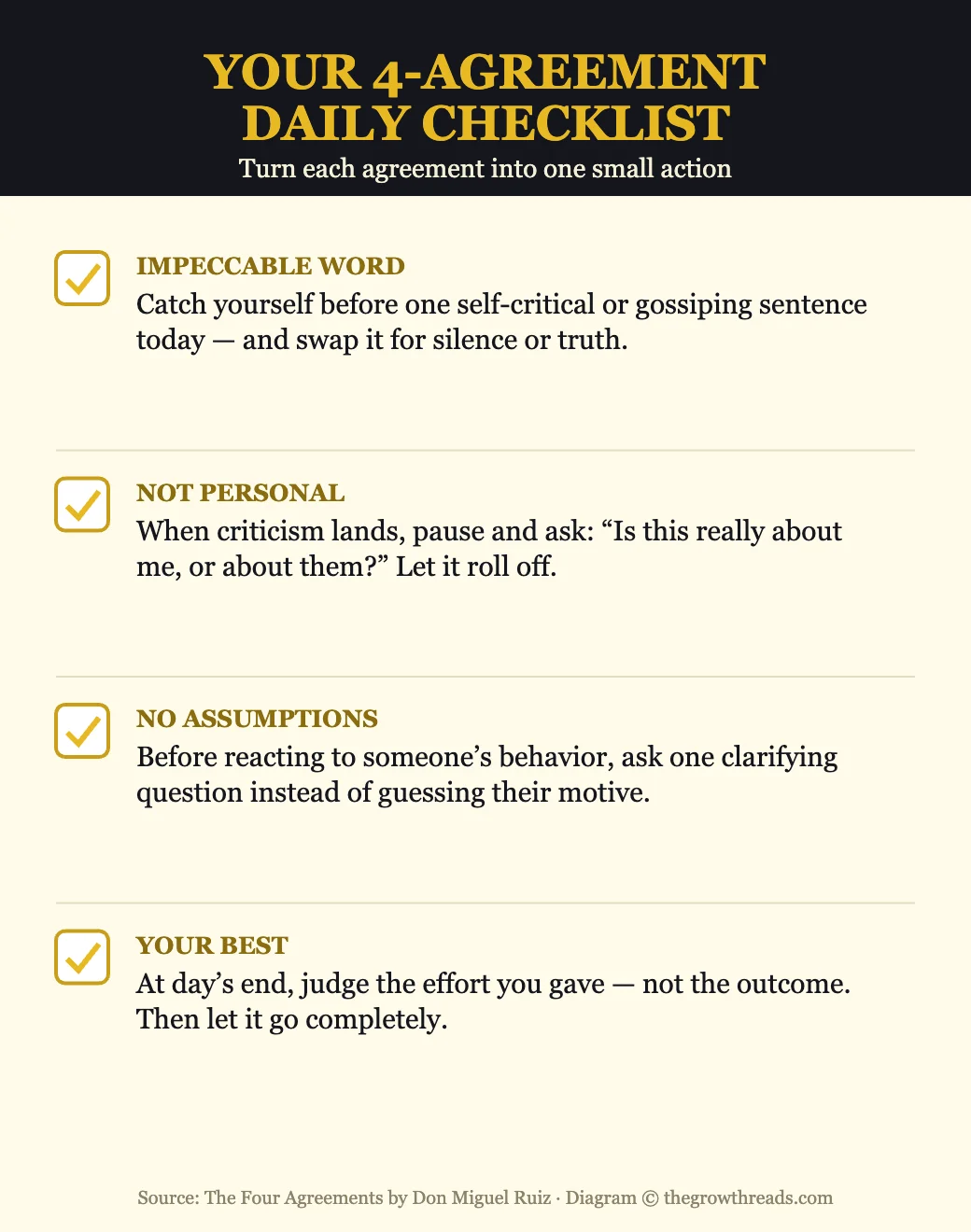
- Day 1 — Notice your word. Read the introduction and Agreement 1. Track one moment today you used words against yourself — self-criticism, an exaggeration, a broken small promise.
- Day 2 — Practice impeccability. Go 24 hours without gossiping or putting yourself down out loud, even as a joke.
- Day 3 — Catch the personal reflex. Read Agreement 2. The next time you feel stung by a comment, silently ask: “Is this about me, or about them?”
- Day 4 — Audit your triggers. Write down every moment today you felt offended, and whose “movie” — whose beliefs and mood — the reaction actually belonged to.
- Day 5 — Ask instead of assume. Read Agreements 3 and 4. Replace at least one assumption today with a direct, specific question.
- Day 6 — Do a best-effort check-in. At day’s end, rate the effort you gave — not the outcome — and consciously let the rest go.
- Day 7 — Choose your agreement. Reread all four agreements aloud as a personal code. Pick the one you’ll keep actively practicing next week.
Frequently asked questions
What are the four agreements in The Four Agreements?
The four agreements are: be impeccable with your word, don’t take anything personally, don’t make assumptions, and always do your best. Don Miguel Ruiz presents them as a personal code of conduct meant to replace the unconscious rules — the “Book of Law” — most people absorb during childhood. Each agreement targets a specific source of unnecessary suffering: careless speech, over-identifying with others’ opinions, filling in gaps with imagined meaning, and holding yourself to an impossible or inconsistent standard of effort.
Is The Four Agreements based on real Toltec teachings, or is it Ruiz’s own philosophy?
It’s a blend of both. Ruiz draws on his family’s oral Toltec teaching lineage — his mother and grandfather were healers and teachers in that tradition — but historians note that the book is a modern, personal synthesis rather than a direct transcription of pre-Columbian Toltec texts, which were largely oral and not preserved in this form. Ruiz himself frames the book as his own interpretation and application of that inherited wisdom, not an academic history.
How long does it take to read The Four Agreements?
The paperback runs about 140 pages, and most readers finish it in roughly two hours in a single sitting or two. It’s written in short chapters with plain, repetitive language by design — Ruiz intends the ideas to be absorbed slowly through practice rather than read once for information, so many readers return to specific chapters for months after their first read.
Is The Four Agreements religious, or does it require a specific belief system?
No specific religious belief is required. The book uses spiritual language — “dream,” “spirit,” “the Toltec” — but the four agreements themselves function as secular, practical guidance about communication, emotional boundaries, and effort. Readers from many religious backgrounds, and readers with none, have applied the framework without adopting Toltec cosmology as a belief system.
What’s the difference between The Four Agreements and The Fifth Agreement?
The Fifth Agreement, co-written with Ruiz’s son Don Jose Ruiz in 2010, adds a fifth practice — “be skeptical, but learn to listen” — aimed at questioning the assumptions and beliefs picked up even after you’ve adopted the original four. It’s best read as a follow-up for readers who’ve already internalized the first book, rather than a substitute for it.
Does The Four Agreements have any scientific backing?
The book itself is not a research-based text — it’s a philosophical and spiritual framework, and Ruiz doesn’t cite clinical studies. That said, several of its core mechanisms overlap with concepts that do have empirical support elsewhere, including cognitive reframing (agreement 2), reducing communication errors through clarifying questions (agreement 3), and self-compassion research on realistic rather than perfectionist standards (agreement 4).
What’s the single best agreement to start with if I can only pick one?
Most readers and teachers of the book point to Agreement 2 — don’t take anything personally — as the highest-leverage starting point, since it immediately reduces reactivity in relationships and buys you the emotional space to practice the other three. Start there for one week before layering in the rest.
Related summaries
- The Let Them Theory Summary & Review
- The 5 Love Languages Summary & Review
- How to Win Friends and Influence People Summary & Review
- Never Split the Difference Summary & Review
- Best Relationship Books — Full List
How we analyze books: Every TGR summary is built from a full read of the source material, cross-referenced against the author’s public interviews and later writing, and structured around what a reader can actually do differently, not just what the book says. We separate the book’s own claims from outside context (like historical or scientific caveats) rather than blending them. Read our full methodology.