

★★★★★ 4.8/5 — the clearest, most practical framework for showing love in a way your partner actually feels it.
Best for: couples, new partners, and anyone who feels loved differently than they show love.
Reading time: ~3.5 hrs to read the book · ~13 min to read this guide
Difficulty to apply: easy — one honest conversation can change how you show up tomorrow.
The 5 Love Languages in one minute
Most relationship friction isn’t a love problem — it’s a translation problem. Gary Chapman’s classic argues that everyone gives and receives love through one of five distinct “languages”: Words of Affirmation, Quality Time, Receiving Gifts, Acts of Service, and Physical Touch. Couples drift apart not because love has faded, but because each partner keeps speaking a language the other doesn’t fluently hear — one person shows love by cooking dinner every night, while their partner is quietly starving for a compliment or an hour of undivided attention.
Chapman’s fix is refreshingly unmysterious: figure out your own primary language, figure out your partner’s, and then deliberately speak theirs — even when it doesn’t come naturally to you. The book has sold more than 20 million copies since 1992 not because the idea is complicated, but because it gives couples a shared vocabulary for a problem most had never been able to name.
Key takeaways
- The “in love” feeling is temporary: the euphoric obsession of new romance typically fades within about two years, and that’s normal, not a warning sign.
- Everyone has an emotional “love tank”: a reservoir that needs regular refilling, and it runs on your partner’s terms, not your own.
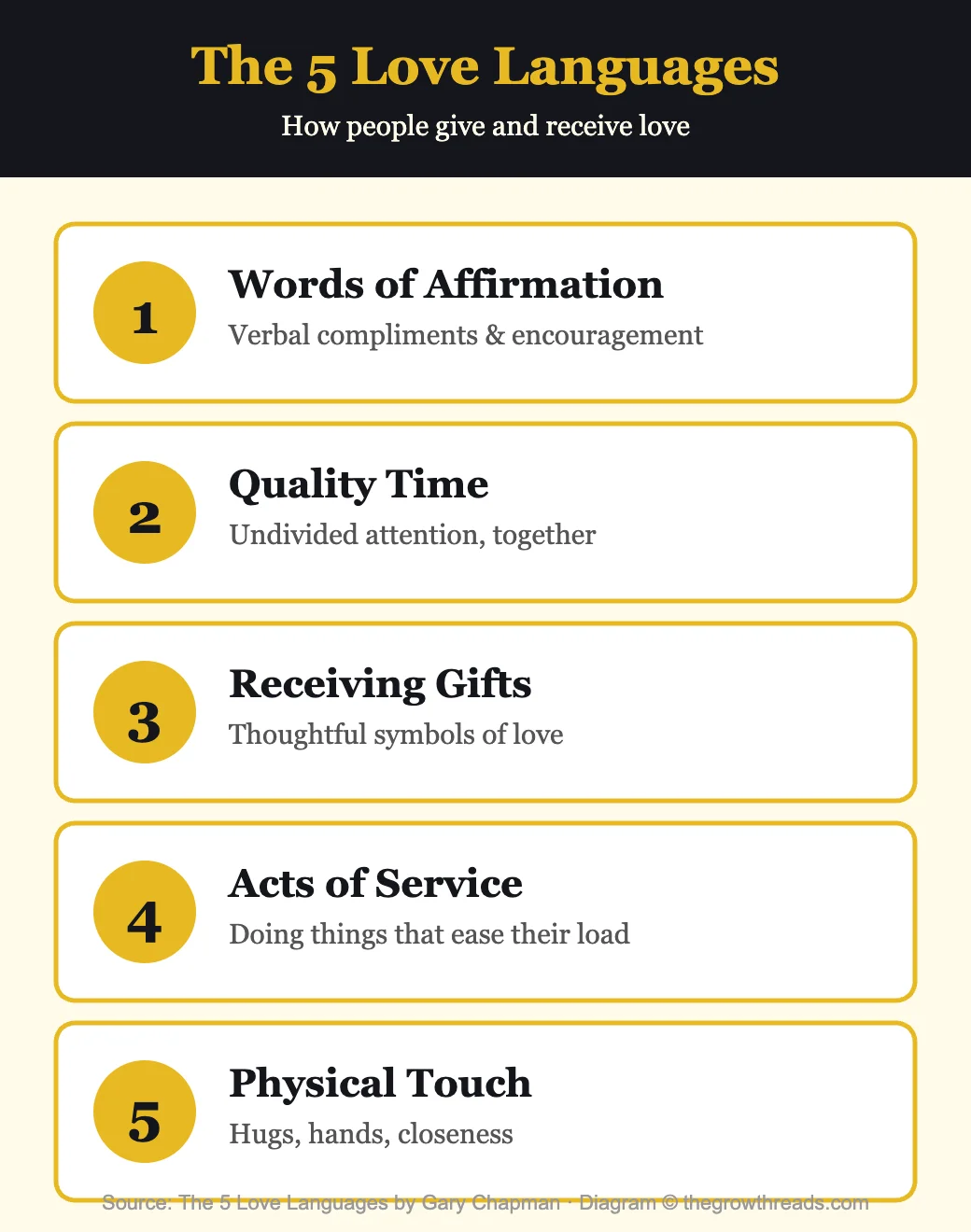
- There are five love languages: Words of Affirmation, Quality Time, Receiving Gifts, Acts of Service, and Physical Touch.
- Most people have one primary language and a secondary one — the rest register, but faintly.
- Effort in the wrong language often goes unnoticed, even when it’s sincere and frequent.
- Love, past the initial infatuation, is a choice you make daily — not just a feeling that happens to you.
- You can learn to speak a language that isn’t natural to you, the same way you’d learn useful phrases in a foreign country.
- Complaints and requests are diagnostic clues: what you complain about and ask for most reveals what you actually need.
- The framework generalizes beyond romance — Chapman has extended it to children, singles, and workplace relationships.
- Small, consistent, correctly-aimed gestures beat rare grand ones that miss your partner’s language entirely.
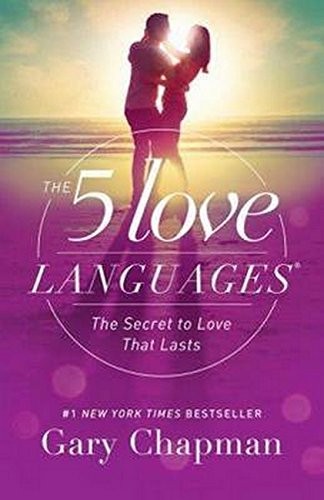
What is The 5 Love Languages about?
The 5 Love Languages is Gary Chapman’s relationship framework arguing that people express and interpret love through five distinct styles: Words of Affirmation, Quality Time, Receiving Gifts, Acts of Service, and Physical Touch. It teaches couples to identify their own and their partner’s primary language so affection actually registers as love, instead of going unnoticed.
About the author
Gary Chapman holds a PhD in adult education and spent decades as a marriage counselor and pastor in Winston-Salem, North Carolina, before writing The 5 Love Languages in 1992. The idea grew directly out of his counseling notes: he kept hearing one partner insist “I show her I love her constantly” while the other said “I never feel loved,” and realized both were telling the truth about two different languages. The book has since sold more than 20 million copies and been translated into 50+ languages, spawning an entire family of spinoffs — editions for singles, children, teenagers, and the workplace, plus a companion book on “apology languages” co-written with Dr. Jennifer Thomas. Chapman still hosts a syndicated radio program and speaks on marriage and family topics worldwide. Explore all Gary Chapman book summaries →
Key concepts at a glance
| Concept | What it means | Use it when |
| Words of Affirmation | Verbal or written encouragement and compliments | Your partner lights up at praise and wilts at criticism |
| Quality Time | Focused, undistracted togetherness | Your partner values real conversation over gifts or tasks |
| Receiving Gifts | Thoughtful, tangible symbols that you were thinking of them | Your partner treasures small tokens and notices when they’re forgotten |
| Acts of Service | Doing tasks that lighten your partner’s load | Your partner says “actions speak louder than words” |
| Physical Touch | Non-sexual and sexual touch as a core channel of connection | Your partner reaches for your hand or sits close often |
| Love Tank | The emotional reservoir that a partner’s love fills | Explaining why someone feels “unloved” despite real effort |
| Love Language Clues | Complaints, requests, and what you naturally give as diagnostic signals | You’re unsure which language you or your partner prefers |
Part 1: Why “In Love” Always Fades
Chapman opens with an idea most couples resist at first: the euphoric, obsessive “in love” feeling that defines new relationships is temporary — on average, he estimates it lasts about two years — and its fading is normal, not evidence that you married the wrong person. He calls this the “in-love experience,” an almost involuntary high that narrows your focus onto one person and makes flaws invisible.
Once that high wears off, couples land back in ordinary life, where love stops being automatic and becomes a choice. This is where Chapman introduces the “emotional love tank”: everyone carries a reservoir that needs to be kept full to feel secure and generous toward a partner, and an empty tank — not a lack of love — is usually what’s behind the criticism, distance, or conflict that shows up in a struggling relationship.
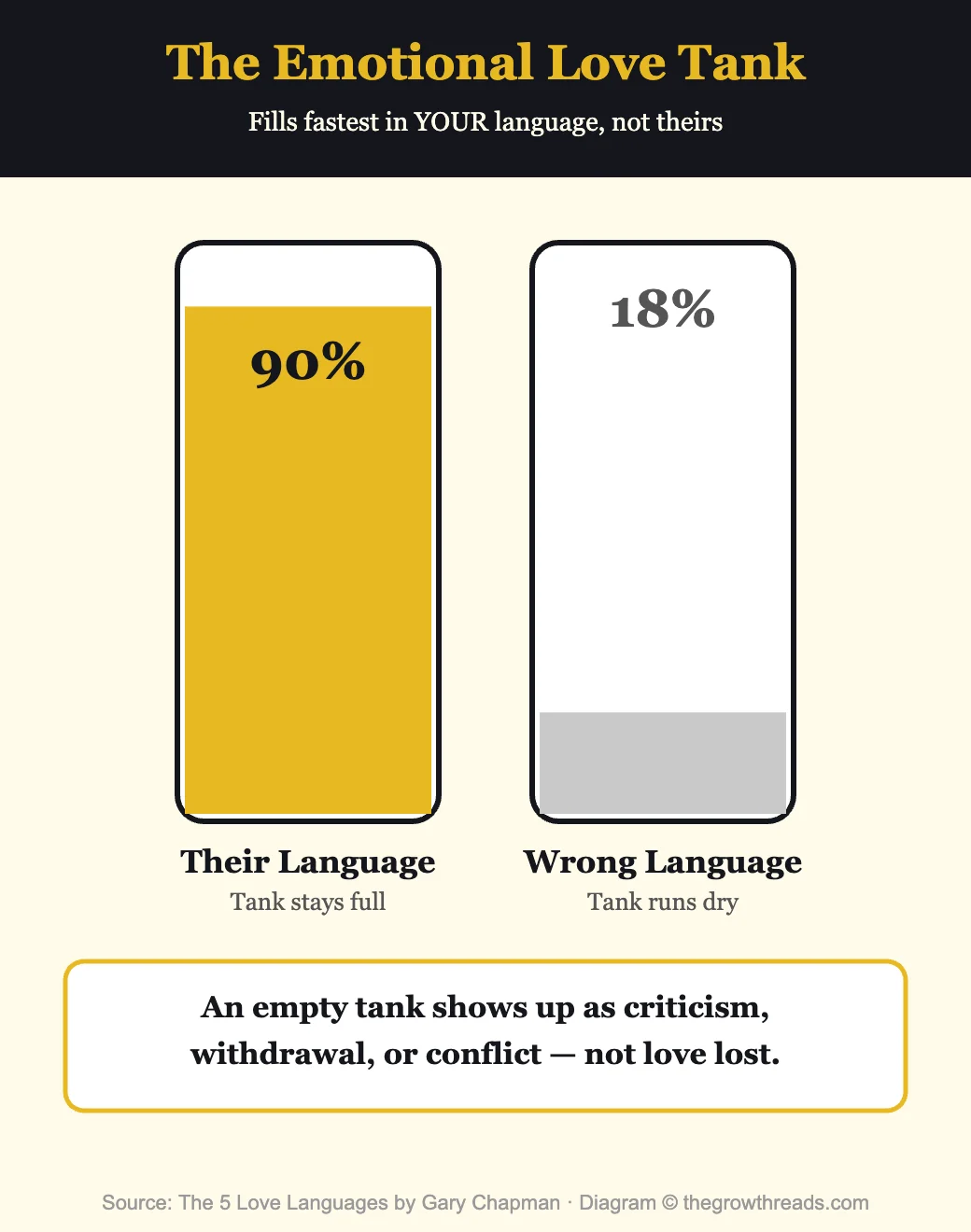
TGR Note: the love-tank idea pairs well with the acceptance work in our The Let Them Theory review — Chapman gives you a way to actively fill your partner’s tank, while The Let Them Theory helps you stop draining your own by fighting things you can’t control.
Part 2: The Five Love Languages, Explained
Words of Affirmation covers spoken and written encouragement — “I’m proud of you,” a specific compliment, an unprompted text — and Chapman is specific that vague praise lands worse than precise, sincere observations. Quality Time isn’t just proximity; it means focused attention with phones down and full eye contact, plus what he calls “quality conversation” — sharing feelings, not just logistics.
Receiving Gifts is the language most often dismissed as materialistic, but Chapman reframes it as symbolism: a gift says “they were thinking of me while we were apart,” and its emotional weight has little to do with price. Acts of Service means chores and tasks — cooking, fixing, running an errand — done as an expression of love rather than obligation or resentment; Chapman notes tone matters as much as the task itself. Physical Touch spans everything from a hand on the shoulder to sex, and for people with this as a primary language, a day without any touch can feel like a day without any love at all, regardless of what else happened.
The core insight running under all five: none is more “correct” than another, and the biggest source of friction is simply assuming your partner’s language matches yours.
Part 3: Finding Your Own (and Your Partner’s) Language
Chapman offers three diagnostic questions rather than a rigid test: what do you complain about most in your relationship, what do you request most often, and how do you naturally express love to other people? A complaint like “you never tell me what you’re thinking” usually points straight at Quality Time or Words of Affirmation as an unmet need; a request repeated often is a direct hint at what would refill the tank fastest; and the way you instinctively show love to others often mirrors what you secretly want back.
He’s candid that this takes honest self-observation over guessing, and that partners are frequently surprised by each other’s answers — the assumption that “of course they know what I need” is, in his experience, almost always wrong. Once each partner names a language, the work becomes concrete and almost mechanical: deliberately schedule the gestures that speak it, the same way you’d practice vocabulary in a language you’re learning.
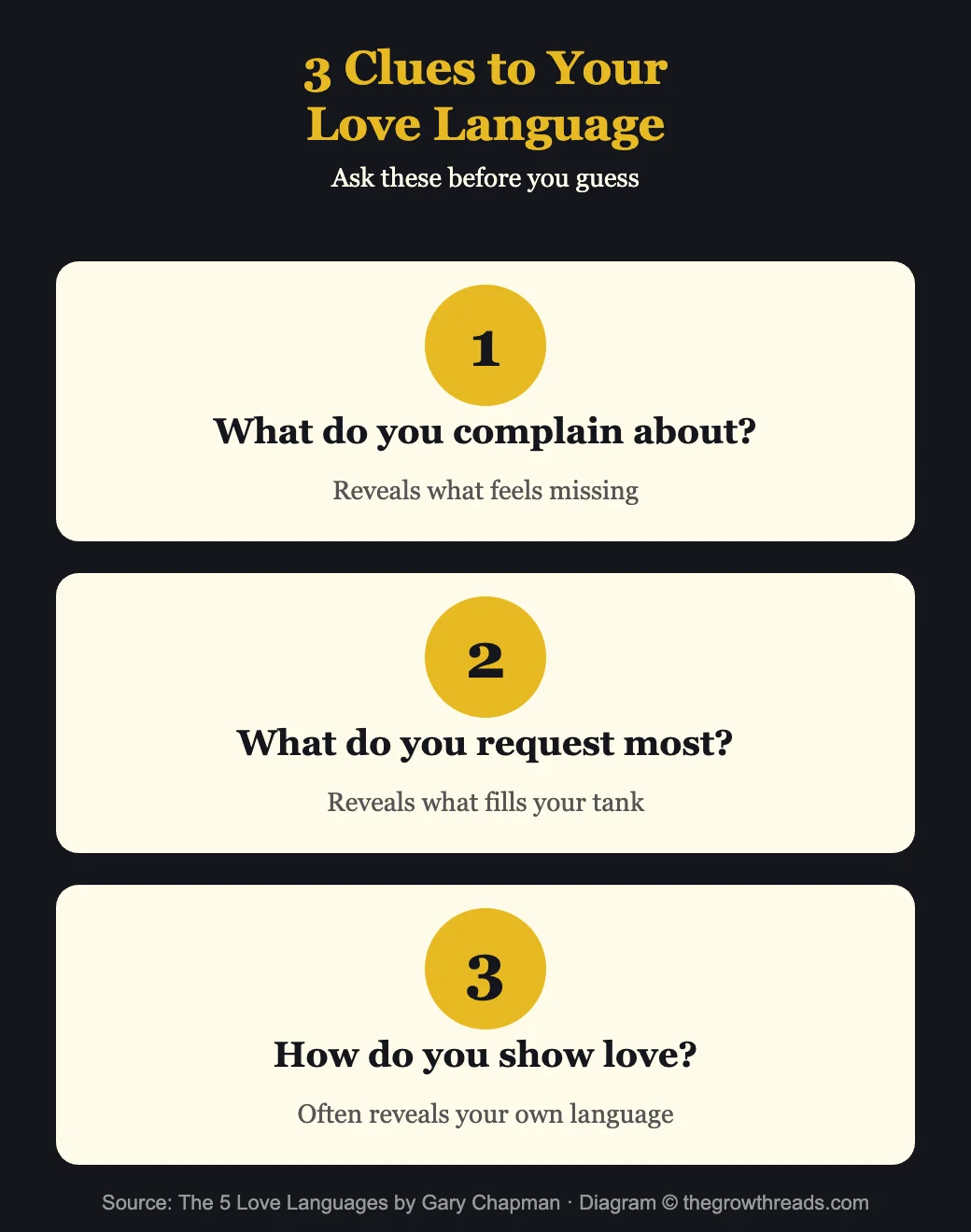
TGR Note: Chapman’s three clues are a simple version of the calibrated-listening skills covered in our Never Split the Difference review — both books agree that what people repeat is more diagnostic than what they say once.
Part 4: Love Is a Choice, Not Just a Feeling
The last section is Chapman’s most practical: once you know both languages, speaking your partner’s — especially on days you don’t feel like it — is what he means by “love as a choice.” He’s not dismissing feelings; he’s arguing that consistent action, aimed correctly, is what regenerates the feeling over time, rather than the reverse.
He also briefly extends the framework past marriage: to singles dating and deciding compatibility, to parents and children (kids have love languages too, and a mismatch there can look like a discipline problem when it’s really a connection problem), and to workplaces, where recognition and teamwork styles echo the same five categories. A later companion book, The Five Languages of Apology, applies the same logic to how people prefer to hear “I’m sorry” — worth knowing about if repair after conflict is your specific sticking point.
TGR Note: if the harder part for you is general rapport and making people feel valued — not just your romantic partner — pair this with our How to Win Friends and Influence People summary, which covers the broader interpersonal skills Chapman assumes you already have.
Who is The 5 Love Languages best for — and who should read something else first?
Best for: couples who love each other but keep feeling unappreciated despite real effort; new partners who want a shared vocabulary early; and anyone whose relationship complaint boils down to “I don’t think they see how much I do.”
Read something else first if: your main issue is high-conflict communication and negotiation dynamics rather than everyday affection — start with Never Split the Difference; or if your pattern is trying to control or fix your partner rather than accept them, start with The Let Them Theory; or if the gap is general people skills rather than romance specifically, start with How to Win Friends and Influence People.
Questions to reflect on
- Which of the five languages makes you feel most loved — and does your partner actually know that?
- What do you complain about most in your relationship? What unmet need might that be pointing to?
- When did you last deliberately speak your partner’s language, even though it wasn’t natural to you?
- Is there a language you quietly avoid because it feels awkward or unfamiliar to use?
- What’s one small, specific action you could take today that would fill your partner’s tank?
🔥 Ready to speak a language your partner actually feels?
Grab a copy and start filling the right tank tonight.
How to apply The 5 Love Languages (7-day plan)
- Day 1: Ask yourself Chapman’s three questions — biggest complaint, most common request, how you naturally show love — and write down a guess at your own primary language.
- Day 2: Ask your partner to do the same, independently, then compare answers over a relaxed conversation, not a debate.
- Day 3: Speak your partner’s top language once today, deliberately and specifically — not a generic gesture, but one aimed at what they actually named.
- Day 4: Track one complaint you make today and “reverse-translate” it into the underlying need instead of just venting it.
- Day 5: Do one act in a language that isn’t natural to you, and notice how it feels to practice it deliberately.
- Day 6: Hold a 15-minute “love tank check-in”: how full does each of you feel this week, on a 1–10 scale, and why?
- Day 7: Pick one recurring weekly ritual in your partner’s primary language and put it on the calendar so it survives a busy month.
Frequently asked questions
What are the five love languages?
The five love languages are Words of Affirmation, Quality Time, Receiving Gifts, Acts of Service, and Physical Touch — the five broad ways Gary Chapman observed people expressing and preferring to receive love. Everyone uses all five to some degree, but most people have one or two that feel far more meaningful than the rest. When a partner consistently uses a different language, real effort can go unnoticed even though love is genuinely present. Identifying both your own and your partner’s primary language gives couples a shared vocabulary for translating affection so it actually registers, instead of getting lost in a mismatched delivery.
How do I find my own love language?
Chapman suggests three diagnostic questions: what do you complain about most in your relationship, what do you request most often from your partner, and how do you naturally show love to other people? Complaints usually point to an unmet need, requests reveal what would fill your tank fastest, and the way you instinctively express affection often mirrors what you secretly want back. Beyond self-reflection, Chapman’s official online quiz offers a faster, structured way to identify your top language, though most people already sense the answer once they consider these three clues honestly.
Can someone have more than one love language?
Yes. Chapman notes most people have a clear primary language and a secondary one that also matters, even if less intensely. Some people score close to evenly across two or three, which usually just means several types of gestures register as meaningful to them. The framework isn’t meant to box anyone into one rigid category — it’s a starting vocabulary. The real value is noticing which language moves the needle most reliably for you and your partner, then making sure that specific one gets spoken regularly, alongside whatever else happens naturally.
Do love languages change over time?
A person’s primary language is generally stable, but Chapman acknowledges it can shift with major life changes — a new baby, illness, grief, or a demanding season at work can temporarily raise the importance of Acts of Service or Physical Touch, for example. The healthiest approach is to treat your love language as a working hypothesis you periodically re-check with your partner, rather than a permanent label. Revisiting the three diagnostic questions every year or after a big life change keeps the framework accurate instead of stale.
What if my partner and I have completely different love languages?
This is exactly the situation the book is written for, and Chapman treats it as normal rather than a warning sign. Mismatched languages explain why one partner can feel deeply loving while the other feels neglected — both can be true at the same time. The fix isn’t to change what feels natural to you personally; it’s to deliberately learn to speak your partner’s language as a secondary skill, the way you’d learn a few useful phrases in a foreign language. Chapman is clear that this takes intention and practice, not natural compatibility.
Is the 5 Love Languages based on scientific research?
The framework grew out of Chapman’s decades of marriage counseling observations rather than a formal research study, and later academic reviews have found mixed support for the idea that people sort neatly into five fixed categories. That said, the underlying behaviors — affirming words, dedicated time, thoughtful gifts, helpful actions, and physical affection — are well-supported relationship practices in their own right. Most readers get value from the book as a practical communication vocabulary rather than a validated psychological instrument, and we treat it accordingly here.
Can love languages apply to kids, friends, or coworkers — not just romance?
Yes — Chapman has written companion books applying the same five categories to children, teenagers, singles, and even workplace relationships. The core idea, that people feel valued differently and matching your effort to their preference works better than defaulting to your own, generalizes well beyond marriage. A parent whose child’s language is Quality Time, for instance, will land better with an afternoon together than with a gift, even though the gift was well-intentioned and generous.
Related summaries
- How to Win Friends and Influence People Summary & Review
- The Let Them Theory Review
- Never Split the Difference Review
- Best Relationship Books — Full List
How we analyze books: every TGR summary is built from a full read of the original text, cross-checked against the author’s interviews and follow-up work, then structured into an actionable framework — key ideas, a practical 7-day plan, and reflection questions — so you can apply it, not just recall it. Read our full methodology.