

★★★★½ 4.5/5 — a gripping, immediately useful negotiation masterclass from an FBI hostage negotiator. Emotional intelligence as a practical toolkit.
Best for: anyone who negotiates — which is everyone: salaries, deals, prices, and everyday disagreements · Reading time: ~7 hours (this guide: 16 min) · Difficulty to apply: Moderate — the tactics are simple to learn and feel awkward until you practice
Never Split the Difference in one minute
Negotiation is not a logical debate to be won with arguments — it is an emotional process to be guided with empathy. Chris Voss spent years as the FBI’s lead international kidnapping negotiator, where “splitting the difference” could get someone killed, and he distilled what actually works into a toolkit anyone can use. His central insight is that people are driven by emotion, not reason, so the negotiator’s job is to understand and influence the other side’s feelings rather than to out-argue them. Through techniques like tactical empathy, mirroring, labeling, and calibrated questions, you make the other person feel understood and safe — which paradoxically gives you enormous influence. Voss deliberately breaks with the classic “win-win, find common ground” school, arguing that compromise usually produces bad deals, and that a negotiator who truly understands the other side can create far better outcomes for both.
Key takeaways
- Tactical empathy: understanding and acknowledging the other side’s feelings and perspective is the master skill of negotiation.
- Mirroring: repeating the last few words someone said prompts them to keep talking and reveal more.
- Labeling: naming the other person’s emotion — “It seems like…” — defuses negatives and reinforces positives.
- Aim for “That’s right”: getting the other side to say “that’s right” signals real understanding — very different from a dismissive “you’re right.”
- “No” is the start, not the end: “No” makes people feel safe and in control, so invite it rather than chasing “yes.”
- Calibrated questions: open “How” and “What” questions give the other side the illusion of control while steering the outcome.
- The accusation audit: naming their worst assumptions about you up front takes the sting out of them.
- Never split the difference: compromise often means both sides lose; keep working toward a genuinely better deal.
- Bend their reality: use anchoring, loss aversion, and framing to shape how the other side perceives the deal.
- Hunt for Black Swans: small pieces of hidden information can completely change a negotiation.
What is Never Split the Difference about?
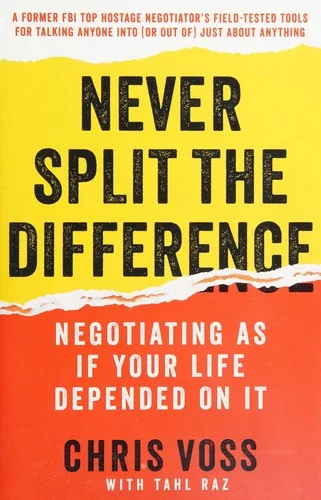
Never Split the Difference is a negotiation book by former FBI hostage negotiator Chris Voss. It argues that negotiation is driven by emotion, not logic, and teaches a set of practical tactics — tactical empathy, mirroring, labeling, calibrated questions, and more — for understanding the other side and guiding them toward agreements that work for you.
About the author
Chris Voss served as the FBI’s lead international kidnapping negotiator, handling high-stakes hostage situations around the world where the wrong word could cost a life. Frustrated that traditional, rational negotiation theory failed in real crises, he helped pioneer an approach grounded in psychology and emotional intelligence. After leaving the Bureau he founded the Black Swan Group, a consultancy that teaches his methods to businesses and individuals, and he now lectures at leading business schools. Co-written with the journalist Tahl Raz and published in 2016, Never Split the Difference became a runaway bestseller, prized because its life-or-death stories make the techniques vivid and its advice transfers directly to salary talks, business deals, and everyday disagreements. Voss writes as a practitioner, not a theorist — every tactic is one he used when the stakes were absolute. Explore all Chris Voss book summaries →
Key concepts at a glance
| Tool | What it does | Use it when |
|---|---|---|
| Tactical empathy | Understand and name their feelings | The whole negotiation |
| Mirroring | Repeat their last words to draw them out | You need more information |
| Labeling | Name an emotion to defuse or affirm it | Tension is rising |
| “That’s right” | Signals genuine understanding | Building trust and buy-in |
| Calibrated questions | Give the illusion of control | You’re stuck or being pushed |
| Accusation audit | Preempt their objections | You expect resistance |
Part 1: Negotiation is emotional — tactical empathy, mirroring, and labeling
Voss opens by rejecting the dominant model of negotiation taught for decades — the rational, interest-based “getting to yes” approach that treats negotiation as a joint problem-solving exercise between logical parties. In the hostage situations he handled, that model fell apart, because the people across the table were terrified, angry, and irrational, and no amount of clever bargaining logic reached them. What worked was tactical empathy: the deliberate practice of recognizing the other side’s perspective and feelings, and then voicing that recognition to build trust and influence. Empathy here is not about being nice; it is a tool for gathering information and lowering the other person’s defenses.
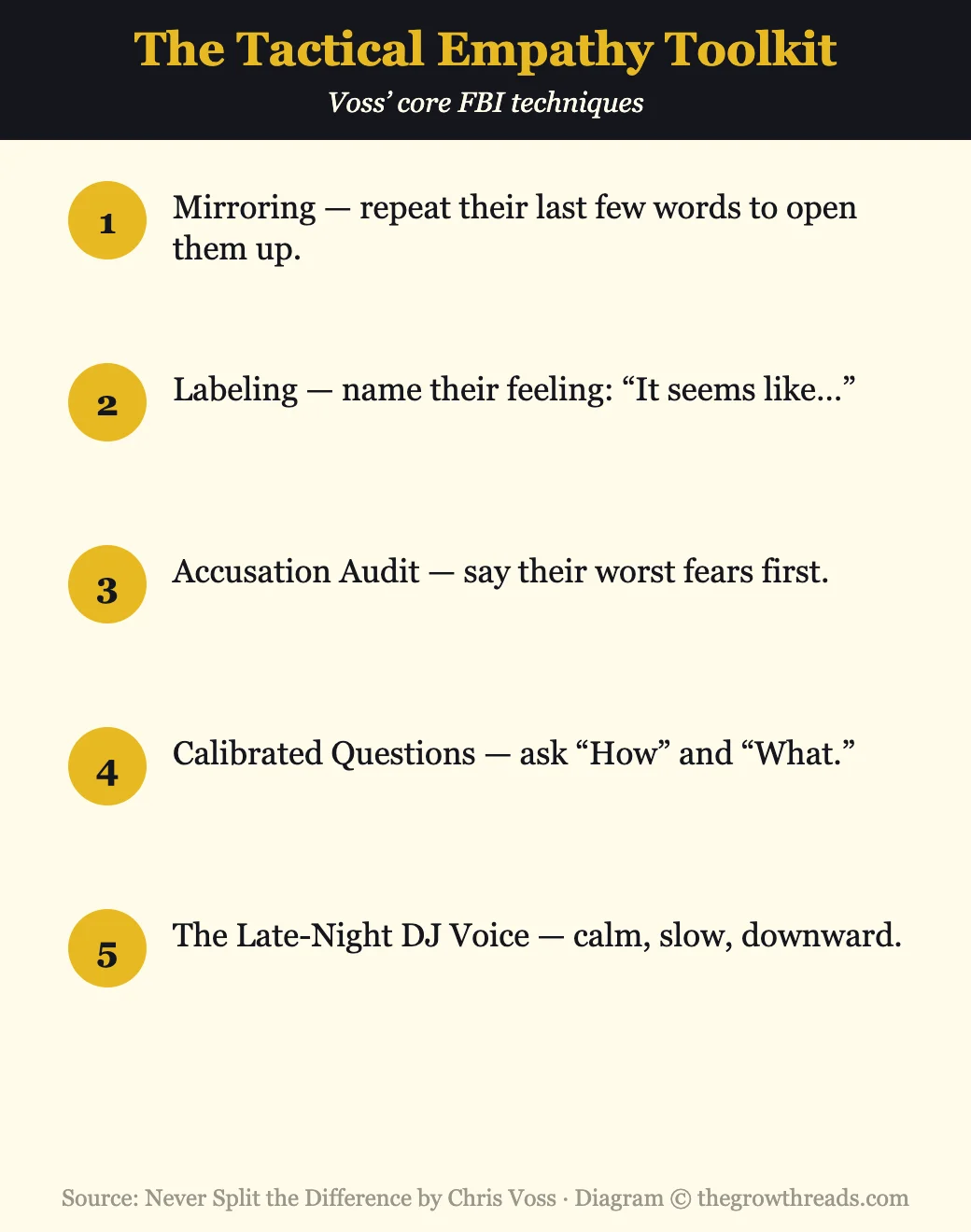
Two techniques do the early heavy lifting. The first is mirroring: simply repeating the last one to three words the other person said, with an upward, curious tone. It sounds absurdly simple, but it triggers the other person to elaborate, reveal more, and feel heard, buying you information and time. The second is labeling: naming the emotion you sense, with a phrase like “It seems like you’re worried about…” or “It sounds like this deadline matters a lot to you.” Labeling a negative emotion diffuses it by bringing it into the open, while labeling a positive one reinforces it. Both techniques share a foundation — slowing down and using what Voss calls the “late-night FM DJ voice,” a calm, warm, downward-inflecting tone that soothes the other side and signals you are in control of yourself.
TGR Note: Voss’s tactical empathy is the high-stakes operationalization of Stephen Covey’s fifth habit in The 7 Habits — “seek first to understand, then to be understood.” And it shares its warm-influence DNA with How to Win Friends and Influence People. Covey and Carnegie give the principle; Voss gives you the exact words to say when the pressure is on.
Part 2: Get to “That’s right” and the power of “No”
Voss identifies a specific moment that signals a breakthrough: when the other person says “that’s right.” This happens when you have summarized their situation, feelings, and perspective so accurately that they feel genuinely understood — and it changes the dynamic completely, because people who feel understood become open and cooperative.
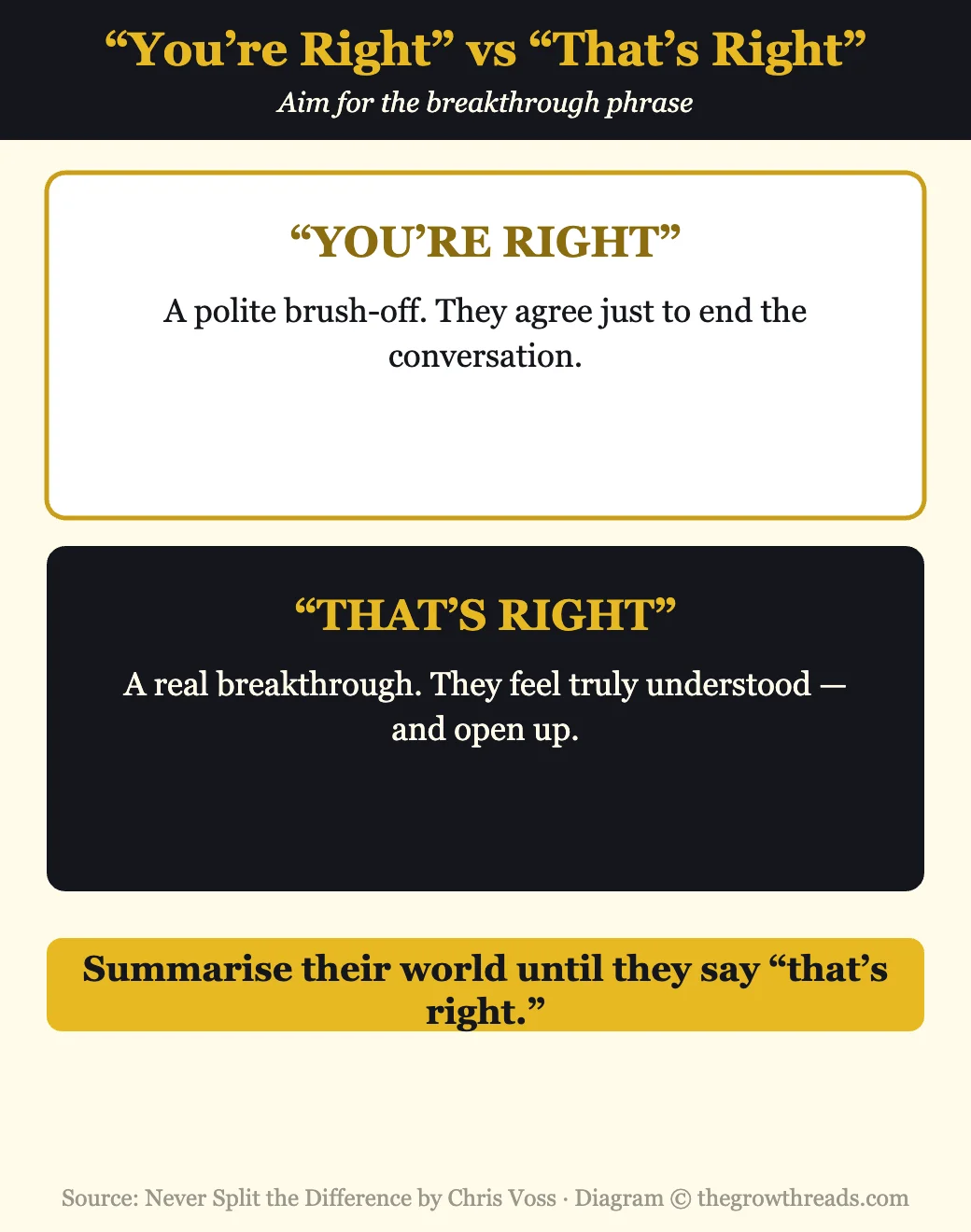
He is careful to distinguish this from “you’re right,” which sounds like agreement but is usually the opposite — a polite brush-off people use to end a conversation without committing to anything. The goal is never to get someone to say “you’re right”; it is to make them say “that’s right” by reflecting their world back to them through labels and a good summary. His second counterintuitive move concerns the word most negotiators chase — “yes.” Voss argues that pushing for “yes” makes people defensive, because they have learned that “yes” is a commitment that traps them. “No,” by contrast, makes people feel safe, autonomous, and in control. So instead of asking “Do you have a few minutes to talk?” (which pressures a yes), you ask “Is now a bad time to talk?” — inviting a “no” that actually moves you forward. Getting a “no” early, he says, is often the real beginning of the negotiation.
Part 3: Calibrated questions and the illusion of control
When a negotiation stalls or the other side pushes hard, Voss’s tool of choice is the calibrated question — an open-ended question, usually starting with “How” or “What,” that cannot be answered with a simple yes or no and that forces the other person to solve your problem for you.
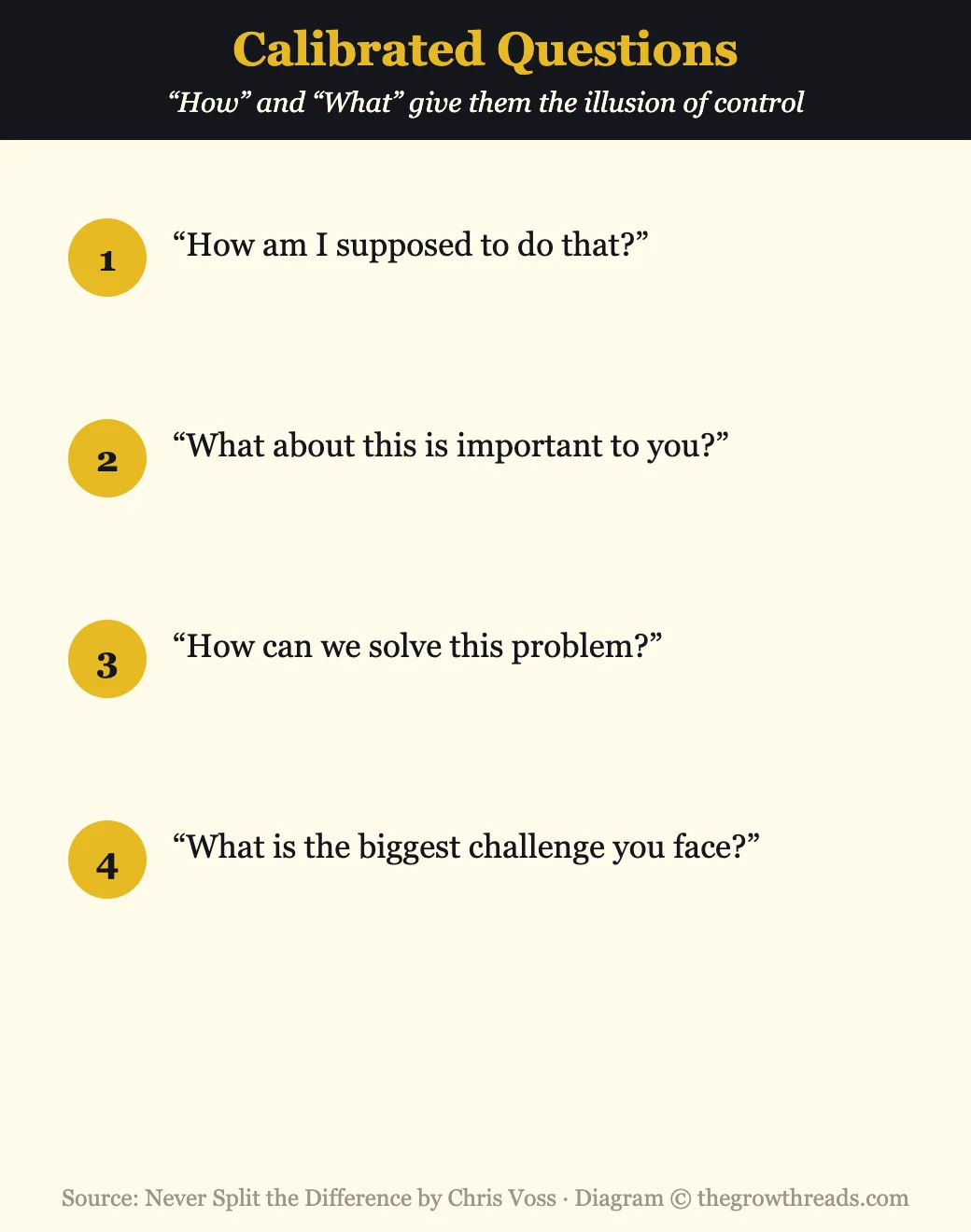
Faced with an unreasonable demand, rather than saying “no” or arguing, you ask “How am I supposed to do that?” This hands the difficulty back to them, makes them feel in control, and often leads them to talk themselves out of the demand or improve their offer. Questions like “What about this is important to you?” and “How can we solve this problem?” gather information, buy time, and steer the conversation without triggering resistance, because the other side feels they are directing things. Voss pairs this with the accusation audit: before the other person can raise their objections, you name them yourself. Opening with “You’re probably going to think I’m being unreasonable, and you may feel like I’ve dropped the ball here…” takes the power out of accusations by saying them first, which builds trust and clears the air. Throughout, he emphasizes that “no” is safe, silence is a tool, and the negotiator who asks rather than tells stays in control.
Part 4: Bending reality, bargaining, and the Black Swan
The final third of the book turns to the numbers. Voss argues that price is perceived through emotion, so you can “bend the other side’s reality” using psychology. He leans on principles like anchoring — the first number sets the frame — and loss aversion, our tendency to fear losses more than we value equivalent gains, which you can use by framing what the other side stands to lose by not agreeing. For the actual haggling, he offers the Ackerman model, a systematic bargaining approach: set a target, open at about 65% of it, then move in decreasing increments (to 85%, 95%, and 100% of your maximum) with calibrated questions and precise, odd-numbered final figures that feel carefully calculated rather than arbitrary. The declining increments signal you are nearing your limit, and the oddly specific final number feels like a real ceiling.
Voss closes with the idea of the Black Swan — pieces of hidden information that, once uncovered, transform a negotiation. Every counterpart has three to five “Black Swans,” unknown facts about their situation, constraints, or motivations that would change everything if you knew them. The job of a great negotiator is to keep probing, listening, and building enough trust that these hidden truths surface. It ties the whole book together: because you cannot out-argue what you do not understand, the deepest source of leverage is not a clever tactic but the empathy and curiosity to truly learn what the other side wants and fears. Master that, and you rarely have to split the difference at all.
TGR Note: Voss’s toolkit sits interestingly between two others we cover. It is the warm cousin of the influence tactics in The 48 Laws of Power — using psychology to shape outcomes — but where Greene can feel adversarial, Voss’s empathy is genuinely collaborative, closer to Carnegie. Read alongside How to Win Friends, you get a full spectrum of ethical influence, from everyday rapport to high-stakes deals.
Who is Never Split the Difference best for — and who should read something else first?
This book is ideal for anyone who negotiates in life or work — which is everyone — from salary talks and business deals to buying a car or resolving a family disagreement. Its FBI stories make it a genuinely thrilling read, and its tactics are unusually concrete and repeatable. It is not a book of soft, feel-good communication advice; some readers find the tactical framing a little manipulative, though Voss frames it as collaborative. If you want the gentler, relationship-first foundation beneath these tactics, start with How to Win Friends and Influence People, then add Voss for the high-stakes toolkit.
Questions to reflect on
- In your last hard conversation, were you trying to win the argument or understand the other person?
- Where could a simple label — “It seems like…” — have defused tension for you recently?
- What “no” could you invite that would actually move a stuck negotiation forward?
- What calibrated question could hand a difficult demand back to the other side?
- What might the “Black Swans” be — the hidden things you don’t yet understand about the people you negotiate with?
🔥 Ready to negotiate like an FBI pro?
This guide is the map — Voss’s hostage-negotiation stories are what make the tactics unforgettable.
How to apply Never Split the Difference (7-day plan)
- Day 1 — Practice mirroring. In one conversation, repeat the last few words the person said and let them elaborate.
- Day 2 — Use a label. Name someone’s emotion with “It seems like…” and watch the tension shift.
- Day 3 — Invite a “no.” Ask a question designed to get a safe “no” (“Is now a bad time?”) instead of chasing “yes.”
- Day 4 — Aim for “that’s right.” Summarize someone’s view until they confirm you truly get it.
- Day 5 — Ask a calibrated question. Meet a demand with “How am I supposed to do that?”
- Day 6 — Run an accusation audit. Before a tricky ask, name their likely objections first.
- Day 7 — Hunt a Black Swan. In your next negotiation, ask questions to uncover one thing you didn’t know.
Frequently asked questions
Is Never Split the Difference worth reading?
Yes — it is one of the most practical and engaging negotiation books available. Chris Voss’s background as an FBI hostage negotiator gives the tactics real credibility and makes the stories genuinely gripping, and the techniques transfer directly to everyday situations like salary talks, sales, and disagreements. Some readers find the tactical framing slightly manipulative, but most come away with concrete tools they can use immediately. If you negotiate anything — and everyone does — it is well worth the read.
What is the main message of Never Split the Difference?
That negotiation is driven by emotion rather than logic, so the way to succeed is through empathy and psychology, not clever arguments or splitting the difference. Voss teaches you to understand and influence the other side’s feelings using tactical empathy, mirroring, labeling, and calibrated questions. The title itself is his core stance: compromise usually produces bad outcomes, and a negotiator who truly understands the other side can find far better deals.
What is tactical empathy in Never Split the Difference?
Tactical empathy is the deliberate practice of recognizing the other side’s perspective and emotions and then voicing that recognition to build trust and influence. It is not about being nice or agreeing; it is a tool for gathering information and lowering defenses. In practice it shows up through techniques like labeling (“It seems like…”) and mirroring, delivered in a calm tone, so the other person feels genuinely understood and becomes more open and cooperative.
What does “never split the difference” actually mean?
It means you should resist the instinct to compromise or meet in the middle just to reach a quick agreement. Voss argues that splitting the difference — say, meeting halfway on price — often leaves both sides with a worse deal than was possible. Instead, by understanding what the other side truly needs and using his techniques, you can craft an outcome that is genuinely better, rather than settling for a mediocre middle simply to avoid discomfort.
What are calibrated questions in Never Split the Difference?
Calibrated questions are open-ended questions, usually beginning with “How” or “What,” that cannot be answered yes or no and that give the other side the illusion of control while steering the outcome. Faced with a tough demand, instead of arguing you ask “How am I supposed to do that?”, which hands the problem back to them. Questions like “What about this is important to you?” gather information and defuse pressure without triggering resistance.
How long does it take to read Never Split the Difference?
The book is around 270 pages and most readers finish it in about seven hours, often faster because the hostage-negotiation stories are hard to put down. It is organized around clear techniques, so it also works well as a reference to revisit before a big negotiation. Our summary above captures the core tactics in roughly 16 minutes.
Is Never Split the Difference manipulative?
It teaches persuasion techniques, and some readers find that uncomfortable, but Voss frames them as collaborative rather than exploitative. The tools are designed to make the other side feel genuinely understood and to uncover what they truly need, which tends to produce better outcomes for both parties, not just for you. As with any influence skill, the ethics depend on how you use it — to reach fair agreements and understanding, or to take advantage. Used honestly, the techniques build trust rather than erode it.
Related summaries
- How to Win Friends Summary — the warm foundation beneath Voss’s tactics.
- The 7 Habits Summary — seek first to understand, then to be understood.
- The 48 Laws of Power Summary — the sharper side of influence.
- Browse all our best relationship books.
How we analyze books: We work from the full book — reconstructing its core arguments in our own words, adding commentary that connects it to related research and other books in our library, and pressure-testing the advice against how it plays out in real life. We never reproduce the text; we synthesize it. Read our full methodology.
Disclosure: The Growth Reads is reader-supported. When you buy through links on our site we may earn an affiliate commission at no extra cost to you. We only recommend books we believe are worth your time, and our summaries and opinions are written independently.