

★★★★ 4.3/5 — a sharp, Stoic-flavored warning that your biggest obstacle is usually yourself. Story-rich, humbling, and endlessly quotable.
Best for: ambitious people who sense that pride and self-regard might be getting in their own way · Reading time: ~5 hours (this guide: 15 min) · Difficulty to apply: Moderate — spotting ego in others is easy; spotting it in yourself is the work
Ego Is the Enemy in one minute
The thing most likely to sabotage your success is not a competitor or bad luck — it is your own ego. Ryan Holiday defines ego as an unhealthy belief in our own importance: the need to be recognized, to be right, to be better than others. Drawing on Stoic philosophy and a parade of historical stories — generals, athletes, artists, and executives who either mastered their ego or were destroyed by it — he shows that ego is dangerous at every stage of a journey. When you are aspiring, ego makes you talk instead of do and skip the humble work of becoming good. When you find success, ego breeds entitlement, delusion, and the loss of the very discipline that got you there. And when you hit failure, ego turns setbacks into bitterness and excuses instead of lessons. The antidote throughout is humility: staying a student, doing the work quietly, and letting results — not self-promotion — speak.
Key takeaways
- Ego is the enemy at every stage: in aspiration, success, and failure, unhealthy self-regard undermines you.
- Talk less, do more: ego loves to talk about plans; talking drains the energy and urgency you need to actually do the work.
- Become a student: stay humble enough to keep learning; the moment you think you know it all, you stop growing.
- Do the work, not the theater: chase real accomplishment, not the appearance of it or the applause.
- Restraint over recognition: the “canvas strategy” — quietly making others look good — builds more than self-promotion ever will.
- Passion can be a liability: raw passion is often ego in disguise; disciplined purpose and process win.
- Success is dangerous: it inflates ego, so you must stay sober, keep learning, and resist entitlement.
- Don’t tell yourself stories: flattering narratives about your own greatness distort reality and lead to bad decisions.
- Turn dead time into alive time: in setbacks, use the time to learn and prepare rather than resent and stall.
- The effort is enough: do your best work for its own sake, detaching from whether the world rewards it.
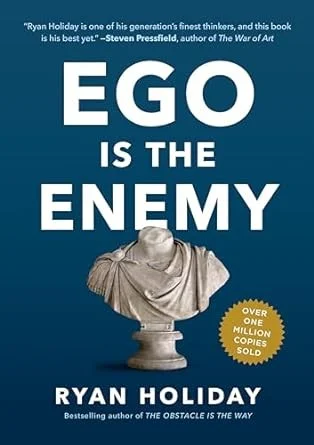
What is Ego Is the Enemy about?
Ego Is the Enemy is a self-development book by Ryan Holiday about how ego — an unhealthy belief in our own importance — sabotages us at every stage of life. Structured around aspiration, success, and failure, it uses Stoic philosophy and historical stories to argue that humility, restraint, and doing the work quietly are what truly lead to lasting achievement.
About the author
Ryan Holiday is an American author and former marketing strategist who became one of the most successful popularizers of Stoic philosophy for modern readers. After an early career that included serving as director of marketing at American Apparel and writing about media manipulation, he turned to translating ancient Stoic ideas into practical guidance, beginning with The Obstacle Is the Way and continuing through Ego Is the Enemy, Stillness Is the Key, and The Daily Stoic. Published in 2016, Ego Is the Enemy is built the way all his books are: short, punchy chapters, each anchored by vivid historical examples — figures like Ulysses S. Grant, William Tecumseh Sherman, Katharine Graham, and Bill Belichick — that dramatize a single principle. Holiday writes with the conviction of someone who has watched ego wreck careers, including cautionary tales he knows well, and his central aim is to make ancient wisdom about humility feel urgent and usable today. Explore all Ryan Holiday book summaries →
Key concepts at a glance
| Concept | What it means | Use it when |
|---|---|---|
| Ego | Unhealthy belief in your own importance | You need recognition or to be right |
| Talk vs do | Talking substitutes for real work | You’re announcing instead of building |
| Be a student | Stay humble and keep learning | You feel you’ve “made it” |
| Canvas strategy | Quietly help others succeed | Early in a career or role |
| Alive vs dead time | Use setbacks to grow, not stall | You’ve hit a failure or wait |
| The effort is enough | Do the work for its own sake | Outcomes feel unfair |
Part 1: Aspire — ego before you’ve done anything
Holiday structures the book around three stages every person passes through — aspiring to something, achieving success, and enduring failure — and shows how ego threatens you differently at each. Ego is especially seductive at the start, when you have grand ambitions but few accomplishments to show for them.
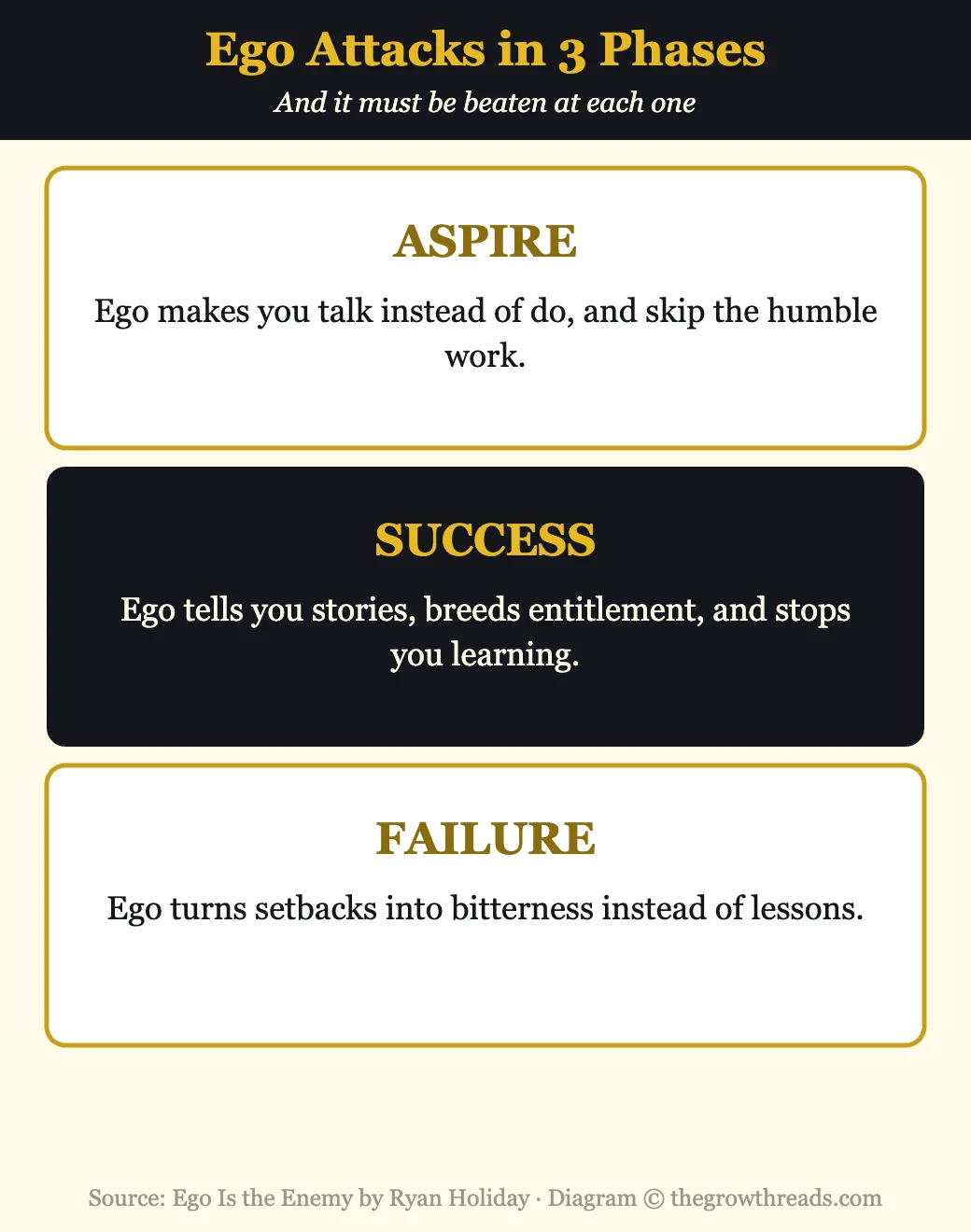
The first and most practical warning is about talk. Ego loves to talk — to announce plans, describe our future greatness, and collect praise for things we have not yet done. But talking, Holiday argues, is not a harmless prelude to doing; it actively drains the drive to do, because the social reward of talking about a goal can trick the brain into feeling as if the goal is already partly accomplished. The aspiring should do more and talk less. From there flow several related ideas. You must “become a student” — approach your field with the humility to keep learning from anyone, rather than the arrogance of assuming you already know. You should focus on doing the real work rather than performing the theater of work or chasing the appearance of success. He offers the “canvas strategy”: early on, make yourself useful by helping others shine, clearing paths and doing the unglamorous tasks, which builds skill, relationships, and character far more than self-promotion. And he cautions that raw passion is often overrated and even dangerous — a cover for ego and impatience — while disciplined purpose and steady process are what actually produce results.
Part 2: Ego versus humility — the core battle
Running underneath all three stages is a single opposition: ego against humility. Holiday is careful to distinguish ego from healthy confidence.
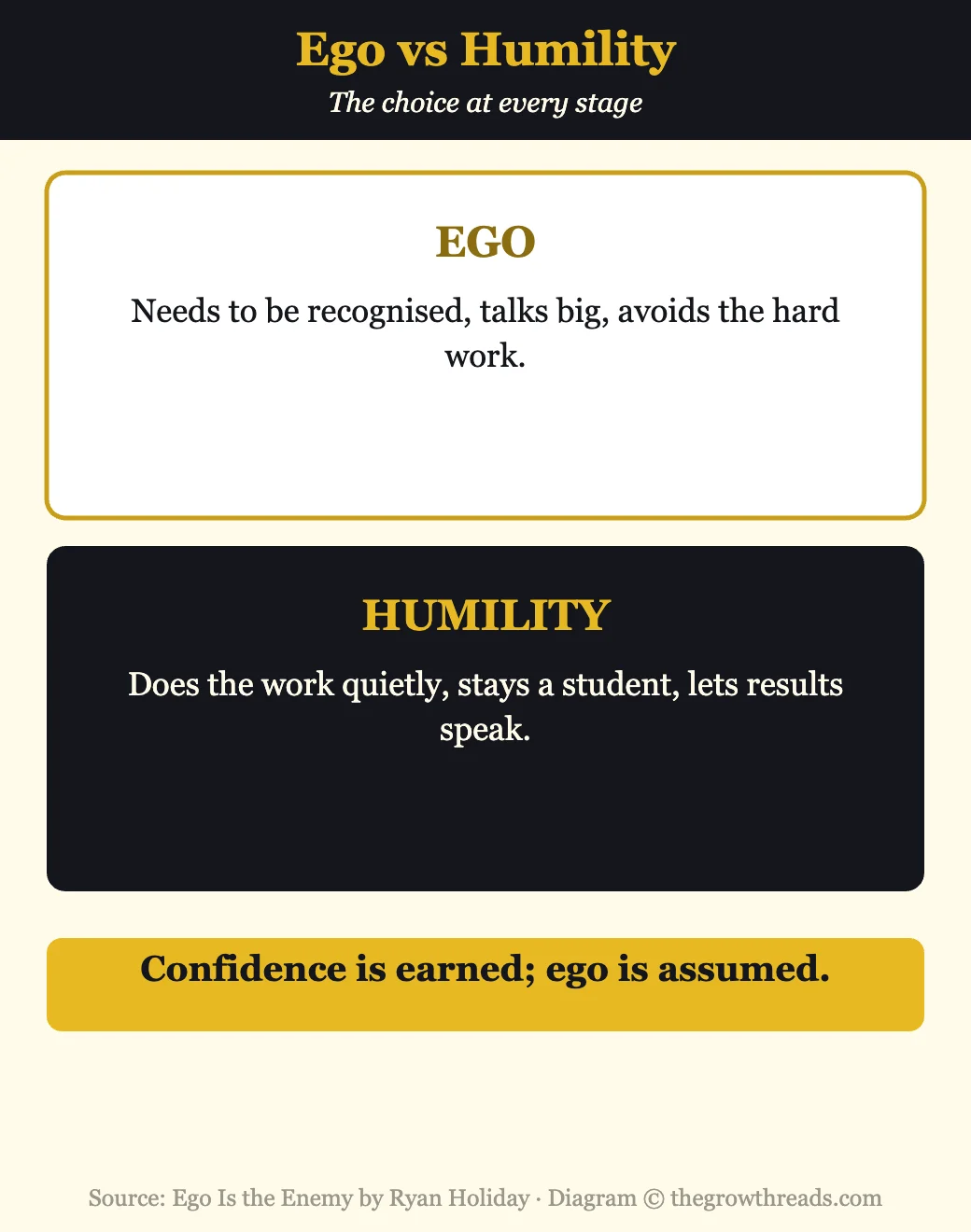
Ego is a needy, fragile thing — it craves recognition, insists on being right, avoids the hard and humble work, and cannot bear criticism. Confidence, by contrast, is quiet and earned; it comes from competence and does not require constant validation. Humility is not weakness or self-doubt but a clear-eyed realism about your own limitations and how much you still have to learn, and it is the trait that lets you keep improving. Holiday’s point is that ego feels like strength but is actually a liability: it distorts your perception, alienates the people you need, and stops you from seeing your own faults. Humility feels like weakness but is actually strength, because it keeps you grounded, teachable, and focused on substance over image. The whole book is, in a sense, an extended argument for choosing humility over ego again and again, precisely when your accomplishments or your failures make ego most tempting.
TGR Note: “Check the ego” is exactly the demand Jocko Willink and Leif Babin make in Extreme Ownership — ego blocks the ownership that solves problems. And Holiday’s humility-over-image message is the calm, classical version of Mark Manson’s The Subtle Art of Not Giving a F*ck: stop needing to look impressive, and pour your energy into what actually matters.
Part 3: Success — how ego destroys what you’ve built
The second stage is, counterintuitively, the most dangerous. Success validates us, and that validation feeds ego, which then quietly dismantles the discipline and humility that created the success in the first place. Holiday catalogs the ways this happens. Success tempts us to tell ourselves stories — flattering narratives about our own genius and inevitability — that detach us from reality and lead to overreach and bad decisions. It breeds entitlement (I deserve this), a need for control, and paranoia, all of which corrode judgment and relationships. And it makes us stop being students: convinced we have figured it out, we quit learning and adapting, just as the world moves on.
His antidotes are all forms of staying grounded. Maintain your “sobriety” — a level-headed refusal to be intoxicated by your own success. Keep learning relentlessly, treating every success as a beginning rather than a destination. Manage yourself and your organization with the same discipline you had when you were hungry. And resist the “disease of me,” the self-centeredness that makes a person prioritize personal glory over the team or the mission. The through-line is that the qualities required to gain success are different from those required to keep it, and ego is what tricks successful people into abandoning the humility and effort that got them there. The higher you rise, the more deliberately you must guard against it.
Part 4: Failure — meeting adversity without ego
The final stage is failure, which comes for everyone, and here ego is what turns a setback into a catastrophe. An ego-driven person meets failure with blame, bitterness, and denial, unable to admit fault or learn, and so repeats the same mistakes. The humble person meets failure very differently — as information, as a teacher, and as an opportunity to grow. Holiday’s most useful concept here is the distinction between “dead time” and “alive time.”
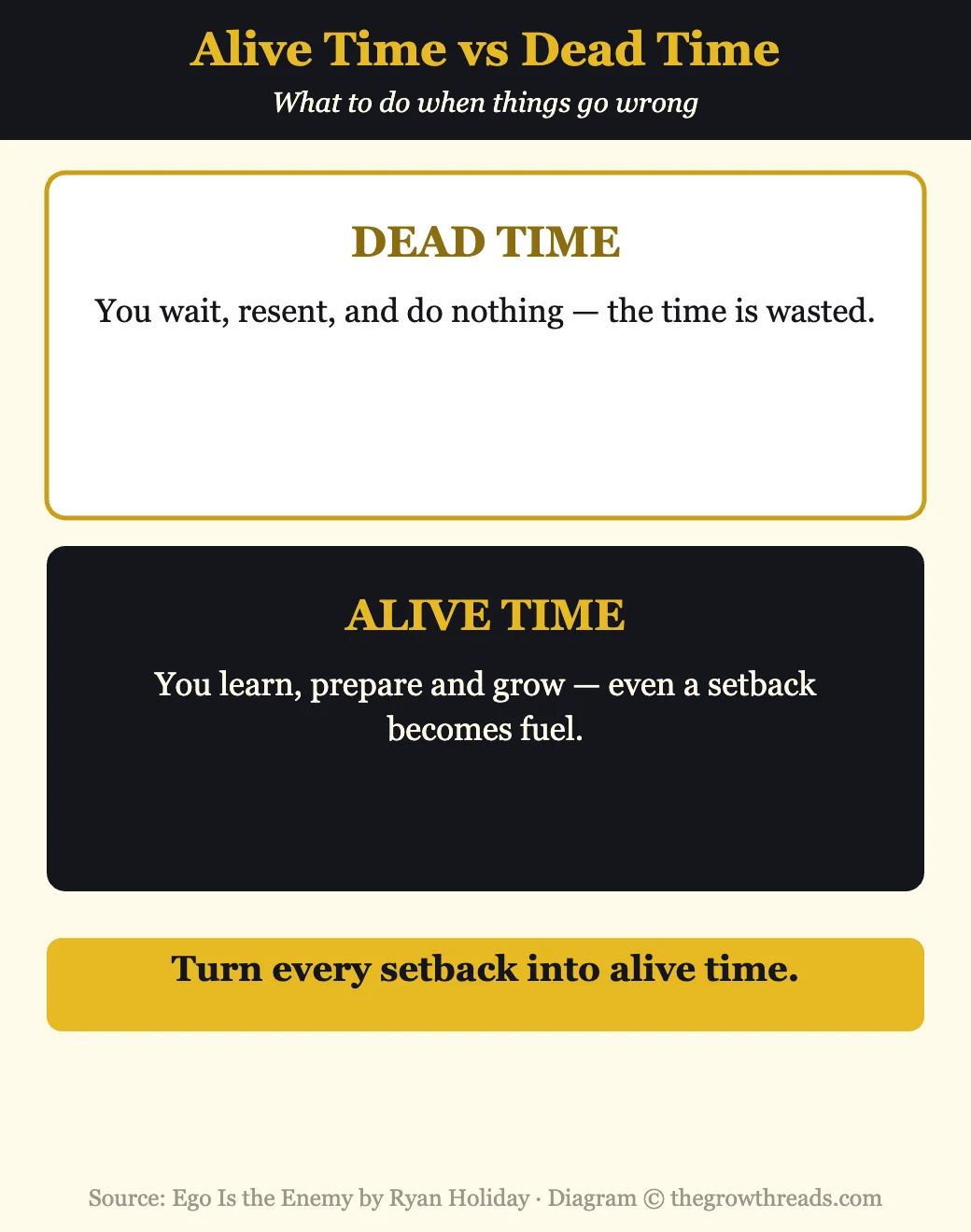
When things go wrong — you are passed over, stuck, sidelined, or waiting — you can treat that period as dead time, sitting in resentment and doing nothing, or as alive time, using it to learn, prepare, build skills, and grow so that you emerge stronger. The choice is entirely yours, and it is ego that pushes you toward the wasteful, self-pitying option. He also urges you to embrace the idea that the effort is its own reward: do your best work for its own sake, and detach from whether the world recognizes or rewards it, because tying your sense of worth to external outcomes hands your peace to forces outside your control. Finally, he counsels drawing a clear line you will not cross even under pressure, and meeting adversity with a kind of love rather than hatred. The book ends where it began — with the insistent, humbling reminder that at every stage, the enemy is not out there. It is the ego within, and the lifelong work is to keep it in check. The historical-anecdote format can feel loose and the argument occasionally repeats itself, but the message is timeless and, for ambitious readers especially, badly needed.
Who is Ego Is the Enemy best for — and who should read something else first?
This book is ideal for ambitious, driven people — founders, creatives, leaders, athletes — who suspect that their own pride, impatience, or need for recognition might be getting in their way. Its Stoic wisdom and vivid stories make humility feel like a competitive advantage rather than a sacrifice. It is not for you if you want a step-by-step system or find the constant historical anecdotes and moralizing tone repetitive. If you want the same humility applied specifically to leadership, read Extreme Ownership; for a lighter, funnier route to caring less about your image, try The Subtle Art of Not Giving a F*ck.
Questions to reflect on
- Where are you talking about a goal instead of quietly doing the work on it?
- In what area have you stopped being a student because you feel you’ve “made it”?
- Is your drive coming from disciplined purpose, or from ego dressed up as passion?
- What flattering story are you telling yourself that might be distorting your judgment?
- Are you treating your current setback or waiting period as dead time or alive time?
🔥 Ready to get out of your own way?
This guide is the map — Holiday’s historical stories are what make the lessons stick.
How to apply Ego Is the Enemy (7-day plan)
- Day 1 — Do, don’t announce. Take a goal you’ve been talking about and work on it quietly instead of sharing it.
- Day 2 — Be a student. Deliberately learn one thing from someone you’d normally overlook.
- Day 3 — Use the canvas strategy. Do one unglamorous task that makes someone else succeed.
- Day 4 — Check a story. Notice one flattering narrative about yourself and question whether it’s true.
- Day 5 — Stay sober in success. After a recent win, name what you still have to learn.
- Day 6 — Convert dead time. Turn one period of waiting or frustration into learning or preparation.
- Day 7 — Do the work for itself. Do one task to your highest standard without seeking any recognition.
Frequently asked questions
Is Ego Is the Enemy worth reading?
Yes, particularly for ambitious people. It delivers a timeless, Stoic-grounded warning — that your own ego is usually your biggest obstacle — through memorable historical stories that make the lessons stick. Its short chapters and quotable insights make it easy and enjoyable to read, and its central message about choosing humility over image is genuinely valuable at every stage of a career. The main criticisms are that the anecdote-heavy format can feel loose and the argument sometimes repeats itself, but the substance more than makes up for it.
What is the main message of Ego Is the Enemy?
That ego — an unhealthy belief in our own importance — is the greatest threat to our success, and that humility is the antidote. Holiday shows that ego sabotages us at three stages: when aspiring (making us talk instead of do), when succeeding (breeding entitlement and complacency), and when failing (turning setbacks into bitterness). The path to lasting achievement is to stay humble, keep learning, do the work quietly, and let results rather than self-promotion speak for you.
What does Ryan Holiday mean by “ego”?
Holiday defines ego not as healthy self-esteem but as an unhealthy, needy belief in your own importance — the craving to be recognized, to be right, to be seen as better than others. He distinguishes it sharply from confidence: confidence is quiet and earned through competence, while ego is loud, fragile, and requires constant validation. Ego distorts your perception, makes you defensive, and stops you learning, which is why he treats it as an enemy to be managed rather than a strength.
What is the difference between alive time and dead time?
It is Holiday’s framework for handling setbacks and waiting. Dead time is when you are stuck, sidelined, or delayed and you spend it resentful, bitter, and idle — the time is simply lost. Alive time is when you take that same period and use it to learn, prepare, build skills, and grow, so you emerge stronger. The situation may be outside your control, but which kind of time it becomes is entirely your choice, and ego is what pushes you toward the wasteful, self-pitying option.
How is Ego Is the Enemy related to Stoicism?
It is heavily influenced by Stoic philosophy, which Holiday has spent his career popularizing. Core Stoic themes run throughout: focusing on what you can control, valuing character and virtue over external recognition, meeting adversity with equanimity, and detaching your sense of worth from outcomes. Figures and ideas from the Stoic tradition inform the book’s argument that humility, discipline, and doing the right work for its own sake matter more than fame or ego gratification. It pairs naturally with his other Stoic-themed books.
How long does it take to read Ego Is the Enemy?
The book is around 250 pages of short, self-contained chapters, and most readers finish it in about five hours. The bite-sized structure makes it easy to read a little at a time or to revisit specific sections. Our summary above captures the core framework and its main lessons in roughly 15 minutes, which is enough to grasp the argument before diving into the historical stories that illustrate each point.
Is Ego Is the Enemy good for beginners?
Yes. It requires no background and is written in an accessible, story-driven style that makes philosophical ideas easy to absorb. Beginners to self-improvement often find it a refreshing counterweight to hustle-and-confidence culture, since it argues that humility, not bravado, drives real success. The one caution is that it offers a mindset and many examples rather than a step-by-step program, so readers who want concrete exercises may wish to pair it with a more tactical book.
Related summaries
- Extreme Ownership Summary — the leadership humility that owns every outcome.
- The Subtle Art of Not Giving a F*ck Summary — caring less about your image.
- 12 Rules for Life Summary — responsibility, meaning, and humility.
- Can’t Hurt Me Summary — accountability and the war within.
- Browse all our best leadership books.
How we analyze books: We work from the full book — reconstructing its core arguments in our own words, adding commentary that connects it to related research and other books in our library, and pressure-testing the advice against how it plays out in real life. We never reproduce the text; we synthesize it. Read our full methodology.
Disclosure: The Growth Reads is reader-supported. When you buy through links on our site we may earn an affiliate commission at no extra cost to you. We only recommend books we believe are worth your time, and our summaries and opinions are written independently.