

★★★★½ 4.5 / 5
One-liner: Bill Bryson turns the human body into a page-turner — a witty, wonder-filled tour through every organ, system, and cell that keeps you alive, written with the curiosity of a journalist and the warmth of a favourite teacher.
Best for: Curious generalists, science enthusiasts, Bryson fans, and anyone who wants to understand what is happening inside them without needing a medical degree.
Reading time: ~9 hrs (guide: 30 min)
Difficulty to apply: Low (knowledge-focused — deepens appreciation rather than prescribing protocols)
The Body in one minute
You are a walking miracle and you have no idea — your body performs feats of engineering, chemistry, and coordination every second that would embarrass the world’s best technology. Bill Bryson, the beloved author of A Short History of Nearly Everything, applies his signature curiosity to the human body, touring it system by system: from the brain that runs on 20 watts of power to the heart that pumps 2,000 gallons of blood a day without maintenance, from the immune system that fights off thousands of threats hourly to the microbiome that outnumbers your cells ten to one. The book is not a health manual — it is a celebration of biological wonder, laced with medical history, bizarre trivia, and Bryson’s trademark dry humour. The underlying message: the more you understand what your body does for you, the better care you will take of it.
Key takeaways
- Your body is staggeringly complex: You contain 37.2 trillion cells, 100,000 miles of blood vessels, and enough DNA to stretch to Pluto and back — all orchestrated without your conscious involvement.
- The brain is the most complex object in the known universe: It contains 86 billion neurons forming trillions of connections, runs on just 20 watts of power, and processes information faster than any supercomputer.
- Your heart is an engineering masterpiece: It beats approximately 3.5 billion times in a lifetime, pumping blood through a vascular network that would circle the Earth four times — without ever stopping for maintenance.
- Skin is your largest and most versatile organ: Covering two square metres, it waterproofs you, regulates temperature, fights infection, synthesises vitamin D, and replaces itself entirely every month.
- You are more microbe than human: The bacteria, viruses, and fungi living on and in you outnumber your own cells. Far from being passengers, they are essential partners in digestion, immunity, and even mood regulation.
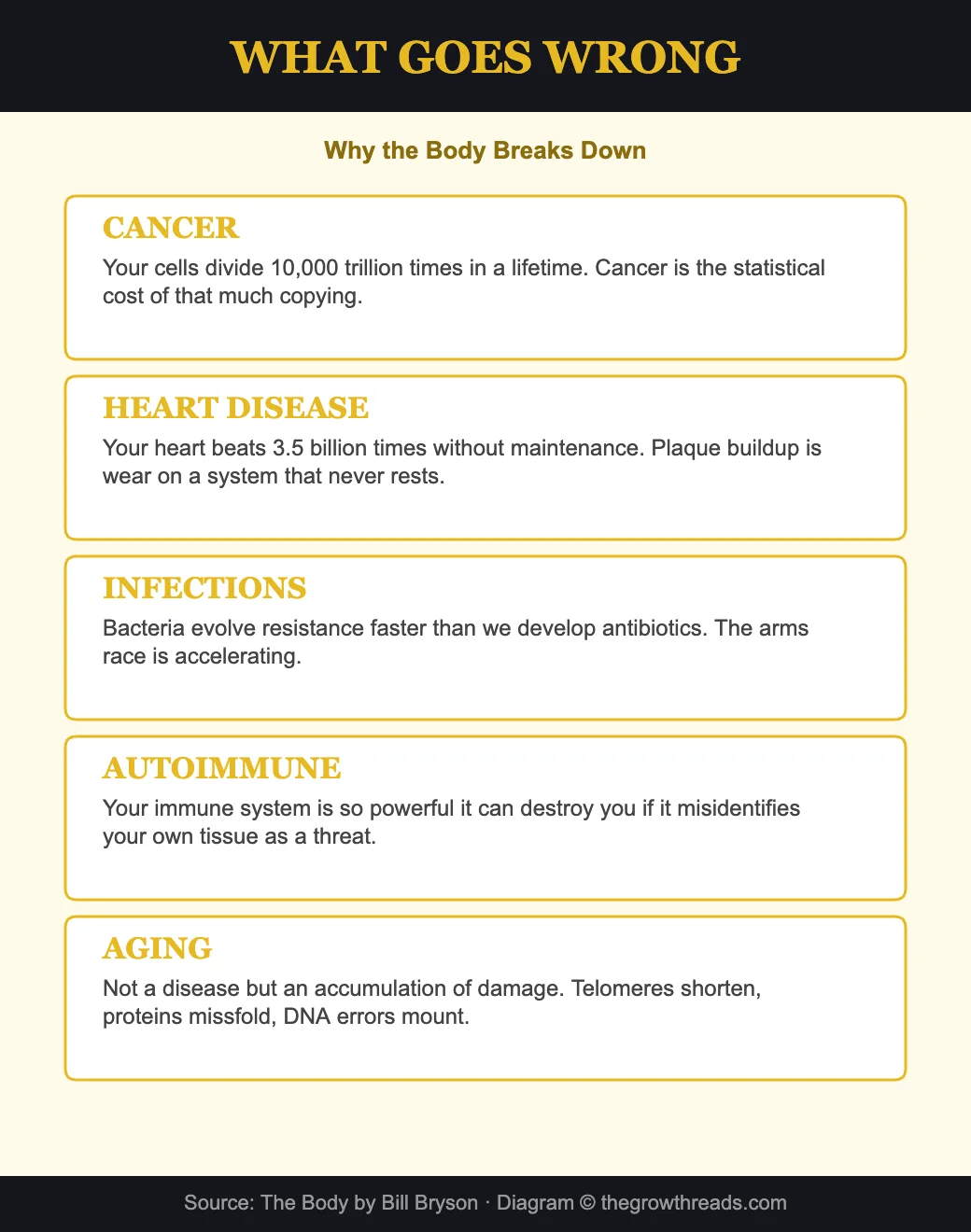
- Cancer is a statistical inevitability we mostly avoid: Your cells divide 10,000 trillion times in a lifetime. Each division risks a copying error. That you do not develop cancer more often is a testament to your repair mechanisms.
- Modern medicine is astonishingly recent: As late as the 1940s, doctors had almost no effective drugs. Antibiotics, vaccines, and anaesthesia — the pillars of modern medicine — are all less than 200 years old.
- Sleep is not optional — it is essential maintenance: During sleep, the brain consolidates memories, clears toxic waste, and repairs neural connections. Chronic sleep deprivation increases the risk of virtually every major disease.
- Exercise is the closest thing to a miracle drug: Regular physical activity reduces the risk of heart disease, cancer, diabetes, depression, and dementia — no pharmaceutical comes close to matching its range of benefits.
- We understand surprisingly little about our own bodies: Despite centuries of research, we still do not fully understand how anaesthesia works, why we yawn, what appendixes do, or how consciousness arises from neurons.
What is The Body about?
The Body is a system-by-system tour of human anatomy and physiology, written by Bill Bryson with his trademark wit and wonder. It covers the brain, heart, bones, skin, immune system, microbiome, diseases, and medicine — celebrating how extraordinary the body is while honestly addressing what goes wrong and how little we still understand.
About the author
Bill Bryson is an American-British author whose books on science, language, travel, and history have sold over 16 million copies worldwide. His 2003 book A Short History of Nearly Everything won the Royal Society’s Aventis Prize for Science Books and the Descartes Prize for Science Communication. Bryson served as Chancellor of Durham University from 2005 to 2020 and was awarded an honorary Order of the British Empire for his contributions to literature. He is not a scientist by training — he is a journalist and generalist whose gift is making complex subjects accessible, entertaining, and deeply human. The Body represents his most personal science book, written partly in response to reaching the age where his own body demanded more attention. Explore all Bill Bryson book summaries →
Key concepts at a glance
| Concept | What it means | Use it when |
|---|---|---|
| Homeostasis | The body’s ability to maintain stable internal conditions despite external changes | You want to understand how your body self-regulates |
| Neuroplasticity | The brain’s ability to reorganise its neural connections throughout life | You are interested in learning, recovery, or brain health |
| Immune surveillance | The constant monitoring and destruction of abnormal cells by your immune system | You want to understand how the body fights cancer naturally |
| Microbiome | The community of trillions of microorganisms living in and on your body | You are exploring the gut-health connection |
| Telomeres | Protective caps on chromosomes that shorten with each cell division, linked to aging | You are curious about why we age |
| BDNF | Brain-derived neurotrophic factor — protein stimulated by exercise that grows neurons | You want to understand why exercise benefits the brain |
| Glymphatic system | The brain’s waste-clearance system that operates primarily during deep sleep | You want to understand why sleep is essential |
Part 1 — The outside: skin, bones, and the senses
Bryson begins at the surface and works inward, starting with skin — the organ most people forget is an organ. Your skin covers roughly two square metres, weighs about four kilograms, and replaces itself entirely every month. It is simultaneously waterproof, breathable, self-repairing, and packed with sensory receptors that can detect pressure, temperature, pain, and texture with extraordinary precision. A single fingertip contains 3,000 touch receptors. Bryson marvels at the engineering: “No one has ever made a material that is as tough, flexible, and self-healing as skin.”
The bones chapter is equally surprising. Far from being inert scaffolding, bones are living tissue that constantly remodels itself — your entire skeleton is replaced roughly every decade. Bone is, weight for weight, stronger than steel and more flexible than concrete. Your skeleton also functions as a mineral bank, storing calcium and phosphorus and releasing them into the bloodstream as needed. Bryson connects this to osteoporosis: the problem is not weak bones but a remodelling process that removes more material than it replaces, often accelerated by inactivity.
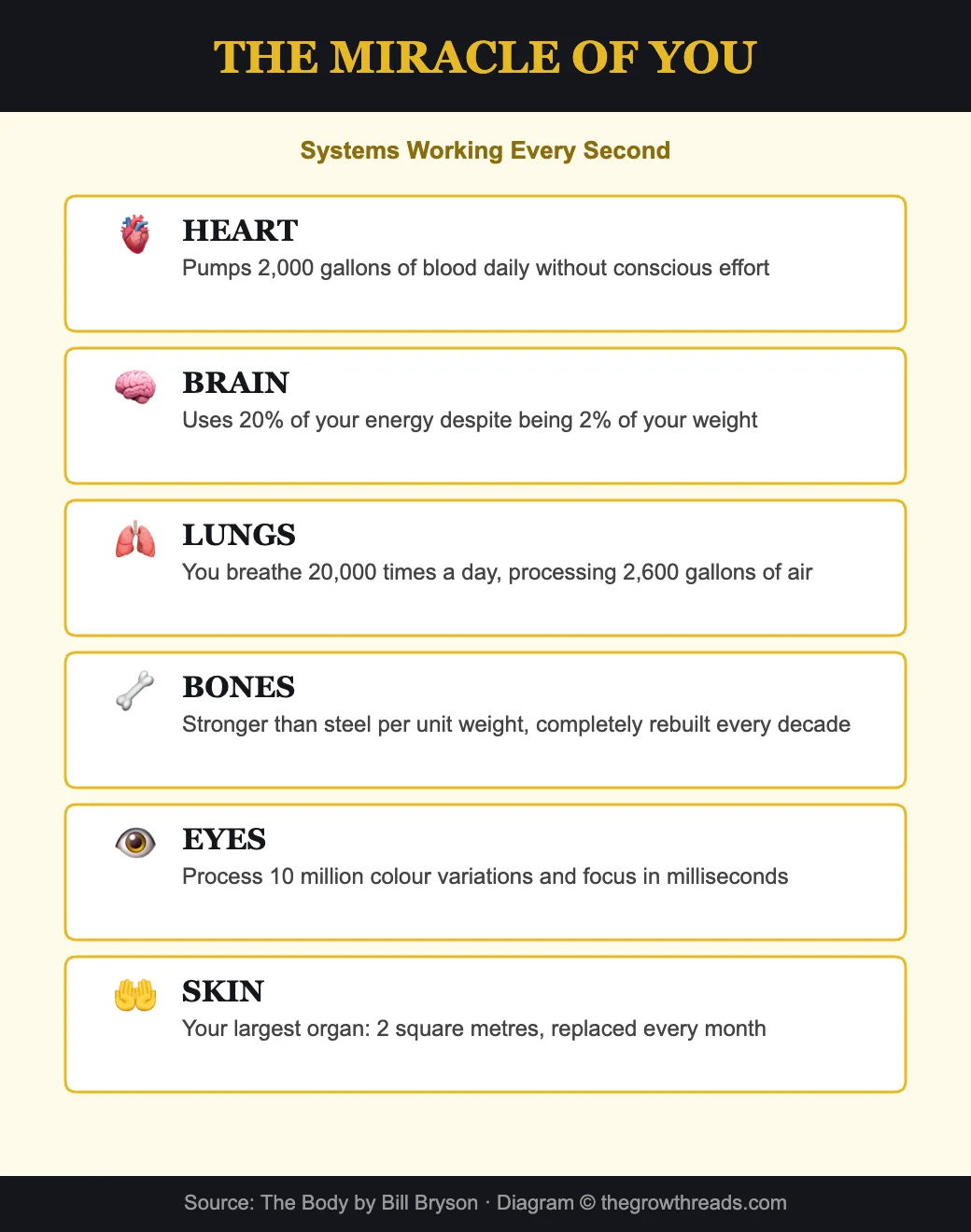
The senses section includes a characteristically Bryson revelation: your eyes process information so quickly that what you “see” is actually a prediction your brain constructed a fraction of a second ago. Perception is not passive reception — it is active construction. Your brain fills in blind spots, smooths out the jerkiness of eye movements, and assembles a coherent visual scene from fragmentary data. You are, in a very real sense, watching a movie your brain is directing in real time.
Part 2 — The inside: brain, heart, and immune system
The brain chapter is the book’s centrepiece, and Bryson approaches it with appropriate awe. The human brain contains 86 billion neurons, each connected to as many as 10,000 others, creating a network of roughly 100 trillion synaptic connections. It runs on just 20 watts of power — less than a refrigerator light bulb — and yet it outperforms any computer ever built at pattern recognition, language processing, and creative problem-solving. Bryson’s key point: despite being the most studied object in neuroscience, the brain remains the least understood organ in the body. We do not know how consciousness arises, how memories are stored, or why we dream.
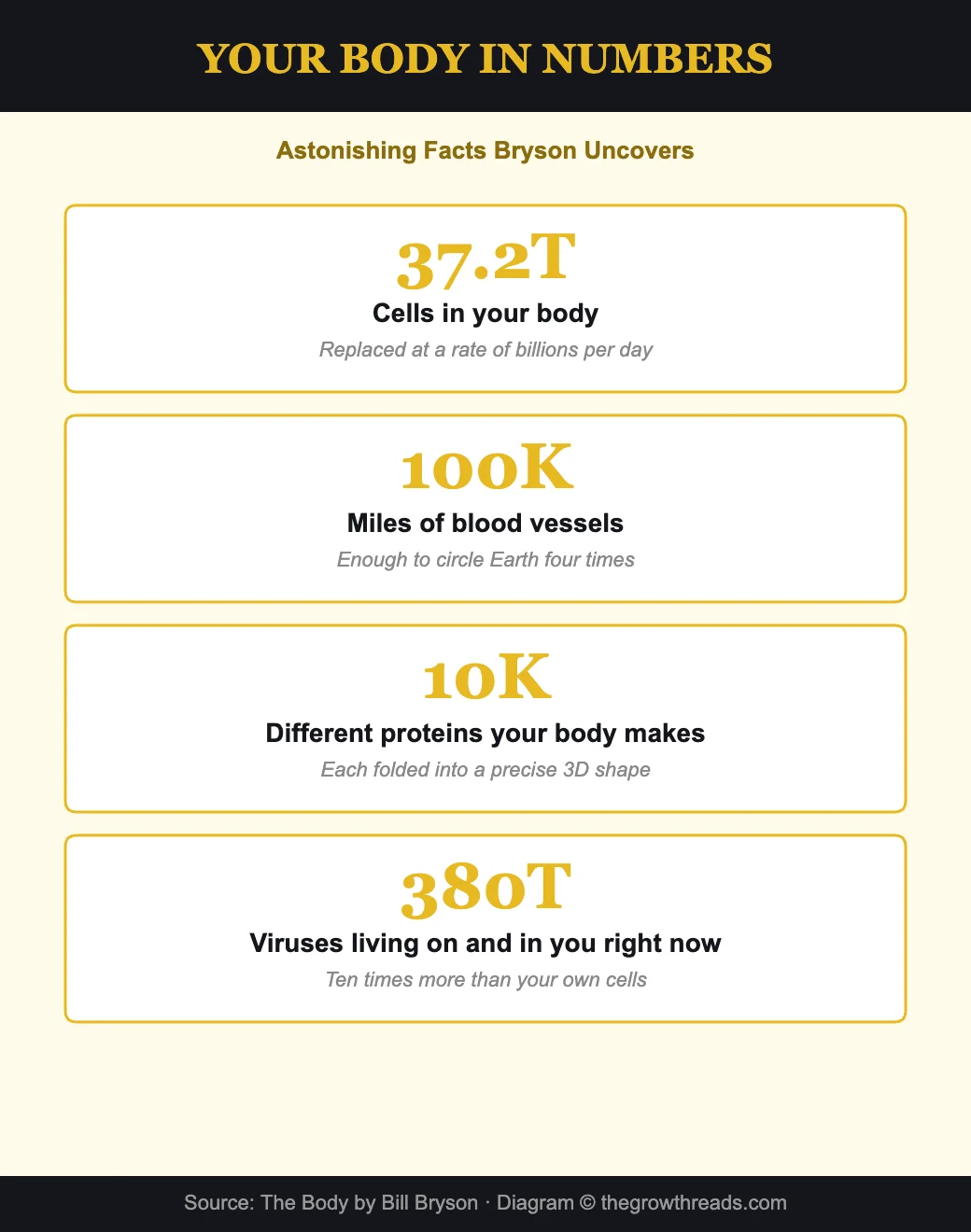
The heart chapter centres on endurance. Your heart beats approximately 100,000 times a day, 35 million times a year, roughly 3.5 billion times in a lifetime — and it never stops. There is no scheduled maintenance, no downtime. The cardiac muscle cells that power this are unique in the body: once they mature, they rarely divide, meaning the heart you have at age 20 is essentially the same heart you have at 80. This makes heart disease particularly devastating — damaged cardiac tissue does not regenerate the way skin or liver tissue does.
The immune system section is where Bryson’s talent for making the invisible vivid shines brightest. He describes the immune system as an army more sophisticated than any human military: it distinguishes self from non-self among billions of molecular signatures, deploys specialised cells to neutralise specific threats, remembers every pathogen it has ever encountered, and maintains constant surveillance of every cell in the body for signs of malignancy. The thymus gland, which trains immune cells during childhood, shrinks by 80% by adulthood — yet the immune memory it created continues to protect you for decades.
Part 3 — What goes wrong: disease, medicine, and death
The final section confronts mortality with Bryson’s characteristic blend of honesty and warmth. Cancer, he explains, is not a foreign invasion — it is your own cells gone rogue. Given that your cells divide 10,000 trillion times in a lifetime, the real surprise is not that cancer occurs but that it does not occur far more often. Your body’s error-correction mechanisms — DNA repair enzymes, tumour-suppressor genes like p53, and immune surveillance — catch and destroy the vast majority of defective cells. Cancer develops when these safeguards fail simultaneously, which is why cancer risk increases with age: the longer you live, the more opportunities for accumulating the multiple mutations required.
The history of medicine provides some of the book’s most astonishing moments. Bryson documents that as recently as the 1930s, a visit to the doctor was as likely to harm you as help you. Effective antibiotics did not exist until 1942. Anaesthesia was discovered essentially by accident. Hand-washing in hospitals was resisted by physicians for decades after Ignaz Semmelweis proved it saved lives. The message is sobering: the medicine we take for granted is extraordinarily recent, and the human body survived millions of years of evolution without it — a testament to its own resilience.
Bryson closes with the things we can control. Exercise, he notes, is the closest thing to a miracle drug ever discovered — it reduces the risk of heart disease, cancer, diabetes, depression, and dementia simultaneously, with no negative side effects at moderate doses. Sleep is not a luxury but a biological necessity: the brain’s glymphatic system clears toxic metabolic waste during deep sleep, and chronic deprivation accelerates every form of decline. Diet matters, but probably less than the diet industry suggests — the Blue Zone populations eat simply, mostly plants, and do not obsess over macros. The final takeaway is pure Bryson: gratitude. The more you understand what your body does for you every second, the harder it is to take it for granted.
Who is The Body best for — and who should read something else first?
This book is perfect for anyone who is curious about how their body works but has been intimidated by medical or scientific texts. Bryson writes for the intelligent generalist, not the specialist. It is also an excellent gift for teenagers and young adults — the combination of wonder, humour, and practical awareness is uniquely engaging for readers encountering biology seriously for the first time.
If you want actionable health protocols rather than knowledge for its own sake, start with Outlive by Peter Attia. If you are specifically focused on one system (gut, brain, sleep), the dedicated books in our Health library go deeper. But if you want to fall in love with the improbable machine you inhabit, there is no better starting point than The Body.
Questions to reflect on
- When was the last time you felt genuine gratitude for something your body did automatically — your heart beating, your lungs breathing, your immune system fighting off a pathogen?
- Which of Bryson’s facts surprised you most, and what does that surprise reveal about how little attention you have paid to your own biology?
- If exercise really is the closest thing to a miracle drug, why are you not taking it daily?
- How much of what you “know” about health comes from actual science versus marketing?
- What is one thing you could do today to show your body you appreciate the work it does for you?
🔥 Ready to meet the most extraordinary machine in existence?
Discover the astonishing engineering, chemistry, and wonder happening inside you right now.
How to apply The Body (7-day plan)
- Day 1 — Take a gratitude inventory: Spend 5 minutes listing everything your body did for you today without being asked: beating your heart, digesting your food, fighting pathogens, healing cuts, regulating temperature. Write down at least 10 items.
- Day 2 — Move for 30 minutes: Bryson identifies exercise as the single most effective health intervention. Walk, cycle, swim, or dance for 30 minutes today — not for fitness, but as a thank-you to the body that carries you.
- Day 3 — Prioritise sleep: Set a consistent bedtime tonight. Remove your phone from the bedroom. Aim for 7–8 hours. Your glymphatic system needs deep sleep to clear the day’s metabolic waste from your brain.
- Day 4 — Learn one thing about your body: Pick the organ system you know least about (your liver? your lymphatic system? your endocrine system?) and spend 15 minutes reading about it. Understanding builds respect.
- Day 5 — Check your skin: Your skin is your largest organ and your first line of defence. Do a brief skin check: note any new moles, spots, or changes. Schedule a dermatologist visit if anything looks different. Early detection saves lives.
- Day 6 — Feed your microbiome: Eat at least one serving of fermented food (yoghurt, sauerkraut, kimchi) and one serving of prebiotic fibre (garlic, onions, oats). Your trillions of bacterial partners will thank you.
- Day 7 — Schedule your annual check-up: Bryson’s history of medicine shows that most of us have access to healthcare our grandparents could not have imagined. Use it. Book your annual physical, dental check, and any overdue screenings.
Frequently asked questions
Is The Body a health book or a science book?
It is a popular science book that covers human biology and medical history, not a health manual with prescriptions. Bryson does not tell you what to eat, how to exercise, or which supplements to take. Instead, he builds your understanding of what your body does and how medicine evolved. The health insights emerge naturally from this understanding — when you appreciate the complexity of your immune system, you are more motivated to support it through sleep, exercise, and nutrition.
Do I need a science background to enjoy this book?
Absolutely not. Bryson is famous for making complex subjects accessible to general readers. He explains technical concepts through stories, analogies, and humour rather than jargon. If you have ever enjoyed a Bryson travel book, you will enjoy this — the style is identical, just applied to the interior landscape rather than the exterior one. The book has been praised by both scientists and casual readers for striking the right balance between rigour and readability.
What makes this different from other anatomy books?
Three things: voice, history, and wonder. Most anatomy books are written by doctors for students. Bryson writes as a curious outsider who is genuinely amazed by what he discovers. He weaves in medical history — the bizarre and often horrifying path from barber-surgeons to modern medicine — and he maintains a sense of awe that most textbooks have trained out of their authors. The result is a book that makes you feel something about biology, not just learn it.
How accurate is the science in the book?
Bryson is a meticulous researcher who consults extensively with subject-matter experts. The book was reviewed by physicians and scientists before publication, and the factual accuracy is generally high. Where scientific consensus is uncertain, Bryson typically says so. A few minor details have been questioned by specialists (exact cell counts, specific historical anecdotes), but the core science is reliable. It is not a primary research source — it is a synthesis and narrative, and an excellent one.
Is the audiobook version good?
The audiobook, narrated by Bryson himself, is widely considered one of the best non-fiction audiobooks available. Bryson’s dry delivery, perfect comic timing, and obvious delight in his material make the 14-hour listen genuinely entertaining. Many readers report absorbing more from the audio version than the print edition because Bryson’s vocal emphasis highlights the most important and surprising points. If you enjoy audiobooks at all, this is an excellent candidate.
How does The Body compare to other health books on this list?
The Body is the best foundational read — it gives you the understanding of what your body is and does before other books tell you how to optimise it. Read The Body first, then Outlive (for longevity protocols), Why We Sleep (for sleep science), or Gut (for microbiome specifics). Bryson provides the “why should I care” motivation that makes the actionable recommendations in other books feel urgent rather than abstract.
What does Bryson say about diet and nutrition?
Bryson is refreshingly undogmatic about diet. He notes that nutrition science is plagued by contradictory studies, industry funding, and the difficulty of isolating dietary variables in free-living humans. His general observation: the longest-lived populations eat simply, mostly plants, in moderate quantities, and do not obsess over macros. He is sceptical of extreme dietary claims from any direction and suggests that the best evidence supports a varied, mostly whole-food diet without overthinking it — a position close to Michael Pollan’s “Eat food. Not too much. Mostly plants.”
Related summaries
- Outlive by Peter Attia — The actionable companion: specific protocols for exercise, nutrition, sleep, and emotional health.
- Why We Sleep by Matthew Walker — Deep dive into the sleep science Bryson touches on, with practical recommendations.
- Gut by Giulia Enders — Another charming science writer exploring the digestive system in delightful detail.
- Lifespan by David Sinclair — The cutting-edge case for treating aging itself as a disease.
- See all Health book summaries on our Best Health Books pillar page.