

⭐⭐⭐⭐ 4.1/5
One-liner: A crisp, entertaining catalogue of 99 cognitive biases that quietly sabotage your everyday decisions.
Best for: Anyone who wants a practical field guide to the thinking errors that lead to bad decisions in business, investing, and daily life.
Reading time: ~6 hours (384 pages)
Difficulty to apply: Low to medium — the short-chapter format makes it easy to absorb, but spotting biases in real time takes practice.
The Art of Thinking Clearly in one minute
You are not as rational as you think — and this book catalogues exactly how your brain betrays you. Rolf Dobelli presents 99 systematic thinking errors — cognitive biases, logical fallacies, and mental shortcuts — that distort our perception, judgement, and decision-making every day. Each chapter is a self-contained two-to-three-page essay covering one bias: what it is, how it works, a vivid real-world example, and what to do about it. The format is deliberately bite-sized — you can read one chapter a day over breakfast and be measurably better at spotting your own mental mistakes within weeks. Dobelli draws on behavioural economics, evolutionary psychology, and decades of research from Kahneman, Tversky, Cialdini, and other giants of the field to make a single, powerful argument: you cannot eliminate cognitive biases, but you can learn to recognise them — and recognition is the first step toward better decisions.
Key takeaways
- Survivorship bias blinds you to failure: We study winners and ignore the vastly larger number of losers, creating a distorted picture of what leads to success.
- Sunk costs trap you in bad decisions: The money, time, or effort you have already invested should never influence whether to continue — only future value matters.
- Confirmation bias is the most dangerous error: We actively seek and remember information that confirms our existing beliefs while ignoring evidence that contradicts them.
- Social proof makes you a follower: The more people doing something, the more right it feels — even when the crowd is wrong.
- The halo effect colours everything: One positive trait (attractiveness, eloquence, fame) makes us assume a person is good at everything else too.
- Anchoring distorts all your estimates: The first number you encounter in a negotiation or decision sets an invisible reference point that biases everything after it.
- Overconfidence is universal: Experts and amateurs alike consistently overestimate their knowledge, abilities, and predictions.
- Story bias makes you narrative-hungry: We prefer a good story to raw data, which makes us vulnerable to compelling but misleading narratives.
- Loss aversion makes you overly cautious: Losing something hurts roughly twice as much as gaining the equivalent feels good, skewing decisions toward the status quo.
- Knowing your biases is not enough: Awareness helps, but systematic checklists and decision processes are more reliable than willpower alone.
What is The Art of Thinking Clearly about?
The Art of Thinking Clearly is a practical guide to 99 cognitive biases and logical fallacies that systematically distort human judgement. Each chapter covers one bias with a real-world example and actionable advice, drawing on behavioural economics research to help readers make better decisions in business, relationships, and daily life.
About the author
Rolf Dobelli is a Swiss author and entrepreneur who has spent two decades studying the intersection of psychology and decision-making. He founded getAbstract, the world’s largest library of business book summaries, and co-founded the WORLD.MINDS foundation, an annual gathering of leading scientists and thinkers. A trained philosopher and MBA graduate of the University of St. Gallen, Dobelli writes a popular column on cognitive biases for leading European newspapers. His books have been translated into over 40 languages and have sold millions of copies worldwide. He lives in Switzerland and practises what he preaches — maintaining a curated media diet and systematic decision-making processes based on the principles in his books.
Key concepts at a glance
| Concept | What it means | Use it when |
|---|---|---|
| Survivorship Bias | Studying only successes, overlooking the silent majority of failures | You are drawing lessons from successful companies or people |
| Sunk Cost Fallacy | Continuing something because of past investment, not future value | You feel reluctant to abandon a project you have poured resources into |
| Confirmation Bias | Seeking only evidence that supports what you already believe | You are evaluating a strategy, hire, or investment thesis |
| Social Proof | Following the crowd instead of thinking independently | Everyone seems excited about a trend and you feel compelled to join |
| Anchoring | Letting the first number you hear shape your estimate | You are entering a negotiation or estimating a budget |
| Overconfidence Effect | Systematically overestimating your knowledge and predictions | You feel very certain about a forecast or judgment call |
| Story Bias | Preferring a good narrative over raw data and probabilities | A proposal or pitch feels compelling but lacks hard evidence |
| Loss Aversion | Feeling losses roughly twice as intensely as equivalent gains | You are holding onto a losing position out of fear rather than analysis |
| Halo Effect | Letting one positive trait colour your entire assessment | You are evaluating someone who is charismatic or physically attractive |
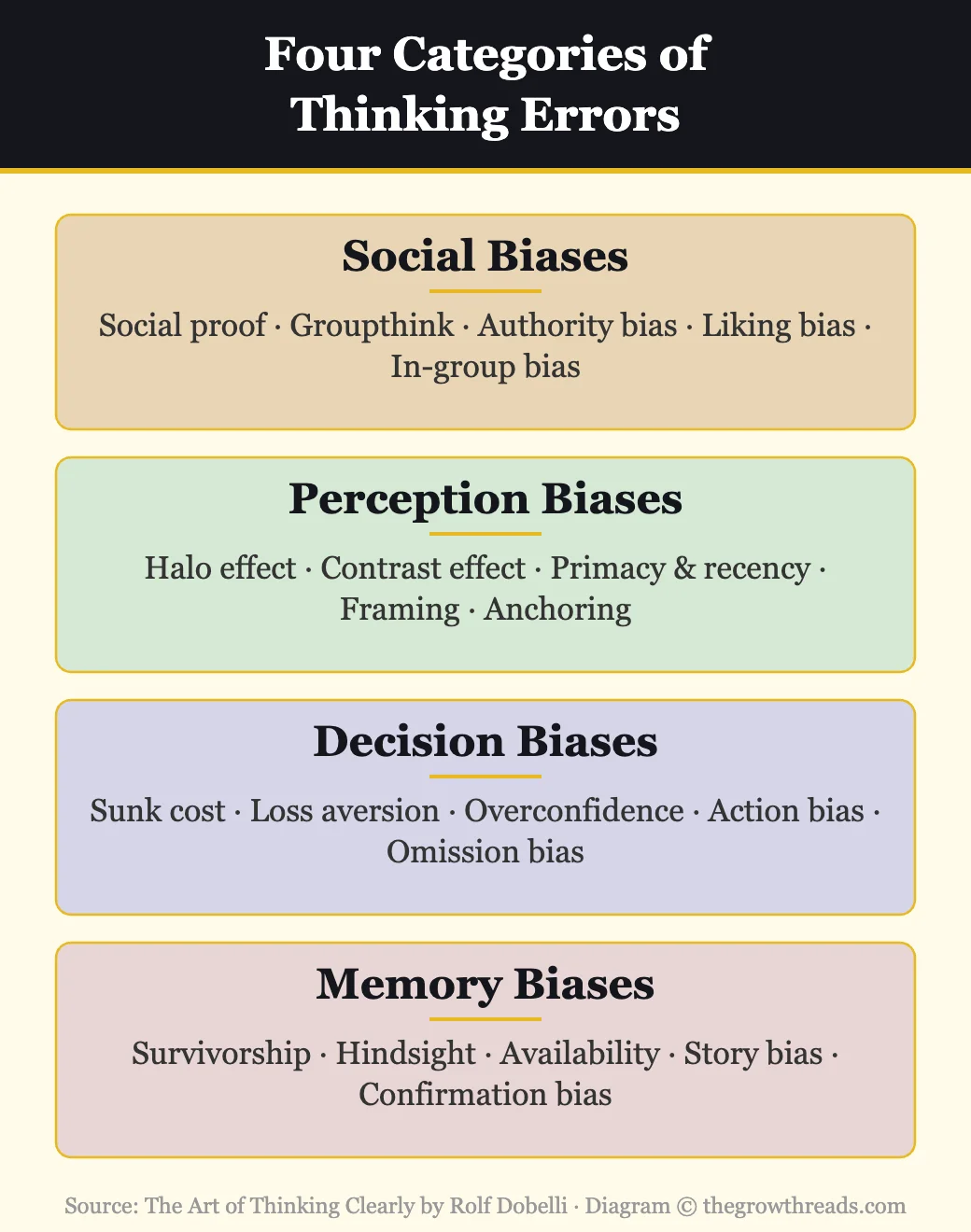
Part 1: Social and group biases — why we follow the herd
Dobelli opens with the biases that emerge from our social nature. Humans evolved in small groups where copying successful neighbours was a survival strategy. But in modern life, this instinct frequently leads us astray.
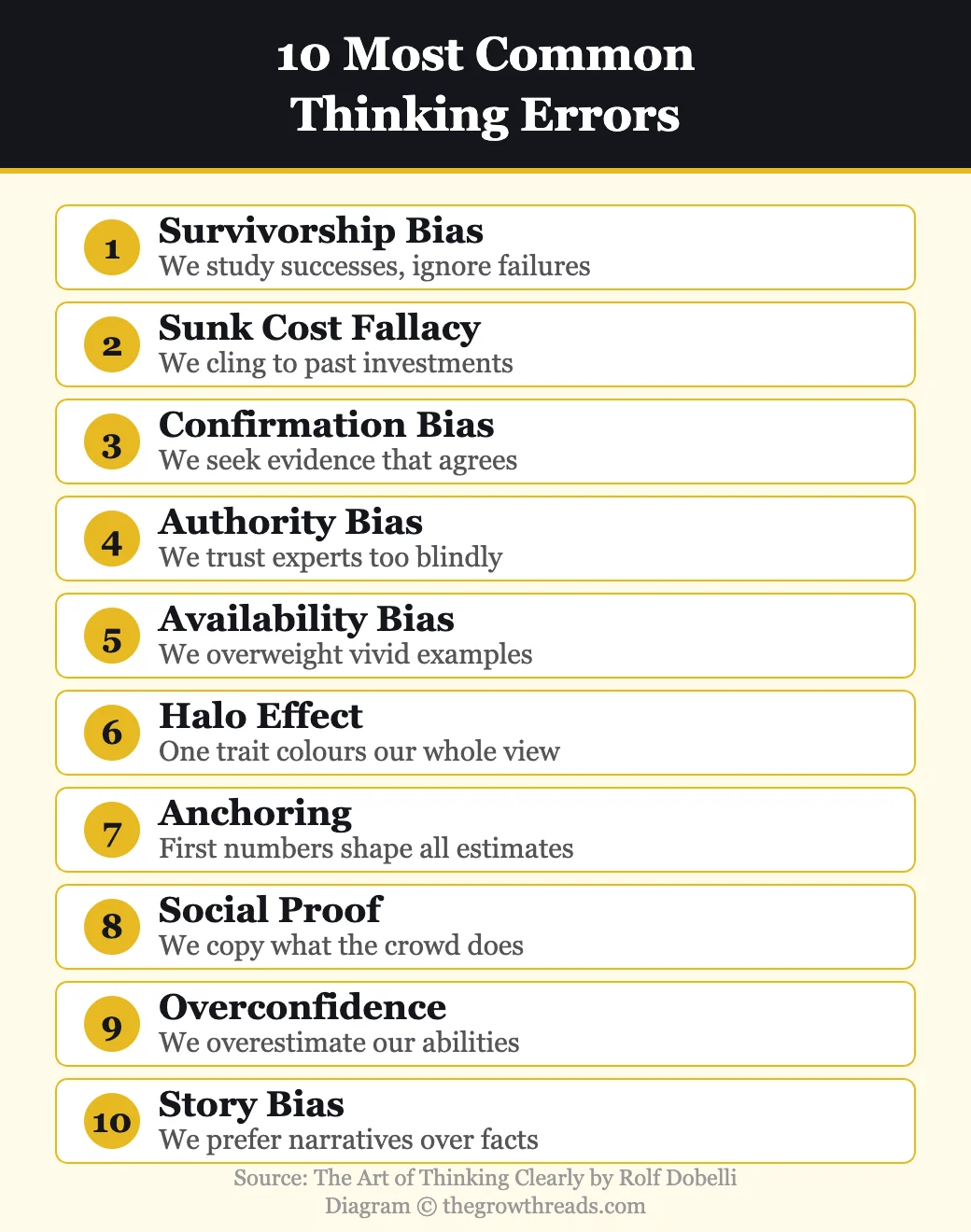
Social proof is the tendency to assume that if many people are doing something, it must be correct. Dobelli illustrates this with the phenomenon of canned laughter on television — audiences rate the same jokes as funnier when they hear others laughing. In business, social proof explains herd behaviour in stock markets, the power of “bestseller” labels, and why restaurants with queues attract more diners. The antidote: ask whether the crowd has independent information or is simply following other followers.
Authority bias makes us defer to experts without scrutiny. Dobelli cites Stanley Milgram’s famous obedience experiments, where ordinary people administered what they believed were lethal electric shocks simply because an authority figure told them to. In everyday life, authority bias explains why we trust doctors who are wrong, follow analysts with poor track records, and accept statements from well-dressed strangers. The fix is not to distrust all authority but to evaluate the quality of evidence separately from the status of the person presenting it.
The halo effect is one of the most pervasive biases. A person who is attractive, articulate, or successful in one domain is automatically assumed to be competent in unrelated areas. Dobelli shows how this distorts hiring, political elections, and even courtroom verdicts. Attractive defendants receive lighter sentences, and CEOs who look the part get hired regardless of track record.
Part 2: Perception and memory biases — why we see what we want to see
The second cluster of errors relates to how we perceive and remember information. Our brains are not cameras that record reality — they are prediction machines that construct a version of reality from limited data, and those constructions are systematically distorted.
Confirmation bias is, in Dobelli’s view, the single most dangerous thinking error. It operates like a filter that lets in information confirming our beliefs and screens out everything else. A climate change sceptic reads articles debunking warming. A cryptocurrency enthusiast scrolls past warnings. A manager who has decided to promote someone notices only their strengths. Dobelli argues that genuine clear thinking requires the discipline to actively seek disconfirming evidence — a practice so unnatural that Charles Darwin kept a special notebook for facts that contradicted his theories, knowing he would otherwise forget them.
Survivorship bias may be the most practically costly error. When we study successful entrepreneurs, bestselling authors, or winning investors, we are looking at the tiny fraction who survived a selection process. The thousands who tried the same strategies and failed are invisible. Dobelli illustrates this with the World War II example: the military wanted to armour the parts of returning bombers that showed the most damage. Statistician Abraham Wald pointed out that the bullet holes showed where planes could take damage and survive — the planes hit in other areas never made it back.
Story bias is our compulsive need to weave facts into narratives. Stories are memorable, emotionally satisfying, and far more persuasive than statistics. But they are also dangerous: a vivid anecdote about one shark attack makes us more afraid of swimming than cold statistics about the actual risk (which is roughly one in 3.75 million). Dobelli urges readers to develop what he calls “statistical thinking” — the habit of asking for base rates, sample sizes, and probabilities rather than accepting stories at face value.
Part 3: Decision biases — why we choose badly
The most consequential biases in Dobelli’s catalogue affect the moment of decision itself. These errors explain why smart people make terrible investments, stay in bad relationships, and repeatedly choose short-term comfort over long-term benefit.
The sunk cost fallacy is devastatingly common. Dobelli describes the Concorde effect: the British and French governments continued funding the supersonic jet long after it was clear it would never be commercially viable — because they had already invested so much. The same logic keeps people in failing businesses, dead-end careers, and unhappy marriages. The rational approach: ignore what you have already spent and evaluate every decision based solely on future costs and benefits. But this is psychologically excruciating because abandoning a sunk cost feels like admitting failure.
Loss aversion, first documented by Kahneman and Tversky, means that the pain of losing $100 is approximately twice as intense as the pleasure of gaining $100. This asymmetry makes us irrationally conservative: we hold losing stocks too long, refuse fair gambles, and cling to the status quo. Dobelli connects loss aversion to the endowment effect — we value things we own more than identical things we do not own — and to the status quo bias — we prefer the current state of affairs even when change would clearly improve our situation.
Anchoring is a bias that shapes virtually every negotiation. When a real estate agent names an asking price, that number becomes the anchor around which all subsequent offers cluster — even if the price is absurdly high. Dobelli reports experiments where judges, estate agents, and other professionals all fell prey to anchoring despite knowing about it. His advice: in any negotiation, make the first offer (setting the anchor in your favour) and be deeply suspicious of any number presented to you first.
Part 4: Self-knowledge biases — why we misunderstand ourselves
Dobelli’s final cluster addresses the most humbling category: the ways we systematically misunderstand our own minds, abilities, and motivations.
The overconfidence effect is one of the best-documented findings in psychology. Experts are not much better than laypeople at predicting complex events — yet they are dramatically more confident. Dobelli cites Philip Tetlock’s research showing that political experts’ predictions were barely better than chance, but their confidence was sky-high. In business, overconfidence drives executives to approve mergers that destroy value, entrepreneurs to launch ventures with minimal research, and investors to trade far more often than is profitable.
The illusion of control makes us believe we can influence outcomes that are actually random. People throw dice harder when they want a high number. Traders develop “systems” for beating markets that are fundamentally unpredictable. Managers attribute team success to their leadership rather than to market conditions or luck. Dobelli argues that this illusion is comforting but costly — it leads us to take unnecessary risks and to blame ourselves (or others) for outcomes that no one could have controlled.
Hindsight bias — the “I knew it all along” effect — makes every outcome seem predictable in retrospect. After a stock crashes, analysts explain exactly why it was inevitable. After an election, pundits claim they saw the result coming. The danger of hindsight bias is that it prevents learning: if we believe we already understood what happened, we feel no need to update our thinking processes.
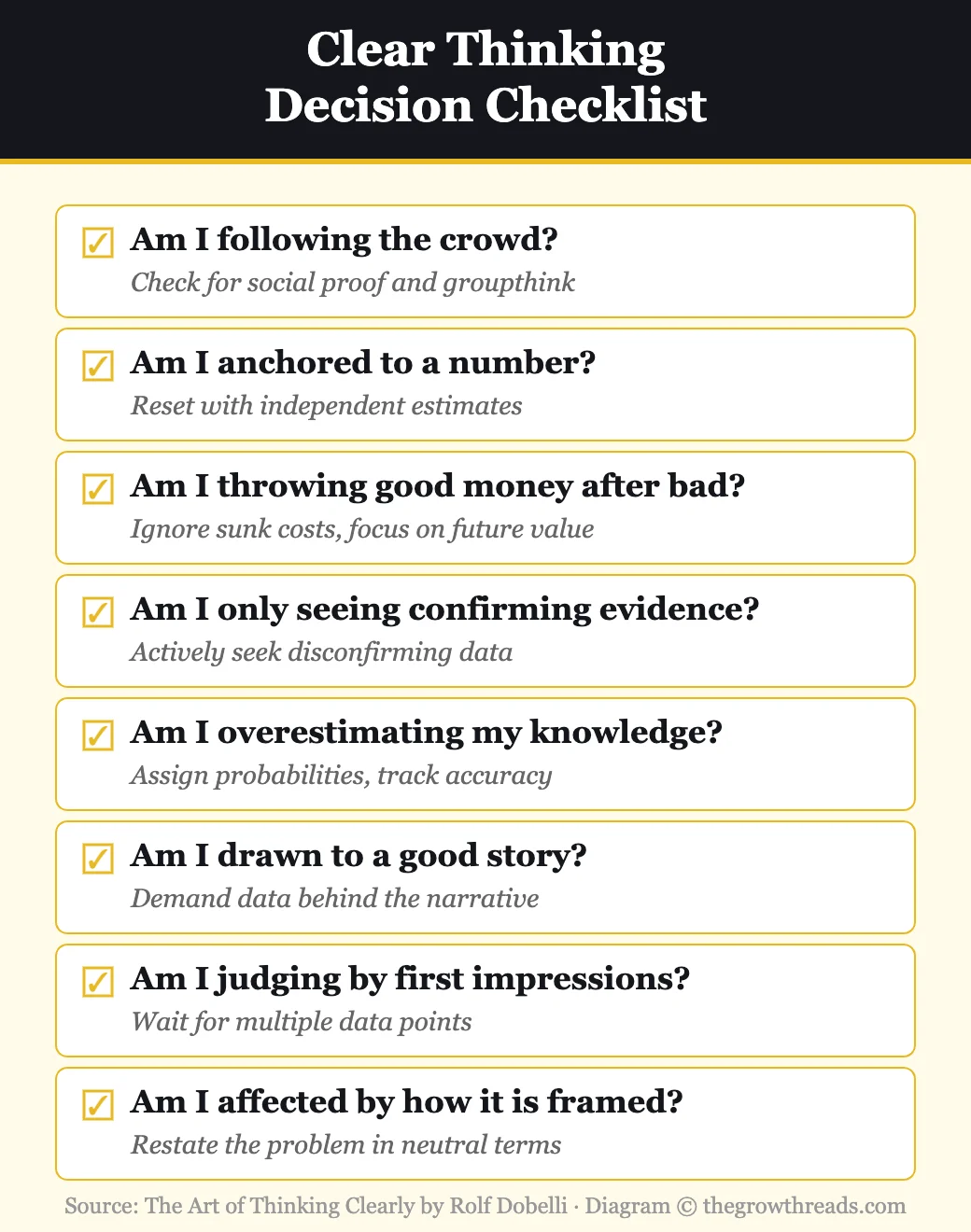
Dobelli closes with a pragmatic message: you cannot eliminate cognitive biases through willpower alone. What you can do is build systems — checklists, decision journals, pre-mortems, and advisory boards of people who think differently — that catch your biases before they cause damage. Awareness is the first step, but structured processes are the real solution.
Who is The Art of Thinking Clearly best for — and who should read something else first?
This book is perfect for anyone who wants a broad, accessible introduction to cognitive biases without wading through academic papers. Its short-chapter format makes it ideal for busy professionals who can read one bias per day, and its practical examples drawn from business, investing, and everyday life make abstract psychology concrete and immediately useful. It is also an excellent gift for skeptics who think they think clearly already — the sheer volume of documented errors is humbling.
If you want deeper academic rigour, start with Thinking, Fast and Slow by Daniel Kahneman instead — it covers fewer biases but with far more scientific depth. If you are specifically interested in how biases affect financial decisions, The Psychology of Money by Morgan Housel is more focused and narrative-driven. And if you want a framework for making better decisions under uncertainty rather than a catalogue of errors, Thinking in Bets by Annie Duke is the stronger choice.
Questions to reflect on
- What decision are you currently making where sunk costs might be influencing your judgment — and what would you do if you started fresh today?
- When you last formed a strong opinion, did you actively seek evidence against it, or did you only look for confirmation?
- Think of a recent success: how much was genuinely due to your skill, and how much was luck or timing that survivorship bias might cause you to ignore?
- In your next negotiation, who will set the anchor — and are you prepared to set it yourself?
- What systematic process (checklist, decision journal, pre-mortem) could you implement this week to catch your own cognitive biases?
🔥 Ready to spot the thinking errors that sabotage your decisions?
The Art of Thinking Clearly gives you 99 tools to think sharper and decide better.
How to apply The Art of Thinking Clearly (7-day plan)
- Day 1 — Start a bias journal. Read three chapters from the book and write down one real example from your own life for each bias. Recognising biases in your past decisions is the first step toward catching them in real time.
- Day 2 — Audit your sunk costs. List any project, subscription, relationship, or commitment you are maintaining primarily because of what you have already invested. For each one, ask: if I were starting fresh today, would I choose this?
- Day 3 — Practise disconfirmation. Take your strongest current belief about your work or industry and spend 15 minutes actively searching for evidence against it. Write down what you find.
- Day 4 — Build a decision checklist. Create a simple list of the five biases most relevant to your work (e.g., anchoring if you negotiate, overconfidence if you forecast) and tape it where you will see it before making important decisions.
- Day 5 — Run a pre-mortem. For your most important current project, imagine it has failed spectacularly. Write down the three most likely reasons. This counters overconfidence and the planning fallacy.
- Day 6 — Check your social proof. Identify one decision you are making because “everyone else is doing it.” Research independently whether the crowd actually has good reasons or is just following other followers.
- Day 7 — Teach one bias. Explain your favourite bias from the book to a friend or colleague. Teaching forces you to understand it deeply and creates an accountability partner who can call you out when they see it in action.
Frequently asked questions
Is The Art of Thinking Clearly a good first book on cognitive biases?
It is one of the best entry points available. The short, self-contained chapters make it far more accessible than academic treatments like Thinking, Fast and Slow. Each bias is explained in two to three pages with a vivid example, making it easy to absorb one concept per sitting. For readers who want rigorous depth, Kahneman’s book is the logical next step, but for breadth and readability, Dobelli is hard to beat.
How many cognitive biases does the book cover?
The book covers 99 distinct cognitive biases and thinking errors, each in its own short chapter. These range from well-known biases like confirmation bias and sunk cost fallacy to less familiar ones like the swimmers body illusion, the conjunction fallacy, and the Will Rogers phenomenon. The breadth is the book’s greatest strength — it functions as a comprehensive field guide rather than a deep dive into any single bias.
Can knowing about biases actually improve my decision-making?
Research suggests that awareness alone has limited effect — you cannot think your way out of biases through pure willpower. However, Dobelli argues that awareness combined with systematic processes (checklists, decision journals, pre-mortems, devil’s advocates) can significantly improve outcomes. The key is building external systems that catch biases before they cause damage, rather than relying on your ability to spot them in the moment.
How is this book different from Thinking, Fast and Slow?
Thinking, Fast and Slow is written by Daniel Kahneman, the Nobel Prize-winning psychologist who discovered many of the biases Dobelli catalogues. Kahneman goes much deeper into the underlying science, explaining the dual-process theory (System 1 and System 2) that explains why biases exist. Dobelli provides a broader, more accessible catalogue with practical examples. Think of Kahneman as the textbook and Dobelli as the field guide — both are valuable, and they complement each other well.
Is the book useful for investors and business professionals?
Extremely. Many of the biases Dobelli covers — anchoring, overconfidence, sunk cost fallacy, social proof, survivorship bias — are directly responsible for the most common investing and business mistakes. The book provides specific examples from finance and corporate life, making the connection between abstract psychology and practical decision-making unusually clear. Several hedge fund managers have recommended it as essential reading for their teams.
What is the best way to read The Art of Thinking Clearly?
Dobelli designed the book to be read in any order — each chapter stands alone. Many readers find the most effective approach is one or two chapters per day, followed by a moment of reflection on where that bias shows up in their own life. Reading it cover to cover in one sitting works but loses the benefits of spaced practice. Keeping a bias journal alongside your reading dramatically increases retention and practical application.
Is The Art of Thinking Clearly worth reading in 2026?
Yes. Cognitive biases are features of the human brain, not trends that expire. If anything, the biases Dobelli catalogues have become more relevant as information overload and AI-generated content make it harder than ever to think clearly. The book remains one of the most efficient ways to get a comprehensive overview of the thinking errors that affect everything from your career to your relationships to your financial decisions.
Related summaries
- Thinking, Fast and Slow by Daniel Kahneman — the definitive academic treatment of cognitive biases and dual-process theory.
- Influence by Robert Cialdini — the six principles of persuasion that exploit our social biases.
- Thinking in Bets by Annie Duke — a practical framework for making better decisions under uncertainty.
- The Black Swan by Nassim Taleb — how rare, unpredictable events shape our world and expose our narrative fallacies.
We read every book cover to cover, cross-reference key claims with primary research, and test practical advice against real-world application. Our ratings weigh five criteria equally: actionability, evidence quality, writing clarity, originality, and lasting value. Read our full methodology.