

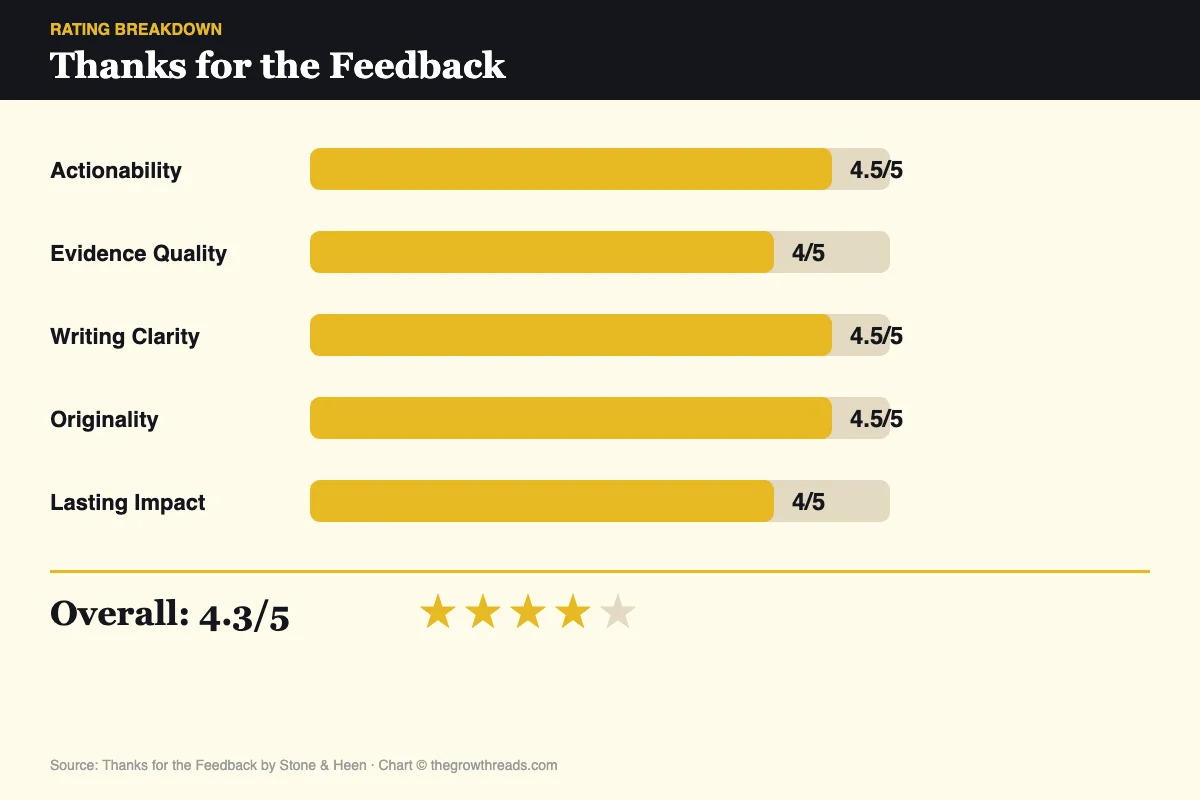
⭐⭐⭐⭐ 4.3/5 — The missing half of every feedback conversation — a brilliant framework for receiving criticism, coaching, and praise without shutting down or blowing up.
Actionability: 4.5/5 · Evidence Quality: 4.0/5 · Writing Clarity: 4.5/5 · Originality: 4.5/5 · Lasting Impact: 4.0/5
Best for: Anyone who gets defensive when criticized, managers who want their teams to actually hear feedback, and couples stuck in the same arguments.
Reading time: ~8 hours (368 pages)
Difficulty to apply: Moderate — understanding the framework is easy; overriding your emotional triggers in the moment takes weeks of deliberate practice.
Thanks for the Feedback in one minute
Every book on feedback tells you how to give it better — this is the only one that teaches you how to receive it. Douglas Stone and Sheila Heen, from the Harvard Negotiation Project, argue that the biggest obstacle to growth is not that people give bad feedback — it is that receivers block, distort, or dismiss even excellent feedback because of three predictable emotional triggers. Truth triggers fire when the content feels wrong. Relationship triggers fire when the messenger is the problem. Identity triggers fire when the feedback threatens your self-story. By understanding these triggers and learning to manage them, you can extract value from almost any feedback — even poorly delivered criticism — and turn conversations that usually end in defensiveness into genuine opportunities for growth.
Key takeaways
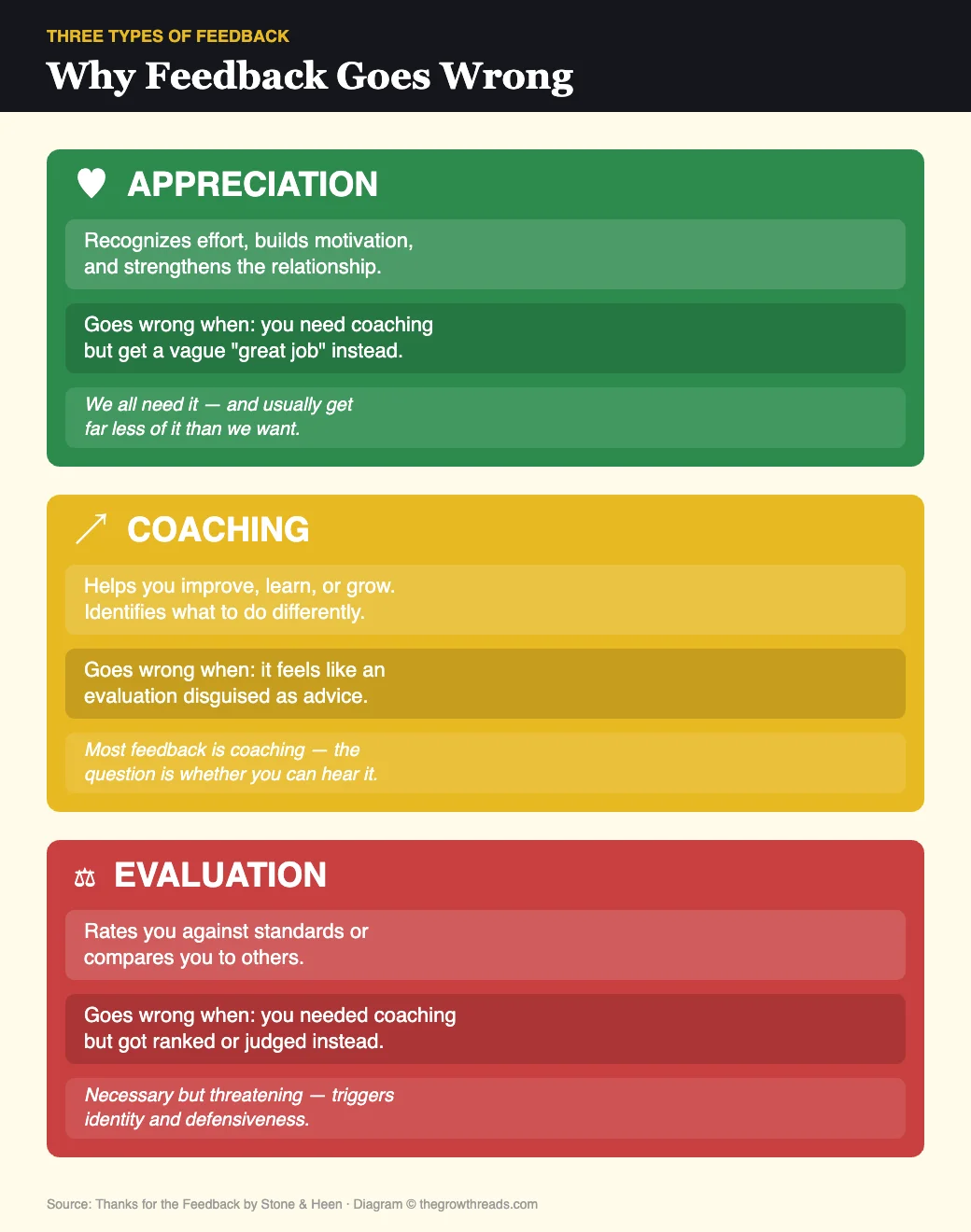
- There are three types of feedback — and most conflicts happen when they get crossed: Appreciation (recognition), coaching (how to improve), and evaluation (where you stand). When you want appreciation but get evaluation, or need coaching but get a vague “good job,” both sides leave frustrated.
- The receiver controls whether feedback works: No matter how skillfully feedback is delivered, the person receiving it decides whether to take it in, argue with it, or discard it. Learning to receive well is a more leveraged skill than learning to give well.
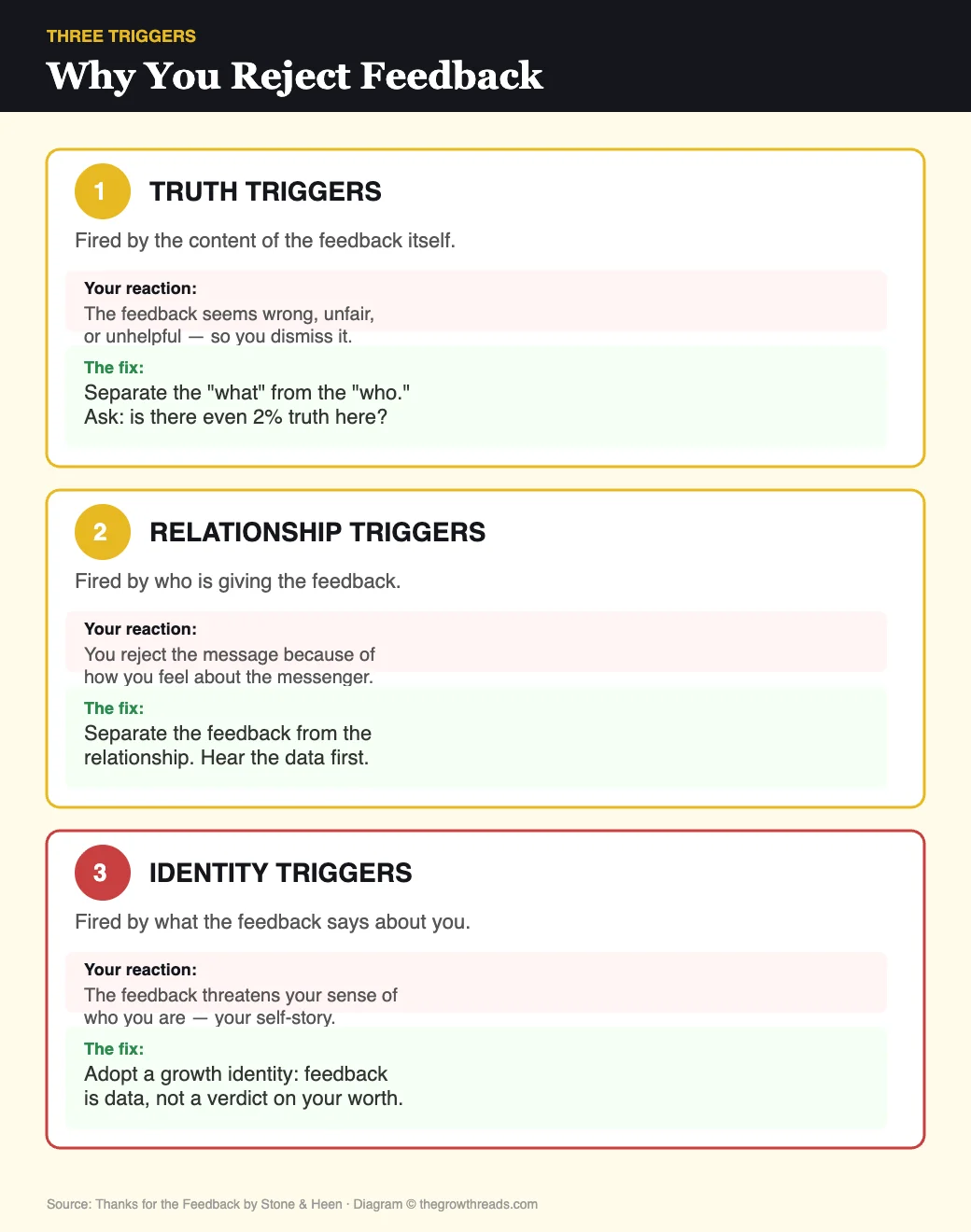
- Truth triggers make you dismiss feedback prematurely: When feedback feels wrong, your first instinct is to reject it. But feedback is almost never 100% wrong — the discipline is finding the 2% that is accurate and useful.
- Relationship triggers turn feedback into a relationship fight: When you do not respect or trust the person giving feedback, you reject the message because of the messenger. Separating the data from the deliverer is essential.
- Identity triggers are the most destabilizing: Some feedback threatens your sense of who you are — “I am not the kind of person who…” When identity is at stake, your brain floods with fight-or-flight chemicals and rational processing shuts down.
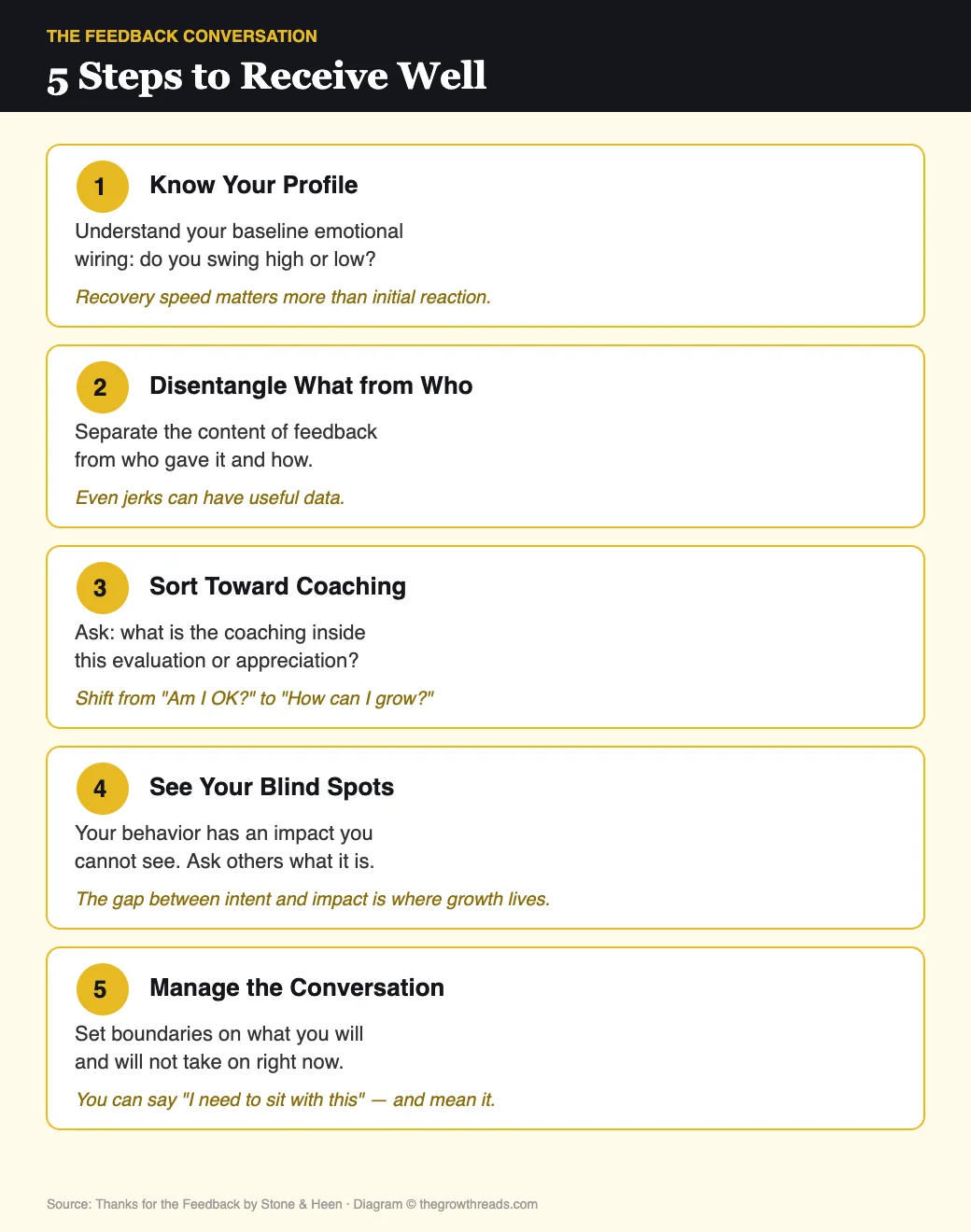
- Your “wiring” determines your initial reaction, not your final response: Some people have a strong emotional swing (intense initial reaction); others have slow recovery (the sting lingers). Knowing your pattern lets you manage it rather than being managed by it.
- Disentangle “what” from “who”: Every feedback conversation contains two channels: the actual content and the relationship dynamics. Most derailments happen when people switch from discussing the content to litigating the relationship.
- Sort toward coaching: When you receive evaluation (“you got a 3 out of 5”), ask: “What would it take to get to a 4?” This converts a judgment into actionable guidance — and puts you back in control.
- Blind spots are invisible by definition: You cannot see your own impact the way others experience it. The gap between your good intentions and your actual impact on others is the most valuable — and hardest — feedback to hear.
- You can set boundaries on feedback: Receiving well does not mean accepting everything. You can say “I need time to process this” or “I am not in a place to hear this right now” — both are legitimate boundary-setting, not avoidance.
What is Thanks for the Feedback about?
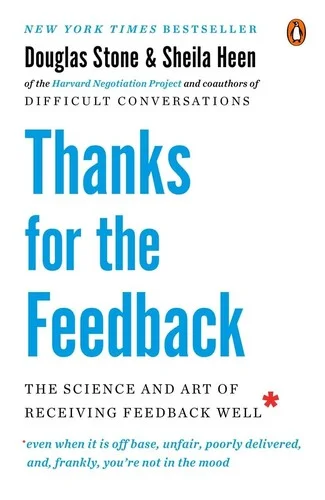
Thanks for the Feedback is about the science and skill of receiving feedback — criticism, coaching, praise, and evaluation — without shutting down, blowing up, or missing the growth opportunity. It identifies three emotional triggers that derail feedback conversations and provides a practical framework for managing each one, drawing on twenty years of research at the Harvard Negotiation Project.
About the authors
Douglas Stone and Sheila Heen are lecturers at Harvard Law School and founding partners of Triad Consulting Group, which advises organizations ranging from the White House to Pixar on how to have difficult conversations. Their first book, Difficult Conversations (co-authored with Bruce Patton), is considered one of the definitive texts on handling high-stakes communication. Thanks for the Feedback grew from a realization during their decades of corporate training: they kept teaching people how to give feedback better, but the real bottleneck was on the receiving end. The book draws on research from neuroscience, psychology, and their experience mediating thousands of real-world feedback conversations across industries and cultures.
Key concepts at a glance
| Concept | What it means | Use it when |
|---|---|---|
| Three Types of Feedback | Appreciation (thanks), coaching (improve), evaluation (rank) | Feedback conversations feel unproductive — you may be crossing types |
| Truth Triggers | Rejecting feedback because the content feels wrong | Your first instinct is “that’s not true” — pause and look for the 2% |
| Relationship Triggers | Rejecting feedback because of who is giving it | You dismiss input because you dislike or distrust the source |
| Identity Triggers | Rejecting feedback because it threatens your self-image | Feedback makes you feel fundamentally flawed, not just corrected |
| Emotional Wiring | Your baseline sensitivity and recovery speed | Understanding why some feedback stings for days while other people shrug it off |
| Blind Spots | The gap between your intentions and your impact on others | People keep giving you the same feedback and you keep not seeing the pattern |
| Sort Toward Coaching | Converting evaluation into actionable improvement guidance | You get a rating or judgment and want to make it useful |
| Boundaries | Setting limits on what feedback you will take on right now | You are overwhelmed, triggered, or the feedback is genuinely inappropriate |
Part 1: The three types of feedback
Stone and Heen begin with an insight that reframes every feedback conversation: there are three fundamentally different types of feedback, and most feedback failures happen when the giver and receiver are not on the same type. Appreciation says “I see you and value what you do” — it is about recognition and connection. Coaching says “here is a way to improve” — it is about growth and learning. Evaluation says “here is where you stand” — it is about ranking, rating, and consequences.
The problems start when these get crossed. Your manager gives you an evaluation (“you are meeting expectations”) when what you desperately needed was appreciation (“your work on that project was outstanding”). Your partner offers coaching (“you should try being less defensive”) when what you needed was appreciation (“I know this is hard and I see you trying”). Each type serves a legitimate purpose, but receiving the wrong type feels dismissive, tone-deaf, or threatening — not because the feedback is bad, but because it is the wrong kind for the moment.
The practical fix is surprisingly simple: before any feedback conversation, ask — or clarify — what type is being offered. “Is this coaching, or are you evaluating me?” can prevent thirty minutes of misunderstanding. And when you are the one seeking feedback, be specific: “I do not need you to tell me it was good — I need you to tell me what I can do differently next time.” This small intervention resolves a surprising number of feedback frustrations.
Part 2: Truth triggers and relationship triggers
The book’s core framework identifies three triggers that cause receivers to block feedback. Truth triggers fire when the content of the feedback feels wrong, unfair, or off-base. Your immediate reaction is “that is simply not accurate” — and you spend the rest of the conversation building a legal case for why the giver is mistaken. The problem, Stone and Heen argue, is that feedback is almost never entirely wrong. Even poorly expressed criticism usually contains a kernel of truth, and the receiver’s job is to find it rather than dismiss the entire package because of imperfect wrapping.
The fix for truth triggers is to disentangle the specific from the general. When someone says “you are not a team player,” that label feels wrong because you can think of ten examples of being collaborative. But if you ask “can you give me a specific example?”, you might learn that you interrupted someone in Tuesday’s meeting — a specific behavior you can evaluate and potentially change. The shift from “is this label true?” to “what specific data is behind this label?” turns a debate into a diagnosis.
Relationship triggers fire when you cannot hear the feedback because of who is delivering it. If you do not respect the person, if they are a hypocrite (“you are giving me this advice?”), or if you have an unresolved conflict with them, the relationship contaminates the data. Stone and Heen call this “switchtracking” — the conversation switches from the feedback topic to the relationship topic, and suddenly you are arguing about who hurt whom last week instead of discussing the actual performance issue. The solution is to acknowledge the relationship issue separately (“I hear that you are frustrated with me, and I want to address that — but can we first finish discussing the project feedback?”) rather than letting them collapse into a single unproductive fight.
Part 3: Identity triggers and emotional wiring
Identity triggers are the deepest and most destabilizing. When feedback threatens not just what you did but who you are — “you are selfish,” “you are not leadership material,” “you are a bad parent” — your brain activates threat responses that shut down rational processing. Stone and Heen draw on neuroscience research showing that identity-threatening feedback activates the same neural circuits as physical pain. Your brain literally cannot think clearly when your self-story is under attack.
The authors identify two dimensions of what they call emotional wiring. The first is baseline sensitivity — how intensely you react to feedback initially. Some people feel devastated by a mildly critical comment; others barely register it. The second is recovery speed — how long it takes to return to baseline after a negative reaction. You might swing hard but recover quickly, or swing mildly but stew for days. Neither pattern is better or worse — but knowing yours lets you manage the feedback process. If you know you swing hard, you can build in processing time before responding. If you know you have slow recovery, you can schedule feedback conversations when you have space afterward to decompress.
The critical insight is that your wiring determines your initial reaction but not your ultimate response. Between the emotional trigger and your chosen behavior is a gap — and in that gap lives the skill of receiving feedback. Stone and Heen provide a framework for widening that gap: separate the feedback from the story you are telling yourself about it, distinguish between “this is useful data” and “this means I am fundamentally flawed,” and remember that your identity is not a single thing that feedback can shatter — it is a complex, evolving narrative that can absorb new information without collapsing.
Part 4: Blind spots, boundaries, and systems
The final section addresses the most uncomfortable truth about feedback: you have blind spots that are invisible to you by definition. Your intentions feel obvious from the inside, but others experience only your impact — and the two often diverge dramatically. You might intend to be thorough; others experience you as controlling. You might intend to be supportive; others experience you as overbearing. The gap between intent and impact is where the most valuable feedback lives — and it is precisely the feedback that is hardest to hear, because from the inside, your intentions feel beyond reproach.
Stone and Heen introduce a concept they call the “Google Maps” view: you can only see your own internal experience (thoughts, intentions, feelings), but others can only see your external behavior (tone, body language, words, actions). Neither view is complete. The skill is developing the humility to accept that other people’s experience of your behavior is valid data, even when it conflicts with your self-perception. This does not mean accepting every critique uncritically — but it does mean treating patterns in feedback (the same criticism from multiple sources) as signals rather than noise.
Finally, the authors address feedback in systems — relationships, families, teams, organizations. Feedback does not exist in a vacuum; it flows through relationships that have histories, power dynamics, and mutual trigger patterns. A manager giving feedback to a direct report is operating within a system where both parties have contributed to the dynamic. Stone and Heen encourage both sides to look at the system, not just the individual: “What am I doing that might be contributing to the pattern we are both stuck in?” This systemic lens transforms feedback from a one-directional correction into a mutual exploration — and makes it far more likely to produce lasting change.
Who is Thanks for the Feedback best for — and who should read something else first?
This book is ideal for anyone who gets defensive when criticized, shuts down during performance reviews, or finds that the same arguments keep recurring in their relationships. It is particularly valuable for managers — not because it teaches them to give better feedback (though it helps indirectly), but because understanding receiver psychology makes them far more effective at framing feedback their teams can actually hear. Couples who find themselves stuck in repetitive conflict patterns will recognize the switchtracking and identity trigger dynamics immediately.
If you are primarily interested in how to give feedback effectively, read Radical Candor by Kim Scott or the companion volume Difficult Conversations by Stone, Heen, and Patton. If your challenge is more about emotional reactivity in general (not just feedback situations), Emotional Intelligence by Daniel Goleman provides the broader foundation. And if the relationship dynamics resonate more than the professional applications, Nonviolent Communication by Marshall Rosenberg offers a complementary framework for expressing needs without triggering defensiveness.
Questions to reflect on
- Think of the last piece of feedback you rejected — which trigger fired (truth, relationship, or identity), and was there a kernel of useful data you missed?
- What is the story you tell yourself when you receive criticism — “I am competent,” “I am likable,” “I am a good parent” — and how does that story shape what you can and cannot hear?
- Is there a piece of feedback you have received from multiple people that you have consistently dismissed? What would it mean to take it seriously?
- When your partner or colleague gives you feedback, do you tend to switchtrack — shifting from the topic they raised to a grievance of your own? What happens when you do?
- What is your emotional wiring: do you swing high (intense initial reaction) or have slow recovery (the sting lingers)? How could knowing this help you manage feedback better?
🔥 Ready to stop dreading feedback and start using it?
Stone and Heen’s framework could transform how you handle criticism, coaching, and praise — at work and at home.
How to apply Thanks for the Feedback (7-day plan)
- Day 1 — Identify your dominant trigger: Think of the last three times you received feedback that stung. For each, determine whether the trigger was truth (content felt wrong), relationship (messenger was the problem), or identity (it threatened who you are). Notice which trigger fires most often for you — that is your growth edge.
- Day 2 — Practice disentangling: The next time someone gives you feedback today, consciously separate the content from the delivery. Write down: (1) What is the specific data in this feedback? (2) What is my feeling about the person giving it? (3) Are those two things contaminating each other?
- Day 3 — Ask for one piece of coaching: Approach someone you trust — a colleague, partner, or friend — and ask: “What is one thing I do that gets in my way that I might not be aware of?” Listen without defending. Write it down and sit with it for 24 hours before responding.
- Day 4 — Sort toward coaching: If you receive any evaluative feedback today (“that was not your best work,” “you could do better”), practice the conversion: “What specifically would make it better?” Turn the judgment into actionable guidance.
- Day 5 — Map your wiring: Reflect on your emotional patterns: Do you react intensely but recover quickly, or react mildly but stew for days? Write down your pattern and one strategy for managing it: building in processing time before responding if you swing hard, or scheduling a debrief with a trusted person if you recover slowly.
- Day 6 — Look for a blind spot: Ask two people (ideally one at work, one at home): “What is the gap between how I see myself and how I come across to you?” Do not argue with their answers. Look for overlap between the two responses — that overlap is your blind spot.
- Day 7 — Set one boundary and one commitment: Identify one type of feedback you will say “I need time to process that” to (your boundary), and one type you commit to leaning into even when it is uncomfortable (your growth commitment). Write both down and revisit them monthly.
Frequently asked questions
What is the main idea of Thanks for the Feedback?
The central argument is that most feedback failures happen on the receiving end, not the giving end. Stone and Heen identify three emotional triggers — truth, relationship, and identity — that cause receivers to block, distort, or dismiss feedback, and provide a framework for managing each trigger so you can extract useful data from even poorly delivered criticism. The revolutionary shift is from “how do I give better feedback?” to “how do I receive feedback so I can actually learn and grow from it?”
What are the three types of feedback?
Appreciation recognizes effort and builds connection (“I see what you did and it matters”). Coaching identifies areas for improvement (“here is how to do it differently next time”). Evaluation rates performance against standards or compares you to others (“you are meeting expectations / you got a 3 out of 5”). Most feedback frustrations happen when the type offered does not match the type needed — when you want appreciation but get evaluation, or need coaching but get a vague compliment.
What are feedback triggers?
Feedback triggers are automatic emotional reactions that cause you to reject feedback. Truth triggers fire when the content feels wrong or inaccurate — you dismiss the message as incorrect. Relationship triggers fire when the messenger is the problem — you reject the data because of who delivered it. Identity triggers fire when the feedback threatens your self-image — you feel fundamentally flawed, not just corrected. Each trigger requires a different management strategy, and most people have one dominant trigger type.
How is this different from Difficult Conversations?
Difficult Conversations (by the same Harvard Negotiation Project team) covers how to have hard conversations of all kinds — delivering bad news, resolving disagreements, discussing feelings. Thanks for the Feedback narrows the focus specifically to feedback situations and shifts the lens from the giver to the receiver. Think of Difficult Conversations as the broad operating system and Thanks for the Feedback as the specialized app for one of the most common and challenging conversation types. They are complementary, not redundant.
What is switchtracking?
Switchtracking is what happens when a feedback conversation derails because the giver and receiver are on different topics. The giver raises topic A (“you were late to the meeting”), and the receiver switches to topic B (“well, you never acknowledge when I stay late”). Now both parties are arguing past each other, each convinced the other is being evasive. The fix is to name the dynamic: “I hear that you want to discuss my late nights — and I do want to talk about that. But can we first finish the conversation about the meeting?” Two topics, two separate conversations.
Can I set boundaries on feedback I receive?
Absolutely — and Stone and Heen argue that setting boundaries is an essential receiving skill, not a weakness. You can say “I need time to sit with this before responding,” “I am not in a place to hear this right now,” or “I appreciate the intent, but I am not going to take this on.” The key is distinguishing between healthy boundaries (managing your capacity and timing) and reflexive avoidance (always shutting down feedback because it is uncomfortable). Boundaries are about when and how you process feedback, not whether you process it at all.
How do I find my blind spots?
By definition, you cannot see your own blind spots — that is what makes them blind spots. The most effective method is to ask trusted people a specific question: “What is one thing I do that gets in my way that I might not be aware of?” Then listen without defending. Look for patterns: if three different people mention the same behavior, it is not their misperception — it is your blind spot. Stone and Heen also recommend paying attention to repeated feedback themes across different relationships and contexts. The feedback you have heard most often and dismissed most consistently is likely your biggest blind spot.
Related summaries
If Thanks for the Feedback opened new ground on communication and relationships, these summaries explore adjacent territory:
- Difficult Conversations Summary — The companion book from the same Harvard Negotiation Project team — covers the full spectrum of hard conversations, not just feedback.
- Crucial Conversations Summary — Patterson et al.’s framework for keeping high-stakes conversations productive when emotions run high.
- Nonviolent Communication Summary — Marshall Rosenberg’s system for expressing needs and hearing others without triggering defensiveness.
- Radical Candor Summary — Kim Scott’s framework for giving feedback that is both caring and direct — the giving side of the equation.
📚 Explore more Relationship book summaries
This review is part of our Best Relationship Books collection — a curated library of the most impactful books on communication, connection, and navigating relationships, with full summaries, key takeaways, and action plans for each.