

★★★★★ 4.5/5 — The clearest map ever drawn of why hard conversations go wrong, and a practical way to have them anyway.
Best for: Anyone who dreads a specific conversation right now — with a partner, a boss, a sibling, a roommate, a neighbor — and wants language for it, not just courage.
Reading time: ~6 hrs to read (about 250 pages); this guide takes ~14 minutes.
Difficulty to apply: Moderate — the framework is simple to learn but takes real practice to use under stress.
Difficult Conversations in one minute
Every difficult conversation is actually three conversations happening at once, and almost everyone is arguing about the wrong one. Douglas Stone, Bruce Patton, and Sheila Heen — negotiation researchers at the Harvard Negotiation Project — spent over a decade studying why conversations about layoffs, breakups, inheritance, and roommate dishes go so badly, and found the same pattern everywhere: people fight over “what happened,” while the conversation that actually matters is happening underneath, in feelings and identity.
TL;DR: Stop arguing about who’s right. Get curious about the other person’s story, own your contribution to the mess, separate your self-worth from the outcome, and tell the “Third Story” — the version a neutral observer would tell — before you say anything else.
Key takeaways
- Every difficult conversation is three conversations: the “What Happened” conversation (facts, blame, intentions), the Feelings conversation, and the Identity conversation — and most people only notice the first one.
- The Third Story: before diving in, describe the situation the way a neutral observer would — not your version, not theirs, but the version that acknowledges both.
- Trade certainty for curiosity: you don’t actually know the other person’s intentions or the full story. Ask instead of assume.
- Contribution beats blame: blame asks “whose fault is it,” which is backward-looking and defensive. Contribution asks “what did each of us do to create this,” which is forward-looking and solvable.
- Impact isn’t the same as intent: you can accurately describe how someone’s action affected you without claiming to know why they did it.
- Feelings are usually the real subject: conversations framed as being about facts are almost always, underneath, about unexpressed feelings.
- The Identity Conversation runs inside you: “Am I competent? Am I a good person? Am I worthy of love?” — difficult conversations threaten these questions, which is why they feel so much bigger than the topic at hand.
- Ground your identity before you start: remind yourself you can be competent and still make mistakes, well-intentioned and still cause harm — this keeps you from going all-or-nothing under stress.
- Listen to understand, not to respond: paraphrase what you heard before adding your own view; it lowers defensiveness faster than any argument.
- Frame it as joint problem-solving: the goal isn’t winning the conversation — it’s finding a way forward that both people can live with.
What is Difficult Conversations about?
Difficult Conversations is a practical guide, from three Harvard Negotiation Project researchers, to having the conversations we most avoid — layoffs, breakups, feedback, conflict. It argues every hard talk is really three conversations at once (facts, feelings, identity), and teaches a curiosity-based approach for navigating all three without losing the relationship.
About the author
Douglas Stone, Bruce Patton, and Sheila Heen are all members of the Harvard Negotiation Project, the same research group behind the negotiation classic Getting to Yes (Patton co-authored both books). Stone and Heen teach negotiation at Harvard Law School and have spent decades training executives, diplomats, and families through their firm Triad Consulting Group. Their clients have ranged from Fortune 500 leadership teams to divorcing couples, which gives the book an unusual range — the same tools apply to a corporate restructuring and a conversation with a teenager. Explore all Douglas Stone book summaries →
The trio followed Difficult Conversations (1999, updated 2010) with Thanks for the Feedback, extending the same three-conversations lens to how we receive criticism. Their work sits at the intersection of negotiation theory, psychology, and communication — rigorous enough to be taught in law school, plain-spoken enough to use at the dinner table.
Key concepts at a glance
| Concept | What it means | Use it when |
|---|---|---|
| The Three Conversations | Every hard talk layers a What Happened, a Feelings, and an Identity conversation on top of each other | You feel like you’re “not even talking about the same thing” as the other person |
| The Third Story | A neutral, observer-style description of the situation that doesn’t take either side | Opening any difficult conversation |
| Contribution vs. blame | Asking what each person did to create the problem, instead of whose fault it is | You’re stuck rehashing who started it |
| The And Stance | Holding two true things at once instead of picking one (“I’m frustrated, and I know you’re doing your best”) | You’re tempted to see the situation as all-or-nothing |
| Impact vs. intent | Separating “how this affected me” from “why you did it” | You catch yourself assuming you know why someone acted a certain way |
| Identity quakes | The three core questions — Am I competent, good, worthy of love — that get shaken by hard conversations | A conversation feels bigger and more threatening than the topic warrants |
| Learning conversation | Reframing the goal from “deliver my message” to “understand and be understood” | You’re preparing what to say instead of preparing what to ask |
Part 1: The Three Conversations
Stone, Patton, and Heen open with a deceptively simple claim: whenever a conversation feels difficult, it’s because you’re actually navigating three separate conversations simultaneously, and most of us are only equipped to handle one of them.
The first is the “What Happened” conversation — the one about facts. Who said what, who did what, who’s right. This is the conversation we prepare for. We rehearse our version of events, gather evidence, and walk in ready to make our case. The trouble is that both people usually walk in with an equally confident, equally sincere, and equally different version of “what happened,” because we each experienced the event through a different set of information, different past experiences, and different assumptions about the other person’s intentions. Arguing over whose facts are correct is, the authors show, usually a dead end — not because facts don’t matter, but because the disagreement is rarely actually about facts.
The second is the Feelings conversation. Almost every difficult conversation carries an emotional charge that goes unacknowledged — hurt, fear, anger, guilt — and when feelings aren’t dealt with directly, they leak into the “facts” conversation and distort it. A disagreement about who left the dishes becomes, underneath, a conversation about feeling unappreciated. A dispute about a missed deadline becomes, underneath, a conversation about feeling disrespected. Stone, Patton, and Heen argue that skipping the feelings conversation doesn’t make it go away — it just makes the facts conversation impossible to resolve, because you’re both fighting the wrong battle.
The third, and the one people notice least, is the Identity conversation — the internal conversation you’re having with yourself about what this situation says about who you are. Am I a competent professional if I made this mistake? Am I a good parent if my child is struggling? Am I a decent person if my friend feels hurt by something I did? This internal conversation determines how much anxiety, defensiveness, or shutdown you bring into the external one, and it’s almost always invisible to the person you’re talking to — and often even to yourself, in the moment.
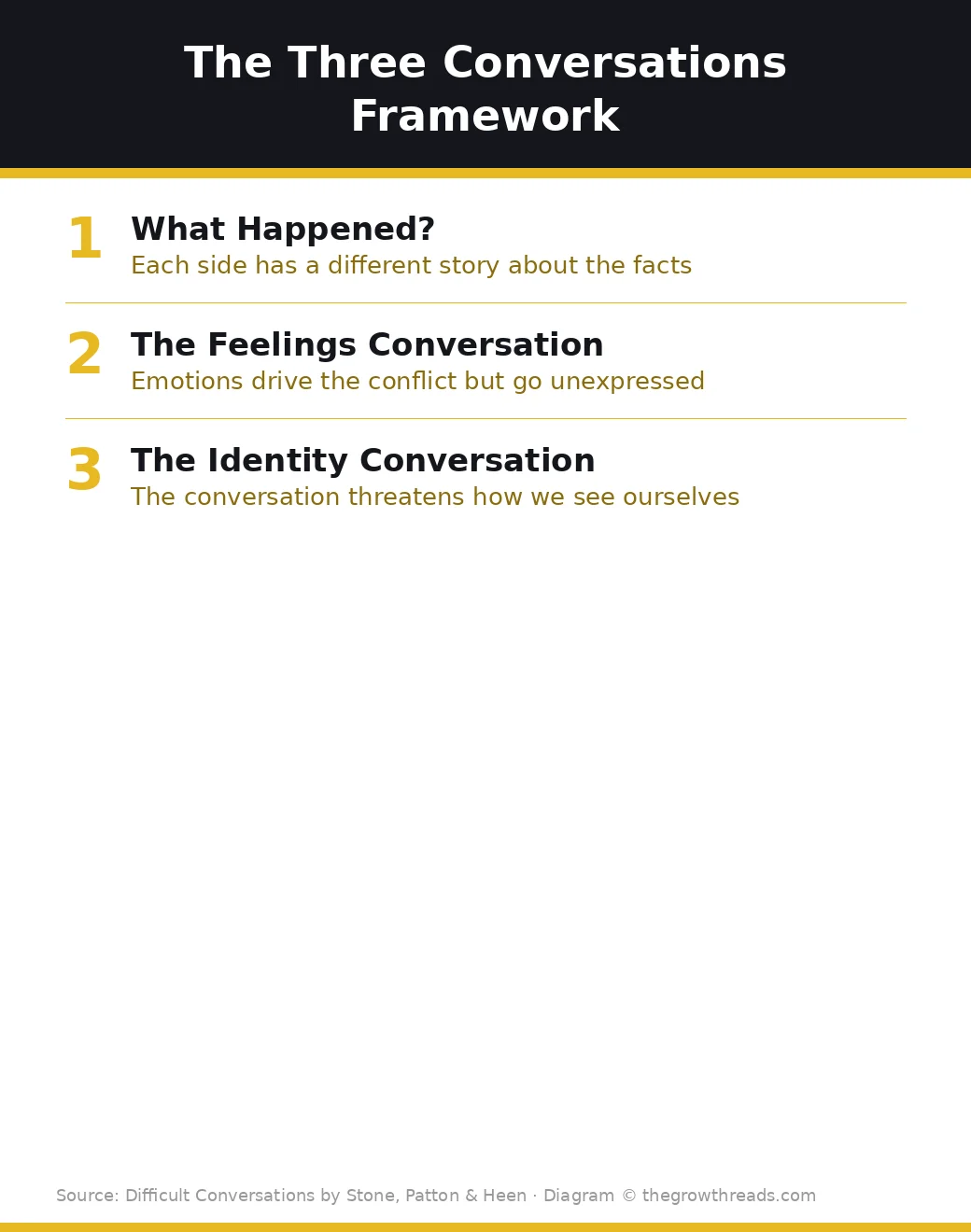
The book’s central move is to teach readers to notice all three layers happening in real time, because you can’t skillfully navigate a conversation you don’t recognize you’re in. A boss delivering a poor performance review who only prepares the “What Happened” facts will be blindsided by the employee’s tears (Feelings) and defensiveness (Identity) — not because the employee is irrational, but because two-thirds of the actual conversation was never on the boss’s radar.
Part 2: Shifting from certainty to curiosity
The single biggest shift the book asks of readers is to trade certainty for curiosity. Most of us walk into a difficult conversation convinced we already understand the situation — what happened, who’s to blame, and what the other person intended. The authors call this “the Battle of Messages”: both sides are so busy delivering their own certain version that no one is actually listening.
The antidote is what they call the And Stance: the ability to hold two seemingly conflicting truths at once, instead of forcing a choice between them. “I’m angry about what you said, and I know you were under enormous pressure that week.” “I think I did nothing wrong here, and I can see why you experienced it as hurtful.” The And Stance isn’t wishy-washy hedging — it’s a more accurate description of most real conflicts, which rarely have a single villain and a single victim.
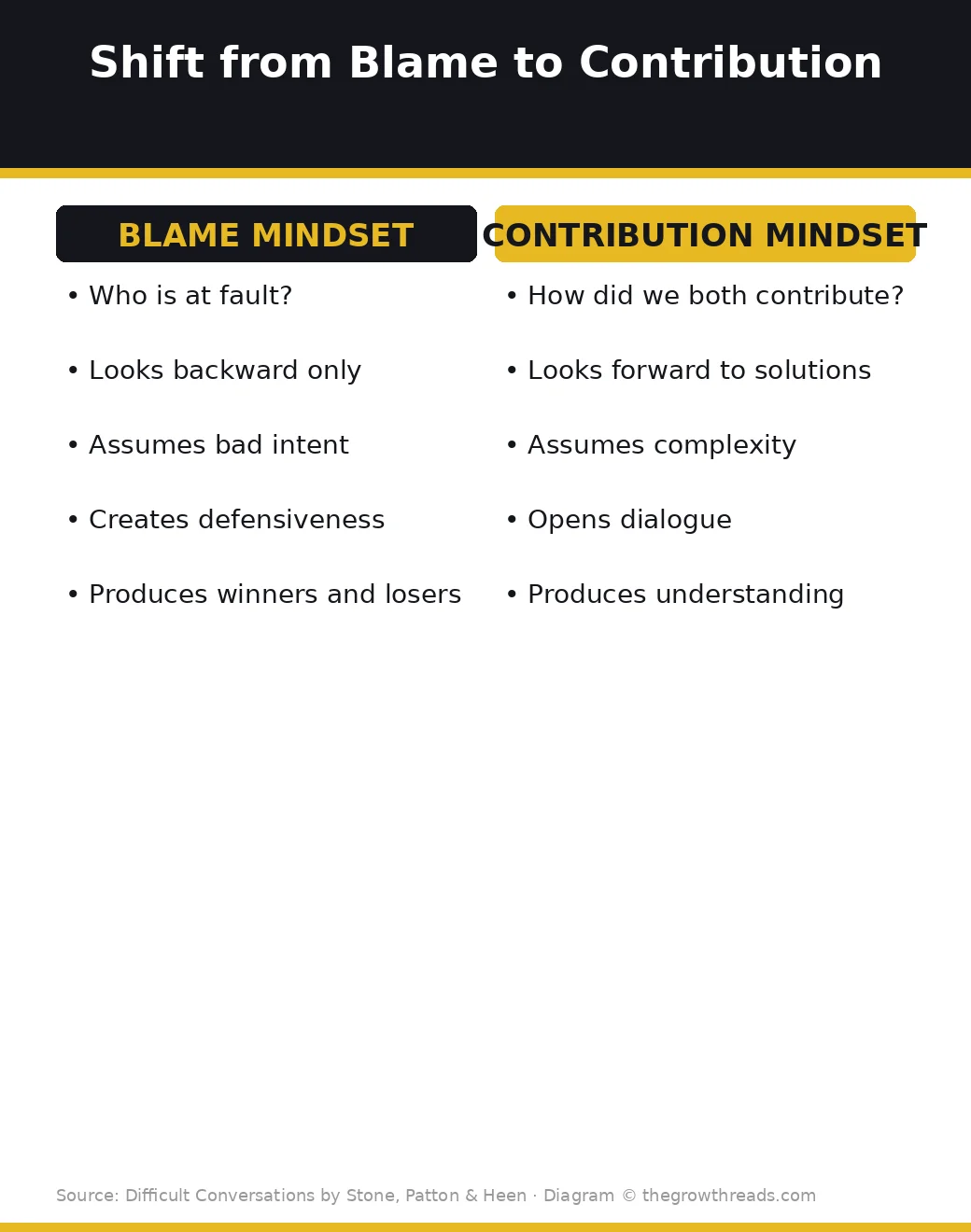
From the And Stance, the book builds its most practically useful reframe: replacing blame with contribution. Blame asks “whose fault is this?” — a backward-looking, either/or question that makes people defensive because admitting fault feels like accepting all the consequences and losing standing in the relationship. Contribution asks a different question entirely: “what did each of us do, or fail to do, that helped create this situation?” It’s forward-looking, it’s almost always shared, and — crucially — it’s the only version of the question that actually helps you change what happens next. A missed deadline might involve one person’s poor time management and another person’s unclear instructions and a third person’s failure to flag the risk early. Blame picks one culprit; contribution maps the whole system.
The authors are careful to distinguish contribution from the false equivalence of “we’re both equally to blame” — contributions are rarely 50/50, and naming them honestly sometimes means acknowledging you contributed 80% or 20%. The point isn’t to distribute blame evenly; it’s to make the map of causes accurate enough that both people can see a path to doing things differently.
Just as important is separating impact from intent. You can know, with total confidence, how someone’s words or actions affected you — that’s your lived experience. What you almost never actually know is why they did it. Yet most of us skip straight from impact to an assumed intent (“that hurt me, so you must have meant to hurt me”) and then argue about the intent as if it were fact. Stone, Patton & Heen recommend stating impact plainly and asking about intent as a genuine question, rather than an accusation dressed up as one.
Part 3: The Identity Conversation
Of the three conversations, the Identity Conversation is the one people most often miss entirely — and the one most responsible for conversations blowing up out of proportion to the actual issue. The authors argue that beneath every difficult conversation, we’re each silently asking ourselves three questions: Am I competent? Am I a good person? Am I worthy of love and respect? A difficult conversation threatens our preferred answer to one or more of these, and the resulting anxiety — what the authors call an “identity quake” — shows up as defensiveness, over-apologizing, stonewalling, or disproportionate anger, long before the actual topic gets addressed.
The core problem, they explain, is all-or-nothing thinking. Most people’s identity is built on binary self-images: “I am competent” or “I am incompetent,” “I am a good friend” or “I am a bad friend.” When a difficult conversation threatens to prove the negative version — “maybe I am the kind of person who hurts people” — the binary framing makes the stakes feel catastrophic, because there’s no room for a mixed, human answer. This is why a relatively small piece of feedback can trigger a wildly outsized reaction: it’s not really about the feedback, it’s about which identity story it seems to confirm.
The fix the book offers is to ground your identity before the conversation starts, by consciously replacing all-or-nothing self-images with more complex, accurate ones. Instead of “I am competent” (which any mistake threatens), aim for “I am someone who is generally competent, sometimes makes mistakes, and is capable of learning from them.” Instead of “I am a good person” (which any accusation threatens), aim for “I am someone who tries to act with good intentions and sometimes falls short, like everyone does.” This isn’t lowering your standards — it’s building an identity sturdy enough to survive an honest conversation, because it was never claiming perfection in the first place.
Grounding your identity has a second benefit the authors emphasize: it frees up the mental bandwidth you need to actually listen. If you’re spending your internal energy protecting a fragile “I’m always right” self-image, you have nothing left to hear what the other person is actually saying. A more grounded identity lets you hear “you hurt me” without translating it into “I am a bad person,” which means you can respond to the actual message instead of defending against the identity threat you imagined.
Part 4: Having the conversation
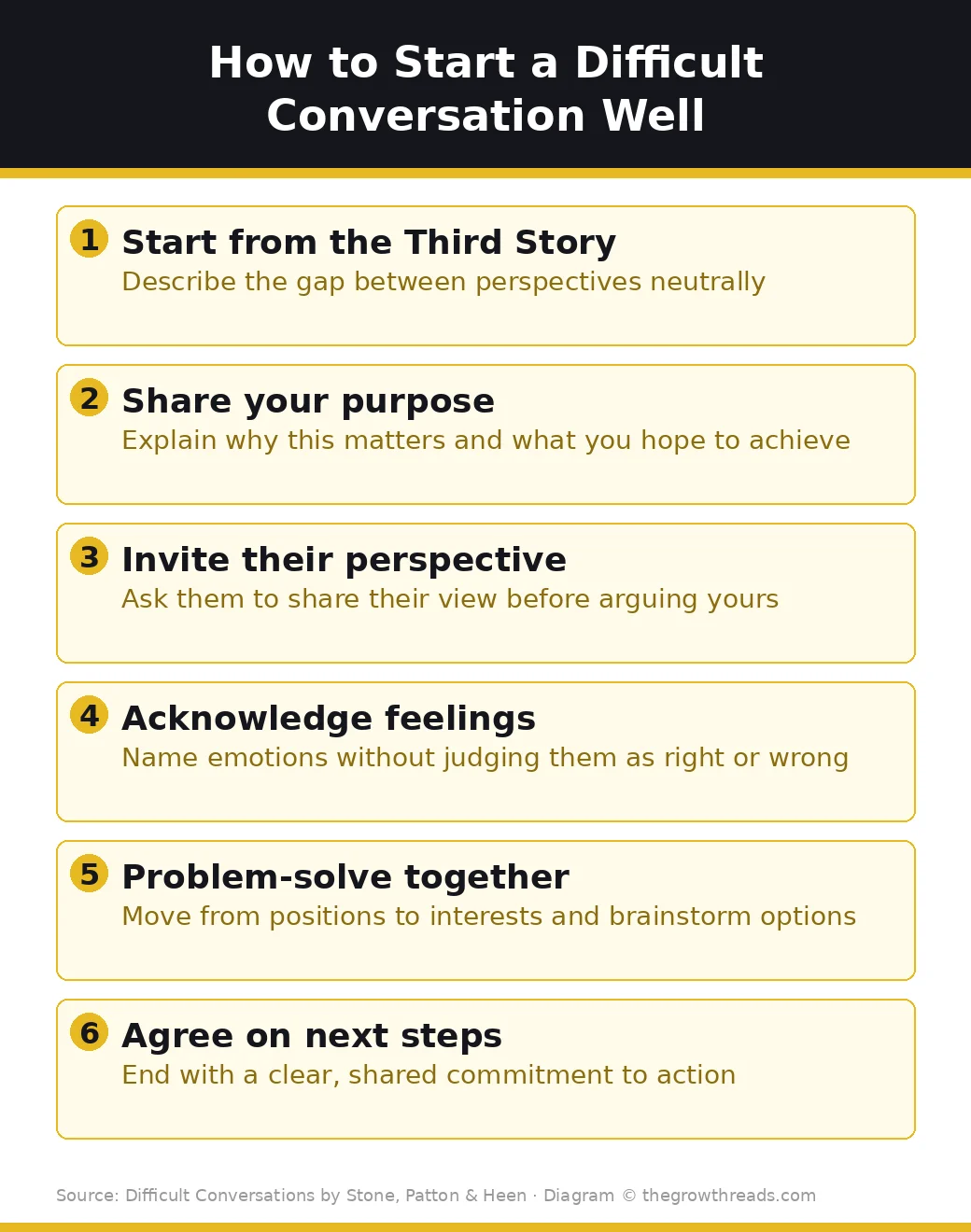
The final part of the book turns theory into a repeatable structure for the conversation itself, built around three moves: start from the Third Story, listen more than you speak, and frame the conversation as joint problem-solving rather than a verdict.
Start with the Third Story. Before saying anything about your own version of events, describe the situation the way a neutral, invested observer might — a description both people could recognize as fair, even if they’d add their own details. “We seem to have different expectations about how weekend chores get split, and it’s been causing tension” lands very differently than “You never do your share.” The Third Story lowers defensiveness because it doesn’t assign blame before the conversation has even begun, which means the other person doesn’t have to start by defending themselves.
Listen to understand, not to rebut. The authors describe most people’s “listening” as actually waiting for a turn to speak, silently building a counter-argument while the other person talks. Real listening means genuinely trying to understand the other person’s story well enough to restate it in a way they’d agree with — even if you still disagree with their conclusions. Paraphrasing (“So it sounds like you felt blindsided when the decision changed without a heads-up — is that right?”) does more to de-escalate a conversation than any argument, because it signals the other person has actually been heard, which is often what they wanted most in the first place.
Express yourself clearly, without exaggeration. Once you’ve genuinely listened, the book encourages stating your own view — including your feelings — plainly and specifically, without inflating it for effect (“I’ve been furious for weeks” tends to land worse than “I felt overlooked when that happened, and I’d like to talk about it”). Speaking from the Third Story and your own specific experience, rather than in absolutes like “always” and “never,” keeps the conversation solvable instead of triggering the other person’s own identity conversation.
Problem-solve together. The last move is reframing the goal: not to win, not to be validated, not even necessarily to be agreed with — but to find a way forward both people can actually live with. That might mean inventing a new option neither person walked in with, revisiting expectations that were never made explicit, or simply agreeing on what to do differently next time. The authors note that conversations framed this way — as two people solving a shared problem rather than opponents in a dispute — routinely surface solutions neither party could see while they were focused on being right.
Who is Difficult Conversations best for — and who should read something else first?
Difficult Conversations is best for people who already know a specific conversation is coming — a tough talk with a partner, a direct report, a parent, a landlord — and want language and structure for it, rather than general communication theory. It’s especially strong for anyone who tends to either avoid hard conversations entirely or go in guns-blazing, because the Third Story and contribution framework give a workable middle path.
If you’re looking for more of a moment-to-moment script for when a conversation is actively heating up, start with Crucial Conversations instead. If your focus is specifically negotiating price, deadlines, or terms rather than relationship repair, Never Split the Difference is the sharper tool. And if the difficult conversation you’re avoiding is about giving or receiving workplace feedback specifically, Radical Candor goes deeper on that particular context.
Questions to reflect on
- What difficult conversation have you been avoiding, and what’s the “Third Story” version of it — the one a neutral friend would tell?
- In your recurring conflicts, are you defending an all-or-nothing identity (“I’m always right,” “I’m a good person”) that makes the conversation feel higher-stakes than it needs to be?
- Where have you been assigning blame when a contribution map — what did each person actually do — would be more accurate and more useful?
- Have you ever confused someone’s impact on you with certainty about their intent? What would it look like to ask instead of assume?
- What would change in your closest relationship if you spent more of each hard conversation listening to understand than preparing your response?
🔥 Ready to have the conversation you’ve been avoiding?
Get the full framework, scripts, and case studies straight from the Harvard Negotiation Project researchers who wrote it.
How to apply Difficult Conversations (7-day plan)
- Day 1: Identify one conversation you’ve been avoiding. Write down your version of “what happened” — then set it aside.
- Day 2: Draft the Third Story: how would a fair, uninvolved observer describe the situation? Aim for language neither side would object to.
- Day 3: Separate impact from intent. Write the impact on you as fact. Write your assumed intent as a guess, then write one alternative explanation.
- Day 4: Map contribution instead of blame — list what you did (or didn’t do) that fed into the situation, honestly, even if it’s a small share.
- Day 5: Ground your identity. Replace any all-or-nothing self-statement (“I’m a terrible communicator”) with a truer, more complex one.
- Day 6: Practice paraphrasing with a friend or in the mirror: state the other person’s likely view back in your own words before you’d respond.
- Day 7: Have the conversation — open with the Third Story, listen first, express your view without exaggeration, and end by naming one next step you can agree on together.
Frequently asked questions
What are the three conversations in Difficult Conversations?
The What Happened conversation (facts, who’s right, who’s to blame), the Feelings conversation (the emotions underneath the disagreement), and the Identity conversation (what the situation seems to say about who you are). The authors argue most people only consciously handle the first, which is why conversations feel harder than they should — the real conflict is often in the other two layers.
What is the “Third Story” in Difficult Conversations?
The Third Story is a neutral description of a situation that a fair, uninvolved observer might give — one that doesn’t take either person’s side. Opening a hard conversation with the Third Story, instead of your own version of events, lowers defensiveness because it doesn’t start by assigning blame.
What’s the difference between blame and contribution?
Blame asks “whose fault is this,” a backward-looking, either/or question that triggers defensiveness. Contribution asks “what did each of us do to help create this situation,” a forward-looking question that’s almost always shared and, crucially, points toward what to change next time rather than just who to punish.
Is Difficult Conversations still relevant today?
Yes — the book was first published in 1999 and updated in 2010, and its core framework hasn’t dated because it’s about human psychology rather than specific technology or workplace trends. Some case studies feel slightly older-fashioned, but the Three Conversations model, contribution vs. blame, and identity grounding are used essentially unchanged in modern negotiation and communication training.
How is Difficult Conversations different from Crucial Conversations?
Difficult Conversations focuses more on the underlying psychology of why hard talks go wrong — the three layers, identity threats, curiosity vs. certainty — and gives you a mindset and structure. Crucial Conversations leans more heavily into moment-to-moment tactics and scripts for de-escalating once a conversation is already heated. They complement each other well; many readers benefit from both.
Can this book help with workplace conversations, not just personal ones?
Yes. Although many of the book’s examples are personal (family, friends, roommates), the framework was developed by negotiation researchers who train executives and organizations, and it applies directly to performance reviews, layoffs, salary negotiations, and team conflict. Readers focused specifically on workplace feedback often pair it with Radical Candor for additional context-specific tools.
What is an “identity quake” in Difficult Conversations?
An identity quake is the internal disruption that happens when a conversation threatens one of your core self-questions — Am I competent, am I a good person, am I worthy of love. The authors argue much of the outsized emotion in hard conversations comes from an identity quake rather than the surface topic, and that grounding your identity beforehand (accepting a more complex, less all-or-nothing self-image) reduces how destabilizing these moments feel.
Related summaries
- Crucial Conversations summary — moment-to-moment tools for high-stakes talks
- Never Split the Difference review — negotiation tactics from a former FBI hostage negotiator
- Nonviolent Communication summary — sentence-level scripts for expressing feelings without blame
- Radical Candor summary — applying direct, caring feedback at work
- Best relationship books — our full ranked guide
How we analyze books: every TGR summary is written after reading the full text, cross-referencing the author’s own talks and interviews, and mapping the book’s core framework against related research and other books in the same category. We focus on what you can actually apply, not just what the book says. Read our full methodology.
Disclosure: This article contains affiliate links, including to Amazon and Bookshop.org. If you buy through them, The Growth Reads may earn a small commission at no extra cost to you. This doesn’t affect which books we choose to cover or how we review them — we only recommend books we believe are genuinely worth your time.