

★★★★☆ 4.5 / 5 — The investing classic that proves you do not need an MBA to beat Wall Street.
Best for: Beginning-to-intermediate investors who want a practical, jargon-free framework for picking individual stocks.
Reading time: ~6 hours (304 pages)
Difficulty to apply: Medium — requires patience, basic financial-statement literacy, and a willingness to do your own research.
One Up On Wall Street in one minute
You already know more than you think about the stock market. Peter Lynch, who delivered a 29.2% average annual return running Fidelity Magellan from 1977 to 1990, argues that amateur investors have a structural advantage over professionals. By paying attention to the products you buy, the stores you visit, and the workplaces you know, you can spot winning stocks long before Wall Street analysts catch on. Lynch sorts every stock into six categories, gives you a concrete checklist for evaluating each one, and teaches you when to buy more and when to walk away — all in plain, witty English that makes investing feel less like rocket science and more like a treasure hunt.
Key takeaways
- Invest in what you know: Your daily life as a consumer, employee, or hobbyist exposes you to companies before professional analysts notice them.
- Six categories clarify every stock: Slow Growers, Stalwarts, Fast Growers, Cyclicals, Turnarounds, and Asset Plays each carry different risk profiles and selling rules.
- The P/E ratio is your friend: Compare a company’s price-to-earnings ratio against its earnings growth rate — a PEG below 1.0 signals potential value.
- Boring is beautiful: Companies with dull names, unglamorous products, or embarrassing businesses often get ignored by Wall Street, which is exactly when you want to buy.
- Do your homework before you buy: Lynch’s two-minute drill (earnings growth, P/E, debt, dividends, insider buying) takes minutes and saves years of regret.
- Know the story behind every stock you own: You should be able to explain in a short paragraph why you expect a stock to go up and what would make you sell.
- Avoid hot tips and crowd behavior: The cocktail-party theory reveals that when everyone is giving stock tips, the market is likely near a top.
- Insider buying is a powerful signal: When executives spend their own money on shares, they are betting on the company’s future with real skin in the game.
- Sell discipline matters as much as buy discipline: Lynch provides specific selling rules for each of the six stock categories so you never hold a winner into a loser.
- Long-term thinking wins: Timing the market is a losing game. Owning good companies through temporary downturns is how fortunes are built.
What is One Up On Wall Street about?
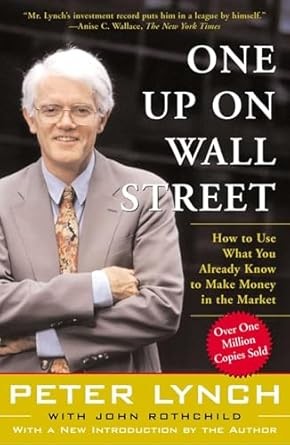
One Up On Wall Street is Peter Lynch’s guide to stock-picking for individual investors. Drawing on his legendary track record at Fidelity Magellan, Lynch explains how to classify stocks into six categories, evaluate their fundamentals with a simple checklist, and build a portfolio of companies you genuinely understand — all without relying on Wall Street’s overcomplicated advice.
About the author
Peter Lynch grew up in Newton, Massachusetts, and started caddying at a golf course at age 11 — where he first overheard business conversations that sparked his interest in investing. After graduating from Boston College and earning an MBA at Wharton, he joined Fidelity Investments in 1969. By 1977 he was managing the Magellan Fund, which he grew from $18 million to $14 billion over 13 years with an annualized return of 29.2% — making it the best-performing mutual fund in the world. Lynch retired in 1990 at age 46 to spend more time with his family and has since devoted himself to philanthropy and writing, co-authoring three bestselling investment books with John Rothchild. Explore all Peter Lynch book summaries →
Key concepts at a glance
| Concept | What it means | Use it when |
|---|---|---|
| Invest in what you know | Spot stocks through everyday consumer and workplace experience | You notice a product or store everyone loves before analysts cover it |
| Six stock categories | Classify every company by growth profile and risk | You need to set realistic expectations and selling rules for each holding |
| The two-minute drill | Quick checklist: P/E, debt, earnings growth, dividends, insider buying | You want to screen a company before doing deep research |
| PEG ratio | P/E divided by earnings growth rate — under 1.0 is attractive | You want a single number to compare value across different companies |
| The cocktail-party theory | Market sentiment indicator based on how many strangers give you stock tips | You need a gut check on whether the market is overheated |
| The story | A one-paragraph thesis for why you own a stock and what would change your mind | You want to avoid emotional buying or holding without a reason |
| Sell discipline by category | Different exit rules for each of the six stock types | You struggle with when to take profits or cut losses |
| Insider buying signal | Executives buying their own shares suggests confidence in the business | You want confirmation that management believes in the company’s future |
Part 1 — Preparing to invest
Lynch opens with a disarming confession: the professional money manager’s life is far less glamorous than you think. Institutional investors are hemmed in by committee approvals, regulatory limits, and the constant pressure to match quarterly benchmarks. The amateur investor, by contrast, can move quickly, invest any amount, and hold positions for years without a board questioning the decision. This structural freedom is your edge, and Lynch wants you to use it.
He introduces the cocktail-party theory as a tongue-in-cheek market barometer. In stage one, nobody wants to talk about stocks — the market has been down and people change the subject when they learn Lynch manages money. In stage two, people acknowledge the market exists but quickly steer conversation elsewhere. In stage three, everyone crowds around Lynch asking for tips. And in stage four, strangers are giving him tips — dentists recommending biotech stocks and cab drivers pitching gold futures. Lynch notes that stage four usually precedes a correction. The theory is deliberately informal, but it captures a real dynamic: widespread euphoria signals that most of the easy gains have already been made.
Before buying a single share, Lynch insists you settle three practical matters. First, own a home — real estate has historically been the average person’s best investment and it provides financial stability that lets you ride out stock-market downturns without panic. Second, determine whether you actually need to invest in stocks at all; if your financial goals are short-term, bonds or savings accounts are safer. Third, know your personal risk tolerance. Lynch detests the advice industry’s one-size-fits-all model and wants you to invest only money you will not need for at least five years.
Part 2 — Picking winners
This is the heart of the book: Lynch’s taxonomy of stocks and his system for evaluating them. Every publicly traded company, he argues, falls into one of six categories, and knowing which category you are dealing with determines everything — your return expectations, your holding period, and your selling rules.
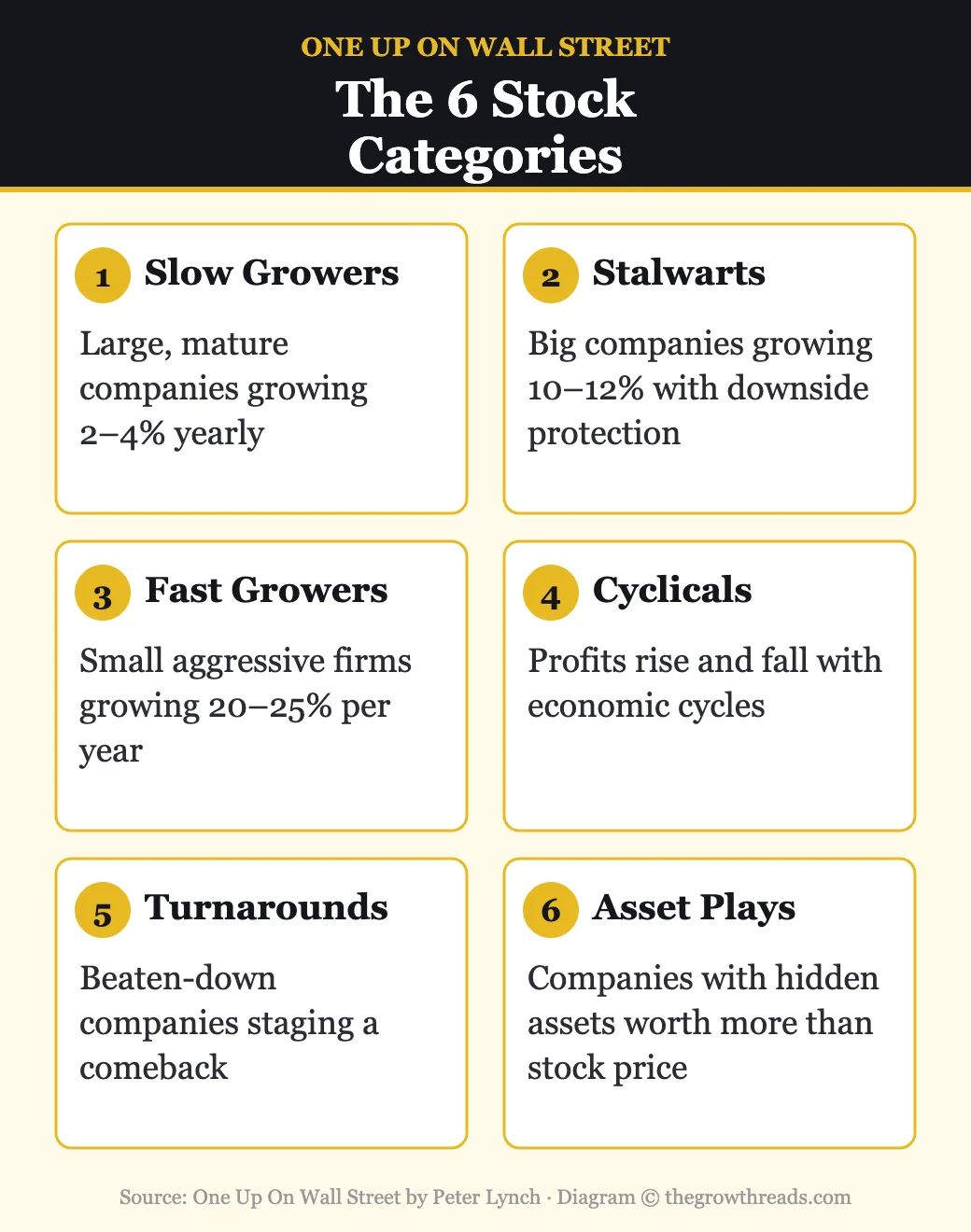
Slow Growers are large, mature companies — often former Fast Growers that have exhausted their runway. They grow earnings at 2–4% and are prized mostly for their dividends. Lynch rarely buys these, but they serve as portfolio ballast. Stalwarts like Coca-Cola or Procter & Gamble grow at 10–12%. Lynch buys them expecting a 30–50% gain and then rotates into the next opportunity. They provide excellent downside protection in recessions — people still buy toothpaste when the economy contracts.
Fast Growers are Lynch’s bread and butter — small, aggressive companies growing at 20–25% per year. These are where tenbaggers come from (Lynch coined the term, meaning a stock that rises tenfold). The trick is finding Fast Growers with strong balance sheets in industries that are themselves growing slowly. A company growing 25% in a 1% industry is taking market share, which is far more sustainable than riding an industry boom. Cyclicals like Ford or Alcoa expand and contract with the business cycle. Timing matters enormously — buy when the P/E is high (earnings are depressed) and sell when the P/E drops (earnings are peaking). This is the opposite of what growth-stock investors do, and confusing the two approaches is a classic mistake.
Turnarounds are companies on the brink of disaster that stage a comeback — Chrysler in the 1980s being Lynch’s most famous example. The risk is total loss, but the reward can be enormous. Lynch looks for turnarounds with enough cash to survive their problems and a credible restructuring plan. Asset Plays are companies sitting on hidden value — real estate, patents, subscriber lists, or tax-loss carryforwards — that the market has not priced in. Lynch recounts finding a company whose real-estate holdings alone were worth more than its entire market capitalization.
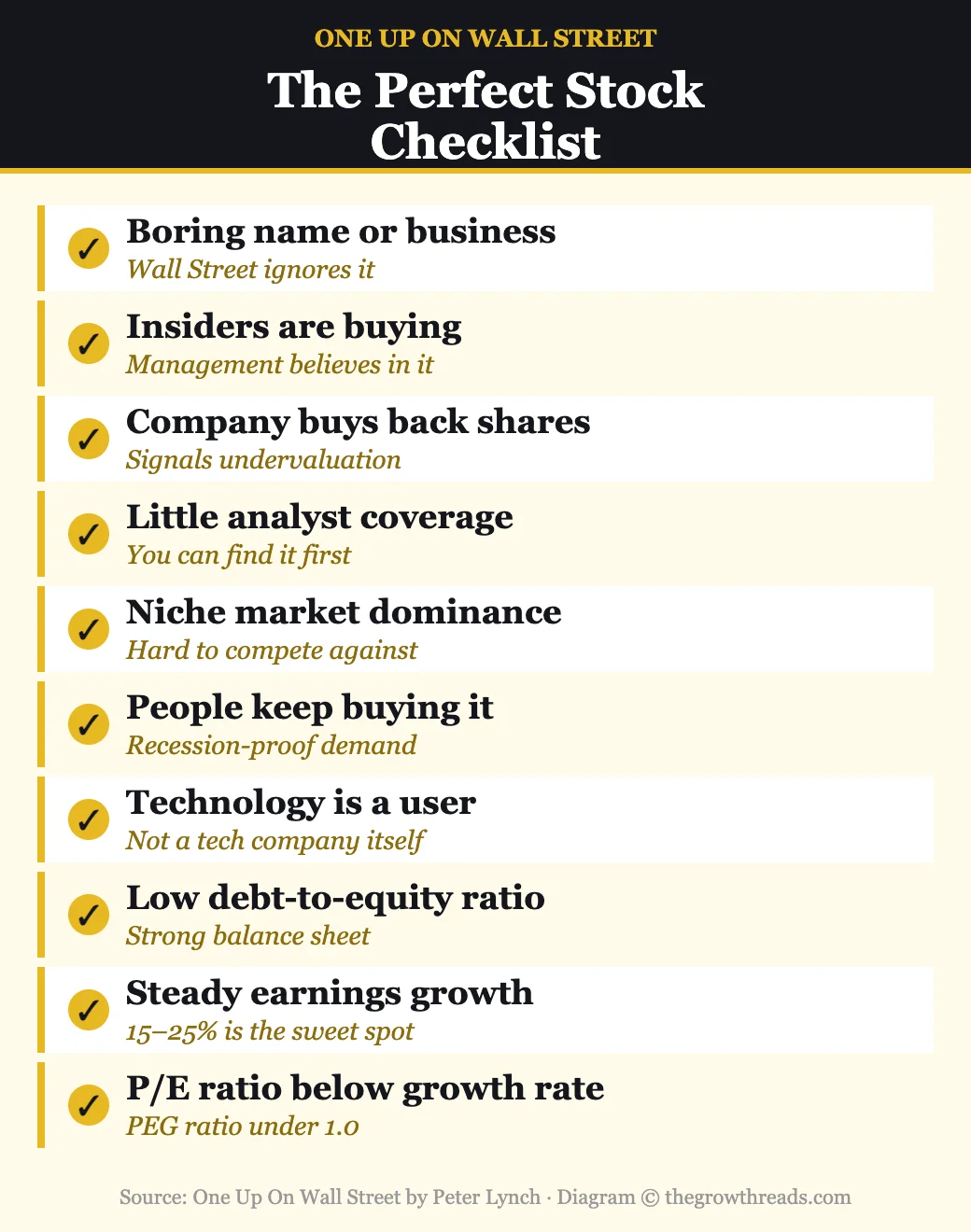
For every stock, Lynch runs what he calls the two-minute drill: check the P/E ratio, debt level, earnings-growth trend, dividend record, and insider transactions. If all five pass muster, the stock deserves deeper research. If even one is a red flag, move on — there are always more opportunities.
Part 3 — The long-term view
Lynch devotes serious attention to portfolio design and risk management — topics that many stock-picking books gloss over. He recommends holding between 3 and 10 stocks at a time. Fewer than three concentrates risk dangerously. More than ten becomes impossible to monitor properly. Every position should represent a stock whose story you can articulate in a short paragraph.
He introduces the concept of rotating out of Stalwarts into Fast Growers as a portfolio management technique. When a Stalwart delivers its expected 30–50% gain, take the profits and redeploy them into a new Fast Grower. This systematic rotation keeps the portfolio biased toward higher-growth opportunities while banking real gains.
Lynch is refreshingly candid about mistakes. He discusses stocks he bought that went to zero and positions he sold too early. The key insight: you do not need to be right on every pick. If you own ten stocks and three of them are tenbaggers while seven are mediocre, your portfolio still crushes the market. This asymmetry — limited downside, unlimited upside — is the mathematical engine of successful stock-picking. Lynch calls it the power of the long shot.
He also dismantles several popular investing myths. “It has already gone up too much” causes investors to sell winners prematurely — Walmart was a 1,000-bagger for those who held. “It is too cheap to go lower” tempts people into value traps — a stock at $3 can absolutely go to zero. And “it will eventually come back” keeps people in broken stories long after the fundamentals have deteriorated. Each myth gets a concrete example from Lynch’s own experience at Fidelity, making the lessons vivid and personal.
Part 4 — Knowing when to sell
Most investing books obsess over buying and ignore selling. Lynch devotes an entire section to it, and his advice is category-specific. Sell a Slow Grower when it loses market share or cuts its dividend. Sell a Stalwart when you have your 30–50% gain or when its P/E stretches above its historical range. Sell a Fast Grower when the story changes — the company enters a new, unrelated business, expansion stalls, or same-store sales flatten. Sell a Cyclical when inventories build, commodity prices fall, or the company adds capacity at the peak of the cycle. Sell a Turnaround after the turnaround is complete and the stock is reclassified as a Stalwart or Fast Grower. And sell an Asset Play when a raider shows up or the hidden assets are finally recognized by the market.
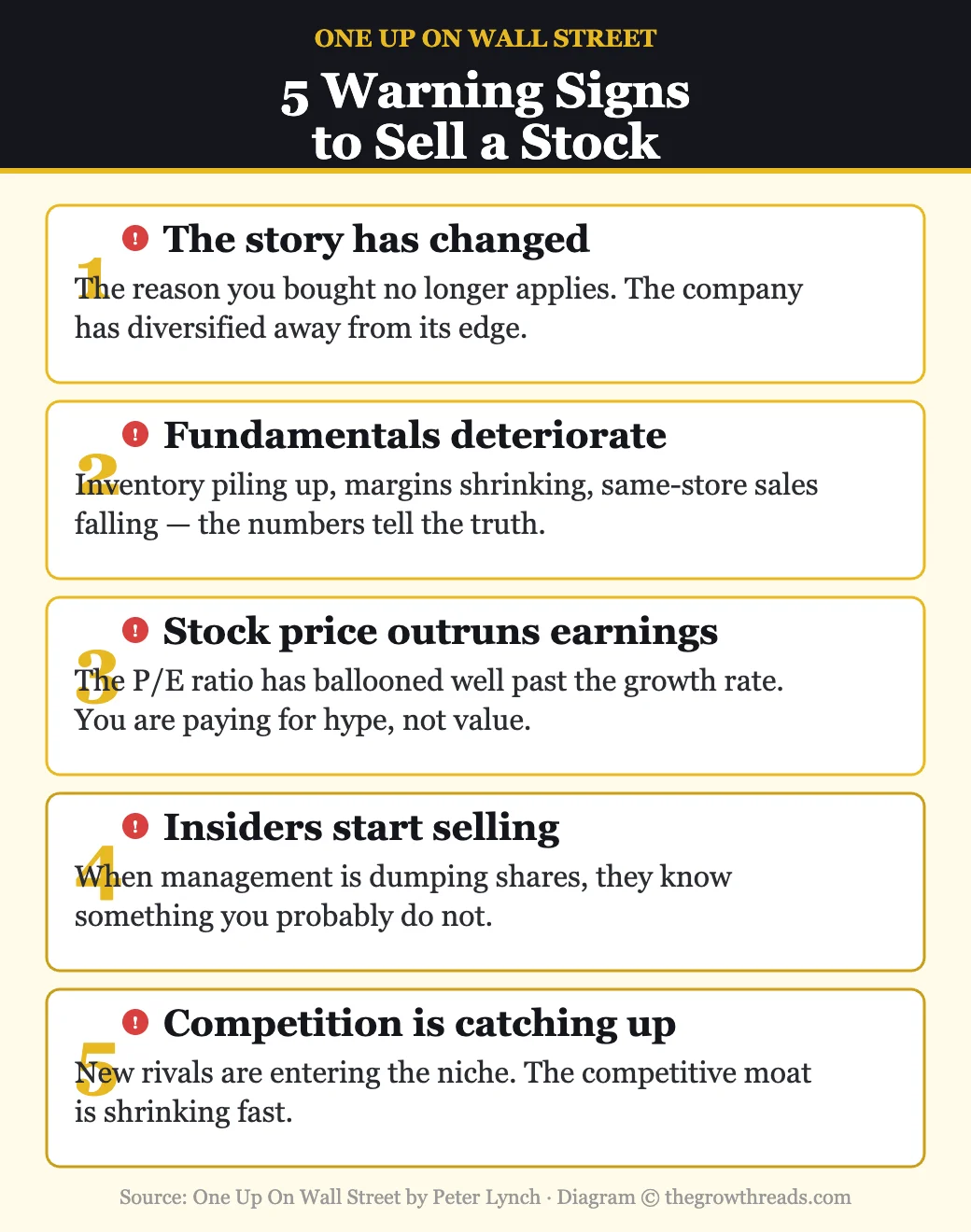
Lynch’s overarching sell rule is simple: when the story changes, sell. Not when the price drops, not when a talking head on television says the market is overvalued, and not when your neighbor tells you the economy is headed for a recession. The story — the original reason you bought the stock — is the only reliable guide.
He also addresses market timing head-on. Lynch studied every market correction and crash in his lifetime and concluded that trying to predict them was futile. Far more money has been lost by investors preparing for corrections than has been lost in the corrections themselves. His solution: stay fully invested, keep researching, and buy more of your best ideas when prices drop. The investor who sat through the crash of 1987 with a portfolio of well-chosen stocks recovered fully within two years. The investor who sold in panic locked in losses permanently.
Who is One Up On Wall Street best for — and who should read something else first?
This book is ideal for individual investors who want to pick their own stocks with confidence, consumers who notice great products and companies in their daily lives and want to profit from that insight, and anyone intimidated by financial jargon who needs an accessible, entertaining introduction to fundamental analysis.
If you are already committed to a passive index-fund strategy, Lynch may tempt you to stray — read The Simple Path to Wealth by JL Collins for the strongest case to stay the course. If you want the quantitative rigor behind value investing rather than Lynch’s intuitive approach, start with The Intelligent Investor by Benjamin Graham.
Questions to reflect on
- Which products or companies do you interact with daily that you have never considered as investments?
- Can you explain, in one paragraph, the story behind every stock you currently own?
- Which of Lynch’s six categories would your current holdings fall into — and are your expectations realistic for that category?
- Have you ever held onto a losing stock because you assumed it would come back? What was the real story?
- How would your investing behavior change if you committed to never trying to time the market?
🔥 Ready to start spotting tenbaggers in your everyday life?
Lynch’s six-category system and two-minute drill will change how you evaluate every company you encounter.
How to apply One Up On Wall Street (7-day plan)
- Day 1 — Build your watch list: Walk through your home, workplace, and favorite stores. Write down 10 companies whose products or services you genuinely love and use regularly.
- Day 2 — Classify each stock: Look up the earnings growth rate, market cap, and industry for each company on your list. Assign each to one of Lynch’s six categories.
- Day 3 — Run the two-minute drill: For each company, check the P/E ratio, debt-to-equity ratio, earnings trend, dividend history, and recent insider transactions.
- Day 4 — Write the story: For the top 3–5 stocks that passed the drill, write a one-paragraph thesis explaining why you expect the stock to go up and what would make you sell.
- Day 5 — Calculate the PEG: Divide each stock’s P/E by its expected earnings growth rate. Prioritize any stock with a PEG below 1.0.
- Day 6 — Check for red flags: Review Lynch’s warning signs: excessive diversification, dependency on a single customer, over-leveraged balance sheet, or a P/E that far exceeds the growth rate.
- Day 7 — Build your starter portfolio: Select 3–5 stocks across at least two of Lynch’s six categories. Set calendar reminders to recheck each story quarterly.
Frequently asked questions
Is One Up On Wall Street still relevant in 2026?
Absolutely. Lynch’s core principles — understanding what you own, using everyday consumer knowledge, and focusing on earnings fundamentals — are timeless. While specific stock examples from the 1980s are dated, the analytical framework applies just as well to modern companies. The PEG ratio he popularized remains a standard screener metric, and his six-category system still provides a useful mental model for classifying any stock you encounter today.
What is a tenbagger?
A tenbagger is a stock that rises to ten times its original purchase price — a 900% gain. Peter Lynch coined the term, borrowing from baseball where a “tenbagger” would be a ten-base hit. Lynch found most of his tenbaggers among Fast Growers and Turnarounds. The key insight is that you only need a few tenbaggers in a diversified portfolio to generate extraordinary overall returns, even if most of your other picks perform modestly.
What is the PEG ratio and how do you use it?
The PEG ratio divides a stock’s price-to-earnings (P/E) ratio by its annual earnings growth rate. A PEG of 1.0 means the stock is fairly valued relative to its growth; below 1.0 suggests undervaluation, and above 2.0 suggests overvaluation. Lynch considered PEG the single most useful quick-screening metric. To use it, find a company’s trailing P/E on any financial site, then divide by the expected earnings growth rate (usually the analyst consensus for the next three to five years).
Should beginners start with One Up On Wall Street or The Intelligent Investor?
For most beginners, One Up On Wall Street is the better starting point. Lynch writes in conversational, jargon-free prose and uses real-world consumer examples that make the concepts immediately relatable. The Intelligent Investor by Benjamin Graham is more rigorous and theoretical — essential reading, but denser. A practical learning path: read Lynch first for the intuitive framework and motivation, then Graham for the quantitative discipline, then practice with both approaches side by side.
How many stocks does Peter Lynch recommend owning?
Lynch recommends holding between 3 and 10 stocks for individual investors. Fewer than three concentrates risk dangerously — one bad pick can devastate your portfolio. More than ten becomes difficult to monitor properly, since each stock requires ongoing research and story-checking. Lynch himself sometimes held over 1,000 positions at Magellan, but he had a full-time team of analysts. For the solo investor, a focused portfolio of well-researched stocks is far more effective than a sprawling collection of half-understood ones.
Does Lynch recommend index funds or individual stocks?
Lynch is firmly in the individual-stock camp, but with an important caveat: he only recommends stock-picking for investors willing to do the research. If you are not prepared to study financial statements, visit stores, and track earnings quarterly, Lynch says you should absolutely buy an index fund instead. He respects the index approach and acknowledges that most professionals fail to beat the market — his argument is that disciplined amateurs can succeed precisely because they are not burdened by the institutional constraints professionals face.
What is Lynch’s cocktail-party theory?
The cocktail-party theory is Lynch’s informal four-stage market-sentiment indicator. Stage one: nobody wants to talk about stocks (good time to buy). Stage two: people acknowledge the market but change the subject quickly (still early). Stage three: everyone crowds around Lynch asking for stock tips (market is getting mature). Stage four: strangers are giving him tips — dentists pitching biotech, cab drivers recommending gold (a correction is likely approaching). It is not a rigorous timing tool, but it captures the psychology of market cycles remarkably well.
Related summaries
- The Intelligent Investor Summary — Benjamin Graham’s foundational value-investing framework
- The Psychology of Money Summary — Morgan Housel on why behavior trumps strategy
- The Little Book of Common Sense Investing Summary — John Bogle’s case for index funds
- Best Money & Investing Books — our full ranked list