

★★★★☆ 4.3 / 5
One-liner: A schoolteacher who became a millionaire on a modest salary shares nine no-nonsense rules for building wealth through index fund investing.
Best for: Beginning investors, young professionals, and anyone who suspects the financial industry is taking too much of their money.
Reading time: ~5 hours (256 pages)
Difficulty to apply: Low — the investing approach is deliberately simple and requires minimal ongoing effort once set up.
Millionaire Teacher in one minute
Andrew Hallam became a millionaire on a teacher’s salary — and he did it without stock-picking, market-timing, or financial advisors. His secret was breathtakingly simple: live below your means, invest early and often in low-cost index funds, ignore the financial media, and never pay a financial advisor to underperform the market. The book distills this approach into nine rules that challenge nearly everything the financial industry tells you. Hallam shows, with data spanning decades and countries, that roughly 90 percent of actively managed funds lose to simple index funds over the long term — yet the industry keeps selling expensive products because the fees are lucrative. Millionaire Teacher is a warm, accessible, and occasionally funny guide to building wealth the boring way — which, as Hallam proves, is the only way that reliably works.
Key takeaways
- Wealth starts with spending less than you earn: The foundation of every millionaire’s fortune is the gap between income and expenses. You cannot invest what you have already spent.
- Compound interest is your greatest ally: Starting early matters more than starting big. A 25-year-old who invests modestly will outperform a 35-year-old who invests aggressively, thanks to the extra decade of compounding.
- Fees are the silent wealth destroyer: A seemingly small 2 percent annual fee can consume over 40 percent of your returns over 25 years. Index funds charge a fraction of what active funds charge.
- Your biggest enemy is in the mirror: Greed makes you chase hot stocks. Fear makes you sell at the bottom. Discipline — the ability to ignore both impulses — is the most valuable investing skill.
- Index funds beat the pros: Over any 15-year period, approximately 90 percent of actively managed funds underperform their benchmark index. You are statistically better off buying the whole market cheaply.
- A simple portfolio beats a complex one: Three index funds — domestic stocks, international stocks, and bonds — are all most people need. Rebalance once a year and ignore the noise.
- Financial advisors often serve their own interests: Many advisors earn commissions by selling expensive products. Fee-only advisors who recommend index funds are the exception, not the rule.
- Never try to time the market: Nobody can consistently predict when markets will rise or fall. The cost of being out of the market on its best days dwarfs the cost of being in it on its worst days.
- Stay the course through crashes: Market downturns are not disasters for long-term investors — they are sales. Buying more when prices are low is how wealth compounds fastest.
- This works in any country: Hallam provides specific portfolio recommendations for Americans, Canadians, Australians, Singaporeans, and international investors.
What is Millionaire Teacher about?
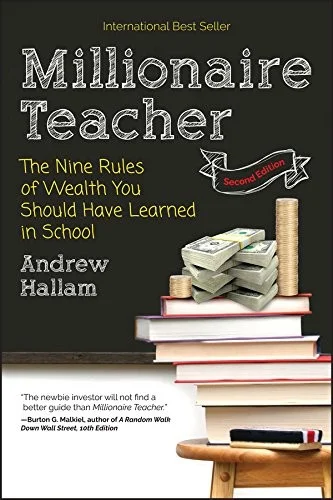
Millionaire Teacher is a personal finance book that teaches nine rules of wealth-building, centered on low-cost index fund investing. Written by a high school teacher who became a millionaire on a modest salary, it uses plain language, personal stories, and global data to show why simple, passive investing beats the vast majority of professional money managers over time.
About the author
Andrew Hallam is a Canadian-born writer and former international school teacher who built a million-dollar portfolio on a teacher’s salary while living overseas in Singapore. He began investing in his early twenties and chronicled his journey in articles for publications including The Globe and Mail, Canadian Business, MoneySense, and AssetBuilder. His personal experience — building wealth without a high income, without stock-picking, and without financial advisors — gives the book an authenticity that purely academic finance books lack. The second edition, published in 2017, updated his portfolio recommendations and added country-specific guidance for investors outside North America. Explore all Andrew Hallam book summaries →
Key concepts at a glance
| Concept | What it means | Use it when |
|---|---|---|
| Index Fund | A fund that buys every stock in a market index at ultra-low cost | You want market returns without the risk of picking individual stocks |
| Expense Ratio | The annual fee a fund charges, expressed as a percentage of your assets | You are comparing funds and want to know the true cost of ownership |
| Compound Interest | Earning returns on your returns, creating exponential growth over time | You need motivation to start investing early, even with small amounts |
| Rebalancing | Selling what has grown and buying what has fallen to maintain your target allocation | One part of your portfolio has grown out of proportion to the rest |
| Couch Potato Portfolio | A simple 3-fund portfolio requiring minimal effort to maintain | You want a complete investing strategy you can manage in 30 minutes per year |
| Dollar-Cost Averaging | Investing a fixed amount at regular intervals regardless of market conditions | You want to invest consistently without worrying about market timing |
| Behavioural Gap | The difference between investment returns and investor returns caused by emotional decisions | You are tempted to sell during a crash or chase a hot stock |
| Fee-Only Advisor | A financial advisor who charges a flat fee and does not earn commissions on products | You want professional help but need to avoid conflicts of interest |
Part 1: The spending rules — building the foundation
Hallam opens with a confession: he was once so frugal that he bought a car from a junkyard and repaired it himself. While he does not recommend that level of austerity, his point is sharp — wealth is built on the gap between what you earn and what you spend, and that gap is entirely within your control. He cites research showing that the average millionaire (the “millionaire next door” type) lives well below their means, drives a modest car, and avoids lifestyle inflation.
The compound interest chapter uses vivid examples to show why starting early is the single most powerful financial decision. A 25-year-old who invests $200 per month at 8 percent average annual returns will have roughly $700,000 by age 65. A 35-year-old investing the same amount reaches only about $300,000. The extra decade of compounding — not a higher income or a better stock pick — accounts for more than doubling the final amount. Hallam calls compound interest “the eighth wonder of the world” and argues that it should be the first thing taught in every school.
The fee chapter is where Hallam begins his assault on the financial industry. He walks through the math of how a 2 percent annual management fee compounds against you. On a $100,000 portfolio earning 8 percent gross, a 0.1 percent index fund fee leaves you with roughly $933,000 after 30 years. The same portfolio with a 2 percent actively managed fund fee leaves you with about $574,000 — a difference of over $350,000. The fee did not just cost you money; it cost you decades of compounding on that money.
Part 2: The investing rules — index funds and the enemy in the mirror
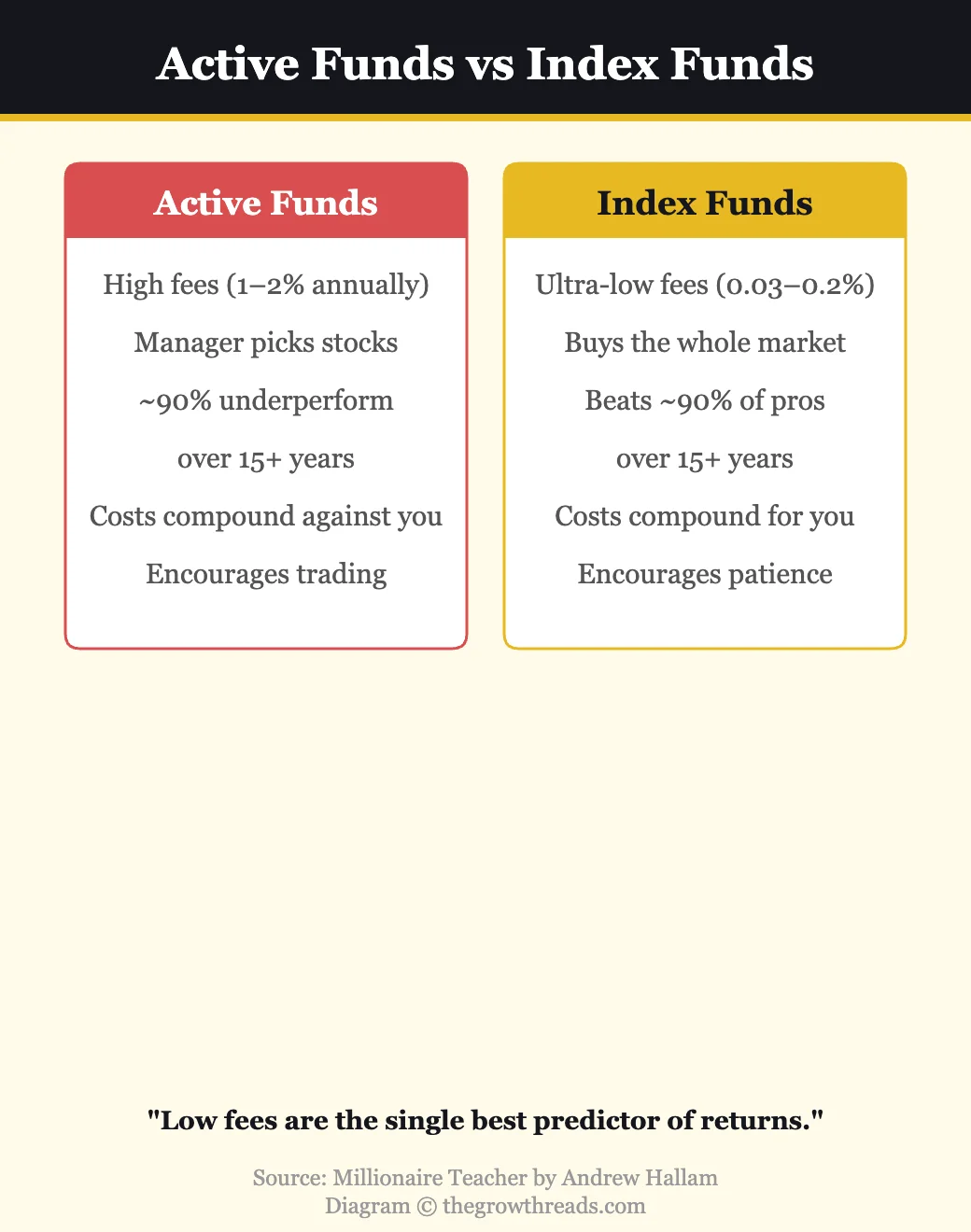
The core of the book makes the case for index fund investing, and Hallam does it with a prosecutor’s zeal. He cites study after study showing that over any 15-year period, roughly 90 percent of actively managed funds underperform their benchmark index after fees. The small percentage that do outperform in one period almost never repeat in the next. Picking a winning fund in advance is, statistically, a coin flip — except you are paying premium prices for the privilege.
The “enemy in the mirror” chapter addresses behavioural finance — the ways in which human psychology sabotages investment returns. Hallam describes the behavioural gap: the difference between what an investment earns and what the investor in that investment earns. Studies consistently show that the average investor earns 2–4 percent less per year than the funds they invest in, because they buy after prices have risen (greed) and sell after prices have fallen (fear). The index fund approach, combined with automatic monthly investing, is designed to remove these emotional decisions from the process entirely.
He is particularly sharp on the financial advisory industry. Most advisors, he argues, are salespeople compensated by commissions on the products they recommend. Their incentive is to sell you the fund that pays them the highest commission, not the fund that is best for you. He describes conversations with advisors who dismissed index funds, insisted that their proprietary fund selections justified higher fees, or used fear tactics to keep clients from switching. The exception, Hallam notes, is the growing number of fee-only advisors who charge a flat rate and recommend low-cost index funds — but these advisors earn far less than commission-based ones, which is why the industry resists the model.
Part 3: The portfolio rules — building it and staying the course
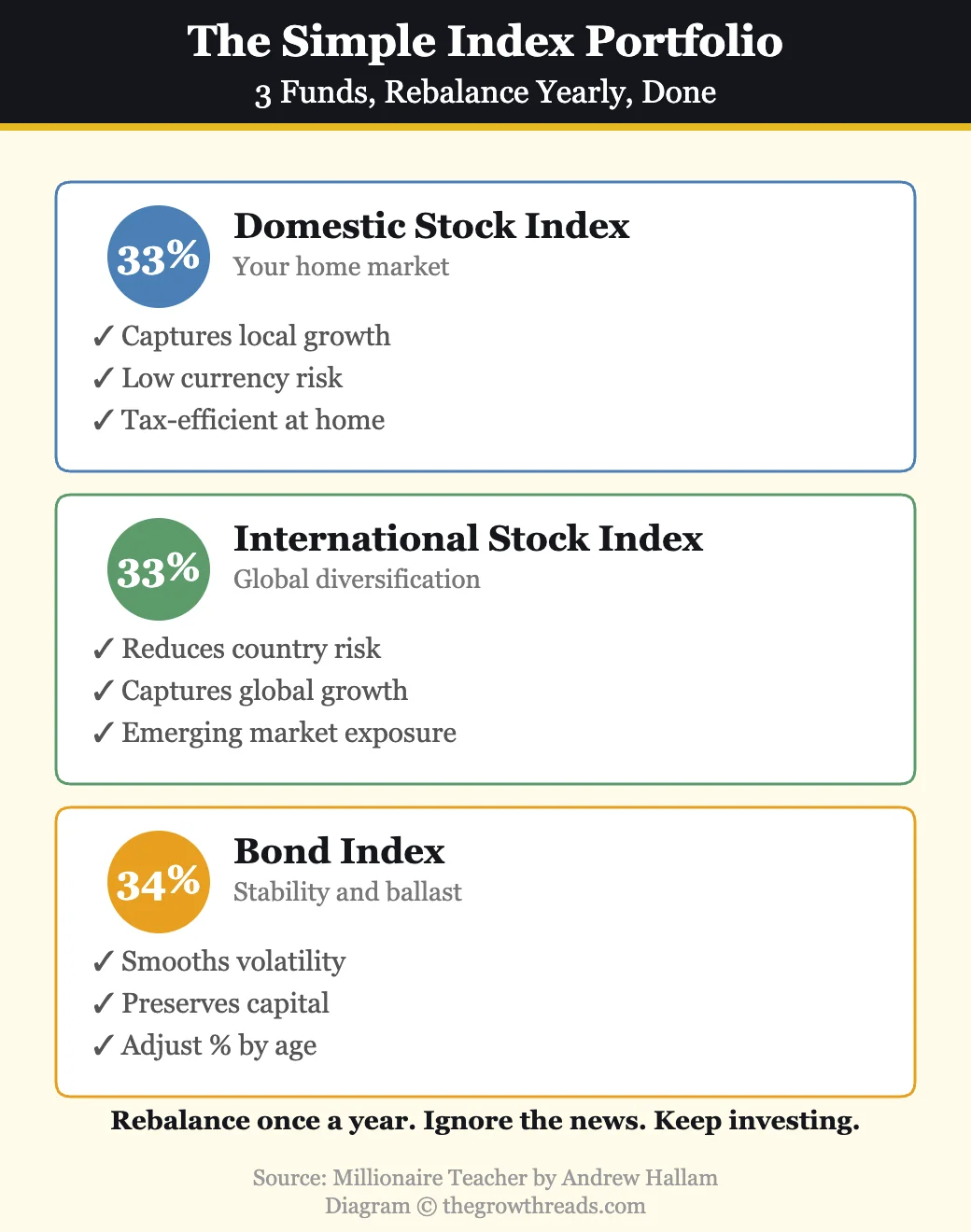
The practical chapters provide specific portfolio recommendations. Hallam advocates what he calls the “couch potato portfolio” — a simple three-fund approach using domestic stock index, international stock index, and bond index funds. The exact allocation depends on your age and risk tolerance: younger investors hold more stocks, older investors hold more bonds. A common starting point is to hold your age in bonds (a 30-year-old holds 30 percent bonds, 70 percent stocks).
He provides country-specific recommendations: for Americans, Vanguard’s total stock market, total international, and total bond market funds; for Canadians, the equivalent iShares or Vanguard Canada products; for Singaporeans, specific STI ETFs and global index funds available through local brokerages. This international perspective is one of the book’s greatest strengths — most personal finance books assume the reader is American.
The market-timing chapter dismantles the idea that you can improve returns by getting in and out of the market at the right time. Hallam cites the classic study showing that missing just the ten best trading days in a 20-year period cuts your returns roughly in half. Those best days, he notes, tend to occur right after the worst days — so if you sell during a crash, you almost certainly miss the recovery. His prescription is simple: invest a fixed amount every month, rebalance once a year, and ignore everything else.
The final rule — staying the course — addresses the hardest part of index investing. When markets drop 30 or 40 percent, every instinct screams “sell.” Hallam reframes crashes as sales: when stock prices fall, your monthly investment buys more shares. If you believe the economy will eventually recover (as it always has), downturns are the best thing that can happen to a long-term investor who is still accumulating. The people who build the most wealth are not the ones who time the bottom but the ones who keep investing through it.
Who is Millionaire Teacher best for — and who should read something else first?
This book is ideal for investing beginners, young professionals opening their first brokerage account, and anyone currently paying high fees for actively managed funds without questioning whether those fees are earned. It is also excellent for international investors, particularly in Canada, Singapore, and Australia, who often find American-focused finance books impractical. Parents who want to teach their children about money will find Hallam’s plain language and personal stories effective.
If you already understand index investing and want a deeper dive into the philosophy of wealth, The Psychology of Money by Morgan Housel is the natural next step. If your challenge is more about controlling spending than choosing investments, The Total Money Makeover by Dave Ramsey provides a more structured debt-elimination framework. And if you want the most rigorous academic treatment of index investing, A Random Walk Down Wall Street by Burton Malkiel is the gold standard.
Note: This summary is for educational purposes. It is not financial advice. Consult a qualified financial professional before making investment decisions.
Questions to reflect on
- What percentage of your income are you currently investing? If it is less than 10 percent, what is one expense you could reduce to close the gap?
- Do you know the expense ratio of every fund in your investment portfolio? If not, look it up today.
- When the market last dropped significantly, did you buy more, hold steady, or sell? What would you do differently next time?
- Is your financial advisor compensated by commissions or flat fees? Have you ever asked them directly?
- If you could go back and start investing five years earlier, how much more would you have today? What is stopping you from starting now?
🔥 Ready to build wealth the simple, proven way?
Get Millionaire Teacher and learn the nine rules of wealth they never taught you in school.
How to apply Millionaire Teacher (7-day plan)
- Day 1 — Calculate your savings rate: Track your income and expenses for the past month. Calculate what percentage of your income you saved. Write down your target savings rate (aim for at least 10–15 percent).
- Day 2 — Audit your current investments: Look up every fund you own and note its expense ratio. If any fund charges more than 0.5 percent, research the equivalent index fund alternative.
- Day 3 — Open an index fund account: If you do not already have one, open a brokerage account with a low-cost provider (Vanguard, Fidelity, Schwab, or your country’s equivalent). Choose the three-fund portfolio: domestic stock index, international stock index, bond index.
- Day 4 — Set up automatic investing: Configure a monthly automatic transfer from your bank account to your brokerage account. The amount matters less than the consistency — start with whatever you can afford.
- Day 5 — Delete financial news apps: Unsubscribe from market alerts, stock-picking newsletters, and financial TV shows. Replace them with a single annual review of your portfolio allocation.
- Day 6 — Write your investment policy statement: In one page, write down your target allocation, your rebalancing schedule (once per year), and your commitment to keep investing during market downturns. Sign it.
- Day 7 — Calculate your future wealth: Use a compound interest calculator to project what your current monthly investment will grow to over 20, 30, and 40 years. Let the numbers motivate you to stay the course.
Frequently asked questions
Is Millionaire Teacher worth reading?
Yes, especially if you are new to investing or currently paying high fees for actively managed funds. Hallam writes in a warm, conversational style with personal anecdotes that make complex financial concepts accessible. The book’s greatest strength is its practical, actionable approach — you can set up the entire investment strategy he describes in a single afternoon. For experienced index fund investors, it may not offer much new, but it is an excellent book to give to someone just starting out.
How did Andrew Hallam become a millionaire on a teacher’s salary?
Hallam started investing in his early twenties, lived frugally (buying used cars, avoiding lifestyle inflation), and invested consistently in low-cost index funds throughout his career. He taught at international schools, which typically offer tax-advantaged savings programs and lower living costs, but his core strategy would work on any middle-class income. The key was starting early, keeping fees low, and never selling during market downturns — letting compound interest do the heavy lifting over three decades.
What are the nine rules in Millionaire Teacher?
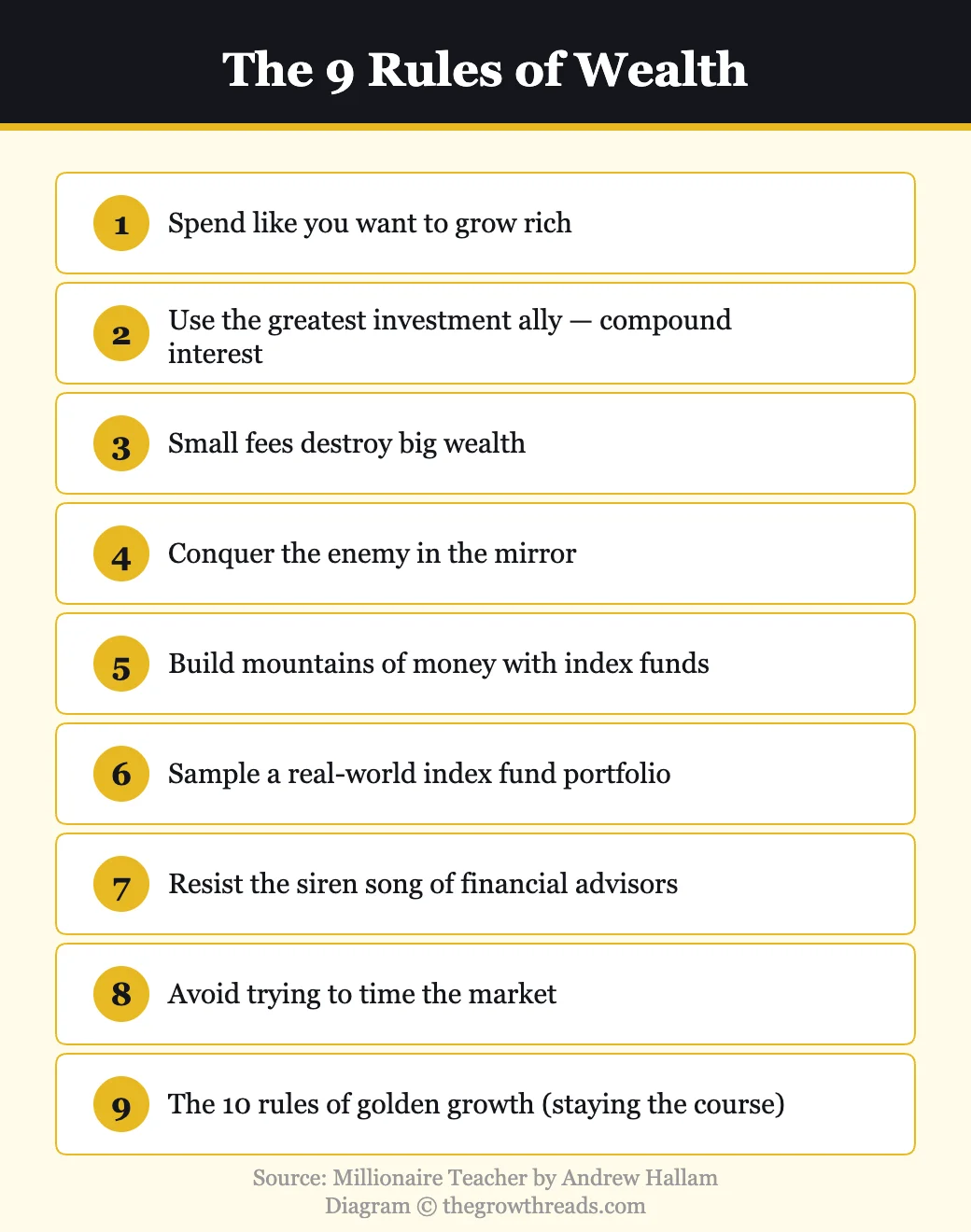
The nine rules are: spend like you want to grow rich, harness the power of compound interest, understand that small fees destroy big wealth, conquer the enemy in the mirror (your own emotions), build wealth with index funds, use a simple real-world portfolio, resist financial advisors who sell expensive products, never try to time the market, and stay the course through market crashes. Each rule builds on the previous one to create a complete, low-maintenance wealth-building system.
What is the couch potato portfolio?
The couch potato portfolio is a simple three-fund investment strategy: one domestic stock index fund, one international stock index fund, and one bond index fund. You divide your money among these three funds according to your age and risk tolerance, invest automatically each month, and rebalance once per year to restore your target allocation. It requires about 30 minutes of maintenance per year and, historically, has outperformed the vast majority of professionally managed portfolios.
Is Millionaire Teacher relevant outside the United States?
Absolutely — this is one of the book’s greatest strengths. Hallam provides specific portfolio recommendations for Americans, Canadians, Australians, Singaporeans, and other international investors. He names specific ETFs and index funds available in each market and addresses country-specific tax considerations. If you have been frustrated by American-centric finance books, this one was written with an international audience in mind from the start.
How does Millionaire Teacher compare to The Psychology of Money?
The two books complement each other well but serve different purposes. Millionaire Teacher is a practical how-to guide — it tells you exactly what to buy, how to set up your portfolio, and what fees to avoid. The Psychology of Money by Morgan Housel is more philosophical — it explores why people make irrational financial decisions and how to develop a healthier relationship with money. Read Millionaire Teacher for the strategy and The Psychology of Money for the mindset.
Why do index funds beat most actively managed funds?
There are two main reasons. First, fees: actively managed funds typically charge 1–2 percent per year, while index funds charge 0.03–0.20 percent. Over decades, this fee difference compounds into hundreds of thousands of dollars. Second, consistency: while a small percentage of active managers outperform in any given year, almost none can do it consistently over 15+ years. The market is so efficient that the aggregate knowledge of all investors is very difficult for any single manager to beat after costs.
Related summaries
- The Psychology of Money by Morgan Housel — the mindset behind sound financial behaviour.
- The Simple Path to Wealth by JL Collins — an even simpler approach to index fund investing.
- The Little Book of Common Sense Investing by John Bogle — the original case for index funds from their creator.
- A Random Walk Down Wall Street by Burton Malkiel — the academic foundation for passive investing.
📚 Explore more: Best Money Books · Best Self-Help Books