

★★★★★ 4.6 / 5
One-liner: The most powerful self-help book ever written — by a Roman emperor who never intended anyone to read it.
Best for: Anyone seeking calm in chaos, emotional resilience, or a timeless framework for living well under pressure.
Reading time: ~4 hrs (256 pages, Hays translation)
Difficulty to apply: Medium — the concepts are simple but require daily practice and honest self-examination.
Meditations in one minute
A Roman emperor wrote a private journal that became the most influential philosophy book in history. Marcus Aurelius composed Meditations during military campaigns and personal crises between roughly 170–180 AD, never intending publication. The twelve books contain his nightly reflections on Stoic philosophy — reminders to himself about controlling his responses rather than external events, acting with virtue regardless of circumstances, accepting mortality, and serving the common good. Nearly two millennia later, the text remains startlingly practical: a manual for staying grounded when life is turbulent, making ethical decisions under pressure, and finding meaning through action rather than comfort.
Key takeaways
- Control the controllable: Your judgements, intentions, and responses are within your power. Other people, the weather, and the past are not. Focus only on the first category.
- Virtue is the only good: Wealth, reputation, and pleasure are “preferred indifferents” — nice but not necessary. Wisdom, courage, justice, and temperance are what matter.
- Impermanence is a feature, not a bug: Everything changes — your body, your empire, the people you love. Accepting this frees you from clinging and makes each moment valuable.
- Your mind creates your suffering: Events are neutral. Your interpretation of events is what causes pain. Change the interpretation, change the experience.
- Serve something larger than yourself: Humans are social creatures designed for cooperation. Your purpose is to contribute to the common good, not to accumulate for yourself.
- Prepare for difficulty every morning: Marcus began each day expecting to meet ungrateful, deceitful, and envious people — so that when he did, he could respond with patience instead of surprise.
- Practice memento mori: Remembering that you will die makes trivial frustrations laughable and important work urgent.
- Act now, not later: Procrastination is a form of self-betrayal. Each day is potentially your last — treat it accordingly.
- Judge actions, not people: When someone wrongs you, consider their ignorance rather than their malice. They are doing what they think is right.
- Take the view from above: Zoom out. See your problems from the perspective of the cosmos. Most of what distresses you is cosmically insignificant.
What is Meditations about?
Meditations is the private journal of Roman Emperor Marcus Aurelius, written as a series of Stoic philosophical exercises between 170 and 180 AD. It covers how to maintain equanimity in adversity, act with virtue, accept impermanence, and fulfil your duty to others — a timeless manual for living with integrity under pressure.
About the author
Marcus Aurelius (121–180 AD) was the last of Rome’s “Five Good Emperors” and ruled from 161 until his death. He governed during plague, wars on multiple frontiers, and political betrayal — yet was remembered by contemporaries as unusually just and self-disciplined. He studied Stoic philosophy under teachers including Junius Rusticus and Apollonius of Chalcedon. Unlike most philosophical authors, Marcus never wrote for an audience; Meditations was discovered after his death and has been continuously in print for centuries. The Gregory Hays translation (2002, Modern Library) is the most widely recommended modern edition for its clarity and readability. Explore all Marcus Aurelius book summaries →
Key concepts at a glance
| Concept | What it means | Use it when |
|---|---|---|
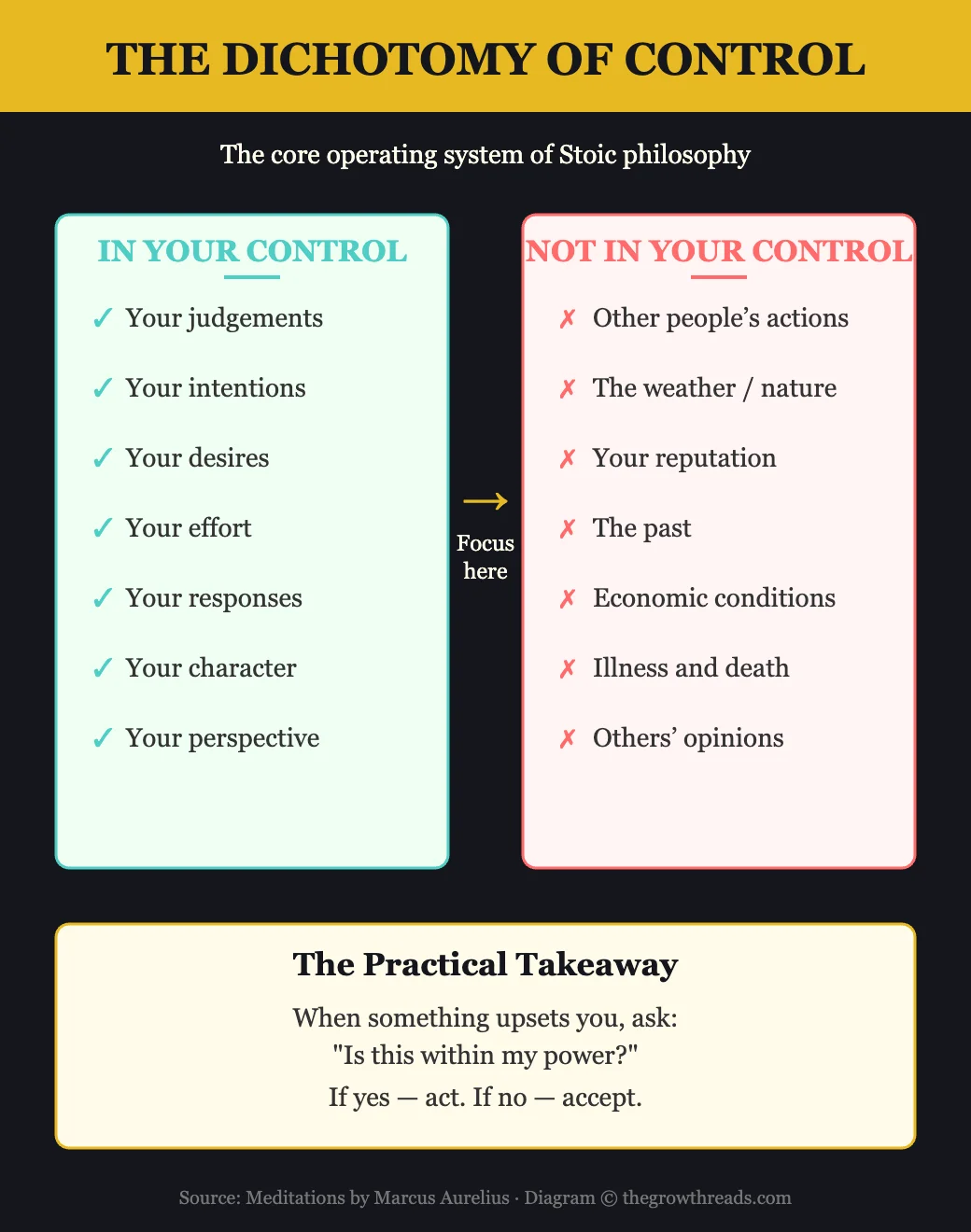
| Dichotomy of Control | Distinguish what depends on you from what does not | You feel anxious or frustrated by external events |
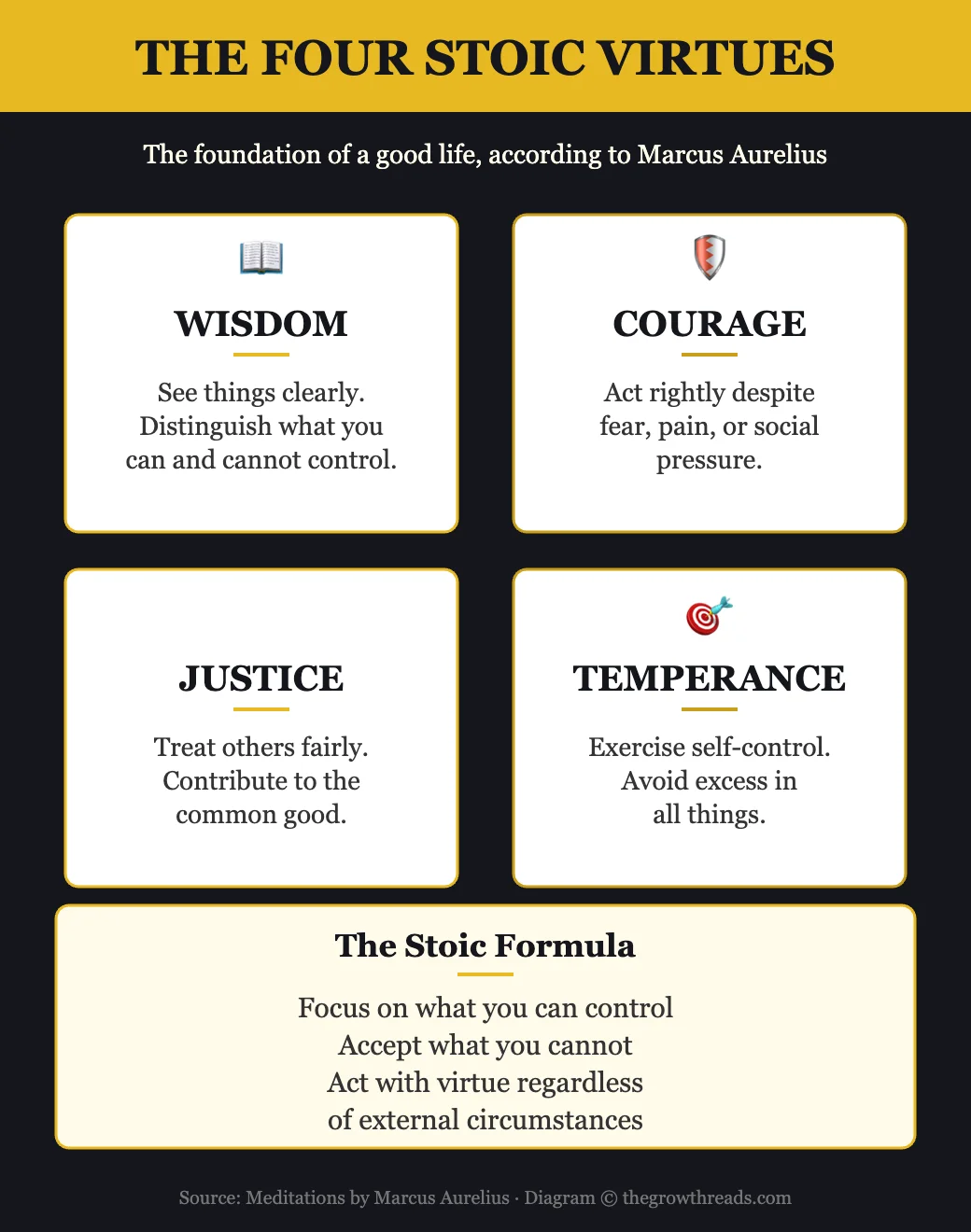
| Four Virtues | Wisdom, courage, justice, temperance as the only true goods | You face a difficult ethical decision |
| Memento Mori | Remember you will die — use it as motivation, not dread | You are procrastinating or sweating trivial things |
| Amor Fati | Love your fate — accept and embrace what happens | Something bad happens that you cannot change |
| View from Above | Zoom out to cosmic perspective to shrink your problems | You are spiralling over something small |
| Premeditatio Malorum | Mentally rehearse worst-case scenarios each morning | You want to be emotionally prepared for difficulty |
| Sympatheia | All things are interconnected; serve the whole | You feel isolated or selfish |
| Voluntary Discomfort | Practise hardship deliberately to build resilience | You feel soft or dependent on comfort |
Part 1 — The foundation: what is in your power (Books 1–3)
The opening books establish the intellectual and emotional foundation of everything that follows. Book 1 is a gratitude list — Marcus catalogues the specific lessons he learned from every mentor, family member, and teacher in his life. From his grandfather Verus, he learned “gentleness and resistance to anger.” From his mother, “generosity and the avoidance of doing wrong.” From Rusticus, the importance of reading carefully rather than skimming. This is not performative humility; it is a deliberate exercise in recognising that every virtue he practises was given to him by others.
Books 2 and 3 introduce the core Stoic operating system: the dichotomy of control. Marcus returns to this theme obsessively throughout the journal — the distinction between ta eph’ hemin (things up to us) and ta ouk eph’ hemin (things not up to us). Your opinions, intentions, desires, and aversions are within your control. Everything else — the actions of others, the weather, your health, your reputation — is not. Suffering arises when you try to control what you cannot, or when you neglect what you can.
He also introduces the concept of proairesis — the rational, choosing faculty that makes humans unique. No external force can corrupt your proairesis unless you allow it. This is radical: it means a slave (Epictetus) can be freer than an emperor, and an emperor (Marcus) can be enslaved by his own reactions.
Part 2 — Impermanence and perspective (Books 4–6)
The middle books tackle the hardest Stoic practice: accepting impermanence. Marcus writes with unflinching directness about death, decay, and the passage of time. He reminds himself that Alexander the Great and his mule-driver were both reduced to the same atoms. That the emperors before him — Augustus, Hadrian, Antoninus — are all forgotten dust. That the fame he might achieve is meaningless because the people who remember him will also die.
This is not nihilism. It is liberation. By accepting that everything is temporary, Marcus frees himself from clinging to outcomes, reputations, and possessions. The Stoic technique of memento mori (remember death) is not morbid — it is motivational. If today might be your last, you will not waste it on petty grudges or comfortable procrastination.
He also introduces the “view from above” — a visualisation exercise where you mentally zoom out from your individual perspective to see the Earth from space, humanity as a colony of ants, your lifespan as a flicker in cosmic time. This practice consistently appears in research on awe and perspective-taking; psychologists find that “overview effect” experiences reduce anxiety and increase prosocial behaviour.
Part 3 — Duty, community, and the good life (Books 7–9)
Having established the inner game (control your responses) and the cosmic perspective (accept impermanence), Marcus turns outward: what do you owe other people? His answer is everything. Stoicism is not a philosophy of withdrawal — it is a philosophy of engaged service. Marcus repeatedly reminds himself that humans are “limbs of the same body,” made for cooperation the way bees are made for the hive.
When others wrong him — and as emperor, he was betrayed, lied to, and attacked constantly — his response is not anger but understanding. He writes: when someone acts badly, consider that they are acting out of ignorance, not malice. They are doing what they believe is right, given their understanding. Your job is not to punish but to educate, and if that fails, to endure patiently.
This is not passive doormat philosophy. Marcus was a military commander who fought wars and made hard decisions. But he insists that justice — treating others fairly and contributing to the common good — is the highest virtue, above even wisdom. A brilliant person who acts unjustly is worse than a simple person who acts kindly.
Part 4 — Practice and persistence (Books 10–12)
The final books are the most intimate and, at times, the most moving. Marcus is tired. He is older, likely ill, and the Marcomannic Wars drag on. Yet the journal entries continue — the same themes repeated, refined, intensified. He reminds himself: do not complain about the work you were given. The vine that produces grapes does not expect a reward. Do your work and move on.
He returns repeatedly to the practice of journaling itself — the nightly examination of actions, thoughts, and intentions. What did I do well today? Where did I fall short? How can I do better tomorrow? This is not self-flagellation but self-improvement through honest observation, essentially the prototype of modern reflective practice.
Marcus also addresses the fear that his philosophy is just words — that he talks about virtue but does not live it. His answer: the practice is the point. You will never arrive at perfection. You will always fall short. But the act of returning to the practice, day after day, is the virtuous life. The Stoic sage is not someone who never fails; it is someone who never stops trying.
Who is Meditations best for — and who should read something else first?
This book is ideal for anyone who wants a mental framework for handling stress, loss, conflict, or uncertainty. Leaders, entrepreneurs, and parents facing relentless pressure will find Marcus’s approach deeply practical. It is also a natural next step if you have read The Obstacle Is the Way or Ego Is the Enemy and want to go to the original source.
If you prefer a structured, how-to format, the aphoristic style may feel fragmented at first. In that case, try The Happiness Hypothesis by Jonathan Haidt for a modern synthesis of ancient and scientific wisdom, or The Courage to Be Disliked for Adlerian psychology in dialogue form.
Questions to reflect on
- What is one thing causing you stress right now — and is it within your control or outside it?
- If you knew you had one year to live, what would you stop doing immediately?
- When was the last time you interpreted someone’s behaviour charitably instead of assuming the worst?
- Which of the four virtues (wisdom, courage, justice, temperance) do you most need to develop?
- What would your nightly review look like if you started journaling like Marcus tonight?
🔥 Ready to read the original Stoic masterwork?
The private journal of a Roman emperor — still the most practical philosophy book ever written.
How to apply Meditations (7-day plan)
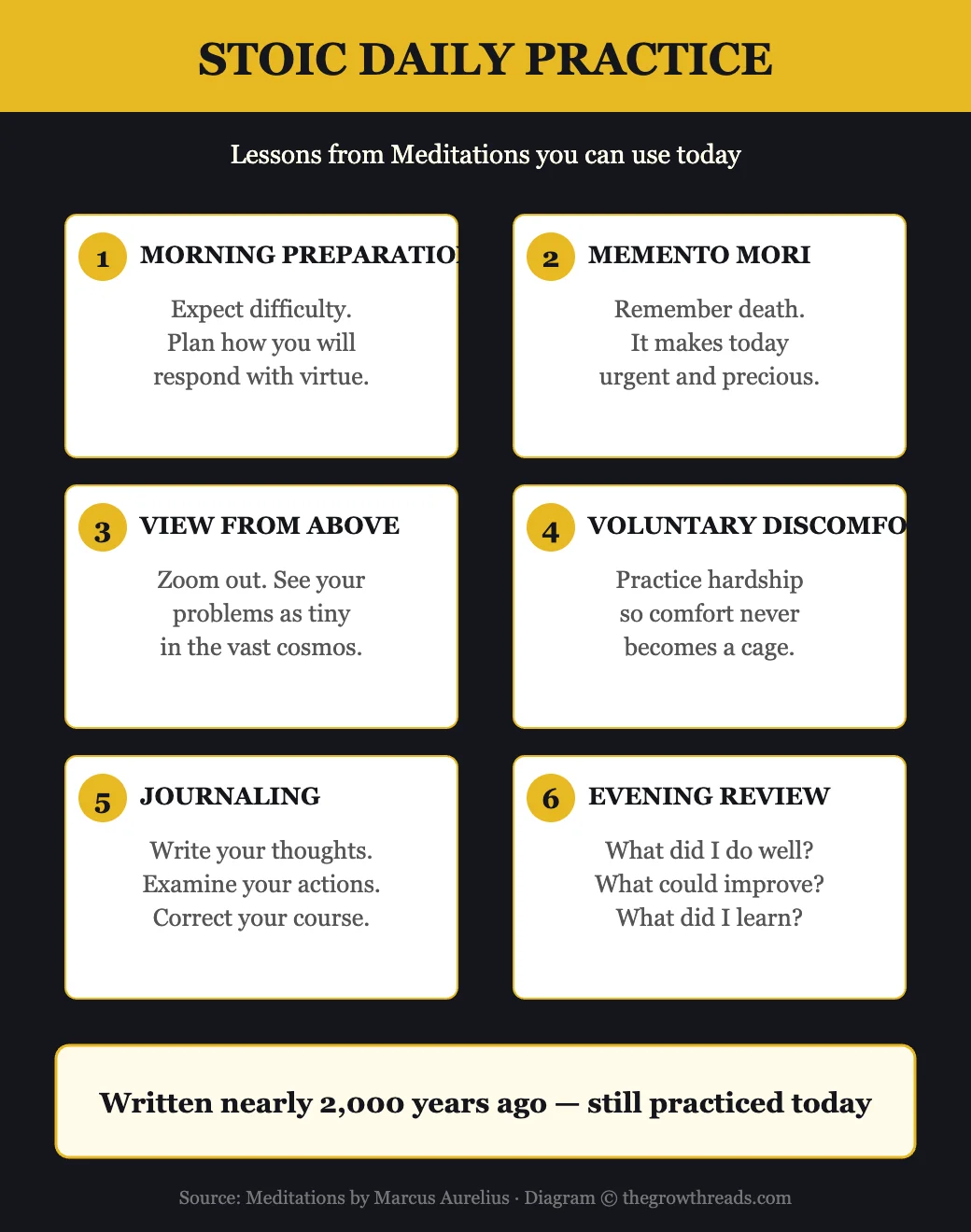
- Day 1 — Morning premeditation: Before checking your phone, spend two minutes imagining the hardest thing that could happen today. Decide in advance how you would respond with calm and virtue.
- Day 2 — Dichotomy audit: Write down everything stressing you. Draw a line through anything outside your control. Focus your energy on the remaining items only.
- Day 3 — Charitable interpretation: When someone frustrates you today, pause and ask: “What might they be going through that explains this behaviour?” Respond to that rather than to the surface action.
- Day 4 — Memento mori walk: Take a 15-minute walk and reflect on your own mortality. Notice how it changes what feels important and what feels trivial.
- Day 5 — View from above: When you feel stressed, close your eyes and zoom out — picture your city, your country, the planet, the solar system. Hold the image for 30 seconds. Notice the emotional shift.
- Day 6 — Voluntary discomfort: Choose one small discomfort today — a cold shower, skipping a meal, working without music. Observe how it builds your tolerance for difficulty.
- Day 7 — Evening review: Before bed, write three sentences: What did I do well today? Where did I fall short? What will I do differently tomorrow? This is now your permanent practice.
Frequently asked questions
What is the best translation of Meditations?
The Gregory Hays translation (2002, Modern Library) is the most widely recommended for general readers because of its clear, contemporary English. For a more literal rendering that preserves the Greek syntax, try the Robin Hard translation (Oxford World’s Classics). The Hays version reads almost like a modern self-help book, which makes it excellent as a first encounter with Stoic philosophy.
Is Meditations hard to read?
In the Hays translation, no. The language is accessible and the entries are short — rarely more than a paragraph. The challenge is that the book is not structured like a modern argument; it is a journal with repeating themes. Reading a few entries per day (rather than straight through) often works better, because each reflection deserves time to settle. Many readers keep it on their nightstand and read one passage before bed.
What is the dichotomy of control in Meditations?
The dichotomy of control is the Stoic distinction between things within your power (your judgements, intentions, desires, and responses) and things outside your power (other people’s actions, natural events, the past, your reputation). Marcus Aurelius returns to this idea throughout the journal as the foundation of emotional resilience: suffering comes from trying to control what you cannot.
How is Meditations different from The Obstacle Is the Way?
The Obstacle Is the Way by Ryan Holiday is a modern interpretation of Stoic principles, structured as a practical business and leadership book with contemporary examples. Meditations is the original source material — Marcus Aurelius’s private journal. Holiday’s book is easier to apply immediately; Meditations is deeper, more personal, and rewards rereading over years. Most readers benefit from reading both.
What are the four Stoic virtues in Meditations?
The four cardinal virtues are wisdom (seeing things as they truly are and making good judgements), courage (doing what is right despite fear or difficulty), justice (treating others fairly and contributing to the common good), and temperance (exercising self-control and avoiding excess). Marcus considered these the only true goods — everything else, including wealth and fame, was morally neutral.
Is Stoicism about suppressing emotions?
No — this is the most common misconception. Stoicism does not ask you to feel nothing. It asks you to examine your automatic emotional reactions and question whether they are based on accurate judgements. Marcus Aurelius felt grief, frustration, and exhaustion — his journal makes this clear. The Stoic practice is not suppression but reappraisal: recognising that your interpretation of events, not the events themselves, causes your suffering.
Why did Marcus Aurelius write Meditations?
Marcus wrote Meditations as a private philosophical exercise — reminders to himself about how to live and lead well. He never intended publication. The journal was likely composed during the Marcomannic Wars on the Danube frontier, between roughly 170 and 180 AD. Its discovery after his death gave the world a unique window into the mind of a philosopher-king practising his principles under extreme real-world pressure.
Related summaries
If you found this summary valuable, explore these related reads:
- The Obstacle Is the Way by Ryan Holiday — modern Stoicism applied to business, sports, and leadership.
- Ego Is the Enemy by Ryan Holiday — how ego undermines success and what the Stoics teach about humility.
- Man’s Search for Meaning by Viktor Frankl — a concentration-camp survivor arrives at Stoic-adjacent conclusions about meaning and suffering.
- The Courage to Be Disliked by Ichiro Kishimi — Adlerian psychology meets Stoic themes of acceptance and responsibility.
📚 Explore more: Best Psychology Books — Our Complete Ranked List