

⭐⭐⭐⭐ 4.0/5
One-liner: A Stoic field guide to the invisible enemy that sabotages you at every stage of ambition.
Best for: Ambitious people who suspect their confidence may be outpacing their competence — and want to fix that before it costs them.
Reading time: ~4 hours (256 pages)
Difficulty to apply: Moderate — the concepts are simple but require genuine self-honesty, which ego resists by definition.
Ego Is the Enemy in one minute
The greatest obstacle between you and your potential is the story you tell yourself about how great you already are. Ryan Holiday draws on Stoic philosophy and historical case studies to argue that ego — the unhealthy belief in your own importance — is the single most destructive force in ambitious lives. It prevents learning when you are aspiring, poisons judgment when you succeed, and magnifies suffering when you fail. Holiday structures the book around these three phases, showing through figures from George Marshall to Howard Hughes how ego transforms talented people into cautionary tales. The antidote is not false modesty but a disciplined commitment to reality, continuous learning, and doing the work rather than performing it.
Key takeaways
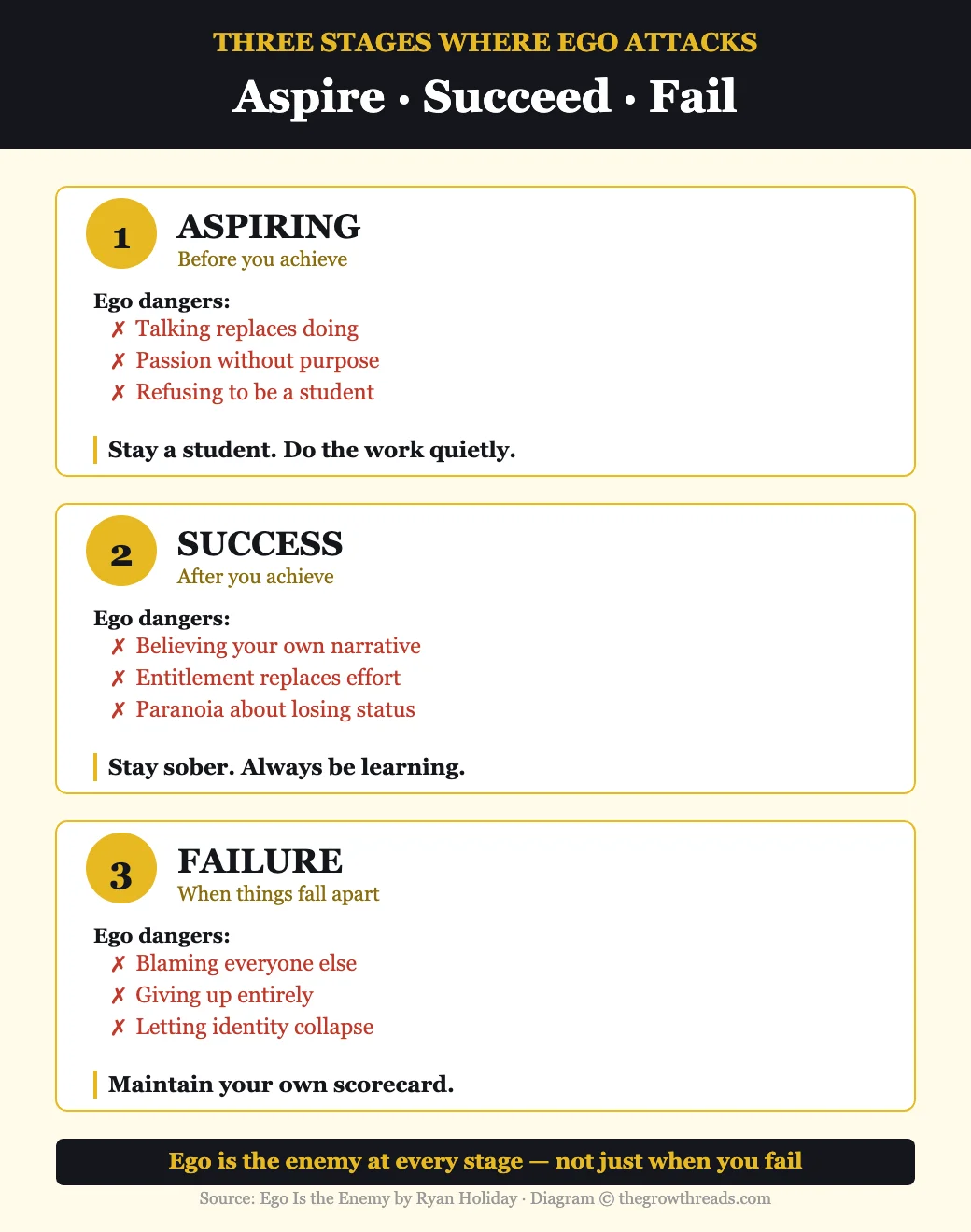
- Ego attacks at every stage: Whether you are aspiring, succeeding, or failing, ego has a specific way of sabotaging you. There is no safe zone — vigilance is permanent.
- Talking replaces doing: The dopamine reward from announcing plans often satisfies the same psychological need as accomplishing them. Holiday warns that talking about work is not working.
- Passion is overrated — purpose is not: Passion without discipline is noise. Purpose — a clear reason paired with consistent effort — produces results that passion alone cannot sustain.
- Be a student, always: Ego tells you that you already know enough. But every master in history maintained a student mindset long after they had the credentials to stop learning.
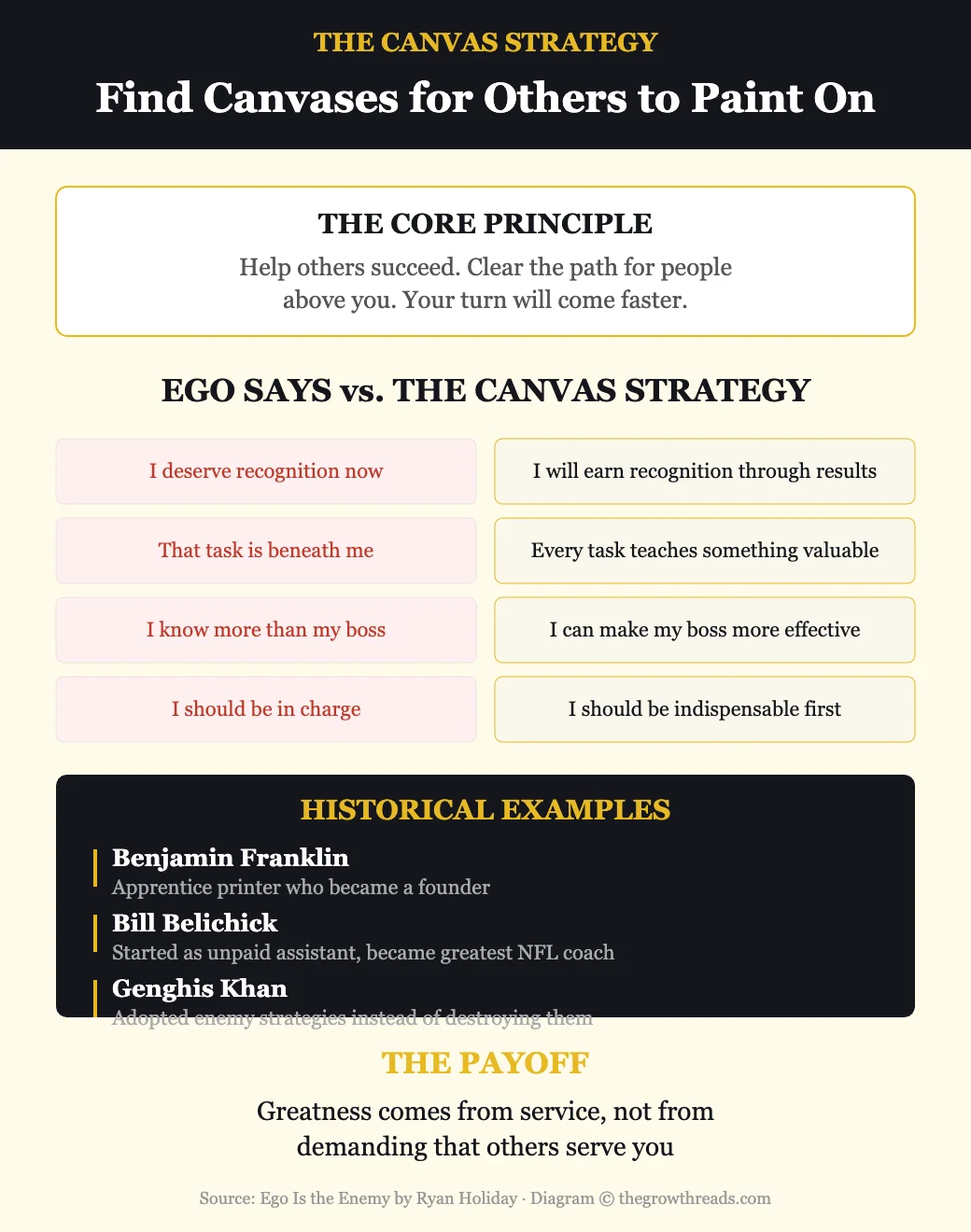
- The Canvas Strategy accelerates growth: Instead of demanding recognition, find ways to help those above you succeed. You learn faster, build allies, and your turn comes sooner.
- Restraint is strength: The ability to not react, not speak, not defend yourself when ego screams at you to fight back — that is where real power lives.
- Success is the most dangerous phase: More careers are destroyed by ego after success than by failure itself. Believing your own narrative blinds you to changing realities.
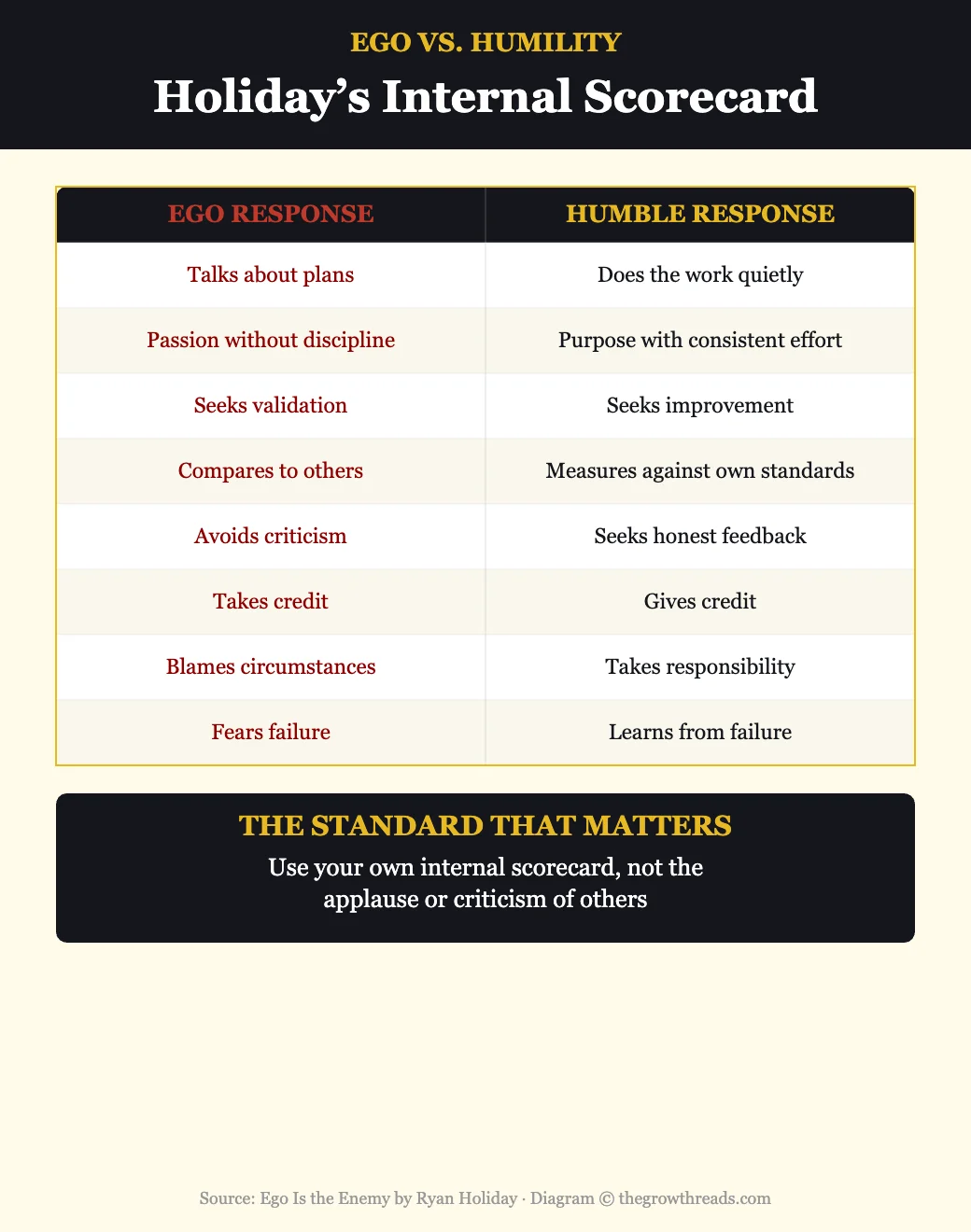
- Maintain your own scorecard: External validation — awards, followers, titles — is unreliable. The only metric that matters is your honest internal assessment of whether you did the work.
- Failure is not the end — ego makes it the end: When things go wrong, ego makes you blame others, deny reality, or give up entirely. Without ego, failure becomes information.
- Do the work: The simplest and most repeated advice in the book. Stop performing. Stop strategizing about performing. Sit down and do the actual work.
What is Ego Is the Enemy about?
Ego Is the Enemy is a Stoic philosophy book that examines how an inflated sense of self-importance sabotages people across three life stages — aspiring, succeeding, and failing. Ryan Holiday uses historical case studies and philosophical principles to show that humility, discipline, and continuous learning are the antidotes to ego’s destructive force.
About the author
Ryan Holiday is a bestselling author, media strategist, and modern popularizer of Stoic philosophy. He dropped out of college at 19 to apprentice under Robert Greene and became the director of marketing for American Apparel at 21. He has since written over a dozen books, including The Obstacle Is the Way, Stillness Is the Key, and The Daily Stoic, which have collectively sold millions of copies and been translated into over 40 languages. His work draws heavily on historical figures, ancient philosophy, and his own experience navigating ego in the media and publishing industries. He runs the Daily Stoic website and bookstore in Bastrop, Texas.
Key concepts at a glance
| Concept | What it means | Use it when |
|---|---|---|
| The Three Stages | Ego attacks differently when you are aspiring, succeeding, and failing — each requires a different defense | You want to diagnose which phase of ego you are battling right now |
| The Canvas Strategy | Find canvases for other people to paint on — help others succeed and you accelerate your own growth | You feel stuck or resentful about lack of recognition early in your career |
| Talk vs. Work | Announcing plans triggers the same dopamine as accomplishing them, killing your drive to actually execute | You notice yourself talking about projects more than doing them |
| Passion vs. Purpose | Passion is emotional volatility; purpose is a disciplined reason paired with sustained effort | You feel fired up but keep quitting when the excitement fades |
| Always Be a Student | The moment you think you have nothing left to learn is the moment decline begins | You have achieved expertise and feel tempted to coast on credentials |
| The Internal Scorecard | Judge yourself by your own honest standards, not external metrics like titles, followers, or awards | You catch yourself comparing your success to peers rather than your own growth |
| Alive Time vs. Dead Time | Every period of life — including setbacks and waiting — can be used productively or wasted | You are in a difficult period and tempted to feel sorry for yourself |
Part 1: Aspire — the ego of the beginner
Holiday opens with a paradox: the qualities that make people ambitious often prevent them from succeeding. Ego whispers that you are special, that the rules do not apply to you, that your talent alone will carry you. But every historical figure Holiday admires — George Marshall, Genghis Khan, Benjamin Franklin — succeeded precisely because they suppressed those whispers.
The most dangerous trap for aspirers is talk. Holiday cites research showing that announcing intentions triggers a premature sense of accomplishment. The brain registers the social validation of talking about a goal as partial completion, reducing the motivation to actually pursue it. This is why Holiday advises near-silence about plans: do the work, then let results speak.
He distinguishes sharply between passion and purpose. Passion is volatile, emotional, and self-centered — it burns hot and flames out. Purpose is steady, disciplined, and directed outward — it sustains effort across years and decades. The passionate person talks about changing the world. The purposeful person shows up at the desk every morning and does the next right thing. Holiday traces this distinction through figures from the civil rights movement to the tech industry, showing that passion without purpose produces noise, while purpose without passion produces lasting change.
Part 2: Success — the ego of the achiever
The most counterintuitive section argues that success is more dangerous than failure. When things go well, ego inflates. You begin to believe your own narrative. You attribute success to talent rather than effort, to brilliance rather than circumstance. And slowly, the qualities that earned the success — humility, hunger, discipline — erode.
Holiday introduces the Canvas Strategy through the story of Benjamin Franklin, who spent his early career as a subordinate, finding ways to make his bosses and mentors look good. Instead of demanding recognition, he made himself indispensable by clearing paths for others. The counterintuitive result: he rose faster than those who competed for credit. Holiday applies this to modern careers — the assistant who makes the CEO look brilliant, the junior developer who solves problems before they escalate, the intern who shows up early and stays late without being asked.
He tells the cautionary tale of Howard Hughes, a man of extraordinary talent and resources who let ego destroy everything. Hughes went from being the world’s most successful filmmaker and aviator to dying alone, emaciated, and mentally broken in a Las Vegas hotel room. The common thread in every cautionary tale Holiday presents is the same: the person stopped being a student. They stopped listening. They surrounded themselves with people who told them what they wanted to hear rather than what they needed to hear.
Part 3: Failure — the ego of the fallen
When things go wrong — and they will — ego determines whether you recover or collapse. Holiday presents failure as a forge: the same heat that destroys weak metal tempers strong metal. The difference is ego. With ego, failure becomes an identity crisis. Without ego, failure becomes feedback.
He introduces the concept of Alive Time vs. Dead Time, borrowed from Robert Greene. Every period of life — including imprisonment, unemployment, illness, and rejection — can be used productively (alive time) or wasted in self-pity (dead time). Malcolm X used his prison sentence to educate himself and became one of the most articulate leaders in American history. Many people spend decades in freedom accomplishing less because ego convinces them their circumstances are beneath them.
Holiday’s treatment of the internal scorecard is the emotional center of the book. Borrowed from Warren Buffett, the concept is simple: would you rather be the greatest investor in the world but have everyone think you are the worst, or be the worst investor in the world but have everyone think you are the greatest? Ego always chooses the second option. Genuine excellence always chooses the first. Your scorecard — honest, private, unaffected by applause or criticism — is the only reliable measure of whether you are actually getting better.
Who is Ego Is the Enemy best for — and who should read something else first?
This book is ideal for ambitious people in their twenties and thirties who are building careers and facing the temptations of early success. It is also valuable for leaders who have achieved significant success and need a reminder of what got them there. Anyone recovering from a professional or personal failure will find the third section particularly grounding. The historical examples and Stoic philosophy make it feel timeless rather than trendy.
If you want a more tactically actionable Stoic book, start with The Obstacle Is the Way. If your challenge is less about ego and more about understanding how other people think, The Laws of Human Nature by Robert Greene is more comprehensive. And if you want the foundational Stoic text that Holiday draws from heavily, Meditations by Marcus Aurelius is the primary source.
Questions to reflect on
- In which of the three stages — aspiring, succeeding, or failing — is ego most active in your life right now?
- How much of your time do you spend talking about your work versus actually doing it?
- Who could you be a canvas for — helping them succeed in a way that also accelerates your growth?
- If you used only your internal scorecard and ignored all external validation, how would your priorities change?
- What current setback could be reframed from dead time to alive time?
🔥 Ready to confront the enemy in the mirror?
Learn the Stoic strategies that history’s greatest achievers used to keep ego from destroying what they built.
How to apply Ego Is the Enemy (7-day plan)
- Day 1 — Diagnose your stage: Identify whether you are currently aspiring, succeeding, or failing in the most important area of your life. Read Holiday’s warnings specific to that stage. Write down the ego trap most relevant to you right now.
- Day 2 — Stop talking, start doing: For the next 48 hours, do not tell anyone about your plans, goals, or ambitions. Channel the energy you would have spent discussing your work into actually doing it. Notice the difference in output.
- Day 3 — Find your canvas: Identify one person above you — a boss, mentor, or senior colleague — and find a specific way to help them succeed today. Do it without expecting credit. Notice what you learn.
- Day 4 — Write your internal scorecard: List five metrics that only you can evaluate — quality of effort, honesty, consistency, learning, and kindness. Rate yourself on each. This is your real scorecard. Compare it to the external metrics you normally track.
- Day 5 — Practice restraint: When someone criticizes you, interrupts you, or takes credit for your work today, do not react. Let the moment pass. Notice how ego screams at you to respond and observe the impulse without acting on it.
- Day 6 — Convert dead time to alive time: Identify a current frustration, delay, or setback in your life. Instead of resenting it, plan how to use this period productively. What can you learn, build, or practice while you wait?
- Day 7 — Commit to the student mindset: Identify one area where you consider yourself expert. Find someone who knows more than you in that area and ask them three genuine questions. Listen without defending your current knowledge.
Frequently asked questions
Is Ego Is the Enemy the same as The Obstacle Is the Way?
No, though they are companion books by the same author. The Obstacle Is the Way focuses on how to turn external obstacles into advantages using Stoic principles of perception, action, and will. Ego Is the Enemy focuses on the internal obstacle — your own inflated sense of self-importance. Obstacle tells you what to do when the world gets in your way; Ego tells you what to do when you get in your own way. Many readers benefit from reading both, starting with whichever problem feels more urgent.
What is the Canvas Strategy?
The Canvas Strategy is Holiday’s term for the practice of finding ways to help people above you succeed — providing the canvas for them to paint on. Instead of competing for recognition, you make yourself indispensable by clearing paths, solving problems, and making others look good. The strategy is drawn from historical examples like Benjamin Franklin, who used his apprenticeship to learn everything he could while serving his masters. The counterintuitive payoff is that you learn faster and rise faster than those who demand recognition.
Is ego always bad?
Holiday distinguishes between healthy confidence and destructive ego. Confidence is evidence-based — you believe you can do something because you have done the work to prepare. Ego is fantasy-based — you believe you deserve something because of who you think you are, not because of what you have done. The book targets the second kind. Some reviewers argue Holiday overstates the case, but his core point is that for ambitious people, ego is far more likely to be an obstacle than a fuel source.
What does alive time vs. dead time mean?
Alive time is any period of life — including setbacks, waiting, imprisonment, or unemployment — that you use productively to learn, build, and grow. Dead time is the same period wasted in self-pity, resentment, or passive consumption. The concept comes from Robert Greene and is central to Holiday’s approach to failure. Malcolm X transformed his prison sentence into an intensive self-education; that was alive time. The distinction is a choice, not a circumstance.
Who are the main historical figures in Ego Is the Enemy?
Holiday draws on a wide range of examples. George Marshall — who refused to lobby for command of D-Day and was rewarded with the Marshall Plan — exemplifies humility in success. Howard Hughes — who let ego destroy his health, relationships, and empire — is the primary cautionary tale. Genghis Khan appears as someone who conquered ego by adopting the best practices of his enemies. Benjamin Franklin illustrates the Canvas Strategy. Katharine Graham of the Washington Post demonstrates overcoming ego-driven fear to lead under pressure.
How do you know if ego is a problem for you?
Holiday suggests several diagnostic questions: Do you talk more about your plans than you execute them? Do you feel entitled to recognition you have not earned? Do you avoid feedback or surround yourself with people who agree with you? Do you compare yourself to peers more than to your own past performance? Do you blame external circumstances when things go wrong? If you answer yes to several of these, ego is likely operating as an invisible drag on your growth.
What Ryan Holiday books should I read first?
For most readers, the ideal order is The Obstacle Is the Way (tactical Stoicism for external challenges), then Ego Is the Enemy (internal ego management), then Stillness Is the Key (finding inner peace and clarity). Together they form Holiday’s Stoic trilogy. If you are primarily interested in daily philosophical practice, The Daily Stoic provides 366 meditations. If you want the original source material, Holiday draws most heavily from Marcus Aurelius’s Meditations and Seneca’s Letters.
Related summaries
If you found Ego Is the Enemy valuable, explore these related summaries:
- The Obstacle Is the Way by Ryan Holiday — the tactical companion for turning external obstacles into advantages.
- Meditations by Marcus Aurelius — the primary Stoic source Holiday draws from most heavily.
- The Laws of Human Nature by Robert Greene — deeper psychology on narcissism, envy, and self-awareness.
- 📚 Browse all psychology book summaries