

★★★★★ 4.6/5 — Esther Perel’s groundbreaking case for why good relationships need mystery, not just closeness.
Best for: Couples in a stable, loving relationship whose sex life has quietly gone flat
Reading time: ~6 hours to read the full book · 12 minutes for this guide
Difficulty to apply: Moderate — some ideas require an honest, occasionally uncomfortable conversation
Mating in Captivity in one minute
Love and desire run on different fuel, and simply loving your partner will not automatically keep you wanting them. Psychotherapist Esther Perel spent decades in the therapy room watching happy, committed couples lose their sex life — not because the relationship was broken, but because the very things that make a relationship feel safe (closeness, predictability, total honesty) sit at odds with what makes a person feel desirable (distance, mystery, risk). Mating in Captivity argues that eroticism is “sex with imagination,” and that couples who want to keep it alive inside a committed household have to deliberately protect space for otherness, fantasy, and a little bit of not-knowing — even after a decade together, two kids, and a shared mortgage.
Key takeaways
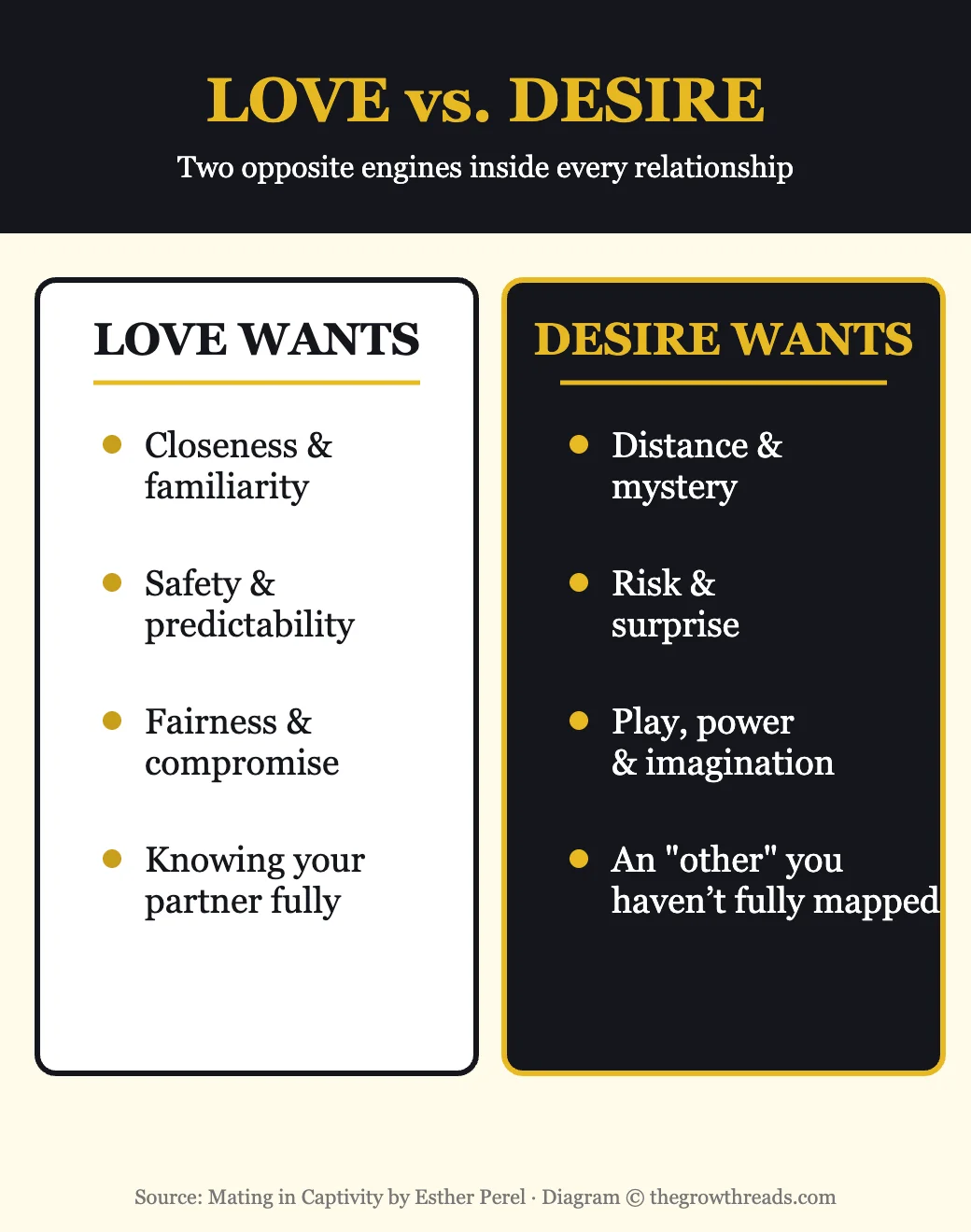
- Love and desire are different engines: love wants closeness, safety, and predictability; desire wants distance, risk, and mystery — you cannot optimize for both at once.
- Domesticity is desire’s quiet enemy: passion doesn’t fade because something is wrong — it fades because the routines that keep a household running are the same routines that dull erotic charge.
- Fantasies are metaphors, not requests: a fantasy about being wanted by a stranger is rarely about the stranger — it is usually about wanting to feel desired, powerful, or briefly free of responsibility.
- Merging too completely kills desire: when two people become one seamless “we,” there is no autonomous other left to reach for — intimacy’s biggest trap is erasing all distance.
- Talking isn’t the only intimacy: modern couples over-rely on verbal disclosure; touch, play, and unstated understanding build closeness too, and some couples connect better through their hands than their words.
- Culture offers no useful script: American culture markets sex as either hedonistic spectacle or Puritan shame, and neither model helps a couple build a private, personal erotic life.
- Parenthood is a structural threat to eroticism: children ask for selflessness; desire asks for a little selfishness — protecting adult-only time after kids arrive is maintenance, not indulgence.
- Every relationship has “a third”: a real or imagined rival for your partner’s desire is normal and even useful — naming it honestly is safer than pretending it doesn’t exist.
- Rekindling desire is qualitative, not quantitative: scheduling more sex or chasing a frequency target rarely works; attention, imagination, and novelty do.
- Good sex inside commitment is possible — but it takes a specific kind of work: treating your partner as someone you are still choosing to discover, not someone you already fully possess.
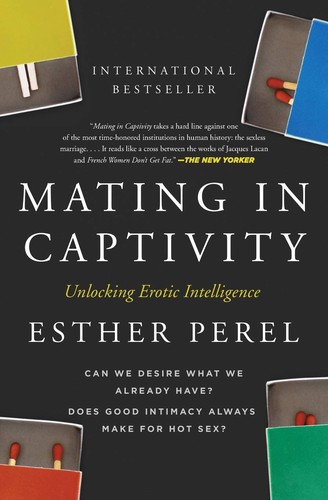
What is Mating in Captivity about?
Mating in Captivity: Unlocking Erotic Intelligence is Esther Perel’s 2006 book on why sexual desire fades in long-term relationships and how couples can revive it. Drawing on her therapy practice, Perel argues that intimacy and eroticism run on opposite logics, and shows how couples can protect mystery, autonomy, and play inside a committed, loving partnership.
About the author
Esther Perel is a Belgian-American psychotherapist born in Antwerp to two Holocaust survivors who, she has said, taught her the difference between “not being dead” and “being fully alive” — a distinction that runs through her entire body of work on desire. She studied in Jerusalem, moved to New York for graduate school, and never left, building a private couples-therapy practice that has now run for more than three decades. Her viral 2006 essay “In Search of Erotic Intelligence,” written in the cultural aftermath of the Clinton-Lewinsky scandal, became the seed of Mating in Captivity. She has since become one of the most-watched relationship voices alive: her TED talks on desire and infidelity have logged tens of millions of views, and her podcast Where Should We Begin lets listeners eavesdrop on real, anonymized couples-therapy sessions. Explore all Esther Perel book summaries →
Key concepts at a glance
| Concept | What it means | Use it when |
|---|---|---|
| Erotic intelligence | The learnable capacity to sustain desire and playfulness inside a committed relationship | Passion has faded but the relationship is otherwise healthy |
| Love vs. desire | Love thrives on closeness and safety; desire thrives on distance and mystery | You feel close to your partner but rarely want sex |
| Otherness / separateness | Keeping an autonomous self your partner doesn’t fully possess or predict | You’ve merged so completely there’s “no one left to desire” |
| The quantitative trap | Treating desire like a project — frequency targets, scheduled date nights, mechanics | “Date night” alone isn’t reviving your sex life |
| Fantasy as metaphor | Sexual fantasies represent a psychological need (freedom, power, admiration), not a literal request | You or your partner feel shame about a recurring fantasy |
| Talking vs. touching | Verbal disclosure isn’t the only path to intimacy — touch, play, and silence count too | You over-communicate but under-touch |
| Protecting erotic space | Deliberately guarding selfish, adult-only time and identity, especially after kids | Parenthood has taken over the household’s emotional bandwidth |
| “The third” | Any real or imagined rival for your partner’s desire — an ex, a fantasy, or a life not lived | Jealousy or a wandering fantasy needs to be named honestly |
Part 1: The paradox at the heart of every long relationship
Perel opens with a question she says clients rarely ask out loud: why does good sex so often disappear from good relationships? Not bad ones — good ones. Couples who like each other, respect each other, and split the chores fairly still end up, a few years in, wondering where the wanting went. Her answer runs against most self-help logic: it is not a symptom of something broken. It is what happens when two forces that need opposite conditions are asked to live in the same house.
Commitment, in her framing, is built from predictability, security, and familiarity — knowing what tomorrow looks like, and who will be in it. Desire is built from the opposite ingredients: novelty, uncertainty, and a bit of risk. Biochemistry backs part of this up. The rush hormones of new romance fade within a few years for almost everyone, while the bonding hormone released by long-term touch and affection keeps building. Perel’s point is not that this is sad. It is that most couples never learn to work with it, because nobody told them eroticism needs upkeep of a completely different kind than the upkeep a household needs.
She defines eroticism plainly: it is sex with imagination. Not a technique, not a body count, not a schedule — an active, curious, sometimes playful use of the mind that treats a partner as someone still worth discovering, not a fully mapped and finished project.
TGR Note: John Gottman’s research, covered in our Seven Principles for Making Marriage Work summary, focuses on building friendship and repairing conflict well — the scaffolding that keeps a couple together. Perel’s book picks up almost exactly where that scaffolding ends: once the friendship and the fighting are handled, what keeps the desire alive? The two books solve different halves of the same long-term relationship problem.
Part 2: Where your desire actually comes from
Before Perel gets to couples, she goes further back — to childhood. Long before anyone has a partner, they have a family, and that family teaches a set of unspoken lessons about dependence, touch, and what emotions are allowed to sit next to sex. A child who learns that needing someone leads to disappointment often grows into an adult who is more comfortable with anonymous, low-stakes physical connection than with vulnerable, emotionally loaded sex with a committed partner. A child who watched parents protect a bit of adult-only, un-explained private time — a locked door on a Saturday afternoon, no explanation required — often grows into an adult who can be fully present during sex and still comfortably ask for their own pleasure, without guilt.
The same early wiring shapes how comfortable someone is with their own sexuality later on, and gender expectations layer on top of it. Perel notes that many women are taught to base their sense of desirability on whether they are wanted, rather than on what they themselves want — which can make claiming personal desire feel unfamiliar even inside a loving relationship.
From family, she moves to fantasy — the other major source of individual desire. For most of the twentieth century, fantasy was treated as shameful or clinical: something religion warned against and early psychology pathologized. Perel argues, in line with contemporary research, that fantasy is a normal, healthy piece of adult sexuality, and that its content is rarely literal. A fantasy is a metaphor. Someone who fantasizes about being pursued by a stranger is usually not asking for a stranger — they are naming a need to feel wanted without having to ask for it directly. Read this way, fantasy becomes useful information about what a person is missing, rather than something to hide or apologize for.
TGR Note: Our Attached summary covers how childhood bonding shapes adult attachment style — anxious, avoidant, or secure. Perel’s family chapter is effectively the same argument aimed specifically at eroticism: the patterns you learned about closeness and distance as a child do not just shape who you fall for, they shape how free you feel once you are already committed to them.
Part 3: Three tensions built into every modern relationship
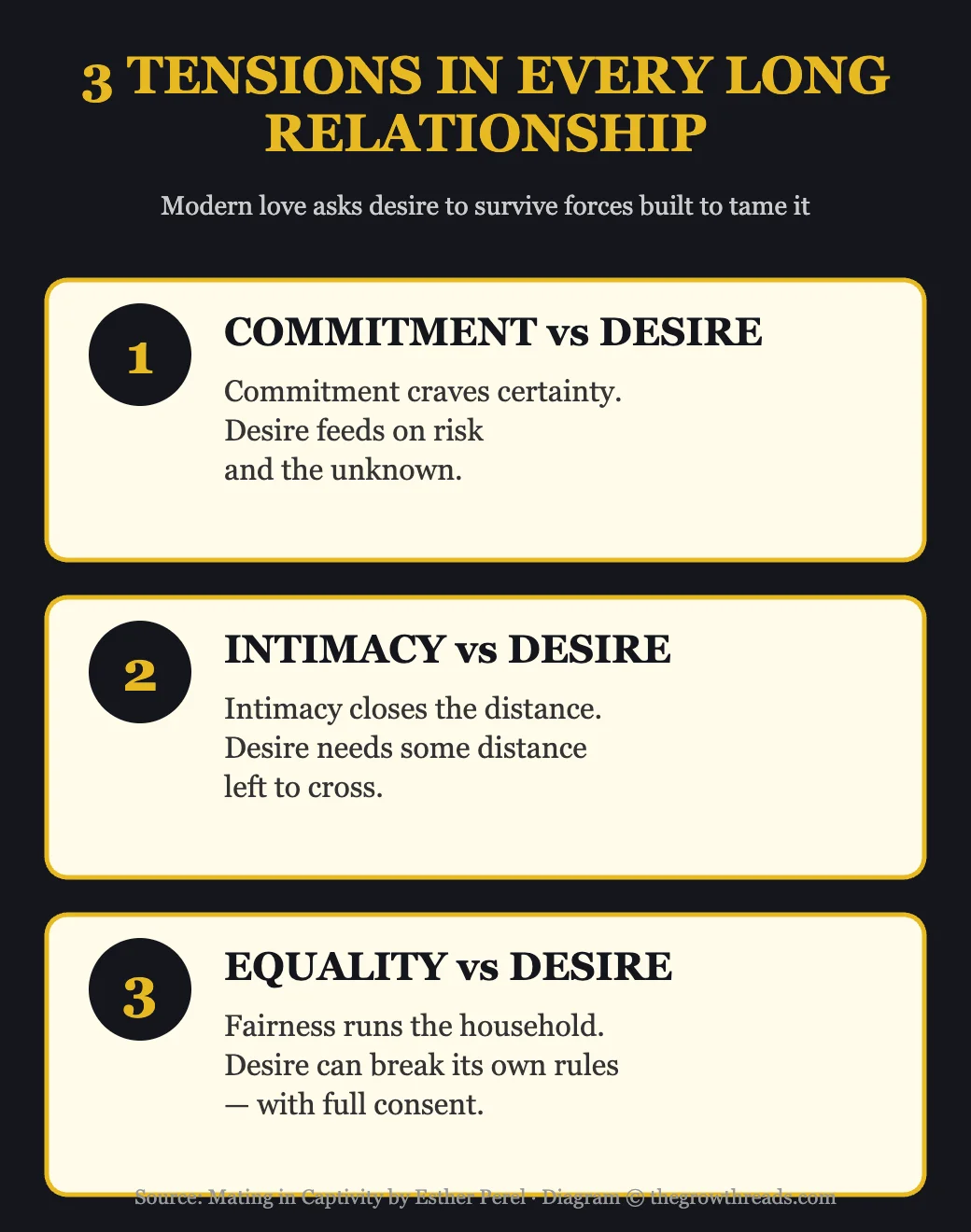
Perel isolates three specific places where the values of a good modern relationship collide head-on with the conditions desire needs. The first is commitment versus desire: commitment runs on certainty, desire runs on risk, and most people quietly pick a side — the “romantic,” who chases the feeling of falling in love over and over because they mistake fading passion for a dead relationship, or the settler, who trades passion for security and rarely looks back. Perel’s argument is that neither trade is necessary if a couple treats desire as something to actively cultivate rather than something that either exists or doesn’t.
The second tension is intimacy versus desire. Closeness requires shrinking the distance between two people until there is very little “otherness” left — which is wonderful for comfort and terrible for eroticism, because desire needs a gap to cross. New relationships feel electric partly because the two people genuinely do not yet know each other; all that unknown territory is exactly what imagination needs to work with. Long relationships that stay exciting are the ones where both people resist fully closing that gap.
The third tension is egalitarianism versus desire. Fairness, compromise, and equal say are non-negotiable values for how a modern household runs — and Perel is unambiguous that they should be. But she also points out that desire itself often runs on ingredients that look nothing like fairness: a little obsession, a little power play, a willingness to be objectified or to objectify, briefly and consensually. Unlike the other two tensions, she frames this one as mostly cultural rather than biological — meaning couples have more room to decide, consensually and privately, what the bedroom is allowed to look like, even when it looks different from how the rest of the household runs.
TGR Note: Hold Me Tight makes the case that couples need more emotional responsiveness and closeness to feel secure. Perel’s intimacy-versus-desire tension sounds like it contradicts that — but read together, the two books actually complete each other: a couple needs a secure emotional base to feel safe, and a protected zone of autonomy and mystery to feel desire. Neither book argues you can skip the other’s half of the equation.
Part 4: The outside pressures nobody warns you about
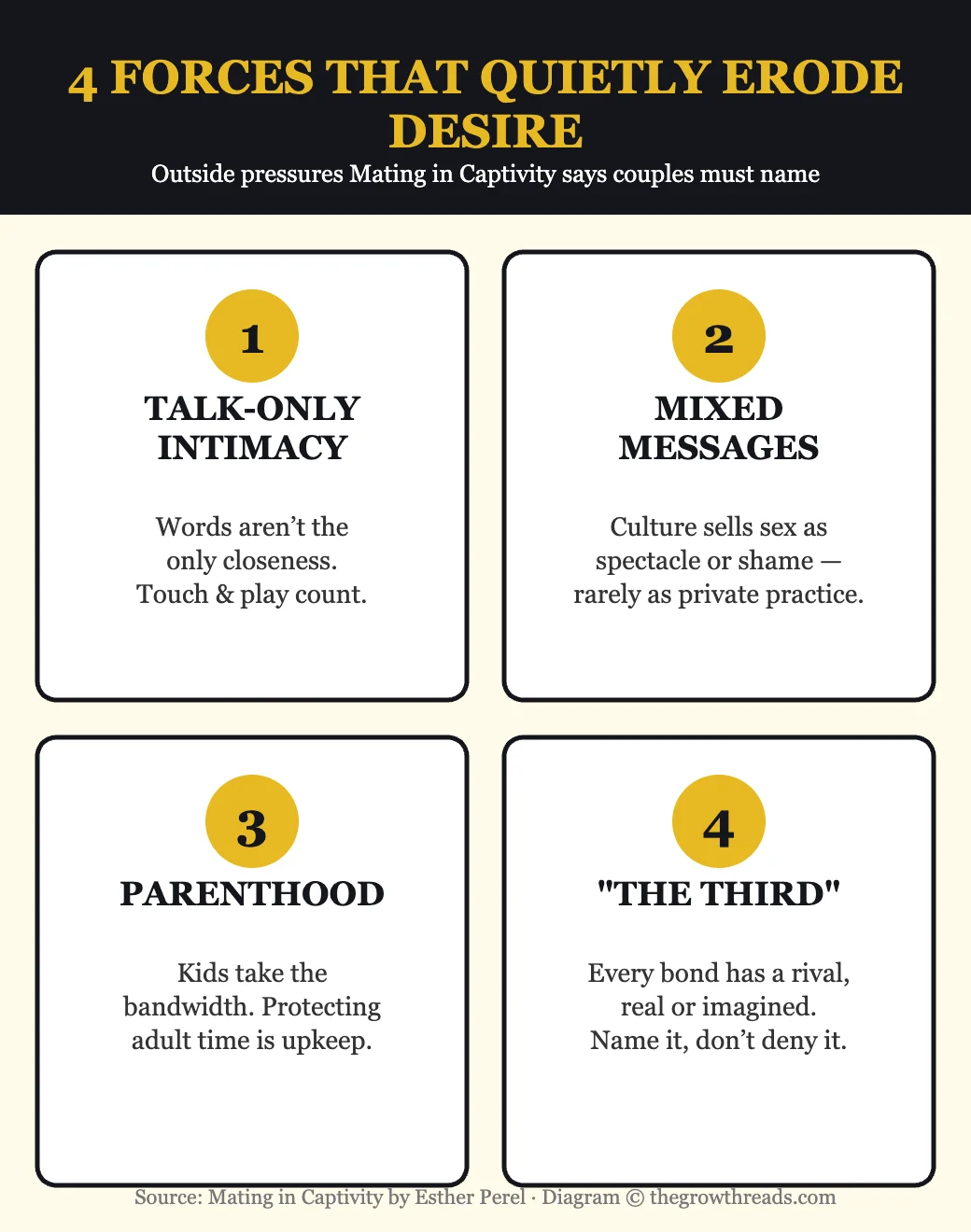
The last quarter of the book turns outward, to forces that press on a couple’s erotic life from outside the relationship itself. The first is language: modern couples have been taught that real intimacy means constant verbal disclosure — sharing feelings, narrating needs, being heard. Perel points out this is a historically recent and fairly Western idea, and that plenty of intimacy has always been built nonverbally, through touch, shared silence, and physical presence. Couples who treat talking as the only legitimate form of closeness can end up starving the nonverbal channel that eroticism actually depends on.
The second outside pressure is culture itself. Sex is everywhere in American media, yet the underlying attitude toward it, Perel argues, has not shifted nearly as far as the imagery suggests — plenty of that “openness” is really commerce wearing liberation’s clothes, layered on top of older Puritan discomfort with pleasure for its own sake. Neither the hedonistic version of sex nor the ashamed version gives a couple a usable, private script for their own erotic life.
The third pressure, and the one Perel says changes a couple’s life more than almost anything else, is parenthood. Children reorganize a couple’s time, bodies, identities, and emotional bandwidth almost overnight, and the change is rarely erotic-friendly: selflessness is the whole job of parenting, while eroticism needs a bit of selfishness to function. Perel is careful not to pathologize couples whose sex life stays quiet for a season, or even permanently, as long as both partners genuinely agree to that arrangement. The problem she flags is mismatch — one partner wanting to reclaim that part of the relationship while the other has quietly closed the door on it.
The final pressure is what Perel calls “the third” — any real or imagined rival for a partner’s desire, whether an ex, a stranger, a fantasy, or simply the unlived life a person sometimes wonders about. She argues every relationship contains a third in some form, because monogamy only means something if it is a continual choice rather than the only option that ever existed. Couples who pretend the third does not exist, she suggests, are often more fragile than couples who can name it honestly and talk about what it means.
TGR Note: If the “talk is the only intimacy” chapter resonates, our Nonviolent Communication summary and Difficult Conversations summary are useful next reads — both give couples a language for the emotionally loaded conversations Perel says are necessary here (naming a fantasy, naming a third, asking for more touch) without those conversations turning into blame.
Who is Mating in Captivity best for — and who should read something else first?
Mating in Captivity is best for couples who already have a fundamentally stable, respectful relationship and are wondering, honestly, where the passion went. It is written for people who are ready to look at their own patterns rather than just their partner’s, and who are comfortable with some ambiguity rather than a strict formula.
If the core problem in your relationship is still about basic emotional safety, trust, or feeling unheard, start with Hold Me Tight first — build the secure emotional bond before layering on the more advanced work of protecting mystery and autonomy. If the issue is more about specific recurring arguments or feeling unable to raise hard topics at all, Difficult Conversations will be more immediately useful. And if the pattern is closer to codependency or difficulty saying no inside the relationship, Boundaries addresses that groundwork directly.
Questions to reflect on
- When did you last feel genuinely curious about your partner, rather than certain you already knew their answer?
- Is there a version of yourself — playful, selfish, a little mysterious — that existed before this relationship and has quietly gone missing?
- Do you and your partner communicate mostly through words, or is there a nonverbal language between you that has been neglected?
- What is your “third” — a person, a fantasy, or a life not chosen — and have you ever said it out loud?
- If desire is a quality you cultivate rather than a fact about your relationship, what is one small, specific thing you could do this week to cultivate it?
🔥 Ready to bring desire back into your relationship?
Get Mating in Captivity and start rebuilding the mystery this week.
How to apply Mating in Captivity (7-day plan)
- Day 1 — Notice the merge. Write down three ways you and your partner have become interchangeable (finishing sentences, identical routines, no separate friendships). Don’t fix anything yet — just notice where “otherness” has quietly disappeared.
- Day 2 — Reclaim one solo interest. Spend 30 minutes on something that is entirely yours — a hobby, a walk alone, a piece of music — with no obligation to report back on it afterward.
- Day 3 — Trade one conversation for one touch. Instead of processing the day in words tonight, try five minutes of wordless physical affection — a shoulder rub, holding hands on the couch — and see what it communicates that talking doesn’t.
- Day 4 — Ask a curious question you think you already know the answer to. Pick something you assume about your partner’s inner life and ask about it anyway, genuinely open to being wrong.
- Day 5 — Name one fantasy or want out loud, even a small one. It doesn’t have to be dramatic — being wanted, being surprised, being looked at. The goal is practicing the sentence, not the scale of the ask.
- Day 6 — Protect two hours of adult-only time. If you have kids, arrange coverage. If you don’t, treat the two hours as off-limits to chores and errands. Use it for anything that isn’t logistics.
- Day 7 — Talk about “the third,” gently. Ask your partner, without accusation, whether there’s a person, memory, or fantasy that occasionally crosses their mind — and share your own. The goal is naming it, not resolving it in one sitting.
Frequently asked questions
What is the main idea of Mating in Captivity?
The main idea is that love and desire depend on opposite conditions — love wants closeness, safety, and predictability, while desire wants distance, mystery, and risk. Esther Perel argues that passion fading in a long relationship is not a sign of failure, but a predictable result of domesticity crowding out the space eroticism needs. She offers a path for couples to consciously protect autonomy, imagination, and play without giving up the security of commitment.
Is Mating in Captivity based on real therapy cases?
Yes. Esther Perel draws heavily on her decades of work as a couples therapist, using anonymized composite examples to illustrate patterns she has seen repeatedly across clients from many cultural backgrounds. The book blends these clinical observations with research on attachment, sexuality, and relationship history, though it is written for a general audience rather than as an academic text.
Does Mating in Captivity apply to all relationship types?
Perel writes primarily about long-term, monogamous, cohabiting couples, since that is the population she has treated most and the cultural default she is responding to. That said, many of the underlying ideas — that closeness and mystery pull in different directions, that fantasy is metaphorical, that outside pressures like parenting affect intimacy — generalize reasonably well to other relationship structures, even though the book doesn’t focus on them directly.
What does Esther Perel mean by “the third”?
“The third” is Perel’s term for any real or imagined rival for a partner’s desire — an ex-partner, a stranger, a private fantasy, or even the life a person might have had with someone else. She argues the third exists in some form in every relationship, because fidelity is only meaningful as an ongoing choice among alternatives. Naming the third honestly, in her view, tends to be healthier than pretending it doesn’t exist.
How is Mating in Captivity different from typical relationship advice?
Most relationship advice focuses on communication, conflict resolution, or emotional bonding — making a couple closer and safer. Perel’s focus is narrower and less common: keeping sexual desire alive specifically inside that safety. Rather than offering step-by-step exercises, she reframes the problem itself, arguing couples often misunderstand why passion fades and therefore chase the wrong fixes, like more date nights or better scheduling.
Has any of the research in Mating in Captivity been debated?
Some of the cultural and historical claims Perel makes — for instance, about shifts in American attitudes toward sex, or the universality of certain gender patterns in desire — are drawn from her clinical observation and broader social commentary rather than large-scale studies, and other researchers have proposed different explanations for some of the same patterns. The practical core of the book, that intimacy and eroticism can pull in different directions and benefit from deliberate attention, is widely echoed across later relationship research.
What should I read after Mating in Captivity?
If you want more on how childhood shapes adult intimacy patterns, read Attached. If your relationship needs a stronger emotional foundation before working on desire specifically, Hold Me Tight is the natural next step. For couples who want a broader, research-driven view of what keeps long marriages strong, The Seven Principles for Making Marriage Work pairs well with Perel’s ideas.
Related summaries
- Attached: The New Science of Adult Attachment
- Hold Me Tight
- The Seven Principles for Making Marriage Work
- The 5 Love Languages
- Browse all Best Relationship Books
How we analyze books: our summaries are built from a full read of the source text, cross-checked against the author’s public interviews and published essays, and structured around practical application rather than just plot or argument recall. Read our full methodology.