

⭐⭐⭐⭐⭐ 4.4 / 5 — The definitive guide to saying no without guilt, protecting your emotional energy, and building healthier relationships through clear limits.
Best for: People-pleasers, over-givers, and anyone who struggles to say no without feeling guilty or selfish.
Reading time: ~6 hours (this guide: 14 min)
Difficulty to apply: High — understanding boundaries is easy, but enforcing them triggers deep emotional patterns that take time to rewire.
Boundaries in one minute
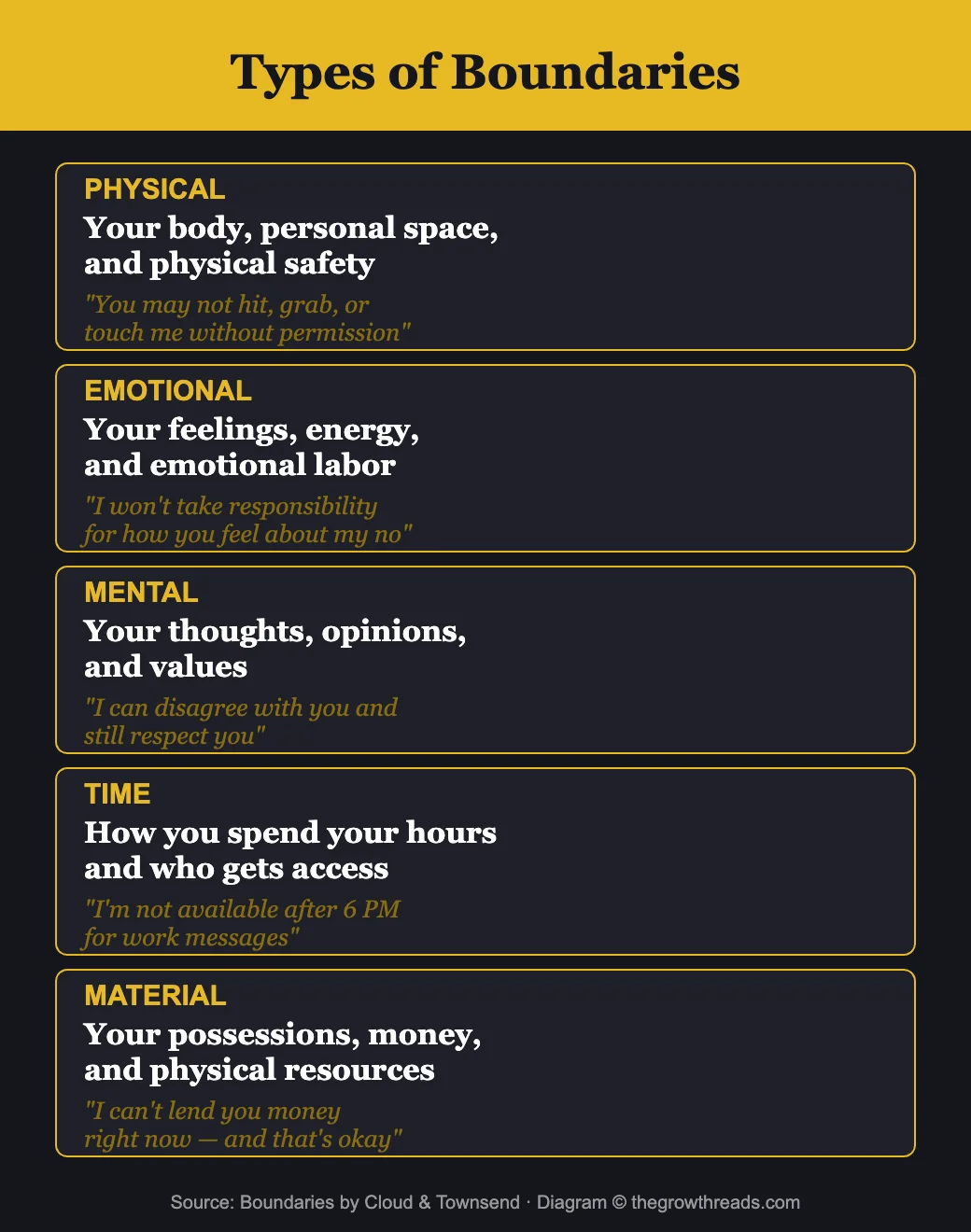
If you can’t say no, your yes means nothing. Psychologists Henry Cloud and John Townsend argue that most relationship dysfunction — resentment, burnout, codependency, passive aggression — stems from a failure to set and enforce healthy boundaries. A boundary is simply a property line: it defines where you end and another person begins. It determines what you are responsible for (your feelings, choices, and behavior) and what you are not responsible for (other people’s feelings, choices, and behavior). The book dismantles common myths about boundaries — that they’re selfish, unloving, or unchristian — and provides a practical framework for establishing limits in every area of life: marriage, family, friendships, work, and your relationship with yourself.
Key takeaways
- Boundaries define responsibility: You are responsible FOR yourself and TO others — but never responsible FOR others. This distinction transforms how you approach every relationship.
- Saying no is not selfish: Boundaries actually increase your capacity to love because you give from genuine desire rather than obligation, guilt, or fear.
- You teach people how to treat you: When you accept mistreatment without consequence, you communicate that the behavior is acceptable. Boundaries change this dynamic.
- Consequences, not control: A boundary is not about controlling someone else’s behavior — it’s about defining what YOU will do if the behavior continues.
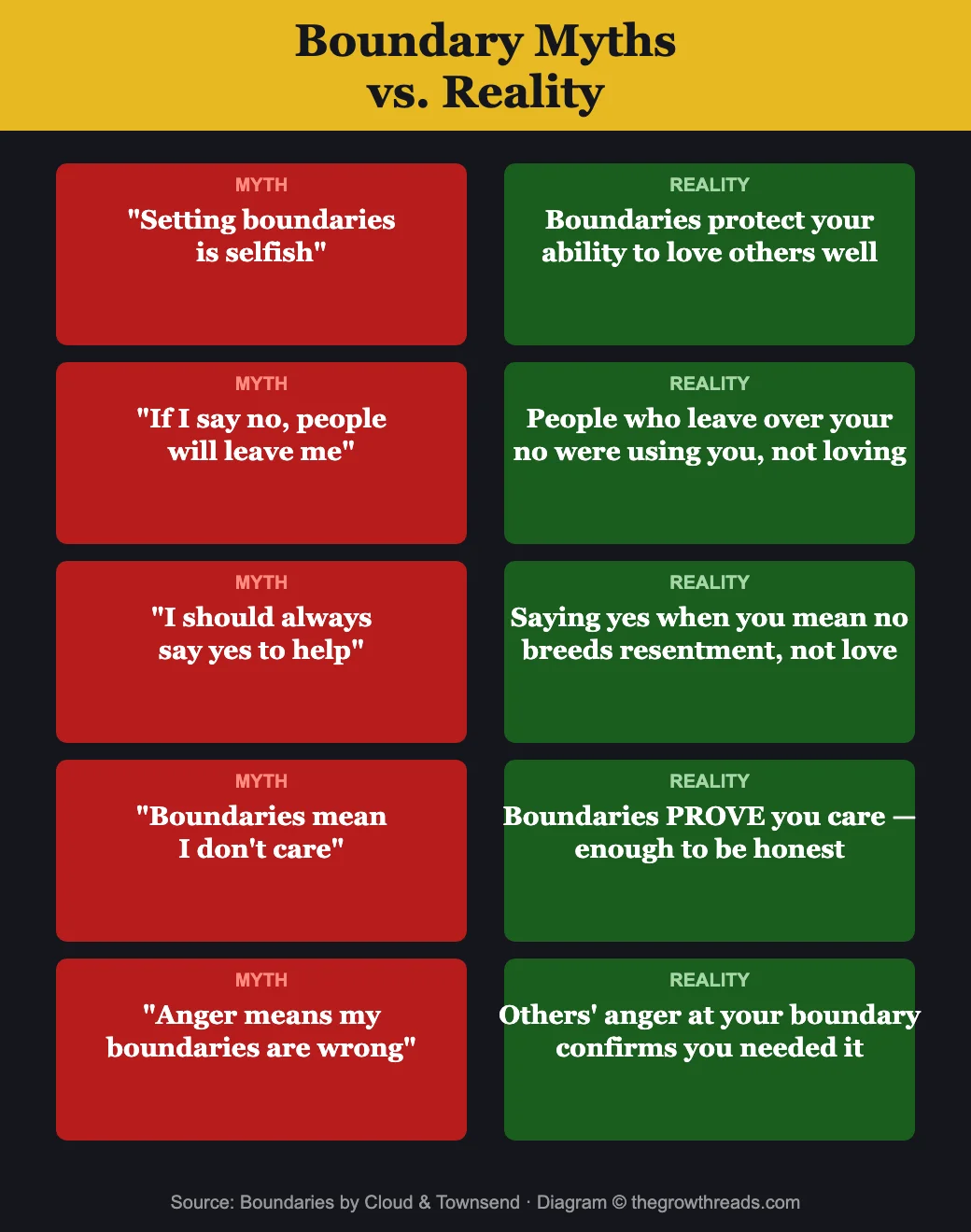
- Others’ anger at your boundary confirms you needed it: People who respect you will respect your limits. People who get angry were benefiting from your lack of them.
- Guilt is the boundary destroyer: The feeling of guilt when saying no is not a moral signal — it’s a conditioned response from childhood patterns that can be unlearned.
- Boundaries require practice: Start small with low-stakes situations and work up to the harder conversations. The muscle strengthens with use.
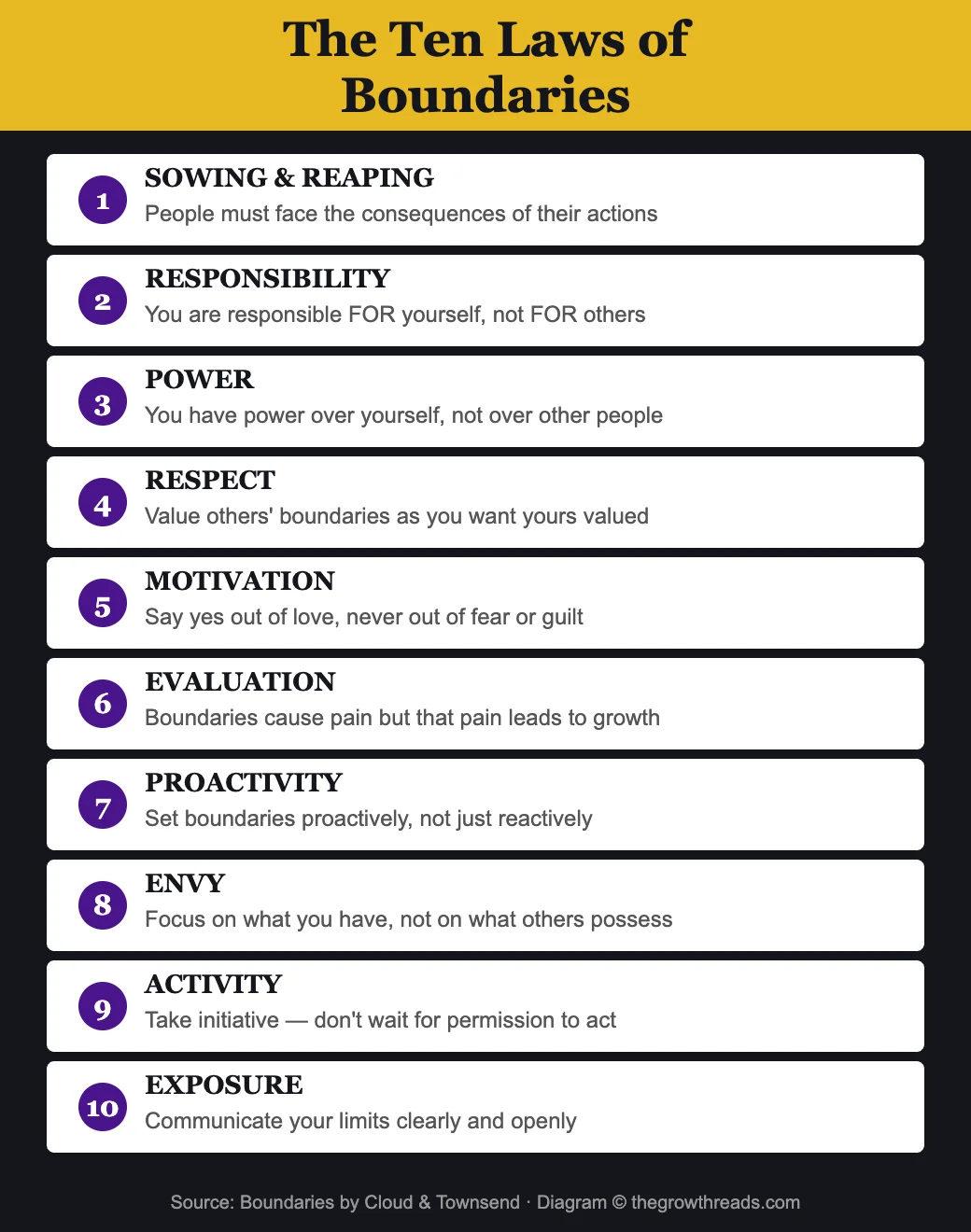
- Ten Laws of Boundaries govern healthy relationships: Sowing and reaping, responsibility, power, respect, motivation, evaluation, proactivity, envy, activity, and exposure provide the foundation.
- Boundary injuries come from childhood: If your family punished you for having limits, you learned that boundaries = rejection. Recognizing this origin is the first step to change.
- Love and limits are not opposites: The most loving thing you can do is be honest about what you can and cannot give — rather than over-promising and under-delivering.
What is Boundaries about?
Boundaries is a psychology-grounded guide to understanding where you end and other people begin. Henry Cloud and John Townsend explain what healthy boundaries are, how boundary injuries develop in childhood, why setting limits feels so difficult, and how to establish and maintain boundaries in every key relationship — marriage, family, friendships, work, and with yourself.
About the author
Henry Cloud and John Townsend are clinical psychologists who have collaborated on over twenty books and built one of the most recognized relationship counseling practices in the United States. Cloud holds a PhD in clinical psychology from Biola University and has consulted for Fortune 500 companies on leadership and organizational health. Townsend earned his PhD from Biola as well and is a professor at Concordia University Irvine. Boundaries, first published in 1992, has sold over five million copies and has been translated into twenty languages. The authors have expanded the Boundaries concept into specialized books covering marriage, dating, children, and leadership, making it one of the most comprehensive relationship frameworks in popular psychology. Explore all Henry Cloud book summaries →
Key concepts at a glance
| Concept | What it means | Use it when |
|---|---|---|
| Property Line | A boundary defines what is yours — your feelings, attitudes, behaviors, choices | You feel responsible for managing someone else’s emotions |
| Responsible FOR vs. TO | You are responsible FOR yourself and TO others, not FOR others | You catch yourself carrying burdens that belong to someone else |
| The Ten Laws | Ten principles governing how healthy boundaries work in practice | You need a framework for evaluating boundary situations |
| Boundary Myths | Common false beliefs that boundaries are selfish, unloving, or hurtful | Guilt tells you that saying no makes you a bad person |
| Boundary Injuries | Childhood experiences that taught you setting limits was dangerous | You freeze when trying to assert yourself with authority figures |
| Consequences Not Control | A boundary defines YOUR response, not their behavior | You try to change someone and it keeps failing |
| The Compliance/Avoidance Pattern | Saying yes when you mean no (compliance) or cutting off entirely (avoidance) | You swing between over-giving and complete withdrawal |
Part 1: What boundaries are and why they matter
Cloud and Townsend open with a simple metaphor: your life is like a property. Just as a fence around your yard marks what’s yours, personal boundaries mark what you’re responsible for — your feelings, attitudes, behaviors, choices, values, desires, thoughts, and limits. Everything inside the fence is yours to manage. Everything outside is someone else’s responsibility.
The problem most people face isn’t a lack of awareness about boundaries — it’s a deep emotional resistance to enforcing them. This resistance typically comes from childhood. If your family punished you for saying no (withdrawing love, getting angry, guilt-tripping), you learned that having boundaries leads to rejection. You were trained to believe that being loving means having no limits — that good people say yes to everything and everyone.
The consequences of poor boundaries are predictable and devastating: resentment (you give until you’re empty and then blame others for taking), burnout (you carry everyone’s burdens and collapse under the weight), passive aggression (you can’t say no directly, so you say it indirectly through lateness, forgetfulness, or sarcasm), and codependency (your identity becomes managing someone else’s life instead of living your own).
Part 2: The ten laws that govern healthy boundaries
The book presents ten principles that govern how boundaries work in healthy relationships. The Law of Sowing and Reaping states that people must experience the natural consequences of their behavior — and when you shield them from those consequences (covering for an alcoholic, doing a lazy coworker’s work), you’re not helping but enabling.
The Law of Responsibility makes a critical distinction: you are responsible FOR yourself (your own feelings, behavior, and growth) and TO others (showing love and respect), but you are never responsible FOR others (their feelings, behavior, or choices). When someone says “You made me feel…,” they’re violating this law — their feelings are their responsibility, not yours.
The Law of Power clarifies what you can and cannot control. You have power over your own actions, attitudes, and responses. You have zero power over other people’s actions, attitudes, and responses. Boundaries work not by changing others but by changing what you will tolerate and how you will respond.
The Law of Motivation addresses why you say yes: if you say yes out of fear, guilt, or obligation rather than genuine love and desire, you’re not being generous — you’re being controlled. The quality of your giving depends entirely on the freedom behind it. A coerced yes breeds resentment; a free yes creates love.
Part 3: Boundaries in every relationship
Cloud and Townsend dedicate practical chapters to boundary challenges in specific relationships. In marriage, the key principle is that love without boundaries becomes enabling, and boundaries without love becomes controlling. Healthy marriages require both partners to say no to each other without fear, and both to accept no without punishment.
With parents (even as adults), boundaries are often the hardest because the boundary-injury patterns started there. The book provides specific scripts for common scenarios: the guilt-tripping mother, the controlling father, the parent who treats you like a child. The key insight is that honoring your parents (a core value in many cultures) does not mean allowing them to control your adult life — you can love them deeply while still maintaining clear limits.
At work, boundaries protect against overwork, resentment, and burnout. The book addresses the boss who expects unlimited availability, the coworker who dumps their responsibilities on you, and the difficulty of saying no when your job feels at stake. Cloud and Townsend argue that people who set healthy work boundaries are actually more respected and more productive than those who say yes to everything.
With yourself, boundaries mean taking ownership of your own life — stopping blame, excuses, and victim thinking. You set internal boundaries when you discipline yourself to follow through on commitments, manage your emotions rather than being managed by them, and hold yourself to the same standards you hold others.
Part 4: Building boundary muscles — from theory to practice
The final section addresses the process of developing boundary skills. Cloud and Townsend acknowledge that reading about boundaries is easy — implementing them is hard, especially if you have decades of boundary-violating patterns. They recommend starting with safe relationships (a supportive friend or therapist) before tackling the most challenging ones (controlling parents or demanding spouses).
The book provides specific language for setting boundaries: “I love you, and I’m not going to do that.” “I understand you’re upset, and this is my decision.” “I can’t control how you respond, but I need to be honest about what I can give.” The formula is consistent: validate the other person’s feelings, state your limit clearly, and accept that you cannot control their reaction.
They also address the aftermath of setting boundaries, which often involves a period of escalation before things improve. The person whose boundary-crossing was previously tolerated will push back — often with anger, guilt-tripping, or withdrawal. This is not a sign that you did something wrong; it’s a sign that the old dynamic is being disrupted. Persistence through this discomfort is essential.
Who is Boundaries best for — and who should read something else first?
This book is transformative for people-pleasers, over-givers, and anyone who regularly feels resentful, exhausted, or taken advantage of in relationships. It’s particularly powerful for adult children of controlling or enmeshed families. The practical scripts and specific scenarios make it immediately applicable.
If your primary challenge is communication rather than boundary-setting, start with Nonviolent Communication for expressing needs without blame. For understanding attachment patterns that underlie boundary difficulties, Attached provides the science. For trauma’s role in boundary struggles, The Body Keeps the Score is essential reading.
Questions to reflect on
- When was the last time you said yes to something you wanted to say no to — and what drove that decision?
- Do you feel more responsible FOR other people’s emotions than for your own — and where did you learn that?
- Which relationship in your life would improve most if you set one clear, loving boundary?
- When someone gets angry at your boundary, do you tend to retreat — and what would it look like to hold firm with compassion?
- Are you confusing being loving with being available for everything at all times?
🔥 Ready to protect your peace without losing your people?
Learn to say no without guilt and build relationships based on respect, not obligation.
How to apply Boundaries (7-day plan)
- Day 1 — Track your yes patterns. Notice every time you say yes today. For each, ask: “Am I saying yes from love or from guilt/fear/obligation?” Write down what you notice.
- Day 2 — Practice one small no. Find one low-stakes request today and say no. It can be as simple as “I can’t take that on right now.” Notice the guilt — and notice that the world doesn’t end.
- Day 3 — Identify your property line. Write a list: “I am responsible for: my feelings, my choices, my time, my energy.” Then: “I am NOT responsible for: other people’s feelings about my choices.”
- Day 4 — Choose one relationship boundary. Identify one specific behavior in one relationship that you’ve been tolerating but shouldn’t. Write the boundary you want to set, using the formula: validate + state limit + accept their reaction.
- Day 5 — Set the boundary. Have the conversation you wrote yesterday. Stay calm, be clear, and don’t over-explain. If they push back, say: “I understand this is hard. This is what I need.”
- Day 6 — Process the aftermath. Journal about how Day 5 felt. Were you tempted to take it back? Did guilt show up? Remind yourself: guilt is a conditioned response, not a moral signal.
- Day 7 — Set an internal boundary. Identify one way you cross your OWN boundaries — procrastination, overeating, over-scrolling, not following through. Set one limit with yourself and practice it today.
Frequently asked questions
What is a boundary in psychology?
A boundary is an invisible line that defines where you end and another person begins. It determines what you are responsible for — your own feelings, behaviors, attitudes, and choices — and what belongs to someone else. Healthy boundaries allow you to love others without losing yourself, give without resentment, and be close without being consumed. They’re not walls that keep people out but fences with gates that you control.
Is setting boundaries selfish?
No — in fact, Cloud and Townsend argue the opposite. Without boundaries, you give from obligation and guilt, which breeds resentment and eventually causes you to withdraw entirely. With boundaries, you give freely from genuine desire, which makes your giving sustainable and authentic. The most generous people are those who can say no, because their yes actually means something. Boundaries protect your ability to love, not diminish it.
Why do I feel guilty when I set boundaries?
Guilt after setting a boundary is almost always a conditioned response, not a moral signal. If your childhood family punished you for saying no — through anger, withdrawal of love, or guilt-tripping — you learned to associate boundary-setting with being a bad person. The guilt doesn’t mean you’re doing something wrong; it means your old programming is being triggered. With practice, the guilt diminishes as you build new neural pathways around healthy limit-setting.
How do I set boundaries with a controlling parent?
Start by recognizing that honoring your parents does not mean allowing them to control your adult life. Use clear, calm language: “I love you, and I’ve made my decision.” Don’t over-explain or justify — that invites negotiation. Expect pushback (anger, guilt-trips, silent treatment) and hold firm. The authors recommend practicing with a supportive friend or therapist first and having a plan for self-care after difficult conversations.
What’s the difference between boundaries and walls?
Boundaries are fences with gates — they’re flexible, allow connection, and you control who comes in and under what conditions. Walls are rigid barriers that block everyone out indiscriminately. People who swing from no boundaries to walls are stuck in the compliance/avoidance pattern: they give too much until they snap, then cut everyone off. Healthy boundaries find the middle ground — connection with limits.
Is Boundaries a Christian book?
Boundaries is written from a Christian perspective and includes biblical references throughout. However, the psychological principles — responsibility, consequences, ownership, the distinction between compliance and genuine love — are universal and apply regardless of your faith background. Many secular readers find the framework valuable by focusing on the psychology and skipping the theological context. The core concepts have been validated by decades of clinical psychology research.
How long does it take to read Boundaries?
The book is approximately 320 pages and takes about 6 hours to read. Cloud and Townsend write in an accessible clinical style with plenty of case studies and practical dialogue examples. The updated edition includes new material on digital boundaries and social media. The audiobook runs about 11 hours and works well because the conversational tone translates naturally to audio format.
Related summaries
If you enjoyed this summary, explore more from our best relationship books collection:
- Nonviolent Communication Summary — express needs without blame.
- The 5 Love Languages Summary — understand how you and your partner give and receive love.
- Attached Summary — the science of adult attachment styles.
- Crucial Conversations Summary — tools for high-stakes dialogue.